OBW Roll Toning? Learning from an incredible 1935 Washington Quarter
 Matt04
Posts: 641 ✭✭✭✭
Matt04
Posts: 641 ✭✭✭✭
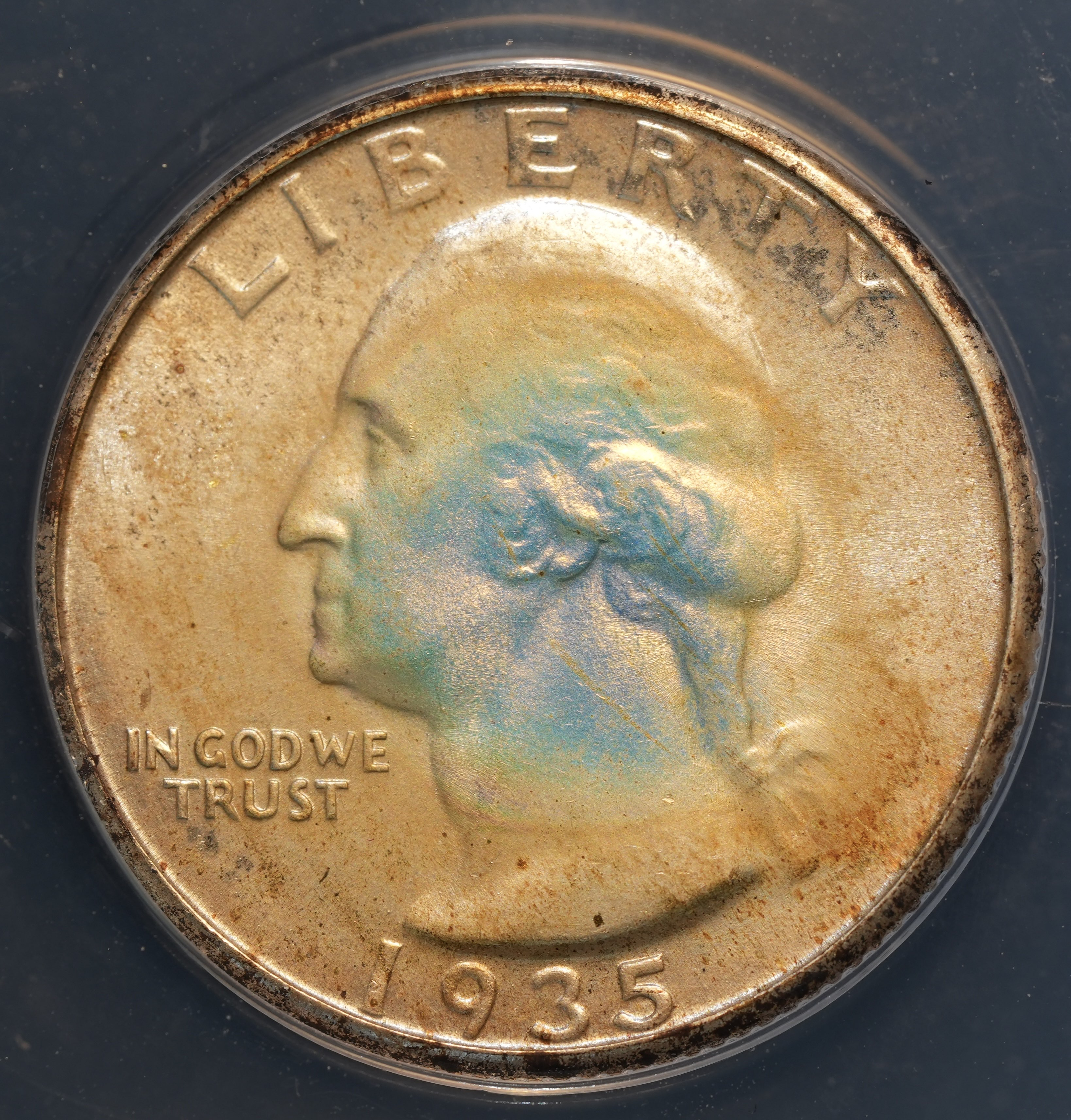
I made this post to share the following 1935 Washington Quarter that I recently purchased, which exhibits some rather unique toning. Over the past several months, I've owned roughly half a dozen examples displaying this style of toning. Some have been in lower Unc grades, while others have been among the finest-known examples for their respective dates.
I'd love to learn more about exactly how toning like this develops. From what I know about this particular coin is that it was sold to a coin shop by a collector. At some point, it had been removed from either a Dansco or Whitman album before eventually being sold to me.
Pattern/Toning Recognition
This type of toning seems to be a very thin layer of film, unlike the usual patina on coins you see. One Quarter with this toning I tested, I noticed my fingernail was able to scratch off this blue toning film.
From what I've found with coins showing this type of toning, I've noticed that similar appearances can sometimes be associated with coins that spent long periods of time in OBW rolls. This seems especially common among Mercury Dimes from this period, as well as Walking Liberty Halves.
The 1939 Washington Quarter, for example, seems to show up fairly often in MS67 or finer with this type of toning.
I also own a 1952 Franklin Half Dollar that came from an original Mint Set and shows a somewhat similar lustrous blue skin.
When it comes to this 1935 Washington Quarter example, the Obverse seems to have possibly been an ender from an OBW Roll. The center having a target like toning while there is a sort of golden brown crust surrounding it meaning it might've possibly been covered by roll paper?
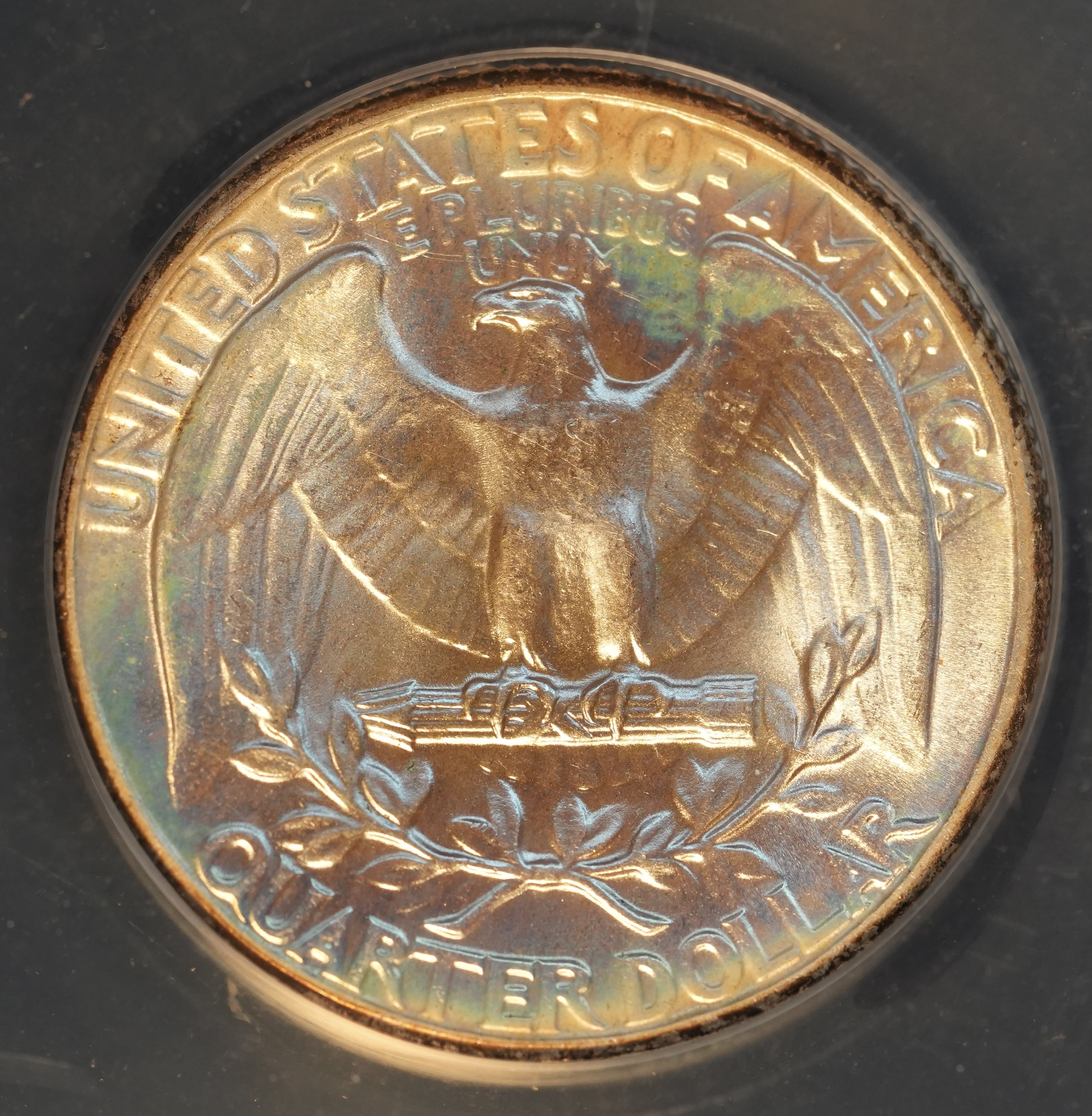
The reverse is especially interesting. Once again, there are strong blues concentrated around portions of the rim. Across much of the reverse, there is also an intense purplish coloration that really comes alive under decent, bright lighting.
I'd be very interested to hear everyone's thoughts on what type of storage environment may have produced this appearance, particularly whether the toning pattern is more consistent with long-term album storage, an Original Bank Wrapped roll, or possibly a combination of different storage environments over the coin's lifetime.
If you have any examples with similar toning, I'd love to see it! Please Share below.
Note: Scratches shown on the reverse including in the area of "E PLURUBUS UNUM" are on the plastic not the coin
Comments
that's unusual toning. are you sure it's not dip residue?
From my understanding, Dip residue would be a rather unpleasant brownish/grey color?
Here is a nearest example pattern/tone wise I have found to mine.
Below is a reverse example from a 1939 example:
While searching auction lots, I also forgot about Jefferson Nickels that showcase these types of toning
ok
I associate that blue hue which I see as almost a glow with virgin older silver, most often seen on quarters and dimes that were stored properly. This one in your op shows some advanced brown tone from long term album storage, although it could come from old rolls, not sure on that as I've never had any like that to open. This walker in my collection shows some of that blue tone/hue as well.
My Collection of Old Holders
Never a slave to one plastic brand will I ever be.
I’ve seen similar hazy toning on 1936-1942 proof coins. It isn’t that uncommon although many frequently encounter dipped blast white coins on the market and think of it as the norm.
Absolutely stunning walker example.
To add on to the other comment mentioning proofs, yes I've noticed those tones on the earlier proofs, in addition to some brown colored toning too, not as extreme as the one on my 35 but there's some brown toning on some examples present
Not my coin
The obverse of this 34 shows a similar type of toning although not as advanced.
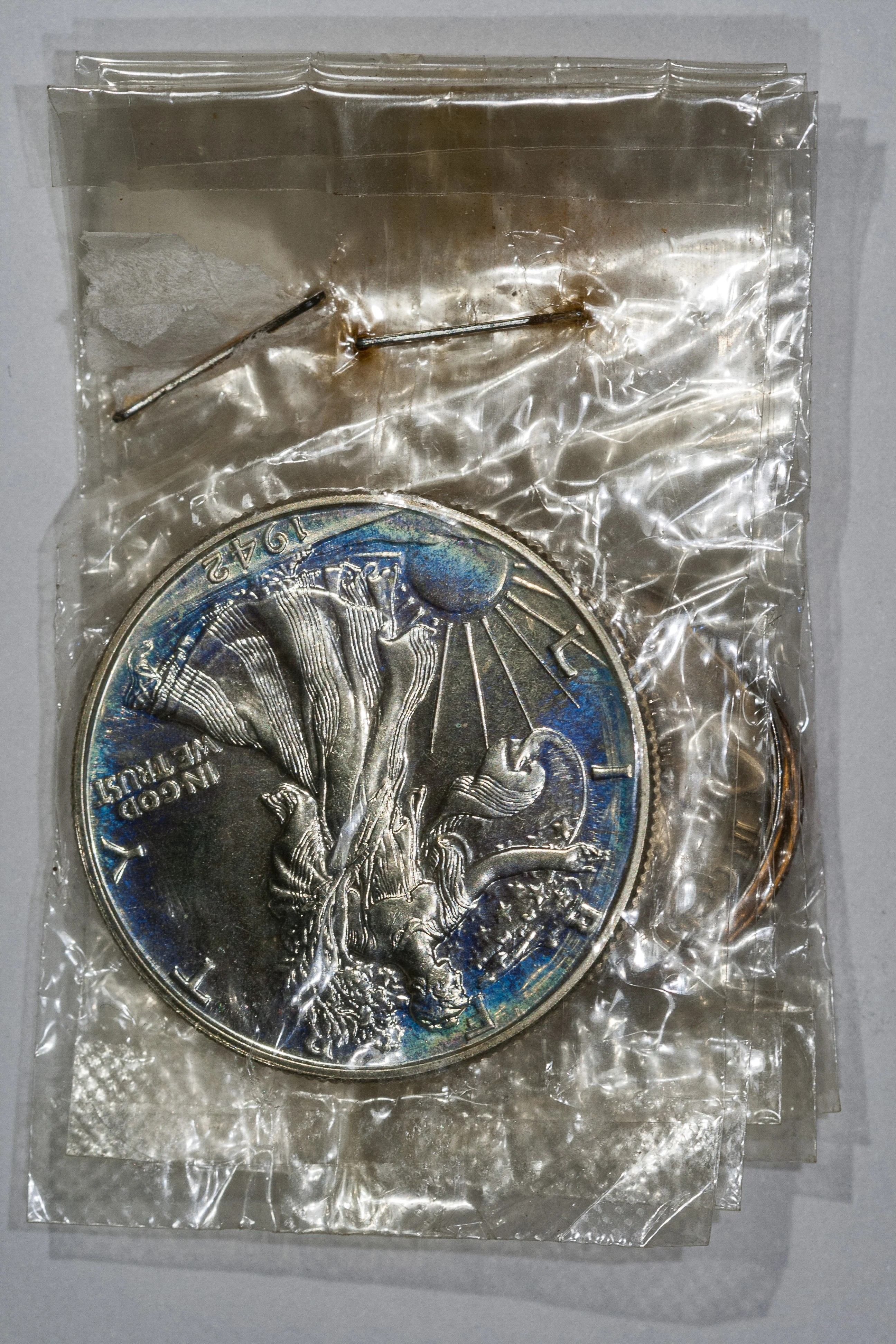
Some of these toned coins remind me of this Beautiful original 1942 proof set posted here several months ago.
I can't recall who, but It was either @FlyingAl or @SanctionII ??
.
Glad you brought that up, I wonder if this has to do with more of the chemicals used in the production of these coins early on than anything else?
I have Original Dealer Sealed Cello packet Quarters Sold in the 40's. I noticed that examples from the 1930's exhibit this blue/gold skin too.
For Sake of preserving the coin, I made the tough decision of removing this 1937 out of its sealed Cello packet. Some reaction was eating at the rim of the Coin.
Not as visible due to lighting you can see signs of the blue/gold in the photo below:
That was me, the half graded 68 CAC. One of the finest original sets in existence for that era.
Very different tone than the OP example though, the cello tone for these Proofs is pretty much unique to the 36-42 era.
Coin Photography
fwiw, i did have some end roll toners and they didn't look like the op coin
It must have been 15+ years ago there was a discussion (I think) about WLHs and "pearl" toning. I've always thought of this type of hazy, pearlescent toning as such. It can be very pretty in its own way.