@ricarf2386 said:
But you have to understand that these are not just ordinary foreign coins sitting in an album. Here in Ecuador, these coins walk like siblings, completely intertwined in people's pockets alongside U.S. dimes, nickels, quarters, and half dollars. They circulate together daily, and they hold the exact same value. It is a unique economic connection directly tied to the U.S. dollar. My display is a piece of that live history, and I am just testing the waters to see who appreciates it
I don't have to understand anything. The only people whose opinions matter are the ones you are trying to sell to.
I'll stick with my earlier comment: I think you'll be disappointed with the results if you try to market these coins to collectors in the United States.
@ricarf2386 said:
But you have to understand that these are not just ordinary foreign coins sitting in an album. Here in Ecuador, these coins walk like siblings, completely intertwined in people's pockets alongside U.S. dimes, nickels, quarters, and half dollars. They circulate together daily, and they hold the exact same value. It is a unique economic connection directly tied to the U.S. dollar. My display is a piece of that live history, and I am just testing the waters to see who appreciates it
I don't have to understand anything. The only people whose opinions matter are the ones you are trying to sell to.
I'll stick with my earlier comment: I think you'll be disappointed with the results if you try to market these coins to collectors in the United States.
@ricarf2386 said:
🇪🇨 Forensic Analysis of a Struck Counterfeit Sacagawea $1 Coin from Ecuador
This is all the forensic analysis you need.
Thank you very much for showing your counterfeit coins, I truly appreciate your contribution! If I had known that this specific grading company encapsulated counterfeit coins in slabs, I definitely would have sent my premium piece to them, especially given its history of passing through both NGC and ANACS.
That is a great reference point, but it also proves that there are many different counterfeiting methods. You have one specific type there, which seems to have a plated or white-metal composition since a silver/plated color shows on the edge of your coins. In contrast, the first specimen I showed in my forensic analysis was completely solid yellow material throughout.
I actually have a counterfeit piece very similar to yours, as well as another one made by casting (fundición). Later today, once I am off from work and have some free time, I will publish the photos and physical metrics for both of them. This thread is getting better and better!
@ricarf2386 said:
With rising tourism and global cash flows, it is only a matter of time before these dangerous regional pieces start showing up in change pockets across the United States.
I doubt that. That would require (1) tourists to travel with significant quantities of heavy dollar coins and (2) the coins to actually circulate within the United States. Besides, $1 is becoming worth less and less due to due to inflation and buys very little in the US today.
Superb collections are built more by omission than by addition.
@Creg said:
To be fair, Ricarf did not bring up selling them, I did.
Thank you so much, Creg! I truly appreciate your support and your honesty in clarifying this for the community. To be completely honest, your idea doesn't displease me at all. If anyone here is truly interested in acquiring any specific pieces or checking out what circulates in my country's environment, you can absolutely count on me. I am more than happy to help you all however I can. And Creg, I am definitely sticking to the plan you suggested earlier today. I am going to keep gathering and sorting through the specimens we talked about this morning, and I will do exactly what you said so we can make these coin exchanges happen. I'll make sure to have a good variety ready!
@ricarf2386 said:
With rising tourism and global cash flows, it is only a matter of time before these dangerous regional pieces start showing up in change pockets across the United States.
I doubt that. That would require (1) tourists to travel with significant quantities of heavy dollar coins and (2) the coins to actually circulate within the United States. Besides, $1 is becoming worth less and less due to due to inflation and buys very little in the US today.
You are completely right about the economy, POCKETCHANGE. Globally, money is simply worth less and less every day, and it is even worse here in my country. Things are not doing so well down here when it comes to security, and the economy is quite tough, but well, here we are, fighting and working hard day by day. Thank you for your comment!
"Dear Friend!"
"Thank you for you comment!"
"Have a great day!"
"Blessings!"
These type of comments are somewhat common among threads such as this.
I continue to hold out hope this is an educational thread that will stick to landing.
Generally if threads like this where the creator of it profusely apologises when really none is warranted leaves me suspect.
I hope I'm wrong. I want to be wrong!
@RedRocket said:
"Dear Friend!"
"Thank you for you comment!"
"Have a great day!"
"Blessings!"
These type of comments are somewhat common among threads such as this.
I continue to hold out hope this is an educational thread that will stick to landing.
Generally if threads like this where the creator of it profusely apologises when really none is warranted leaves me suspect.
I hope I'm wrong. I want to be wrong!
I hope and think that you are.
Mark Feld* of Heritage Auctions*Unless otherwise noted, my posts here represent my personal opinions.
@RedRocket said:
"Dear Friend!"
"Thank you for you comment!"
"Have a great day!"
"Blessings!"
These type of comments are somewhat common among threads such as this.
I continue to hold out hope this is an educational thread that will stick to landing.
Generally if threads like this where the creator of it profusely apologises when really none is warranted leaves me suspect.
I hope I'm wrong. I want to be wrong!
I hope and think that you are.
Please remember that I am working with an AI and a translator. To be honest, I am naturally a very polite person, but this AI multiplies my education by three or four. I hope this explains all the excessive details, thank yous, and "please" in the previous posts. In reality, I am just a natural and respectful guy. Do not think that I am here to annoy this community; my only goal is to learn from your experience.
@RedRocket said:
"Dear Friend!"
"Thank you for you comment!"
"Have a great day!"
"Blessings!"
These type of comments are somewhat common among threads such as this.
I continue to hold out hope this is an educational thread that will stick to landing.
Generally if threads like this where the creator of it profusely apologises when really none is warranted leaves me suspect.
I hope I'm wrong. I want to be wrong!
I hope and think that you are.
Please remember that I am working with an AI and a translator. To be honest, I am naturally a very polite person, but this AI multiplies my education by three or four. I hope this explains all the excessive details, thank yous, and "please" in the previous posts. In reality, I am just a natural and respectful guy. Do not think that I am here to annoy this community; my only goal is to learn from your experience.
I think you’re doing an excellent job of communicating.
Mark Feld* of Heritage Auctions*Unless otherwise noted, my posts here represent my personal opinions.
@RedRocket said:
"Dear Friend!"
"Thank you for you comment!"
"Have a great day!"
"Blessings!"
These type of comments are somewhat common among threads such as this.
I continue to hold out hope this is an educational thread that will stick to landing.
Generally if threads like this where the creator of it profusely apologises when really none is warranted leaves me suspect.
I hope I'm wrong. I want to be wrong!
I hope and think that you are.
Please remember that I am working with an AI and a translator. To be honest, I am naturally a very polite person, but this AI multiplies my education by three or four.
Maybe I should try AI. 😀
I hope this explains all the excessive details, thank yous, and "please" in the previous posts. In reality, I am just a natural and respectful guy.
I could guess that from your earlier posts.
Do not think that I am here to annoy this community; my only goal is to learn from your experience.
@RedRocket said:
"Dear Friend!"
"Thank you for you comment!"
"Have a great day!"
"Blessings!"
These type of comments are somewhat common among threads such as this.
I continue to hold out hope this is an educational thread that will stick to landing.
Generally if threads like this where the creator of it profusely apologises when really none is warranted leaves me suspect.
I hope I'm wrong. I want to be wrong!
I hope and think that you are.
Please remember that I am working with an AI and a translator. To be honest, I am naturally a very polite person, but this AI multiplies my education by three or four. I hope this explains all the excessive details, thank yous, and "please" in the previous posts. In reality, I am just a natural and respectful guy. Do not think that I am here to annoy this community; my only goal is to learn from your experience.
I think you’re doing an excellent job of communicating.
Dear Mark, thank you very much for your trust. I truly appreciate it!
@RedRocket said:
"Dear Friend!"
"Thank you for you comment!"
"Have a great day!"
"Blessings!"
These type of comments are somewhat common among threads such as this.
I continue to hold out hope this is an educational thread that will stick to landing.
Generally if threads like this where the creator of it profusely apologises when really none is warranted leaves me suspect.
I hope I'm wrong. I want to be wrong!
I hope and think that you are.
Please remember that I am working with an AI and a translator. To be honest, I am naturally a very polite person, but this AI multiplies my education by three or four.
Maybe I should try AI. 😀
I hope this explains all the excessive details, thank yous, and "please" in the previous posts. In reality, I am just a natural and respectful guy.
I could guess that from your earlier posts.
Do not think that I am here to annoy this community; my only goal is to learn from your experience.
Understood!
Haha, I highly recommend you try it, JBK! Honestly, AI is like driving a car—you are the pilot, and you steer it in whichever direction you want it to go, straight toward the right destination. The massive advantage is that it completely breaks down language barriers. If you wanted to join a Chinese numismatic forum today, you could easily dialogue with them. I definitely encourage you to test it out; you will see how incredibly useful it can be!
Here is the technical and forensic analysis for Specimen #2.
This specific counterfeit was also manufactured using a die strike. In comparison to the first specimen, this one actually has finer details and a better finish. I imagine that at the beginning of its lifespan, this coin easily passed through daily circulation without raising any suspicions at all to anyone's eyes.
However, time and wear have revealed its true nature. Here are the exact numbers from my scale and calipers:
Diameter: 26.5 mm (identical to a genuine coin)
Thickness: Approx. 2.0 mm
Weight: 8.6 grams (A heavy overweight compared to the standard 8.1 grams of an original)
The most interesting detail about this piece is the edge. The counterfeiters actually took the time to paint a reddish-copper line along the edge to mimic the inner copper core of a real US dollar coin. But due to daily circulation and wear, that painted red-copper line is now fading and flaking off, exposing the real base metal underneath.
Furthermore, the heavy wear on the surfaces has exposed the raw base material of the core. It looks greyish and dark, resembling lead, steel, or some type of white metal. You can clearly see this dark core material bleeding through the high points on both the Sacagawea side and the eagle side.
Here is the technical and forensic analysis for Specimen #3.
This specific counterfeit was manufactured using a casting process (fundición). Unlike the previous struck specimens, the physical metrics here reveal an absolute extreme in low-budget operations. Here are the exact numbers from my scale and calipers:
Diameter: 26.5 mm
Thickness: Approx. 1.7 mm to 1.8 mm
Weight: 3.9 grams (An absolute extreme underweight compared to the standard 8.1 grams of a genuine coin)
This coin is unbelievably light, losing more than half of its original weight. Holding it feels like holding a piece of plastic or aluminum rather than metal. The surfaces are dark, highly porous, and rough, with extremely soft, crude details on both faces due to the liquid metal cooling process in a very basic mold. This is a perfect example of a low-cost casting operation meant to be passed quickly in high-volume, low-light street circulation.
Thank you all so much for taking the time to read this forensic analysis of the counterfeit coins that have reached my hands. If I manage to find any of the Presidential dollar counterfeits in the future, I will definitely add them to this same thread.
For those who are just joining the community and want to learn more about the numismatics of my country, I warmly invite you to check out my other thread: "The Official Word on Ecuador's Numismatic Journey: A Paradise of Rarities for PCGS Collectors".
Also, I want to invite you all to stay tuned for the updates I will be posting in the coming weeks about a massive international numismatic event happening here in Guayaquil, Ecuador, on September 18th and 19th. The event is called COSPEL 2026, and it will take place at the DoubleTree by Hilton hotel. To give you an idea, this event is very similar in spirit to the ANA World's Fair of Money that you experience over there in the US.
As the official PCGS Message Boards correspondent here in Ecuador, I commit to bringing you photos and live updates of all the beautiful pieces we will see there, like the ancient pre-Columbian money axes and the historic Ecuadorian gold coins. Thank you.
Today I woke up feeling truly blessed and inspired. I want to thank the friend who shared the image yesterday of his encapsulated counterfeit coin. Thanks to that post, a crazy but interesting idea cooked in my mind while I was sleeping.
Since these pieces have a legal tender value of absolute zero, I am going to thoroughly investigate the legal possibilities in my country to see if they can be officially exported as educational material. If that is the case, my goal would be to help those collectors in this forum who appreciate this type of numismatic specimens so you can add them to your collections for study.
More than anything, my true goal here is to build genuine relationships of friendship, break down borders, and unite collectors from different sides of the yard under this same passion. I want to share with you the concept design of how my personal brand slab would look for this forensic project.
@ricarf2386 said:
Today I woke up feeling truly blessed and inspired. I want to thank the friend who shared the image yesterday of his encapsulated counterfeit coin. Thanks to that post, a crazy but interesting idea cooked in my mind while I was sleeping.
Since these pieces have a legal tender value of absolute zero, I am going to thoroughly investigate the legal possibilities in my country to see if they can be officially exported as educational material. If that is the case, my goal would be to help those collectors in this forum who appreciate this type of numismatic specimens so you can add them to your collections for study.
More than anything, my true goal here is to build genuine relationships of friendship, break down borders, and unite collectors from different sides of the yard under this same passion. I want to share with you the concept design of how my personal brand slab would look for this forensic project.
To support this research, I would highly appreciate it if those who are genuinely interested in these specimens—like my friend Creg—could leave a comment below. This will allow me to demonstrate the real interest of this prestigious community before the legal authorities in my country. Thank you in advance!
@ricarf2386 said:
To support this research, I would highly appreciate it if those who are genuinely interested in these specimens—like my friend Creg—could leave a comment below. This will allow me to demonstrate the real interest of this prestigious community before the legal authorities in my country. Thank you in advance!
My sense is that there is genuine interest in your counterfeits from a select group of people. I'm surprised that up until now, no one has mentioned the very striking doubled die obverse on the counterfeit you posted at the beginning of this thread. That is a piece I might be interested in if the price didn't exceed, say, $20.
I would think that the custom slabbing & labeling you propose would be too expensive relative to the market value of your counterfeits. That is probably a moot point, however, because if you need government approval to export them, that will probably put a stop to everything.
The people who deal in collectible counterfeits in the United States take their chances buying, selling, and shipping these pieces without any official approval, knowing that it is extremely unlikely that the authorities here would ever intervene. It may be riskier for you to do so in Ecuador, and since you seem concerned about it, it may be best not to take the risk. Perhaps the best way for you to share your counterfeits with us is through photos.
@ricarf2386 said:
To support this research, I would highly appreciate it if those who are genuinely interested in these specimens—like my friend Creg—could leave a comment below. This will allow me to demonstrate the real interest of this prestigious community before the legal authorities in my country. Thank you in advance!
My sense is that there is genuine interest in your counterfeits from a select group of people. I'm surprised that up until now, no one has mentioned the very striking doubled die obverse on the counterfeit you posted at the beginning of this thread. That is a piece I might be interested in if the price didn't exceed, say, $20.
I would think that the custom slabbing & labeling you propose would be too expensive relative to the market value of your counterfeits. That is probably a moot point, however, because if you need government approval to export them, that will probably put a stop to everything.
The people who deal in collectible counterfeits in the United States take their chances buying, selling, and shipping these pieces without any official approval, knowing that it is extremely unlikely that the authorities here would ever intervene. It may be riskier for you to do so in Ecuador, and since you seem concerned about it, it may be best not to take the risk. Perhaps the best way for you to share your counterfeits with us is through photos.
Your counterfeit doubled die obverse:
You are completely right about the legal and government regulations, IkesT. However, I am going to take my time to thoroughly research and investigate if it is possible to export them exactly as I proposed—safely sealed in those slabs—proving they are strictly for educational and study purposes. There is absolutely nothing to lose by asking.
Regarding this specific specimen that caught your attention, that is actually the first piece I used for the destructive forensic analysis. It was the "victim" of my testing and was completely cut in half using an angle grinder to check the inner core layers. Since it is sliced open, I don't think it would interest you anymore for a collection.
@ricarf2386 said:
To support this research, I would highly appreciate it if those who are genuinely interested in these specimens—like my friend Creg—could leave a comment below. This will allow me to demonstrate the real interest of this prestigious community before the legal authorities in my country. Thank you in advance!
My sense is that there is genuine interest in your counterfeits from a select group of people. I'm surprised that up until now, no one has mentioned the very striking doubled die obverse on the counterfeit you posted at the beginning of this thread. That is a piece I might be interested in if the price didn't exceed, say, $20.
I would think that the custom slabbing & labeling you propose would be too expensive relative to the market value of your counterfeits. That is probably a moot point, however, because if you need government approval to export them, that will probably put a stop to everything.
The people who deal in collectible counterfeits in the United States take their chances buying, selling, and shipping these pieces without any official approval, knowing that it is extremely unlikely that the authorities here would ever intervene. It may be riskier for you to do so in Ecuador, and since you seem concerned about it, it may be best not to take the risk. Perhaps the best way for you to share your counterfeits with us is through photos.
Your counterfeit doubled die obverse:
You are completely right about the legal and government regulations, IkesT. However, I am going to take my time to thoroughly research and investigate if it is possible to export them exactly as I proposed—safely sealed in those slabs—proving they are strictly for educational and study purposes. There is absolutely nothing to lose by asking.
Regarding this specific specimen that caught your attention, that is actually the first piece I used for the destructive forensic analysis. It was the "victim" of my testing and was completely cut in half using an angle grinder to check the inner core layers. Since it is sliced open, I don't think it would interest you anymore for a collection.
By the way, to be completely honest, you really have a very sharp eye! I hadn't even noticed that specific doubling feature myself before I used the angle grinder on it, haha.
@ricarf2386 said:
Regarding this specific specimen that caught your attention, that is actually the first piece I used for the destructive forensic analysis. It was the "victim" of my testing and was completely cut in half using an angle grinder to check the inner core layers. Since it is sliced open, I don't think it would interest you anymore for a collection.
Yes, I agree; it is not very marketable anymore if it is cut in half.
@ricarf2386 said:
To support this research, I would highly appreciate it if those who are genuinely interested in these specimens—like my friend Creg—could leave a comment below. This will allow me to demonstrate the real interest of this prestigious community before the legal authorities in my country. Thank you in advance!
My sense is that there is genuine interest in your counterfeits from a select group of people. I'm surprised that up until now, no one has mentioned the very striking doubled die obverse on the counterfeit you posted at the beginning of this thread. That is a piece I might be interested in if the price didn't exceed, say, $20.
I would think that the custom slabbing & labeling you propose would be too expensive relative to the market value of your counterfeits. That is probably a moot point, however, because if you need government approval to export them, that will probably put a stop to everything.
The people who deal in collectible counterfeits in the United States take their chances buying, selling, and shipping these pieces without any official approval, knowing that it is extremely unlikely that the authorities here would ever intervene. It may be riskier for you to do so in Ecuador, and since you seem concerned about it, it may be best not to take the risk. Perhaps the best way for you to share your counterfeits with us is through photos.
Your counterfeit doubled die obverse:
You are completely right about the legal and government regulations, IkesT. However, I am going to take my time to thoroughly research and investigate if it is possible to export them exactly as I proposed—safely sealed in those slabs—proving they are strictly for educational and study purposes. There is absolutely nothing to lose by asking.
Regarding this specific specimen that caught your attention, that is actually the first piece I used for the destructive forensic analysis. It was the "victim" of my testing and was completely cut in half using an angle grinder to check the inner core layers. Since it is sliced open, I don't think it would interest you anymore for a collection.
By the way, to be completely honest, you really have a very sharp eye! I hadn't even noticed that specific doubling feature myself before I used the angle grinder on it, haha.
@ricarf2386 said:
To support this research, I would highly appreciate it if those who are genuinely interested in these specimens—like my friend Creg—could leave a comment below. This will allow me to demonstrate the real interest of this prestigious community before the legal authorities in my country. Thank you in advance!
My sense is that there is genuine interest in your counterfeits from a select group of people. I'm surprised that up until now, no one has mentioned the very striking doubled die obverse on the counterfeit you posted at the beginning of this thread. That is a piece I might be interested in if the price didn't exceed, say, $20.
I would think that the custom slabbing & labeling you propose would be too expensive relative to the market value of your counterfeits. That is probably a moot point, however, because if you need government approval to export them, that will probably put a stop to everything.
The people who deal in collectible counterfeits in the United States take their chances buying, selling, and shipping these pieces without any official approval, knowing that it is extremely unlikely that the authorities here would ever intervene. It may be riskier for you to do so in Ecuador, and since you seem concerned about it, it may be best not to take the risk. Perhaps the best way for you to share your counterfeits with us is through photos.
Your counterfeit doubled die obverse:
You are completely right about the legal and government regulations, IkesT. However, I am going to take my time to thoroughly research and investigate if it is possible to export them exactly as I proposed—safely sealed in those slabs—proving they are strictly for educational and study purposes. There is absolutely nothing to lose by asking.
Regarding this specific specimen that caught your attention, that is actually the first piece I used for the destructive forensic analysis. It was the "victim" of my testing and was completely cut in half using an angle grinder to check the inner core layers. Since it is sliced open, I don't think it would interest you anymore for a collection.
The slab does not make them legal.
To completely remove any legal classification of "counterfeit currency" and prevent any possibility of the piece entering fractional circulation, a technical solution is to permanently deface the metal by drilling a small hole on the edge. By physically altering the piece this way, it loses all deceptive capability and its legal definition under monetary and customs laws shifts from a fake coin to a zero-value, inert metallurgical study specimen. It would still remain securely encapsulated strictly for scientific and educational study.
Additionally, this tiny drilled hole offers a huge forensic advantage: it exposes the raw base metal of the inner core, allowing collectors to examine the exact material layers used in the fake operation.
For those of you who are genuinely interested in these types of specimens, I have a direct question: do you think that adding this small drilled hole would still generate interest for your study collections?
@ricarf2386 said:
To support this research, I would highly appreciate it if those who are genuinely interested in these specimens—like my friend Creg—could leave a comment below. This will allow me to demonstrate the real interest of this prestigious community before the legal authorities in my country. Thank you in advance!
My sense is that there is genuine interest in your counterfeits from a select group of people. I'm surprised that up until now, no one has mentioned the very striking doubled die obverse on the counterfeit you posted at the beginning of this thread. That is a piece I might be interested in if the price didn't exceed, say, $20.
I would think that the custom slabbing & labeling you propose would be too expensive relative to the market value of your counterfeits. That is probably a moot point, however, because if you need government approval to export them, that will probably put a stop to everything.
The people who deal in collectible counterfeits in the United States take their chances buying, selling, and shipping these pieces without any official approval, knowing that it is extremely unlikely that the authorities here would ever intervene. It may be riskier for you to do so in Ecuador, and since you seem concerned about it, it may be best not to take the risk. Perhaps the best way for you to share your counterfeits with us is through photos.
Your counterfeit doubled die obverse:
You are completely right about the legal and government regulations, IkesT. However, I am going to take my time to thoroughly research and investigate if it is possible to export them exactly as I proposed—safely sealed in those slabs—proving they are strictly for educational and study purposes. There is absolutely nothing to lose by asking.
Regarding this specific specimen that caught your attention, that is actually the first piece I used for the destructive forensic analysis. It was the "victim" of my testing and was completely cut in half using an angle grinder to check the inner core layers. Since it is sliced open, I don't think it would interest you anymore for a collection.
By the way, to be completely honest, you really have a very sharp eye! I hadn't even noticed that specific doubling feature myself before I used the angle grinder on it, haha.
@ricarf2386 said:
To support this research, I would highly appreciate it if those who are genuinely interested in these specimens—like my friend Creg—could leave a comment below. This will allow me to demonstrate the real interest of this prestigious community before the legal authorities in my country. Thank you in advance!
My sense is that there is genuine interest in your counterfeits from a select group of people. I'm surprised that up until now, no one has mentioned the very striking doubled die obverse on the counterfeit you posted at the beginning of this thread. That is a piece I might be interested in if the price didn't exceed, say, $20.
I would think that the custom slabbing & labeling you propose would be too expensive relative to the market value of your counterfeits. That is probably a moot point, however, because if you need government approval to export them, that will probably put a stop to everything.
The people who deal in collectible counterfeits in the United States take their chances buying, selling, and shipping these pieces without any official approval, knowing that it is extremely unlikely that the authorities here would ever intervene. It may be riskier for you to do so in Ecuador, and since you seem concerned about it, it may be best not to take the risk. Perhaps the best way for you to share your counterfeits with us is through photos.
Your counterfeit doubled die obverse:
You are completely right about the legal and government regulations, IkesT. However, I am going to take my time to thoroughly research and investigate if it is possible to export them exactly as I proposed—safely sealed in those slabs—proving they are strictly for educational and study purposes. There is absolutely nothing to lose by asking.
Regarding this specific specimen that caught your attention, that is actually the first piece I used for the destructive forensic analysis. It was the "victim" of my testing and was completely cut in half using an angle grinder to check the inner core layers. Since it is sliced open, I don't think it would interest you anymore for a collection.
The slab does not make them legal.
To completely remove any legal classification of "counterfeit currency" and prevent any possibility of the piece entering fractional circulation, a technical solution is to permanently deface the metal by drilling a small hole on the edge. By physically altering the piece this way, it loses all deceptive capability and its legal definition under monetary and customs laws shifts from a fake coin to a zero-value, inert metallurgical study specimen. It would still remain securely encapsulated strictly for scientific and educational study.
Additionally, this tiny drilled hole offers a huge forensic advantage: it exposes the raw base metal of the inner core, allowing collectors to examine the exact material layers used in the fake operation.
For those of you who are genuinely interested in these types of specimens, I have a direct question: do you think that adding this small drilled hole would still generate interest for your study collections?
And please, forgive me if I am too ingenious, haha.
@ricarf2386 said:
For those of you who are genuinely interested in these types of specimens, I have a direct question: do you think that adding this small drilled hole would still generate interest for your study collections?
Yes. I am very interested in the counterfeit dollar coins of Ecuador, but no, I would not want one that had a hole drilled into it.
And, as another poster mentioned, none of the ideas presented would make them legal to import into the US. You would have to ship them to the US raw, perhaps mixed with some well-worn genuine examples.
Once here, people could get them slabbed by ICG in their special holder for counterfeits if desired.
@ricarf2386 said:
For those of you who are genuinely interested in these types of specimens, I have a direct question: do you think that adding this small drilled hole would still generate interest for your study collections?
Yes. I am very interested in the counterfeit dollar coins of Ecuador, but no, I would not want one that had a hole drilled into it.
And, as another poster mentioned, none of the ideas presented would make them legal to import into the US. You would have to ship them to the US raw, perhaps mixed with some well-worn genuine examples.
Once here, people could get them slabbed by ICG in their special holder for counterfeits if desired.
Thank you for your comment, my friend. I completely understand your point about wanting the coin without any major damage. Please keep in mind that the image I shared is just a concept design to visually illustrate my idea.
In reality, if this goes through, the technical solution would be to use a micro-drill with an extremely fine bit to make a minuscule, almost unnoticeable hole right on the outer edge. It would be placed in a strategic spot that absolutely does not damage the aesthetics, the details, or that beautiful doubling feature of the coin.
I interact a lot with the AI, and analyzing international regulations, this tiny micro-perforation combined with the secure slab creates the perfect legal loophole under 15 U.S. Code § 2101 (Hobby Protection Act) and 18 U.S. Code § 492. Because the piece is permanently defaced and explicitly labeled, it is stripped of any fractional currency potential or "intent to defraud." This shifts its classification from counterfeit currency to a zero-value, inert metallurgical study specimen, which is permissible for import. It keeps the piece completely safe for the law, yet intact and beautiful for your study collections!
@ricarf2386 said:
For those of you who are genuinely interested in these types of specimens, I have a direct question: do you think that adding this small drilled hole would still generate interest for your study collections?
Yes. I am very interested in the counterfeit dollar coins of Ecuador, but no, I would not want one that had a hole drilled into it.
And, as another poster mentioned, none of the ideas presented would make them legal to import into the US. You would have to ship them to the US raw, perhaps mixed with some well-worn genuine examples.
Once here, people could get them slabbed by ICG in their special holder for counterfeits if desired.
Thank you for your comment, my friend. I completely understand your point about wanting the coin without any major damage. Please keep in mind that the image I shared is just a concept design to visually illustrate my idea.
In reality, if this goes through, the technical solution would be to use a micro-drill with an extremely fine bit to make a minuscule, almost unnoticeable hole right on the outer edge. It would be placed in a strategic spot that absolutely does not damage the aesthetics, the details, or that beautiful doubling feature of the coin.
I interact a lot with the AI, and analyzing international regulations, this tiny micro-perforation combined with the secure slab creates the perfect legal loophole under 15 U.S. Code § 2101 (Hobby Protection Act)
That law stipulates that numismatic reproductions must be marked COPY. It does not provide alternate methods such as hole drilling.
The "exemptions" mentioned refer to the carrier (USPS, DHL, UPS, FedEx, etc.), which would not be held liable for unknowingly handling such shipments.
and 18 U.S. Code § 492.
That provision has to do with the forfeiture to the government of counterfeit items. The Treasury Department can be petitioned for an exemption but I doubt many or any such exceptions are issued.
Because the piece is permanently defaced and explicitly labeled, it is stripped of any fractional currency potential or "intent to defraud." This shifts its classification from counterfeit currency to a zero-value, inert metallurgical study specimen, which is permissible for import. It keeps the piece completely safe for the law, yet intact and beautiful for your study collections!
You might be able to avoid prosecution if you can prove lack of intent to defraud, but the coins will still be confiscated.
Once again, collectors of contemporary counterfeits would not want defaced coins (unless marked by the government or a bank, perhaps).
I really wouldn't spend any time trying to design an acceptable presentation. You won't make the coins any more legal, and you will alienate the collectors who might otherwise be interested.
That doubling is pretty neat on your counterfeit Sacagawea coin. I would be interested in die struck counterfeits, but would also prefer them as made and not defaced. As mentioned this could create a legal problem though.
Slabbed or unslabbed lowball Sacs (legal ones) from circulation would interest a few.
Is there a French or British TPG that would grade the Ecuadorean counterfeits?
@ricarf2386 said:
To support this research, I would highly appreciate it if those who are genuinely interested in these specimens—like my friend Creg—could leave a comment below. This will allow me to demonstrate the real interest of this prestigious community before the legal authorities in my country. Thank you in advance!
My sense is that there is genuine interest in your counterfeits from a select group of people. I'm surprised that up until now, no one has mentioned the very striking doubled die obverse on the counterfeit you posted at the beginning of this thread. That is a piece I might be interested in if the price didn't exceed, say, $20.
I would think that the custom slabbing & labeling you propose would be too expensive relative to the market value of your counterfeits. That is probably a moot point, however, because if you need government approval to export them, that will probably put a stop to everything.
The people who deal in collectible counterfeits in the United States take their chances buying, selling, and shipping these pieces without any official approval, knowing that it is extremely unlikely that the authorities here would ever intervene. It may be riskier for you to do so in Ecuador, and since you seem concerned about it, it may be best not to take the risk. Perhaps the best way for you to share your counterfeits with us is through photos.
Your counterfeit doubled die obverse:
You are completely right about the legal and government regulations, IkesT. However, I am going to take my time to thoroughly research and investigate if it is possible to export them exactly as I proposed—safely sealed in those slabs—proving they are strictly for educational and study purposes. There is absolutely nothing to lose by asking.
Regarding this specific specimen that caught your attention, that is actually the first piece I used for the destructive forensic analysis. It was the "victim" of my testing and was completely cut in half using an angle grinder to check the inner core layers. Since it is sliced open, I don't think it would interest you anymore for a collection.
@ricarf2386 said:
For those of you who are genuinely interested in these types of specimens, I have a direct question: do you think that adding this small drilled hole would still generate interest for your study collections?
Yes. I am very interested in the counterfeit dollar coins of Ecuador, but no, I would not want one that had a hole drilled into it.
And, as another poster mentioned, none of the ideas presented would make them legal to import into the US. You would have to ship them to the US raw, perhaps mixed with some well-worn genuine examples.
Once here, people could get them slabbed by ICG in their special holder for counterfeits if desired.
@TrickleCharge said:
That doubling is pretty neat on your counterfeit Sacagawea coin. I would be interested in die struck counterfeits, but would also prefer them as made and not defaced. As mentioned this could create a legal problem though.
@Creg said:
Slabbed or unslabbed lowball Sacs (legal ones) from circulation would interest a few.
Is there a French or British TPG that would grade the Ecuadorean counterfeits?
@ricarf2386 said:
To support this research, I would highly appreciate it if those who are genuinely interested in these specimens—like my friend Creg—could leave a comment below. This will allow me to demonstrate the real interest of this prestigious community before the legal authorities in my country. Thank you in advance!
My sense is that there is genuine interest in your counterfeits from a select group of people. I'm surprised that up until now, no one has mentioned the very striking doubled die obverse on the counterfeit you posted at the beginning of this thread. That is a piece I might be interested in if the price didn't exceed, say, $20.
I would think that the custom slabbing & labeling you propose would be too expensive relative to the market value of your counterfeits. That is probably a moot point, however, because if you need government approval to export them, that will probably put a stop to everything.
The people who deal in collectible counterfeits in the United States take their chances buying, selling, and shipping these pieces without any official approval, knowing that it is extremely unlikely that the authorities here would ever intervene. It may be riskier for you to do so in Ecuador, and since you seem concerned about it, it may be best not to take the risk. Perhaps the best way for you to share your counterfeits with us is through photos.
Your counterfeit doubled die obverse:
You are completely right about the legal and government regulations, IkesT. However, I am going to take my time to thoroughly research and investigate if it is possible to export them exactly as I proposed—safely sealed in those slabs—proving they are strictly for educational and study purposes. There is absolutely nothing to lose by asking.
Regarding this specific specimen that caught your attention, that is actually the first piece I used for the destructive forensic analysis. It was the "victim" of my testing and was completely cut in half using an angle grinder to check the inner core layers. Since it is sliced open, I don't think it would interest you anymore for a collection.
By the way, to be completely honest, you really have a very sharp eye! I hadn't even noticed that specific doubling feature myself before I used the angle grinder on it, haha.
@ricarf2386 said:
To support this research, I would highly appreciate it if those who are genuinely interested in these specimens—like my friend Creg—could leave a comment below. This will allow me to demonstrate the real interest of this prestigious community before the legal authorities in my country. Thank you in advance!
My sense is that there is genuine interest in your counterfeits from a select group of people. I'm surprised that up until now, no one has mentioned the very striking doubled die obverse on the counterfeit you posted at the beginning of this thread. That is a piece I might be interested in if the price didn't exceed, say, $20.
I would think that the custom slabbing & labeling you propose would be too expensive relative to the market value of your counterfeits. That is probably a moot point, however, because if you need government approval to export them, that will probably put a stop to everything.
The people who deal in collectible counterfeits in the United States take their chances buying, selling, and shipping these pieces without any official approval, knowing that it is extremely unlikely that the authorities here would ever intervene. It may be riskier for you to do so in Ecuador, and since you seem concerned about it, it may be best not to take the risk. Perhaps the best way for you to share your counterfeits with us is through photos.
Your counterfeit doubled die obverse:
You are completely right about the legal and government regulations, IkesT. However, I am going to take my time to thoroughly research and investigate if it is possible to export them exactly as I proposed—safely sealed in those slabs—proving they are strictly for educational and study purposes. There is absolutely nothing to lose by asking.
Regarding this specific specimen that caught your attention, that is actually the first piece I used for the destructive forensic analysis. It was the "victim" of my testing and was completely cut in half using an angle grinder to check the inner core layers. Since it is sliced open, I don't think it would interest you anymore for a collection.
The slab does not make them legal.
To completely remove any legal classification of "counterfeit currency" and prevent any possibility of the piece entering fractional circulation, a technical solution is to permanently deface the metal by drilling a small hole on the edge. By physically altering the piece this way, it loses all deceptive capability and its legal definition under monetary and customs laws shifts from a fake coin to a zero-value, inert metallurgical study specimen. It would still remain securely encapsulated strictly for scientific and educational study.
Additionally, this tiny drilled hole offers a huge forensic advantage: it exposes the raw base metal of the inner core, allowing collectors to examine the exact material layers used in the fake operation.
For those of you who are genuinely interested in these types of specimens, I have a direct question: do you think that adding this small drilled hole would still generate interest for your study collections?
Drilling a hole in the edge would not make it legal.
Reading everything you all have contributed to this thread, I am very grateful for generating so much interest here. Based on your valuable insights, I have another technical question for the community: what if instead of a major alteration, we make a microscopic hole on the edge (canto) and also find a way to stamp the word "COPY" permanently on the edge as well?
Do you think this dual edge-defacement would fully comply with both local and US legal requirements? If so, it could be shipped raw without the slab, allowing you to examine the piece freely and have it certified at your own preference over there.
@ricarf2386 said:
To support this research, I would highly appreciate it if those who are genuinely interested in these specimens—like my friend Creg—could leave a comment below. This will allow me to demonstrate the real interest of this prestigious community before the legal authorities in my country. Thank you in advance!
My sense is that there is genuine interest in your counterfeits from a select group of people. I'm surprised that up until now, no one has mentioned the very striking doubled die obverse on the counterfeit you posted at the beginning of this thread. That is a piece I might be interested in if the price didn't exceed, say, $20.
I would think that the custom slabbing & labeling you propose would be too expensive relative to the market value of your counterfeits. That is probably a moot point, however, because if you need government approval to export them, that will probably put a stop to everything.
The people who deal in collectible counterfeits in the United States take their chances buying, selling, and shipping these pieces without any official approval, knowing that it is extremely unlikely that the authorities here would ever intervene. It may be riskier for you to do so in Ecuador, and since you seem concerned about it, it may be best not to take the risk. Perhaps the best way for you to share your counterfeits with us is through photos.
Your counterfeit doubled die obverse:
You are completely right about the legal and government regulations, IkesT. However, I am going to take my time to thoroughly research and investigate if it is possible to export them exactly as I proposed—safely sealed in those slabs—proving they are strictly for educational and study purposes. There is absolutely nothing to lose by asking.
Regarding this specific specimen that caught your attention, that is actually the first piece I used for the destructive forensic analysis. It was the "victim" of my testing and was completely cut in half using an angle grinder to check the inner core layers. Since it is sliced open, I don't think it would interest you anymore for a collection.
@ricarf2386 said:
For those of you who are genuinely interested in these types of specimens, I have a direct question: do you think that adding this small drilled hole would still generate interest for your study collections?
Yes. I am very interested in the counterfeit dollar coins of Ecuador, but no, I would not want one that had a hole drilled into it.
And, as another poster mentioned, none of the ideas presented would make them legal to import into the US. You would have to ship them to the US raw, perhaps mixed with some well-worn genuine examples.
Once here, people could get them slabbed by ICG in their special holder for counterfeits if desired.
@TrickleCharge said:
That doubling is pretty neat on your counterfeit Sacagawea coin. I would be interested in die struck counterfeits, but would also prefer them as made and not defaced. As mentioned this could create a legal problem though.
@Creg said:
Slabbed or unslabbed lowball Sacs (legal ones) from circulation would interest a few.
Is there a French or British TPG that would grade the Ecuadorean counterfeits?
@ricarf2386 said:
To support this research, I would highly appreciate it if those who are genuinely interested in these specimens—like my friend Creg—could leave a comment below. This will allow me to demonstrate the real interest of this prestigious community before the legal authorities in my country. Thank you in advance!
My sense is that there is genuine interest in your counterfeits from a select group of people. I'm surprised that up until now, no one has mentioned the very striking doubled die obverse on the counterfeit you posted at the beginning of this thread. That is a piece I might be interested in if the price didn't exceed, say, $20.
I would think that the custom slabbing & labeling you propose would be too expensive relative to the market value of your counterfeits. That is probably a moot point, however, because if you need government approval to export them, that will probably put a stop to everything.
The people who deal in collectible counterfeits in the United States take their chances buying, selling, and shipping these pieces without any official approval, knowing that it is extremely unlikely that the authorities here would ever intervene. It may be riskier for you to do so in Ecuador, and since you seem concerned about it, it may be best not to take the risk. Perhaps the best way for you to share your counterfeits with us is through photos.
Your counterfeit doubled die obverse:
You are completely right about the legal and government regulations, IkesT. However, I am going to take my time to thoroughly research and investigate if it is possible to export them exactly as I proposed—safely sealed in those slabs—proving they are strictly for educational and study purposes. There is absolutely nothing to lose by asking.
Regarding this specific specimen that caught your attention, that is actually the first piece I used for the destructive forensic analysis. It was the "victim" of my testing and was completely cut in half using an angle grinder to check the inner core layers. Since it is sliced open, I don't think it would interest you anymore for a collection.
By the way, to be completely honest, you really have a very sharp eye! I hadn't even noticed that specific doubling feature myself before I used the angle grinder on it, haha.
@ricarf2386 said:
To support this research, I would highly appreciate it if those who are genuinely interested in these specimens—like my friend Creg—could leave a comment below. This will allow me to demonstrate the real interest of this prestigious community before the legal authorities in my country. Thank you in advance!
My sense is that there is genuine interest in your counterfeits from a select group of people. I'm surprised that up until now, no one has mentioned the very striking doubled die obverse on the counterfeit you posted at the beginning of this thread. That is a piece I might be interested in if the price didn't exceed, say, $20.
I would think that the custom slabbing & labeling you propose would be too expensive relative to the market value of your counterfeits. That is probably a moot point, however, because if you need government approval to export them, that will probably put a stop to everything.
The people who deal in collectible counterfeits in the United States take their chances buying, selling, and shipping these pieces without any official approval, knowing that it is extremely unlikely that the authorities here would ever intervene. It may be riskier for you to do so in Ecuador, and since you seem concerned about it, it may be best not to take the risk. Perhaps the best way for you to share your counterfeits with us is through photos.
Your counterfeit doubled die obverse:
You are completely right about the legal and government regulations, IkesT. However, I am going to take my time to thoroughly research and investigate if it is possible to export them exactly as I proposed—safely sealed in those slabs—proving they are strictly for educational and study purposes. There is absolutely nothing to lose by asking.
Regarding this specific specimen that caught your attention, that is actually the first piece I used for the destructive forensic analysis. It was the "victim" of my testing and was completely cut in half using an angle grinder to check the inner core layers. Since it is sliced open, I don't think it would interest you anymore for a collection.
The slab does not make them legal.
To completely remove any legal classification of "counterfeit currency" and prevent any possibility of the piece entering fractional circulation, a technical solution is to permanently deface the metal by drilling a small hole on the edge. By physically altering the piece this way, it loses all deceptive capability and its legal definition under monetary and customs laws shifts from a fake coin to a zero-value, inert metallurgical study specimen. It would still remain securely encapsulated strictly for scientific and educational study.
Additionally, this tiny drilled hole offers a huge forensic advantage: it exposes the raw base metal of the inner core, allowing collectors to examine the exact material layers used in the fake operation.
For those of you who are genuinely interested in these types of specimens, I have a direct question: do you think that adding this small drilled hole would still generate interest for your study collections?
Drilling a hole in the edge would not make it legal.
Reading everything you all have contributed to this thread, I am very grateful for generating so much interest here. Based on your valuable insights, I have another technical question for the community: what if instead of a major alteration, we make a microscopic hole on the edge (canto) and also find a way to stamp the word "COPY" permanently on the edge as well?
Do you think this dual edge-defacement would fully comply with both local and US legal requirements? If so, it could be shipped raw without the slab, allowing you to examine the piece freely and have it certified at your own preference over there.
Regardless, on my end, I am going to move forward with the necessary research here in my country to ensure everything can be exported legally. I strictly want to make sure I am not breaking any laws, either here in my country or over there in yours. That is my absolute priority.
@ricarf2386 said:
To support this research, I would highly appreciate it if those who are genuinely interested in these specimens—like my friend Creg—could leave a comment below. This will allow me to demonstrate the real interest of this prestigious community before the legal authorities in my country. Thank you in advance!
My sense is that there is genuine interest in your counterfeits from a select group of people. I'm surprised that up until now, no one has mentioned the very striking doubled die obverse on the counterfeit you posted at the beginning of this thread. That is a piece I might be interested in if the price didn't exceed, say, $20.
I would think that the custom slabbing & labeling you propose would be too expensive relative to the market value of your counterfeits. That is probably a moot point, however, because if you need government approval to export them, that will probably put a stop to everything.
The people who deal in collectible counterfeits in the United States take their chances buying, selling, and shipping these pieces without any official approval, knowing that it is extremely unlikely that the authorities here would ever intervene. It may be riskier for you to do so in Ecuador, and since you seem concerned about it, it may be best not to take the risk. Perhaps the best way for you to share your counterfeits with us is through photos.
Your counterfeit doubled die obverse:
You are completely right about the legal and government regulations, IkesT. However, I am going to take my time to thoroughly research and investigate if it is possible to export them exactly as I proposed—safely sealed in those slabs—proving they are strictly for educational and study purposes. There is absolutely nothing to lose by asking.
Regarding this specific specimen that caught your attention, that is actually the first piece I used for the destructive forensic analysis. It was the "victim" of my testing and was completely cut in half using an angle grinder to check the inner core layers. Since it is sliced open, I don't think it would interest you anymore for a collection.
@ricarf2386 said:
For those of you who are genuinely interested in these types of specimens, I have a direct question: do you think that adding this small drilled hole would still generate interest for your study collections?
Yes. I am very interested in the counterfeit dollar coins of Ecuador, but no, I would not want one that had a hole drilled into it.
And, as another poster mentioned, none of the ideas presented would make them legal to import into the US. You would have to ship them to the US raw, perhaps mixed with some well-worn genuine examples.
Once here, people could get them slabbed by ICG in their special holder for counterfeits if desired.
@TrickleCharge said:
That doubling is pretty neat on your counterfeit Sacagawea coin. I would be interested in die struck counterfeits, but would also prefer them as made and not defaced. As mentioned this could create a legal problem though.
@Creg said:
Slabbed or unslabbed lowball Sacs (legal ones) from circulation would interest a few.
Is there a French or British TPG that would grade the Ecuadorean counterfeits?
@ricarf2386 said:
To support this research, I would highly appreciate it if those who are genuinely interested in these specimens—like my friend Creg—could leave a comment below. This will allow me to demonstrate the real interest of this prestigious community before the legal authorities in my country. Thank you in advance!
My sense is that there is genuine interest in your counterfeits from a select group of people. I'm surprised that up until now, no one has mentioned the very striking doubled die obverse on the counterfeit you posted at the beginning of this thread. That is a piece I might be interested in if the price didn't exceed, say, $20.
I would think that the custom slabbing & labeling you propose would be too expensive relative to the market value of your counterfeits. That is probably a moot point, however, because if you need government approval to export them, that will probably put a stop to everything.
The people who deal in collectible counterfeits in the United States take their chances buying, selling, and shipping these pieces without any official approval, knowing that it is extremely unlikely that the authorities here would ever intervene. It may be riskier for you to do so in Ecuador, and since you seem concerned about it, it may be best not to take the risk. Perhaps the best way for you to share your counterfeits with us is through photos.
Your counterfeit doubled die obverse:
You are completely right about the legal and government regulations, IkesT. However, I am going to take my time to thoroughly research and investigate if it is possible to export them exactly as I proposed—safely sealed in those slabs—proving they are strictly for educational and study purposes. There is absolutely nothing to lose by asking.
Regarding this specific specimen that caught your attention, that is actually the first piece I used for the destructive forensic analysis. It was the "victim" of my testing and was completely cut in half using an angle grinder to check the inner core layers. Since it is sliced open, I don't think it would interest you anymore for a collection.
By the way, to be completely honest, you really have a very sharp eye! I hadn't even noticed that specific doubling feature myself before I used the angle grinder on it, haha.
@ricarf2386 said:
To support this research, I would highly appreciate it if those who are genuinely interested in these specimens—like my friend Creg—could leave a comment below. This will allow me to demonstrate the real interest of this prestigious community before the legal authorities in my country. Thank you in advance!
My sense is that there is genuine interest in your counterfeits from a select group of people. I'm surprised that up until now, no one has mentioned the very striking doubled die obverse on the counterfeit you posted at the beginning of this thread. That is a piece I might be interested in if the price didn't exceed, say, $20.
I would think that the custom slabbing & labeling you propose would be too expensive relative to the market value of your counterfeits. That is probably a moot point, however, because if you need government approval to export them, that will probably put a stop to everything.
The people who deal in collectible counterfeits in the United States take their chances buying, selling, and shipping these pieces without any official approval, knowing that it is extremely unlikely that the authorities here would ever intervene. It may be riskier for you to do so in Ecuador, and since you seem concerned about it, it may be best not to take the risk. Perhaps the best way for you to share your counterfeits with us is through photos.
Your counterfeit doubled die obverse:
You are completely right about the legal and government regulations, IkesT. However, I am going to take my time to thoroughly research and investigate if it is possible to export them exactly as I proposed—safely sealed in those slabs—proving they are strictly for educational and study purposes. There is absolutely nothing to lose by asking.
Regarding this specific specimen that caught your attention, that is actually the first piece I used for the destructive forensic analysis. It was the "victim" of my testing and was completely cut in half using an angle grinder to check the inner core layers. Since it is sliced open, I don't think it would interest you anymore for a collection.
The slab does not make them legal.
To completely remove any legal classification of "counterfeit currency" and prevent any possibility of the piece entering fractional circulation, a technical solution is to permanently deface the metal by drilling a small hole on the edge. By physically altering the piece this way, it loses all deceptive capability and its legal definition under monetary and customs laws shifts from a fake coin to a zero-value, inert metallurgical study specimen. It would still remain securely encapsulated strictly for scientific and educational study.
Additionally, this tiny drilled hole offers a huge forensic advantage: it exposes the raw base metal of the inner core, allowing collectors to examine the exact material layers used in the fake operation.
For those of you who are genuinely interested in these types of specimens, I have a direct question: do you think that adding this small drilled hole would still generate interest for your study collections?
Drilling a hole in the edge would not make it legal.
Reading everything you all have contributed to this thread, I am very grateful for generating so much interest here. Based on your valuable insights, I have another technical question for the community: what if instead of a major alteration, we make a microscopic hole on the edge (canto) and also find a way to stamp the word "COPY" permanently on the edge as well?
Do you think this dual edge-defacement would fully comply with both local and US legal requirements? If so, it could be shipped raw without the slab, allowing you to examine the piece freely and have it certified at your own preference over there.
A thousand times "no!".
US law is very specific about the word "copy", where it has to be placed, how big it has to be, and how deep it must be struck into the coin's surface. Adding it to the edge does not satisfy any of these requirements.
And I'm not sure where the obsession with drilling a hole came from. 😕
I'm afraid that this project has gotten away from you, unfortunately. Yes, there are collectors of contemporary counterfeits, but most likely not the altered coins you are suggesting. It might be time to move on to other numismatic pursuits.
@ricarf2386 said:
To support this research, I would highly appreciate it if those who are genuinely interested in these specimens—like my friend Creg—could leave a comment below. This will allow me to demonstrate the real interest of this prestigious community before the legal authorities in my country. Thank you in advance!
My sense is that there is genuine interest in your counterfeits from a select group of people. I'm surprised that up until now, no one has mentioned the very striking doubled die obverse on the counterfeit you posted at the beginning of this thread. That is a piece I might be interested in if the price didn't exceed, say, $20.
I would think that the custom slabbing & labeling you propose would be too expensive relative to the market value of your counterfeits. That is probably a moot point, however, because if you need government approval to export them, that will probably put a stop to everything.
The people who deal in collectible counterfeits in the United States take their chances buying, selling, and shipping these pieces without any official approval, knowing that it is extremely unlikely that the authorities here would ever intervene. It may be riskier for you to do so in Ecuador, and since you seem concerned about it, it may be best not to take the risk. Perhaps the best way for you to share your counterfeits with us is through photos.
Your counterfeit doubled die obverse:
You are completely right about the legal and government regulations, IkesT. However, I am going to take my time to thoroughly research and investigate if it is possible to export them exactly as I proposed—safely sealed in those slabs—proving they are strictly for educational and study purposes. There is absolutely nothing to lose by asking.
Regarding this specific specimen that caught your attention, that is actually the first piece I used for the destructive forensic analysis. It was the "victim" of my testing and was completely cut in half using an angle grinder to check the inner core layers. Since it is sliced open, I don't think it would interest you anymore for a collection.
@ricarf2386 said:
For those of you who are genuinely interested in these types of specimens, I have a direct question: do you think that adding this small drilled hole would still generate interest for your study collections?
Yes. I am very interested in the counterfeit dollar coins of Ecuador, but no, I would not want one that had a hole drilled into it.
And, as another poster mentioned, none of the ideas presented would make them legal to import into the US. You would have to ship them to the US raw, perhaps mixed with some well-worn genuine examples.
Once here, people could get them slabbed by ICG in their special holder for counterfeits if desired.
@TrickleCharge said:
That doubling is pretty neat on your counterfeit Sacagawea coin. I would be interested in die struck counterfeits, but would also prefer them as made and not defaced. As mentioned this could create a legal problem though.
@Creg said:
Slabbed or unslabbed lowball Sacs (legal ones) from circulation would interest a few.
Is there a French or British TPG that would grade the Ecuadorean counterfeits?
@ricarf2386 said:
To support this research, I would highly appreciate it if those who are genuinely interested in these specimens—like my friend Creg—could leave a comment below. This will allow me to demonstrate the real interest of this prestigious community before the legal authorities in my country. Thank you in advance!
My sense is that there is genuine interest in your counterfeits from a select group of people. I'm surprised that up until now, no one has mentioned the very striking doubled die obverse on the counterfeit you posted at the beginning of this thread. That is a piece I might be interested in if the price didn't exceed, say, $20.
I would think that the custom slabbing & labeling you propose would be too expensive relative to the market value of your counterfeits. That is probably a moot point, however, because if you need government approval to export them, that will probably put a stop to everything.
The people who deal in collectible counterfeits in the United States take their chances buying, selling, and shipping these pieces without any official approval, knowing that it is extremely unlikely that the authorities here would ever intervene. It may be riskier for you to do so in Ecuador, and since you seem concerned about it, it may be best not to take the risk. Perhaps the best way for you to share your counterfeits with us is through photos.
Your counterfeit doubled die obverse:
You are completely right about the legal and government regulations, IkesT. However, I am going to take my time to thoroughly research and investigate if it is possible to export them exactly as I proposed—safely sealed in those slabs—proving they are strictly for educational and study purposes. There is absolutely nothing to lose by asking.
Regarding this specific specimen that caught your attention, that is actually the first piece I used for the destructive forensic analysis. It was the "victim" of my testing and was completely cut in half using an angle grinder to check the inner core layers. Since it is sliced open, I don't think it would interest you anymore for a collection.
By the way, to be completely honest, you really have a very sharp eye! I hadn't even noticed that specific doubling feature myself before I used the angle grinder on it, haha.
@ricarf2386 said:
To support this research, I would highly appreciate it if those who are genuinely interested in these specimens—like my friend Creg—could leave a comment below. This will allow me to demonstrate the real interest of this prestigious community before the legal authorities in my country. Thank you in advance!
My sense is that there is genuine interest in your counterfeits from a select group of people. I'm surprised that up until now, no one has mentioned the very striking doubled die obverse on the counterfeit you posted at the beginning of this thread. That is a piece I might be interested in if the price didn't exceed, say, $20.
I would think that the custom slabbing & labeling you propose would be too expensive relative to the market value of your counterfeits. That is probably a moot point, however, because if you need government approval to export them, that will probably put a stop to everything.
The people who deal in collectible counterfeits in the United States take their chances buying, selling, and shipping these pieces without any official approval, knowing that it is extremely unlikely that the authorities here would ever intervene. It may be riskier for you to do so in Ecuador, and since you seem concerned about it, it may be best not to take the risk. Perhaps the best way for you to share your counterfeits with us is through photos.
Your counterfeit doubled die obverse:
You are completely right about the legal and government regulations, IkesT. However, I am going to take my time to thoroughly research and investigate if it is possible to export them exactly as I proposed—safely sealed in those slabs—proving they are strictly for educational and study purposes. There is absolutely nothing to lose by asking.
Regarding this specific specimen that caught your attention, that is actually the first piece I used for the destructive forensic analysis. It was the "victim" of my testing and was completely cut in half using an angle grinder to check the inner core layers. Since it is sliced open, I don't think it would interest you anymore for a collection.
The slab does not make them legal.
To completely remove any legal classification of "counterfeit currency" and prevent any possibility of the piece entering fractional circulation, a technical solution is to permanently deface the metal by drilling a small hole on the edge. By physically altering the piece this way, it loses all deceptive capability and its legal definition under monetary and customs laws shifts from a fake coin to a zero-value, inert metallurgical study specimen. It would still remain securely encapsulated strictly for scientific and educational study.
Additionally, this tiny drilled hole offers a huge forensic advantage: it exposes the raw base metal of the inner core, allowing collectors to examine the exact material layers used in the fake operation.
For those of you who are genuinely interested in these types of specimens, I have a direct question: do you think that adding this small drilled hole would still generate interest for your study collections?
Drilling a hole in the edge would not make it legal.
Reading everything you all have contributed to this thread, I am very grateful for generating so much interest here. Based on your valuable insights, I have another technical question for the community: what if instead of a major alteration, we make a microscopic hole on the edge (canto) and also find a way to stamp the word "COPY" permanently on the edge as well?
Do you think this dual edge-defacement would fully comply with both local and US legal requirements? If so, it could be shipped raw without the slab, allowing you to examine the piece freely and have it certified at your own preference over there.
Regardless, on my end, I am going to move forward with the necessary research here in my country to ensure everything can be exported legally. I strictly want to make sure I am not breaking any laws, either here in my country or over there in yours. That is my absolute priority.
@ricarf2386 said:
To support this research, I would highly appreciate it if those who are genuinely interested in these specimens—like my friend Creg—could leave a comment below. This will allow me to demonstrate the real interest of this prestigious community before the legal authorities in my country. Thank you in advance!
My sense is that there is genuine interest in your counterfeits from a select group of people. I'm surprised that up until now, no one has mentioned the very striking doubled die obverse on the counterfeit you posted at the beginning of this thread. That is a piece I might be interested in if the price didn't exceed, say, $20.
I would think that the custom slabbing & labeling you propose would be too expensive relative to the market value of your counterfeits. That is probably a moot point, however, because if you need government approval to export them, that will probably put a stop to everything.
The people who deal in collectible counterfeits in the United States take their chances buying, selling, and shipping these pieces without any official approval, knowing that it is extremely unlikely that the authorities here would ever intervene. It may be riskier for you to do so in Ecuador, and since you seem concerned about it, it may be best not to take the risk. Perhaps the best way for you to share your counterfeits with us is through photos.
Your counterfeit doubled die obverse:
You are completely right about the legal and government regulations, IkesT. However, I am going to take my time to thoroughly research and investigate if it is possible to export them exactly as I proposed—safely sealed in those slabs—proving they are strictly for educational and study purposes. There is absolutely nothing to lose by asking.
Regarding this specific specimen that caught your attention, that is actually the first piece I used for the destructive forensic analysis. It was the "victim" of my testing and was completely cut in half using an angle grinder to check the inner core layers. Since it is sliced open, I don't think it would interest you anymore for a collection.
@ricarf2386 said:
For those of you who are genuinely interested in these types of specimens, I have a direct question: do you think that adding this small drilled hole would still generate interest for your study collections?
Yes. I am very interested in the counterfeit dollar coins of Ecuador, but no, I would not want one that had a hole drilled into it.
And, as another poster mentioned, none of the ideas presented would make them legal to import into the US. You would have to ship them to the US raw, perhaps mixed with some well-worn genuine examples.
Once here, people could get them slabbed by ICG in their special holder for counterfeits if desired.
@TrickleCharge said:
That doubling is pretty neat on your counterfeit Sacagawea coin. I would be interested in die struck counterfeits, but would also prefer them as made and not defaced. As mentioned this could create a legal problem though.
@Creg said:
Slabbed or unslabbed lowball Sacs (legal ones) from circulation would interest a few.
Is there a French or British TPG that would grade the Ecuadorean counterfeits?
@ricarf2386 said:
To support this research, I would highly appreciate it if those who are genuinely interested in these specimens—like my friend Creg—could leave a comment below. This will allow me to demonstrate the real interest of this prestigious community before the legal authorities in my country. Thank you in advance!
My sense is that there is genuine interest in your counterfeits from a select group of people. I'm surprised that up until now, no one has mentioned the very striking doubled die obverse on the counterfeit you posted at the beginning of this thread. That is a piece I might be interested in if the price didn't exceed, say, $20.
I would think that the custom slabbing & labeling you propose would be too expensive relative to the market value of your counterfeits. That is probably a moot point, however, because if you need government approval to export them, that will probably put a stop to everything.
The people who deal in collectible counterfeits in the United States take their chances buying, selling, and shipping these pieces without any official approval, knowing that it is extremely unlikely that the authorities here would ever intervene. It may be riskier for you to do so in Ecuador, and since you seem concerned about it, it may be best not to take the risk. Perhaps the best way for you to share your counterfeits with us is through photos.
Your counterfeit doubled die obverse:
You are completely right about the legal and government regulations, IkesT. However, I am going to take my time to thoroughly research and investigate if it is possible to export them exactly as I proposed—safely sealed in those slabs—proving they are strictly for educational and study purposes. There is absolutely nothing to lose by asking.
Regarding this specific specimen that caught your attention, that is actually the first piece I used for the destructive forensic analysis. It was the "victim" of my testing and was completely cut in half using an angle grinder to check the inner core layers. Since it is sliced open, I don't think it would interest you anymore for a collection.
By the way, to be completely honest, you really have a very sharp eye! I hadn't even noticed that specific doubling feature myself before I used the angle grinder on it, haha.
@ricarf2386 said:
To support this research, I would highly appreciate it if those who are genuinely interested in these specimens—like my friend Creg—could leave a comment below. This will allow me to demonstrate the real interest of this prestigious community before the legal authorities in my country. Thank you in advance!
My sense is that there is genuine interest in your counterfeits from a select group of people. I'm surprised that up until now, no one has mentioned the very striking doubled die obverse on the counterfeit you posted at the beginning of this thread. That is a piece I might be interested in if the price didn't exceed, say, $20.
I would think that the custom slabbing & labeling you propose would be too expensive relative to the market value of your counterfeits. That is probably a moot point, however, because if you need government approval to export them, that will probably put a stop to everything.
The people who deal in collectible counterfeits in the United States take their chances buying, selling, and shipping these pieces without any official approval, knowing that it is extremely unlikely that the authorities here would ever intervene. It may be riskier for you to do so in Ecuador, and since you seem concerned about it, it may be best not to take the risk. Perhaps the best way for you to share your counterfeits with us is through photos.
Your counterfeit doubled die obverse:
You are completely right about the legal and government regulations, IkesT. However, I am going to take my time to thoroughly research and investigate if it is possible to export them exactly as I proposed—safely sealed in those slabs—proving they are strictly for educational and study purposes. There is absolutely nothing to lose by asking.
Regarding this specific specimen that caught your attention, that is actually the first piece I used for the destructive forensic analysis. It was the "victim" of my testing and was completely cut in half using an angle grinder to check the inner core layers. Since it is sliced open, I don't think it would interest you anymore for a collection.
The slab does not make them legal.
To completely remove any legal classification of "counterfeit currency" and prevent any possibility of the piece entering fractional circulation, a technical solution is to permanently deface the metal by drilling a small hole on the edge. By physically altering the piece this way, it loses all deceptive capability and its legal definition under monetary and customs laws shifts from a fake coin to a zero-value, inert metallurgical study specimen. It would still remain securely encapsulated strictly for scientific and educational study.
Additionally, this tiny drilled hole offers a huge forensic advantage: it exposes the raw base metal of the inner core, allowing collectors to examine the exact material layers used in the fake operation.
For those of you who are genuinely interested in these types of specimens, I have a direct question: do you think that adding this small drilled hole would still generate interest for your study collections?
Drilling a hole in the edge would not make it legal.
Reading everything you all have contributed to this thread, I am very grateful for generating so much interest here. Based on your valuable insights, I have another technical question for the community: what if instead of a major alteration, we make a microscopic hole on the edge (canto) and also find a way to stamp the word "COPY" permanently on the edge as well?
Do you think this dual edge-defacement would fully comply with both local and US legal requirements? If so, it could be shipped raw without the slab, allowing you to examine the piece freely and have it certified at your own preference over there.
Regardless, on my end, I am going to move forward with the necessary research here in my country to ensure everything can be exported legally. I strictly want to make sure I am not breaking any laws, either here in my country or over there in yours. That is my absolute priority.
I wouldn't touch that with a 200-ft pole. You are literally talking about exporting into the US illegal counterfeit coins. There is absolutely no upside to it to compensate for the risk of becoming an international counterfeiter. Merely suggesting it, quite frankly, damages your reputation on these boards.
There is an unending supply of counterfeits available from China in the $2 and $3 range. I'm rather appalled that anyone has even suggested they would want to purchase such South American counterfeits given the absolute (and deserved) disdain leveled at Chinese counterfeits.
Please, stop.
You are completely right, and I respect your perspective. However, I want to clarify that I never suggested smuggling pieces or sending anything hidden; from the very first second, my focus was to research the strictly formal and institutional channels. I only brought this up because of the genuine interest shown here, but since it involves so many legal complexities, I prefer to stop the topic right here. I apologize if this caused any wrong impressions. My absolute priority remains keeping everything 100% within the law and protecting my reputation. Thank you for your honest advice!
@ricarf2386 said:
To support this research, I would highly appreciate it if those who are genuinely interested in these specimens—like my friend Creg—could leave a comment below. This will allow me to demonstrate the real interest of this prestigious community before the legal authorities in my country. Thank you in advance!
My sense is that there is genuine interest in your counterfeits from a select group of people. I'm surprised that up until now, no one has mentioned the very striking doubled die obverse on the counterfeit you posted at the beginning of this thread. That is a piece I might be interested in if the price didn't exceed, say, $20.
I would think that the custom slabbing & labeling you propose would be too expensive relative to the market value of your counterfeits. That is probably a moot point, however, because if you need government approval to export them, that will probably put a stop to everything.
The people who deal in collectible counterfeits in the United States take their chances buying, selling, and shipping these pieces without any official approval, knowing that it is extremely unlikely that the authorities here would ever intervene. It may be riskier for you to do so in Ecuador, and since you seem concerned about it, it may be best not to take the risk. Perhaps the best way for you to share your counterfeits with us is through photos.
Your counterfeit doubled die obverse:
You are completely right about the legal and government regulations, IkesT. However, I am going to take my time to thoroughly research and investigate if it is possible to export them exactly as I proposed—safely sealed in those slabs—proving they are strictly for educational and study purposes. There is absolutely nothing to lose by asking.
Regarding this specific specimen that caught your attention, that is actually the first piece I used for the destructive forensic analysis. It was the "victim" of my testing and was completely cut in half using an angle grinder to check the inner core layers. Since it is sliced open, I don't think it would interest you anymore for a collection.
@ricarf2386 said:
For those of you who are genuinely interested in these types of specimens, I have a direct question: do you think that adding this small drilled hole would still generate interest for your study collections?
Yes. I am very interested in the counterfeit dollar coins of Ecuador, but no, I would not want one that had a hole drilled into it.
And, as another poster mentioned, none of the ideas presented would make them legal to import into the US. You would have to ship them to the US raw, perhaps mixed with some well-worn genuine examples.
Once here, people could get them slabbed by ICG in their special holder for counterfeits if desired.
@TrickleCharge said:
That doubling is pretty neat on your counterfeit Sacagawea coin. I would be interested in die struck counterfeits, but would also prefer them as made and not defaced. As mentioned this could create a legal problem though.
@Creg said:
Slabbed or unslabbed lowball Sacs (legal ones) from circulation would interest a few.
Is there a French or British TPG that would grade the Ecuadorean counterfeits?
@ricarf2386 said:
To support this research, I would highly appreciate it if those who are genuinely interested in these specimens—like my friend Creg—could leave a comment below. This will allow me to demonstrate the real interest of this prestigious community before the legal authorities in my country. Thank you in advance!
My sense is that there is genuine interest in your counterfeits from a select group of people. I'm surprised that up until now, no one has mentioned the very striking doubled die obverse on the counterfeit you posted at the beginning of this thread. That is a piece I might be interested in if the price didn't exceed, say, $20.
I would think that the custom slabbing & labeling you propose would be too expensive relative to the market value of your counterfeits. That is probably a moot point, however, because if you need government approval to export them, that will probably put a stop to everything.
The people who deal in collectible counterfeits in the United States take their chances buying, selling, and shipping these pieces without any official approval, knowing that it is extremely unlikely that the authorities here would ever intervene. It may be riskier for you to do so in Ecuador, and since you seem concerned about it, it may be best not to take the risk. Perhaps the best way for you to share your counterfeits with us is through photos.
Your counterfeit doubled die obverse:
You are completely right about the legal and government regulations, IkesT. However, I am going to take my time to thoroughly research and investigate if it is possible to export them exactly as I proposed—safely sealed in those slabs—proving they are strictly for educational and study purposes. There is absolutely nothing to lose by asking.
Regarding this specific specimen that caught your attention, that is actually the first piece I used for the destructive forensic analysis. It was the "victim" of my testing and was completely cut in half using an angle grinder to check the inner core layers. Since it is sliced open, I don't think it would interest you anymore for a collection.
By the way, to be completely honest, you really have a very sharp eye! I hadn't even noticed that specific doubling feature myself before I used the angle grinder on it, haha.
@ricarf2386 said:
To support this research, I would highly appreciate it if those who are genuinely interested in these specimens—like my friend Creg—could leave a comment below. This will allow me to demonstrate the real interest of this prestigious community before the legal authorities in my country. Thank you in advance!
My sense is that there is genuine interest in your counterfeits from a select group of people. I'm surprised that up until now, no one has mentioned the very striking doubled die obverse on the counterfeit you posted at the beginning of this thread. That is a piece I might be interested in if the price didn't exceed, say, $20.
I would think that the custom slabbing & labeling you propose would be too expensive relative to the market value of your counterfeits. That is probably a moot point, however, because if you need government approval to export them, that will probably put a stop to everything.
The people who deal in collectible counterfeits in the United States take their chances buying, selling, and shipping these pieces without any official approval, knowing that it is extremely unlikely that the authorities here would ever intervene. It may be riskier for you to do so in Ecuador, and since you seem concerned about it, it may be best not to take the risk. Perhaps the best way for you to share your counterfeits with us is through photos.
Your counterfeit doubled die obverse:
You are completely right about the legal and government regulations, IkesT. However, I am going to take my time to thoroughly research and investigate if it is possible to export them exactly as I proposed—safely sealed in those slabs—proving they are strictly for educational and study purposes. There is absolutely nothing to lose by asking.
Regarding this specific specimen that caught your attention, that is actually the first piece I used for the destructive forensic analysis. It was the "victim" of my testing and was completely cut in half using an angle grinder to check the inner core layers. Since it is sliced open, I don't think it would interest you anymore for a collection.
The slab does not make them legal.
To completely remove any legal classification of "counterfeit currency" and prevent any possibility of the piece entering fractional circulation, a technical solution is to permanently deface the metal by drilling a small hole on the edge. By physically altering the piece this way, it loses all deceptive capability and its legal definition under monetary and customs laws shifts from a fake coin to a zero-value, inert metallurgical study specimen. It would still remain securely encapsulated strictly for scientific and educational study.
Additionally, this tiny drilled hole offers a huge forensic advantage: it exposes the raw base metal of the inner core, allowing collectors to examine the exact material layers used in the fake operation.
For those of you who are genuinely interested in these types of specimens, I have a direct question: do you think that adding this small drilled hole would still generate interest for your study collections?
Drilling a hole in the edge would not make it legal.
Reading everything you all have contributed to this thread, I am very grateful for generating so much interest here. Based on your valuable insights, I have another technical question for the community: what if instead of a major alteration, we make a microscopic hole on the edge (canto) and also find a way to stamp the word "COPY" permanently on the edge as well?
Do you think this dual edge-defacement would fully comply with both local and US legal requirements? If so, it could be shipped raw without the slab, allowing you to examine the piece freely and have it certified at your own preference over there.
A thousand times "no!".
US law is very specific about the word "copy", where it has to be placed, how big it has to be, and how deep it must be struck into the coin's surface. Adding it to the edge does not satisfy any of these requirements.
And I'm not sure where the obsession with drilling a hole came from. 😕
I'm afraid that this project has gotten away from you, unfortunately. Yes, there are collectors of contemporary counterfeits, but most likely not the altered coins you are suggesting. It might be time to move on to other numismatic pursuits.
Thank you for clarifying the legal strictness regarding the "COPY" stamp placement. I want to make one thing absolutely clear to everyone in this thread: if you review all my messages, I have never, at any point, suggested bypassing the law or taking illegal shortcuts. My only goal from the very beginning has been to research strictly formal, transparent, and institutional channels to see if these could be treated as educational specimens. Since the regulatory reality between our countries makes this project unfeasible and raises concerns, I am officially stopping this topic here. My integrity as a researcher and respect for the law are non-negotiable. I appreciate your honest guidance.
@ricarf2386 said:
To support this research, I would highly appreciate it if those who are genuinely interested in these specimens—like my friend Creg—could leave a comment below. This will allow me to demonstrate the real interest of this prestigious community before the legal authorities in my country. Thank you in advance!
My sense is that there is genuine interest in your counterfeits from a select group of people. I'm surprised that up until now, no one has mentioned the very striking doubled die obverse on the counterfeit you posted at the beginning of this thread. That is a piece I might be interested in if the price didn't exceed, say, $20.
I would think that the custom slabbing & labeling you propose would be too expensive relative to the market value of your counterfeits. That is probably a moot point, however, because if you need government approval to export them, that will probably put a stop to everything.
The people who deal in collectible counterfeits in the United States take their chances buying, selling, and shipping these pieces without any official approval, knowing that it is extremely unlikely that the authorities here would ever intervene. It may be riskier for you to do so in Ecuador, and since you seem concerned about it, it may be best not to take the risk. Perhaps the best way for you to share your counterfeits with us is through photos.
Your counterfeit doubled die obverse:
You are completely right about the legal and government regulations, IkesT. However, I am going to take my time to thoroughly research and investigate if it is possible to export them exactly as I proposed—safely sealed in those slabs—proving they are strictly for educational and study purposes. There is absolutely nothing to lose by asking.
Regarding this specific specimen that caught your attention, that is actually the first piece I used for the destructive forensic analysis. It was the "victim" of my testing and was completely cut in half using an angle grinder to check the inner core layers. Since it is sliced open, I don't think it would interest you anymore for a collection.
@ricarf2386 said:
For those of you who are genuinely interested in these types of specimens, I have a direct question: do you think that adding this small drilled hole would still generate interest for your study collections?
Yes. I am very interested in the counterfeit dollar coins of Ecuador, but no, I would not want one that had a hole drilled into it.
And, as another poster mentioned, none of the ideas presented would make them legal to import into the US. You would have to ship them to the US raw, perhaps mixed with some well-worn genuine examples.
Once here, people could get them slabbed by ICG in their special holder for counterfeits if desired.
@TrickleCharge said:
That doubling is pretty neat on your counterfeit Sacagawea coin. I would be interested in die struck counterfeits, but would also prefer them as made and not defaced. As mentioned this could create a legal problem though.
@Creg said:
Slabbed or unslabbed lowball Sacs (legal ones) from circulation would interest a few.
Is there a French or British TPG that would grade the Ecuadorean counterfeits?
@ricarf2386 said:
To support this research, I would highly appreciate it if those who are genuinely interested in these specimens—like my friend Creg—could leave a comment below. This will allow me to demonstrate the real interest of this prestigious community before the legal authorities in my country. Thank you in advance!
My sense is that there is genuine interest in your counterfeits from a select group of people. I'm surprised that up until now, no one has mentioned the very striking doubled die obverse on the counterfeit you posted at the beginning of this thread. That is a piece I might be interested in if the price didn't exceed, say, $20.
I would think that the custom slabbing & labeling you propose would be too expensive relative to the market value of your counterfeits. That is probably a moot point, however, because if you need government approval to export them, that will probably put a stop to everything.
The people who deal in collectible counterfeits in the United States take their chances buying, selling, and shipping these pieces without any official approval, knowing that it is extremely unlikely that the authorities here would ever intervene. It may be riskier for you to do so in Ecuador, and since you seem concerned about it, it may be best not to take the risk. Perhaps the best way for you to share your counterfeits with us is through photos.
Your counterfeit doubled die obverse:
You are completely right about the legal and government regulations, IkesT. However, I am going to take my time to thoroughly research and investigate if it is possible to export them exactly as I proposed—safely sealed in those slabs—proving they are strictly for educational and study purposes. There is absolutely nothing to lose by asking.
Regarding this specific specimen that caught your attention, that is actually the first piece I used for the destructive forensic analysis. It was the "victim" of my testing and was completely cut in half using an angle grinder to check the inner core layers. Since it is sliced open, I don't think it would interest you anymore for a collection.
By the way, to be completely honest, you really have a very sharp eye! I hadn't even noticed that specific doubling feature myself before I used the angle grinder on it, haha.
@ricarf2386 said:
To support this research, I would highly appreciate it if those who are genuinely interested in these specimens—like my friend Creg—could leave a comment below. This will allow me to demonstrate the real interest of this prestigious community before the legal authorities in my country. Thank you in advance!
My sense is that there is genuine interest in your counterfeits from a select group of people. I'm surprised that up until now, no one has mentioned the very striking doubled die obverse on the counterfeit you posted at the beginning of this thread. That is a piece I might be interested in if the price didn't exceed, say, $20.
I would think that the custom slabbing & labeling you propose would be too expensive relative to the market value of your counterfeits. That is probably a moot point, however, because if you need government approval to export them, that will probably put a stop to everything.
The people who deal in collectible counterfeits in the United States take their chances buying, selling, and shipping these pieces without any official approval, knowing that it is extremely unlikely that the authorities here would ever intervene. It may be riskier for you to do so in Ecuador, and since you seem concerned about it, it may be best not to take the risk. Perhaps the best way for you to share your counterfeits with us is through photos.
Your counterfeit doubled die obverse:
You are completely right about the legal and government regulations, IkesT. However, I am going to take my time to thoroughly research and investigate if it is possible to export them exactly as I proposed—safely sealed in those slabs—proving they are strictly for educational and study purposes. There is absolutely nothing to lose by asking.
Regarding this specific specimen that caught your attention, that is actually the first piece I used for the destructive forensic analysis. It was the "victim" of my testing and was completely cut in half using an angle grinder to check the inner core layers. Since it is sliced open, I don't think it would interest you anymore for a collection.
The slab does not make them legal.
To completely remove any legal classification of "counterfeit currency" and prevent any possibility of the piece entering fractional circulation, a technical solution is to permanently deface the metal by drilling a small hole on the edge. By physically altering the piece this way, it loses all deceptive capability and its legal definition under monetary and customs laws shifts from a fake coin to a zero-value, inert metallurgical study specimen. It would still remain securely encapsulated strictly for scientific and educational study.
Additionally, this tiny drilled hole offers a huge forensic advantage: it exposes the raw base metal of the inner core, allowing collectors to examine the exact material layers used in the fake operation.
For those of you who are genuinely interested in these types of specimens, I have a direct question: do you think that adding this small drilled hole would still generate interest for your study collections?
Drilling a hole in the edge would not make it legal.
Reading everything you all have contributed to this thread, I am very grateful for generating so much interest here. Based on your valuable insights, I have another technical question for the community: what if instead of a major alteration, we make a microscopic hole on the edge (canto) and also find a way to stamp the word "COPY" permanently on the edge as well?
Do you think this dual edge-defacement would fully comply with both local and US legal requirements? If so, it could be shipped raw without the slab, allowing you to examine the piece freely and have it certified at your own preference over there.
Regardless, on my end, I am going to move forward with the necessary research here in my country to ensure everything can be exported legally. I strictly want to make sure I am not breaking any laws, either here in my country or over there in yours. That is my absolute priority.
I wouldn't touch that with a 200-ft pole. You are literally talking about exporting into the US illegal counterfeit coins. There is absolutely no upside to it to compensate for the risk of becoming an international counterfeiter. Merely suggesting it, quite frankly, damages your reputation on these boards.
There is an unending supply of counterfeits available from China in the $2 and $3 range. I'm rather appalled that anyone has even suggested they would want to purchase such South American counterfeits given the absolute (and deserved) disdain leveled at Chinese counterfeits.
Please, stop.
For some there is a big difference between a modern Chinese 1804 dollar made for collectors and a circulating counterfeit Sacagawea dollar. From a collecting standpoint.
@ricarf2386 said:
To support this research, I would highly appreciate it if those who are genuinely interested in these specimens—like my friend Creg—could leave a comment below. This will allow me to demonstrate the real interest of this prestigious community before the legal authorities in my country. Thank you in advance!
My sense is that there is genuine interest in your counterfeits from a select group of people. I'm surprised that up until now, no one has mentioned the very striking doubled die obverse on the counterfeit you posted at the beginning of this thread. That is a piece I might be interested in if the price didn't exceed, say, $20.
I would think that the custom slabbing & labeling you propose would be too expensive relative to the market value of your counterfeits. That is probably a moot point, however, because if you need government approval to export them, that will probably put a stop to everything.
The people who deal in collectible counterfeits in the United States take their chances buying, selling, and shipping these pieces without any official approval, knowing that it is extremely unlikely that the authorities here would ever intervene. It may be riskier for you to do so in Ecuador, and since you seem concerned about it, it may be best not to take the risk. Perhaps the best way for you to share your counterfeits with us is through photos.
Your counterfeit doubled die obverse:
You are completely right about the legal and government regulations, IkesT. However, I am going to take my time to thoroughly research and investigate if it is possible to export them exactly as I proposed—safely sealed in those slabs—proving they are strictly for educational and study purposes. There is absolutely nothing to lose by asking.
Regarding this specific specimen that caught your attention, that is actually the first piece I used for the destructive forensic analysis. It was the "victim" of my testing and was completely cut in half using an angle grinder to check the inner core layers. Since it is sliced open, I don't think it would interest you anymore for a collection.
@ricarf2386 said:
For those of you who are genuinely interested in these types of specimens, I have a direct question: do you think that adding this small drilled hole would still generate interest for your study collections?
Yes. I am very interested in the counterfeit dollar coins of Ecuador, but no, I would not want one that had a hole drilled into it.
And, as another poster mentioned, none of the ideas presented would make them legal to import into the US. You would have to ship them to the US raw, perhaps mixed with some well-worn genuine examples.
Once here, people could get them slabbed by ICG in their special holder for counterfeits if desired.
@TrickleCharge said:
That doubling is pretty neat on your counterfeit Sacagawea coin. I would be interested in die struck counterfeits, but would also prefer them as made and not defaced. As mentioned this could create a legal problem though.
@Creg said:
Slabbed or unslabbed lowball Sacs (legal ones) from circulation would interest a few.
Is there a French or British TPG that would grade the Ecuadorean counterfeits?
@ricarf2386 said:
To support this research, I would highly appreciate it if those who are genuinely interested in these specimens—like my friend Creg—could leave a comment below. This will allow me to demonstrate the real interest of this prestigious community before the legal authorities in my country. Thank you in advance!
My sense is that there is genuine interest in your counterfeits from a select group of people. I'm surprised that up until now, no one has mentioned the very striking doubled die obverse on the counterfeit you posted at the beginning of this thread. That is a piece I might be interested in if the price didn't exceed, say, $20.
I would think that the custom slabbing & labeling you propose would be too expensive relative to the market value of your counterfeits. That is probably a moot point, however, because if you need government approval to export them, that will probably put a stop to everything.
The people who deal in collectible counterfeits in the United States take their chances buying, selling, and shipping these pieces without any official approval, knowing that it is extremely unlikely that the authorities here would ever intervene. It may be riskier for you to do so in Ecuador, and since you seem concerned about it, it may be best not to take the risk. Perhaps the best way for you to share your counterfeits with us is through photos.
Your counterfeit doubled die obverse:
You are completely right about the legal and government regulations, IkesT. However, I am going to take my time to thoroughly research and investigate if it is possible to export them exactly as I proposed—safely sealed in those slabs—proving they are strictly for educational and study purposes. There is absolutely nothing to lose by asking.
Regarding this specific specimen that caught your attention, that is actually the first piece I used for the destructive forensic analysis. It was the "victim" of my testing and was completely cut in half using an angle grinder to check the inner core layers. Since it is sliced open, I don't think it would interest you anymore for a collection.
By the way, to be completely honest, you really have a very sharp eye! I hadn't even noticed that specific doubling feature myself before I used the angle grinder on it, haha.
@ricarf2386 said:
To support this research, I would highly appreciate it if those who are genuinely interested in these specimens—like my friend Creg—could leave a comment below. This will allow me to demonstrate the real interest of this prestigious community before the legal authorities in my country. Thank you in advance!
My sense is that there is genuine interest in your counterfeits from a select group of people. I'm surprised that up until now, no one has mentioned the very striking doubled die obverse on the counterfeit you posted at the beginning of this thread. That is a piece I might be interested in if the price didn't exceed, say, $20.
I would think that the custom slabbing & labeling you propose would be too expensive relative to the market value of your counterfeits. That is probably a moot point, however, because if you need government approval to export them, that will probably put a stop to everything.
The people who deal in collectible counterfeits in the United States take their chances buying, selling, and shipping these pieces without any official approval, knowing that it is extremely unlikely that the authorities here would ever intervene. It may be riskier for you to do so in Ecuador, and since you seem concerned about it, it may be best not to take the risk. Perhaps the best way for you to share your counterfeits with us is through photos.
Your counterfeit doubled die obverse:
You are completely right about the legal and government regulations, IkesT. However, I am going to take my time to thoroughly research and investigate if it is possible to export them exactly as I proposed—safely sealed in those slabs—proving they are strictly for educational and study purposes. There is absolutely nothing to lose by asking.
Regarding this specific specimen that caught your attention, that is actually the first piece I used for the destructive forensic analysis. It was the "victim" of my testing and was completely cut in half using an angle grinder to check the inner core layers. Since it is sliced open, I don't think it would interest you anymore for a collection.
The slab does not make them legal.
To completely remove any legal classification of "counterfeit currency" and prevent any possibility of the piece entering fractional circulation, a technical solution is to permanently deface the metal by drilling a small hole on the edge. By physically altering the piece this way, it loses all deceptive capability and its legal definition under monetary and customs laws shifts from a fake coin to a zero-value, inert metallurgical study specimen. It would still remain securely encapsulated strictly for scientific and educational study.
Additionally, this tiny drilled hole offers a huge forensic advantage: it exposes the raw base metal of the inner core, allowing collectors to examine the exact material layers used in the fake operation.
For those of you who are genuinely interested in these types of specimens, I have a direct question: do you think that adding this small drilled hole would still generate interest for your study collections?
Drilling a hole in the edge would not make it legal.
Reading everything you all have contributed to this thread, I am very grateful for generating so much interest here. Based on your valuable insights, I have another technical question for the community: what if instead of a major alteration, we make a microscopic hole on the edge (canto) and also find a way to stamp the word "COPY" permanently on the edge as well?
Do you think this dual edge-defacement would fully comply with both local and US legal requirements? If so, it could be shipped raw without the slab, allowing you to examine the piece freely and have it certified at your own preference over there.
Regardless, on my end, I am going to move forward with the necessary research here in my country to ensure everything can be exported legally. I strictly want to make sure I am not breaking any laws, either here in my country or over there in yours. That is my absolute priority.
I wouldn't touch that with a 200-ft pole. You are literally talking about exporting into the US illegal counterfeit coins. There is absolutely no upside to it to compensate for the risk of becoming an international counterfeiter. Merely suggesting it, quite frankly, damages your reputation on these boards.
There is an unending supply of counterfeits available from China in the $2 and $3 range. I'm rather appalled that anyone has even suggested they would want to purchase such South American counterfeits given the absolute (and deserved) disdain leveled at Chinese counterfeits.
Please, stop.
For some there is a big difference between a modern Chinese 1804 dollar made for collectors and a circulating counterfeit Sacagawea dollar. From a collecting standpoint.
Yes, I'm aware. But the Chinese fakes are actually less sinister as they aren't designed to deceive and circulate. I'm not saying collectors should want to collect Chinese fakes. I'm saying it is hypocritical to rail against Chinese fantasies while trying to collect Colombian or Ecuadorian fakes. How do you know they aren't Chinese made and then circulated? These are not 19th century contemporary counterfeits.
For me it's more about the intent. Henning nickels aren't 19th century counterfeits either, but have an interesting history and are widely collected. The United States actually produced counterfeit paper bills and helped distribute them in the Japanese occupied Philippines during WW2. Economically and globally, yes circulating counterfeits cause damage. From a purely collecting standpoint, a modern fake struck solely to fool a collector is less interesting to me and is more damaging to the hobby.
@ricarf2386 said:
To support this research, I would highly appreciate it if those who are genuinely interested in these specimens—like my friend Creg—could leave a comment below. This will allow me to demonstrate the real interest of this prestigious community before the legal authorities in my country. Thank you in advance!
My sense is that there is genuine interest in your counterfeits from a select group of people. I'm surprised that up until now, no one has mentioned the very striking doubled die obverse on the counterfeit you posted at the beginning of this thread. That is a piece I might be interested in if the price didn't exceed, say, $20.
I would think that the custom slabbing & labeling you propose would be too expensive relative to the market value of your counterfeits. That is probably a moot point, however, because if you need government approval to export them, that will probably put a stop to everything.
The people who deal in collectible counterfeits in the United States take their chances buying, selling, and shipping these pieces without any official approval, knowing that it is extremely unlikely that the authorities here would ever intervene. It may be riskier for you to do so in Ecuador, and since you seem concerned about it, it may be best not to take the risk. Perhaps the best way for you to share your counterfeits with us is through photos.
Your counterfeit doubled die obverse:
You are completely right about the legal and government regulations, IkesT. However, I am going to take my time to thoroughly research and investigate if it is possible to export them exactly as I proposed—safely sealed in those slabs—proving they are strictly for educational and study purposes. There is absolutely nothing to lose by asking.
Regarding this specific specimen that caught your attention, that is actually the first piece I used for the destructive forensic analysis. It was the "victim" of my testing and was completely cut in half using an angle grinder to check the inner core layers. Since it is sliced open, I don't think it would interest you anymore for a collection.
@ricarf2386 said:
For those of you who are genuinely interested in these types of specimens, I have a direct question: do you think that adding this small drilled hole would still generate interest for your study collections?
Yes. I am very interested in the counterfeit dollar coins of Ecuador, but no, I would not want one that had a hole drilled into it.
And, as another poster mentioned, none of the ideas presented would make them legal to import into the US. You would have to ship them to the US raw, perhaps mixed with some well-worn genuine examples.
Once here, people could get them slabbed by ICG in their special holder for counterfeits if desired.
@TrickleCharge said:
That doubling is pretty neat on your counterfeit Sacagawea coin. I would be interested in die struck counterfeits, but would also prefer them as made and not defaced. As mentioned this could create a legal problem though.
@Creg said:
Slabbed or unslabbed lowball Sacs (legal ones) from circulation would interest a few.
Is there a French or British TPG that would grade the Ecuadorean counterfeits?
@ricarf2386 said:
To support this research, I would highly appreciate it if those who are genuinely interested in these specimens—like my friend Creg—could leave a comment below. This will allow me to demonstrate the real interest of this prestigious community before the legal authorities in my country. Thank you in advance!
My sense is that there is genuine interest in your counterfeits from a select group of people. I'm surprised that up until now, no one has mentioned the very striking doubled die obverse on the counterfeit you posted at the beginning of this thread. That is a piece I might be interested in if the price didn't exceed, say, $20.
I would think that the custom slabbing & labeling you propose would be too expensive relative to the market value of your counterfeits. That is probably a moot point, however, because if you need government approval to export them, that will probably put a stop to everything.
The people who deal in collectible counterfeits in the United States take their chances buying, selling, and shipping these pieces without any official approval, knowing that it is extremely unlikely that the authorities here would ever intervene. It may be riskier for you to do so in Ecuador, and since you seem concerned about it, it may be best not to take the risk. Perhaps the best way for you to share your counterfeits with us is through photos.
Your counterfeit doubled die obverse:
You are completely right about the legal and government regulations, IkesT. However, I am going to take my time to thoroughly research and investigate if it is possible to export them exactly as I proposed—safely sealed in those slabs—proving they are strictly for educational and study purposes. There is absolutely nothing to lose by asking.
Regarding this specific specimen that caught your attention, that is actually the first piece I used for the destructive forensic analysis. It was the "victim" of my testing and was completely cut in half using an angle grinder to check the inner core layers. Since it is sliced open, I don't think it would interest you anymore for a collection.
By the way, to be completely honest, you really have a very sharp eye! I hadn't even noticed that specific doubling feature myself before I used the angle grinder on it, haha.
@ricarf2386 said:
To support this research, I would highly appreciate it if those who are genuinely interested in these specimens—like my friend Creg—could leave a comment below. This will allow me to demonstrate the real interest of this prestigious community before the legal authorities in my country. Thank you in advance!
My sense is that there is genuine interest in your counterfeits from a select group of people. I'm surprised that up until now, no one has mentioned the very striking doubled die obverse on the counterfeit you posted at the beginning of this thread. That is a piece I might be interested in if the price didn't exceed, say, $20.
I would think that the custom slabbing & labeling you propose would be too expensive relative to the market value of your counterfeits. That is probably a moot point, however, because if you need government approval to export them, that will probably put a stop to everything.
The people who deal in collectible counterfeits in the United States take their chances buying, selling, and shipping these pieces without any official approval, knowing that it is extremely unlikely that the authorities here would ever intervene. It may be riskier for you to do so in Ecuador, and since you seem concerned about it, it may be best not to take the risk. Perhaps the best way for you to share your counterfeits with us is through photos.
Your counterfeit doubled die obverse:
You are completely right about the legal and government regulations, IkesT. However, I am going to take my time to thoroughly research and investigate if it is possible to export them exactly as I proposed—safely sealed in those slabs—proving they are strictly for educational and study purposes. There is absolutely nothing to lose by asking.
Regarding this specific specimen that caught your attention, that is actually the first piece I used for the destructive forensic analysis. It was the "victim" of my testing and was completely cut in half using an angle grinder to check the inner core layers. Since it is sliced open, I don't think it would interest you anymore for a collection.
The slab does not make them legal.
To completely remove any legal classification of "counterfeit currency" and prevent any possibility of the piece entering fractional circulation, a technical solution is to permanently deface the metal by drilling a small hole on the edge. By physically altering the piece this way, it loses all deceptive capability and its legal definition under monetary and customs laws shifts from a fake coin to a zero-value, inert metallurgical study specimen. It would still remain securely encapsulated strictly for scientific and educational study.
Additionally, this tiny drilled hole offers a huge forensic advantage: it exposes the raw base metal of the inner core, allowing collectors to examine the exact material layers used in the fake operation.
For those of you who are genuinely interested in these types of specimens, I have a direct question: do you think that adding this small drilled hole would still generate interest for your study collections?
Drilling a hole in the edge would not make it legal.
Reading everything you all have contributed to this thread, I am very grateful for generating so much interest here. Based on your valuable insights, I have another technical question for the community: what if instead of a major alteration, we make a microscopic hole on the edge (canto) and also find a way to stamp the word "COPY" permanently on the edge as well?
Do you think this dual edge-defacement would fully comply with both local and US legal requirements? If so, it could be shipped raw without the slab, allowing you to examine the piece freely and have it certified at your own preference over there.
A thousand times "no!".
US law is very specific about the word "copy", where it has to be placed, how big it has to be, and how deep it must be struck into the coin's surface. Adding it to the edge does not satisfy any of these requirements.
And I'm not sure where the obsession with drilling a hole came from. 😕
I'm afraid that this project has gotten away from you, unfortunately. Yes, there are collectors of contemporary counterfeits, but most likely not the altered coins you are suggesting. It might be time to move on to other numismatic pursuits.
Hello everyone,
I wanted to share an update to officially close this topic. Thanks to a member of this community, I was able to get in touch with Mr. Winston Zack from "Bad Metal Coin". He was genuinely interested in this research and even took the time to log in and read through the comments on this forum regarding the counterfeit Sacagawea dollars circulating here in Ecuador.
Mr. Zack from Bad Metal Coin thoroughly reviewed the legal framework and confirmed that US federal laws and anti-counterfeiting statutes are extremely strict, completely prohibiting the import or mailing of these unmarked pieces, even for educational or research purposes. For this reason, we have officially concluded any potential project involving these pieces.
I want to explicitly give credit to JBK and jmlanzaf. You were absolutely right from the beginning regarding the legal boundaries. I deeply appreciate your guidance and warnings; protecting the integrity of the hobby and respecting international laws has always been my top priority.
Hello forum, I found an apparently counterfeit Abraham Lincoln Presidential dollar with some similarities to mine—the one that was at NGC and ANACS—in the province of Riobamba thanks to social media (TikTok). I am currently negotiating with the owner to have it shipped to Guayaquil so I can perform a forensic analysis on it as well, so I am preparing my angle grinder jajaja. Stay tuned for this possible analysis if the deal goes through. Best regards.
Llamas and alpacas are camels. They aren't like camels, or related. They are camels. When was anyone going to tell me this?! How long had Bill Nye been holding out on us?
Thank you, RiveraFamilyCollect! Just as my friend @johnny9434 said in another thread, I add his exact words here: "Si alegra el día de alguien, me parece bien (también)." Everything seems perfect to me!
🚨 [REPORTE] Operación Victoria: Desmantelan megafábrica de dólares en Colombia con ruta hacia la economía dolarizada de Ecuador
*
Septiembre de 2026
Hola a todos:
Les comparto un análisis técnico importante respecto a una de las mayores incautaciones de dólares estadounidenses falsificados en Sudamérica en lo que va del año, cuyo principal vector de distribución afectaba directamente el flujo circulante de Ecuador.
En un operativo conjunto denominado "Operación Victoria", la Policía Nacional de Colombia (DIJÍN), la Fiscalía General de la Nación y el Servicio Secreto de los Estados Unidos desmantelaron una imprenta clandestina de nivel industrial.
📊 Cifras clave de la incautación
Divisa falsa incautada: $517,730 dólares falsos y $350,950,000 pesos colombianos adulterados.
Capacidad estimada: La organización operaba con maquinaria litográfica de calidad industrial (incluyendo una prensa offset pesada y dos impresoras láser de alta definición), con una capacidad de producción estimada de 10,000 billetes estadounidenses por día.
Detenidos: 5 individuos capturados en total. En el centro de producción del Valle del Cauca cayeron Hugo Chávez, alias "Majinbu" (cabecilla y financier) junto al impresor técnico William Ibáñez. En simultáneo, se allanó el nodo de acopio en Bogotá capturando a Omar Montes, alias "Damián".
🗺️ Logística, vectores de transporte y el factor "Uniforme"
La organización criminal operaba bajo una estructura fragmentada y perfiles de alta confianza para evitar las alertas de inteligencia militar:
1. La Fábrica: Oculta en una casa discreta del municipio de La Unión, Valle del Cauca, donde procesaban las plantillas y el tratamiento químico de las tintas para dar relieve al papel.
2. Uso de uniformes militares como camuflaje: Al momento de capturar a alias "Damián" en Bogotá, se le incautó un uniforme de uso privativo del Ejército Nacional. Las investigaciones determinaron que los implicados utilizaban uniformes y credenciales falsas de las Fuerzas Militares para pasar cargamentos enteros de divisas a través de los retenes viales sin levantar sospechas, ganando además la confianza de ciertos transportistas y enlaces logísticos.
3. El Vector Sur hacia Ecuador: El destino final de gran parte de la producción masiva de estos dólares litográficos era el departamento de Putumayo, zona fronteriza clave utilizada para ingresar el efectivo a través de pasos ilegales (trochas) hacia Ecuador.
🇪🇨 Impacto en el sistema dolarizado ecuatoriano
Para la comunidad numismática y de análisis de divisas de PCGS, el caso de Ecuador es sumamente crítico. Al ser una economía 100% dolarizada que depende masivamente del dinero en efectivo para el comercio diario, se convierte en el sumidero perfecto para las redes de falsificación transnacional. Los criminales aprovechan las economías informales y los comercios minoristas fronterizos para inyectar estas piezas de alta fidelidad, lavando el dinero falso a cambio de dólares genuinos sin tocar los filtros del sistema bancario centralizado.
📲 El agravante digital: Distribución masiva en TikTok
Un fenómeno alarmante que se observa localmente en Ecuador es que la distribución ya no es puramente clandestina. Cuentas anónimas y redes criminales utilizan activamente TikTok y Telegram para promocionar abiertamente la venta de estos fajos de dólares falsos traídos de Colombia. Mediante videos cortos, incentivan de forma descarada el "engaño diario" y la estafa hormiga, vendiendo estos billetes a una fracción de su valor real a ciudadanos comunes, afectando masivamente a pequeños comerciantes inocentes que carecen de herramientas de verificación avanzadas.
Comments
I don't have to understand anything. The only people whose opinions matter are the ones you are trying to sell to.
I'll stick with my earlier comment: I think you'll be disappointed with the results if you try to market these coins to collectors in the United States.
Dear friend, thank you for your input.
This is all the forensic analysis you need.
Thank you very much for showing your counterfeit coins, I truly appreciate your contribution! If I had known that this specific grading company encapsulated counterfeit coins in slabs, I definitely would have sent my premium piece to them, especially given its history of passing through both NGC and ANACS.
That is a great reference point, but it also proves that there are many different counterfeiting methods. You have one specific type there, which seems to have a plated or white-metal composition since a silver/plated color shows on the edge of your coins. In contrast, the first specimen I showed in my forensic analysis was completely solid yellow material throughout.
I actually have a counterfeit piece very similar to yours, as well as another one made by casting (fundición). Later today, once I am off from work and have some free time, I will publish the photos and physical metrics for both of them. This thread is getting better and better!
To be fair, Ricarf did not bring up selling them, I did.
I doubt that. That would require (1) tourists to travel with significant quantities of heavy dollar coins and (2) the coins to actually circulate within the United States. Besides, $1 is becoming worth less and less due to due to inflation and buys very little in the US today.
Superb collections are built more by omission than by addition.
Thank you so much, Creg! I truly appreciate your support and your honesty in clarifying this for the community. To be completely honest, your idea doesn't displease me at all. If anyone here is truly interested in acquiring any specific pieces or checking out what circulates in my country's environment, you can absolutely count on me. I am more than happy to help you all however I can. And Creg, I am definitely sticking to the plan you suggested earlier today. I am going to keep gathering and sorting through the specimens we talked about this morning, and I will do exactly what you said so we can make these coin exchanges happen. I'll make sure to have a good variety ready!
You are completely right about the economy, POCKETCHANGE. Globally, money is simply worth less and less every day, and it is even worse here in my country. Things are not doing so well down here when it comes to security, and the economy is quite tough, but well, here we are, fighting and working hard day by day. Thank you for your comment!
"Dear Friend!"
"Thank you for you comment!"
"Have a great day!"
"Blessings!"
These type of comments are somewhat common among threads such as this.
I continue to hold out hope this is an educational thread that will stick to landing.
Generally if threads like this where the creator of it profusely apologises when really none is warranted leaves me suspect.
I hope I'm wrong. I want to be wrong!
I hope and think that you are.
Mark Feld* of Heritage Auctions*Unless otherwise noted, my posts here represent my personal opinions.
Please remember that I am working with an AI and a translator. To be honest, I am naturally a very polite person, but this AI multiplies my education by three or four. I hope this explains all the excessive details, thank yous, and "please" in the previous posts. In reality, I am just a natural and respectful guy. Do not think that I am here to annoy this community; my only goal is to learn from your experience.
I think you’re doing an excellent job of communicating.
Mark Feld* of Heritage Auctions*Unless otherwise noted, my posts here represent my personal opinions.
Maybe I should try AI. 😀
I could guess that from your earlier posts.
Understood!
Dear Mark, thank you very much for your trust. I truly appreciate it!
Haha, I highly recommend you try it, JBK! Honestly, AI is like driving a car—you are the pilot, and you steer it in whichever direction you want it to go, straight toward the right destination. The massive advantage is that it completely breaks down language barriers. If you wanted to join a Chinese numismatic forum today, you could easily dialogue with them. I definitely encourage you to test it out; you will see how incredibly useful it can be!
Here is the technical and forensic analysis for Specimen #2.
This specific counterfeit was also manufactured using a die strike. In comparison to the first specimen, this one actually has finer details and a better finish. I imagine that at the beginning of its lifespan, this coin easily passed through daily circulation without raising any suspicions at all to anyone's eyes.
However, time and wear have revealed its true nature. Here are the exact numbers from my scale and calipers:
The most interesting detail about this piece is the edge. The counterfeiters actually took the time to paint a reddish-copper line along the edge to mimic the inner copper core of a real US dollar coin. But due to daily circulation and wear, that painted red-copper line is now fading and flaking off, exposing the real base metal underneath.
Furthermore, the heavy wear on the surfaces has exposed the raw base material of the core. It looks greyish and dark, resembling lead, steel, or some type of white metal. You can clearly see this dark core material bleeding through the high points on both the Sacagawea side and the eagle side.
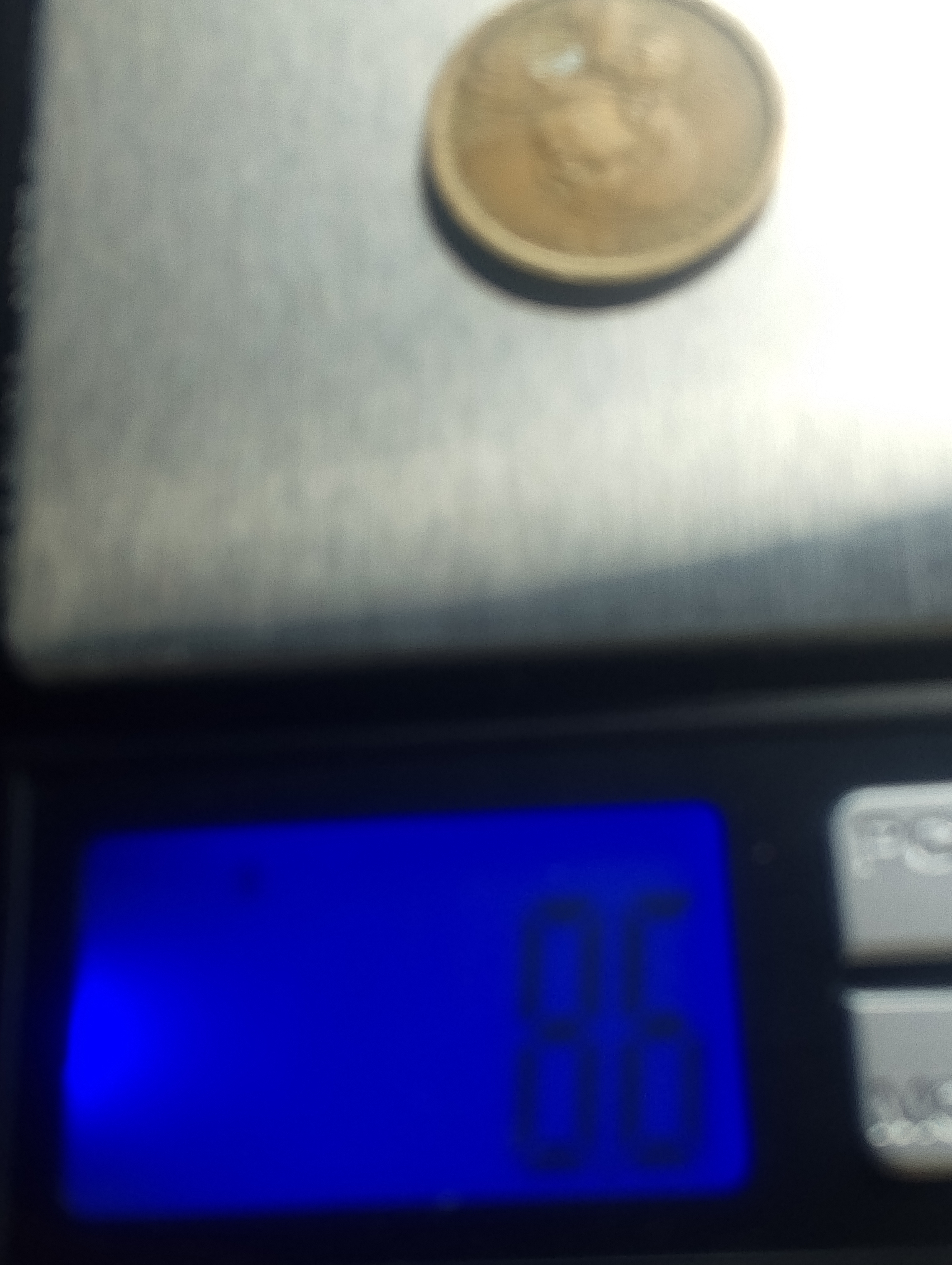
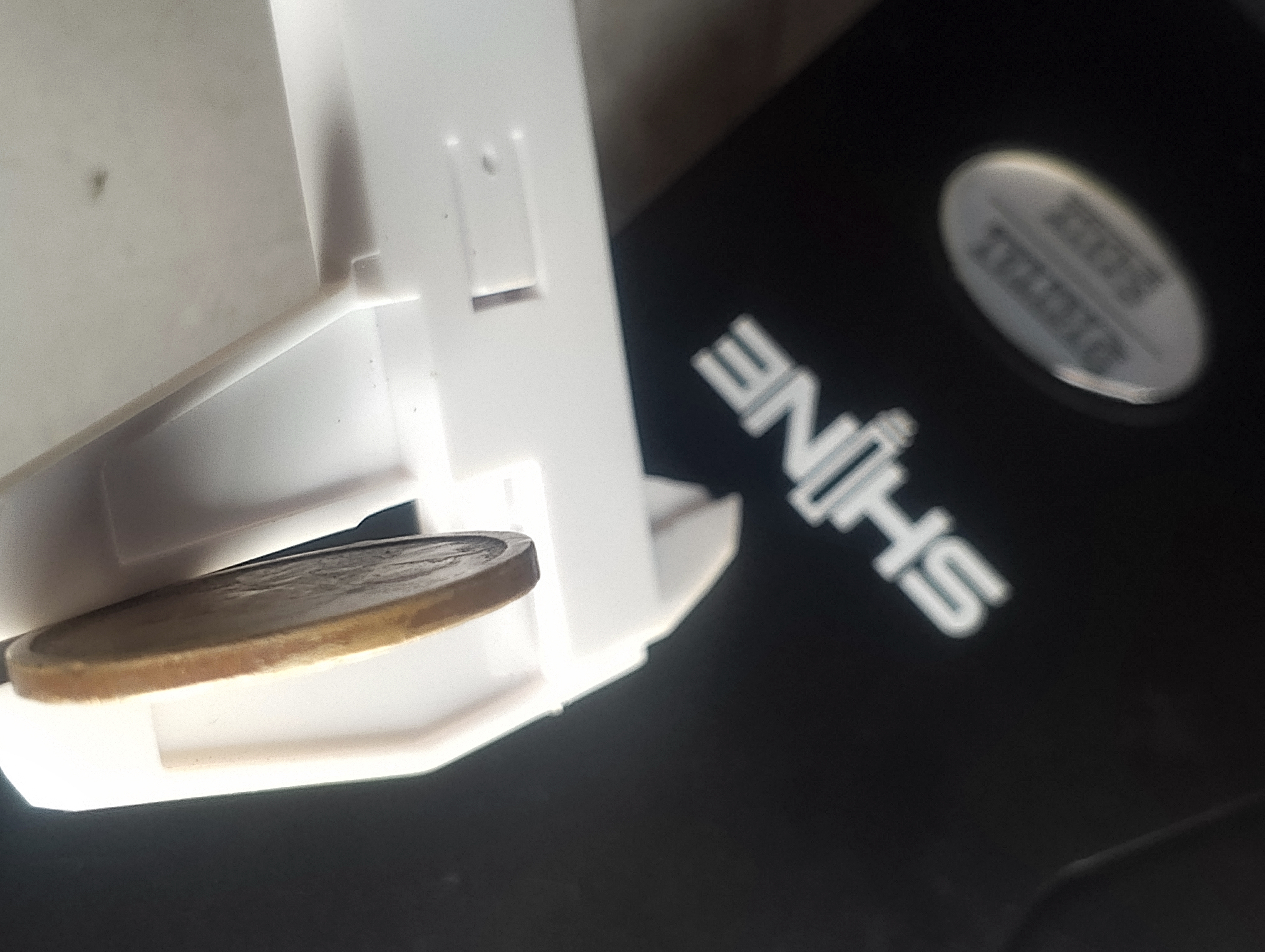
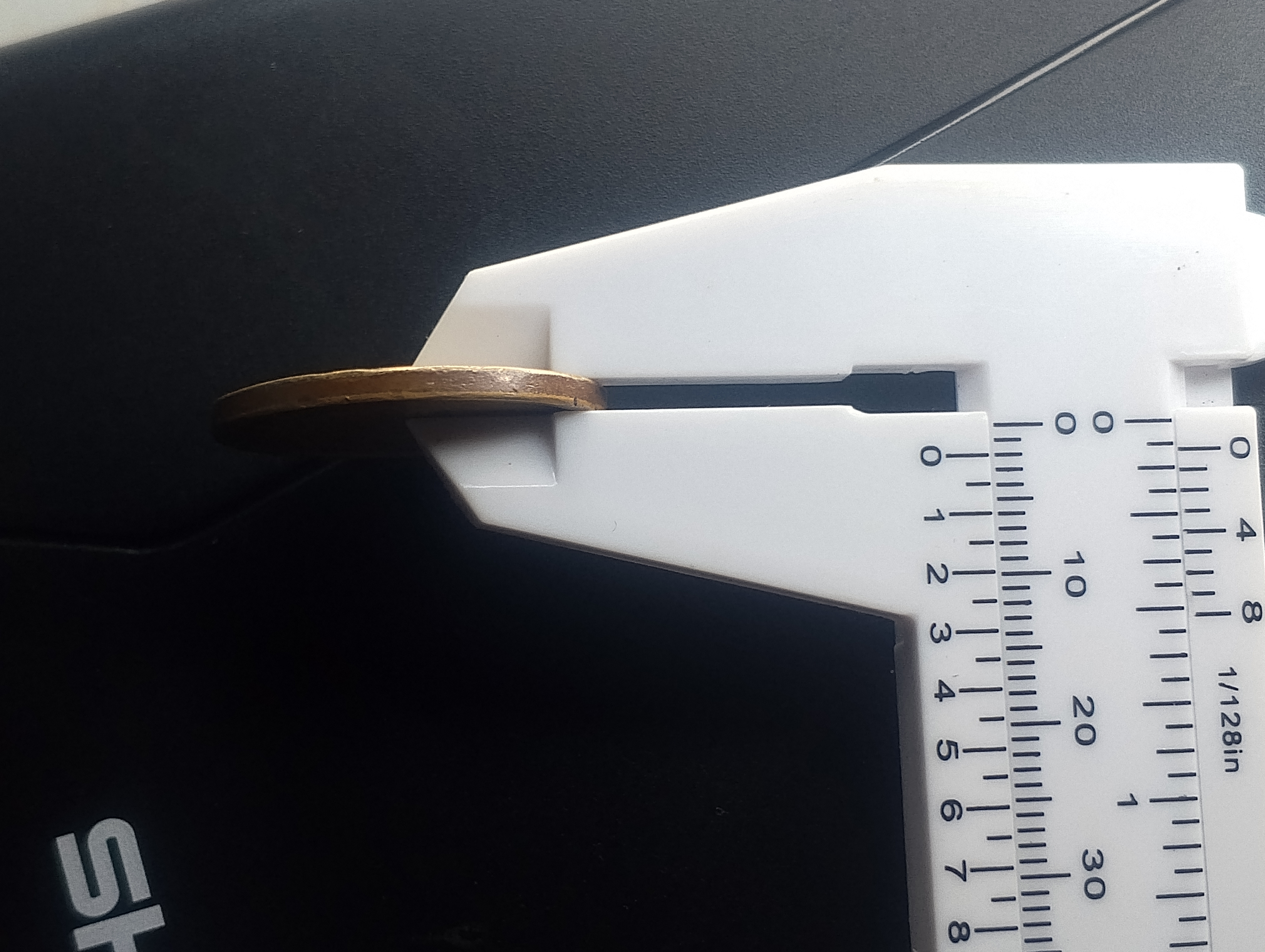
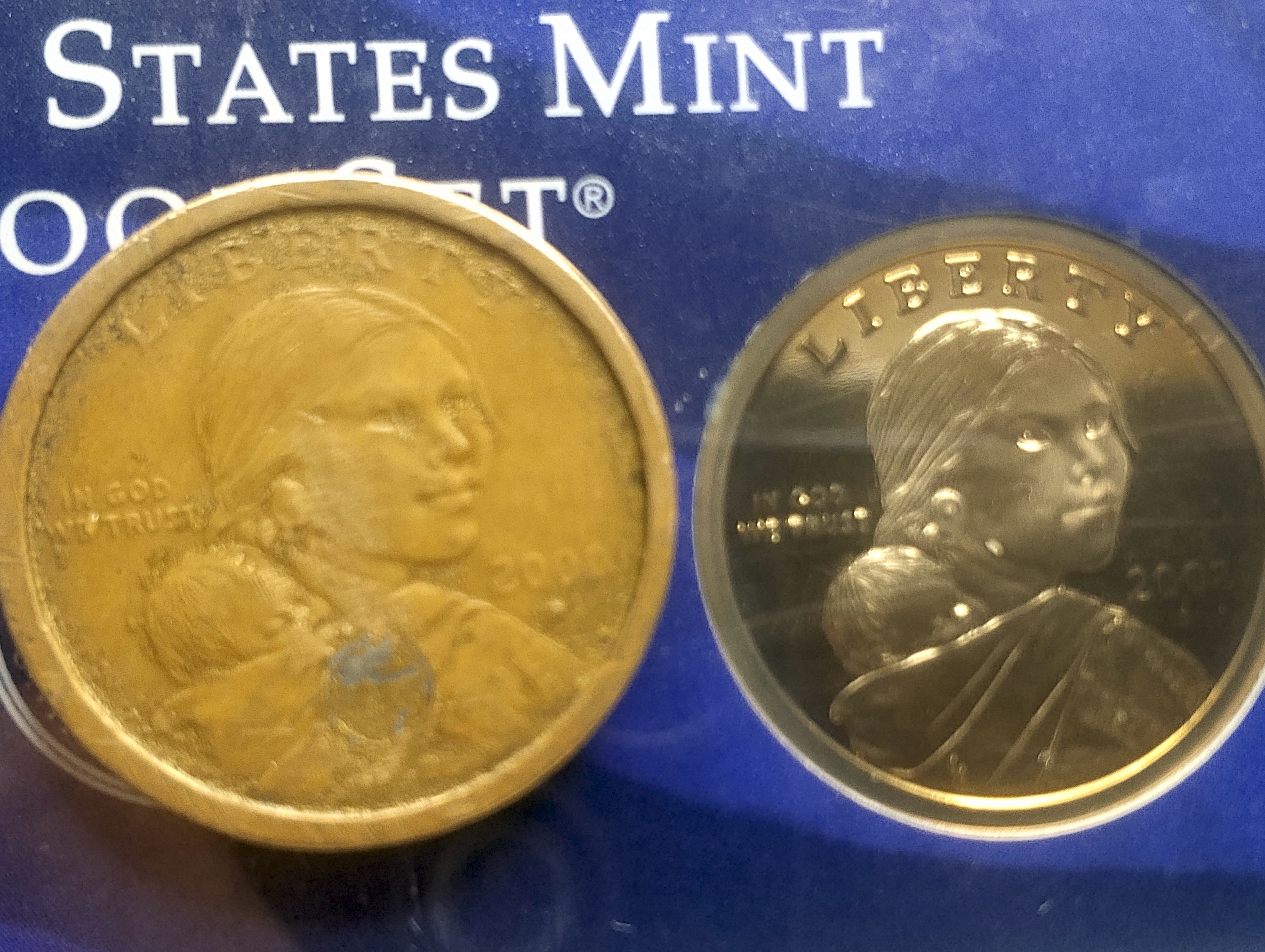
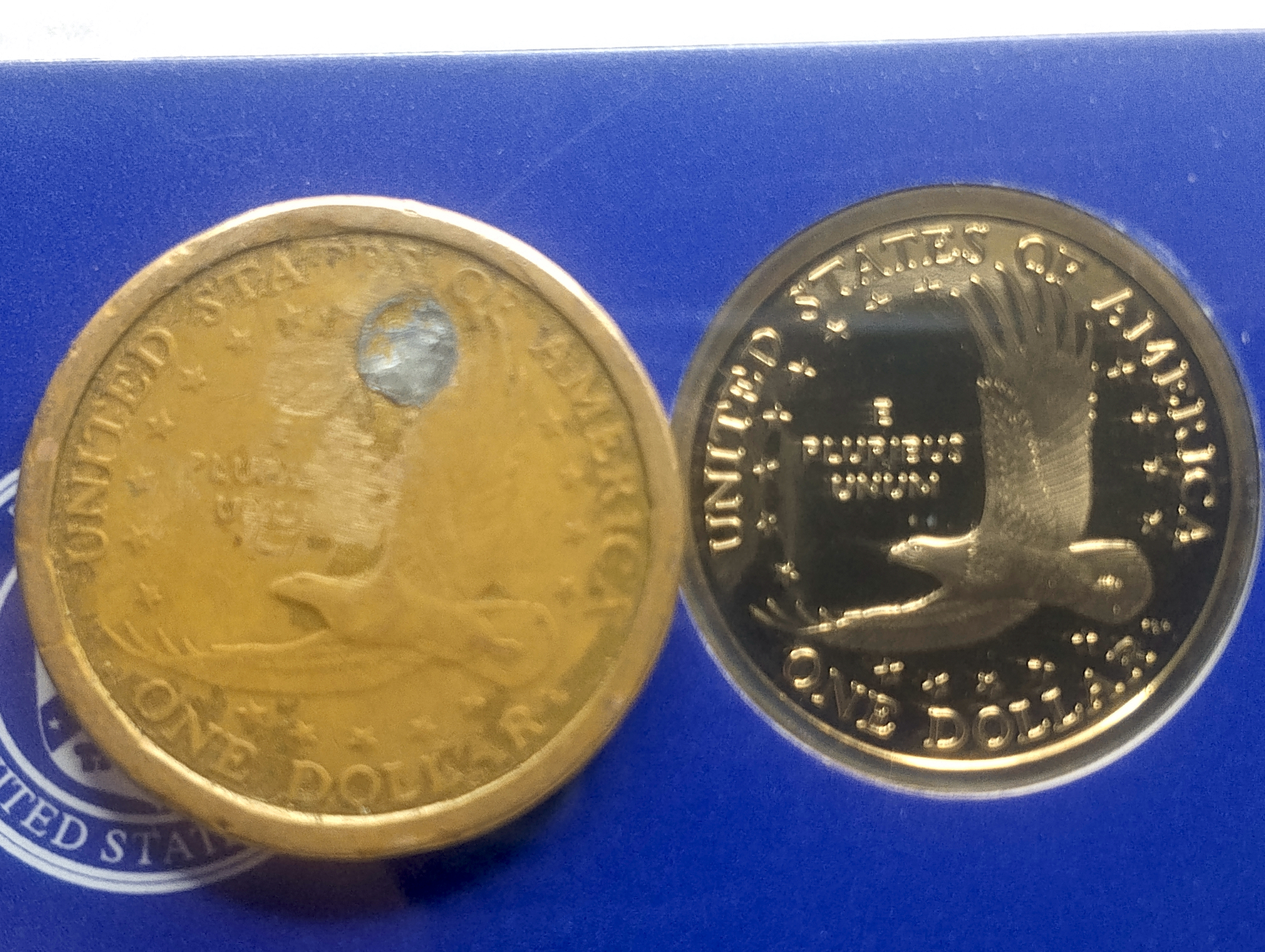
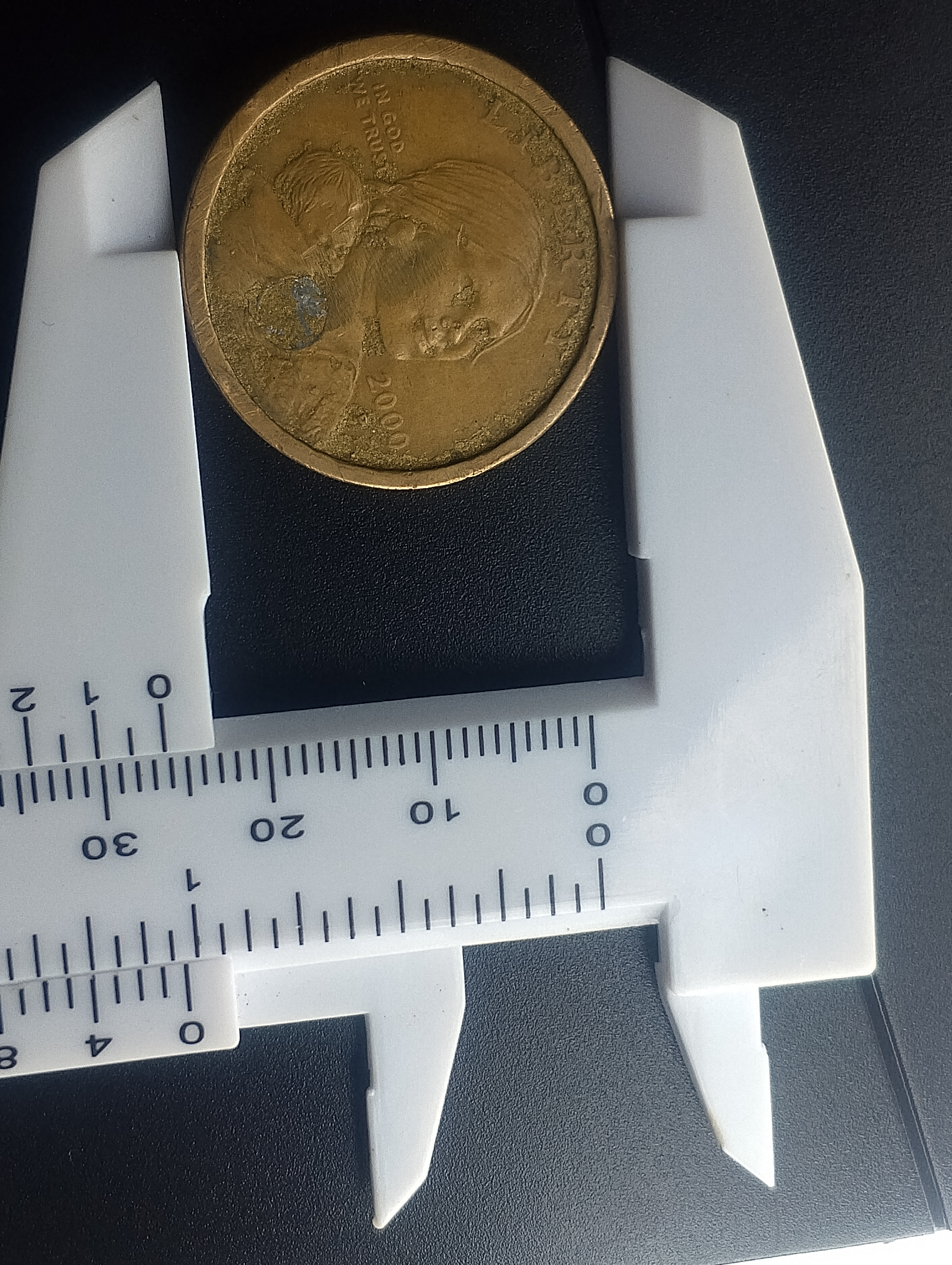
Here is the technical and forensic analysis for Specimen #3.
This specific counterfeit was manufactured using a casting process (fundición). Unlike the previous struck specimens, the physical metrics here reveal an absolute extreme in low-budget operations. Here are the exact numbers from my scale and calipers:
This coin is unbelievably light, losing more than half of its original weight. Holding it feels like holding a piece of plastic or aluminum rather than metal. The surfaces are dark, highly porous, and rough, with extremely soft, crude details on both faces due to the liquid metal cooling process in a very basic mold. This is a perfect example of a low-cost casting operation meant to be passed quickly in high-volume, low-light street circulation.
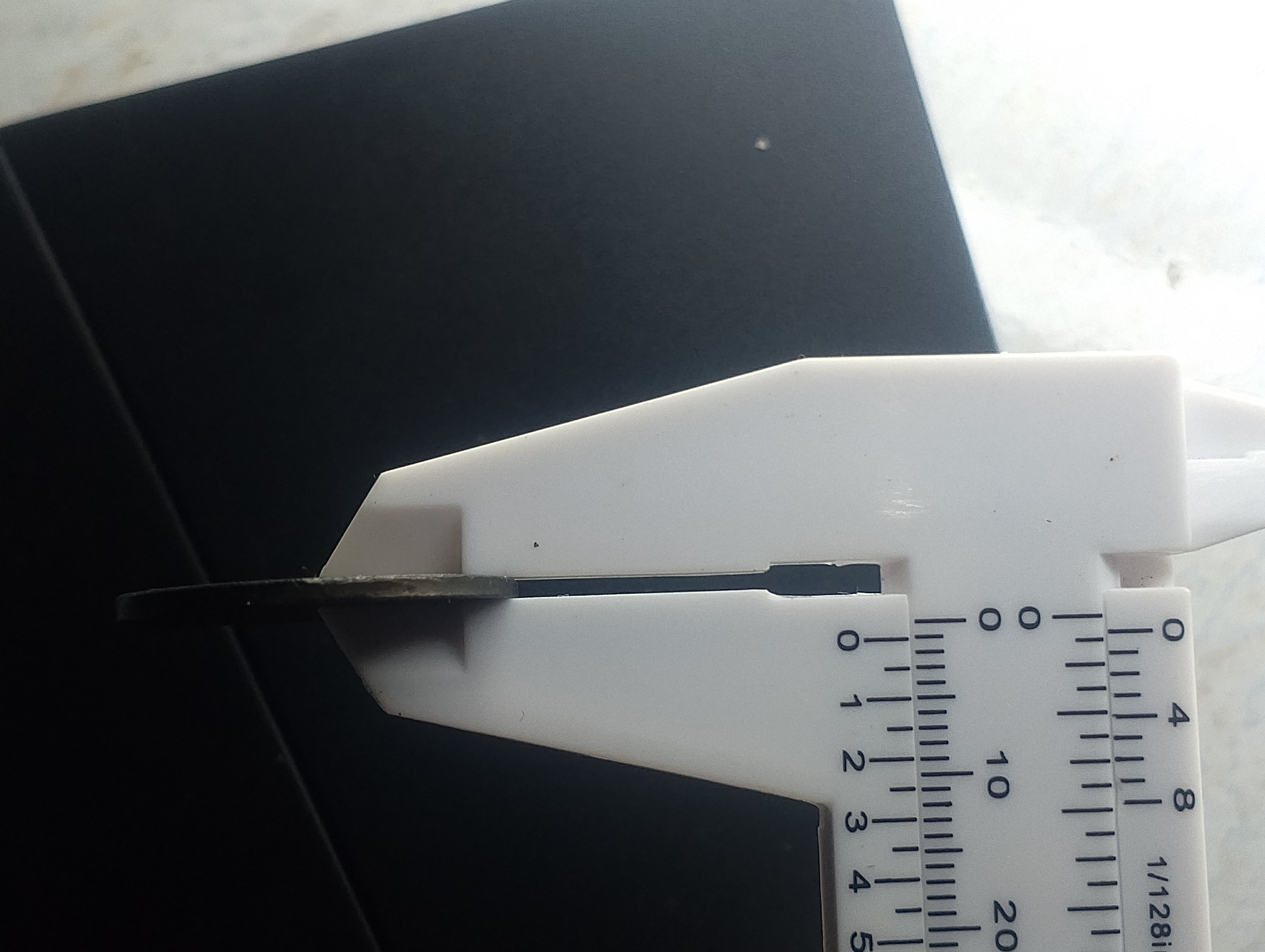
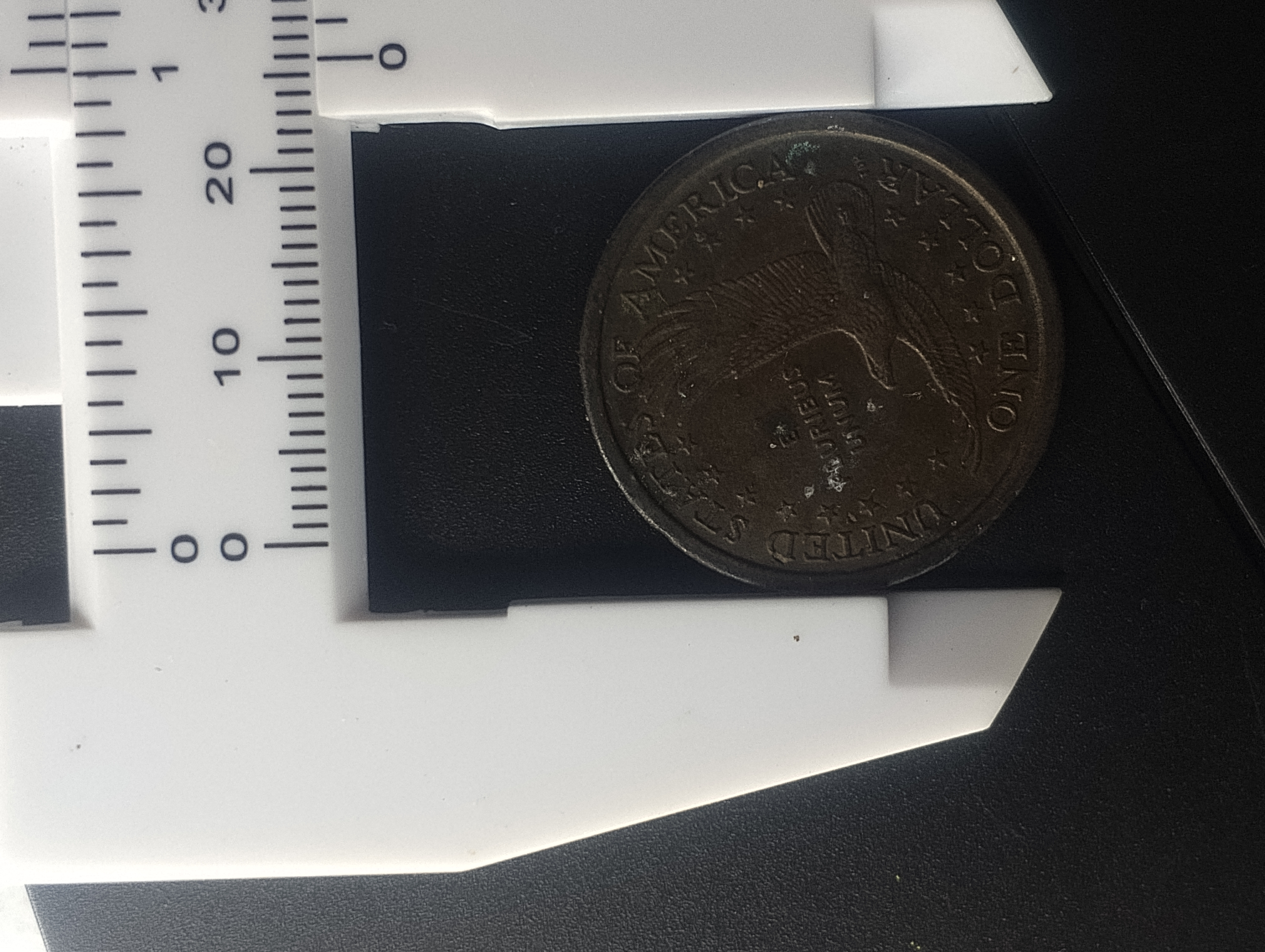
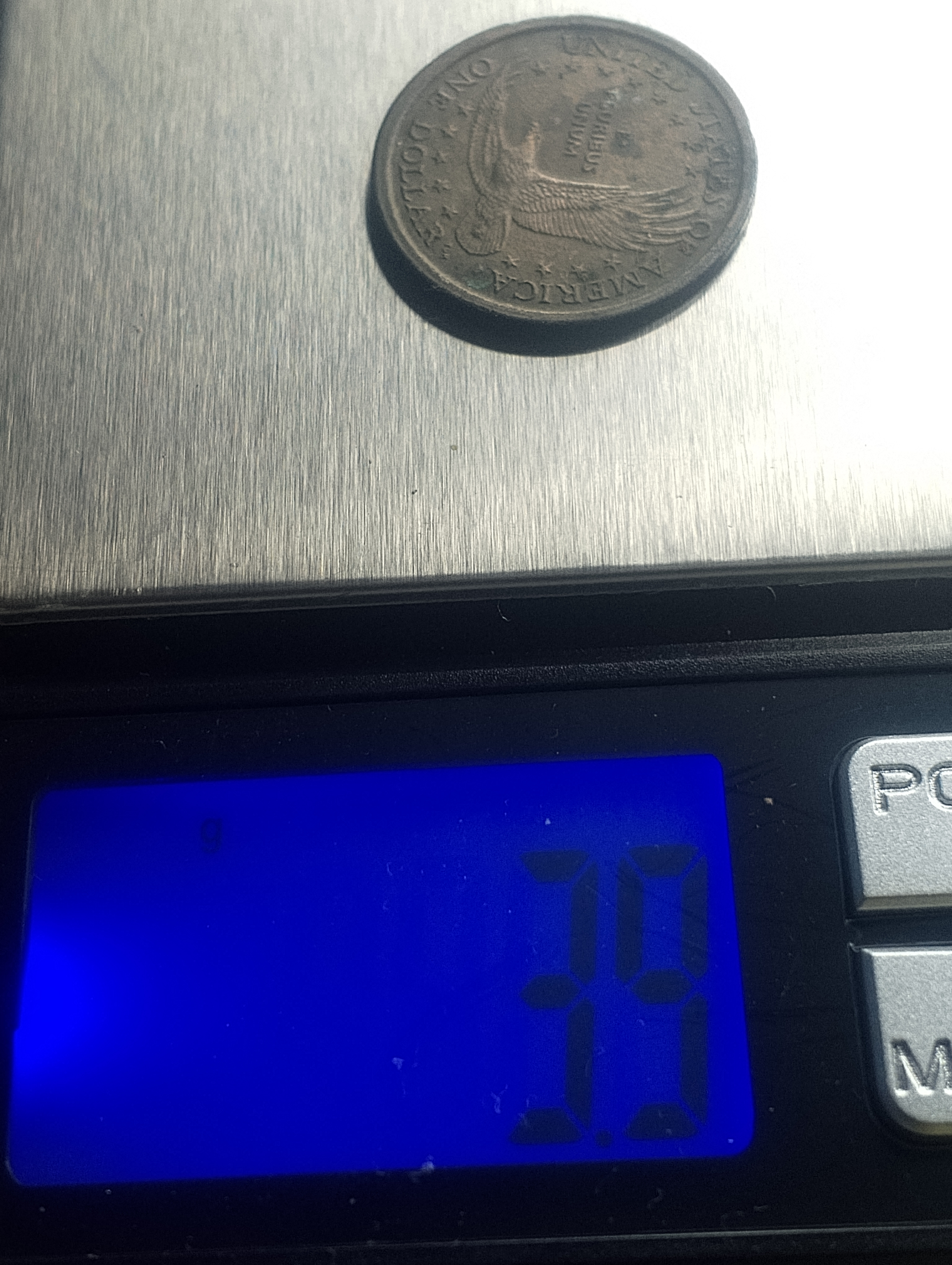
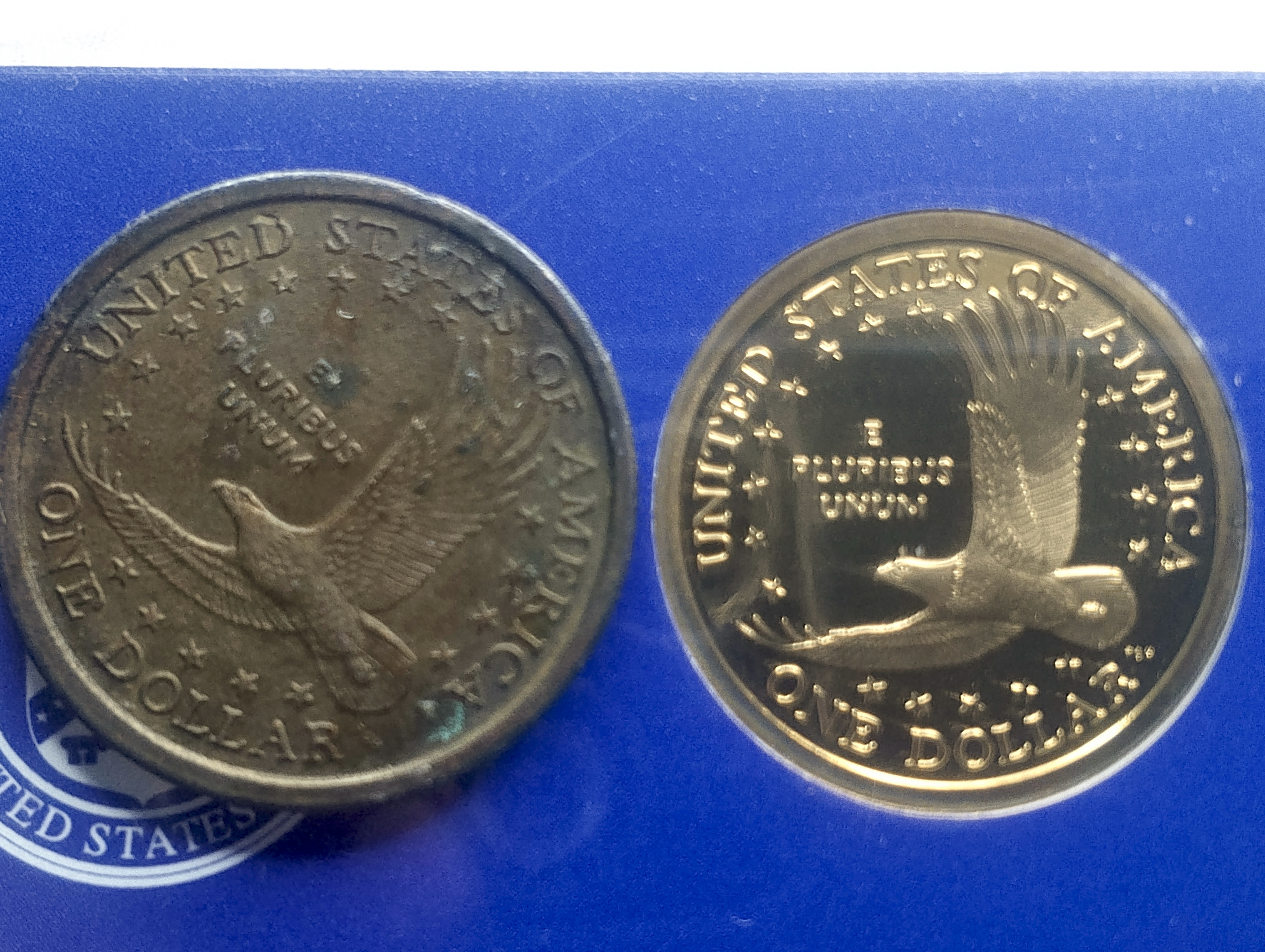
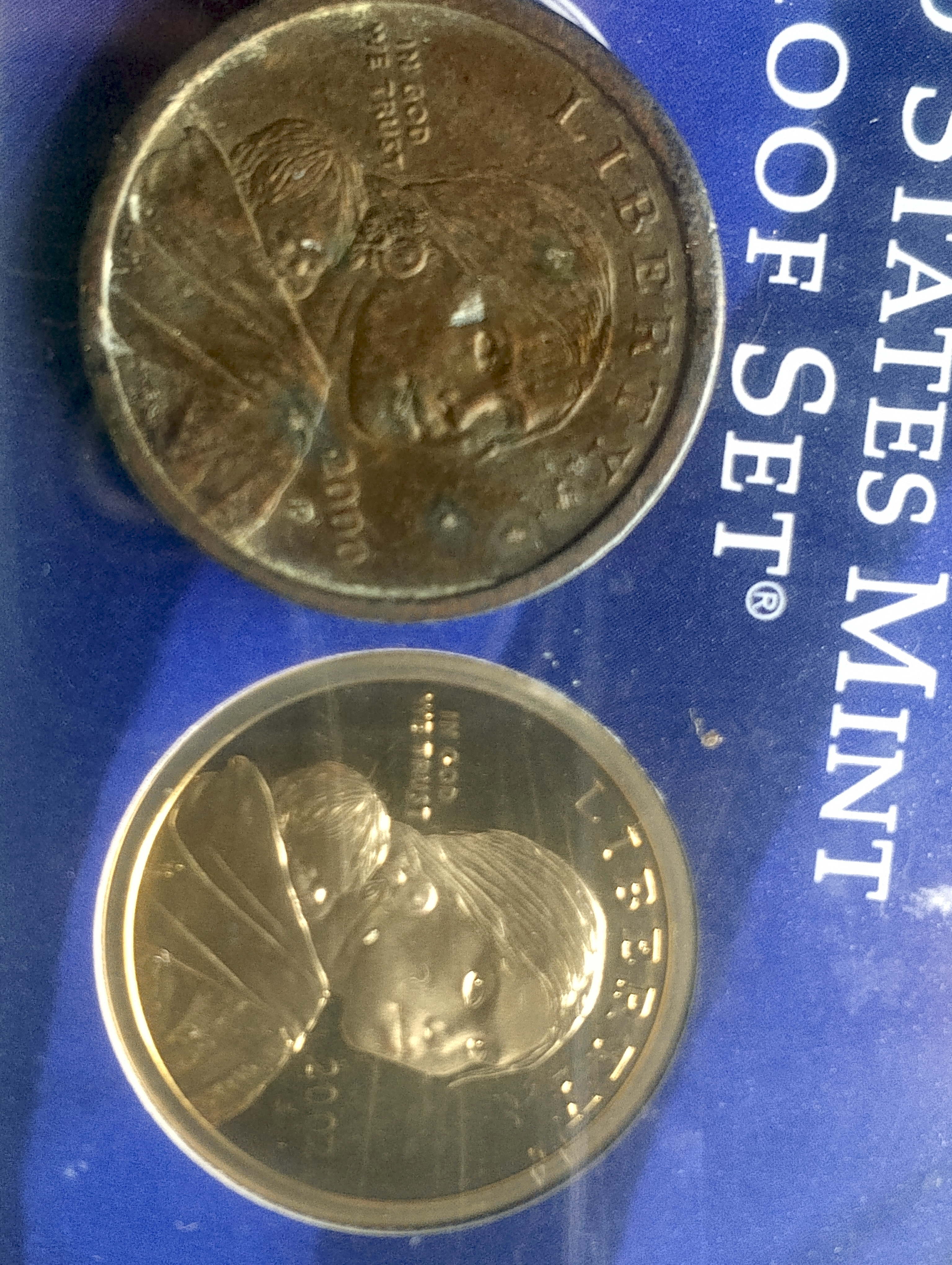
Thank you all so much for taking the time to read this forensic analysis of the counterfeit coins that have reached my hands. If I manage to find any of the Presidential dollar counterfeits in the future, I will definitely add them to this same thread.
For those who are just joining the community and want to learn more about the numismatics of my country, I warmly invite you to check out my other thread: "The Official Word on Ecuador's Numismatic Journey: A Paradise of Rarities for PCGS Collectors".
Also, I want to invite you all to stay tuned for the updates I will be posting in the coming weeks about a massive international numismatic event happening here in Guayaquil, Ecuador, on September 18th and 19th. The event is called COSPEL 2026, and it will take place at the DoubleTree by Hilton hotel. To give you an idea, this event is very similar in spirit to the ANA World's Fair of Money that you experience over there in the US.
As the official PCGS Message Boards correspondent here in Ecuador, I commit to bringing you photos and live updates of all the beautiful pieces we will see there, like the ancient pre-Columbian money axes and the historic Ecuadorian gold coins. Thank you.
I am grateful to learn I am wrong with my first assessment.
Keep going!
This is a great thread.
Today I woke up feeling truly blessed and inspired. I want to thank the friend who shared the image yesterday of his encapsulated counterfeit coin. Thanks to that post, a crazy but interesting idea cooked in my mind while I was sleeping.
Since these pieces have a legal tender value of absolute zero, I am going to thoroughly investigate the legal possibilities in my country to see if they can be officially exported as educational material. If that is the case, my goal would be to help those collectors in this forum who appreciate this type of numismatic specimens so you can add them to your collections for study.
More than anything, my true goal here is to build genuine relationships of friendship, break down borders, and unite collectors from different sides of the yard under this same passion. I want to share with you the concept design of how my personal brand slab would look for this forensic project.
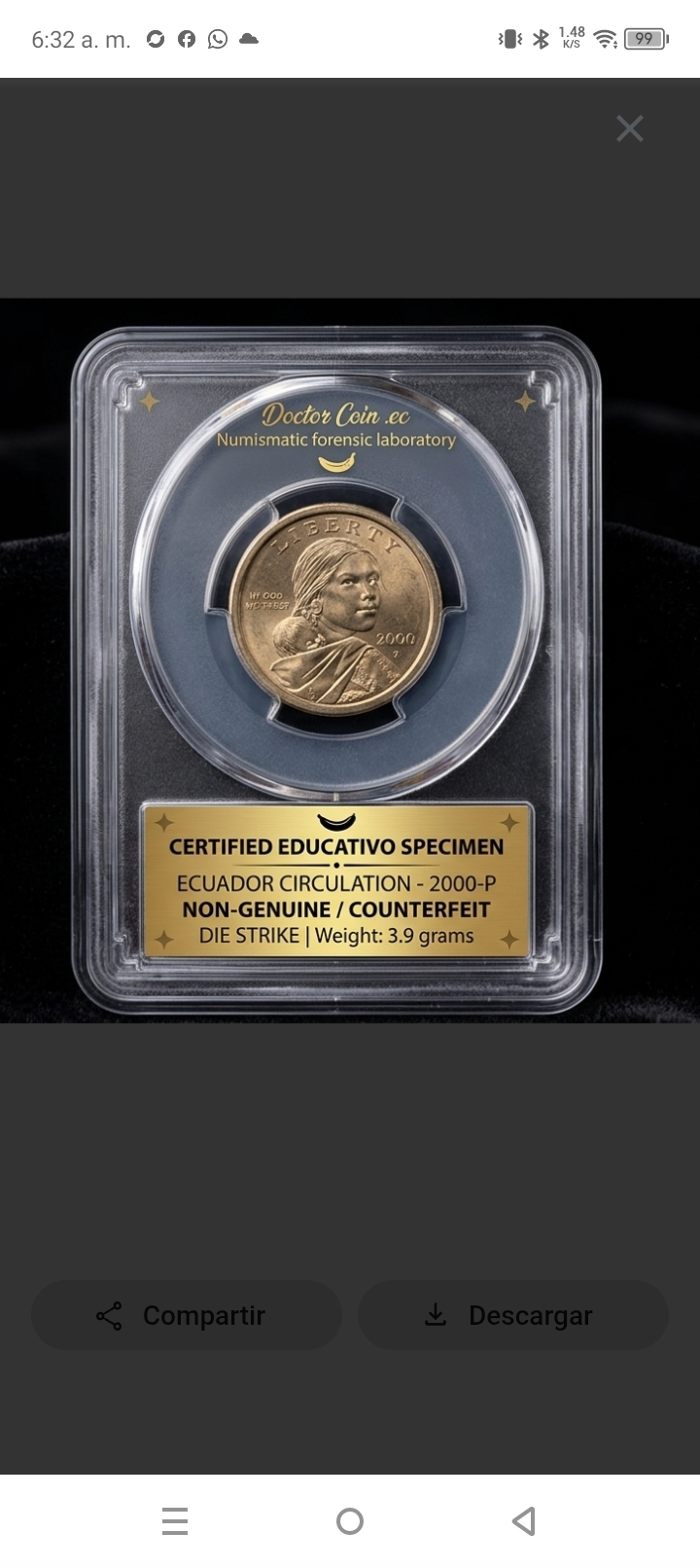
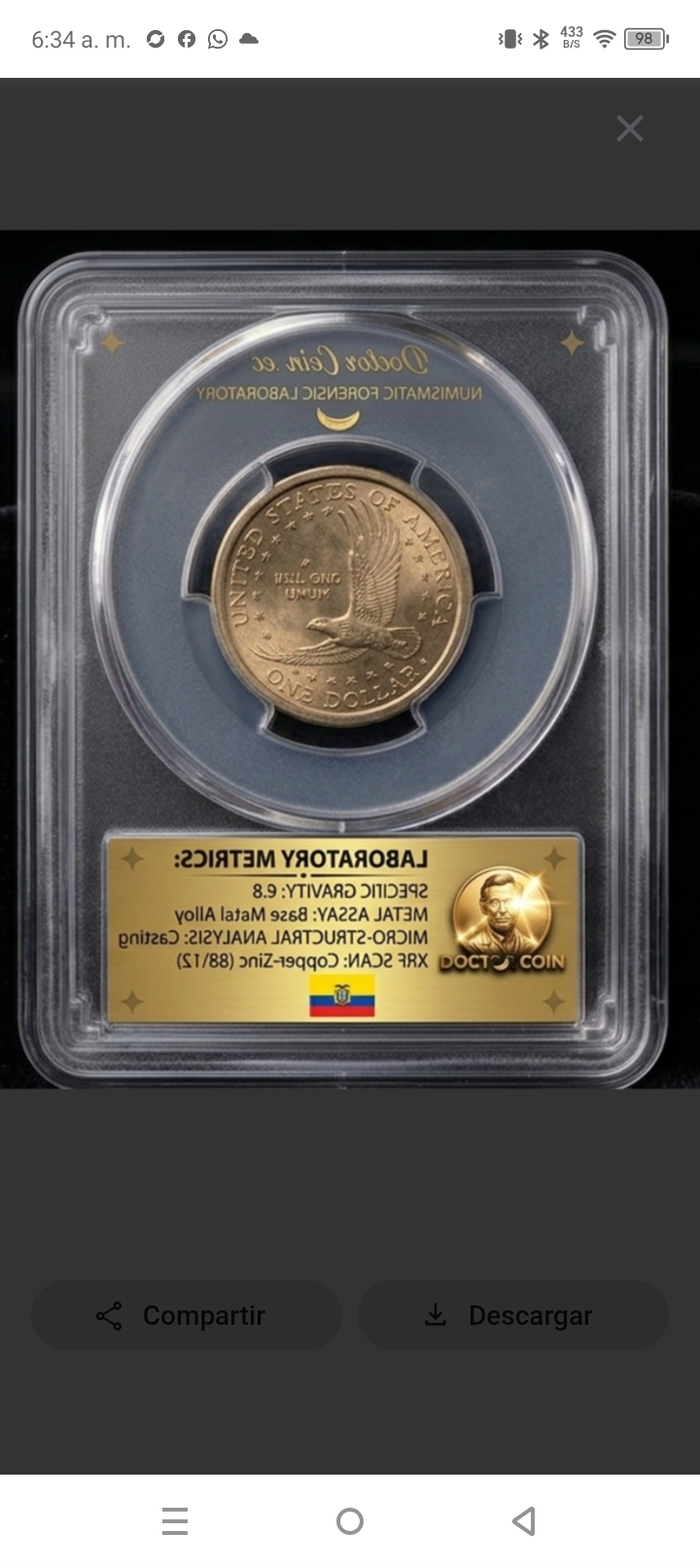
To support this research, I would highly appreciate it if those who are genuinely interested in these specimens—like my friend Creg—could leave a comment below. This will allow me to demonstrate the real interest of this prestigious community before the legal authorities in my country. Thank you in advance!
My sense is that there is genuine interest in your counterfeits from a select group of people. I'm surprised that up until now, no one has mentioned the very striking doubled die obverse on the counterfeit you posted at the beginning of this thread. That is a piece I might be interested in if the price didn't exceed, say, $20.
I would think that the custom slabbing & labeling you propose would be too expensive relative to the market value of your counterfeits. That is probably a moot point, however, because if you need government approval to export them, that will probably put a stop to everything.
The people who deal in collectible counterfeits in the United States take their chances buying, selling, and shipping these pieces without any official approval, knowing that it is extremely unlikely that the authorities here would ever intervene. It may be riskier for you to do so in Ecuador, and since you seem concerned about it, it may be best not to take the risk. Perhaps the best way for you to share your counterfeits with us is through photos.
Your counterfeit doubled die obverse:
You are completely right about the legal and government regulations, IkesT. However, I am going to take my time to thoroughly research and investigate if it is possible to export them exactly as I proposed—safely sealed in those slabs—proving they are strictly for educational and study purposes. There is absolutely nothing to lose by asking.
Regarding this specific specimen that caught your attention, that is actually the first piece I used for the destructive forensic analysis. It was the "victim" of my testing and was completely cut in half using an angle grinder to check the inner core layers. Since it is sliced open, I don't think it would interest you anymore for a collection.
By the way, to be completely honest, you really have a very sharp eye! I hadn't even noticed that specific doubling feature myself before I used the angle grinder on it, haha.
Yes, I agree; it is not very marketable anymore if it is cut in half.
By the way, to be completely honest, you really have a very sharp eye! I hadn't even noticed that specific doubling feature myself before I used the angle grinder on it, haha.
To completely remove any legal classification of "counterfeit currency" and prevent any possibility of the piece entering fractional circulation, a technical solution is to permanently deface the metal by drilling a small hole on the edge. By physically altering the piece this way, it loses all deceptive capability and its legal definition under monetary and customs laws shifts from a fake coin to a zero-value, inert metallurgical study specimen. It would still remain securely encapsulated strictly for scientific and educational study.
Additionally, this tiny drilled hole offers a huge forensic advantage: it exposes the raw base metal of the inner core, allowing collectors to examine the exact material layers used in the fake operation.
For those of you who are genuinely interested in these types of specimens, I have a direct question: do you think that adding this small drilled hole would still generate interest for your study collections?
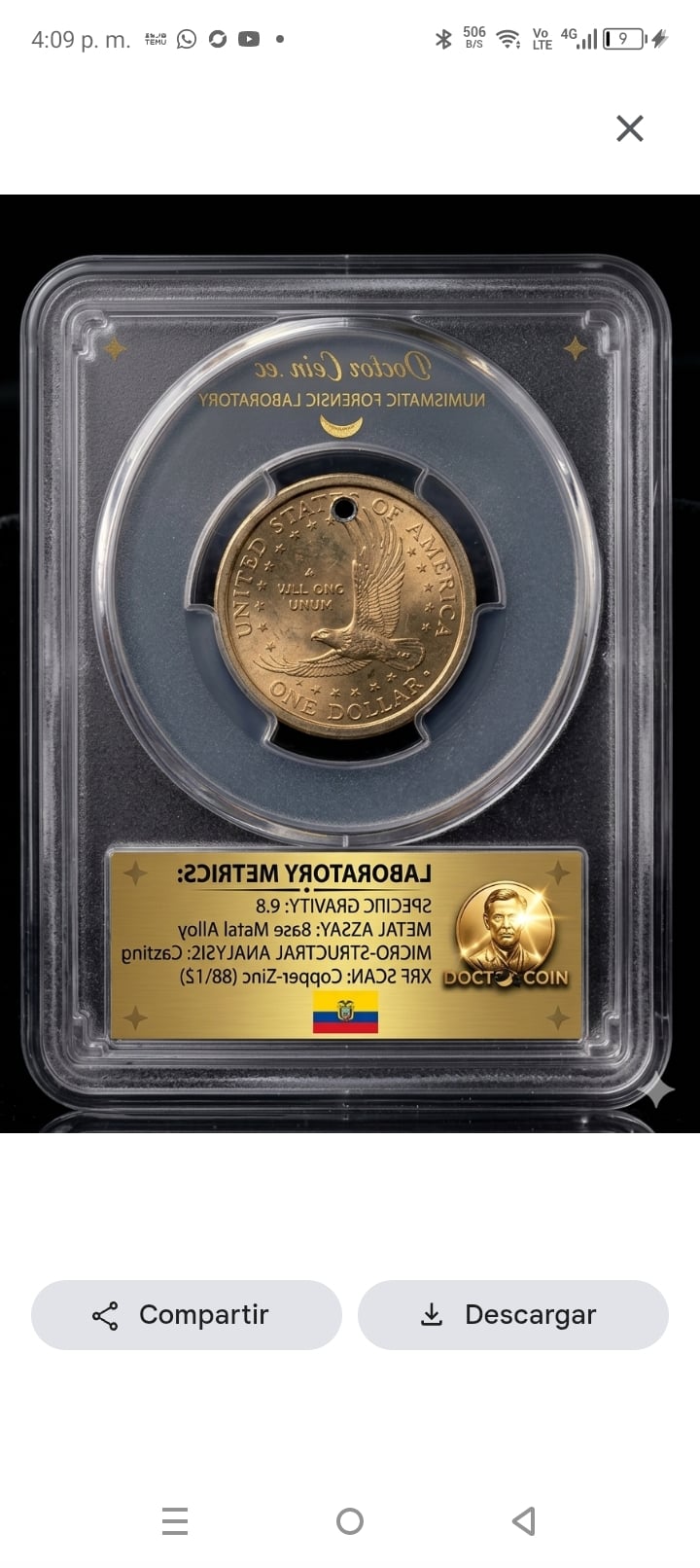
And please, forgive me if I am too ingenious, haha.
Yes. I am very interested in the counterfeit dollar coins of Ecuador, but no, I would not want one that had a hole drilled into it.
And, as another poster mentioned, none of the ideas presented would make them legal to import into the US. You would have to ship them to the US raw, perhaps mixed with some well-worn genuine examples.
Once here, people could get them slabbed by ICG in their special holder for counterfeits if desired.
Thank you for your comment, my friend. I completely understand your point about wanting the coin without any major damage. Please keep in mind that the image I shared is just a concept design to visually illustrate my idea.
In reality, if this goes through, the technical solution would be to use a micro-drill with an extremely fine bit to make a minuscule, almost unnoticeable hole right on the outer edge. It would be placed in a strategic spot that absolutely does not damage the aesthetics, the details, or that beautiful doubling feature of the coin.
I interact a lot with the AI, and analyzing international regulations, this tiny micro-perforation combined with the secure slab creates the perfect legal loophole under 15 U.S. Code § 2101 (Hobby Protection Act) and 18 U.S. Code § 492. Because the piece is permanently defaced and explicitly labeled, it is stripped of any fractional currency potential or "intent to defraud." This shifts its classification from counterfeit currency to a zero-value, inert metallurgical study specimen, which is permissible for import. It keeps the piece completely safe for the law, yet intact and beautiful for your study collections!
That law stipulates that numismatic reproductions must be marked COPY. It does not provide alternate methods such as hole drilling.
The "exemptions" mentioned refer to the carrier (USPS, DHL, UPS, FedEx, etc.), which would not be held liable for unknowingly handling such shipments.
That provision has to do with the forfeiture to the government of counterfeit items. The Treasury Department can be petitioned for an exemption but I doubt many or any such exceptions are issued.
You might be able to avoid prosecution if you can prove lack of intent to defraud, but the coins will still be confiscated.
Once again, collectors of contemporary counterfeits would not want defaced coins (unless marked by the government or a bank, perhaps).
I really wouldn't spend any time trying to design an acceptable presentation. You won't make the coins any more legal, and you will alienate the collectors who might otherwise be interested.
That doubling is pretty neat on your counterfeit Sacagawea coin. I would be interested in die struck counterfeits, but would also prefer them as made and not defaced. As mentioned this could create a legal problem though.
Slabbed or unslabbed lowball Sacs (legal ones) from circulation would interest a few.
Is there a French or British TPG that would grade the Ecuadorean counterfeits?
Reading everything you all have contributed to this thread, I am very grateful for generating so much interest here. Based on your valuable insights, I have another technical question for the community: what if instead of a major alteration, we make a microscopic hole on the edge (canto) and also find a way to stamp the word "COPY" permanently on the edge as well?
Do you think this dual edge-defacement would fully comply with both local and US legal requirements? If so, it could be shipped raw without the slab, allowing you to examine the piece freely and have it certified at your own preference over there.
Regardless, on my end, I am going to move forward with the necessary research here in my country to ensure everything can be exported legally. I strictly want to make sure I am not breaking any laws, either here in my country or over there in yours. That is my absolute priority.
A thousand times "no!".
US law is very specific about the word "copy", where it has to be placed, how big it has to be, and how deep it must be struck into the coin's surface. Adding it to the edge does not satisfy any of these requirements.
And I'm not sure where the obsession with drilling a hole came from. 😕
I'm afraid that this project has gotten away from you, unfortunately. Yes, there are collectors of contemporary counterfeits, but most likely not the altered coins you are suggesting. It might be time to move on to other numismatic pursuits.
Regardless, on my end, I am going to move forward with the necessary research here in my country to ensure everything can be exported legally. I strictly want to make sure I am not breaking any laws, either here in my country or over there in yours. That is my absolute priority.
You are completely right, and I respect your perspective. However, I want to clarify that I never suggested smuggling pieces or sending anything hidden; from the very first second, my focus was to research the strictly formal and institutional channels. I only brought this up because of the genuine interest shown here, but since it involves so many legal complexities, I prefer to stop the topic right here. I apologize if this caused any wrong impressions. My absolute priority remains keeping everything 100% within the law and protecting my reputation. Thank you for your honest advice!
Thank you for clarifying the legal strictness regarding the "COPY" stamp placement. I want to make one thing absolutely clear to everyone in this thread: if you review all my messages, I have never, at any point, suggested bypassing the law or taking illegal shortcuts. My only goal from the very beginning has been to research strictly formal, transparent, and institutional channels to see if these could be treated as educational specimens. Since the regulatory reality between our countries makes this project unfeasible and raises concerns, I am officially stopping this topic here. My integrity as a researcher and respect for the law are non-negotiable. I appreciate your honest guidance.
For some there is a big difference between a modern Chinese 1804 dollar made for collectors and a circulating counterfeit Sacagawea dollar. From a collecting standpoint.
For me it's more about the intent. Henning nickels aren't 19th century counterfeits either, but have an interesting history and are widely collected. The United States actually produced counterfeit paper bills and helped distribute them in the Japanese occupied Philippines during WW2. Economically and globally, yes circulating counterfeits cause damage. From a purely collecting standpoint, a modern fake struck solely to fool a collector is less interesting to me and is more damaging to the hobby.
Hello everyone,
I wanted to share an update to officially close this topic. Thanks to a member of this community, I was able to get in touch with Mr. Winston Zack from "Bad Metal Coin". He was genuinely interested in this research and even took the time to log in and read through the comments on this forum regarding the counterfeit Sacagawea dollars circulating here in Ecuador.
Mr. Zack from Bad Metal Coin thoroughly reviewed the legal framework and confirmed that US federal laws and anti-counterfeiting statutes are extremely strict, completely prohibiting the import or mailing of these unmarked pieces, even for educational or research purposes. For this reason, we have officially concluded any potential project involving these pieces.
I want to explicitly give credit to JBK and jmlanzaf. You were absolutely right from the beginning regarding the legal boundaries. I deeply appreciate your guidance and warnings; protecting the integrity of the hobby and respecting international laws has always been my top priority.
Thank you all for your time and insights!
Hello forum, I found an apparently counterfeit Abraham Lincoln Presidential dollar with some similarities to mine—the one that was at NGC and ANACS—in the province of Riobamba thanks to social media (TikTok). I am currently negotiating with the owner to have it shipped to Guayaquil so I can perform a forensic analysis on it as well, so I am preparing my angle grinder jajaja. Stay tuned for this possible analysis if the deal goes through. Best regards.
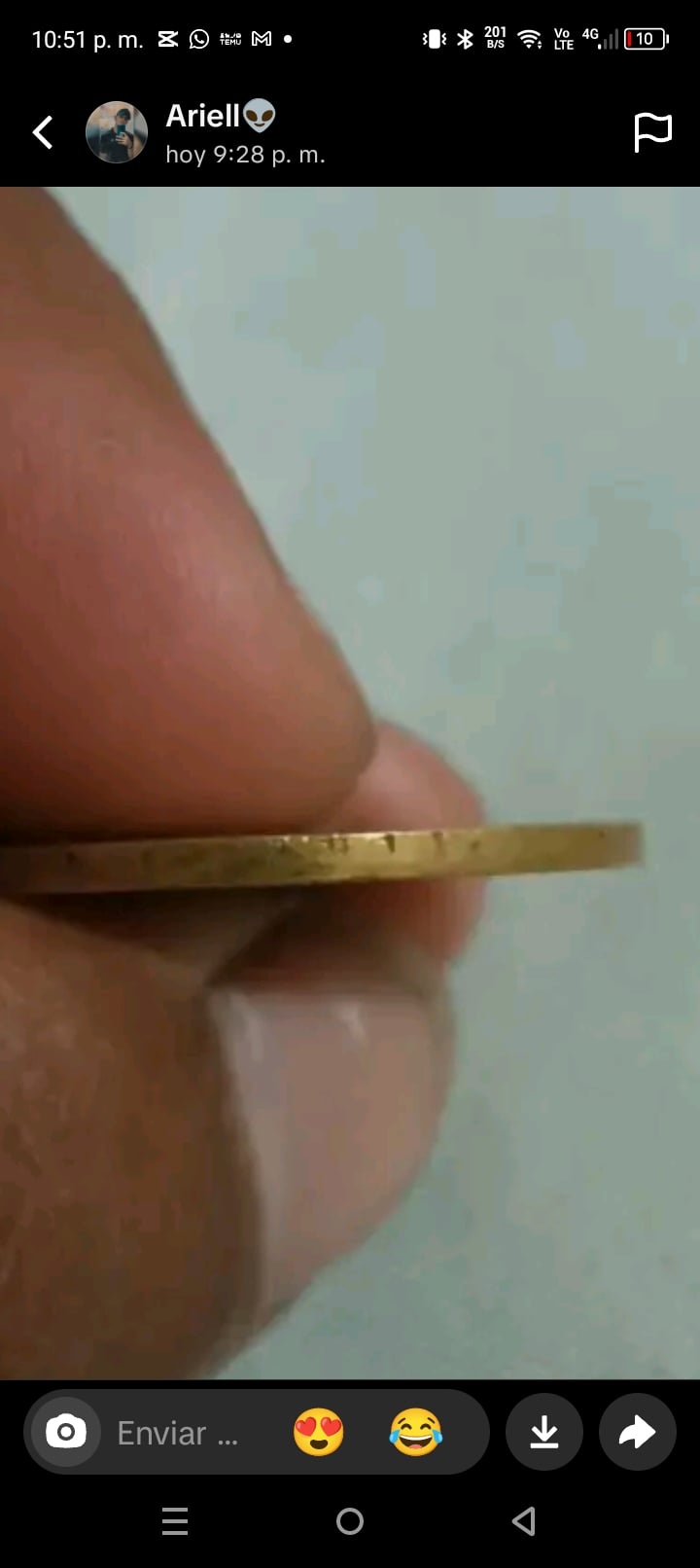
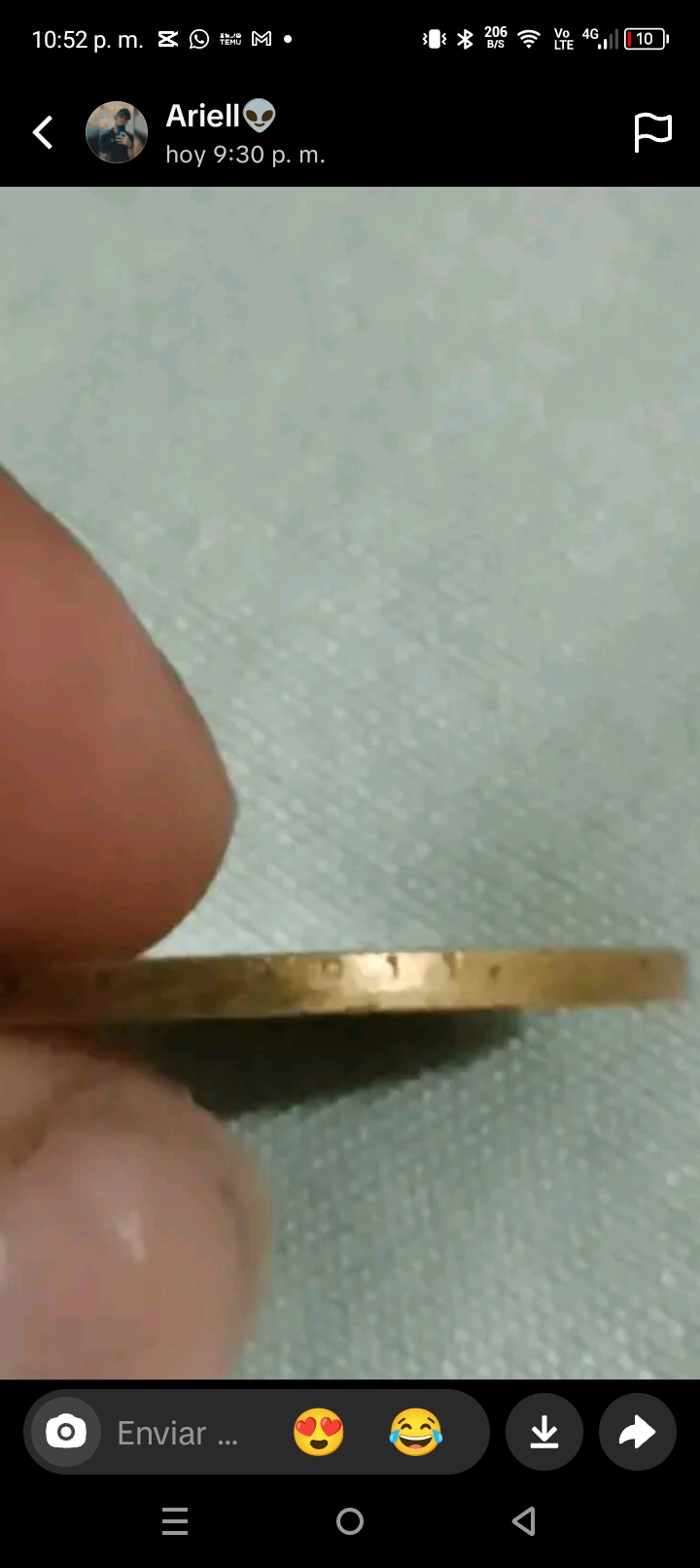
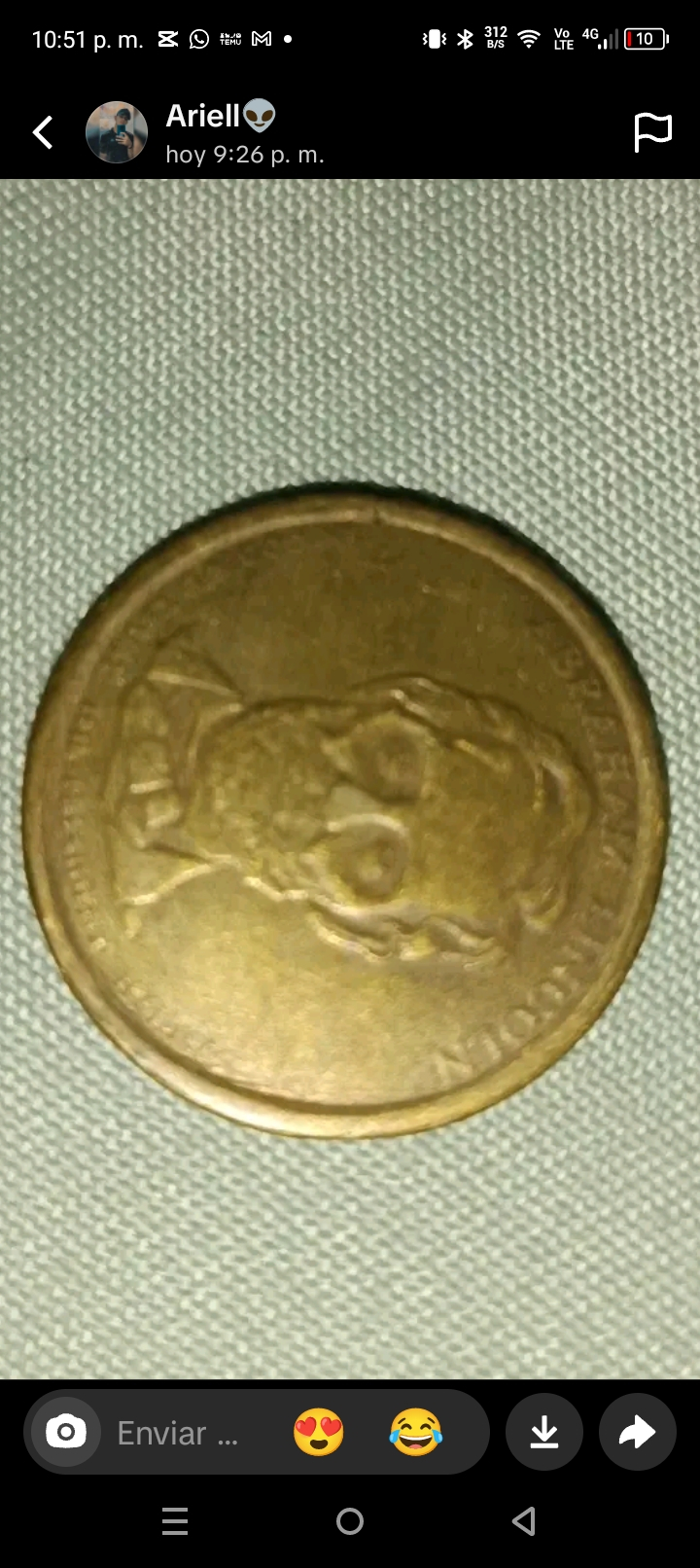
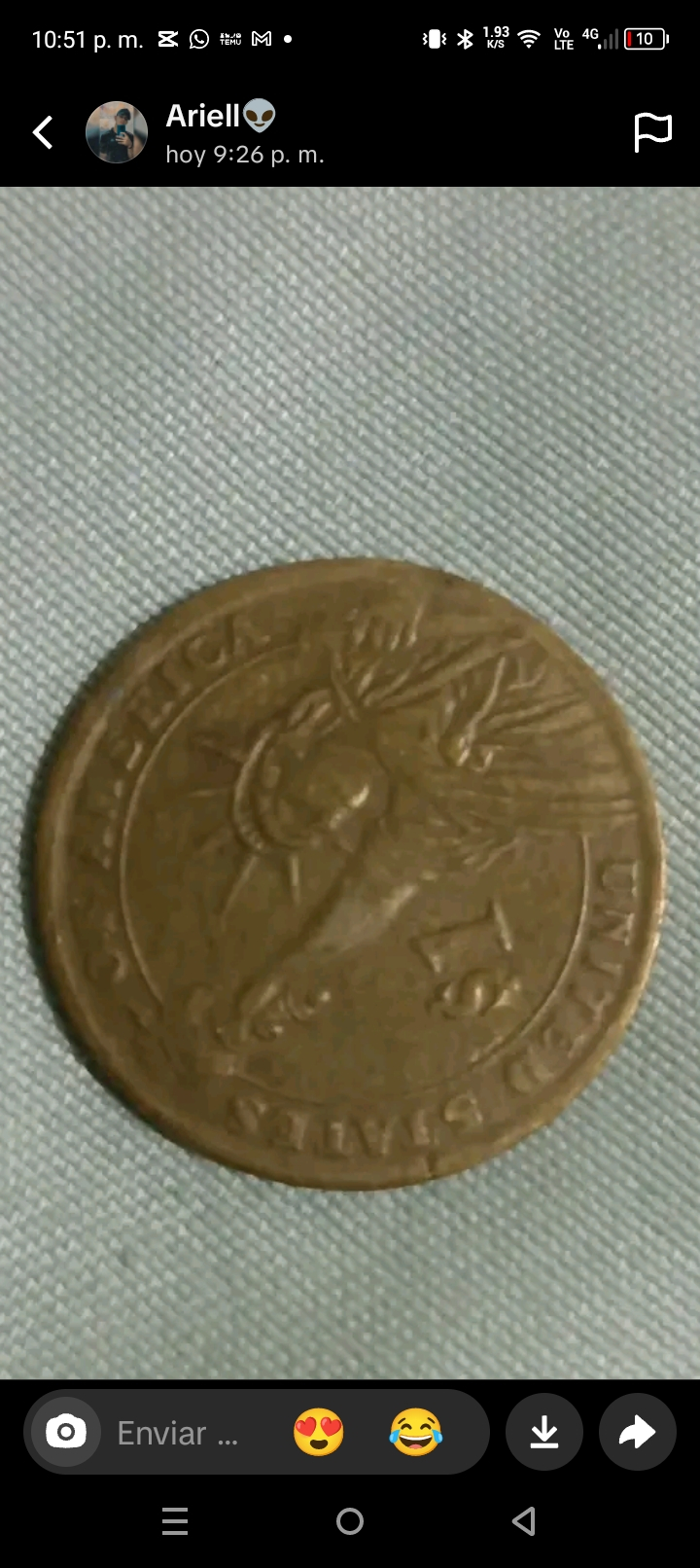
As a side note,
mine is still in the US
with a contact.
I will have it
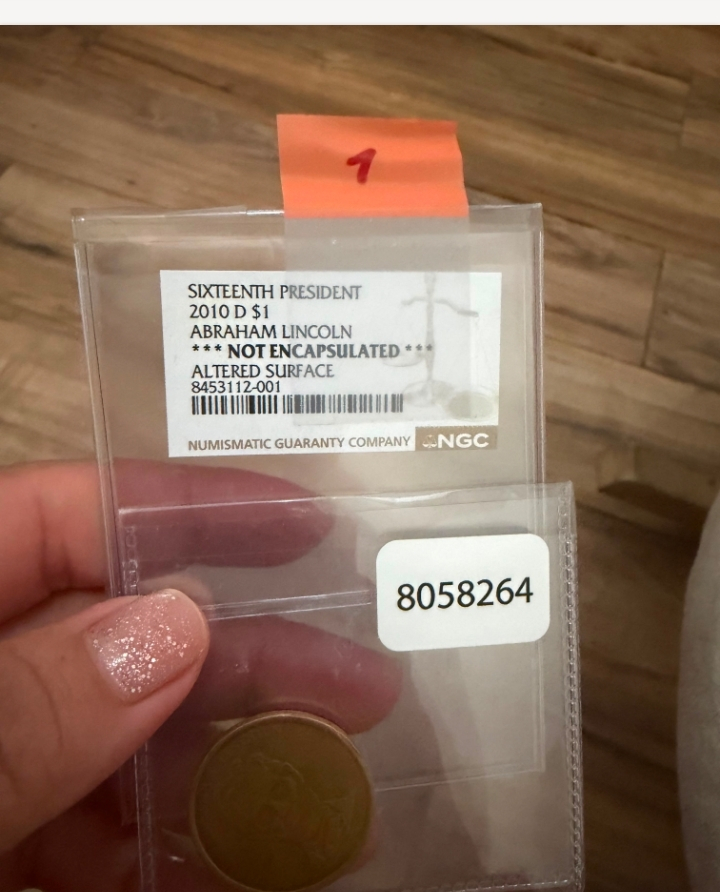
back here soon.
This was a fun read. Thanks Ricarf.
Llamas and alpacas are camels. They aren't like camels, or related. They are camels. When was anyone going to tell me this?! How long had Bill Nye been holding out on us?
Thank you, RiveraFamilyCollect! Just as my friend @johnny9434 said in another thread, I add his exact words here: "Si alegra el día de alguien, me parece bien (también)." Everything seems perfect to me!
🚨 [REPORTE] Operación Victoria: Desmantelan megafábrica de dólares en Colombia con ruta hacia la economía dolarizada de Ecuador
*
Septiembre de 2026
Hola a todos:
Les comparto un análisis técnico importante respecto a una de las mayores incautaciones de dólares estadounidenses falsificados en Sudamérica en lo que va del año, cuyo principal vector de distribución afectaba directamente el flujo circulante de Ecuador.
En un operativo conjunto denominado "Operación Victoria", la Policía Nacional de Colombia (DIJÍN), la Fiscalía General de la Nación y el Servicio Secreto de los Estados Unidos desmantelaron una imprenta clandestina de nivel industrial.
📊 Cifras clave de la incautación
🗺️ Logística, vectores de transporte y el factor "Uniforme"
La organización criminal operaba bajo una estructura fragmentada y perfiles de alta confianza para evitar las alertas de inteligencia militar:
1. La Fábrica: Oculta en una casa discreta del municipio de La Unión, Valle del Cauca, donde procesaban las plantillas y el tratamiento químico de las tintas para dar relieve al papel.
2. Uso de uniformes militares como camuflaje: Al momento de capturar a alias "Damián" en Bogotá, se le incautó un uniforme de uso privativo del Ejército Nacional. Las investigaciones determinaron que los implicados utilizaban uniformes y credenciales falsas de las Fuerzas Militares para pasar cargamentos enteros de divisas a través de los retenes viales sin levantar sospechas, ganando además la confianza de ciertos transportistas y enlaces logísticos.
3. El Vector Sur hacia Ecuador: El destino final de gran parte de la producción masiva de estos dólares litográficos era el departamento de Putumayo, zona fronteriza clave utilizada para ingresar el efectivo a través de pasos ilegales (trochas) hacia Ecuador.
🇪🇨 Impacto en el sistema dolarizado ecuatoriano
Para la comunidad numismática y de análisis de divisas de PCGS, el caso de Ecuador es sumamente crítico. Al ser una economía 100% dolarizada que depende masivamente del dinero en efectivo para el comercio diario, se convierte en el sumidero perfecto para las redes de falsificación transnacional. Los criminales aprovechan las economías informales y los comercios minoristas fronterizos para inyectar estas piezas de alta fidelidad, lavando el dinero falso a cambio de dólares genuinos sin tocar los filtros del sistema bancario centralizado.
📲 El agravante digital: Distribución masiva en TikTok
Un fenómeno alarmante que se observa localmente en Ecuador es que la distribución ya no es puramente clandestina. Cuentas anónimas y redes criminales utilizan activamente TikTok y Telegram para promocionar abiertamente la venta de estos fajos de dólares falsos traídos de Colombia. Mediante videos cortos, incentivan de forma descarada el "engaño diario" y la estafa hormiga, vendiendo estos billetes a una fracción de su valor real a ciudadanos comunes, afectando masivamente a pequeños comerciantes inocentes que carecen de herramientas de verificación avanzadas.