🇪🇨 Forensic Analysis of a Struck Counterfeit Sacagawea $1 Coin from Ecuador

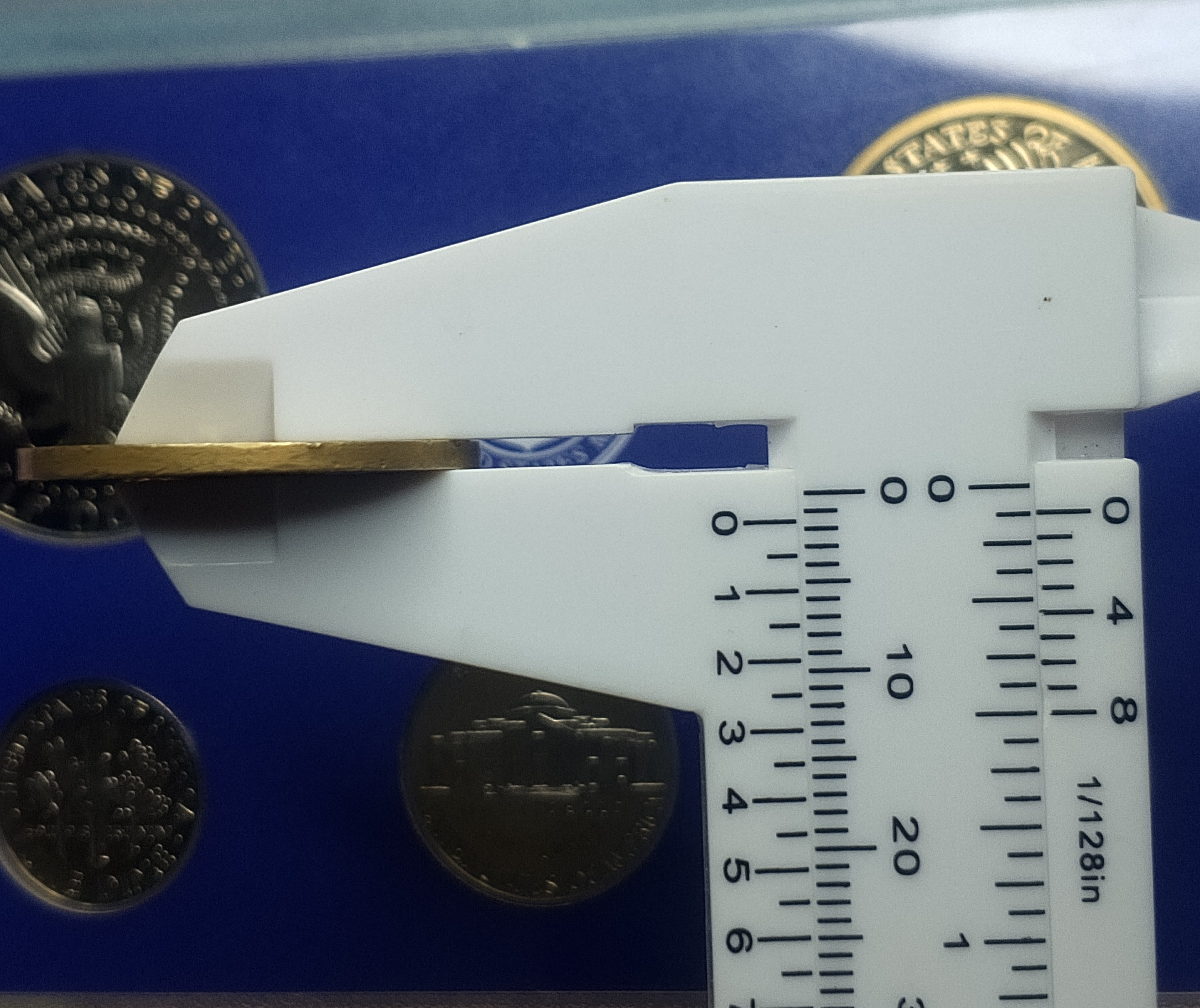
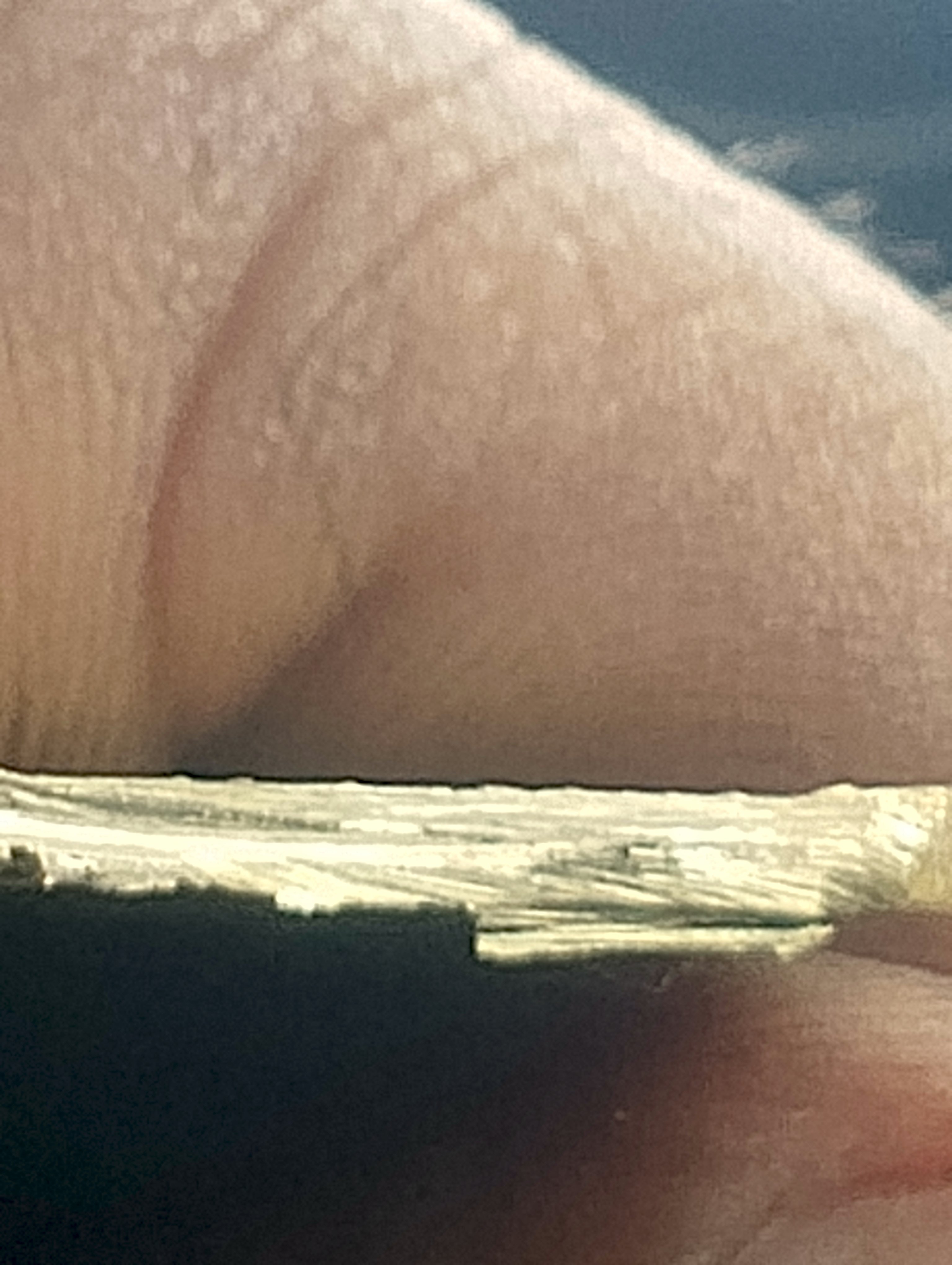
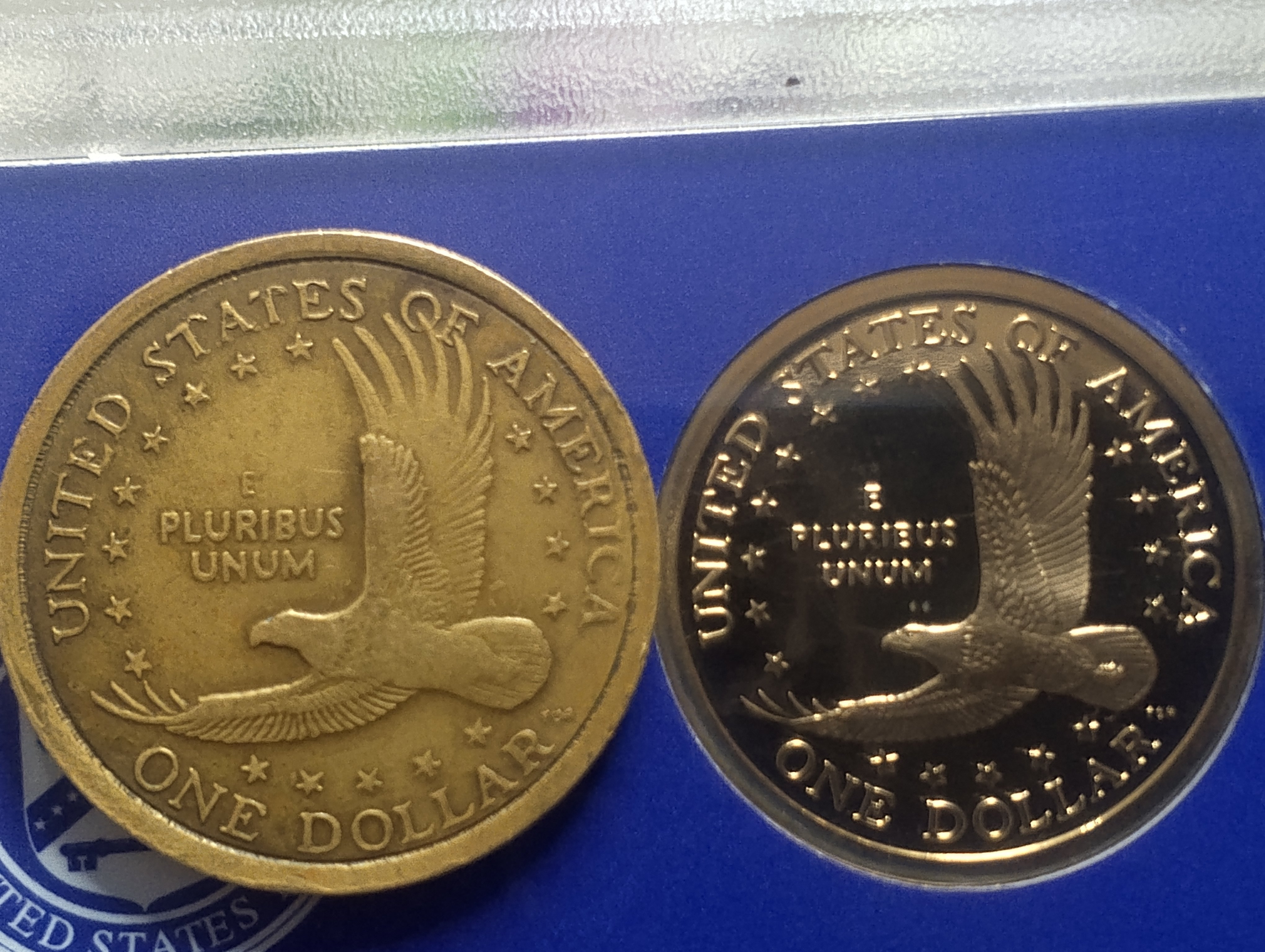
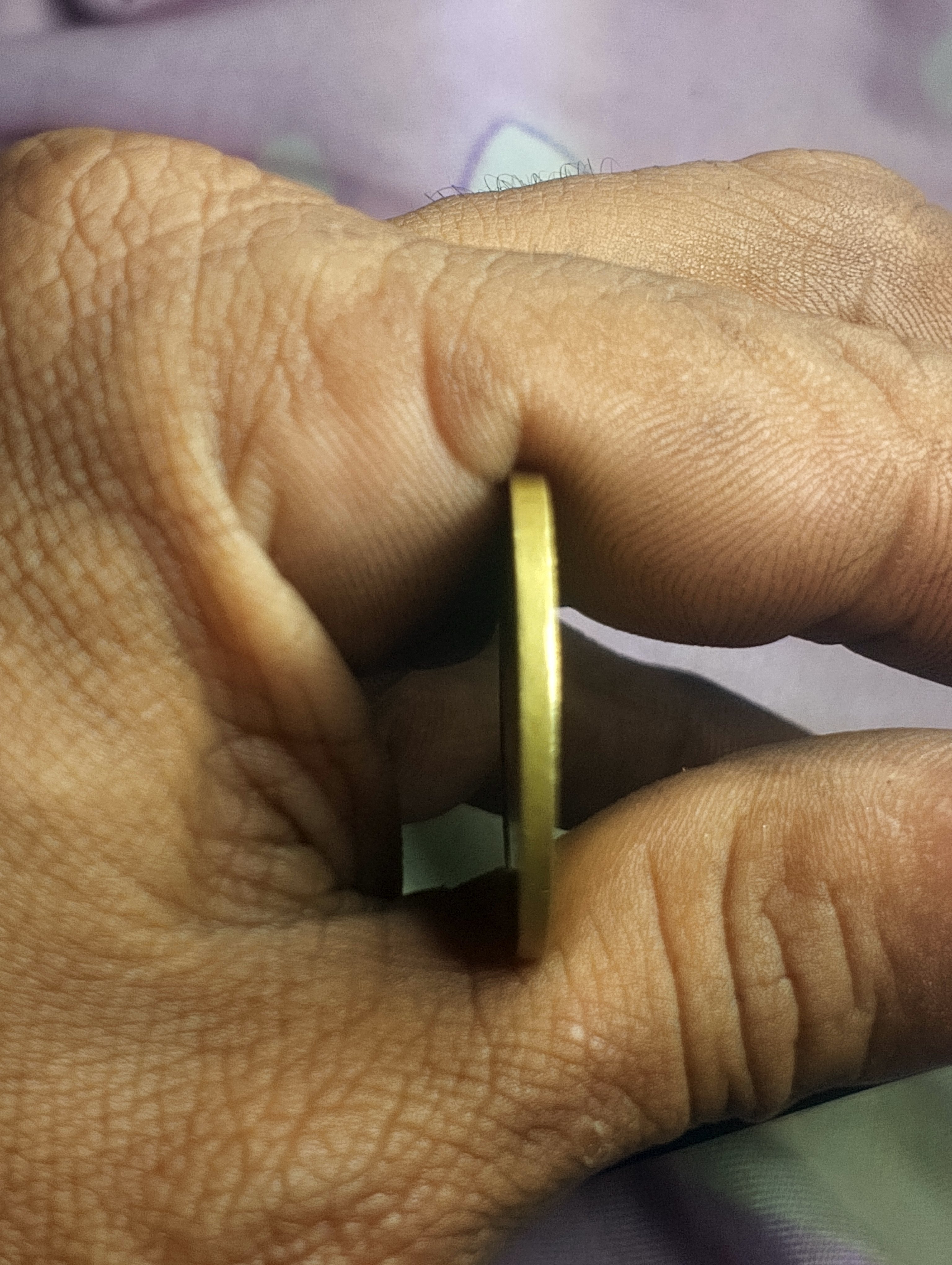
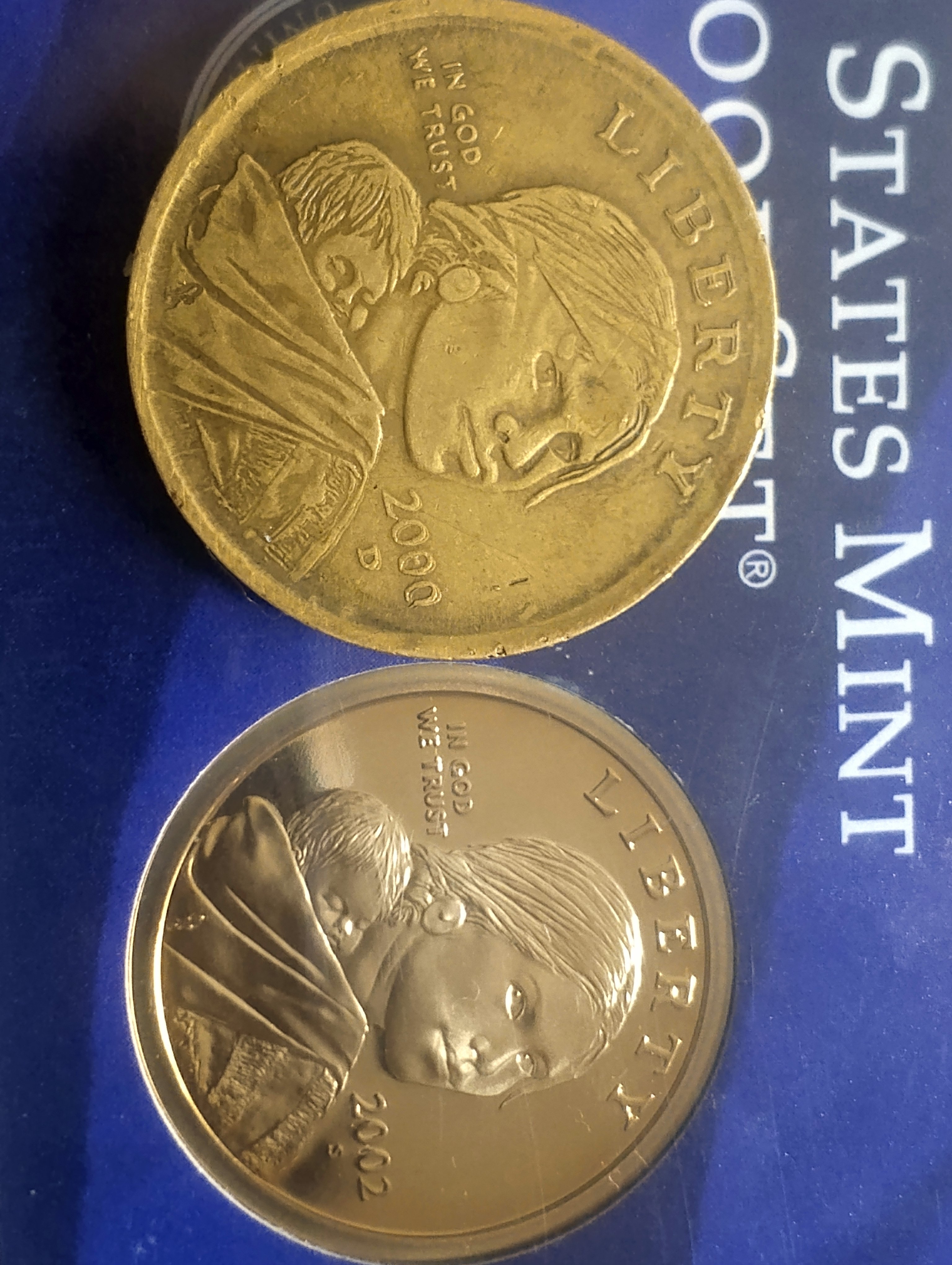
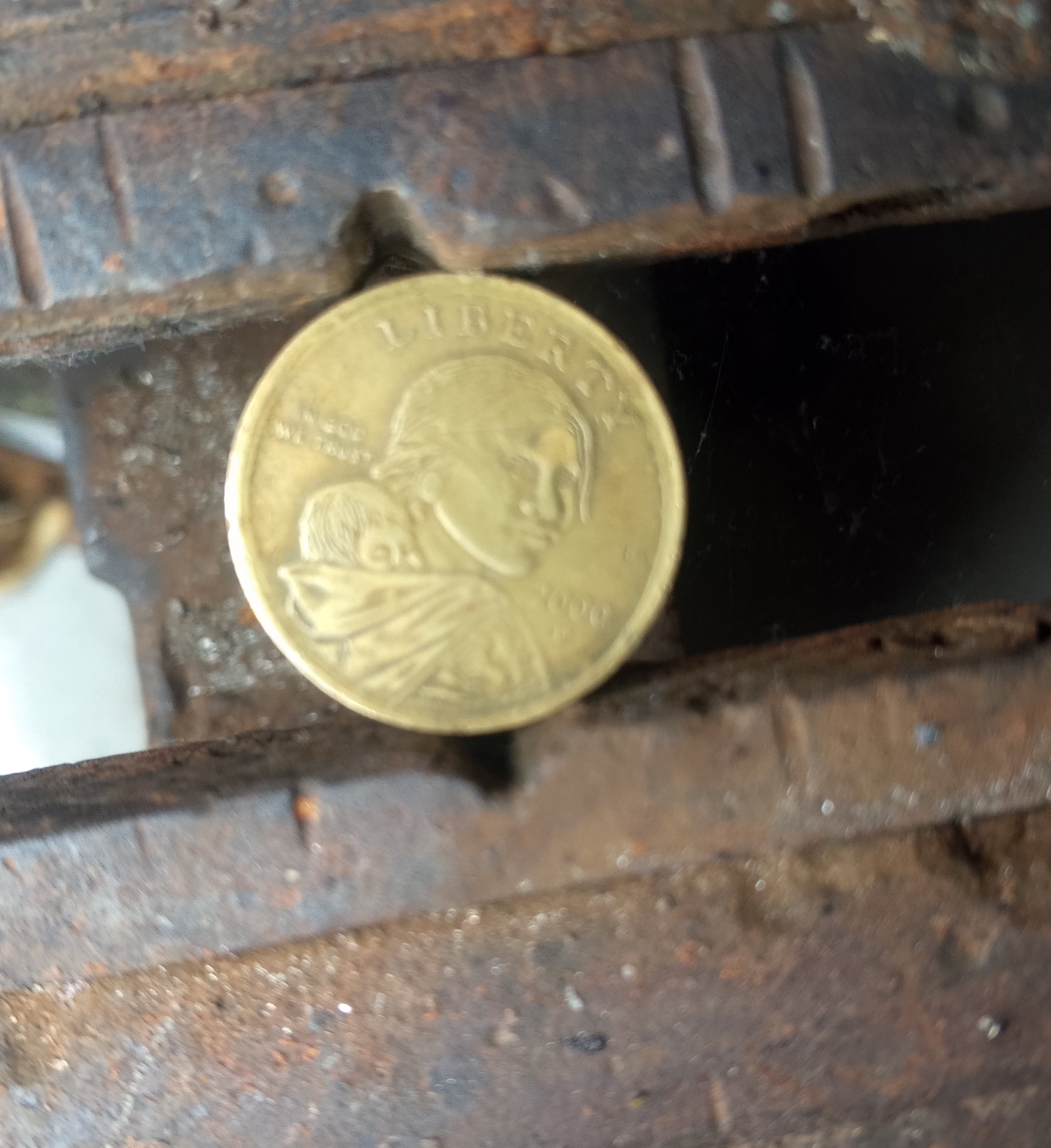
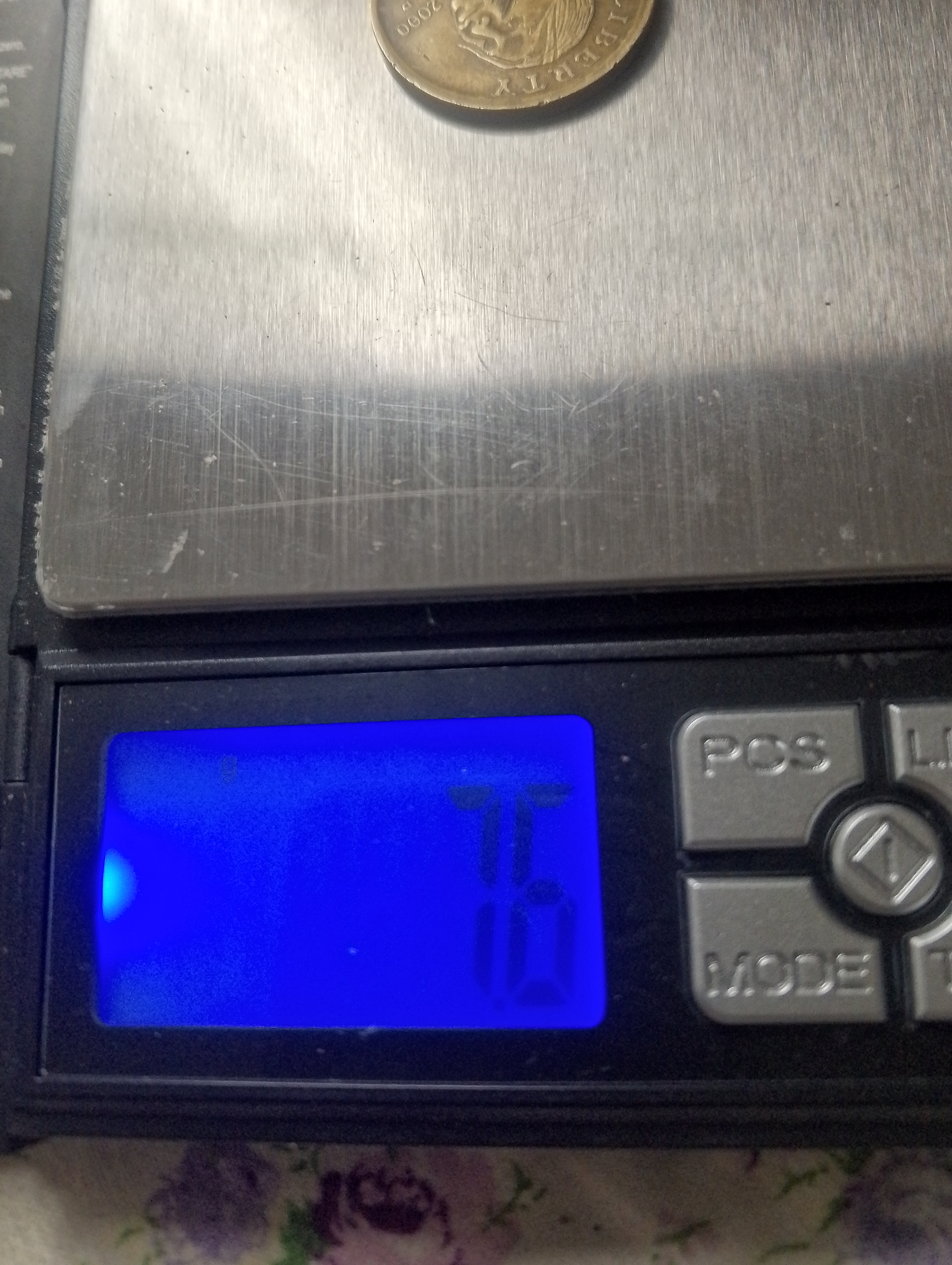
Dear moderators and members of the PCGS board, first of all, I would like to sincerely apologize for bringing a counterfeit, coarse, and visually unappealing piece to this space, which is legitimately dedicated to the discussion of beautiful coins, high-grade specimens, and fascinating official mint errors. I know this is not the type of aesthetic content we usually enjoy here. However, I request your permission and understanding to open this thread for strictly educational and numismatic security purposes. In Ecuador (a fully dollarized economy), counterfeit rings are perfecting clandestine striking techniques using solid base metals that are successfully bypassing traditional authentication filters. To give you the proper context of why I am conducting this destructive testing today, this study stems from a very concerning personal experience. A previous specimen from the same family of illegal operations—but struck with brand-new dies and fresh machinery—displayed an exceptional level of detail that closely mimicked a genuine U.S. Mint product. That coin actually passed through two local experts here in Ecuador who determined it to be genuine. When submitted to NGC, it caused a similar confusion due to its high-quality details, receiving an initial verdict of "Altered Surface." Ultimately, it was ANACS that uncovered the truth through deeper analysis, officially determining the coin to be a counterfeit. The piece I am presenting today is not of that same elite quality; it is a more common, worn specimen from those same illicit operations. However, it shares key similarities with the coin submitted to NGC, specifically its final weight and the distinct solid yellow edge. By performing a metrological and forensic analysis on it, my goal is to provide an educational case study for the international community. With rising tourism and global cash flows, it is only a matter of time before these dangerous regional pieces start showing up in change pockets across the United States. When analyzing this piece using precision calipers and a digital scale, the dimensions reveal critical discrepancies compared to the official U.S. Mint specifications for a Sacagawea dollar: Measured Diameter is 26.80 mm (Official: 26.49 mm), which represents an excess of 0.31 mm caused by the metal expanding under the high pressure of a clandestine hydraulic press. Measured Thickness is 1.50 mm (Official: 2.00 mm), meaning the coin is significantly thinner than a genuine piece. Actual Weight is 7.60 grams (Official: 8.10 grams). Applying the mass-over-volume formula for this cylinder yields a forensic density of 8.98 g/cm³. This density value acts as a digital fingerprint for pure copper (8.96 g/cm³) or heavy industrial brass. This proves that the counterfeiters did not use cheap, lightweight metals like zinc or antimony. Instead, they utilized solid, dense commercial brass or heavy scrap copper sheets, planed down to 1.50 mm, ensuring the final weight (7.60 g) would feel close enough to a real coin to deceive the average citizen's touch. The most obvious visual red flag is its solid yellow edge, completely lacking the classic copper core "sandwich" line found on legitimate U.S. clad coins. To scientifically verify the inner structure and study the manufacturing process, I conducted a destructive test by making a deep cut into the edge. Al performing the incision, I confirmed two fundamental facts that prove the true nature of this piece. First, it features a Monometallic Composition, as the exposed interior of the cut shows the exact same homogeneous yellow/silvery-gold color as the surface, with no hidden copper core or multi-layer electroplating. Second, it has a Struck Counterfeit Structure (Not Cast), since the inner metal is completely solid, lacking any porosity, air bubbles, or grainy textures typical of crude sand-casting. This confirms the piece is a struck counterfeit made with dies and a matrix. The counterfeiters struck a solid, cold planchet using hand-made steel dies under immense pressure, compacting the metal atoms and forcing the planchet to expand outward to its current 26.80 mm diameter. This forensic breakdown demonstrates that South American counterfeiting rings have mastered planchet weight and density using commercial brass sheets. While they failed to match the official thickness, the crisp strike from their hydraulic presses creates a dangerous illusion of authenticity. If a high-quality strike from a fresh die could initially confuse major grading eyes, these coins pose a real threat to foreign-circulated U.S. currency authentication. What are your thoughts on this case, and how can international grading standards better adapt to detect these high-pressure regional struck counterfeits? Thank you for your time and for allowing this educational study on the board.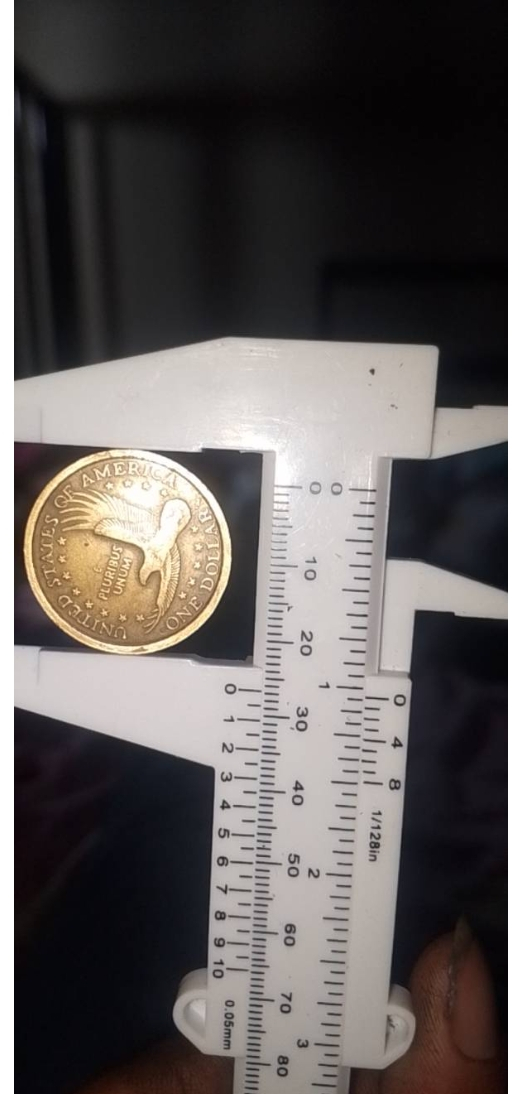
Comments
-
 3
3 -
 1
1 -
"grading standards" have nothing to do with authenticity.
Authentication can probably easily be determined by XRF analysis since the coin does not have the right composition. Even more to the point, it appears to be the wrong size and weight, so authentication is incredibly easy for anyone who took more than a cursory glance at the coin.
I'm not quite sure what you are looking for.
All comments reflect the opinion of the author, even when irrefutably accurate.
0 -
Paragraphs, pretty please.
Mark Feld* of Heritage Auctions*Unless otherwise noted, my posts here represent my personal opinions.
11 -
@MFeld said:
Paragraphs, pretty please.Give me a break!
Professional Numismatist, Retired. 55 year member ANA. Former ANA Senior Authenticator. Winner of four ANA Heath Literary Awards; three Wayte and Olga Raymond Literary Awards; Numismatist of the Year Award 2009, and ANA Lifetime Achievement Award 2020. Winner of the PNG's 2026 Robert Friedberg Award for "The Enigmatic Lincoln Cents of 1922," Available now from Whitman or Amazon.11 -
Calling @burfle23 for expertise on counterfeits.
0 -
I love some good natured grammar and syntax humor .
chopmarkedtradedollars.com
9 -
Well, here you go. When properly used, the term "good-natured" is hyphenated (according to Merriam Webster and Cambridge Dictionary).
Successful BST transactions: EagleEye, Christos, Proofmorgan, Coinlearner, Ahrensdad, Nolawyer, RG, coinlieutenant, Yorkshireman, lordmarcovan, Soldi, masscrew, JimTyler, Relaxn, jclovescoins, justindan, doubleeagle07
Now listen boy, I'm tryin' to teach you sumthin' . . . . that ain't an optical illusion, it only looks like an optical illusion.
My mind reader refuses to charge me. . . . . . .7 -
Cleaned up a bit:
In Ecuador (a fully dollarized economy), counterfeit rings are perfecting clandestine striking techniques using solid base metals that are successfully bypassing traditional authentication filters.
>
A previous specimen from the same family of illegal operations—but struck with brand-new dies and fresh machinery—displayed an exceptional level of detail that closely mimicked a genuine U.S. Mint product. That coin actually passed through two local experts here in Ecuador who determined it to be genuine. When submitted to NGC, it caused a similar confusion due to its high-quality details, receiving an initial verdict of "Altered Surface." Ultimately, it was ANACS that uncovered the truth through deeper analysis, officially determining the coin to be a counterfeit.
>
The piece I am presenting today is not of that same elite quality; it is a more common, worn specimen from those same illicit operations. However, it shares key similarities with the coin submitted to NGC, specifically its final weight and the distinct solid yellow edge. By performing a metrological and forensic analysis on it, my goal is to provide an educational case study for the international community. When analyzing this piece using precision calipers and a digital scale, the dimensions reveal critical discrepancies compared to the official U.S. Mint specifications for a Sacagawea dollar: Measured Diameter is 26.80 mm (Official: 26.49 mm), which represents an excess of 0.31 mm caused by the metal expanding under the high pressure of a clandestine hydraulic press. Measured Thickness is 1.50 mm (Official: 2.00 mm), meaning the coin is significantly thinner than a genuine piece. Actual Weight is 7.60 grams (Official: 8.10 grams). Applying the mass-over-volume formula for this cylinder yields a forensic density of 8.98 g/cm³. This density value acts as a digital fingerprint for pure copper (8.96 g/cm³) or heavy industrial brass.
>
This proves that the counterfeiters did not use cheap, lightweight metals like zinc or antimony. Instead, they utilized solid, dense commercial brass or heavy scrap copper sheets, planed down to 1.50 mm, ensuring the final weight (7.60 g) would feel close enough to a real coin to deceive the average citizen's touch. The most obvious visual red flag is its solid yellow edge, completely lacking the classic copper core "sandwich" line found on legitimate U.S. clad coins. To scientifically verify the inner structure and study the manufacturing process, I conducted a destructive test by making a deep cut into the edge.
>
Al performing the incision, I confirmed two fundamental facts that prove the true nature of this piece. First, it features a Monometallic Composition, as the exposed interior of the cut shows the exact same homogeneous yellow/silvery-gold color as the surface, with no hidden copper core or multi-layer electroplating. Second, it has a Struck Counterfeit Structure (Not Cast), since the inner metal is completely solid, lacking any porosity, air bubbles, or grainy textures typical of crude sand-casting. This confirms the piece is a struck counterfeit made with dies and a matrix. The counterfeiters struck a solid, cold planchet using hand-made steel dies under immense pressure, compacting the metal atoms and forcing the planchet to expand outward to its current 26.80 mm diameter.
>
This forensic breakdown demonstrates that South American counterfeiting rings have mastered planchet weight and density using commercial brass sheets. While they failed to match the official thickness, the crisp strike from their hydraulic presses creates a dangerous illusion of authenticity. If a high-quality strike from a fresh die could initially confuse major grading eyes, these coins pose a real threat to foreign-circulated U.S. currency authentication.
>
What are your thoughts on this case, and how can international grading standards (sic - grading companies) better adapt to detect these high-pressure regional struck counterfeits? Thank you for your time and for allowing this educational study on the board.
5 -
@cameonut2011 said:
@MFeldCleaned up a bit:
OP needs to ask his AI translator to be a bit more concise. Even with the paragraph breaks, it's still:
chopmarkedtradedollars.com
6 -
@lermish said:
@cameonut2011 said:
@MFeldCleaned up a bit:
OP needs to ask his AI translator to be a bit more concise. Even with the paragraph breaks, it's still:
In short, he is stating there is a counterfeiting ring in South America that appears to be creating die struck counterfeits using base metal planchets. So far, only the small dollar coins have been targeted. The pieces are purportedly good enough to fool NGC but ANACS figured it out. He performed his own physical analysis with density and measurements. He leaves us with a question in the last paragraph.
0 -
Measured Diameter is 26.80 mm (Official: 26.49 mm)
Measured Thickness is 1.50 mm (Official: 2.00 mm)
Actual Weight is 7.60 grams (Official: 8.10 g)
Density of 8.98 g/cm³.His Analysis :
This density is close to pure copper (8.96 g/cm³) or heavy industrial brass.This proves that the counterfeiters did not use cheap, lightweight metals like zinc or antimony. Instead, they utilized solid, dense commercial brass or heavy scrap copper sheets, planed down to 1.50 mm, ensuring the final weight (7.60 g) would feel close enough to a real coin to deceive the average citizen's touch. The most obvious visual red flag is its solid yellow edge, completely lacking the classic copper core "sandwich" line found on legitimate U.S. clad coins.
He cut the coin. His analysis:
First, it features a Monometallic Composition, as the exposed interior of the cut shows the exact same homogeneous yellow/silvery-gold color as the surface, with no hidden copper core or multi-layer electroplating.
Second, it has a Struck Counterfeit Structure (Not Cast), since the inner metal is completely solid, lacking any porosity, air bubbles, or grainy textures typical of crude sand-casting. This confirms the piece is a struck counterfeit made with dies.
1 -
@jmlanzaf said:
"grading standards" have nothing to do with authenticity.Authentication can probably easily be determined by XRF analysis since the coin does not have the right composition. Even more to the point, it appears to be the wrong size and weight, so authentication is incredibly easy for anyone who took more than a cursory glance at the coin.
I'm not quite sure what you are looking for.
You are completely right in theory: grading criteria and authentication are two different things. But in the real world, that is exactly what happened here. Before making the jump to NGC, two local coin specialists right here in Ecuador examined that high-quality piece and determined it was completely authentic. Then, when I complained to NGC via WhatsApp about their verdict, they explicitly told me that the piece had been examined by at least two of their expert graders, and both determined it was authentic, calling it an "Altered Surface." Honestly, I do not blame NGC for their mistake, as this coin managed to deceive several expert eyes. There must be something truly special and deceptive about that specific piece to have fooled so many people in a row, which is why the final verdict points toward a struck counterfeit. Regarding the XRF analysis you mention, I would absolutely love to have an XRF machine! But those devices are extremely expensive and hard to get here. That is why I used basic home tools—precision calipers and a scale—to do this forensic test to show how these counterfeits can sometimes look and feel good enough to trick even the eyes of professional graders before anyone thinks about using expensive laboratory equipment.
2 -
@MFeld said:
Paragraphs, pretty please.@lermish said:
I love some good natured grammar and syntax humor .
@CaptHenway said:
@MFeld said:
Paragraphs, pretty please.Give me a break!
@lermish said:
@cameonut2011 said:
@MFeldCleaned up a bit:
OP needs to ask his AI translator to be a bit more concise. Even with the paragraph breaks, it's still:
I would like to apologize if there was a confusing mess in the way the content of this thread was laid out. Everything is clear and concise up until about the middle of the post, but after that, it got a bit tangled up. Please understand that my native language is Spanish, so I have to use an AI to translate my thoughts and findings into English to share them with all of you. To be honest, I wanted to edit the entire text afterward, but I decided to just leave it as it is since the core of what I wanted to show and prove can still be understood. But hey, at least I hope reading through this big messy uproar brought a good laugh to some of you! Furthermore, I will be adding two more counterfeit specimens to this thread very soon. They are the exact same denomination and coin type ($1 Sacagawea), but they feature completely different counterfeiting processes and finishes. I hope you will find them interesting!
0 -
What am I missing? The piece shown is obviously fake. Do you have an image of one more convincing?
5 -
@OnTheHunt said:
What am I missing? The piece shown is obviously fake. Do you have an image of one more convincing?You are completely right, this specific specimen is obviously a counterfeit due to its current wear and crude details. That is precisely why it served as a perfect educational tool for the destructive cutting test. However, you are missing the bigger picture: this coin comes from the same family of illegal workshops where, when they use brand-new dies, they achieve a high-pressure strike so supreme that it has successfully fooled veteran numismatists. Here in Ecuador, we call that level of extreme deception "la mamá de la mentira" (the mother of all lies). Please bear with me, as I will soon be uploading the other two specimens with different processes and finishes.
3 -
@ricarf2386 said:
Dear moderators and members of the PCGS board, first of all, I would like to sincerely apologize for bringing a counterfeit, coarse, and visually unappealing piece to this space, which is legitimately dedicated to the discussion of beautiful coins, high-grade specimens, and fascinating official mint errors. I know this is not the type of aesthetic content we usually enjoy here. However, I request your permission and understanding to open this thread for strictly educational and numismatic security purposes.Okay, I know that you are a serious member. I do not ask that you apologzize for posting any coin or token that fits this category, counterfeits are valid in discussion here.
You’re not asking Isabela for ships. Ugly coins are more welcome than adjectives and adverbs.You describe a local conspiracy that some of us find curious—I want to buy examples—however, the Chinese silver-dollar-counterfeit-thing is worthy of alarm, drama, and conspiracy theory, and as bigger as China is than Ecuador.
You do not have to ask permission to post any more. Keep tweaking the ai translator, relax.1 -
@ricarf2386 said:
@OnTheHunt said:
What am I missing? The piece shown is obviously fake. Do you have an image of one more convincing?You are completely right, this specific specimen is obviously a counterfeit due to its current wear and crude details. That is precisely why it served as a perfect educational tool for the destructive cutting test. However, you are missing the bigger picture: this coin comes from the same family of illegal workshops where, when they use brand-new dies, they achieve a high-pressure strike so supreme that it has successfully fooled veteran numismatists. Here in Ecuador, we call that level of extreme deception "la mamá de la mentira" (the mother of all lies). Please bear with me, as I will soon be uploading the other two specimens with different processes and finishes.
Sadly, during the past decade, there has been a huge increase in the number of counterfeits on the market. Their quality ranges anywhere from laughably poor to alarmingly good.
Among other places, they appear on eBay, on various other websites, at flea markets, at pawn shops and to a lesser degree, at some coin shops.So, despite your analysis, I doubt that this thread is going to surprise forum members or cause them to be anymore concerned than they already are.
Mark Feld* of Heritage Auctions*Unless otherwise noted, my posts here represent my personal opinions.
0 -
@Creg said:
@ricarf2386 said:
Dear moderators and members of the PCGS board, first of all, I would like to sincerely apologize for bringing a counterfeit, coarse, and visually unappealing piece to this space, which is legitimately dedicated to the discussion of beautiful coins, high-grade specimens, and fascinating official mint errors. I know this is not the type of aesthetic content we usually enjoy here. However, I request your permission and understanding to open this thread for strictly educational and numismatic security purposes.Okay, I know that you are a serious member. I do not ask that you apologzize for posting any coin or token that fits this category, counterfeits are valid in discussion here.
You’re not asking Isabela for ships. Ugly coins are more welcome than adjectives and adverbs.You describe a local conspiracy that some of us find curious—I want to buy examples—however, the Chinese silver-dollar-counterfeit-thing is worthy of alarm, drama, and conspiracy theory, and as bigger as China is than Ecuador.
You do not have to ask permission to post any more. Keep tweaking the ai translator, relax.Thank you so much for your words and for your support. Oh, really? Are you interested in buying these counterfeits? I would be delighted to help you get some. I actually have a contact in the United States. If you are truly interested, please send me a private message (PM) so we can figure out how I can help you acquire them. Here in Ecuador, you can find them in your daily pocket change; it is just a matter of searching, knowing what to look for, and recognizing them.
Regarding why I asked for permission before posting this: as you know, I have been posting quite frequently and I know I am an active member. But you must understand that I am not posting on a simple Facebook group. From what I understand, this is a very, very important forum—I would say it is the absolute top premium forum in the numismatic world. That is why I take these precautions, out of respect for this community. Thank you very much for your feedback, I really appreciate it!
2 -
I love all the Ecuador counterfeit dollar coins, no matter how good or bad they are. It's great to see the various attempts by the counterfeiters. Some are better than others. It's an unusual opportunity to examine a large-scale operation (or several) in action.
0 -
Why wouldn’t you offer them to us through eBay? Or change exchanges.
1 -
@Creg said:
@ricarf2386 said:
Dear moderators and members of the PCGS board, first of all, I would like to sincerely apologize for bringing a counterfeit, coarse, and visually unappealing piece to this space, which is legitimately dedicated to the discussion of beautiful coins, high-grade specimens, and fascinating official mint errors. I know this is not the type of aesthetic content we usually enjoy here. However, I request your permission and understanding to open this thread for strictly educational and numismatic security purposes.Okay, I know that you are a serious member. I do not ask that you apologzize for posting any coin or token that fits this category, counterfeits are valid in discussion here.
You’re not asking Isabela for ships. Ugly coins are more welcome than adjectives and adverbs.You describe a local conspiracy that some of us find curious—I want to buy examples—however, the Chinese silver-dollar-counterfeit-thing is worthy of alarm, drama, and conspiracy theory, and as bigger as China is than Ecuador.
You do not have to ask permission to post any more. Keep tweaking the ai translator, relax.Thank you so much for your words and for your support. Oh, really? Are you interested in buying these counterfeits? I would be delighted to help you get some. I actually have a contact in the United States. If you are truly interested, please send me a private message (PM) so we can figure out how I can help you acquire them. Here in Ecuador, you can find them in your daily pocket change; it is just a matter of searching, knowing what to look for, and recognizing them.
Regarding why I asked for permission before posting this: as you know, I have been posting quite frequently and I know I am an active member. But you must understand that I am not posting on a simple Facebook group. From what I understand, this is a very, very important forum—I would say it is the absolute top premium forum in the numismatic world. That is why I take these precautions, out of respect for this community. Thank you very much for your feedback, I really appreciate it!
@MFeld said:
@ricarf2386 said:
@OnTheHunt said:
What am I missing? The piece shown is obviously fake. Do you have an image of one more convincing?You are completely right, this specific specimen is obviously a counterfeit due to its current wear and crude details. That is precisely why it served as a perfect educational tool for the destructive cutting test. However, you are missing the bigger picture: this coin comes from the same family of illegal workshops where, when they use brand-new dies, they achieve a high-pressure strike so supreme that it has successfully fooled veteran numismatists. Here in Ecuador, we call that level of extreme deception "la mamá de la mentira" (the mother of all lies). Please bear with me, as I will soon be uploading the other two specimens with different processes and finishes.
Sadly, during the past decade, there has been a huge increase in the number of counterfeits on the market. Their quality ranges anywhere from laughably poor to alarmingly good.
Among other places, they appear on eBay, on various other websites, at flea markets, at pawn shops and to a lesser degree, at some coin shops.So, despite your analysis, I doubt that this thread is going to surprise forum members or cause them to be anymore concerned than they already are.
I completely understand your point, Mark. With your years of experience in the high-end market, an immense number of high-quality counterfeits must have passed before your eyes. From what I have researched, in your market, people usually create fakes to simulate rare mint errors that command huge premiums among collectors. However, here in Ecuador, the dynamic is completely different: these counterfeits are made strictly to be injected into the daily cash flow of regular citizens as genuine money. To give you an idea of how wild the situation is here, people even openly promote and sell counterfeit coins and bills on TikTok. These criminals call themselves "high-quality counterfeiters" and have the audacity to display their phone numbers to make sales. Personally, I completely stay away from that because it goes against the law, but it shows how active and brazen these operations are. That is why I want to share the physical differences of these pieces with the forum.
2 -
@Creg said:
Why wouldn’t you offer them to us through eBay? Or change exchanges.That sounds like a fantastic idea! I am definitely very interested in doing coin swaps (trades). I love the idea of trading these regional counterfeits for genuine or interesting pieces from your side. Let's move this to a Private Message (PM) so we can discuss the details, what kind of coins we can exchange, and how to coordinate the shipping safely. Looking forward to trading with you!
2 -
From what I have researched, in your market, people usually create fakes to simulate rare mint errors that command huge premiums among collectors**.
There are counterfeits of all sorts of coins. And that includes many of values that are so low, some people wonder why the counterfeiters even bothered producing them.
Mark Feld* of Heritage Auctions*Unless otherwise noted, my posts here represent my personal opinions.
0 -
@MFeld said:
From what I have researched, in your market, people usually create fakes to simulate rare mint errors that command huge premiums among collectors**.
There are counterfeits of all sorts of coins. And that includes many of values that are so low, some people wonder why the counterfeiters even bothered producing them.
You are absolutely right, Mark. History repeats itself. Your comment reminds me exactly of the famous Henning Nickels from the 1950s. Back then, people also wondered why anyone would trouble themselves to counterfeit a 5-cent coin.
Just to be clear (and so you know the AI isn't doing the thinking for me here!), this is a piece of history that I discovered myself through my own research. I truly love to investigate, read, and educate myself on numismatics. That is how I found out about the Henning case from years ago.
The logic back then was exactly the same as what we see here in Ecuador with the $1 coins: it was cheap to produce, and nobody double-checked small change in their daily life. It is fascinating to see how the same criminal economic logic from decades ago in the US is alive and well in South America today.
0 -
Gather your inventory, figure your shipping costs and wish list, post in the BST.
0 -
@Creg said:
Gather your inventory, figure your shipping costs and wish list, post in the BST.Thank you, Creg! I currently have a few pieces, but I want to gather a larger, more diverse inventory first to make it truly worthwhile for everyone. Once I have enough variety, I will check the shipping logistics from Ecuador. Just so you know, my wishlist for trades includes low-cost graded coins (certified pieces) or official mint sets. My goal for the near future is to implement a brand-new concept here in my country through live TikTok auctions—emulating the grandeur of the major auction houses in the US, wearing a suit and vest, with Frank Sinatra playing in the background. Apologies for my big dreams, haha!
1 -
@ricarf2386 said:
A previous specimen from the same family of illegal operations—but struck with brand-new dies and fresh machinery—displayed an exceptional level of detail that closely mimicked a genuine U.S. Mint product. That coin actually passed through two local experts here in Ecuador who determined it to be genuine. When submitted to NGC, it caused a similar confusion due to its high-quality details, receiving an initial verdict of "Altered Surface." Ultimately, it was ANACS that uncovered the truth through deeper analysis, officially determining the coin to be a counterfeit..
What are your thoughts on this case, and how can international grading standards better adapt to detect these high-pressure regional struck counterfeits?
There was nothing special about your counterfeit. We could tell it was fake just by looking at it, and no doubt the graders at ANACS were able to do the same. NGC simply made a sloppy mistake, either at the grading stage or the labeling stage. The mistake is not acceptable either way, but it exemplifies a wider and ongoing TPG problem. Simply put, TPG mistakes are too frequent and numerous in general. You were the unfortunate recipient on this occasion, but it can happen to anyone. Most, if not all Forum members who submit coins have a story to tell about sloppy TPG mistakes, and those that submit regularly usually have several.
The best defense against TPG mistakes is to have a good eye and to be knowledgeable about the coins you are submitting, which is why you should not be submitting any coins, as previously advised.
4 -
^
This is all true. I still kind of want one though.0 -
@IkesT said:
@ricarf2386 said:
A previous specimen from the same family of illegal operations—but struck with brand-new dies and fresh machinery—displayed an exceptional level of detail that closely mimicked a genuine U.S. Mint product. That coin actually passed through two local experts here in Ecuador who determined it to be genuine. When submitted to NGC, it caused a similar confusion due to its high-quality details, receiving an initial verdict of "Altered Surface." Ultimately, it was ANACS that uncovered the truth through deeper analysis, officially determining the coin to be a counterfeit..
What are your thoughts on this case, and how can international grading standards better adapt to detect these high-pressure regional struck counterfeits?
There was nothing special about your counterfeit. We could tell it was fake just by looking at it, and no doubt the graders at ANACS were able to do the same. NGC simply made a sloppy mistake, either at the grading stage or the labeling stage. The mistake is not acceptable either way, but it exemplifies a wider and ongoing TPG problem. Simply put, TPG mistakes are too frequent and numerous in general. You were the unfortunate recipient on this occasion, but it can happen to anyone. Most, if not all Forum members who submit coins have a story to tell about sloppy TPG mistakes, and those that submit regularly usually have several.
The best defense against TPG mistakes is to have a good eye and to be knowledgeable about the coins you are submitting, which is why you should not be submitting any coins, as previously advised.
Dear friend, first of all, I would like to sincerely apologize if there was any imbalance or poorly chosen words in our previous discussions. I truly want to take my hat off to you for such a respectful, detailed, and educated response this time; I really appreciate your perspective on the frequent mistakes made by TPG firms. However, I have to respectfully disagree with the statement that the coin had nothing special about it. If it truly were that simple or obvious, it wouldn't have successfully deceived eight expert eyes consecutively (the two specialists here in Ecuador, the two NGC graders, and my own eyes). That ability to bypass consecutive human filters in the real world is exactly what makes its deceptive quality special. To be honest, during these past few days, I listened to a piece of advice from someone, and it made me reflect on how I approach these discussions. The advice goes like this: if you hang around three alcoholics, you will become the fourth alcoholic. If you hang around three failures, you will become the fourth failure. But if you surround yourself with three successful people who live by great perspectives and achieve big things in life, you will become the fourth person in that group, and you will strive to be great in life as well. That is exactly the ultimate goal and desire of this Ecuadorian who is part of this forum: to learn and grow together with all of you.
0 -
Thank you for the warning, I completely understand and I absolutely do not want to be outside the law. That is exactly why I prefer to avoid platforms like eBay for this. My point is that if these pieces ever reach your hands, they would be cataloged strictly as educational specimens with zero monetary value, meant only for numismatic study and research. Thank you for the clarification!
0 -
@ricarf2386 said:
@IkesT said:
@ricarf2386 said:
A previous specimen from the same family of illegal operations—but struck with brand-new dies and fresh machinery—displayed an exceptional level of detail that closely mimicked a genuine U.S. Mint product. That coin actually passed through two local experts here in Ecuador who determined it to be genuine. When submitted to NGC, it caused a similar confusion due to its high-quality details, receiving an initial verdict of "Altered Surface." Ultimately, it was ANACS that uncovered the truth through deeper analysis, officially determining the coin to be a counterfeit..
What are your thoughts on this case, and how can international grading standards better adapt to detect these high-pressure regional struck counterfeits?
There was nothing special about your counterfeit. We could tell it was fake just by looking at it, and no doubt the graders at ANACS were able to do the same. NGC simply made a sloppy mistake, either at the grading stage or the labeling stage. The mistake is not acceptable either way, but it exemplifies a wider and ongoing TPG problem. Simply put, TPG mistakes are too frequent and numerous in general. You were the unfortunate recipient on this occasion, but it can happen to anyone. Most, if not all Forum members who submit coins have a story to tell about sloppy TPG mistakes, and those that submit regularly usually have several.
The best defense against TPG mistakes is to have a good eye and to be knowledgeable about the coins you are submitting, which is why you should not be submitting any coins, as previously advised.
Dear friend, first of all, I would like to sincerely apologize if there was any imbalance or poorly chosen words in our previous discussions. I truly want to take my hat off to you for such a respectful, detailed, and educated response this time; I really appreciate your perspective on the frequent mistakes made by TPG firms. However, I have to respectfully disagree with the statement that the coin had nothing special about it. If it truly were that simple or obvious, it wouldn't have successfully deceived eight expert eyes consecutively (the two specialists here in Ecuador, the two NGC graders, and my own eyes). That ability to bypass consecutive human filters in the real world is exactly what makes its deceptive quality special.
Thank you for the apology.
Respectfully, neither you nor anyone in your circle of friends is a numismatic expert. You said so yourself. See below.
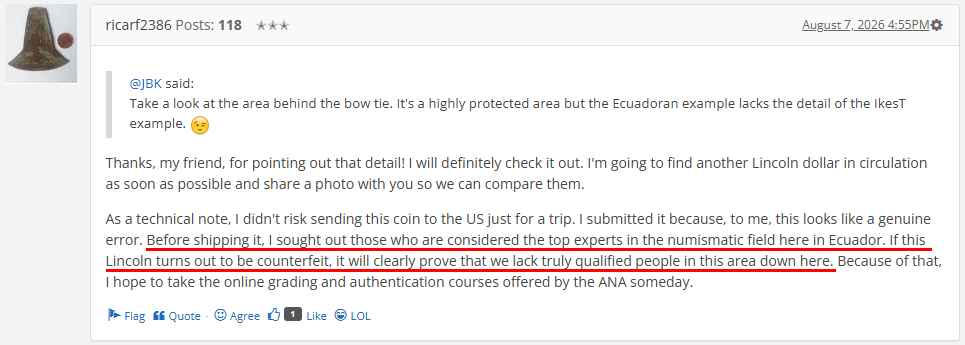
To be honest, during these past few days, I listened to a piece of advice from someone, and it made me reflect on how I approach these discussions. The advice goes like this: if you hang around three alcoholics, you will become the fourth alcoholic. If you hang around three failures, you will become the fourth failure. But if you surround yourself with three successful people who live by great perspectives and achieve big things in life, you will become the fourth person in that group, and you will strive to be great in life as well. That is exactly the ultimate goal and desire of this Ecuadorian who is part of this forum: to learn and grow together with all of you.
Respectfully, your approach here on the Forum is to dismiss any information that does not agree with your preexisting bias. That approach will not allow you to learn.
0 -
Dear friend, I accept those were my exact words. However, please take into account that the mistake made down here wasn't by my "friends"—they are not my friends, but rather the most qualified coin specialists in the country who handle currency daily. Also, let's not forget that right there in your own backyard, the second largest grading service in your country made the exact same mistake.
But well, it seems that you and I always have these little situations where we just spin in circles and never reach a conclusion. From my side, all I can say is okay, I accept everything you say. To be honest, I don't even know who I am debating or talking with. For all I know, you could be the owner of a major numismatic company or you might have been a senior grader at a top certification firm; it feels like a tiny cat trying to fight a lion because I genuinely don't know who you are. On my end, you all already know exactly who I am: just an Ecuadorian who loves to investigate.
0 -
@ricarf2386 said:
Dear friend, I accept those were my exact words. However, please take into account that the mistake made down here wasn't by my "friends"—they are not my friends, but rather the most qualified coin specialists in the country who handle currency daily. Also, let's not forget that right there in your own backyard, the second largest grading service in your country made the exact same mistake.Whoever they are, it was you who said they were not qualified.
NGC made an unacceptable and sloppy mistake, as I said. You are assuming they were fooled by the counterfeit, but it could very easily have been a data entry error when the label was created. This is what we call a "mechanical error".
As I also said, we on the Forum could tell that your piece was counterfeit right away just by looking at it.
But well, it seems that you and I always have these little situations where we just spin in circles and never reach a conclusion.
Respectfully, that is because your approach here on the Forum is to dismiss any information that does not agree with your preexisting bias.
0 -
@IkesT said:
@ricarf2386 said:
Dear friend, I accept those were my exact words. However, please take into account that the mistake made down here wasn't by my "friends"—they are not my friends, but rather the most qualified coin specialists in the country who handle currency daily. Also, let's not forget that right there in your own backyard, the second largest grading service in your country made the exact same mistake.Whoever they are, it was you who said they were not qualified.
NGC made an unacceptable and sloppy mistake, as I said. You are assuming they were fooled by the counterfeit, but it could very easily have been a data entry error when the label was created. This is what we call a "mechanical error".
As I also said, we on the Forum could tell that your piece was counterfeit right away just by looking at it.
But well, it seems that you and I always have these little situations where we just spin in circles and never reach a conclusion.
Respectfully, that is because your approach here on the Forum is to dismiss any information that does not agree with your preexisting bias.
To clarify your point about a "mechanical error" or a data-entry mistake on the label: I do not like to speak lightly without evidence. I took the time to contact NGC support directly via WhatsApp—many of you who use their services know that people like Bri, Gabe, and others are the ones who regularly reply to customer inquiries there. After my formal complaints, one of their representatives explicitly confirmed to me that the piece had to be physically examined and approved by at least two expert graders who certified it as genuine before the label was ever made. There was no typing mistake. This is the main issue here: when someone pays for a professional grading service, they are paying exactly for their expertise to differentiate between an authentic piece and a struck counterfeit. It simply doesn't seem fair or valid that a paid service fails at this, only to later treat it as a minor mechanical error.
To be completely honest, I have a mountain of evidence, emails, and screenshots regarding my case with NGC. However, I prefer to keep those private because I do not want to look like a problematic or dramatic person in the eyes of this community. But personally, I will never send another coin to NGC again. Based on my experience, this is how I rank the grading services now: First PCGS, second ANACS, third ICG, and fourth NGC.
0 -
@ricarf2386 said:
To clarify your point about a "mechanical error" or a data-entry mistake on the label: I do not like to speak lightly without evidence. I took the time to contact NGC support directly via WhatsApp—many of you who use their services know that people like Bri, Gabe, and others are the ones who regularly reply to customer inquiries there. After my formal complaints, one of their representatives explicitly confirmed to me that the piece had to be physically examined and approved by at least two expert graders who certified it as genuine before the label was ever made. There was no typing mistake. This is the main issue here: when someone pays for a professional grading service, they are paying exactly for their expertise to differentiate between an authentic piece and a struck counterfeit. It simply doesn't seem fair or valid that a paid service fails at this, only to later treat it as a minor mechanical error.OK, thank you for the clarification. Mechanical errors are also common, and I do not think anyone on the Forum views them as minor; they do just as much harm as grader errors.
Even though it sounds like the graders did make the mistake in this case, you should not view that as evidence that your counterfeit was particularly well made or deceptive; it wasn't.
1 -
@IkesT said:
@ricarf2386 said:
Dear friend, I accept those were my exact words. However, please take into account that the mistake made down here wasn't by my "friends"—they are not my friends, but rather the most qualified coin specialists in the country who handle currency daily. Also, let's not forget that right there in your own backyard, the second largest grading service in your country made the exact same mistake.Whoever they are, it was you who said they were not qualified.
NGC made an unacceptable and sloppy mistake, as I said. You are assuming they were fooled by the counterfeit, but it could very easily have been a data entry error when the label was created. This is what we call a "mechanical error".
As I also said, we on the Forum could tell that your piece was counterfeit right away just by looking at it.
But well, it seems that you and I always have these little situations where we just spin in circles and never reach a conclusion.
Respectfully, that is because your approach here on the Forum is to dismiss any information that does not agree with your preexisting bias.
To clarify your point about a "mechanical error" or a data-entry mistake on the label: I do not like to speak lightly without evidence. I took the time to contact NGC support directly via WhatsApp—many of you who use their services know that people like Bri, Gabe, and others are the ones who regularly reply to customer inquiries there. After my formal complaints, one of their representatives explicitly confirmed to me that the piece had to be physically examined and approved by at least two expert graders who certified it as genuine before the label was ever made. There was no typing mistake. This is the main issue here: when someone pays for a professional grading service, they are paying exactly for their expertise to differentiate between an authentic piece and a struck counterfeit. It simply doesn't seem fair or valid that a paid service fails at this, only to later treat it as a minor mechanical error.
To be completely honest, I have a mountain of evidence, emails, and screenshots regarding my case with NGC. However, I prefer to keep those private because I do not want to look like a problematic or dramatic person in the eyes of this community. But personally, I will never send another coin to NGC again. Based on my experience, this is how I rank the grading services now: First PCGS, second ANACS, third ICG, and fourth NGC.
@IkesT said:
@ricarf2386 said:
To clarify your point about a "mechanical error" or a data-entry mistake on the label: I do not like to speak lightly without evidence. I took the time to contact NGC support directly via WhatsApp—many of you who use their services know that people like Bri, Gabe, and others are the ones who regularly reply to customer inquiries there. After my formal complaints, one of their representatives explicitly confirmed to me that the piece had to be physically examined and approved by at least two expert graders who certified it as genuine before the label was ever made. There was no typing mistake. This is the main issue here: when someone pays for a professional grading service, they are paying exactly for their expertise to differentiate between an authentic piece and a struck counterfeit. It simply doesn't seem fair or valid that a paid service fails at this, only to later treat it as a minor mechanical error.OK, thank you for the clarification. Mechanical errors are also common, and I do not think anyone on the Forum views them as minor; they do just as much harm as grader errors.
Even though it sounds like the graders did make the mistake in this case, you should not view that as evidence that your counterfeit was particularly well made or deceptive; it wasn't.
Dear friend, we keep spinning in circles, so I accept your interpretation. However, please understand this critical point: you have only seen that coin through photos, while everyone else physically held it in their hands. That is the big difference. I have realized here in the forum that a poorly taken photo can make people assume a million different things.
For now, this is the last time I will speak about that coin until I have it back in my hands, still in its NGC "dead holder" along with the ANACS counterfeit certification. When it arrives, I will post the actual photos, weights, and all the physical data. This coin has certainly given everyone a lot to talk about! Haha.
0 -
Quick note before anyone attacks me: my autocorrect and translator got totally confused and didn't understand the Spanish expression for "funda de muerto" (dead sleeve/body bag)!
0 -
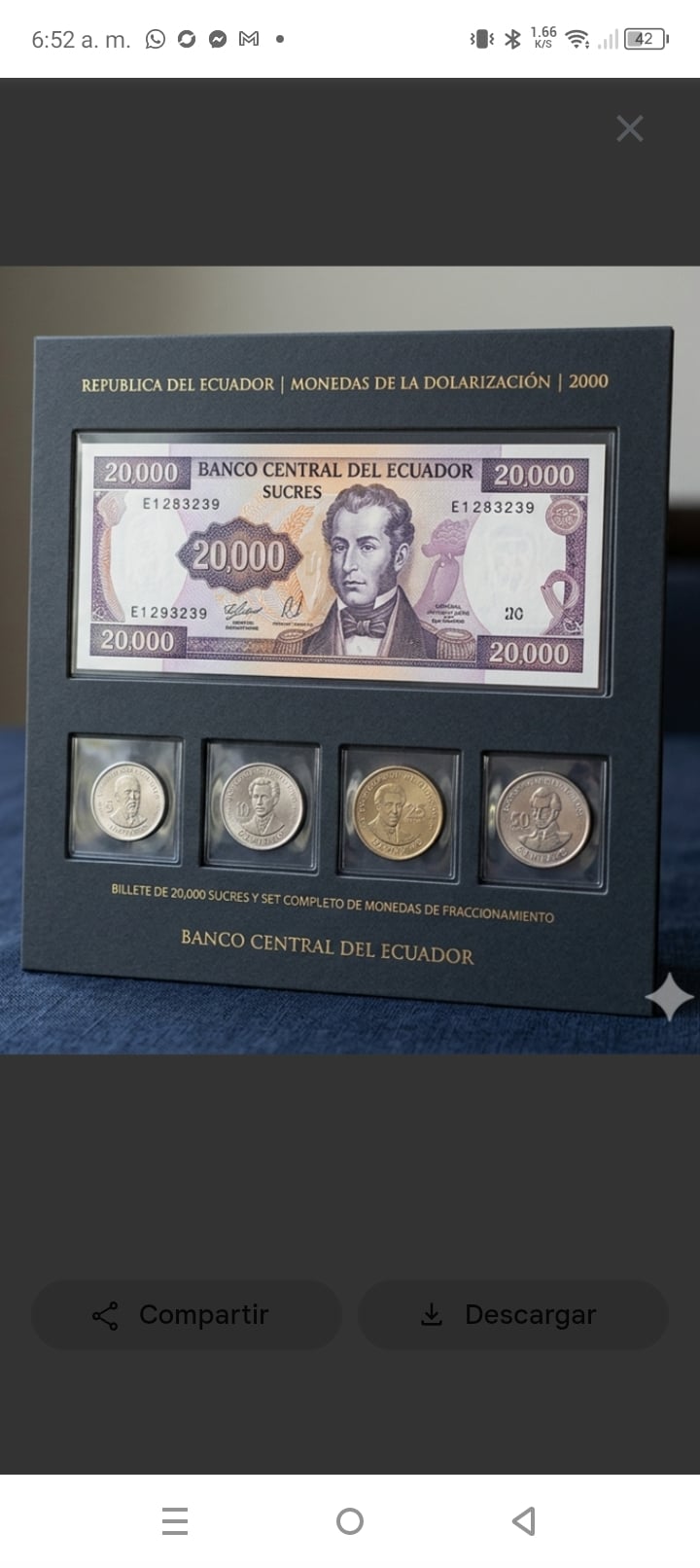
Hey Creg, my friend, this is exactly the vision and style I have in mind! This is a prototype design I am currently working on. It is an idea in progress featuring our historic 20,000 Sucres bill alongside the complete 2000 Ecuadorian dollarization coin set. I wanted to share this with you to see if this kind of premium historical display is something that would actually interest collectors in your market. I am aiming for this level of elegance and presentation for my future projects. Hope you like the concept!
 0
0 -
@ricarf2386 said:
I wanted to share this with you to see if this kind of premium historical display is something that would actually interest collectors in your market.What market are you referring to?
Collectors in the United States have essentially no interest in modern coinage, and essentially no interest in foreign coinage. You are not likely to be happy with the results if you try to market modern foreign coinage to collectors in the United States.
I suspect that @Creg was interested in getting one of the counterfeits, simply for the novelty of seeing an example in hand.
1 -
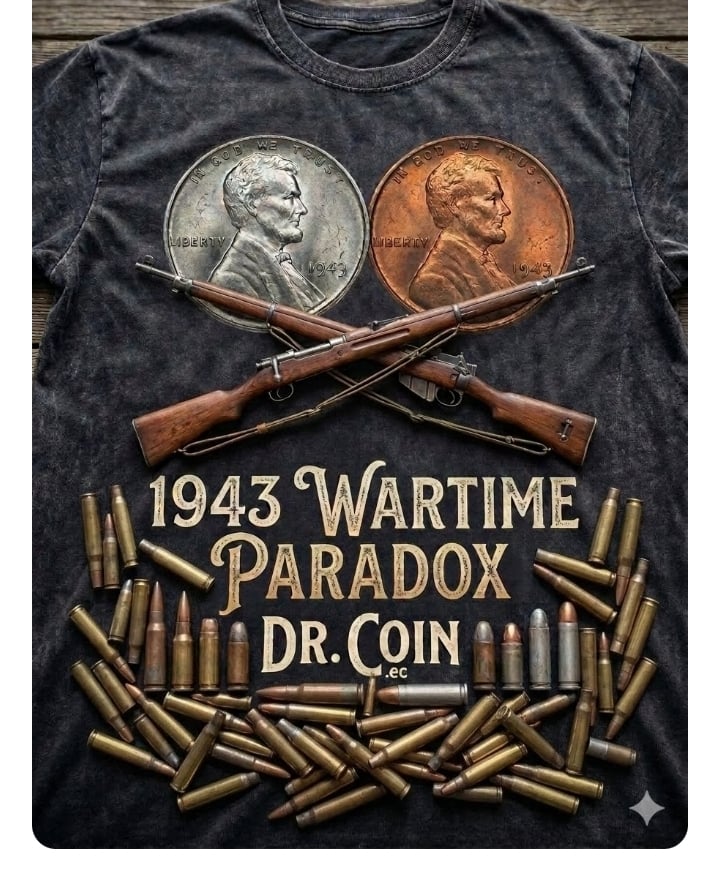
Since I have a little bit of your attention right now, and with all the respect that your history deserves, I would like to show you a t-shirt design I created. It is inspired by an impressive and monumental mint error: the 1943 Wartime Paradox with the Lincoln cent. I wanted to capture the contrast between the official steel cent and the ultra-rare copper error from that same year, framed with WWII elements. I hope you find this concept interesting and that it doesn't cause any offense, as it was made out of pure admiration for US numismatic history!
 0
0 -
@IkesT said:
@ricarf2386 said:
To clarify your point about a "mechanical error" or a data-entry mistake on the label: I do not like to speak lightly without evidence. I took the time to contact NGC support directly via WhatsApp—many of you who use their services know that people like Bri, Gabe, and others are the ones who regularly reply to customer inquiries there. After my formal complaints, one of their representatives explicitly confirmed to me that the piece had to be physically examined and approved by at least two expert graders who certified it as genuine before the label was ever made. There was no typing mistake. This is the main issue here: when someone pays for a professional grading service, they are paying exactly for their expertise to differentiate between an authentic piece and a struck counterfeit. It simply doesn't seem fair or valid that a paid service fails at this, only to later treat it as a minor mechanical error.OK, thank you for the clarification. Mechanical errors are also common, and I do not think anyone on the Forum views them as minor; they do just as much harm as grader errors.
Even though it sounds like the graders did make the mistake in this case, you should not view that as evidence that your counterfeit was particularly well made or deceptive; it wasn't.
We haven't seen it. The picture he posted isn't the coin he sent in.
All comments reflect the opinion of the author, even when irrefutably accurate.
0 -
@jmlanzaf said:
@IkesT said:
@ricarf2386 said:
To clarify your point about a "mechanical error" or a data-entry mistake on the label: I do not like to speak lightly without evidence. I took the time to contact NGC support directly via WhatsApp—many of you who use their services know that people like Bri, Gabe, and others are the ones who regularly reply to customer inquiries there. After my formal complaints, one of their representatives explicitly confirmed to me that the piece had to be physically examined and approved by at least two expert graders who certified it as genuine before the label was ever made. There was no typing mistake. This is the main issue here: when someone pays for a professional grading service, they are paying exactly for their expertise to differentiate between an authentic piece and a struck counterfeit. It simply doesn't seem fair or valid that a paid service fails at this, only to later treat it as a minor mechanical error.OK, thank you for the clarification. Mechanical errors are also common, and I do not think anyone on the Forum views them as minor; they do just as much harm as grader errors.
Even though it sounds like the graders did make the mistake in this case, you should not view that as evidence that your counterfeit was particularly well made or deceptive; it wasn't.
We haven't seen it. The picture he posted isn't the coin he sent in.
We saw it in his previous thread.
0 -
@jonathanb said:
@ricarf2386 said:
I wanted to share this with you to see if this kind of premium historical display is something that would actually interest collectors in your market.What market are you referring to?
Collectors in the United States have essentially no interest in modern coinage, and essentially no interest in foreign coinage. You are not likely to be happy with the results if you try to market modern foreign coinage to collectors in the United States.
I suspect that @Creg was interested in getting one of the counterfeits, simply for the novelty of seeing an example in hand.
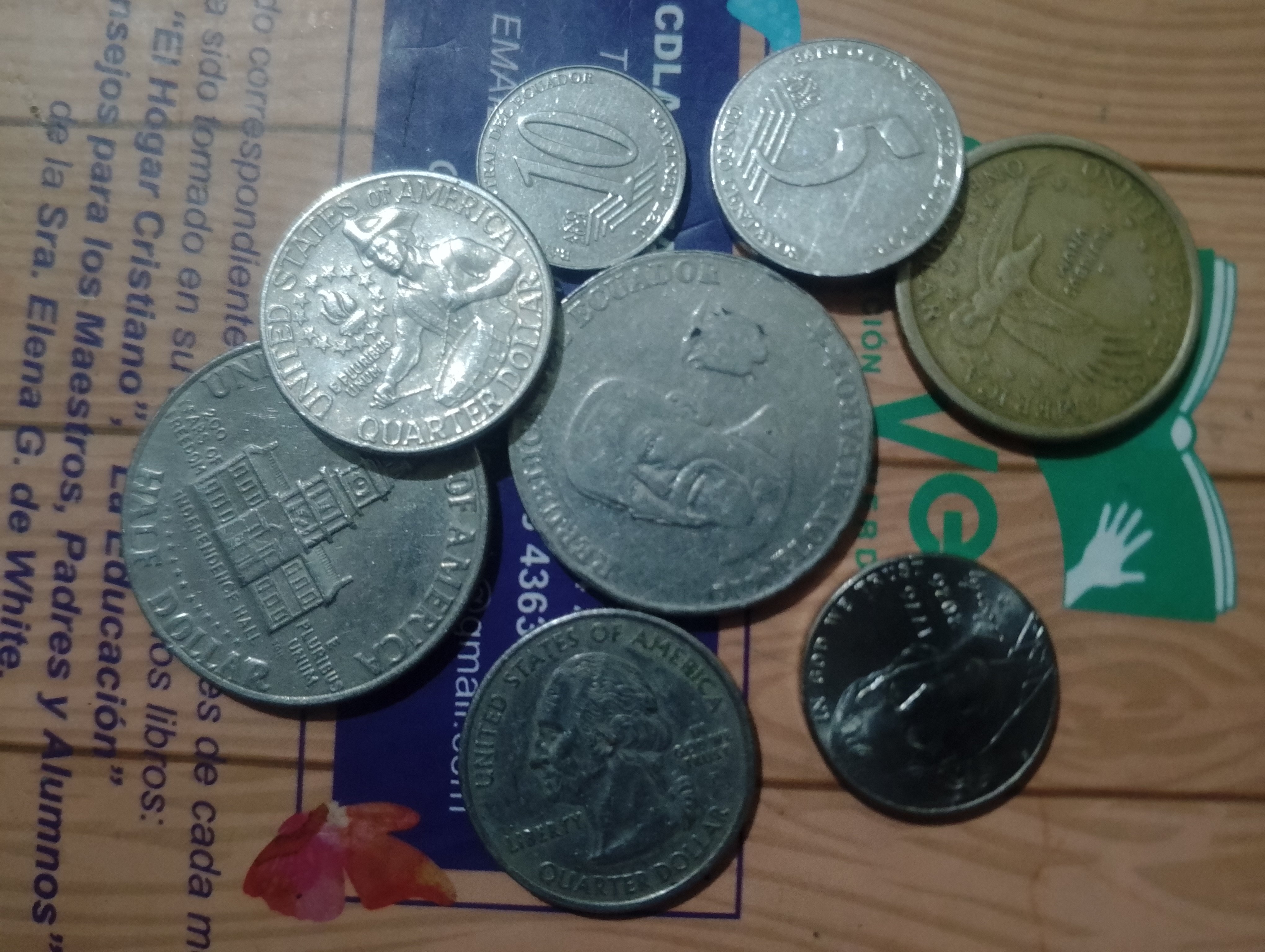
Thank you for your perspective, jonathanb. But you have to understand that these are not just ordinary foreign coins sitting in an album. Here in Ecuador, these coins walk like siblings, completely intertwined in people's pockets alongside U.S. dimes, nickels, quarters, and half dollars. They circulate together daily, and they hold the exact same value. It is a unique economic connection directly tied to the U.S. dollar. My display is a piece of that live history, and I am just testing the waters to see who appreciates it. After all, as we say around here: if everyone had the same taste, colors wouldn't exist!
0 -
@jonathanb said:
@ricarf2386 said:
I wanted to share this with you to see if this kind of premium historical display is something that would actually interest collectors in your market.What market are you referring to?
Collectors in the United States have essentially no interest in modern coinage, and essentially no interest in foreign coinage. You are not likely to be happy with the results if you try to market modern foreign coinage to collectors in the United States.
I suspect that @Creg was interested in getting one of the counterfeits, simply for the novelty of seeing an example in hand.
Thank you for your perspective, jonathanb. But you have to understand that these are not just ordinary foreign coins sitting in an album. Here in Ecuador, these coins walk like siblings, completely intertwined in people's pockets alongside U.S. dimes, nickels, quarters, and half dollars. They circulate together daily, and they hold the exact same value. It is a unique economic connection directly tied to the U.S. dollar. My display is a piece of that live history, and I am just testing the waters to see who appreciates it. After all, as we say around here: if everyone had the same taste, colors wouldn't exist!
@ricarf2386 said:
@jonathanb said:
@ricarf2386 said:
I wanted to share this with you to see if this kind of premium historical display is something that would actually interest collectors in your market.What market are you referring to?
Collectors in the United States have essentially no interest in modern coinage, and essentially no interest in foreign coinage. You are not likely to be happy with the results if you try to market modern foreign coinage to collectors in the United States.
I suspect that @Creg was interested in getting one of the counterfeits, simply for the novelty of seeing an example in hand.
Thank you for your perspective, jonathanb. But you have to understand that these are not just ordinary foreign coins sitting in an album. Here in Ecuador, these coins walk like siblings, completely intertwined in people's pockets alongside U.S. dimes, nickels, quarters, and half dollars. They circulate together daily, and they hold the exact same value. It is a unique economic connection directly tied to the U.S. dollar. My display is a piece of that live history, and I am just testing the waters to see who appreciates it. After all, as we say around here: if everyone had the same taste, colors wouldn't exist!
 1
1


Leave a Comment
Categories
- All Categories
- 520.1K Coins and Currency - PCGS
- 328.5K U.S. Coin Forum
- 14.8K PCGS Set Registry Forum
- 5.2K Q & A Forum
- 41.4K World & Ancient Coins Forum
- 3K U.S. & World Currency Forum
- 96.4K Buy, Sell, & Trade - U.S. Coins
- 7.3K Buy, Sell & Trade - World & Ancient Coins
- 1.5K Buy, Sell & Trade - Currency
- 61 Random
- 246.2K Trading Cards, Autographs and Memorabilia - PSA
- 90.3K Trading Cards & Memorabilia Forum
- 1.7K Autographs Forum
- 16.4K PSA Set Registry Forum
- 22K Sports Talk
- 115K Buy, Sell & Trade - Cards & Memorabilia
- 663 Buy, Sell & Trade - Autographs
- 2.2K Stamps
- 1.5K Stamps Forum
- 670 Buy, Sell & Trade - Stamps
- 83 Coin Shows
- 83 General Coin Show Information and Discussion
- 11.9K Misc
- 11.9K Testing Forum