@OwenSeymour said:
It’s also interesting that you managed to eat around all the parts of the CoinFacts commentary that would debunk your
coin like (this is direct copy and paste):
“ The 1964 Special Strike Kennedy Half dollars display very unique characteristics unseen on any other coins of the era. First of all, the strike is very sharp as it displays very clear details on both the obverse and the reverse. The coins also contain a smooth satin like appearance with the rims being very square and sharp. There are die polishing lines throughout the coins surfaces. These coins also tend to lack contact marks unlike business strike coins, indicating that they were struck and handled under extreme care.”
Seems to me like you’re just trying to use some outdated non-authoritative 20 year blip tucked away at the bottom of a CoinFacts page to strong-arm a very not-SP-looking coin into an SP holder
That certainly is nebulous. The coins in Coin Facts look to be well within the spectrum of what business strike production could produce from an early strike. They don’t appear that special to me.
I’ve handled a nauseating amount of UNC 1964 coins, many hundreds of thousands.
I’ve also handled SP-designated 1964 halves, and other denoms, and they’re unlike any business strike coin I’ve ever encountered in a roll or bag, by a long ways. They have a very striking and unique appearance in hand. The market, TPGs, and practically all experts have considered these SPs for decades. I think grading companies (PCGS in this case) understand and designate them correctly.
There’s a semantics argument to be had about what to call the unique looking 1964 coins, I like SP.
Materially how are they different from well struck early strikes from a die? I also collect proof like coins including from the 19th and early 20th century. I could make the same arguments about many of them including the unique or near unique PL buffalo nickel I made several years ago as well as a PL half cent. Had I labeled them as “specimen” strikes no one would have taken me seriously. Just as PL coinage, while special, is within the normal range of quality from normal production business strikes so are the 1964 SMS coins IMHO. I could be convinced otherwise, but the Coin Facts images aren’t helping.
Edited: About the only undocumented specimen coin I could justify the designation for was Bruce’s 1794 specimen Flowing Hair Dollar.
Have you seen any of the 1964 SMS halves in hand?
In fairness no. That’s why I remain agnostic and not a total denier. Having undoubtedly seen many, what are your thoughts on them and the OP’s coin?
For what it’s worth, I think you’re doing an excellent job of remaining agnostic.👍
Most of the ones I’ve seen were during the time I was grading at NGC approximately 30 years ago.
Based on those and a few I’ve seen since, I thought they were likely specially made.
That said, I’ve admittedly been influenced by what I was told by long-time dealer, Steve Blum, and which I’ve posted about previously. Here’s a link to my thread on the topic from February of 2024:
To my knowledge, no documentation of their production or discovery has surfaced and I don’t think it ever will. Some numismatists even doubt that the coins were specially made. Highly regarded numismatic researcher and author, Roger W. Burdette, holds such a view.
Last year, out of the blue, I received a call from a coin dealer I’ve known for roughly 40 years. He’d seen a thread about the 1964 SMS coins on this forum and decided to share his personal experiences with me. He also gave me permission to disclose the details of our conversation. As best I can remember, the following is what he told me, none of which I have reason to doubt:
The dealer was friends with coin dealer Lester Merkin. One day (in either 1991 or 1992) while he was at Lester Merkin’s office, Mr. Merkin pulled some coins out of his desk drawer and handed them to him to look at.
The coins weren’t in special holders or accompanied by any paperwork. But you can probably guess what date they were. There were approximately 4 or 5 sets, cents through half dollars. The dealer (who is highly expert) was immediately convinced that he was looking at some very distinctive, special coins. Mr. Merkin told him that Eva Adams, who had been U.S. Mint Director from 1961-1969, had given him the sets and asked him to show them around to some people and ask what they thought of them. It was obvious that Lester Merkin was very proud of them.
Sometime not too long afterwards, Lester Merkin passed away. The dealer was subsequently contacted by Mr. Merkin’s widow, who mentioned the coins to him. He was sure they were valuable, but he chose not to try to buy them from her. As far as the dealer knows, Mrs. Merkin consigned the coins to Stack’s and they were auctioned in the early 90’s.
Speaking of the early 90’s, I happened to be a grader at NGC from 1991-1998. And while I was there, (edited from “a handful”) several unusual 1964 sets were submitted to us for grading by a well known dealer who’d purchased them out of Stack’s auctions. I think that we at NGC, were the first graders to see the coins. Most, though not all of them looked quite distinctive/specially made. And as a result, if memory serves me correctly, not all of the coins were given special designations. I remember thinking it was a tough call to do that, seeing as how we were examining complete sets. But ultimately, we felt that each coin needed to stand on its own merits.
It’s clear that the dealer who contacted me didn’t see all of the 1964 SMS sets that have surfaced, as he only remembered having seen approximately 4 to 5 of them. And, while it would be fun to speculate as to how the other sets entered the marketplace, I choose not to do so.
Admittedly, If I were to see a post like this on a coin forum, I’d be at least somewhat skeptical, regardless of who wrote it. So I certainly won’t take it personally if this post is questioned, doubted or debated. But I hope it has at least called into question, some of the inaccurate “information” about the discovery and source of 1964 SMS coins that has persisted for so many years.
Edited to add:
After making the referenced dealer aware of this thread, he gave me permission to disclose his name - Steve Blum. He also messaged me with the following: “…Lester’s widow gave me the contents of his desk and included the SMS sets. I let her know the coins were very rare and I could sell them for her. She immediately decided to give them to Stacks. I wanted to do the right thing since Lester was a good friend.”
Mark Feld* of Heritage Auctions*Unless otherwise noted, my posts here represent my personal opinions.
Mark Feld* of Heritage Auctions*Unless otherwise noted, my posts here represent my personal opinions.
Thank you for sharing. It would be fascinating to see them all together. I wish I had been collecting at that level back in the early 1990s. It would have been a treat to see the coins side by side in the Stack’s auction. I doubt now that the coins have been disbursed that there will ever be a reunion. Maybe some collectors will pool together and make a show exhibit someday.
Based on the anecdote from Mark, it also would seemingly explain the OP’s coin. If the coins were struck from the same dies but not qualifying for a SMS designation, it would seem the OP’s coin should receive some sort of variety designation perhaps like the Zerbe Morgans.
@cameonut2011 said:
Thank you for sharing. It would be fascinating to see them all together. I wish I had been collecting at that level back in the early 1990s. It would have been a treat to see the coins side by side in the Stack’s auction. I doubt now that the coins have been disbursed that there will ever be a reunion. Maybe some collectors will pool together and make a show exhibit someday.
You’re most welcome.
If I recall correctly, there was only one set in any given Stack’s sale offering the coins.
A reunion sounds close to impossible, but even a partial one would be a treat.
Mark Feld* of Heritage Auctions*Unless otherwise noted, my posts here represent my personal opinions.
@cameonut2011 said:
Thank you for sharing. It would be fascinating to see them all together. I wish I had been collecting at that level back in the early 1990s. It would have been a treat to see the coins side by side in the Stack’s auction. I doubt now that the coins have been disbursed that there will ever be a reunion. Maybe some collectors will pool together and make a show exhibit someday.
You’re most welcome.
If I recall correctly, there was only one set in any given Stack’s sale offering the coins.
A reunion sounds close to impossible, but even a partial one would be a treat.
@cameonut2011 said:
Thank you for sharing. It would be fascinating to see them all together. I wish I had been collecting at that level back in the early 1990s. It would have been a treat to see the coins side by side in the Stack’s auction. I doubt now that the coins have been disbursed that there will ever be a reunion. Maybe some collectors will pool together and make a show exhibit someday.
You’re most welcome.
If I recall correctly, there was only one set in any given Stack’s sale offering the coins.
A reunion sounds close to impossible, but even a partial one would be a treat.
Mark, there was a lot of 3 complete sets.
Alex, thanks for setting the record straight. It seems I did not recall correctly.😉
Mark Feld* of Heritage Auctions*Unless otherwise noted, my posts here represent my personal opinions.
@cameonut2011 said:
Based on the anecdote from Mark, it also would seemingly explain the OP’s coin. If the coins were struck from the same dies but not qualifying for a SMS designation, it would seem the OP’s coin should receive some sort of variety designation perhaps like the Zerbe Morgans.
I would present an alternate reality that I believe fits the coins much better.
Each year, the first few strikes of the dies used for Mint Sets were saved and sent to the Smithsonian as standard practice. In 1964, a few extra sets were saved for the Mint Director's use (this was not uncommon). Those sets are what you see described as the "SMS" coins. Indeed, the die pairs in the Smithsonian are the "SMS" die pairs. What is interesting, however, is how the Mint does not call them anything special in the letter to the Smithsonian for the year. They say they are "Uncirculated". The official accession record for the Smithsonian states that they got "20 coins of regular coinage from the Philadelphia Mint and Denver Mint". No mention of specimen, specially prepared, nothing. There is no distinction at all for these coins, and that is straight from the Mint itself.
Every other coin struck buy those dies is still fundamentally the same, just that the dies get more worn and the coins see circulation. Thus they lose their "strike sharpness, surface texture, etc" that the graders insist they have due to their specialness (which is just a fresh strike on new dies). A coin from fresh dies will inherently look much better than one from worn dies, this is a known fact. Add in that special preservation and you can see why you might get confused. But as @cameonut2011 said, these coins are well within tolerance of normal business strike production.
Additionally, I will post a document from Eva Adams herself regarding trial strikes for the Kennedy half. If the "SMS" story is true, we accept that Eva Adams specifically disobeyed regulations on the destruction of trial pieces (really laughed in the face of them, and her own words). But, if you save some mint sets, there's no harm no foul with that. That's standard practice.
.
.
As much as I appreciate Mark's version - it is simply that - a story. There is no physical evidence to support it. Rather, most of the statements that whirl around that story are beginning to crumble - we now know that the dies were not specially prepared, we know that they were not used just for those coins, and we know that these die pairings are found in Mint Sets of the year. We also know that there were sets sold before Merkin and Adams died, which makes one wonder where they came from. Mark and I have discussed this topic for years, so I think he understands when I say that that it's not a personal attack - just that I believe it is factually incorrect and is leading people to believe an incorrect story and thus pay more for coins that are not what the auction companies and TPGs say they are.
The TPGs need to revise what they say about these coins and how they label them. If they wish to call them special, they need to remove "SMS". They need to remove mentions of die pairs or die markers. They need to remove mentions of special preparation.
What they can call them (all of the coins from these die pairs) is "Smithsonian Die Pair". That will have to be good enough, since in 30 years there has been no objective definitive way to attribute these coins. They can grade some of them higher due to the better characteristics, but you can't claim that they were struck differently. That path is a very dangerous indeed, and the day of reckoning is coming.
@cameonut2011 said:
Based on the anecdote from Mark, it also would seemingly explain the OP’s coin. If the coins were struck from the same dies but not qualifying for a SMS designation, it would seem the OP’s coin should receive some sort of variety designation perhaps like the Zerbe Morgans.
I would present an alternate reality that I believe fits the coins much better.
Each year, the first few strikes of the dies used for Mint Sets were saved and sent to the Smithsonian as standard practice. In 1964, a few extra sets were saved for the Mint Director's use (this was not uncommon). Those sets are what you see described as the "SMS" coins. Indeed, the die pairs in the Smithsonian are the "SMS" die pairs. What is interesting, however, is how the Mint does not call them anything special in the letter to the Smithsonian for the year. They say they are "Uncirculated". The official accession record for the Smithsonian states that they got "20 coins of regular coinage from the Philadelphia Mint and Denver Mint". No mention of specimen, specially prepared, nothing. There is no distinction at all for these coins, and that is straight from the Mint itself.
Every other coin struck buy those dies is still fundamentally the same, just that the dies get more worn and the coins see circulation. Thus they lose their "strike sharpness, surface texture, etc" that the graders insist they have due to their specialness (which is just a fresh strike on new dies). A coin from fresh dies will inherently look much better than one from worn dies, this is a known fact. Add in that special preservation and you can see why you might get confused. But as @cameonut2011 said, these coins are well within tolerance of normal business strike production.
Additionally, I will post a document from Eva Adams herself regarding trial strikes for the Kennedy half. If the "SMS" story is true, we accept that Eva Adams specifically disobeyed regulations on the destruction of trial pieces (really laughed in the face of them, and her own words). But, if you save some mint sets, there's no harm no foul with that. That's standard practice.
.
.
As much as I appreciate Mark's version - it is simply that - a story. There is no physical evidence to support it. Rather, most of the statements that whirl around that story are beginning to crumble - we now know that the dies were not specially prepared, we know that they were not used just for those coins, and we know that these die pairings are found in Mint Sets of the year. We also know that there were sets sold before Merkin and Adams died, which makes one wonder where they came from. Mark and I have discussed this topic for years, so I think he understands when I say that that it's not a personal attack - just that I believe it is factually incorrect and is leading people to believe an incorrect story and thus pay more for coins that are not what the auction companies and TPGs say they are.
The TPGs need to revise what they say about these coins and how they label them. If they wish to call them special, they need to remove "SMS". They need to remove mentions of die pairs or die markers. They need to remove mentions of special preparation.
What they can call them (all of the coins from these die pairs) is "Smithsonian Die Pair". That will have to be good enough, since in 30 years there has been no objective definitive way to attribute these coins. They can grade some of them higher due to the better characteristics, but you can't claim that they were struck differently. That path is a very dangerous indeed, and the day of reckoning is coming.
Alex, you continue to make excellent points and I certainly don’t consider them to be personal attacks.
I have great respect for your work and the way you go about discussing this subject.
I sure wish I could go back in time. If what Steve Blum told me was accurate, I have a very hard time believing, that with his immense experience, Lester Merkin would be so proud of the coins if they were merely very early strikes. And there are plenty of highly knowledgeable present-day numismatists who believe that the SMS examples were specially made.
On the other hand, the document that you linked (written by Eva Adams) adds to the strength of your version. I have to admit, despite my personal beliefs, if I were a judge and had to make a ruling based on the preponderance of evidence, I think I would rule in your favor.
Mark Feld* of Heritage Auctions*Unless otherwise noted, my posts here represent my personal opinions.
As far as what Merkin thought of the coins, I don't know. However, I'm pretty convinced that fresh dies can make a coin look "different". The change between the OP coin when it had the marks and when I edited the image to remove the marks is not to be dismissed. That coin looks like a dipped version of the "SMS".
Knowing what you know now, if we could go back in time to that 1990s grading room, would you still grade those coins the same? Or would you do anything differently? Said another way, do you think PCGS now has an obligation to change how they describe these coins and/or holder them, even to a slight degree?
As far as what Merkin thought of the coins, I don't know. However, I'm pretty convinced that fresh dies can make a coin look "different". The change between the OP coin when it had the marks and when I edited the image to remove the marks is not to be dismissed. That coin looks like a dipped version of the "SMS".
Knowing what you know now, if we could go back in time to that 1990s grading room, would you still grade those coins the same? Or would you do anything differently? Said another way, do you think PCGS now has an obligation to change how they describe these coins and/or holder them, even to a slight degree?
Thank you, Alex.
I’m not convinced that expert numismatists wouldn’t be able to distinguish coins struck from fresh dies from specially made examples.
In general, I feel that in order for a coin to receive a special designation, there should be official documentation. So no matter what I thought or think about the 1964 SMS coins, I wouldn’t assign them special designations. I’d say the same about esoteric Proof coins such as branch mint pieces. However, I’d struggle in deciding how to handle coins such as pre-1858 pieces that looked like obvious Proofs, but for which there was no official documentation.
Mark Feld* of Heritage Auctions*Unless otherwise noted, my posts here represent my personal opinions.
Unfortunately Sura (the Mint superintendent) died in 1972 long before the coins came to light. There were at least two rounds of documented pieces dubbed as trial or “pattern pieces.” The first were struck December 13th and the second run struck in later December (sometime before December 27th). On December 15th the initial trial pieces were presented to Mrs. Kennedy who made suggestions about strengthening the hair. So the SMS pieces are almost certainly not from the first batch of trial strikes/patterns. There was a second batch with the new design that were presented to Secretary of Treasury Dillion and his wife. I can’t find anything ever speaking of the disposition of the pieces.
This sounds like a research project for RWB. I suppose someone could attempt a FOIA request to seek documentation concerning the alleged destruction of the second batch of trial strikes.
PCGS has now removed the Ron Guth statement. This is a step in the right direction.
PCGS retains incorrect mentions of die polish and the incorrect information that the first set was discovered in 1993 (it was May 2nd, 1990). They also mention/allude that the coins connect to Lester Merkin (only some connect to Merkin, shown by how many of the sets sold before the ones in his estate sale). There are also several factual contradictions in the minor denomination's descriptions to the other denominations.
Will PCGS be revising those incorrect statements as well?
@FlyingAl said:
PCGS has now removed the Ron Guth statement. This is a step in the right direction.
PCGS retains incorrect mentions of die polish and the incorrect information that the first set was discovered in 1993 (it was May 2nd, 1990). They also mention/allude that the coins connect to Lester Merkin (only some connect to Merkin, shown by how many of the sets sold before the ones in his estate sale). There are also several factual contradictions in the minor denomination's descriptions to the other denominations.
Will PCGS be revising those incorrect statements as well?
And what are they doing for your coin? It seems you relied on their statements and are left holding the bag in time, grading fees, insurance, and postage.
@FlyingAl said:
PCGS has now removed the Ron Guth statement. This is a step in the right direction.
PCGS retains incorrect mentions of die polish and the incorrect information that the first set was discovered in 1993 (it was May 2nd, 1990). They also mention/allude that the coins connect to Lester Merkin (only some connect to Merkin, shown by how many of the sets sold before the ones in his estate sale). There are also several factual contradictions in the minor denomination's descriptions to the other denominations.
Will PCGS be revising those incorrect statements as well?
And what are they doing for your coin? It seems you relied on their statements and are left holding the bag in time, grading fees, insurance, and postage.
Comments
For what it’s worth, I think you’re doing an excellent job of remaining agnostic.👍
Most of the ones I’ve seen were during the time I was grading at NGC approximately 30 years ago.
Based on those and a few I’ve seen since, I thought they were likely specially made.
That said, I’ve admittedly been influenced by what I was told by long-time dealer, Steve Blum, and which I’ve posted about previously. Here’s a link to my thread on the topic from February of 2024:
https://forums.collectors.com/discussion/1100576/1964-sms-coins-what-i-ve-heard-what-i-ve-seen-what-i-know-and-what-i-don-t-know-about-them/p1
Post
To my knowledge, no documentation of their production or discovery has surfaced and I don’t think it ever will. Some numismatists even doubt that the coins were specially made. Highly regarded numismatic researcher and author, Roger W. Burdette, holds such a view.
Last year, out of the blue, I received a call from a coin dealer I’ve known for roughly 40 years. He’d seen a thread about the 1964 SMS coins on this forum and decided to share his personal experiences with me. He also gave me permission to disclose the details of our conversation. As best I can remember, the following is what he told me, none of which I have reason to doubt:
The dealer was friends with coin dealer Lester Merkin. One day (in either 1991 or 1992) while he was at Lester Merkin’s office, Mr. Merkin pulled some coins out of his desk drawer and handed them to him to look at.
The coins weren’t in special holders or accompanied by any paperwork. But you can probably guess what date they were. There were approximately 4 or 5 sets, cents through half dollars. The dealer (who is highly expert) was immediately convinced that he was looking at some very distinctive, special coins. Mr. Merkin told him that Eva Adams, who had been U.S. Mint Director from 1961-1969, had given him the sets and asked him to show them around to some people and ask what they thought of them. It was obvious that Lester Merkin was very proud of them.
Sometime not too long afterwards, Lester Merkin passed away. The dealer was subsequently contacted by Mr. Merkin’s widow, who mentioned the coins to him. He was sure they were valuable, but he chose not to try to buy them from her. As far as the dealer knows, Mrs. Merkin consigned the coins to Stack’s and they were auctioned in the early 90’s.
Speaking of the early 90’s, I happened to be a grader at NGC from 1991-1998. And while I was there, (edited from “a handful”) several unusual 1964 sets were submitted to us for grading by a well known dealer who’d purchased them out of Stack’s auctions. I think that we at NGC, were the first graders to see the coins. Most, though not all of them looked quite distinctive/specially made. And as a result, if memory serves me correctly, not all of the coins were given special designations. I remember thinking it was a tough call to do that, seeing as how we were examining complete sets. But ultimately, we felt that each coin needed to stand on its own merits.
It’s clear that the dealer who contacted me didn’t see all of the 1964 SMS sets that have surfaced, as he only remembered having seen approximately 4 to 5 of them. And, while it would be fun to speculate as to how the other sets entered the marketplace, I choose not to do so.
Admittedly, If I were to see a post like this on a coin forum, I’d be at least somewhat skeptical, regardless of who wrote it. So I certainly won’t take it personally if this post is questioned, doubted or debated. But I hope it has at least called into question, some of the inaccurate “information” about the discovery and source of 1964 SMS coins that has persisted for so many years.
Edited to add:
After making the referenced dealer aware of this thread, he gave me permission to disclose his name - Steve Blum. He also messaged me with the following: “…Lester’s widow gave me the contents of his desk and included the SMS sets. I let her know the coins were very rare and I could sell them for her. She immediately decided to give them to Stacks. I wanted to do the right thing since Lester was a good friend.”
Mark Feld* of Heritage Auctions*Unless otherwise noted, my posts here represent my personal opinions.
Mark Feld* of Heritage Auctions*Unless otherwise noted, my posts here represent my personal opinions.
Thank you for sharing. It would be fascinating to see them all together. I wish I had been collecting at that level back in the early 1990s. It would have been a treat to see the coins side by side in the Stack’s auction. I doubt now that the coins have been disbursed that there will ever be a reunion. Maybe some collectors will pool together and make a show exhibit someday.
Based on the anecdote from Mark, it also would seemingly explain the OP’s coin. If the coins were struck from the same dies but not qualifying for a SMS designation, it would seem the OP’s coin should receive some sort of variety designation perhaps like the Zerbe Morgans.
You’re most welcome.
If I recall correctly, there was only one set in any given Stack’s sale offering the coins.
A reunion sounds close to impossible, but even a partial one would be a treat.
Mark Feld* of Heritage Auctions*Unless otherwise noted, my posts here represent my personal opinions.
Mark, there was a lot of 3 complete sets.
Coin Photography
Alex, thanks for setting the record straight. It seems I did not recall correctly.😉
Mark Feld* of Heritage Auctions*Unless otherwise noted, my posts here represent my personal opinions.
I would present an alternate reality that I believe fits the coins much better.
Each year, the first few strikes of the dies used for Mint Sets were saved and sent to the Smithsonian as standard practice. In 1964, a few extra sets were saved for the Mint Director's use (this was not uncommon). Those sets are what you see described as the "SMS" coins. Indeed, the die pairs in the Smithsonian are the "SMS" die pairs. What is interesting, however, is how the Mint does not call them anything special in the letter to the Smithsonian for the year. They say they are "Uncirculated". The official accession record for the Smithsonian states that they got "20 coins of regular coinage from the Philadelphia Mint and Denver Mint". No mention of specimen, specially prepared, nothing. There is no distinction at all for these coins, and that is straight from the Mint itself.
Every other coin struck buy those dies is still fundamentally the same, just that the dies get more worn and the coins see circulation. Thus they lose their "strike sharpness, surface texture, etc" that the graders insist they have due to their specialness (which is just a fresh strike on new dies). A coin from fresh dies will inherently look much better than one from worn dies, this is a known fact. Add in that special preservation and you can see why you might get confused. But as @cameonut2011 said, these coins are well within tolerance of normal business strike production.
Additionally, I will post a document from Eva Adams herself regarding trial strikes for the Kennedy half. If the "SMS" story is true, we accept that Eva Adams specifically disobeyed regulations on the destruction of trial pieces (really laughed in the face of them, and her own words). But, if you save some mint sets, there's no harm no foul with that. That's standard practice.
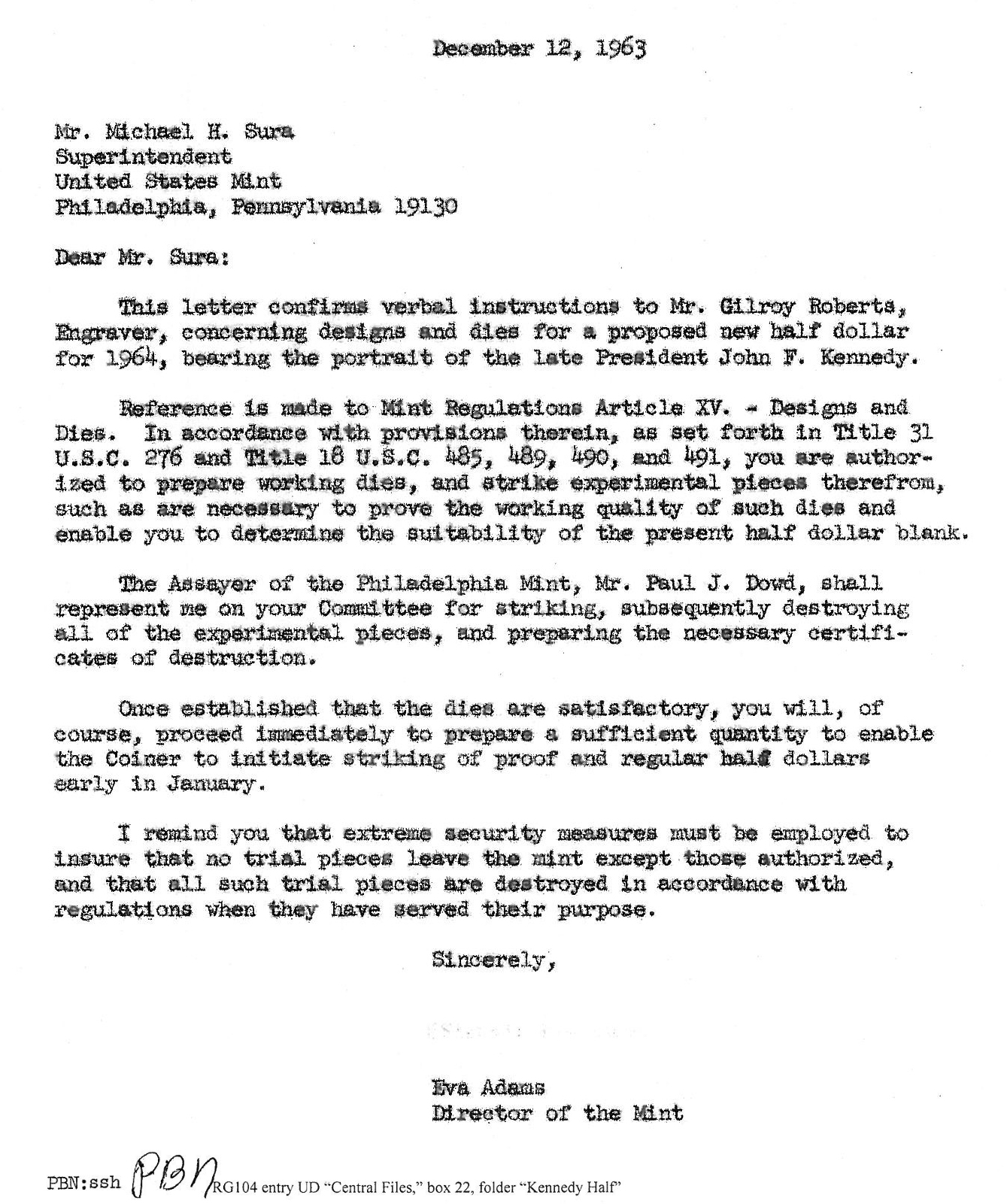
.
.
As much as I appreciate Mark's version - it is simply that - a story. There is no physical evidence to support it. Rather, most of the statements that whirl around that story are beginning to crumble - we now know that the dies were not specially prepared, we know that they were not used just for those coins, and we know that these die pairings are found in Mint Sets of the year. We also know that there were sets sold before Merkin and Adams died, which makes one wonder where they came from. Mark and I have discussed this topic for years, so I think he understands when I say that that it's not a personal attack - just that I believe it is factually incorrect and is leading people to believe an incorrect story and thus pay more for coins that are not what the auction companies and TPGs say they are.
The TPGs need to revise what they say about these coins and how they label them. If they wish to call them special, they need to remove "SMS". They need to remove mentions of die pairs or die markers. They need to remove mentions of special preparation.
What they can call them (all of the coins from these die pairs) is "Smithsonian Die Pair". That will have to be good enough, since in 30 years there has been no objective definitive way to attribute these coins. They can grade some of them higher due to the better characteristics, but you can't claim that they were struck differently. That path is a very dangerous indeed, and the day of reckoning is coming.
Coin Photography
Alex, you continue to make excellent points and I certainly don’t consider them to be personal attacks.
I have great respect for your work and the way you go about discussing this subject.
I sure wish I could go back in time. If what Steve Blum told me was accurate, I have a very hard time believing, that with his immense experience, Lester Merkin would be so proud of the coins if they were merely very early strikes. And there are plenty of highly knowledgeable present-day numismatists who believe that the SMS examples were specially made.
On the other hand, the document that you linked (written by Eva Adams) adds to the strength of your version. I have to admit, despite my personal beliefs, if I were a judge and had to make a ruling based on the preponderance of evidence, I think I would rule in your favor.
Mark Feld* of Heritage Auctions*Unless otherwise noted, my posts here represent my personal opinions.
@MFeld - a very similar sentiment to you.
As far as what Merkin thought of the coins, I don't know. However, I'm pretty convinced that fresh dies can make a coin look "different". The change between the OP coin when it had the marks and when I edited the image to remove the marks is not to be dismissed. That coin looks like a dipped version of the "SMS".
Knowing what you know now, if we could go back in time to that 1990s grading room, would you still grade those coins the same? Or would you do anything differently? Said another way, do you think PCGS now has an obligation to change how they describe these coins and/or holder them, even to a slight degree?
Coin Photography
Thank you, Alex.
I’m not convinced that expert numismatists wouldn’t be able to distinguish coins struck from fresh dies from specially made examples.
In general, I feel that in order for a coin to receive a special designation, there should be official documentation. So no matter what I thought or think about the 1964 SMS coins, I wouldn’t assign them special designations. I’d say the same about esoteric Proof coins such as branch mint pieces. However, I’d struggle in deciding how to handle coins such as pre-1858 pieces that looked like obvious Proofs, but for which there was no official documentation.
Mark Feld* of Heritage Auctions*Unless otherwise noted, my posts here represent my personal opinions.
Great research and analysis...
Experience the World through Numismatics...it's more than you can imagine.
Unfortunately Sura (the Mint superintendent) died in 1972 long before the coins came to light. There were at least two rounds of documented pieces dubbed as trial or “pattern pieces.” The first were struck December 13th and the second run struck in later December (sometime before December 27th). On December 15th the initial trial pieces were presented to Mrs. Kennedy who made suggestions about strengthening the hair. So the SMS pieces are almost certainly not from the first batch of trial strikes/patterns. There was a second batch with the new design that were presented to Secretary of Treasury Dillion and his wife. I can’t find anything ever speaking of the disposition of the pieces.
This sounds like a research project for RWB. I suppose someone could attempt a FOIA request to seek documentation concerning the alleged destruction of the second batch of trial strikes.
PCGS has now removed the Ron Guth statement. This is a step in the right direction.
PCGS retains incorrect mentions of die polish and the incorrect information that the first set was discovered in 1993 (it was May 2nd, 1990). They also mention/allude that the coins connect to Lester Merkin (only some connect to Merkin, shown by how many of the sets sold before the ones in his estate sale). There are also several factual contradictions in the minor denomination's descriptions to the other denominations.
Will PCGS be revising those incorrect statements as well?
@pcgs_education @PCGS_Cheyne @pcgs_education @PCGS_Hy @PCGS_Marketing @PCGS_Moderator
Coin Photography
And what are they doing for your coin? It seems you relied on their statements and are left holding the bag in time, grading fees, insurance, and postage.
Unsure.
Coin Photography