@mr1931S said: two grading services having differing opinions by 5 grades seems....problematic.
Absolutely IS problematic.
Not all five-grade differences are the same. And that aside, in this case, two of the five grades (60 and 61) aren’t used as often as most other grades.
Fair enough, but that is a huge difference. For what it is worth, I think you and Tom Bush are right in calling in a 58. A 63 is a crazy high grade for it, but it also looks silly to me in a 55 holder.
It’s certainly a large difference, if not a huge one. 😉 However, I wouldn’t say the same if CACG’s grade had been 58 instead of 55.
Mark Feld* of Heritage Auctions*Unless otherwise noted, my posts here represent my personal opinions.
@mr1931S said: two grading services having differing opinions by 5 grades seems....problematic.
Absolutely IS problematic.
Not all five-grade differences are the same. And that aside, in this case, two of the five grades (60 and 61) aren’t used as often as most other grades.
Fair enough, but that is a huge difference. For what it is worth, I think you and Tom Bush are right in calling in a 58. A 63 is a crazy high grade for it, but it also looks silly to me in a 55 holder.
It’s certainly a large difference, if not a huge one. 😉 However, I wouldn’t say the same if CACG’s grade had been 58 instead of 55.
Here’s the interesting corollary: David Hall declared anything >2 points a mechanical error. Would they honor the guarantee on the 63? If not, what is the meaning of third party grading guarantees in the modern era? Are these just hopes and dreams? No one is crying over a low value Peace Dollar, but imagine the coins that most of us collect. This is terrifying to me.
I am concerned that PCGS is not now using experienced numismatist graders for less valuable coins as done previously.
This has affected the grading of PCGS slabbed coins as shown in the video. I can see why PCGS graded them so high. On more valuable coins PCGS is more conservative.
@oreville said:
I am concerned that PCGS is not now using experienced numismatist graders for less valuable coins as done previously.
This has affected the grading of PCGS slabbed coins as shown in the video. I can see why PCGS graded them so high. On more valuable coins PCGS is more conservative.
If true, that is a scary system. Just assign a declared value at five intervals lower and voila a gem or superb gem holder we go.
@mr1931S said: two grading services having differing opinions by 5 grades seems....problematic.
Absolutely IS problematic.
Not all five-grade differences are the same. And that aside, in this case, two of the five grades (60 and 61) aren’t used as often as most other grades.
Fair enough, but that is a huge difference. For what it is worth, I think you and Tom Bush are right in calling in a 58. A 63 is a crazy high grade for it, but it also looks silly to me in a 55 holder.
It’s certainly a large difference, if not a huge one. 😉 However, I wouldn’t say the same if CACG’s grade had been 58 instead of 55.
Here’s the interesting corollary: David Hall declared anything >2 points a mechanical error. Would they honor the guarantee on the 63? If not, what is the meaning of third party grading guarantees in the modern era? Are these just hopes and dreams? No one is crying over a low value Peace Dollar, but imagine the coins that most of us collect. This is terrifying to me.
Sorry, I don’t understand. Anything >2 points relative to what?
I’ve never felt that grading guarantees offered a whole lot to the majority of coin buyers. The main reason is that the party who decides whether a guarantee should be paid out is the same one that issued the guarantee. I believe that under such circumstances, objectivity is extremely difficult to achieve.
Mark Feld* of Heritage Auctions*Unless otherwise noted, my posts here represent my personal opinions.
@mr1931S said: two grading services having differing opinions by 5 grades seems....problematic.
Absolutely IS problematic.
Not all five-grade differences are the same. And that aside, in this case, two of the five grades (60 and 61) aren’t used as often as most other grades.
Fair enough, but that is a huge difference. For what it is worth, I think you and Tom Bush are right in calling in a 58. A 63 is a crazy high grade for it, but it also looks silly to me in a 55 holder.
It’s certainly a large difference, if not a huge one. 😉 However, I wouldn’t say the same if CACG’s grade had been 58 instead of 55.
Here’s the interesting corollary: David Hall declared anything >2 points a mechanical error. Would they honor the guarantee on the 63? If not, what is the meaning of third party grading guarantees in the modern era? Are these just hopes and dreams? No one is crying over a low value Peace Dollar, but imagine the coins that most of us collect. This is terrifying to me.
Sorry, I don’t understand. Anything >2 points relative to what?
I’ve never felt that grading guarantees offered a whole lot to the majority of coin buyers. The main reason is that the party who decides whether a guarantee should be paid out is the same one that issued the guarantee. I believe that under such circumstances, objectivity is extremely difficult to achieve.
On regrade. If during review under the guarantee the revised grade differs more than two points from the original holder grade then, if Hall’s guidance is still controlling, the coin is declared a mechanical error and the guarantee is void. A 3+ interval spread among top graders, as suggested by the video, is perhaps not as rare as we think. That would make the guarantee nearly worthless.
@mr1931S said: two grading services having differing opinions by 5 grades seems....problematic.
Absolutely IS problematic.
Not all five-grade differences are the same. And that aside, in this case, two of the five grades (60 and 61) aren’t used as often as most other grades.
Fair enough, but that is a huge difference. For what it is worth, I think you and Tom Bush are right in calling in a 58. A 63 is a crazy high grade for it, but it also looks silly to me in a 55 holder.
It’s certainly a large difference, if not a huge one. 😉 However, I wouldn’t say the same if CACG’s grade had been 58 instead of 55.
Here’s the interesting corollary: David Hall declared anything >2 points a mechanical error. Would they honor the guarantee on the 63? If not, what is the meaning of third party grading guarantees in the modern era? Are these just hopes and dreams? No one is crying over a low value Peace Dollar, but imagine the coins that most of us collect. This is terrifying to me.
Sorry, I don’t understand. Anything >2 points relative to what?
I’ve never felt that grading guarantees offered a whole lot to the majority of coin buyers. The main reason is that the party who decides whether a guarantee should be paid out is the same one that issued the guarantee. I believe that under such circumstances, objectivity is extremely difficult to achieve.
On regrade. If during review under the guarantee the revised grade differs more than two points from the original holder grade then, if Hall’s guidance is still controlling, the coin is declared a mechanical error and the guarantee is void. A 3+ interval spread among top graders, as suggested by the video, is perhaps not as rare as we think. That would make the guarantee nearly worthless.
Thank you.
I would hope that a 2+ point difference on a regrade wouldn’t void the grade guarantee.
Mark Feld* of Heritage Auctions*Unless otherwise noted, my posts here represent my personal opinions.
@Maxvan1 said:
I have two or three CACG AU55 that should be MS62 (even by CACG's own standards), a "scratched" coin that is actually a die break, a "wiped" coin that believe is actually die scratches...
CACG = Can't Actually Conservatively Grade?
Do you post on their forum?
Not the AU55s but other coins from the same order. I may have been a little too aggressive in my critique and the mod locked my thread, but their responses also fed my animosity. The mod was like "you're on the clock to post a video of the cartwheel" - cartwheel is beside the point. If they call the final die state of a progression set scratched (clearly not a scratch), I'm skeptical they graded the prior progression states correctly. I think they mistook die scratches and die gouges as contact marks. I also submitted 8 PCGS/NGC coins (all the same year / variety) and not a single one crossed.
*I'll post pictures when I get home.
I’d be very surprised if they mistook mint-made die scratches and/or die gouges for contact marks. Why do you think you know better than they do? You should try to let go of your animosity (which will get you nowhere good) and be open to the possibility that they’re right.
Well, I'm open to that possibility but the mod's response was "send a video of the cartwheel" which tells me they're not hearing the concern. I don't think it's everyday that someone sends in an 18 coin die progression set for the key date of a series... My conclusions could be wrong (50/50 chance TBH), but my conviction comes from the efforts I've spent studying this particular date and variety...
This AU55 is not a great example to compare the die break with, but the AU55 keeps it germane. Apologies for the length of the video and post but hopefully the point is understood.
(Pause at 3:48/3:49, then jump to 5:20 and watch from there). https://www.youtube.com/watch?v=iX6MymLXJHM
Pictured above -- AU Details (Scratched). If it is indeed a die crack, then its numismatic value would be very high, at least to me, because it would help tell the numismatic story of the 1956 Type B Rev. (This progression set is going to be awesome, just wait!).
Pictured above -- AU55 (I don't see very much circulation wear). I believe there was some grease on the die state for this AU55. Applying CACG's stated standards, I would call this MS61-62.
Pictured above -- And just for fun, another AU55. This one, I do agree is in AU condition. But, is that the eagle's wing die clashed down by the bow? Maybe. TBD.
PS: Don't mean to distract from others discussion on this thread. I'll be gone! Cheers.
@MsMorrisine said:
if putty were to be noted, neither service would grade it
Oops… I thought that was the link for the Morgan @logger7 posted. That coin was details questionable surfaces.
Newbie collector of type and circulated Peace dollars, photographer of places and animals, player of instruments and builder of amplifiers, espresso industry professional, and a person distracted by shiny objects.
Tell you what, @Maxvan1, I have kept up with this thread and when I got to your posts I had to scratch my head a bit at them. So I re-read the conversation and I think you would be best served if you started your own thread on your topic of interest.
You seem to be quite invested in it, but what you have posted here is somewhat difficult to follow and the video (which I watched in its entirety) was pretty useless. If that is your best evidence and the most clearly you can communicate a point then, well, I'm not certain anything I write can help you.
@TomB said:
Tell you what, @Maxvan1, I have kept up with this thread and when I got to your posts I had to scratch my head a bit at them. So I re-read the conversation and I think you would be best served if you started your own thread on your topic of interest.
You seem to be quite invested in it, but what you have posted here is somewhat difficult to follow and the video (which I watched in its entirety) was pretty useless. If that is your best evidence and the most clearly you can communicate a point then, well, I'm not certain anything I write can help you.
Your #146610022 1956 quarter definitely shows circulation or stacking on George’s sideburn. Had there also been stacking or wear on George’s frontal hairline I would have also graded it AU-55. Even without it, at best I would call it would be AU-58. Technical grading. I learned this back in the 1970’s. Just looking at this quarter, it would be a pass. I agree with your AU grade of your second 1956 quarter.
Your other 1956 quarters shown on CACG closed thread looked nicer than MS-62.
@mr1931S said: two grading services having differing opinions by 5 grades seems....problematic.
Absolutely IS problematic.
Not all five-grade differences are the same. And that aside, in this case, two of the five grades (60 and 61) aren’t used as often as most other grades.
Some grade differentials are hard to fathom. When I used to do crackouts, PCGS to NGC, I'd get XF45 old holder to AU58, AU50 to AU58 in "O" mint $20 gold. I once sent some certified coins to "Visionary" rc and they gave me their feedback on the ones with the best upgrade shot.
@MsMorrisine said:
there are straight graded coins where the tpg holdered it despite knowing ths> @renomedphys said:
CACG is being very careful. It has become apparent that a CAC AU58 is essentially what PCGS has been calling 63-65. Nothing to see here. Move along.
Duplicate post deleted.
Mark Feld* of Heritage Auctions*Unless otherwise noted, my posts here represent my personal opinions.
-Learn to grade as grading is both and art and science with a significant subjective component
Learn about the series you choose to collect
Know the characteristics of each mint and date to develop a reasonable point of reference
Accept the fact that not all coins within the same series are created equal… so
Accept that not all coins at the same grade level are created equal… some are just better
Accept that TPG is an opinion at a given time and is subject to change… that is how it is.
And that grade opinion is not set in stone and not the same as an answer to a math problem
I really do not see how this discussion is remotely helpful unless one takes the time to recognize that there is more to collecting than looking at slabs and the grade on them. The slab merely frames a narrative which may not be consistent with the narrative of the coin. And understanding the narrative of the coin is far more important than the slab grade. So the real take away here should be to appreciate what is within your control and to sharpen a skill set instead of complaining.
Experience the World through Numismatics...it's more than you can imagine.
@renomedphys said:
CACG is being very careful. It has become apparent that a CAC AU58 is essentially what PCGS has been calling 63-65. Nothing to see here. Move along.
That’s an unfair generalization. Certainly there are some coins that CACG will knock into AU, but the equivalency you suggested isn’t reality. If it was, I’d be blindly buying every AU58 CACG on the market and crossing them.
Superb collections are built more by omission than by addition.
Although the rub and luster look 58, there appears to be significant hairlines running vertically down Liberty's face in the video. Probably not from a cleaning since they do not appear to extend into the fields but appears mishandled in either circulation or by collector. Not sure I'd label that cabinet friction. Actually I would not want that coin in my collection, even as a 55, with those hairlines. Would bother me every time I looked at the coin. If a mid-AU coin was in my needs, I would take a coin with a little more rub/wear, and less luster, but handled less roughly. I can accept dings and bagmarks but hairlines that run parallel bother me.
@renomedphys said:
CACG is being very careful. It has become apparent that a CAC AU58 is essentially what PCGS has been calling 63-65. Nothing to see here. Move along.
Based on the many grading results and coins I’ve seen, that grossly overstates the typical difference in grades between the two companies.
Mark Feld* of Heritage Auctions*Unless otherwise noted, my posts here represent my personal opinions.
I have not been a fan of CACG grading, since they started, and nonsense like this just adds to that feeling; ultra-orthodoxy, to me, is to be viewed skeptically.
I can see, perhaps, a "disagreement" about whether a coin may have the very slightest bit of "rub," so that a beautiful coin is graded AU58+ by one TPG, but another, equally competent, TPG feels that that is not circulation "rub," so it gets an uncirculated grade.
But AU55 crossing to MS63 is a very bad look, IMO, and does no favors to serious collectors. There should be no question that a coin graded AU55 has been circulated; the only question would be what AU level it would have. As between PCGS grading it MS63 and CACG grading it AU55, I am inclined to believe PCGS.
I cannot imagine why I would ever want to submit a coin to CACG for grading; but this makes me feel a little bit good about the one CACG-graded coin I have bought, a 1916 SLQ graded AU55....
Comments
Not the way PCGS and NGC grade. There are lots of AU62s out there.
It’s certainly a large difference, if not a huge one. 😉 However, I wouldn’t say the same if CACG’s grade had been 58 instead of 55.
Mark Feld* of Heritage Auctions*Unless otherwise noted, my posts here represent my personal opinions.
Both can be dangerous to the unwary.
I celebrated when PCGS downgraded my 1955 DDO cent in the old ANACS MS-60BN grade to AU-58 as I knew it would be a gold CAC candidate. I was right.
Sometimes better to get a NGC or other TPG slabbed coin downgraded by PCGS rather than upgraded.
Here’s the interesting corollary: David Hall declared anything >2 points a mechanical error. Would they honor the guarantee on the 63? If not, what is the meaning of third party grading guarantees in the modern era? Are these just hopes and dreams? No one is crying over a low value Peace Dollar, but imagine the coins that most of us collect. This is terrifying to me.
I am concerned that PCGS is not now using experienced numismatist graders for less valuable coins as done previously.
This has affected the grading of PCGS slabbed coins as shown in the video. I can see why PCGS graded them so high. On more valuable coins PCGS is more conservative.
If true, that is a scary system. Just assign a declared value at five intervals lower and voila a gem or superb gem holder we go.
Sorry, I don’t understand. Anything >2 points relative to what?
I’ve never felt that grading guarantees offered a whole lot to the majority of coin buyers. The main reason is that the party who decides whether a guarantee should be paid out is the same one that issued the guarantee. I believe that under such circumstances, objectivity is extremely difficult to achieve.
Mark Feld* of Heritage Auctions*Unless otherwise noted, my posts here represent my personal opinions.
On regrade. If during review under the guarantee the revised grade differs more than two points from the original holder grade then, if Hall’s guidance is still controlling, the coin is declared a mechanical error and the guarantee is void. A 3+ interval spread among top graders, as suggested by the video, is perhaps not as rare as we think. That would make the guarantee nearly worthless.
If only that were true...
there are straight graded coins where the tpg holdered it despite knowing there's putty on it?
Thank you.
I would hope that a 2+ point difference on a regrade wouldn’t void the grade guarantee.
Mark Feld* of Heritage Auctions*Unless otherwise noted, my posts here represent my personal opinions.
Well, I'm open to that possibility but the mod's response was "send a video of the cartwheel" which tells me they're not hearing the concern. I don't think it's everyday that someone sends in an 18 coin die progression set for the key date of a series... My conclusions could be wrong (50/50 chance TBH), but my conviction comes from the efforts I've spent studying this particular date and variety...
This AU55 is not a great example to compare the die break with, but the AU55 keeps it germane. Apologies for the length of the video and post but hopefully the point is understood.
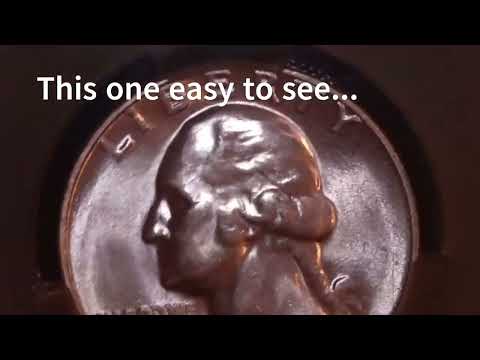 https://www.youtube.com/watch?v=iX6MymLXJHM
(Pause at 3:48/3:49, then jump to 5:20 and watch from there).
Pictured above -- AU Details (Scratched). If it is indeed a die crack, then its numismatic value would be very high, at least to me, because it would help tell the numismatic story of the 1956 Type B Rev. (This progression set is going to be awesome, just wait!).
Pictured above -- AU55 (I don't see very much circulation wear). I believe there was some grease on the die state for this AU55. Applying CACG's stated standards, I would call this MS61-62.
Pictured above -- And just for fun, another AU55. This one, I do agree is in AU condition. But, is that the eagle's wing die clashed down by the bow?
PS: Don't mean to distract from others discussion on this thread. I'll be gone! Cheers.
Oops… I thought that was the link for the Morgan @logger7 posted. That coin was details questionable surfaces.
Newbie collector of type and circulated Peace dollars, photographer of places and animals, player of instruments and builder of amplifiers, espresso industry professional, and a person distracted by shiny objects.
CACG Registry
MyCollect Registry
Tell you what, @Maxvan1, I have kept up with this thread and when I got to your posts I had to scratch my head a bit at them. So I re-read the conversation and I think you would be best served if you started your own thread on your topic of interest.
You seem to be quite invested in it, but what you have posted here is somewhat difficult to follow and the video (which I watched in its entirety) was pretty useless. If that is your best evidence and the most clearly you can communicate a point then, well, I'm not certain anything I write can help you.
In honor of the memory of Cpl. Michael E. Thompson
i'm not seeing a die crack or a scratch on 146610022
and wear doesn't have to be circular.
Typo. *Circulation.
start a new thread for your coins. i'd be interested in seeing what you have
I am in the same boat as @TomB.
Your #146610022 1956 quarter definitely shows circulation or stacking on George’s sideburn. Had there also been stacking or wear on George’s frontal hairline I would have also graded it AU-55. Even without it, at best I would call it would be AU-58. Technical grading. I learned this back in the 1970’s. Just looking at this quarter, it would be a pass. I agree with your AU grade of your second 1956 quarter.
Your other 1956 quarters shown on CACG closed thread looked nicer than MS-62.
Some grade differentials are hard to fathom. When I used to do crackouts, PCGS to NGC, I'd get XF45 old holder to AU58, AU50 to AU58 in "O" mint $20 gold. I once sent some certified coins to "Visionary" rc and they gave me their feedback on the ones with the best upgrade shot.
CACG is being very careful. It has become apparent that a CAC AU58 is essentially what PCGS has been calling 63-65. Nothing to see here. Move along.
Empty Nest Collection
Duplicate post deleted.
Mark Feld* of Heritage Auctions*Unless otherwise noted, my posts here represent my personal opinions.
Just afew comments:
-Learn to grade as grading is both and art and science with a significant subjective component
I really do not see how this discussion is remotely helpful unless one takes the time to recognize that there is more to collecting than looking at slabs and the grade on them. The slab merely frames a narrative which may not be consistent with the narrative of the coin. And understanding the narrative of the coin is far more important than the slab grade. So the real take away here should be to appreciate what is within your control and to sharpen a skill set instead of complaining.
Experience the World through Numismatics...it's more than you can imagine.
That’s an unfair generalization. Certainly there are some coins that CACG will knock into AU, but the equivalency you suggested isn’t reality. If it was, I’d be blindly buying every AU58 CACG on the market and crossing them.
Superb collections are built more by omission than by addition.
I smell opportunity. Crack out game has been going on for years.
Although the rub and luster look 58, there appears to be significant hairlines running vertically down Liberty's face in the video. Probably not from a cleaning since they do not appear to extend into the fields but appears mishandled in either circulation or by collector. Not sure I'd label that cabinet friction. Actually I would not want that coin in my collection, even as a 55, with those hairlines. Would bother me every time I looked at the coin. If a mid-AU coin was in my needs, I would take a coin with a little more rub/wear, and less luster, but handled less roughly. I can accept dings and bagmarks but hairlines that run parallel bother me.
Excuse me while I go find some CACG AU55 1884-S Morgans
Collector, occasional seller
Based on the many grading results and coins I’ve seen, that grossly overstates the typical difference in grades between the two companies.
Mark Feld* of Heritage Auctions*Unless otherwise noted, my posts here represent my personal opinions.
Interesting thread.
I have not been a fan of CACG grading, since they started, and nonsense like this just adds to that feeling; ultra-orthodoxy, to me, is to be viewed skeptically.
I can see, perhaps, a "disagreement" about whether a coin may have the very slightest bit of "rub," so that a beautiful coin is graded AU58+ by one TPG, but another, equally competent, TPG feels that that is not circulation "rub," so it gets an uncirculated grade.
But AU55 crossing to MS63 is a very bad look, IMO, and does no favors to serious collectors. There should be no question that a coin graded AU55 has been circulated; the only question would be what AU level it would have. As between PCGS grading it MS63 and CACG grading it AU55, I am inclined to believe PCGS.
I cannot imagine why I would ever want to submit a coin to CACG for grading; but this makes me feel a little bit good about the one CACG-graded coin I have bought, a 1916 SLQ graded AU55....