Is it a proof? Certified as proof coin sells repeatedly at auction for “proof money” now at GC
 renomedphys
Posts: 3,990 ✭✭✭✭✭
renomedphys
Posts: 3,990 ✭✭✭✭✭
Twice this coin has sold at auction, at Heritage. Both times it was correctly attributed by the auction house as a Snow-1, with a wide RPD, and the obverse style of 1856. The thing is, these aren’t the proof dies. Rick Snow writes:
“This is the only die variety from the “Obverse of
1856” group. These are quite scarce and in high demand.
The coins from this die are some of the most attractive
regular issue Flying Eagles struck. Usually with sharp
strikes and very fine details. The earliest strikes are
prooflike and at times have been confused for proofs by
auction catalogers and grading services.
Probably no more than 300 known. Two are graded
MS-66 by PCGS, the finest of these being a proof-
like example. There are in fact at least 7 gem prooflike
examples known, These are very well struck and can
easily be mistaken for actual proofs. It is important that grading services know the die characteristics
of the proofs rather than just determining Proof
status solely on look and feel.”
So I did call GC and told them about this coin, and it looks like it’s still listed four days later, so here it is.
Here is a link to the GC auction:
https://www.greatcollections.com/Coin/2215900/1857-Flying-Eagle-Cent-PCGS-Proof-64-CAMEO-CAC-Green
And here is a link to the most recent Heritage auction:
And here are the lot photos:
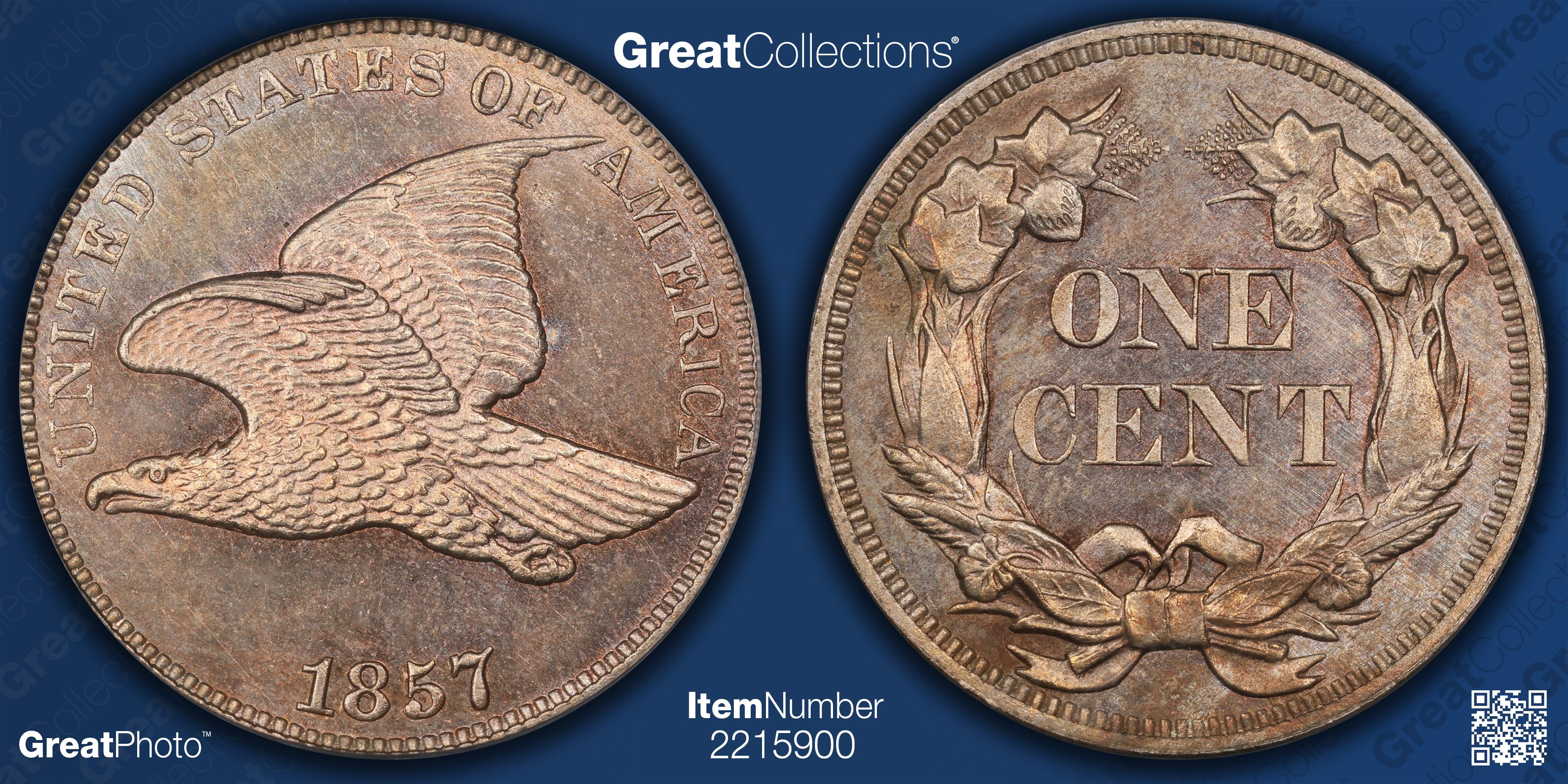
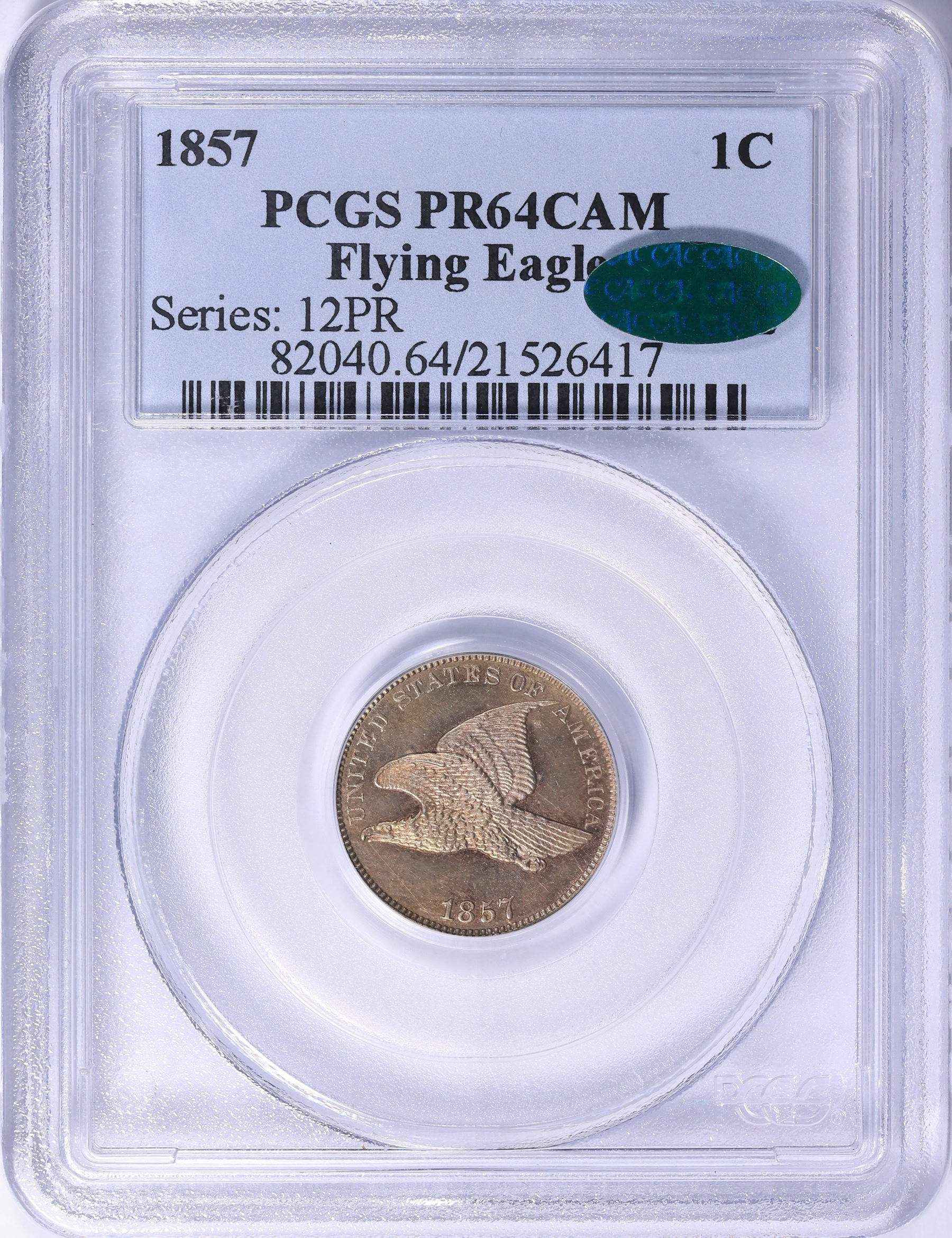
Thoughts? Naturally I’m interested to see how this turns out, because both other times it sold, it brought “cheap” proof money. Naturally I’d like to see this coin sold attributed correctly, so it doesn’t produce another low result for what lists as a much rarer bird.
Comments
IMO, the subject coin properly attributed is PCGS #410433. Description is FS-401a, Obv of 1856, RPD, S-1 (FS-001). Here’s pics of my example:
“The thrill of the hunt never gets old”
PCGS Registry: Screaming Eagles
Copperindian
Copperindian II
Indy Eagles
Gold Rush
Retired sets: Soaring Eagles
Copperindian
Nickelodeon
Early Walkers
Successful transactions: redraider, winesteven, renomedphys, splitaces, oreville, ajaan, Cent1225, onlyroosies, justindan, blitzdude, DesertMoon, johnnyb, Heubschgold, SunshineRareCoins, ParadimeCoins, ndeagles, Southern_Knights, pcgsregistrycollector
Get ahold of cac and let them get involved with gc to implement their guarantee?
This is a good idea. GC is a well run business with really good customer service but having CAC lean on them can speed up the review process significantly. And as good as GC's customer service turnaround has been, CAC's is even better.
chopmarkedtradedollars.com
Does a CAC sticker guarantee strike type?
Is it completely impossible for a proof (or "specimen") Snow-1 to have been struck off of freshly prepared dies intended for circulation strike cents?
Official PCGS account of:
www.TallahasseeCoinClub.com
I'm not exactly sure what you're trying to say.
If it was circulation dies in a circulation press, it is impossible for it to be a "proof". It could be "proof-like", but it can't be a "proof".
If you are asking whether they could use circulation dies in a proof press. Certainly. Is it then a "proof"? Maybe. But die preparation is usually considered part of the process.
The more common crossover is to use proof dies to strike circulation cents after they are done striking proofs.
All comments reflect the opinion of the author, even when irrefutably accurate.
The holder no 6417 says proof 64 DC plus it is stickered. I guess the bidders will make that decision. Looks like a really nice PQ coin. Will put it on my bid list if it’s still out there.
The holder doesn't "say" anything, you have to read the words.
[Sorry, that was one of my grandfather's favorite jokes. If you asked "what time does your watch say?" He'd immediately say, "it didn't 'say' anything, you have to look at it." It's funny what sticks in your head for 50 years. ]
All comments reflect the opinion of the author, even when irrefutably accurate.
The old blue label and ‘series’ designation means the coin was graded quite some time ago.
Would PCGS reconsider, and possibly revoke, their former opinion as to the coin’s Proof status if the coin was sent to them now?
The issue involved reminds me of the recently discovered (and discussed here) 1824/1 proof bust half - when PCGS
calls a coin a Proof, does that make it so?
30+ years coin shop experience (ret.) Coins, bullion, currency, scrap & interesting folks. Loved every minute!
Would it be unreasonable for PCGS to take the position that when a coin really truly looks like a proof, it’s a proof as far as they’re concerned? I mean, it’s their grading service, so their call, right?
Doggedly collecting coins of the Central American Republic.
Visit the Society of US Pattern Collectors at USPatterns.com.
It is their grading service and it is their call...and it is unreasonable.
They can do whatever they want but one should hope that they have some rationale behind their grading/designation calls besides, "Meh, it looks like it, who cares?"
chopmarkedtradedollars.com
Then the OPs coin he posted is wrong, consistency ranks really high in the desirable attributes in the grading biz, IMHO. I seem to be a minority opinion, but on the larger issue my rule would be coins with a documented mint paper trail would be labeled PR, Coins that with their physical characteristics being exceptional ( razor strike, vertical letter sides, sharp rims, etc ) are SP, and the rest are MS. By that rule, this one would be SP or MS. I'm not sure how the initial MS designation was made by Rick Snow, or others, what documentations there is for 1857 proofs, how its known that this is not one of them, etc.
Rick has conducted extensive research on these as documented in the OP’s post. I’m not in a position to question his findings, but have collected this series (both MS & PR) for 15+ years. I haven’t encountered anything that refutes his assertions.
The nuances that determine some of these FE’s (both MS & PR) are sometimes difficult to discern. This has been acknowledged by PCGS, resulting in occasionally getting it wrong. My experience is 1) they’re good about backing up their contention; & 2) changing it when they’re proven to be incorrect.
“The thrill of the hunt never gets old”
PCGS Registry: Screaming Eagles
Copperindian
Copperindian II
Indy Eagles
Gold Rush
Retired sets: Soaring Eagles
Copperindian
Nickelodeon
Early Walkers
Successful transactions: redraider, winesteven, renomedphys, splitaces, oreville, ajaan, Cent1225, onlyroosies, justindan, blitzdude, DesertMoon, johnnyb, Heubschgold, SunshineRareCoins, ParadimeCoins, ndeagles, Southern_Knights, pcgsregistrycollector
For whatever it’s worth, it seems to me within my limited area of study that many MS issues can be PL. Look at 1908-S Indian cents. Or 1859’s. 1856 S-3’s also come PL. Indeed it seems like any time the mint produced brand new dies for a brand new design or a first run at a branch mint, some are struck so well that we might mistake them for actual proofs. Heck, I have an MS 1877 Indian that has no reverse clashing and is in fact very PL. I also own an 1809 cent that is very EDS and has been called semi PL by more than just one dealer.
I don’t think we should be surprised by this. I also don’t think this is an excuse to call them proofs. Brand new dies and a handful of “test run” blanks, along with careful initial setup and a bit of pressure tweaking can produce really excellent results. This in spite of the fact that the coins in question were produced in almost the exact same manner as every other MS coin for that date.
Empty Nest Collection
The earliest meaning of “proof” in coinage was the first coin strike off new dies. This coin was a test, struck to ‘prove’ that the die brought up all the details intended.
But the definition of ‘Proof’ has changed over time.
Until the US Mint started offering ‘proof’ coins for public sale in 1858, obtaining what we now call proof coins was a matter of having connections at the Mint, or being an honored guest who was allowed to purchase a shiny new coin, or a few. Often both obverse and reverse dies were polished for this purpose, sometimes only the obverse, and at times the planchet was also polished before the coin was struck. Some were struck twice, but I don’t think that was usual in the early days.
Research in this field of is often thwarted because early proofs seldom left a paper trail. A simple swap of specie-for-specie would not generate a Mint document (for instance, Izzy Switt)
My point is that what numismatists today call Proofs among pre1858 coins are a motley crew. They were not the first strike, were made under varying degrees of care, and are for the most part undocumented orphans. Do they look like specially made ‘Proofs’? If so, then they are (see: the recently sold 1824/1 Proof Bust Half)
As for the 1857 FE under discussion, its early strike status actually puts it pretty close to the earliest meaning of ‘proof.’
Perhaps one of the existing Prooflike S-1 examples WAS the one struck to ‘prove’ the dies - making it a true proof coin.
30+ years coin shop experience (ret.) Coins, bullion, currency, scrap & interesting folks. Loved every minute!
My Dad would say a watch doesn't "say" anything. It "indicates". I've been annoying people with this ever since. LOL
Newbie collector of type and circulated Peace dollars, photographer of places and animals, player of instruments and builder of amplifiers, espresso industry professional, and a person distracted by shiny objects.
CACG Registry
MyCollect Registry
To put it another way, this is an entirely different era of numismatic production. I do believe the research that has suggested in the past that a proof coin could have been struck off of fresh circulation-strike dies. It would amount to a combination of flan quality and preparation, die preparation, striking pressure, etc.
Official PCGS account of:
www.TallahasseeCoinClub.com
Intent is impossible to prove. For many years at early ANACS we asked the question, does it matter if it was intentionally made to be a proof? We tried to document aspects of obvious proof dies and use them as earmarks for future calls. There in fact were thousands of photos taken through a microscope in the ANACS files. When this scientific method was used to expose proof like early strikes, the common response IN THE 1970'S-1980'S was that they were "Market Proofs" and were traded as such. If it looks like a proof, it's a proof.
It is hard to argue with this form of logic when money is the driver.
Proof dies are rarley used to make business strikes. Seems counterproductive as economics suggest the opposite to be true. Why would a mint dispose of perfectly good dies?. Undated dies can and were used, but rarely dated dies.
In making the call on Matte proof minor coins 1909-1916, It was common to call first strikes off new dies,off new hubs proof. There was fairly limited knowledge to actual diagnostics and dealers used their best judgement to make the call.
In 1982 ANACS produced diagnostics on the Matte cents. collectors now had the evidence to make educated purchases. The rarity could then be established based on proven populations. Confidence in the true rarity gives bidders what they need to move markets.
Another example that comes to mind is the 1880 nickel. Comparitively common as a proof, Business strikes are rare. Later proof die strikes develop some luster and were commonly passed as superb business strikings. Die characteristics for the business strike reverse die can now seperate PF/BS coins even in lower grades. Business strike prices prices have only risen once the true rarity has been defined
This technical method has gained traction when these calls attract the attention and money we see today.This
not only applies to PF/MS calls, but to long held beliefs on varieties. 1868/9 cents,1922 cents, Etc.
Accountability comes when as a grading service or auction firm Has to put their name behind a call. J.P.Martin
62 yrs in Coins, 42 yrs Certifying/Grading, CoinWorld's Most Influential People In Numismatics, 1960-2020. 30 consecutive yrs teaching ANA Summer seminar, Numismatic Ambassador award, 1998 Doctorate in Numismatics, Glenn Smedley Award, ANA Governor 2009/2011, Author/ Host of ANA's best selling video's, courses on grading & counterfeit detection. Taught over 1,100 paying students, Secret service agents, San Diego to Boston, Anchorage to Miami, including 2 coin cruise lecturer. many Free presentations. NLG book and video awards. ANA photographer, SEM operator, ASA Appraiser, Contributor to Redbook, Numismatist, Coin World, Numismatic News, ANA Grading Guides, 40,000 Volume Library, Founder ANAAB, ICG, 1995 ANA collector services appraisal/conservation, First full service Ancient coin grading service. Navy 75-77, WIU 77-81, Dealer1981-1984, ANA 1984-1998, 60 year Collector U.S./ 50 Year Ancient coins. ANA Advisory Committee. Life member ANA, ANS. Semi-retired grader in Denver area
So I guess it really is all about what the plastic says these days. Interesting.
Coin Photography
@ianrussell
"She comes out of the sun in a silk dress,
running like a water color in the rain...."
I would not argue with Rick Snow. It would be hard to find a more dedicated researcher/specialist. If I am in disagreement with his call on a coin, I backtrack and try to figure where I went wrong. In this particular case it appears to be an early strike of dies that were prepared off fresh hubbing (as they all are). A remarkable technical Business striking that may trade as a market proof. I own a proof not off these dies. Pcgs has been grading since 1986. I believe that today they would not make this call. Possibly a unreconsidered reholder. These Business Strike coins make the proof census look more common than they are. I believe the 1857's are the rarest of the three dates. J.P. Martin
62 yrs in Coins, 42 yrs Certifying/Grading, CoinWorld's Most Influential People In Numismatics, 1960-2020. 30 consecutive yrs teaching ANA Summer seminar, Numismatic Ambassador award, 1998 Doctorate in Numismatics, Glenn Smedley Award, ANA Governor 2009/2011, Author/ Host of ANA's best selling video's, courses on grading & counterfeit detection. Taught over 1,100 paying students, Secret service agents, San Diego to Boston, Anchorage to Miami, including 2 coin cruise lecturer. many Free presentations. NLG book and video awards. ANA photographer, SEM operator, ASA Appraiser, Contributor to Redbook, Numismatist, Coin World, Numismatic News, ANA Grading Guides, 40,000 Volume Library, Founder ANAAB, ICG, 1995 ANA collector services appraisal/conservation, First full service Ancient coin grading service. Navy 75-77, WIU 77-81, Dealer1981-1984, ANA 1984-1998, 60 year Collector U.S./ 50 Year Ancient coins. ANA Advisory Committee. Life member ANA, ANS. Semi-retired grader in Denver area