A few people here are a bit jealous about the dollar coin opportunities you have at your fingertips.
Potential treasures like Cheerios dollars, elongated ray on the Statue of Liberty on the George Washington dollars, and numerous counterfeits of US dollar coins. Plus, some people collect "low ball" grades, and Ecuador is the absolute best place in the world to find them.
By the way...do other US coins besides dollar coins circulate there?
@JBK said:
Edge lettering comes in various depths (deeply impressed numbers will look a little different than light ones) but the basic shape of letters/numbers shouldn't change.
not different like what's shown, as you indicate
the coin is a counterfeit based on more than just the edge lettering. the edge lettering just highlights it the easiest
@ricarf2386 said:
Yes, I already have it. In fact, I already have a Whitman album and I am filling the 5-cent book with uncirculated coins, because that is what shows truly new coins.
I also have about six proof sets, the complete series of quarters (also uncirculated), and many, many more coins. If I were to post absolutely everything I have here, they might even kick me out of this forum for spamming.
We have a saying here in North America: "Posting your Whitman folders takes precious time away from filling your Whitman folders."
@MsMorrisine said:
in fact, all the numbers of the date are wrong
Hi MsMorrisine, thank you for taking the time to crop and compare the images! However, your analysis overlooks a couple of fundamental mechanical facts about edge lettering production.
First, you are comparing a regular, crisp strike to a coin that has gone through circulation and potential "edge smearing" pressure. Mechanical wear and the rolling process in the Schuler machine frequently distort, flatten, or widen characters on the rim, which easily explains why that "0" or the other numbers appear thicker in a digital zoom. Analyzing a physical coin’s microscopic typography based entirely on the pixel distortion of a zoomed-in photograph is just a guessing game.
Second, as we discussed before, you collectors in the US rarely see these Presidential Dollars in daily use. Here in Ecuador, due to dollarization, these coins circulate heavily every single day. Based on my own hands-on experience examining thousands of them, from 2009 onward, nearly all presidential coins down here show highly irregular, weak, blurry, or improperly rolled edge lettering. You cannot evaluate an unprecedented transitional or mismatched die error by expecting it to look like a perfect textbook specimen.
If you or anyone else on this thread has any doubts or wants to see the technical details, just ask me for photos and I will gladly share microscopic images of how messy these edges actually get in reality.
we have worn coins here too. nothing smears edge lettering in circulation. the "0" looks more like a "O" because it's a counterfeit. if it were smeared, then why aren't the numbers' indentations wider?
I look at the edge of every dollar I see hoping for some error. I've seen lots of them and the edge lettering differences were very obvious because the edge lettering does not smear with wear
@ricarf2386 said:
I have a question about ANACS processing: Once a coin has already been assigned a valid Certificate Number in their online system, is there still a probability that the coin could end up being returned in a "bodybag" (rejected)? Or does the generation of an active certificate number with specific metadata mean it passed authentication and will be encapsulated?
ALL coins get a number assigned when they are checked in and entered into the system. In fact, when we take them in at coin shows, we have number stickers we put on them and record on the submission form before we ship them, to aid with getting them into the system quickly. The number functions as an inventory tracking number as the coins move through grading, and this number is used as the official cert number when a coin is encapsulated.
You Suck! Awarded 6/2008- 1901-O Micro O Morgan, 8/2008- 1878 VAM-123 Morgan, 9/2022 1888-O VAM-1B3 H8 Morgan | Senior Regional Representative- ANACS Coin Grading. Posted opinions on coins are my own, and are not an official ANACS opinion.
That is pure gold! Your comment makes perfect sense. This is exactly how they guarantee that 100% of customers pay for their service. By displaying clean metadata online (Year/Mint) but hiding the specific details and grade, they keep you on the hook. Nobody walks away without funding their card because we are all dying to know the final outcome!
To add more context, I didn't just send a coin; I attached a 15-page dossier filled with technical analysis and high-resolution photos highlighting every single error location. Because of this massive documentation, I suspect they might even attribute more errors to my coin. Right now, I'm keeping my expectations grounded at a realistic 50/50 probability, but the battle is on.
We display the list of submitted coins in the order summary so a user can be confident their coins are in the system and match what they submitted. If there's an entry error, they can call customer service and get it corrected, without having to wait until they get their coins back (this does happen occasionally with ALL grading services- it's called a mechanical error).
Grading services like ANACS and our host charge for grading AND authentication. That's what you're paying for (basically, our opinion on grade and authentication), regardless of the outcome, because the coin went through the grading/authentication process where it was reviewed by our experts we pay to do so. We don't waive the fee because you had a counterfeit coin.
You Suck! Awarded 6/2008- 1901-O Micro O Morgan, 8/2008- 1878 VAM-123 Morgan, 9/2022 1888-O VAM-1B3 H8 Morgan | Senior Regional Representative- ANACS Coin Grading. Posted opinions on coins are my own, and are not an official ANACS opinion.
That is pure gold! Your comment makes perfect sense. This is exactly how they guarantee that 100% of customers pay for their service. By displaying clean metadata online (Year/Mint) but hiding the specific details and grade, they keep you on the hook. Nobody walks away without funding their card because we are all dying to know the final outcome!
To add more context, I didn't just send a coin; I attached a 15-page dossier filled with technical analysis and high-resolution photos highlighting every single error location. Because of this massive documentation, I suspect they might even attribute more errors to my coin. Right now, I'm keeping my expectations grounded at a realistic 50/50 probability, but the battle is on.
We display the list of submitted coins in the order summary so a user can be confident their coins are in the system and match what they submitted. If there's an entry error, they can call customer service and get it corrected, without having to wait until they get their coins back (this does happen occasionally with ALL grading services- it's called a mechanical error).
Grading services like ANACS and our host charge for grading AND authentication. That's what you're paying for (basically, our opinion on grade and authentication), regardless of the outcome, because the coin went through the grading/authentication process where it was reviewed by our experts we pay to do so. We don't waive the fee because you had a counterfeit coin.
Thank you so much for your comment! It is very gratifying to know that a senior ANACS representative has taken the time to clear up my doubts. To be honest, I was not familiar with the internal procedures of the company, and that is precisely why I decided to bring this question to the forum, hoping to get some guidance and clear the air.
I am currently waiting for the final resolution. I just received an email notification letting me know that the manual payment will be processed tomorrow morning. Once the invoice is fully settled, the system will officially dictate whether the coin is genuine or not. I am extremely grateful for your professional clarification. It is a pleasure!
@JBK said:
A few people here are a bit jealous about the dollar coin opportunities you have at your fingertips.
Potential treasures like Cheerios dollars, elongated ray on the Statue of Liberty on the George Washington dollars, and numerous counterfeits of US dollar coins. Plus, some people collect "low ball" grades, and Ecuador is the absolute best place in the world to find them.
By the way...do other US coins besides dollar coins circulate there?
To be honest, I really like you, my friend! You are awesome.
To answer your question: Yes, absolutely everything here is US currency. Since our economy is fully dollarized, we use every single denomination daily: 10-cent, 25-cent, and 50-cent coins, as well as Sacagawea, Native American, and Presidential $1 coins. We also have all US paper bills circulating constantly, and many of them arrive brand new, straight from original mint boxes and Federal Reserve straps.
A fascinating historical detail about Ecuador is that silver coins are still found in normal circulation here. Because the general public does not know how to recognize coin history, people still spend 90% silver Dimes, Quarters, and Half Dollars at face value as regular pocket change. We also constantly find old wheat cents and even wartime steel cents in daily circulation.
The hunt down here is a daily adventure because you never know what historic piece has been sitting in a vault. If you’d like, I can gladly share some photos here on the thread so you can see the kind of fresh material that is being examined every single day.
@MsMorrisine said:
in fact, all the numbers of the date are wrong
Hi MsMorrisine, thank you for taking the time to crop and compare the images! However, your analysis overlooks a couple of fundamental mechanical facts about edge lettering production.
First, you are comparing a regular, crisp strike to a coin that has gone through circulation and potential "edge smearing" pressure. Mechanical wear and the rolling process in the Schuler machine frequently distort, flatten, or widen characters on the rim, which easily explains why that "0" or the other numbers appear thicker in a digital zoom. Analyzing a physical coin’s microscopic typography based entirely on the pixel distortion of a zoomed-in photograph is just a guessing game.
Second, as we discussed before, you collectors in the US rarely see these Presidential Dollars in daily use. Here in Ecuador, due to dollarization, these coins circulate heavily every single day. Based on my own hands-on experience examining thousands of them, from 2009 onward, nearly all presidential coins down here show highly irregular, weak, blurry, or improperly rolled edge lettering. You cannot evaluate an unprecedented transitional or mismatched die error by expecting it to look like a perfect textbook specimen.
If you or anyone else on this thread has any doubts or wants to see the technical details, just ask me for photos and I will gladly share microscopic images of how messy these edges actually get in reality.
we have worn coins here too. nothing smears edge lettering in circulation. the "0" looks more like a "O" because it's a counterfeit. if it were smeared, then why aren't the numbers' indentations wider?
I look at the edge of every dollar I see hoping for some error. I've seen lots of them and the edge lettering differences were very obvious because the edge lettering does not smear with wear
My dear friend, thank you for your analysis. I actually did the exact same comparison you are trying to do before sending the coin to the lab.
I have examined a huge amount of these coins from 2011, and to be honest, the zero on my coin does not look perfectly round or normal either; it is visibly distorted. I have tons of close-up photos of genuine circulating specimens showing how much these letters change, distort, or flatten out due to high-pressure rolling or heavy circulation wear on a soft manganese-brass alloy. Here are some of those clear photos so you can compare the edge shapes for yourself.
@JBK said:
A few people here are a bit jealous about the dollar coin opportunities you have at your fingertips.
Potential treasures like Cheerios dollars, elongated ray on the Statue of Liberty on the George Washington dollars, and numerous counterfeits of US dollar coins. Plus, some people collect "low ball" grades, and Ecuador is the absolute best place in the world to find them.
By the way...do other US coins besides dollar coins circulate there?
To be honest, I really like you, my friend! You are awesome.
To answer your question: Yes, absolutely everything here is US currency. Since our economy is fully dollarized, we use every single denomination daily: 10-cent, 25-cent, and 50-cent coins, as well as Sacagawea, Native American, and Presidential $1 coins. We also have all US paper bills circulating constantly, and many of them arrive brand new, straight from original mint boxes and Federal Reserve straps.
A fascinating historical detail about Ecuador is that silver coins are still found in normal circulation here. Because the general public does not know how to recognize coin history, people still spend 90% silver Dimes, Quarters, and Half Dollars at face value as regular pocket change. We also constantly find old wheat cents and even wartime steel cents in daily circulation.
The hunt down here is a daily adventure because you never know what historic piece has been sitting in a vault. If you’d like, I can gladly share some photos here on the thread so you can see the kind of fresh material that is being examined every single day.
Personally, I'd love to hear about the numismatic situation in Ecuador. Maybe start a new thread with a title dedicated to that so more people will see it.
Thank you for making me laugh for a while! It was a clever move, and I deeply appreciate it because you truly brought a smile to my face. If you thought this was going to make me angry, not at all! I take things with total calm and peace of mind.
To be honest, my approach is focused on being resourceful. If you only knew that I have several other shirt designs just like this one, featuring different mint error coin ideas, it would probably leave you with your mouth wide open. God willing, I might actually bring those exact shirts and designs to your market someday, and who knows, maybe you will end up wearing one of my shirts in the future! Thanks for the free promotion of my design, my friend!
By the way, IkesT, based on your experience, I'm still grounded on my 50/50 outlook. But tell me, do you really believe a crude or sloppy counterfeit could capture the gaze of Lincoln with such total clarity? The expression is so sharp and full that it feels like he is staring right at you. I am attaching a close-up photo here—feel free to give me your opinion on that specific details!
@ricarf2386 said:
Thank you for making me laugh for a while! It was a clever move, and I deeply appreciate it because you truly brought a smile to my face. If you thought this was going to make me angry, not at all! I take things with total calm and peace of mind.
I'm glad to hear that; feel free to calmly and peacefully use it as your thumbnail photo.
By the way, IkesT, based on your experience, I'm still grounded on my 50/50 outlook. But tell me, do you really believe a crude or sloppy counterfeit could capture the gaze of Lincoln with such total clarity? The expression is so sharp and full that it feels like he is staring right at you. I am attaching a close-up photo here—feel free to give me your opinion on that specific details!
The detail on your counterfeit is soft, mushy, and lacks the sharpness of the genuine coin. This is what the bust on a genuine Lincoln dollar is supposed to look like:
@ricarf2386 said:
Thank you for making me laugh for a while! It was a clever move, and I deeply appreciate it because you truly brought a smile to my face. If you thought this was going to make me angry, not at all! I take things with total calm and peace of mind.
I'm glad to hear that; feel free to calmly and peacefully use it as your thumbnail photo.
By the way, IkesT, based on your experience, I'm still grounded on my 50/50 outlook. But tell me, do you really believe a crude or sloppy counterfeit could capture the gaze of Lincoln with such total clarity? The expression is so sharp and full that it feels like he is staring right at you. I am attaching a close-up photo here—feel free to give me your opinion on that specific details!
The detail on your counterfeit is soft, mushy, and lacks the sharpness of the genuine coin. This is what the bust on a genuine Lincoln dollar is supposed to look like:
Hi IkesT, thank you for sharing that image! However, you are making a basic mistake by trying to compare a pristine, uncirculated specimen (or a proof-like stock photo) to a coin that has been heavily circulating in daily commerce for years.
It completely lacks common sense and logical reasoning to expect a coin that has gone through constant friction in people's pockets, cash registers, and bank bags to maintain the exact same crisp, untouched surface lines as a brand new mint piece. Circulation wear naturally flattens, smooths, and softens the fine details of the bust over time—that is basic numismatic physics, not a sign of a counterfeit.
Thank you, and I truly hope you can sleep well tonight thinking about the eyes of this beloved Abe Lincoln, hahaha!
@ricarf2386 said:
Thank you for making me laugh for a while! It was a clever move, and I deeply appreciate it because you truly brought a smile to my face. If you thought this was going to make me angry, not at all! I take things with total calm and peace of mind.
I'm glad to hear that; feel free to calmly and peacefully use it as your thumbnail photo.
By the way, IkesT, based on your experience, I'm still grounded on my 50/50 outlook. But tell me, do you really believe a crude or sloppy counterfeit could capture the gaze of Lincoln with such total clarity? The expression is so sharp and full that it feels like he is staring right at you. I am attaching a close-up photo here—feel free to give me your opinion on that specific details!
The detail on your counterfeit is soft, mushy, and lacks the sharpness of the genuine coin. This is what the bust on a genuine Lincoln dollar is supposed to look like:
Hi IkesT, thank you for sharing that image! However, you are making a basic mistake by trying to compare a pristine, uncirculated specimen (or a proof-like stock photo) to a coin that has been heavily circulating in daily commerce for years.
I'm afraid you are the one who is mistaken. One of the hallmarks of a counterfeit coin is that it looks circulated without being circulated, due to the missing detail. Most crude counterfeits have this look. When you have seen as many counterfeits as I and others on the Forum have, you may be able to learn to tell the difference. Your coin may have seen some circulation, but most of the detail was missing before it started circulating.
@ricarf2386 said:
Thank you for making me laugh for a while! It was a clever move, and I deeply appreciate it because you truly brought a smile to my face. If you thought this was going to make me angry, not at all! I take things with total calm and peace of mind.
I'm glad to hear that; feel free to calmly and peacefully use it as your thumbnail photo.
By the way, IkesT, based on your experience, I'm still grounded on my 50/50 outlook. But tell me, do you really believe a crude or sloppy counterfeit could capture the gaze of Lincoln with such total clarity? The expression is so sharp and full that it feels like he is staring right at you. I am attaching a close-up photo here—feel free to give me your opinion on that specific details!
The detail on your counterfeit is soft, mushy, and lacks the sharpness of the genuine coin. This is what the bust on a genuine Lincoln dollar is supposed to look like:
Hi IkesT, thank you for sharing that image! However, you are making a basic mistake by trying to compare a pristine, uncirculated specimen (or a proof-like stock photo) to a coin that has been heavily circulating in daily commerce for years.
I'm afraid you are the one who is mistaken. One of the hallmarks of a counterfeit coin is that it looks circulated without being circulated, due to the missing detail. Most crude counterfeits have this look. When you have seen as many counterfeits as I and others on the Forum have, you may be able to learn to tell the difference. Your coin may have seen some circulation, but most of the detail was missing before it started circulating.
My dear friend, historically speaking, we all know that Susan B. Anthony and Presidential $1 coins were never popular or widely accepted in daily circulation within the US. But here in Ecuador, handling and spending these dollar coins is like eating every single day; they circulate heavily. I’m not sure if you actually have heavily circulated Presidential Dollars in hand over there to prove that this specific soft alloy doesn't lose its fine details under years of aggressive friction.
Right now, my stance remains a realistic 50/50. No matter what, I will post the official ANACS verdict here, whether it rules in my favor or against me. My true satisfaction is knowing that I defended my specimen to the best of my ability and had the privilege to technical-debate in one of the largest numismatic forums in the world. I honestly don't know if any other Ecuadorian collector has ever had this privilege here before.
If my specimen turns out to be fake, that's fine—the hunt doesn't stop. I will keep searching for other treasures in our banks, like the famous Zachary Taylor "traveling coin" edge lettering error, or my absolute favorite: the legendary Sacagawea/Washington Quarter mule error.
Right now, my stance remains a realistic 50/50. No matter what, I will post the official ANACS verdict here, whether it rules in my favor or against me.
with the amount you are arguing we expect you'll argue that anacs is wrong
@JBK said:
Take a look at the area behind the bow tie. It's a highly protected area but the Ecuadoran example lacks the detail of the IkesT example.
Thanks, my friend, for pointing out that detail! I will definitely check it out. I'm going to find another Lincoln dollar in circulation as soon as possible and share a photo with you so we can compare them.
As a technical note, I didn't risk sending this coin to the US just for a trip. I submitted it because, to me, this looks like a genuine error. Before shipping it, I sought out those who are considered the top experts in the numismatic field here in Ecuador. If this Lincoln turns out to be counterfeit, it will clearly prove that we lack truly qualified people in this area down here. Because of that, I hope to take the online grading and authentication courses offered by the ANA someday.
Right now, my stance remains a realistic 50/50. No matter what, I will post the official ANACS verdict here, whether it rules in my favor or against me.
with the amount you are arguing we expect you'll argue that anacs is wrong
Hi MsMorrisine, I am not stubborn; I am simply a collector defending my argument and my research with the physical evidence I have in front of me. That is what any passionate numismatist does.
However, make no mistake: once ANACS finishes processing the payment and releases their official written certificate, I will close this case immediately and move on to my daily roll hunting at the banks. Simple as that!
The only thing that will honestly leave me intrigued is how NGC handles things and fails to truly detail the situation like a professional lab should. If it is counterfeit, they should say so, instead of returning an oracle-like "Altered Surface" voucher. But on my end, once the final results drop, the book is closed.
@pruebas said:
“Do not answer a fool according to his folly, or you yourself will be just like him.”
Speaking of words of wisdom, Proverbs 17:27 teaches us: "He who has knowledge spares his words, and a man of understanding is of a calm spirit."
I have always responded in this forum with the utmost respect toward all members. I believe that labels and personal remarks are unnecessary and lower the level of the conversation.
that head is the most disconnected head I have ever seen
on a real coin, what would cause part of the neck to disappear is over-polishing the die. however, when it becomes heavy, there are flat spots between the folds of the gown at the bottom of the coin. the above is a normal coin, and I don't have a coin to show what the flat spots would look like, but the peaks of the folds of the gown would not flow down into a curve but would hit a wide flat spot instead.
@MsMorrisine said:
that head is the most disconnected head I have ever seen
on a real coin, what would cause part of the neck to disappear is over-polishing the die. however, when it becomes heavy, there are flat spots between the folds of the gown at the bottom of the coin. the above is a normal coin, and I don't have a coin to show what the flat spots would look like, but the peaks of the folds of the gown would not flow down into a curve but would hit a wide flat spot instead.
Thank you for your highly detailed and technical breakdown, MsMorrisine.
To contribute to your photographic forensic analysis, I noticed these vertical lines running through the statue's reliefs in this close-up image.
In your opinion, does the presence of these vertical lines provide further evidence supporting your theory that this coin is a counterfeit, or what are your thoughts on this specific feature?
@MsMorrisine said:
that head is the most disconnected head I have ever seen
on a real coin, what would cause part of the neck to disappear is over-polishing the die. however, when it becomes heavy, there are flat spots between the folds of the gown at the bottom of the coin. the above is a normal coin, and I don't have a coin to show what the flat spots would look like, but the peaks of the folds of the gown would not flow down into a curve but would hit a wide flat spot instead.
Thank you for your highly detailed and technical breakdown, MsMorrisine.
To contribute to your photographic forensic analysis, I noticed these vertical lines running through the statue's reliefs in this close-up image.
In your opinion, does the presence of these vertical lines provide further evidence supporting your theory that this coin is a counterfeit, or what are your thoughts on this specific feature?
In this other image I am sharing, there is a small raised square block near the statue's arm. It looks like the transfer mold used to create this piece might have been deteriorating or breaking apart during the process.
Do you think this anomaly adds more weight to the theory that the coin is counterfeit, or what are your thoughts on this feature?
@logger7 said:
Did they give you the verdict yet? I hope you get what you're looking for.
Thank you very much, my friend! I appreciate your good wishes. I haven't received the verdict yet; I am still waiting for it.
To be honest, after being in this forum and seeing everything that has been posted, it has given me more doubts than certainties. That is why I proceeded to keep investigating in detail. As it was mentioned in previous messages, it is true that there have been these specialized groups dedicated to manufacturing these types of coins using ultra-high-quality dies.
Later today, I will upload some photos showing exactly how they used to make these coins.
@ricarf2386 said:
In your opinion, does the presence of these vertical lines provide further evidence supporting your theory that this coin is a counterfeit, or what are your thoughts on this specific feature?
>
I've never seen anything like it. it may be why ngc said altered surfaces. I wouldn't say it adds to the counterfeit idea
@ricarf2386 said:
In this other image I am sharing, there is a small raised square block near the statue's arm. It looks like the transfer mold used to create this piece might have been deteriorating or breaking apart during the process.
Do you think this anomaly adds more weight to the theory that the coin is counterfeit, or what are your thoughts on this feature?
the image is too grainy to see it, but raised metal without evidence of a cause i a problem, but the bump can't even be seen
Another option is ICG, much faster on their 5 day tier and they've hired PCGS and NGC graders in the last couple years. $25 for that tier and around $10 bucks for an attribution.
Another option is ICG, much faster on their 5 day tier and they've hired PCGS and NGC graders in the last couple years. $25 for that tier and around $10 bucks for an attribution.
Considering that the current submission is with a different major grading company than the first one, under what circumstances would you recommend his trying a third one? I don’t see the use in that.
Mark Feld* of Heritage Auctions*Unless otherwise noted, my posts here represent my personal opinions.
@logger7 said:
Another option is ICG, much faster on their 5 day tier and they've hired PCGS and NGC graders in the last couple years. $25 for that tier and around $10 bucks for an attribution.
Considering that the current submission is with a different major grading company than the first one, under what circumstances would you recommend his trying a third one? I don’t see the use in that.
I think logger is either totally misguided or he is trying to give our friend false hope. That would be a very cruel thing to do, in my opinion.
@ricarf2386 said:
In this other image I am sharing, there is a small raised square block near the statue's arm. It looks like the transfer mold used to create this piece might have been deteriorating or breaking apart during the process.
Do you think this anomaly adds more weight to the theory that the coin is counterfeit, or what are your thoughts on this feature?
the image is too grainy to see it, but raised metal without evidence of a cause i a problem, but the bump can't even be seen
Hi MsMorrisine, thank you for checking that detail. The truth is, those vertical lines run across the entire relief of the Statue of Liberty. And inside that specific raised square block of metal, you can actually see what looks like a "W" shape under closer view. I have examined this coin millimeter by millimeter, which is why I noticed every single tiny detail.
As I mentioned earlier regarding the counterfeits circulating around my country, they are actually struck using high-end, fine-finished dies. To be honest, they are made so perfectly that I haven't personally found a counterfeit with this specific level of die texture yet, but who knows. They even use specialized tooling to replicate the edge lettering. In a bit, I am going to share some photos of the specialized tools used by these counterfeiters so you can see how advanced they are!
@logger7 said:
Another option is ICG, much faster on their 5 day tier and they've hired PCGS and NGC graders in the last couple years. $25 for that tier and around $10 bucks for an attribution.
Hi logger7, thank you so much for the advice and the information! I really appreciate the recommendation.
However, whatever the outcome turns out to be for this specific coin, I am going to stick with the final resolution from ANACS, whether it rules in my favor or against me. But if I decide to submit any other piece in the future, I will definitely take ICG into consideration as a solid option. Thanks again, my friend!
Another option is ICG, much faster on their 5 day tier and they've hired PCGS and NGC graders in the last couple years. $25 for that tier and around $10 bucks for an attribution.
Considering that the current submission is with a different major grading company than the first one, under what circumstances would you recommend his trying a third one? I don’t see the use in that.
Hi @MFeld, thank you for your input! From a strictly technical and analytical standpoint, you are completely right; it wouldn't make much sense to continue chasing opinions across a third grading company.
The main reason I sought a second opinion with ANACS was the deep frustration of receiving NGC's vague verdict. For those of you who work in this market daily, it's tough when a corporate company leaves a paying customer completely in the limbo instead of giving a clear, definitive answer—whether good or bad. I feel ANACS should have been my first choice from the very beginning.
That being used said, I know @logger7 gave his advice in absolute good faith as a helpful suggestion for the future, and I truly appreciate his kindness. But on my end, whatever ANACS officially determines next week will either be the definitive end of this story or a fascinating "to be continued." I really appreciate your common sense!
@logger7 said:
Another option is ICG, much faster on their 5 day tier and they've hired PCGS and NGC graders in the last couple years. $25 for that tier and around $10 bucks for an attribution.
Considering that the current submission is with a different major grading company than the first one, under what circumstances would you recommend his trying a third one? I don’t see the use in that.
I think logger is either totally misguided or he is trying to give our friend false hope. That would be a very cruel thing to do, in my opinion.
Hi IkesT, just like someone recently tried to call me stubborn, let me clear this up: I am not stubborn, I am a realist.
Once ANACS releases the official written report next week, we will have the definitive verdict from two of the three most important grading services in the world. If both labs determine there is an anomaly—whether they officially declare it a counterfeit or agree on an altered surface designation—that will be the final stop for this coin. At that exact moment, I will close the book on this piece, regardless of whether the final outcome is good or bad. That will be the definitive end of the story for this Lincoln dollar, and I will be right back to my daily roll hunting at the banks. Simple as that!
@logger7 said:
Another option is ICG, much faster on their 5 day tier and they've hired PCGS and NGC graders in the last couple years. $25 for that tier and around $10 bucks for an attribution.
Considering that the current submission is with a different major grading company than the first one, under what circumstances would you recommend his trying a third one? I don’t see the use in that.
I think logger is either totally misguided or he is trying to give our friend false hope. That would be a very cruel thing to do, in my opinion.
He might feel that the OP requires clarity.
However, the problem with multiple opinions is that you don't end up with clarity unless they all agree.
@ricarf2386 did you try contacting NGC and see if they could provide specifics on the body bag?
Hi jmlanzaf, to answer your question directly: Yes, I absolutely did contact NGC. I am not the type of collector who stays quiet or lives with the doubt, so I reached out to them and asked exactly why they determined it was an "Altered Surface."
During our conversation via WhatsApp message, they implied that I had probably bought the coin from someone and had been deceived. They actually asked me who I purchased the coin from so that I could go back and make a financial claim against the seller. I clarified to them immediately: "No, I didn't buy it from anyone; this coin simply came to me as part of my loose change in daily circulation here in Ecuador." After I gave them that context, the customer service representative completely shut down and refused to provide any further technical details or explanations about the matter.
What left me with the biggest doubt—and the main reason why I sought a second opinion—is how their own grading manual defines things. If you check NGC's guidelines, they state that the "Altered Surface" designation is applied when they detect that the surfaces have been cleaned, chemically treated, or superficially manipulated. However, that designation does not explicitly state that the coin itself is a counterfeit, or that it is a fabricated fake piece. If they had truly determined that the coin was a complete fake, their own protocol would have forced them to label it under an official counterfeit code, or as a "Magician's Coin" if it were an altered novelty. Because their manual left such a gray area without proving it was a counterfeit, I couldn't stay with the doubt.
@MsMorrisine said:
what does the mintmark look like?
To be completely honest and upfront, the mintmark is not very sharp or clear because the strike from the Schuler machine was simply not strong enough. However, as I mentioned in my previous messages, I will be sharing more photos soon so you can analyze it for yourself.
As an independent business owner here in Ecuador, cash flows through my hands constantly every single day. Lately, I have been taking the time to thoroughly inspect the edges of thousands of dollar coins that pass through my shop. Based on my personal hands-on research, up until 2009, the edge lettering production from the U.S. Mint was nearly perfect. But from 2010 and 2011 onward, the edge quality became an absolute disaster. On many genuine coins, the year, the mintmark, the stars, and the "E Pluribus Unum" are extremely weak, blurry, or practically invisible because the machine stamping was too weak, leaving just faint traces of the inscriptions.
By the way, just like a senior representative from ANACS kindly showed up here to clear up my doubts, it would be absolutely perfect if someone could invite or tag a representative from NGC into this thread. To be honest, I am not sure if that is even possible on this platform, but having both perspectives here would be amazing!
Comments
A few people here are a bit jealous about the dollar coin opportunities you have at your fingertips.
Potential treasures like Cheerios dollars, elongated ray on the Statue of Liberty on the George Washington dollars, and numerous counterfeits of US dollar coins. Plus, some people collect "low ball" grades, and Ecuador is the absolute best place in the world to find them.
By the way...do other US coins besides dollar coins circulate there?
not different like what's shown, as you indicate
the coin is a counterfeit based on more than just the edge lettering. the edge lettering just highlights it the easiest
We have a saying here in North America: "Posting your Whitman folders takes precious time away from filling your Whitman folders."
we have worn coins here too. nothing smears edge lettering in circulation. the "0" looks more like a "O" because it's a counterfeit. if it were smeared, then why aren't the numbers' indentations wider?
I look at the edge of every dollar I see hoping for some error. I've seen lots of them and the edge lettering differences were very obvious because the edge lettering does not smear with wear
ALL coins get a number assigned when they are checked in and entered into the system. In fact, when we take them in at coin shows, we have number stickers we put on them and record on the submission form before we ship them, to aid with getting them into the system quickly. The number functions as an inventory tracking number as the coins move through grading, and this number is used as the official cert number when a coin is encapsulated.
We display the list of submitted coins in the order summary so a user can be confident their coins are in the system and match what they submitted. If there's an entry error, they can call customer service and get it corrected, without having to wait until they get their coins back (this does happen occasionally with ALL grading services- it's called a mechanical error).
Grading services like ANACS and our host charge for grading AND authentication. That's what you're paying for (basically, our opinion on grade and authentication), regardless of the outcome, because the coin went through the grading/authentication process where it was reviewed by our experts we pay to do so. We don't waive the fee because you had a counterfeit coin.
Thank you so much for your comment! It is very gratifying to know that a senior ANACS representative has taken the time to clear up my doubts. To be honest, I was not familiar with the internal procedures of the company, and that is precisely why I decided to bring this question to the forum, hoping to get some guidance and clear the air.
I am currently waiting for the final resolution. I just received an email notification letting me know that the manual payment will be processed tomorrow morning. Once the invoice is fully settled, the system will officially dictate whether the coin is genuine or not. I am extremely grateful for your professional clarification. It is a pleasure!
To be honest, I really like you, my friend! You are awesome.
To answer your question: Yes, absolutely everything here is US currency. Since our economy is fully dollarized, we use every single denomination daily: 10-cent, 25-cent, and 50-cent coins, as well as Sacagawea, Native American, and Presidential $1 coins. We also have all US paper bills circulating constantly, and many of them arrive brand new, straight from original mint boxes and Federal Reserve straps.
A fascinating historical detail about Ecuador is that silver coins are still found in normal circulation here. Because the general public does not know how to recognize coin history, people still spend 90% silver Dimes, Quarters, and Half Dollars at face value as regular pocket change. We also constantly find old wheat cents and even wartime steel cents in daily circulation.
The hunt down here is a daily adventure because you never know what historic piece has been sitting in a vault. If you’d like, I can gladly share some photos here on the thread so you can see the kind of fresh material that is being examined every single day.
My dear friend, thank you for your analysis. I actually did the exact same comparison you are trying to do before sending the coin to the lab.
I have examined a huge amount of these coins from 2011, and to be honest, the zero on my coin does not look perfectly round or normal either; it is visibly distorted. I have tons of close-up photos of genuine circulating specimens showing how much these letters change, distort, or flatten out due to high-pressure rolling or heavy circulation wear on a soft manganese-brass alloy. Here are some of those clear photos so you can compare the edge shapes for yourself.
Personally, I'd love to hear about the numismatic situation in Ecuador. Maybe start a new thread with a title dedicated to that so more people will see it.
@ricarf2386 You will need a new t-shirt to represent your counterfeit coin; feel free to use it as your thumbnail photo, as well:
Thank you for making me laugh for a while! It was a clever move, and I deeply appreciate it because you truly brought a smile to my face. If you thought this was going to make me angry, not at all! I take things with total calm and peace of mind.
To be honest, my approach is focused on being resourceful. If you only knew that I have several other shirt designs just like this one, featuring different mint error coin ideas, it would probably leave you with your mouth wide open. God willing, I might actually bring those exact shirts and designs to your market someday, and who knows, maybe you will end up wearing one of my shirts in the future! Thanks for the free promotion of my design, my friend!
By the way, IkesT, based on your experience, I'm still grounded on my 50/50 outlook. But tell me, do you really believe a crude or sloppy counterfeit could capture the gaze of Lincoln with such total clarity? The expression is so sharp and full that it feels like he is staring right at you. I am attaching a close-up photo here—feel free to give me your opinion on that specific details!
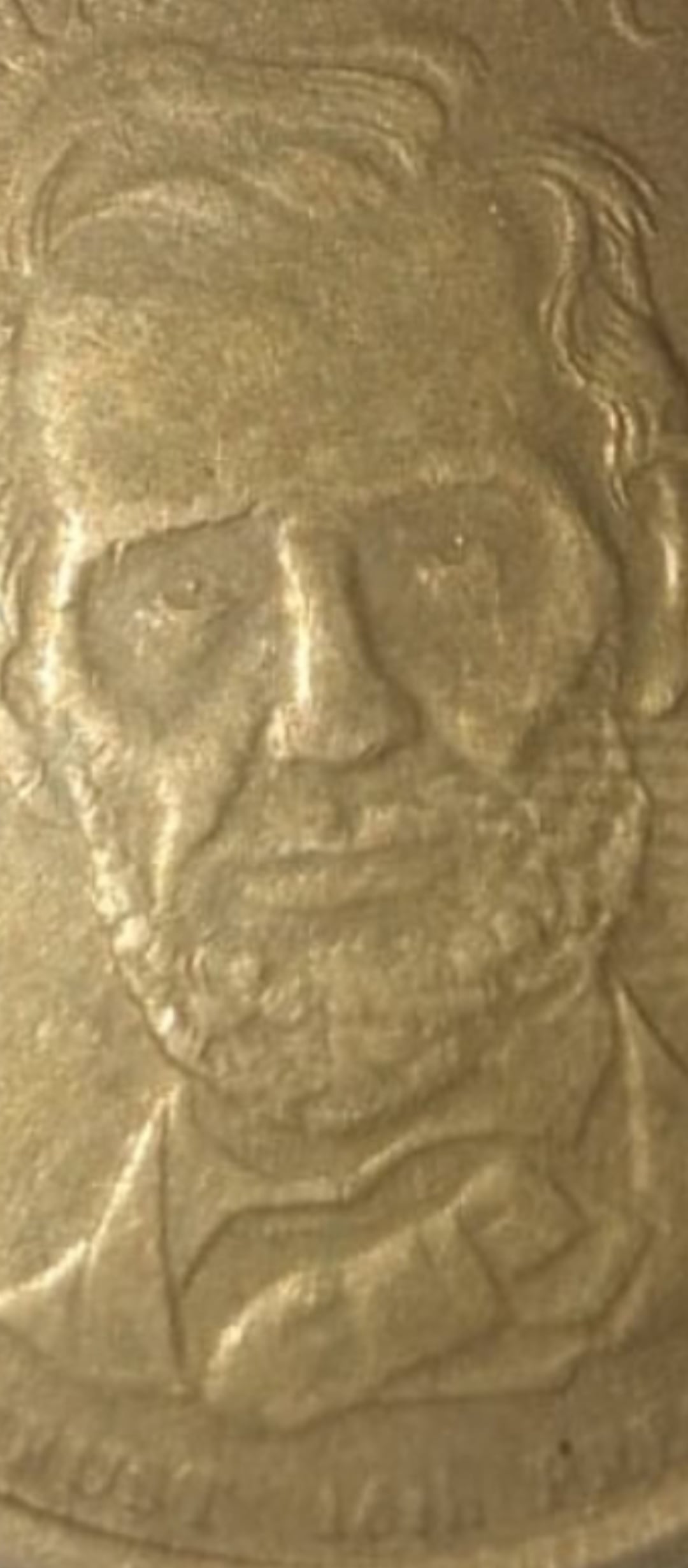
I'm glad to hear that; feel free to calmly and peacefully use it as your thumbnail photo.
The detail on your counterfeit is soft, mushy, and lacks the sharpness of the genuine coin. This is what the bust on a genuine Lincoln dollar is supposed to look like:
Hi IkesT, thank you for sharing that image! However, you are making a basic mistake by trying to compare a pristine, uncirculated specimen (or a proof-like stock photo) to a coin that has been heavily circulating in daily commerce for years.
It completely lacks common sense and logical reasoning to expect a coin that has gone through constant friction in people's pockets, cash registers, and bank bags to maintain the exact same crisp, untouched surface lines as a brand new mint piece. Circulation wear naturally flattens, smooths, and softens the fine details of the bust over time—that is basic numismatic physics, not a sign of a counterfeit.
Thank you, and I truly hope you can sleep well tonight thinking about the eyes of this beloved Abe Lincoln, hahaha!
I'm afraid you are the one who is mistaken. One of the hallmarks of a counterfeit coin is that it looks circulated without being circulated, due to the missing detail. Most crude counterfeits have this look. When you have seen as many counterfeits as I and others on the Forum have, you may be able to learn to tell the difference. Your coin may have seen some circulation, but most of the detail was missing before it started circulating.
My dear friend, historically speaking, we all know that Susan B. Anthony and Presidential $1 coins were never popular or widely accepted in daily circulation within the US. But here in Ecuador, handling and spending these dollar coins is like eating every single day; they circulate heavily. I’m not sure if you actually have heavily circulated Presidential Dollars in hand over there to prove that this specific soft alloy doesn't lose its fine details under years of aggressive friction.
Right now, my stance remains a realistic 50/50. No matter what, I will post the official ANACS verdict here, whether it rules in my favor or against me. My true satisfaction is knowing that I defended my specimen to the best of my ability and had the privilege to technical-debate in one of the largest numismatic forums in the world. I honestly don't know if any other Ecuadorian collector has ever had this privilege here before.
If my specimen turns out to be fake, that's fine—the hunt doesn't stop. I will keep searching for other treasures in our banks, like the famous Zachary Taylor "traveling coin" edge lettering error, or my absolute favorite: the legendary Sacagawea/Washington Quarter mule error.
Take a look at the area behind the bow tie. It's a highly protected area but the Ecuadoran example lacks the detail of the IkesT example.
with the amount you are arguing we expect you'll argue that anacs is wrong
Thanks, my friend, for pointing out that detail! I will definitely check it out. I'm going to find another Lincoln dollar in circulation as soon as possible and share a photo with you so we can compare them.
As a technical note, I didn't risk sending this coin to the US just for a trip. I submitted it because, to me, this looks like a genuine error. Before shipping it, I sought out those who are considered the top experts in the numismatic field here in Ecuador. If this Lincoln turns out to be counterfeit, it will clearly prove that we lack truly qualified people in this area down here. Because of that, I hope to take the online grading and authentication courses offered by the ANA someday.
Hi MsMorrisine, I am not stubborn; I am simply a collector defending my argument and my research with the physical evidence I have in front of me. That is what any passionate numismatist does.
However, make no mistake: once ANACS finishes processing the payment and releases their official written certificate, I will close this case immediately and move on to my daily roll hunting at the banks. Simple as that!
The only thing that will honestly leave me intrigued is how NGC handles things and fails to truly detail the situation like a professional lab should. If it is counterfeit, they should say so, instead of returning an oracle-like "Altered Surface" voucher. But on my end, once the final results drop, the book is closed.
To show you what actually circulates down here, here are these photos of two different counterfeit presidential dollar coins as samples.
Man, it's a contemporary counterfeit collector's dream down there!
the pierce looks to be of the same process and materials as the lincoln
Speaking of words of wisdom, Proverbs 17:27 teaches us: "He who has knowledge spares his words, and a man of understanding is of a calm spirit."
I have always responded in this forum with the utmost respect toward all members. I believe that labels and personal remarks are unnecessary and lower the level of the conversation.
that head is the most disconnected head I have ever seen
on a real coin, what would cause part of the neck to disappear is over-polishing the die. however, when it becomes heavy, there are flat spots between the folds of the gown at the bottom of the coin. the above is a normal coin, and I don't have a coin to show what the flat spots would look like, but the peaks of the folds of the gown would not flow down into a curve but would hit a wide flat spot instead.
Thank you for your highly detailed and technical breakdown, MsMorrisine.
To contribute to your photographic forensic analysis, I noticed these vertical lines running through the statue's reliefs in this close-up image.
In your opinion, does the presence of these vertical lines provide further evidence supporting your theory that this coin is a counterfeit, or what are your thoughts on this specific feature?
In this other image I am sharing, there is a small raised square block near the statue's arm. It looks like the transfer mold used to create this piece might have been deteriorating or breaking apart during the process.
Do you think this anomaly adds more weight to the theory that the coin is counterfeit, or what are your thoughts on this feature?
Did they give you the verdict yet? I hope you get what you're looking for.
Thank you very much, my friend! I appreciate your good wishes. I haven't received the verdict yet; I am still waiting for it.
To be honest, after being in this forum and seeing everything that has been posted, it has given me more doubts than certainties. That is why I proceeded to keep investigating in detail. As it was mentioned in previous messages, it is true that there have been these specialized groups dedicated to manufacturing these types of coins using ultra-high-quality dies.
Later today, I will upload some photos showing exactly how they used to make these coins.
>
I've never seen anything like it. it may be why ngc said altered surfaces. I wouldn't say it adds to the counterfeit idea
the image is too grainy to see it, but raised metal without evidence of a cause i a problem, but the bump can't even be seen
Another option is ICG, much faster on their 5 day tier and they've hired PCGS and NGC graders in the last couple years. $25 for that tier and around $10 bucks for an attribution.
.> @logger7 said:
Considering that the current submission is with a different major grading company than the first one, under what circumstances would you recommend his trying a third one? I don’t see the use in that.
Mark Feld* of Heritage Auctions*Unless otherwise noted, my posts here represent my personal opinions.
I think logger is either totally misguided or he is trying to give our friend false hope. That would be a very cruel thing to do, in my opinion.
what does the mintmark look like?
Hi MsMorrisine, thank you for checking that detail. The truth is, those vertical lines run across the entire relief of the Statue of Liberty. And inside that specific raised square block of metal, you can actually see what looks like a "W" shape under closer view. I have examined this coin millimeter by millimeter, which is why I noticed every single tiny detail.
As I mentioned earlier regarding the counterfeits circulating around my country, they are actually struck using high-end, fine-finished dies. To be honest, they are made so perfectly that I haven't personally found a counterfeit with this specific level of die texture yet, but who knows. They even use specialized tooling to replicate the edge lettering. In a bit, I am going to share some photos of the specialized tools used by these counterfeiters so you can see how advanced they are!
Hi logger7, thank you so much for the advice and the information! I really appreciate the recommendation.
However, whatever the outcome turns out to be for this specific coin, I am going to stick with the final resolution from ANACS, whether it rules in my favor or against me. But if I decide to submit any other piece in the future, I will definitely take ICG into consideration as a solid option. Thanks again, my friend!
Hi @MFeld, thank you for your input! From a strictly technical and analytical standpoint, you are completely right; it wouldn't make much sense to continue chasing opinions across a third grading company.
The main reason I sought a second opinion with ANACS was the deep frustration of receiving NGC's vague verdict. For those of you who work in this market daily, it's tough when a corporate company leaves a paying customer completely in the limbo instead of giving a clear, definitive answer—whether good or bad. I feel ANACS should have been my first choice from the very beginning.
That being used said, I know @logger7 gave his advice in absolute good faith as a helpful suggestion for the future, and I truly appreciate his kindness. But on my end, whatever ANACS officially determines next week will either be the definitive end of this story or a fascinating "to be continued." I really appreciate your common sense!
Hi IkesT, just like someone recently tried to call me stubborn, let me clear this up: I am not stubborn, I am a realist.
Once ANACS releases the official written report next week, we will have the definitive verdict from two of the three most important grading services in the world. If both labs determine there is an anomaly—whether they officially declare it a counterfeit or agree on an altered surface designation—that will be the final stop for this coin. At that exact moment, I will close the book on this piece, regardless of whether the final outcome is good or bad. That will be the definitive end of the story for this Lincoln dollar, and I will be right back to my daily roll hunting at the banks. Simple as that!
Hi jmlanzaf, to answer your question directly: Yes, I absolutely did contact NGC. I am not the type of collector who stays quiet or lives with the doubt, so I reached out to them and asked exactly why they determined it was an "Altered Surface."
During our conversation via WhatsApp message, they implied that I had probably bought the coin from someone and had been deceived. They actually asked me who I purchased the coin from so that I could go back and make a financial claim against the seller. I clarified to them immediately: "No, I didn't buy it from anyone; this coin simply came to me as part of my loose change in daily circulation here in Ecuador." After I gave them that context, the customer service representative completely shut down and refused to provide any further technical details or explanations about the matter.
What left me with the biggest doubt—and the main reason why I sought a second opinion—is how their own grading manual defines things. If you check NGC's guidelines, they state that the "Altered Surface" designation is applied when they detect that the surfaces have been cleaned, chemically treated, or superficially manipulated. However, that designation does not explicitly state that the coin itself is a counterfeit, or that it is a fabricated fake piece. If they had truly determined that the coin was a complete fake, their own protocol would have forced them to label it under an official counterfeit code, or as a "Magician's Coin" if it were an altered novelty. Because their manual left such a gray area without proving it was a counterfeit, I couldn't stay with the doubt.
To be completely honest and upfront, the mintmark is not very sharp or clear because the strike from the Schuler machine was simply not strong enough. However, as I mentioned in my previous messages, I will be sharing more photos soon so you can analyze it for yourself.
As an independent business owner here in Ecuador, cash flows through my hands constantly every single day. Lately, I have been taking the time to thoroughly inspect the edges of thousands of dollar coins that pass through my shop. Based on my personal hands-on research, up until 2009, the edge lettering production from the U.S. Mint was nearly perfect. But from 2010 and 2011 onward, the edge quality became an absolute disaster. On many genuine coins, the year, the mintmark, the stars, and the "E Pluribus Unum" are extremely weak, blurry, or practically invisible because the machine stamping was too weak, leaving just faint traces of the inscriptions.
By the way, just like a senior representative from ANACS kindly showed up here to clear up my doubts, it would be absolutely perfect if someone could invite or tag a representative from NGC into this thread. To be honest, I am not sure if that is even possible on this platform, but having both perspectives here would be amazing!