Home U.S. Coin Forum
Options

Does an active ANACS Cert Number guarantee encapsulation?

Hi everyone,

First of all, with all due respect to the administrators and members of this PCGS forum, I am posting this strictly as a technical and educational inquiry regarding grading company dynamics.

I have a question about ANACS processing: Once a coin has already been assigned a valid Certificate Number in their online system, is there still a probability that the coin could end up being returned in a "bodybag" (rejected)? Or does the generation of an active certificate number with specific metadata mean it passed authentication and will be encapsulated?

I would love to hear about your past experiences with this. Thank you for your time and guidance!

«1

Comments

  • Options

    To give you a bit more context, my question is based on a major mint error I found and submitted: an Abraham Lincoln Presidential $1 Coin featuring a mismatched die/wrong year error (stamped 2011) and a 90-degree rotated die error. This is why I am so anxious to know if the active cert number means it was officially recognized and authenticated by the lab, or if there is still a risk of a bodybag.

  • Options
    CaptHenwayCaptHenway Posts: 33,994 ✭✭✭✭✭

    I cannot speak for how ANACS does things today (I left there in 1984, for heaven’s sake) but back then every coin got an inventory number to enable us to keep track of it through the process and back to the correct person. I assume that they do so today for the same reasons.

    Numismatist. 54 year member ANA. Former ANA Senior Authenticator. Winner of four ANA Heath Literary Awards; three Wayte and Olga Raymond Literary Awards; Numismatist of the Year Award 2009, and ANA Lifetime Achievement Award 2020. Also won the PNG's Robert Friedberg Award for "The Enigmatic Lincoln Cents of 1922," Available now from Whitman or Amazon.
  • Options
    illini420illini420 Posts: 11,581 ✭✭✭✭✭

    I had a recent submission to ANACS that included a Mercury Dime that was worn, but looked like it might be a 1916-D so I sent it in for verification of authenticity before I attempted to sell it. ANACS gave it a cert number on my submission page and it's on their cert verification too as seen below, but it's not genuine and not encapsulated:

  • Options
    IkesTIkesT Posts: 4,399 ✭✭✭✭✭
    edited August 6, 2026 12:54AM

    @ricarf2386 said:
    To give you a bit more context, my question is based on a major mint error I found and submitted: an Abraham Lincoln Presidential $1 Coin featuring a mismatched die/wrong year error (stamped 2011) and a 90-degree rotated die error. This is why I am so anxious to know if the active cert number means it was officially recognized and authenticated by the lab, or if there is still a risk of a bodybag.

    ANACS giving your coin a cert number does not mean they have attributed any Mint errors to your coin.

    Based on your posting history, you were most likely mistaken about the errors. However, ANACS will still encapsulate it as a regular coin (without any error attributions) if it is genuine. I hope that eases your anxiety.

  • Options
    JBKJBK Posts: 17,592 ✭✭✭✭✭

    OP, how about some photos?

    The Lincoln dollar was issued in 2010, so it's a little problematic that you have one dated 2011. The date is on the edge and I've seen lots of cases of damage that obscures the edge lettering (scratches, hits, etc.).

    Also, in a prior thread you said you were from Ecuador. Is there any chance that it is counterfeit? Lots of counterfeit Sacagawea dollars were made in Colombia. Maybe they are also making other forgeries?

  • Options

    To give you a bit more context, my question is based on a major mint error I found and submitted: an Abraham Lincoln Presidential $1 Coin featuring a mismatched die/wrong year error (stamped 2011) and a 90-degree rotated die error. This is why I am so anxious to know if the active cert number means it was officially recognized and authenticated by the lab, or if there is still a risk of a bodybag.

    @illini420 said:
    I had a recent submission to ANACS that included a Mercury Dime that was worn, but looked like it might be a 1916-D so I sent it in for verification of authenticity before I attempted to sell it. ANACS gave it a cert number on my submission page and it's on their cert verification too as seen below, but it's not genuine and not encapsulated:

    That is pure gold! Your comment makes perfect sense. This is exactly how they guarantee that 100% of customers pay for their service. By displaying clean metadata online (Year/Mint) but hiding the specific details and grade, they keep you on the hook. Nobody walks away without funding their card because we are all dying to know the final outcome!

    To add more context, I didn't just send a coin; I attached a 15-page dossier filled with technical analysis and high-resolution photos highlighting every single error location. Because of this massive documentation, I suspect they might even attribute more errors to my coin. Right now, I'm keeping my expectations grounded at a realistic 50/50 probability, but the battle is on.

  • Options

    @CaptHenway said:
    I cannot speak for how ANACS does things today (I left there in 1984, for heaven’s sake) but back then every coin got an inventory number to enable us to keep track of it through the process and back to the correct person. I assume that they do so today for the same reasons.

    Wow, CaptHenway! Thank you so much for your illustration on how ANACS used to work back in the day. I feel deeply honored and pleased that a true heavyweight with your immense experience has taken the time to comment on my thread. Your insight is highly appreciated!

  • Options

    @IkesT said:

    @ricarf2386 said:
    To give you a bit more context, my question is based on a major mint error I found and submitted: an Abraham Lincoln Presidential $1 Coin featuring a mismatched die/wrong year error (stamped 2011) and a 90-degree rotated die error. This is why I am so anxious to know if the active cert number means it was officially recognized and authenticated by the lab, or if there is still a risk of a bodybag.

    ANACS giving your coin a cert number does not mean they have attributed any Mint errors to your coin.

    Based on your posting history, you were most likely mistaken about the errors. However, ANACS will still encapsulate it as a regular coin (without any error attributions) if it is genuine. I hope that eases your anxiety.

    Thanks for your comment! I understand your point, but I didn't take the risk of sending this coin blindly or relying solely on my own eyes and analysis.

    Before submitting it, I had the coin examined by two professional numismatists here in Guayaquil, and both confirmed that the errors and the piece are genuine. I am not guessing; I am backed by expert opinions and a full 15-page technical dossier that I attached to the submission.

    I completely understand that the level of knowledge and numismatic expertise in Ecuador might not be the same as yours in the US. However, the word of these two local numismatists gives me a bit of hope while we wait for the final outcome once ANACS processes the payment and releases all the data.

  • Options
    jmlanzafjmlanzaf Posts: 42,115 ✭✭✭✭✭
    edited August 6, 2026 6:52AM

    @ricarf2386 said:
    To give you a bit more context, my question is based on a major mint error I found and submitted: an Abraham Lincoln Presidential $1 Coin featuring a mismatched die/wrong year error (stamped 2011) and a 90-degree rotated die error. This is why I am so anxious to know if the active cert number means it was officially recognized and authenticated by the lab, or if there is still a risk of a bodybag.

    @illini420 said:
    I had a recent submission to ANACS that included a Mercury Dime that was worn, but looked like it might be a 1916-D so I sent it in for verification of authenticity before I attempted to sell it. ANACS gave it a cert number on my submission page and it's on their cert verification too as seen below, but it's not genuine and not encapsulated:

    That is pure gold! Your comment makes perfect sense. This is exactly how they guarantee that 100% of customers pay for their service. By displaying clean metadata online (Year/Mint) but hiding the specific details and grade, they keep you on the hook. Nobody walks away without funding their card because we are all dying to know the final outcome!

    To add more context, I didn't just send a coin; I attached a 15-page dossier filled with technical analysis and high-resolution photos highlighting every single error location. Because of this massive documentation, I suspect they might even attribute more errors to my coin. Right now, I'm keeping my expectations grounded at a realistic 50/50 probability, but the battle is on.

    I think this post proves that you need to do more research. Coins do not tend to have multiple errors. If you see multiple error locations, you aren't seeing "errors" at all but probably damage.

    Could there be a date error? Yes. Is it likely to be combined with other errors? NO

    All comments reflect the opinion of the author, even when irrefutably accurate.

  • Options

    @JBK said:
    OP, how about some photos?

    The Lincoln dollar was issued in 2010, so it's a little problematic that you have one dated 2011. The date is on the edge and I've seen lots of cases of damage that obscures the edge lettering (scratches, hits, etc.).

    Also, in a prior thread you said you were from Ecuador. Is there any chance that it is counterfeit? Lots of counterfeit Sacagawea dollars were made in Colombia. Maybe they are also making other forgeries?

    Hi JBK, thank you for your technical input! You raise some very solid and realistic points.

    You are completely right about the South American counterfeit factor; it is a harsh reality in our region. In fact, I actually own one of those contemporary counterfeit Sacagawea dollars for comparison purposes. On those fakes, the weight is noticeably lighter, the strike is weak, and the surfaces look bubbly due to poor casting. That is exactly why I examined this Lincoln dollar so thoroughly before submitting it.

    Historically, we have the famous Zachary Taylor Presidential Dollar error, where the edge lettering die from the following year was mistakenly used. Since the beloved Abe Lincoln dollar was the last production run of 2010, there is a technical possibility that a similar transitional or mismatched die error occurred with the 2011 edge dies as the mint prepared for the next series. Furthermore, I managed to find a similar case of a potential wrong-year edge error discussed on an online forum a while ago.

    I found this piece directly in normal circulation here in Ecuador. What causes me the most doubt is that if this coin were just a fake, why would a counterfeiter take the time and effort to precisely replicate the edge lettering just to release a crude imitation into daily loose change? It simply doesn't make sense for a circulating fake.

  • Options


  • Options

    @jmlanzaf said:

    @ricarf2386 said:
    To give you a bit more context, my question is based on a major mint error I found and submitted: an Abraham Lincoln Presidential $1 Coin featuring a mismatched die/wrong year error (stamped 2011) and a 90-degree rotated die error. This is why I am so anxious to know if the active cert number means it was officially recognized and authenticated by the lab, or if there is still a risk of a bodybag.

    @illini420 said:
    I had a recent submission to ANACS that included a Mercury Dime that was worn, but looked like it might be a 1916-D so I sent it in for verification of authenticity before I attempted to sell it. ANACS gave it a cert number on my submission page and it's on their cert verification too as seen below, but it's not genuine and not encapsulated:

    That is pure gold! Your comment makes perfect sense. This is exactly how they guarantee that 100% of customers pay for their service. By displaying clean metadata online (Year/Mint) but hiding the specific details and grade, they keep you on the hook. Nobody walks away without funding their card because we are all dying to know the final outcome!

    To add more context, I didn't just send a coin; I attached a 15-page dossier filled with technical analysis and high-resolution photos highlighting every single error location. Because of this massive documentation, I suspect they might even attribute more errors to my coin. Right now, I'm keeping my expectations grounded at a realistic 50/50 probability, but the battle is on.

    I think this post proves that you need to do more research. Coins do not tend to have multiple errors. If you see multiple error locations, you aren't seeing "errors" at all but probably damage.

    Could get be a date error? Yes. Is it likely to be combined with other errors? NO

    Thanks for your perspective. However, saying that multiple errors cannot occur on a single coin overlooks well-documented numismatic history.

    That is exactly why I only focused on the two most visible and structural errors: the mismatched year on the edge and the 90-degree rotated die. This rotation is an undeniable physical fact, not damage. When I flip the Lincoln dollar on its vertical axis, the Statue of Liberty on the reverse appears completely sideways (laying down). If I do it vice versa, the same thing happens. That is why I refer to these two as definitive, while any other minor details were only mentioned as "possible" errors for the lab to examine.

    When a tooling mix-up or mechanical issue occurs during a transitional period at the mint, a cascade of faults can happen. That is why I preferred to let the experts analyze it. God willing, the lab will first determine that it is completely genuine, and secondly, officially attribute its major errors.

  • Options
    JBKJBK Posts: 17,592 ✭✭✭✭✭
    edited August 6, 2026 6:48AM

    Thanks for the photos.

    This comment represents faulty reasoning:

    What causes me the most doubt is that if this coin were just a fake, why would a counterfeiter take the time and effort to precisely replicate the edge lettering just to release a crude imitation into daily loose change? It simply doesn't make sense for a circulating fake.

    Check out the deluge of fake British pound coins (old design). Quality varied, but often times the intricate edge lettering was excellent. It helped convince people that it was real. It was sometimes mismatched to the reverse design snd that gave them away as forgeries. (As did the frequent die rotation issues).

    On your coin, were the clad layers visible on the edge?

    You have one advantage over Americans in that we dont usually see well-circulated examples of these. However, i suspect you might have found a counterfeit coin.

  • Options

    @JBK said:
    Thanks for the photos.

    This comment represents faulty reasoning:

    What causes me the most doubt is that if this coin were just a fake, why would a counterfeiter take the time and effort to precisely replicate the edge lettering just to release a crude imitation into daily loose change? It simply doesn't make sense for a circulating fake.

    Check out the deluge of fake British pound coins (old design). Quality varied, but often times the intricate edge lettering was excellent. It helped convince people that it was real. It was sometimes mismatched to the reverse design snd that gave them away as forgeries. (As did the frequent die rotation issues).

    On your coin, were the clax layers visible on the edge?

    You have one advantage over Americans in that we dont usually see well-circulated examples of these. However, i suspect you might have found a counterfeit coin.

    That is exactly why I am keeping my expectations at a realistic 50/50. I honestly don't know if this fact is a point in my favor or something that drops the percentage of my coin meeting all requirements to be successfully certified and attributed with the errors.

    But there is a huge detail: this coin already went through NGC's strict quality controls before, and they officially identified it in their system by its exact name: "Abraham Lincoln Presidential $1 Coin, 16th President." They didn't call it a counterfeit; they only returned it with the designation of "Altered Surface."

    This proves that the metal and the coin itself are 100% genuine U.S. Mint material, and the only technical debate is whether the 2011 edge lettering is a mint error or a post-mint alteration. We just have to wait for ANACS's final verdict now!

  • Options

  • Options
    jmlanzafjmlanzaf Posts: 42,115 ✭✭✭✭✭

    .> @ricarf2386 said:

    @jmlanzaf said:

    @ricarf2386 said:
    To give you a bit more context, my question is based on a major mint error I found and submitted: an Abraham Lincoln Presidential $1 Coin featuring a mismatched die/wrong year error (stamped 2011) and a 90-degree rotated die error. This is why I am so anxious to know if the active cert number means it was officially recognized and authenticated by the lab, or if there is still a risk of a bodybag.

    @illini420 said:
    I had a recent submission to ANACS that included a Mercury Dime that was worn, but looked like it might be a 1916-D so I sent it in for verification of authenticity before I attempted to sell it. ANACS gave it a cert number on my submission page and it's on their cert verification too as seen below, but it's not genuine and not encapsulated:

    That is pure gold! Your comment makes perfect sense. This is exactly how they guarantee that 100% of customers pay for their service. By displaying clean metadata online (Year/Mint) but hiding the specific details and grade, they keep you on the hook. Nobody walks away without funding their card because we are all dying to know the final outcome!

    To add more context, I didn't just send a coin; I attached a 15-page dossier filled with technical analysis and high-resolution photos highlighting every single error location. Because of this massive documentation, I suspect they might even attribute more errors to my coin. Right now, I'm keeping my expectations grounded at a realistic 50/50 probability, but the battle is on.

    I think this post proves that you need to do more research. Coins do not tend to have multiple errors. If you see multiple error locations, you aren't seeing "errors" at all but probably damage.

    Could get be a date error? Yes. Is it likely to be combined with other errors? NO

    Thanks for your perspective. However, saying that multiple errors cannot occur on a single coin overlooks well-documented numismatic history.

    That is exactly why I only focused on the two most visible and structural errors: the mismatched year on the edge and the 90-degree rotated die. This rotation is an undeniable physical fact, not damage. When I flip the Lincoln dollar on its vertical axis, the Statue of Liberty on the reverse appears completely sideways (laying down). If I do it vice versa, the same thing happens. That is why I refer to these two as definitive, while any other minor details were only mentioned as "possible" errors for the lab to examine.

    When a tooling mix-up or mechanical issue occurs during a transitional period at the mint, a cascade of faults can happen. That is why I preferred to let the experts analyze it. God willing, the lab will first determine that it is completely genuine, and secondly, officially attribute its major errors.

    Incorrect.

    I said "don't tend", not that it never happens.

    You refer to multiple locations. Every additional "error" is increasingly statistically unlikely.

    Even the rotation coupled with the date suggest it is more likely (statistically) a sloppy counterfeit than a genuine dual error.

    All comments reflect the opinion of the author, even when irrefutably accurate.

  • Options

    @jmlanzaf said:
    .> @ricarf2386 said:

    @jmlanzaf said:

    @ricarf2386 said:
    To give you a bit more context, my question is based on a major mint error I found and submitted: an Abraham Lincoln Presidential $1 Coin featuring a mismatched die/wrong year error (stamped 2011) and a 90-degree rotated die error. This is why I am so anxious to know if the active cert number means it was officially recognized and authenticated by the lab, or if there is still a risk of a bodybag.

    @illini420 said:
    I had a recent submission to ANACS that included a Mercury Dime that was worn, but looked like it might be a 1916-D so I sent it in for verification of authenticity before I attempted to sell it. ANACS gave it a cert number on my submission page and it's on their cert verification too as seen below, but it's not genuine and not encapsulated:

    That is pure gold! Your comment makes perfect sense. This is exactly how they guarantee that 100% of customers pay for their service. By displaying clean metadata online (Year/Mint) but hiding the specific details and grade, they keep you on the hook. Nobody walks away without funding their card because we are all dying to know the final outcome!

    To add more context, I didn't just send a coin; I attached a 15-page dossier filled with technical analysis and high-resolution photos highlighting every single error location. Because of this massive documentation, I suspect they might even attribute more errors to my coin. Right now, I'm keeping my expectations grounded at a realistic 50/50 probability, but the battle is on.

    I think this post proves that you need to do more research. Coins do not tend to have multiple errors. If you see multiple error locations, you aren't seeing "errors" at all but probably damage.

    Could get be a date error? Yes. Is it likely to be combined with other errors? NO

    Thanks for your perspective. However, saying that multiple errors cannot occur on a single coin overlooks well-documented numismatic history.

    That is exactly why I only focused on the two most visible and structural errors: the mismatched year on the edge and the 90-degree rotated die. This rotation is an undeniable physical fact, not damage. When I flip the Lincoln dollar on its vertical axis, the Statue of Liberty on the reverse appears completely sideways (laying down). If I do it vice versa, the same thing happens. That is why I refer to these two as definitive, while any other minor details were only mentioned as "possible" errors for the lab to examine.

    When a tooling mix-up or mechanical issue occurs during a transitional period at the mint, a cascade of faults can happen. That is why I preferred to let the experts analyze it. God willing, the lab will first determine that it is completely genuine, and secondly, officially attribute its major errors.

    Incorrect.

    I said "don't tend", not that it never happens.

    You refer to multiple locations. Every additional "error" is increasingly statistically unlikely.

    Even the rotation coupled with the date suggest it is more likely (statistically) a sloppy counterfeit than a genuine dual error.

    I think there might have been a slight misunderstanding in the translation, or perhaps I misread your point. Just to give you more context, I didn't take this journey lightly.

    Before shipping the coin, I had it thoroughly examined by local experts here in Ecuador. Sending a coin from my country is a massive challenge: it's very difficult to send currency abroad, and dealing with customs paperwork to get the coin legally into the US was a complex task. When you add up the shipping costs, customs fees, and express grading rates, the financial investment has been considerable.

    I've read on the forums that even for collectors living in the US, submissions can be complicated, and sometimes coins even get lost in transit. However, we have a saying down here in South America—and I'm not sure if you have a similar one over there: "He who does not risk, does not win." I just couldn't live with the doubt; I needed to know the absolute truth about this piece, whether the final answer is a yes or a no. Let's wait and see the final result!

  • Options
    JBKJBK Posts: 17,592 ✭✭✭✭✭

    When you submit do you pay for error attribution?

    I don't know how NGC would handle it but I'd hope they'd slab it with the error and note the surfaces on the label.

  • Options

    Thank you so much! I really appreciate your good wishes, and I truly hope it ends up encapsulated with the error noted on the slab.

    To answer your question, I ask myself the same thing. I actually did pay NGC for the full error attribution service, but they refused to encapsulate it. My personal theory is that because of their strict financial grade and authenticity guarantee, they chose to wash their hands of it rather than take a risk on an unprecedented error.

    I had this exact technical discussion with Todd Pollock on MyCollect a while ago, and I explained this reasoning to him. In my view, that is the main reason why NGC backed down and didn't slab it. Hopefully, ANACS takes a more scientific and less corporate approach.

  • Options
    jmlanzafjmlanzaf Posts: 42,115 ✭✭✭✭✭

    @JBK said:
    When you submit do you pay for error attribution?

    I don't know how NGC would handle it but I'd hope they'd slab it with the error and note the surfaces on the label.

    Actually, since they only designated altered surface and a body bag, I don't think the OP can conclude that NGC is declaring it to be genuine.

    The altered surface could be the date.

    All comments reflect the opinion of the author, even when irrefutably accurate.

  • Options

    @JBK said:
    When you submit do you pay for error attribution?

    I don't know how NGC would handle it but I'd hope they'd slab it with the error and note the surfaces on the label.

    Thank you so much! I really appreciate your good wishes, and I truly hope it ends up encapsulated with the error noted on the slab.

    To answer your question, I ask myself the same thing. I actually did pay NGC for the full error attribution service, but they refused to encapsulate it. My personal theory is that because of their strict financial grade and authenticity guarantee, they chose to wash their hands of it rather than take a risk on an unprecedented error.

    I had this exact technical discussion with Todd Pollock on MyCollect a while ago, and I explained this reasoning to him. In my view, that is the main reason why NGC backed down and didn't slab it. Hopefully, ANACS takes a more scientific and less corporate approach.

  • Options

    @JBK said:
    When you submit do you pay for error attribution?

    I don't know how NGC would handle it but I'd hope they'd slab it with the error and note the surfaces on the label.

    Thank you so much! I really appreciate your good wishes, and I truly hope it ends up encapsulated with the error noted on the slab.

    To answer your question, I ask myself the same thing. I actually did pay NGC for the full error attribution service, but they refused to encapsulate it. My personal theory is that because of their strict financial grade and authenticity guarantee, they chose to wash their hands of it rather than take a risk on an unprecedented error.

    I had this exact technical discussion with Todd Pollock on MyCollect a while ago, and I explained this reasoning to him. In my view, that is the main reason why NGC backed down and didn't slab it. Hopefully, ANACS takes a more scientific and less corporate approach.

    @jmlanzaf said:

    @JBK said:
    When you submit do you pay for error attribution?

    I don't know how NGC would handle it but I'd hope they'd slab it with the error and note the surfaces on the label.

    Actually, since they only designated altered surface and a body bag, I don't think the OP can conclude that NGC is declaring it to be genuine.

    The altered surface could be the date.

    Hi jmlanzaf, thank you for your critical input! You make a fair point, but from a technical grading perspective, there is a very strict difference in how NGC handles fakes versus alterations.

    If NGC’s advanced lab had determined that the entire planchet or the coin itself was a contemporary counterfeit or an illegal cast, their protocol dictates returning the coin under the strict code of "Not Genuine" or "Counterfeit." By explicitly assigning it the catalog identity of a 2010-D Abraham Lincoln Presidential $1 Coin and labeling it "Altered Surface," they legally authenticated the metal host and the Denver mintmark as original U.S. Mint products.

    You are completely right that the "altered surface" they refer to could be the 2011 date on the edge. However, if this is a simple post-mint alteration on a genuine coin, could you explain to me how a superficial edge manipulation could possibly produce a perfect 90-degree rotated die error between the obverse and reverse? The rotation is an internal minting flaw, not surface damage.

    That is exactly why I submitted it to ANACS—to see if their specialized error technicians determine if this is a genuine transitional cascade error or a post-mint manipulation. Let's wait for the final data!

  • Options
    JBKJBK Posts: 17,592 ✭✭✭✭✭
    edited August 6, 2026 8:09AM

    I don't know the answer, but I wonder if NGC does the whole authentication on a coin that they've deemed to have altered surfaces. Maybe they reach that first hurdle and then just pull the plug.

    As suggested, the "altered surfaces" could be the edge lettering, but why would someone grind off the legitimate lettering, add new, and then spend the coin.

    The rotation is what it is. If it's there then it's there, whether the coin is genuine or counterfeit.

  • Options
    coinbufcoinbuf Posts: 12,511 ✭✭✭✭✭
    edited August 6, 2026 8:09AM

    @JBK said:
    When you submit do you pay for error attribution?

    I don't know how NGC would handle it but I'd hope they'd slab it with the error and note the surfaces on the label.

    From the NGC website:

    @JBK said:
    I don't know the answer, but I wonder if NGC does the whole authentication on a coin that they've deemed to have altered surfaces. Maybe they reach that first hurdle and then just pull the plug.

    While I cannot say for sure I do believe that once a critical issue (meaning an issue that results in a bodybag) is found there is no reason to go any further and indeed just pull the plug. Just because NGC did not note not genuine on the tag does not imply that the coin is actually genuine.

    My Lincoln Registry
    My Collection of Old Holders

    Never a slave to one plastic brand will I ever be.
  • Options
    jmlanzafjmlanzaf Posts: 42,115 ✭✭✭✭✭

    @ricarf2386 said:

    @JBK said:
    When you submit do you pay for error attribution?

    I don't know how NGC would handle it but I'd hope they'd slab it with the error and note the surfaces on the label.

    Thank you so much! I really appreciate your good wishes, and I truly hope it ends up encapsulated with the error noted on the slab.

    To answer your question, I ask myself the same thing. I actually did pay NGC for the full error attribution service, but they refused to encapsulate it. My personal theory is that because of their strict financial grade and authenticity guarantee, they chose to wash their hands of it rather than take a risk on an unprecedented error.

    I had this exact technical discussion with Todd Pollock on MyCollect a while ago, and I explained this reasoning to him. In my view, that is the main reason why NGC backed down and didn't slab it. Hopefully, ANACS takes a more scientific and less corporate approach.

    @jmlanzaf said:

    @JBK said:
    When you submit do you pay for error attribution?

    I don't know how NGC would handle it but I'd hope they'd slab it with the error and note the surfaces on the label.

    Actually, since they only designated altered surface and a body bag, I don't think the OP can conclude that NGC is declaring it to be genuine.

    The altered surface could be the date.

    Hi jmlanzaf, thank you for your critical input! You make a fair point, but from a technical grading perspective, there is a very strict difference in how NGC handles fakes versus alterations.

    If NGC’s advanced lab had determined that the entire planchet or the coin itself was a contemporary counterfeit or an illegal cast, their protocol dictates returning the coin under the strict code of "Not Genuine" or "Counterfeit." By explicitly assigning it the catalog identity of a 2010-D Abraham Lincoln Presidential $1 Coin and labeling it "Altered Surface," they legally authenticated the metal host and the Denver mintmark as original U.S. Mint products.

    You are completely right that the "altered surface" they refer to could be the 2011 date on the edge. However, if this is a simple post-mint alteration on a genuine coin, could you explain to me how a superficial edge manipulation could possibly produce a perfect 90-degree rotated die error between the obverse and reverse? The rotation is an internal minting flaw, not surface damage.

    That is exactly why I submitted it to ANACS—to see if their specialized error technicians determine if this is a genuine transitional cascade error or a post-mint manipulation. Let's wait for the final data!

    An altered date wouldn't be considered "counterfeit". And sometimes, once they have any reason to body bag it, they stop looking.

    All comments reflect the opinion of the author, even when irrefutably accurate.

  • Options
    JBKJBK Posts: 17,592 ✭✭✭✭✭

    You might have to send it to ICG to have it slabbed in one if their "counterfeit" holders and see if they reject it as genuine. :)

  • Options
    lermishlermish Posts: 4,800 ✭✭✭✭✭

    @pruebas said:
    Why all the beating around the bush and hesitation on this thread. The coin is 100% fake and quite obviously so, even from the crappy photos.

    That was my immediate gut reaction but I have never handled/seen one of these coins in any condition, much less well circulated. I suspect others are in the same boat which may lead to some of the hesitation.

    chopmarkedtradedollars.com

  • Options
    pruebaspruebas Posts: 5,248 ✭✭✭✭✭

    There’s a reason it has so many errors. Counterfeiters have crappy equipment. The US Mint does not.

    The coin isn’t circulated. It’s FAKE.

  • Options
    JBKJBK Posts: 17,592 ✭✭✭✭✭

    I have felt it was likely counterfeit from the beginning, but as I and others have said, we are at a disadvantage because we rarely if ever see these with any kind of wear on them.

    I'm not a huge fan of the obverse lettering and both obverse and reverse faces.

    I had asked if the clad layers were visible on the edge but that question wasn't answered. The layers are one thing the counterfeiters can't fake. (I do have a counterfeit Sacagawea where a dark stripe was painted around the edge to simulate a darkened copper core, but that was fairly obvious upon close inspection.)

  • Options
    AngryTurtleAngryTurtle Posts: 1,609 ✭✭✭

    It just strikes me as odd that we keep having debates over the meanings of grading company written opinions. I.'m thinking of this case plus the off metal lincoln (https://forums.collectors.com/discussion/1121524/1983-lincoln-cent-defective-bronze-planchet-ngc-vs-pcgs#latest) . Grading companies are paid for their opinion, the opinion is rendered, and then its like a pronouncement from the oracle of delphi, with no one agreeing on the meaning of the grading companies ruling.

  • Options
    coinbufcoinbuf Posts: 12,511 ✭✭✭✭✭
    edited August 6, 2026 9:53AM

    @AngryTurtle said:
    It just strikes me as odd that we keep having debates over the meanings of grading company written opinions. I.'m thinking of this case plus the off metal lincoln (https://forums.collectors.com/discussion/1121524/1983-lincoln-cent-defective-bronze-planchet-ngc-vs-pcgs#latest) . Grading companies are paid for their opinion, the opinion is rendered, and then its like a pronouncement from the oracle of delphi, with no one agreeing on the meaning of the grading companies ruling.

    Because the TPG's are not doing a good job of communication and or identification. In the case of that Lincoln you linked there are three different opinions, one from NGC and two from PCGS. How do you not expect debates when the TPG's are that inconsistent and provide zero transparency on the opinions they render.

    I fully think the op coin of this thread is a counterfeit, but NGC did not do the op any favors with their opinion. Had they said counterfeit the op's hopes would not have been bolstered and he would not have needed to spend further monies on this.

    My Lincoln Registry
    My Collection of Old Holders

    Never a slave to one plastic brand will I ever be.
  • Options

    I have been reading everyone's comments here on the thread, and based on your insights, I can now assume that I was the one who took the wrong path—not NGC. My mistake was trusting NGC to grade a complex piece like this in the first place. If this coin is truly a counterfeit, as many of you firmly believe, NGC should have officially certified it as such. The grading and error attribution service I paid for was not free; they have a duty to take their work seriously. In reality, this lack of transparency is a much bigger problem for all of you than it is for me, since you are the ones dealing with these corporate grading companies on a daily basis in the US market.

    To answer the questions about the exact edge details and physical specs: The edge is completely golden. However, under close inspection, I managed to find two minuscule, 1mm spots where the reddish copper core peeks through under the wear. Also, the edge has a distinctive tapered shape (cónico)—it is noticeably thinner on one side and wider on the other, creating a slight flange effect.

    Furthermore, before shipping it to the US, the coin was physically weighed and thoroughly examined by two independent numismatic experts here in Guayaquil. It registered right around the marginal tolerance limits for a genuine clad planchet. Both local experts concluded that the piece is genuine mint material, not a crude casting. But at the end of the day, the multi-million dollar third-party grading labs hold the final word. Let's see what ANACS dictates!

  • Options

    To add even more context to my research, I also found a documented case from a collector inside the United States on an online forum who reported this exact same anomaly. Therefore, if this coin turns out to be a counterfeit, there is a very high probability that it was not manufactured here in South America, but rather in highly sophisticated operations within the United States or China.
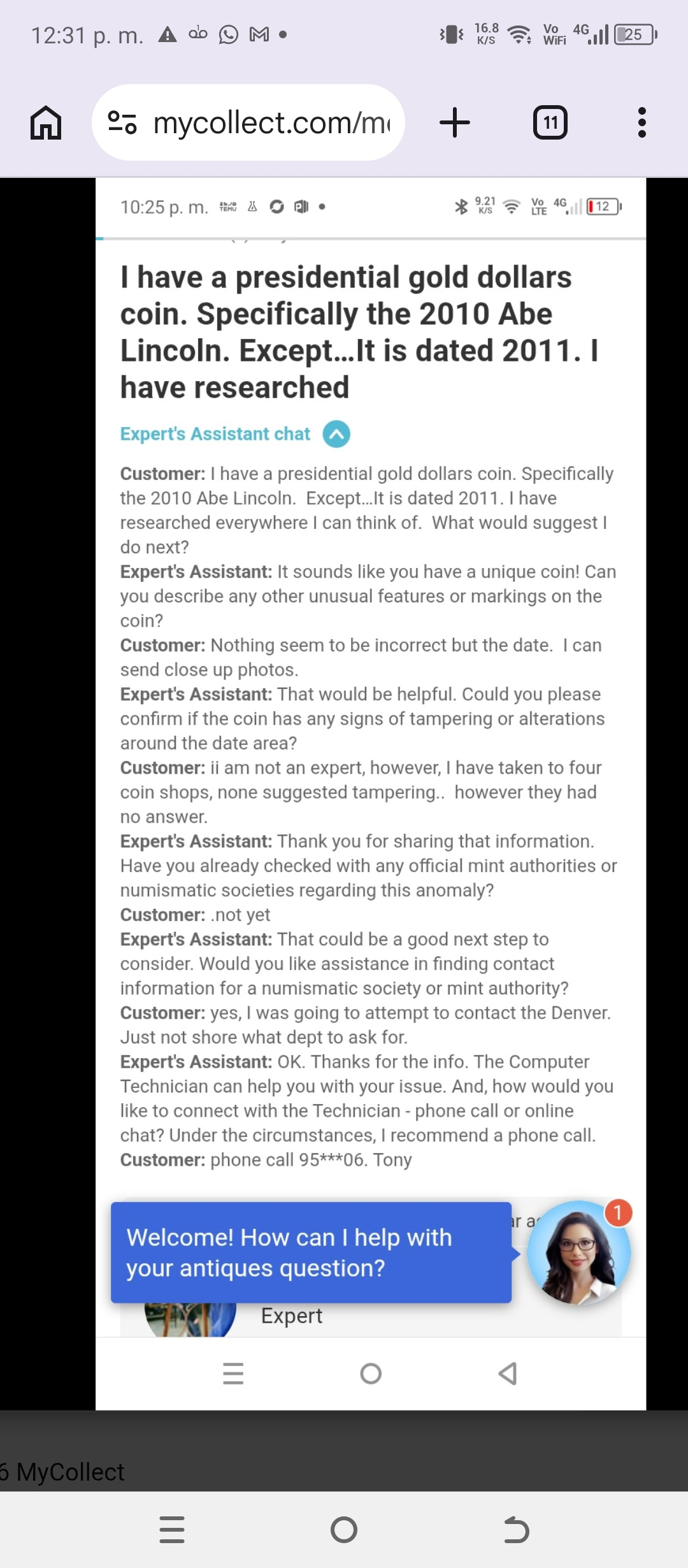
  • Options
    JBKJBK Posts: 17,592 ✭✭✭✭✭

    Thanks for the additional details.

    Here are my thoughts...

    @ricarf2386 said:

    To answer the questions about the exact edge details and physical specs: The edge is completely golden. However, under close inspection, I managed to find two minuscule, 1mm spots where the reddish copper core peeks through under the wear.

    The layers are rarely equal or even in thickness (as viewed from the edge) but they should usually be visible. Only one or two spots on the whole edge is concerning. Of course, heavy tarnish can obscure the color differences among the layers, but they should hopefully still be visible under close examination on a genuine coin.

    Also, the edge has a distinctive tapered shape (cónico)—it is noticeably thinner on one side and wider on the other, creating a slight flange effect.

    Not unknown on a genuine coin, but not reassuring.

    Both local experts concluded that the piece is genuine mint material, not a crude casting.

    The Colombian counterfeits are struck, not cast, so if your local experts are deciding between struck or crude casting, they will get fooled by counterfeits. (The dies themselves are of varying quality, but some are very good).

    By the way, you could probably make some money by looking for counterfeit dollar coins in Equador and selling them to American collectors. :)

  • Options

    @JBK said:
    Thanks for the additional details.

    Here are my thoughts...

    @ricarf2386 said:

    To answer the questions about the exact edge details and physical specs: The edge is completely golden. However, under close inspection, I managed to find two minuscule, 1mm spots where the reddish copper core peeks through under the wear.

    The layers are rarely equal or even in thickness (as viewed from the edge) but they should usually be visible. Only one or two spots on the whole edge is concerning. Of course, heavy tarnish can obscure the color differences among the layers, but they should hopefully still be visible under close examination on a genuine coin.

    Also, the edge has a distinctive tapered shape (cónico)—it is noticeably thinner on one side and wider on the other, creating a slight flange effect.

    Not unknown on a genuine coin, but not reassuring.

    Both local experts concluded that the piece is genuine mint material, not a crude casting.

    The Colombian counterfeits are struck, not cast, so if your local experts are deciding between struck or crude casting, they will get fooled by counterfeits. (The dies themselves are of varying quality, but some are very good).

    By the way, you could probably make some money by looking for counterfeit dollar coins in Equador and selling them to American collectors. :)

    Hi JBK, thank you for another brilliant and highly technical response! You are completely right about the Colombian fakes being struck rather than cast. That is a massive distinction, and it's true that a struck counterfeit can easily fool someone who is only looking for crude casting bubbles. I appreciate that warning.

    Regarding the clad layers being completely hidden by the solid golden edge, that can actually point to a known mint error as well. When the planchet strip is irregular or undergoes a malfunction during the heating process at the mint—known as an "Improperly Annealed Planchet"—molecules from the copper core can fuse into the outer layers, or the extreme pressure from the Schuler edge machine causes "edge smearing." This mechanical rollover covers the copper core completely, making the edge look like solid gold under normal view. The true copper core usually only peeks through on tiny 1mm spots where deep circulation marks or specific wear have cut through that smeared outer layer over time.

    Okay, okay, challenge accepted! I am actually going to start hunting for those unique circulating fakes down here. I already have one contemporary counterfeit Sacagawea dollar in my possession, but that one was definitely made by casting. I will share a photo of it very soon here on the thread so you can all check it out!

  • Options

    @pruebas said:
    Why all the beating around the bush and hesitation on this thread. The coin is 100% fake and quite obviously so, even from the crappy photos.

    I have no doubt ANACS will proclaim it so and put the OP out of his misery (and his money).

    Hi @pruebas, thank you for your opinion, although I didn't know we had an official top-tier grader from the U.S. Mint among us who can authenticate coins strictly through low-quality photos!

    Regarding the money I spent on the express submission: don't worry about my finances. This expense doesn't make me any richer, nor does it make me any poorer. For a true collector, investing in the search for the truth and gaining numismatic education is always money well spent. I simply couldn't live with the doubt, and hiding behind assumptions without trying is not my style.

    At the end of the day, I prefer to rely on the scientific metallurgical testing of an actual lab rather than a quick guess on a forum. Let's let ANACS settle the suffering very soon!

  • Options
    MsMorrisineMsMorrisine Posts: 39,638 ✭✭✭✭✭


    counterfeit

    one thing that is easy to see is the difference in the '0' in the date. the subject coin's '0' is too fat

    Current maintainer of Stone's Master List of Favorite Websites // My BST transactions
  • Options
    MsMorrisineMsMorrisine Posts: 39,638 ✭✭✭✭✭

    Current maintainer of Stone's Master List of Favorite Websites // My BST transactions
  • Options
    MsMorrisineMsMorrisine Posts: 39,638 ✭✭✭✭✭

    in fact, all the numbers of the date are wrong

    Current maintainer of Stone's Master List of Favorite Websites // My BST transactions
  • Options
    jmlanzafjmlanzaf Posts: 42,115 ✭✭✭✭✭

    @ricarf2386 said:

    @pruebas said:
    Why all the beating around the bush and hesitation on this thread. The coin is 100% fake and quite obviously so, even from the crappy photos.

    I have no doubt ANACS will proclaim it so and put the OP out of his misery (and his money).

    Hi @pruebas, thank you for your opinion, although I didn't know we had an official top-tier grader from the U.S. Mint among us who can authenticate coins strictly through low-quality photos!

    Regarding the money I spent on the express submission: don't worry about my finances. This expense doesn't make me any richer, nor does it make me any poorer. For a true collector, investing in the search for the truth and gaining numismatic education is always money well spent. I simply couldn't live with the doubt, and hiding behind assumptions without trying is not my style.

    At the end of the day, I prefer to rely on the scientific metallurgical testing of an actual lab rather than a quick guess on a forum. Let's let ANACS settle the suffering very soon!

    There are no U.S. Mint graders. I think you mean a "top-tier grader" from a grading service. And, in fact, we do have some of them on this forum.

    The low-quality photos are why most of us, even though suspicious, have not made any definite determination.

    All comments reflect the opinion of the author, even when irrefutably accurate.

  • Options

    @MsMorrisine said:
    in fact, all the numbers of the date are wrong

    Hi MsMorrisine, thank you for taking the time to crop and compare the images! However, your analysis overlooks a couple of fundamental mechanical facts about edge lettering production.

    First, you are comparing a regular, crisp strike to a coin that has gone through circulation and potential "edge smearing" pressure. Mechanical wear and the rolling process in the Schuler machine frequently distort, flatten, or widen characters on the rim, which easily explains why that "0" or the other numbers appear thicker in a digital zoom. Analyzing a physical coin’s microscopic typography based entirely on the pixel distortion of a zoomed-in photograph is just a guessing game.

    Second, as we discussed before, you collectors in the US rarely see these Presidential Dollars in daily use. Here in Ecuador, due to dollarization, these coins circulate heavily every single day. Based on my own hands-on experience examining thousands of them, from 2009 onward, nearly all presidential coins down here show highly irregular, weak, blurry, or improperly rolled edge lettering. You cannot evaluate an unprecedented transitional or mismatched die error by expecting it to look like a perfect textbook specimen.

    If you or anyone else on this thread has any doubts or wants to see the technical details, just ask me for photos and I will gladly share microscopic images of how messy these edges actually get in reality.

  • Options

    @jmlanzaf said:

    @ricarf2386 said:

    @pruebas said:
    Why all the beating around the bush and hesitation on this thread. The coin is 100% fake and quite obviously so, even from the crappy photos.

    I have no doubt ANACS will proclaim it so and put the OP out of his misery (and his money).

    Hi @pruebas, thank you for your opinion, although I didn't know we had an official top-tier grader from the U.S. Mint among us who can authenticate coins strictly through low-quality photos!

    Regarding the money I spent on the express submission: don't worry about my finances. This expense doesn't make me any richer, nor does it make me any poorer. For a true collector, investing in the search for the truth and gaining numismatic education is always money well spent. I simply couldn't live with the doubt, and hiding behind assumptions without trying is not my style.

    At the end of the day, I prefer to rely on the scientific metallurgical testing of an actual lab rather than a quick guess on a forum. Let's let ANACS settle the suffering very soon!

    There are no U.S. Mint graders. I think you mean a "top-tier grader" from a grading service. And, in fact, we do have some of them on this forum.

    The low-quality photos are why most of us, even though suspicious, have not made any definite determination.

    Thank you for your honest and fair comment. You are completely right about the photos; I know my equipment isn't high-quality right now, and that makes it hard to see the fine details clearly.

    The truth is, I am deeply passionate about numismatics, and this experience has motivated me to upgrade my gear. I definitely plan to invest in a much better microscope and high-quality camera setup very soon. There is a huge advantage down here in Ecuador because our banks still hold thousands of original, unsearched rolls of Presidential and Sacagawea dollars from over a decade ago. I am going to keep hunting for mint errors and varieties in these fresh rolls, and next time, I promise I will bring you all crystal-clear, professional images to examine!

    In the meantime, since camera flash can sometimes distort the edge surfaces, I want to share that I have uploaded a 2-minute video on MyCollect. In that video, under natural lighting, I clearly demonstrate both the 2011 edge lettering error and the 90-degree rotated die anomaly in real time. You can easily find it on my profile there under the username ricarf2386 if you want to take a closer look!

  • Options
    pruebaspruebas Posts: 5,248 ✭✭✭✭✭
    edited August 6, 2026 11:26AM

    @jmlanzaf said:

    @ricarf2386 said:

    @pruebas said:
    Why all the beating around the bush and hesitation on this thread. The coin is 100% fake and quite obviously so, even from the crappy photos.

    I have no doubt ANACS will proclaim it so and put the OP out of his misery (and his money).

    Hi @pruebas, thank you for your opinion, although I didn't know we had an official top-tier grader from the U.S. Mint among us who can authenticate coins strictly through low-quality photos!

    There are no U.S. Mint graders. I think you mean a "top-tier grader" from a grading service. And, in fact, we do have some of them on this forum.

    He was being sarcastic. Or more correctly, his AI was being sarcastic.

  • Options

    @pruebas said:

    @jmlanzaf said:

    @ricarf2386 said:

    @pruebas said:
    Why all the beating around the bush and hesitation on this thread. The coin is 100% fake and quite obviously so, even from the crappy photos.

    I have no doubt ANACS will proclaim it so and put the OP out of his misery (and his money).

    Hi @pruebas, thank you for your opinion, although I didn't know we had an official top-tier grader from the U.S. Mint among us who can authenticate coins strictly through low-quality photos!

    There are no U.S. Mint graders. I think you mean a "top-tier grader" from a grading service. And, in fact, we do have some of them on this forum.

    He was being sarcastic. Or more correctly, his AI was being sarcastic.

    My dear friend, AI is simply a tool that allows you and me to communicate, since my native language is not the same as yours. To be honest, I perceived your previous message that way, and that is why I responded in that tone. If you felt offended by my response, I sincerely apologize. I took your words as sarcasm, and that was the reason behind my reaction. Let's keep a friendly discussion!

  • Options
    JBKJBK Posts: 17,592 ✭✭✭✭✭

    I suspect that you are seeing a lot more counterfeit coins there in Ecuador than you might realize. ;)

    The edge lettering animolies might be a good indicator. Edge lettering comes in various depths (deeply impressed numbers will look a little different than light ones) but the basic shape of letters/numbers shouldn't change.

  • Options
    IkesTIkesT Posts: 4,399 ✭✭✭✭✭
    edited August 6, 2026 11:48AM

    @ricarf2386 Remember the golden rule that was revealed to you here on the Forum: if it is a coin you found, it is not a monumental rarity.

    Treasure these golden words and keep them close to your heart at all times.

  • Options

    @JBK said:
    I suspect that you are seeing a lot more counterfeit coins there in Ecuador than you might realize. ;)

    The edge lettering animolies might be a good indicator. Edge lettering comes in various depths (deeply impressed numbers will look a little different than light ones) but the basic shape of letters/numbers shouldn't change.

    @JBK said:
    I suspect that you are seeing a lot more counterfeit coins there in Ecuador than you might realize. ;)

    The edge lettering animolies might be a good indicator. Edge lettering comes in various depths (deeply impressed numbers will look a little different than light ones) but the basic shape of letters/numbers shouldn't change.

    @IkesT said:
    @ricarf2386 Remember the golden rule that was revealed to you here on the Forum: if it is a coin you found, it is not a monumental rarity.

    Treasure these golden words and keep them close to your heart at all times.

    Hi IkesT, I deeply appreciate your poetic comment! To be honest, I am going to write your words down on a piece of paper and swallow it, just to see if my heart pulls them in and keeps your phrase close to it forever. Your message was truly interesting and very educational.

    But let's not forget one thing: art doesn't make everyone fall in love in the same way. There are many painted masterpieces in history that might look ugly or distorted to the naked eye, yet for many people, they represent a beautiful and priceless piece of art. The same thing happens with complex mint errors.

    Like we say down here in South America: "He who does not risk, does not win." I am keeping my expectations grounded at a realistic 50/50.

  • Options
    IkesTIkesT Posts: 4,399 ✭✭✭✭✭

    @ricarf2386 We have a saying here in North America: "He who does not know the rules of the game always loses."

    At your stage of collecting, you should not be submitting coins for any reason. Filling a Whitman folder would be much more appropriate.

    Let these illuminating words dispel the shadow of your doubts and misconceptions with the brilliance of a thousand diamonds.

  • Options


    Yes, I already have it. In fact, I already have a Whitman album and I am filling the 5-cent book with uncirculated coins, because that is what shows truly new coins.

    I also have about six proof sets, the complete series of quarters (also uncirculated), and many, many more coins. If I were to post absolutely everything I have here, they might even kick me out of this forum for spamming.

    By the way, since you enlighten me so poetically with the "brightness of your a thousand diamonds", I imagine those diamonds must be worth a lot of money. With such a fortune, I assume you must be financially on par with Donald Trump or Elon Musk.

Leave a Comment

BoldItalicStrikethroughOrdered listUnordered list
Emoji
Image
Align leftAlign centerAlign rightToggle HTML viewToggle full pageToggle lights
Drop image/file