Options
Coin Error Info
 homerj
Posts: 14 ✭
homerj
Posts: 14 ✭
Many thanks for your acceptance.
Attached is my first attempt at joining a forum. I'm one of the 100's maybe 1000's that join every week that develop interest in the "Coin Error Hunt", thanks for giving me to opportunity.
At 82 years old there's always more in life to learn.
I apologize; my "Coin Error" jargon is not where I want it to be, but I'm working on it.
Thanks for being there, wherever you are.
Tagged:
0
Comments
Howdy and welcome.
If you are willing to accept guidance then you will learn a lot. If you are less willing then your participation might be less satisfactory. Good luck!
In honor of the memory of Cpl. Michael E. Thompson
Those are also not cuds, those are minor die chips. Cuds form when a portion of the die falls off adjacent to the rim and allows metal to flow into that recess. Die chips happen because a small piece of the die "chips" off. While the cause and effect are similar different terms are used.
If you find these interesting there is no reason you cannot keep/collect them, but minor issues like die chips are common and are considered manufacturing defects rather than errors. You will see some less than ethical sellers that hype and sell things like this to uneducated buyers.
https://error-ref.com/?s=die+chips
https://error-ref.com/?s=cud
My Collection of Old Holders
Never a slave to one plastic brand will I ever be.
Welcome @homerj
There are a few of us old guys around! I am 85!
I would suggest that In the long-running discussion about what constitutes a variety versus an error, there should probably be a third category labeled “Die Event”. A variety, then, is a “variation” originally created on the die (hub doubling, RPM, etc.), an error is a one-time event (wrong stock, brockage, off center, double strike, etc.), and a die event happens during the striking life of the die (cracks, chips, ripples, fatigue, wear, abrasion, feeder mechanism scrapes, misalignment, etc.).
Many of these die events are quite minor, as has been pointed out. Their desirability and collectability has varied over the years. From what I have noticed, interest may be returning somewhat.
Some die chips have been recognized as errors for at least 75 years! They were acknowledged as errors in the 50s, 60s and 70s with a publication of a book by Jean Cohen:
The Classification and Value of Errors on the Lincoln Cent
(The Encyclopedia of Fidology)
By Jean Cohen, 1967, 1969
Published by Jean Cohen, Bonita Springs. Fla.
Library of Congress Catalog Card Number 76-91934
Most of her error categories no longer sustain interest and have little, if any value, but some continue to hold interest such as BIEs, some minor cracks (e.g. Cracked Skulls), and Interior Die Breaks. These 3 have extensive listings on Cuds-ON-Coins.
So some interest does remain and one can even find sales on eBay and other platforms.
Welcome to the forum
If you are interested in hunting for errors, then suggest you do some studying first. Start by learning the minting process and how coins are struck as this is the only time an error occurs. You need to learn what an actual error is compared to damage. Learn the difference between a variety and an error. Even then there will be questions as I don’t think anyone knows everything about all aspects of coin collecting. One thing to note is that about 99% of anomolies on a coin are damage, not errors. There are plenty of websites available if you are interested in learning. If you are, then either I or other members can point you in the right direction.
I know of at least two resources responsible for the vagueness surrounding the definition of a cud, and they insist that any break larger than a chip (whatever that means!) is a cud. This is false information and reflects a lack of understanding of the mechanics of die breakage.
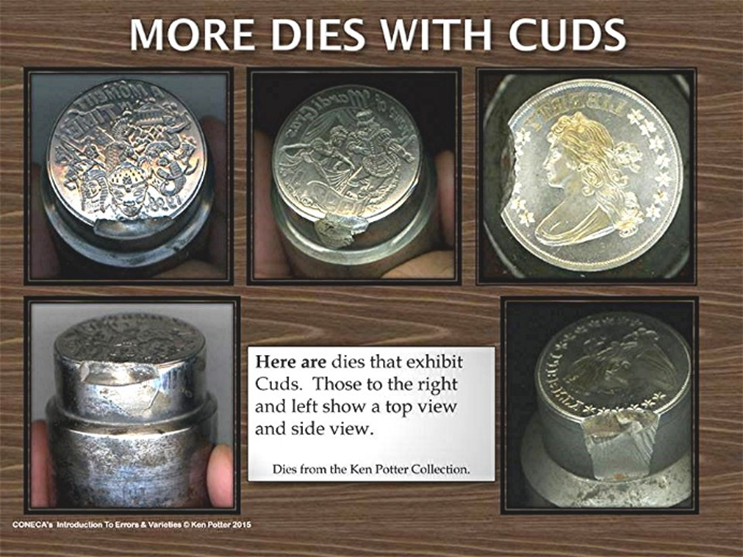
“Cuds (corner die breaks) form at the right-angle junction of [the] die face and [the] die neck, an area vulnerable to both damage and breakage… Some areas break more than others for understandable reasons. [For example] Base-of-bust cuds are common in Lincoln cents. There is a long, narrow gap of uniform width separating the bust from the design rim. On the die, this takes the form of a slender, fragile isthmus separating the right and left portions of the field.” This fragile isthmus breaks easily with the metal separating below it down the die neck. – Mike Diamond, Coin World, “Cud locations are far from random” October 4, 2021, Page 148.
So, a CUD is ONLY associated with the rim of a coin. This photo, by Ken Potter, of dies which produce cuds, can help us visualize why a cud is associated with the rim/edge of a coin. A portion of the neck of the die breaks away, leaving a void on the face of the die. This void is filled with metal during the strike. The filled area is called a cud.
Outstanding Information!!!
Now I feel like I found a home.
Your responses are full of care and kindness. Life is BETTER when you have FRIENDS that have your BACK!!
Thanks for not hanging me out to dry.
Homer