Options
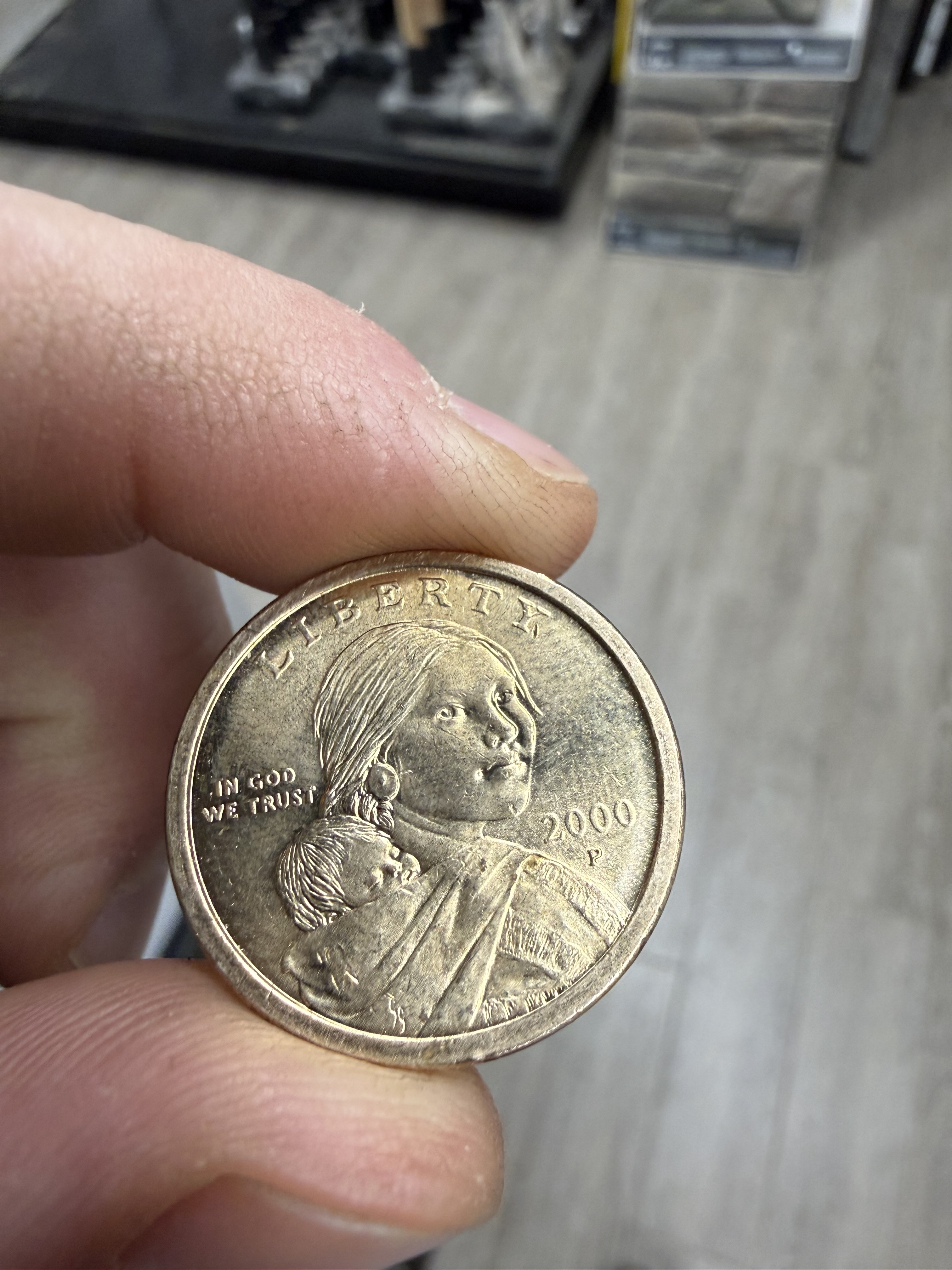
2000 p sacagawea dollar cheerios?
 Jillom3
Posts: 9 ✭
Jillom3
Posts: 9 ✭
Any help with the ID the tail feathers show a lot of detail. Any input would be greatly appreciated 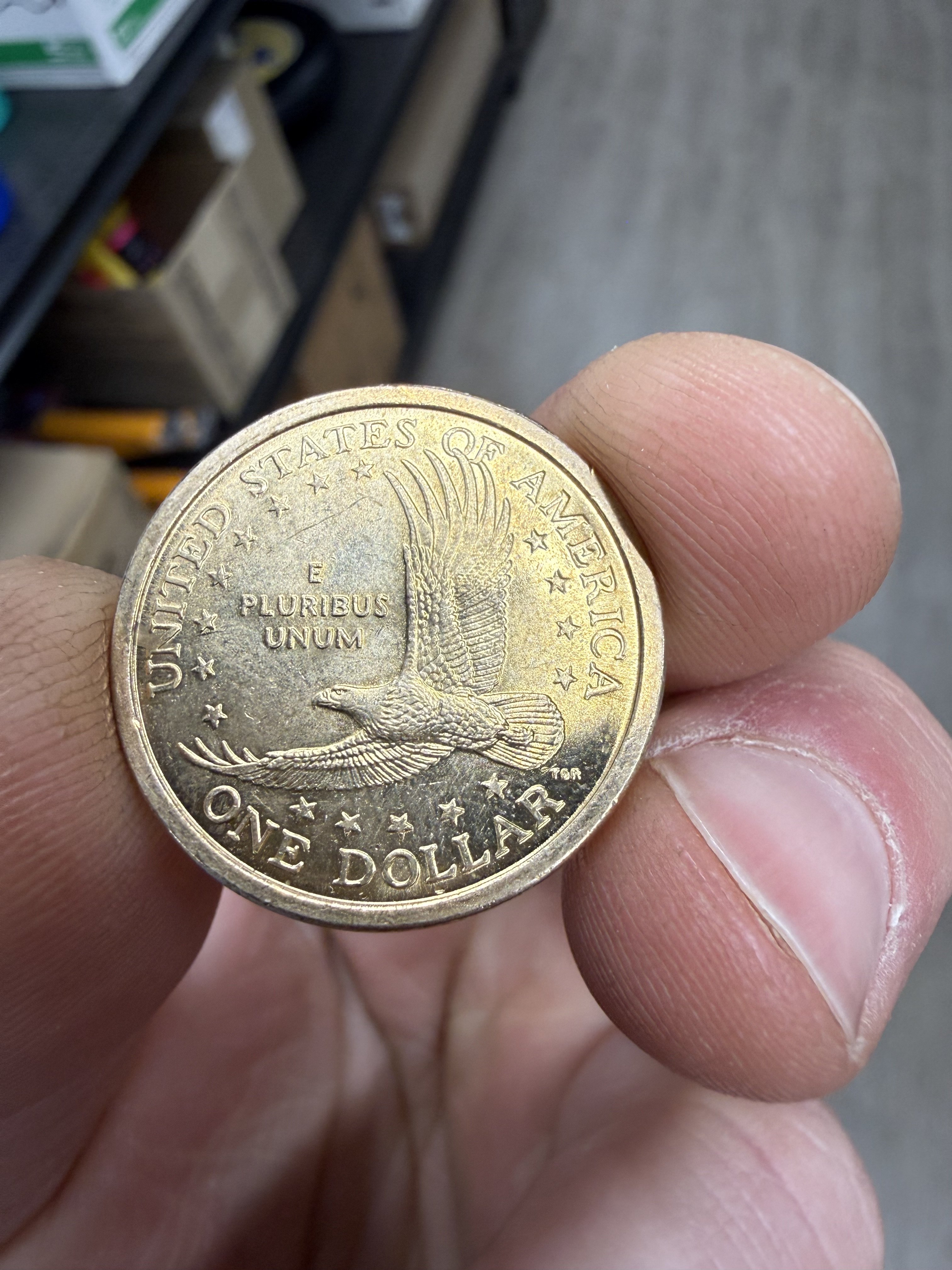
1
Comments
You'll have better luck in the coin forum.
You don't have a Cheerios dollar.
https://www.smalldollars.com/dollar/page20c.html
Wrong forum, just a heads up
Just a normal coin worth one dollar
Not Cheerios
“Land of the free because of the brave”
“Saved by grace alone, through faith alone, in Christ alone”
In Deo solo confidimus
ΙΧΘΥΣ
ΙϹ ΧϹ ΝΙΚΑ (ΙΗΣΟΥΣ ΧΡΙΣΤΟΣ ΝΙΚΑ)
Member since 2026
Successful BST transactions with: Ted 1, JWP, bigjpst, Vetter, nickelsciolist, ajaan, USMarine6, ad4400, grote15, coinbuf, Gothat3rs, No Headlights, PROMETHIUS88, Harlequin, Coin Finder, Coins3675, CKcollectibles2
There was an earlier thread on a cheerios dollar
https://forums.collectors.com/discussion/1121913/2000-p-sacagawea-dollar
i would like you to stay and ask questions but we get a lot of questions and provide the best info we can
the first response to the first 2000p cheerios thread gave pictures on how to tell them apart (see below)
there are hundreds of millions non-cheerios dollars and we can't look at them all. please use the pictures if you find another 2000p dollar
https://forums.collectors.com/discussion/comment/14077674/#Comment_14077674
.
https://forums.collectors.com/discussion/comment/14077678/#Comment_14077678
I know it's been discussed before but I'd still like to know, where are they all?
General Mills shipped boxes of Cheerios to Ecuador? 🤣 😂
So they hit circulation here, Ecuadorian's put them in their pockets and walk them back to Ecuador? 🤣 😂 Sure, no way!
Ecuador’s bank and government imports those dollars from us treasury
No, the US government shipped millions of dollar coins to Ecuador since Ecuador had adopted the US dollar as their unit of currency and they liked to use the dollar coins which few people in the US wanted.
Boldly detailed tail feathers. Once you see …..you’ll know
Practice makes perfect & nobody is perfect. So, practice being nobody and be perfect !
Over a billion dollar coins were minted in 2000.
If you found one in a box of cereal before they became generally available at the banks you might hold onto it as a novelty. After that, why not just spend it? As far as anyone knew at the time it was no different than the billion others. It was several years before the difference was identified.
There are billions and billions of Sacagawea dollar coins sitting in vaults. You can look there.
@bigmountainlion @JBK
That all makes sense but "Cheerios" dollars? I know the Sacagawea bust on the dollar looks like an Ecuadorian woman or any Central American woman. I believe that's why they like them down there.
So the US government shipped millions of dollar coins to Ecuador... okay, got it!... But not one of them were the enhanced tail feather cheerios dollars. Those all went in Cheerios boxes.. not shipped to Ecuador.
On a serious note. Someone said that unslabbed/ungraded/raw Cheerios dollars are being held in private collections. If that's true, what would be the justification "NOT" to get them graded? If any of you thought you had a Cheerios dollar, wouldn't the first thing you do is get it graded??
I have a sneaky suspicion the reverse die was so “smoothed”, at the time of production, that finding the crossbones in the tail feathers would still be detectable with the naked eye . Although, I also think not even one specimen was ever delivered
to Ecuador.
Practice makes perfect & nobody is perfect. So, practice being nobody and be perfect !
How do you know that?
I personally suspect that they might have used new production to fill the Ecuadoran orders, in which case they would not have sent Cheerios dollars. But I have seen nothing to prove that, so if they pulled coins from the fed or banks then there could have been some Cheerios dollars.
I do know that SBAs were not sent and since the banks/fed did not routinely differentiate or sort for coin type, that would support the idea that only new production was used for Ecuador. (When I say "new production" I mean solid rolls/bags of new coins that were in storage).
I have no idea which "someone" made that claim but it's most likely just idle speculation. Whether they didn't properly frame the proposed scenario or maybe you didn't hear it correctly, who knows. But I suspect there are more than a few Cheerios dollars sitting around in kitchen drawers or kids' toy boxes without the owners knowing what the significance if them is. I doubt many serious coin collectors have raw Cheerios dollars lying around.
I hear and see a lot of speculation in both our comments.
There's wild speculation and then there's educated speculation.
It's the proven one we want. 😉
That's the whole point, very little is proven.
You joke a lot don't you? You say the vast majority of the "missing" coins were circulated?.... Really? And you know that for a fact? That's why there are virtually zero circulated coins graded. 99% of them are all mint state graded.
Even on a low grade coin with the detailed tail feathers away, you would still be able to identify the pattern reverse by this lobster-claw-like pair of feathers just below the eagles "ankles" and further down as part of the outline of the bird. The one just below the "ankles" is very obvious and well protected.
Pointed out to me by collector Dennis Smith. His picture.
Screencap of a random coin from eBay showing the "lobster claw" feathers seen on the pattern reverse.
Excellent point and indicator but the question still remains, where are all the low "graded" Cheerios dollars? Unless I'm missing it, I don't see any.
Here's a couple of lowball Philly's that might be hard to ID as Cheerios dollars.
So the consensus is the U.S. gov't shipped millions of these coins to Ecuador or Central America. These coins have apparently been used heavily down there in circulation and commerce everyday for the past 26 years. Not only that, the Ecuadorian people apparently love the coins because Sacagawea heavily resembles the traditional woven shawls (known as quepinas) worn by indigenous Andean woman.
I've search boxes and boxes, "thousands" of these dollar coins over the past few years. (I know, I need a life. 😂) I'm guessing, the coins shipped the Ecuador were from Denver. Why am I guessing?.. Because the overwhelming majority of these heavily circulated coins all have Denver mint marks. The Cheerios dollar is a Philly coin not Denver.
Someone is going to say: How do you know these coins weren't circulated here in the states? I can't prove they haven't been. I'm just using process of elimination and logic. We all know these small dollar coins were never popular with the general public here. You're right @jmlanzaf "They generally don't circulate enough to wear much"... Exactly my point.
Another question: What % of the American public do you think are even aware of this Cheerios dollar?? I would say 1% would be extremely high. Ask any of your "non-numismatic" friends: What's a Cheerios dollar?.. No rush, get back with me on the answer. 😂
So why am I finding these in circulated boxes? With the open boarder policy of the last Administration, there's no doubt in my mind these coins were walking and flying their way back into our country in the pockets of illegal aliens!
As you can see, I'm serious about these coins. I'm not messing or "joking" around!
What happened to most Cheerios dollars has never been a mystery to me. They were spent.
They were a novelty for a few months when they were first distributed in Cheerios boxes and then after that they were just spending money.
If someone collected numismatic ephemera or marketing materials they might have kept a sealed example in their collection. (I have a couple Cheerios cents that I saved that way.) If someone saved all the freebies that often came in cereal boxes then they might have saved one in original packaging. (I have a few Matchbox cars that I saved in original packaging).
As for the majority of Cheerios dollars, where are they at this very moment? They're with the over one billion other 2000-dated Sacagawea dollars.
Having been a 10 year old boy myself back when dinosaurs still roamed the Earth, had I gotten one of these in a cereal box BEFORE I started collecting coins I would have spent it up at the corner candy store. It would have been just another dollar to me.
Here's another Cheerios dollar currently on eBay showing the "Lobster Claw" hub diagnostic. Courtesy of Jon Sullivan.
Tom- You have a link to that?
I dont know if many of you have been to Ecuador, but these coins really do circulate there. I was in Quito probably ten years ago and was handed a pile of worn Sacagawea dollars in change.
Dead Cat Waltz Exonumia
"Coin collecting for outcasts..."
Do you recall the dates? Did you bring any back with you?
https://www.ebay.com/itm/298496606932
https://www.ebay.com/itm/298496606932?
Thank you gents!
Hmmm, interesting. I'm just wondering about this stuff. It looks like it's on the coin, not the holder. You think Jon submitted it?... Probably not. @SullivanNumismatics ?
If it's on the coin, I wonder if it appeared after the coin was slabbed? Acetone may have mitigated that problem. Again, if (a lot of if's here, sorry) it's on the coin, could this stuff have affected the grade?
Not that it really matters at this point. But if someone thought this stuff could be removed with acetone, and they had deep pockets, they could break out and resubmitted it for a higher grade.
Don't mind me, I'm just thinking out loud here.
There was a lot of trouble with spotting on the normal Sacagawea dollars that came out in circulation starting in January of 2000. I am assuming that the manganese-brass cladding was prone to it. Eventually the Mint purchased machinery that basically burnished the planchets prior to them being struck, and this helped quite a lot. I wrote an article about the burnishing machinery in COINage Magazine in 2009.
I have long suspected that the reason why some of the Cheerios Dollars found in original Cheerios packaging do not have the prototype reverse is that when General Mills got the coins some of them were badly spotted or otherwise discolored, and General Mills pulled out the worst ones and sent them back to the Mint for replacement. By then the Mint was using the revised regular reverse, and nobody noticed the difference.
If so, and neither General Mills or the Mint has anything to say on the question (I asked long ago), this might be one of the original spotted coins that got packaged anyways. It is what it is.
TD
P.S.: When the Sacagaweas became available in $1,000 boxes of $25 rolls, we bought several boxes and gave them out in change at the coin shop instead of dollar bills, and let people buy rolls of them for $25 (cash) to spend if they wish just to try to get some into circulation. In either case we got complaints from people (who had gotten them at face value!) about the spotting!
Point noted. Please edit your copy.
It was originally in an ANACS holder, but I did submit it to NGC. The coin was (I was told by the seller) originally found in a roll of coins from a bank. Apparently, it was put into circulation!
Jon- Like Tom said, spotting was a problem. Was the coin submitted to NGC in the ANACS holder or did you break it out? Did the coin upgrade from ANACS to NGC?
It was cracked out. It was ANACS MS63, and went up to MS64 with NGC.
Great! Thanks Jon! 👍