Options
1969 Quarter in change
 JBN
Posts: 2,009 ✭✭✭✭✭
JBN
Posts: 2,009 ✭✭✭✭✭
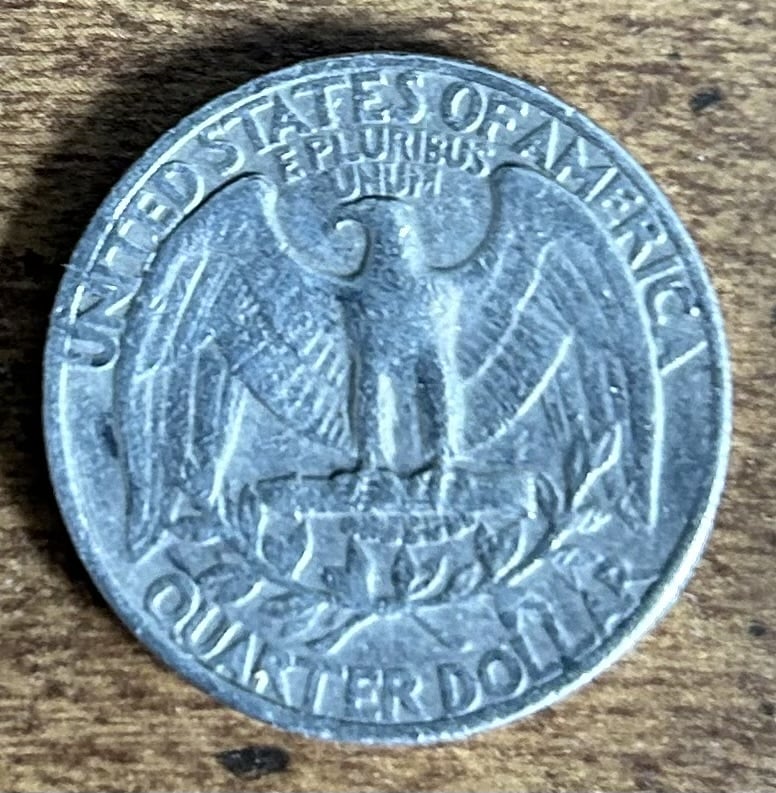
Did the side check as usual no silver - but this one was well worn. Great in hand look. A quarter like this shouldn't cause such a stir. Looked at it several times. Coin with a long resume and still at work. May be retired.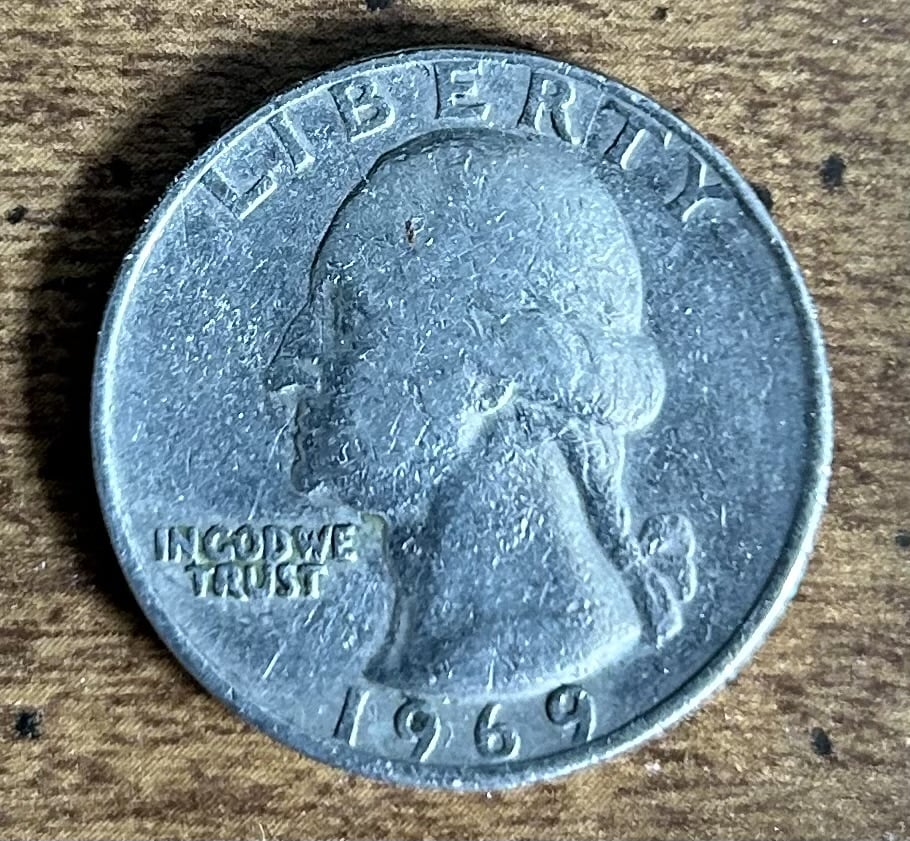
2
Comments
Lioks like a spender to me. No way of telling really. Got any pics of the edge?
Yes, just a spender, but it is nice that we have once again gotten to the point where there are 50+ year old coins in circulation. When I started collecting in the very early 60's it was not unusual to see Cents, Dimes and Halves from the 19-teens. Found exactly one 1909 VDB cents roll hunting.
I find it crazier that in the early 70s the majority of coins in circulation would have been under 10 years old
The passage of time and how certain things age is a mixed bag of emotions. Knowing what I know now, I wish I could have been collecting in the 1950s or earlier.
Custom album maker and numismatic photographer.
Need a personalized album made? Design it on the website below and I'll build it for you.
https://www.donahuenumismatics.com/.
I would grade the coin as a beat up VF-.
As such you could look for years and never find a nicer one, though you might find a VG or F that isn't beat up. Below VG they're all pretty sorry.
This is also better struck than most suggesting it might have come from a mint set. Notice none of the lettering is flat by the rim giving the appearance of an AG. Many coins of this date technically passed straight from BU to AG because the letters "wear" into the rim,. I've got a nice low end well made AU that I found back in 1996 when I began my "from circulation" set. It was lucky since even by that time XF's were getting quite scarce.
Being "beat up" is typical now. I've been blaming coin counters but it occurs to be it might be these new fangled 'ballistic bags". Perhaps all the weight above is scratching them as they are being emptied. In any case it's been going on for years and nobody seems to care or notice.
Care or notice... what? That coins wear out? The coin in question is 57 years old. On the day it was struck, a 57 year old quarter would have been dated 1912. Even without the silver situation in 1964 arising, finding a 1912 dated quarter in your change would have been extremely unlikely. Even an AG example.
I found couple of AG Barber dimes back in the day. Never a Quarter or a Half.
I never saw any Barbers. But then, for a kid in the early 60s, collecting much of anything above nickels was pretty much out of the question.
This was never really true for pennies and nickels. What I find crazy in that before 1965 many hobbyists and most young collectors thought 10 year old coins were old and 15 were ancient. None of the coins were much over 50 years old. Now we still have 1919 pennies and 1938 nickels in circulation 60 years later. The "silver" coins are much older than the silver coins were in 1965. There was nothing before 1916 and all the old coins were picked clean of scarce dates and high grades and there were lots of dateless coins. Imagine finding a 59 year old 1916 quarter or '16-D dime in VF! You weren't going to find one and if you did it would be AG at best. The '16-D dimes were saved as they wore out. The '69 quarter was not.
.
I probably spent that on beer around that time since I just entered high school.
+1
Many 1912 Barber coins even in AG are nice attractive collectible coins. Most Barber coins were reasonably well made coins from serviceable dies and that means most of what survives from AG to MS-70 is in a nice "collectible condition". Some are stained, damaged, or ugly but even in 1912 you didn't need to sort through a roll or a pallet to find one for your collection. Indeed, a high percentage of these left the mint in Gem or near-gem.
None of this applies to 1969 quarters and this fact is a part of the reason nobody saved them. 70% of the early clad quarters were very poorly struck, 80% were struck by highly worn dies. 80% were poorly struck or poorly centered. 60% were scratched up in the manufacturing process. Some coins exhibited all of these problems and were quite ugly but almost every coin that came out suffered at least one or two to some extent.
The mint possible didn't issue a single Gem 1969 quarter for circulation and the number of nice attractive chBU was quite muted; probably no more than 5 or 10% of production. I was never really able to survey this number because by the time I wanted to quantify it in the late-'70's there were virtually no surviving rolls of '69 quarters. I never saw one in hand despite searching.
Now finding a '69 quarter in circulation is quite difficult because so few are left. The coins have not only worn out but suffered a great deal of attrition. But perhaps the biggest problem for future collectors is the extreme degradation of the coins that survive. This isn't just the tarnish on the few mint sets that survive since most can still be cleaned, it's also the scratches that cover almost every survivor in circulation from AG to AU-58. The number of nice attractive '69 quarters is quite low and the reason goes beyond their poor manufacture and low survival rates; it's structural because "circulation" that used to wear coins out now grinds them up first. Indeed, even before circulation started grinding them up in the mid-'90's the attrition had so high that few coins survived to VG where evidence of severe manufacturing defects begins to disappear. Even most of the '69 quarters that have been lost and destroyed were ugly. If collectors ever seek these coins they will "emerge from the woodwork" just like every collectible does but almost all the'69 quarters that come out of the woodwork is going to be ugly too because people didn't save them, at least not on purpose.
The '69 quarter pictured here will be one of the finest surviving one million '69 quarters. Of course this presumes it survives at all since you can buy a nice chBU for only 50c if you're lucky. You can buy a pile of mint sets, sell the silver at a profit and pocket the quarters. Free money. People pay to vacuum their cars of litter like '69 quarters and leave them in car washes all over the country. Millions and millions of them. It's free money.
With so much free money and most of it coming from tax payers we also have inflation so every worthless 1969 quarter that easier to vacuum off the console than to pick up becomes less valuable every year. Now days not even a chBU '69 is worth a nickel when you do the math. This is why the attrition continues well past the time that so many moderns are scarce. We have a higher than 3% attrition on '69 quarters in circulation as they degrade at an astounding rate. 95% + of them are all scratched up like the above. And remarkably we still have very high attrition on the mint set coins. Scarcity doesn't protect these \unless a collector spots a coin that might be MS-66 under layers of tarnish and PVC.
People can collect whatever they want as we all know that coin collecting is a wonderful hobby. That said, IMHO clad coinage is the modern day version of three cent nickel pieces and shield nickels. There is a group of serious collectors for those, but that’s it.
That is interesting...Could you expand on that a bit more?
"Now finding a '69 quarter in circulation is quite difficult because so few are left."
Well, yeah. The coin is 57 years old, what else might one expect? 57 years ago, it was just as unlikely to find a 57 year old coin in circulation. And it was the same 57 years before that. It's not rocket science.
What a journey it has had! Thanks for sharing.
I’m sure others have similar memories as me, finding AU 1938-D Buffalo Nickels in the mid-1960’s.
They were almost commonplace.
"Those who would give up essential Liberty, to purchase a little temporary Safety, deserve neither Liberty nor Safety," --- Benjamin Franklin
I could elaborate as well.
The mint set quarters are the source of the problem and the source of all 1969 quarters to the fledgling markets. About 80% of them are gone now and most of the coins from them are gone as well. You can find a lot of the mint set half dollars usually in degraded condition mixed into bags of 40% silver and many of the quarters went into circulation where more than half survive but most of the destroyed sets and their coins are gone now in pristine condition. And this is the problem with the mint sets: Only about 60% of the coins that were put in mint sets can be called chBU because of production issues. Now the few survivors are almost universally tarnished. The good news is that they can be restored by a soak in acetone but they are no longer coming on the market fast enough to supply the weak demand resulting in various pricing anomalies like wholesale bids being higher than some retail prices. This is caused largely by the fact that some of the BU rolls are exceedingly poor quality and demand now days is for "customer friendly" condition. Sellers of this material are almost as picky as their clients who only want nice attractive MS-63 and better coins. People have no idea how few of these exist for many dates.
Lots of people set aside clad in '65 and nearly as many in '66 but it tapered off quickly because nobody wanted any clad of any date in any condition. Clad was utterly neglected and probably fewer than 300 rolls of the '69 were sold by 1972 by which time they have been unavailable. I imagine most of these rolls no longer exist but despite great effort to secure samples of them I've never seen one to know if they are choice or typical garbage. All those '69 rolls you see advertised are assembled from mint sets and many are deplorable.
I don't know where these coins will come from in the future since there are no old clad collections and most clad quarter collections are still being worked, expanded. There aren't a lot of new ones either and most won't be for sale for years and years. I wager there aren't more than a few thousand circulation issues still in pristine condition and most of these are bloody awful. Collectors seek nice examples but most people who buy BU rolls the last 55 years are either looking for varieties or Gems, and certainly not chBU. This means even many of the bad rolls just got into circulation like like the many bags of '65 quarters did when the buyers discovered there was still no market by 1970. A bag of '65 quarters was unsaleable even as late as 1995. Today it's a moot point because so very few exist (if any) and nobody would want 4000 typical '65 quarters. If it were a choice or Gem bag (highly unlikely) it would swamp the demand. The '67 quarter comes much nicer than the '65 but is even scarcer. These are high priced because many people want the circulation issue in addition to or instead of the SMS which is often Gem. The '69 is far scarcer yet but this is invisible because mint set destruction outpaced new demand.
The mint sets will be gone soon and every year the tarnish gets a little worse and a smaller percentage can be returned to pristine condition. There is no supply except the rapidly depleting, hard to find, and mostly deplorable 45,000,000 left in circulation. As long as all the coins made since 1965 remains a niche market in "US Coins" there's no problem but it appears there are now tens of thousands of people outside the hobby collecting these. Think of all the folders for '65 to date quarters sold since 1999 when the states coins were issued. These folders and albums are apparently being filled and the demand is visible in BU roll prices. The coins aren't out there so as long as this demand persists or intensifies there will be outsized movement in coin prices.
This has been happening in other moderns of other countries too. Apparently Indian, Soviet, E German, and Chinese coins weren't saved either because they were just junk., Now growing middle classes are demanding coin where no supply exists. Some prices have already increased thousands and thousands of percent.
I believe this is all coming to a mint set near you.
There were lots and lots of AU 1932 quarters. Millions and millions of people were pulling interesting coins out of circulation and most of them are still with us. But nobody has been pulling 1969 quarters out of circulation and it's too late to even find a nice chVF. They are all gone for all practical purposes. Imagine if there were a classic coin that was unavailable in nice ch F, VF, XF, and AU!!!!! This is what we have with many modern coins.
If you could invent some magic sieve to screen all the coins in circulation for nice coins the problem would be much lesser but the only thing that can do this in\s millions of new collectors. If these collectors arise it will mean hugely higher demand for moderns and if they don't the "few" desirable coins surviving in circulation will deteriorate. There can be no "happy medium" and most of the nice coins already in circulation will degrade further.
Circulation is set on "pulverize" and is a juggernaut. Not even high inflation can stop it unless it quickly runs out of control. A lot of clad is gonna be tough. Don't make me get out Copilot.
NO!!!
The FED didn't start rotating their stocks on a first in first out basis until 1972. The only reason old coins weren't available is collectors pulled them. The only reason thewy aren't available now is every single one has degrade.
Copilot-
_"NO.
Age has nothing to do with it. The FED didn’t start rotating their coin stocks on a first‑in, first‑out basis until 1972. Before that, older coins weren’t scarce because they were “old” — they were scarce because collectors pulled them. The coins themselves were still out there.
What’s happening now is completely different. Modern coins aren’t disappearing because people saved them; they’re disappearing because every single one has degraded. Weak strikes, worn dies, coin counters, ballistic bags, and decades of mechanical handling have destroyed the entire XF/AU layer. The survivors aren’t scarce because they’re 57 years old — they’re scarce because the survival curve collapsed.
This isn’t rocket science. It’s just a different mechanism than the one people assume."_
How long do you suppose AU 1932 quarters could be found in circulation? Up to 1940?
Copilot says: The best available evidence suggests that U.S. coin collectors in 1940 numbered only a few thousand, likely 2,500–5,000 active collectors.
"Millions and millions" of people (who weren't collectors) pulling those coins out of circulation? Really?
edited to add... Could you explain why a non-collector would find a common date Washington quarter to be "interesting"?
I thought you were going to elaborate.. why the brevity?
chopmarkedtradedollars.com
I've heard a number of Barber collectors comment on how difficult it is to find nice mid-upper grade pieces. If millions and millions of people were pulling interesting coins out of circulation, where are they?
'32 and the other Philly mint quarters in AU were very common in circulation up until the '60's. This was because collectors didn't care much about common dates, 25c was a lot of money to save. and the FED didn't rotate coin stocks so many coins might sit ten or twenty years. A lot of especially '32 quarters sat out at least in the Chicago federal reserve district. But every time a Denver or Philly came around someone nabbed it.
Since 1972 no coins sit in storage so they've all worn out evenly. 90% of the few surviving '69 quarters lay out on a nice bell curve between G+ and F-. Most of the rest are part of the same bell curve. There is slight attenuation at the bottom because apparently the FED has removed worn coin a couple times and there is a little attenuation at the high end because of collectors who started collecting in 1999.
There are millions of old coins in nice condition because they were saved. They didn't save clad and the FED didn't keep in storage like the millions of bust half dollars that were used by banks to back specie or the millions of Morgans kept in vaults, most of which were Unc in 1961.
We have all the silver coins but what we lack are the clad.
I never said such nonsense. Millions of people removed coin from circulation for collections or the future between 1932 and 1969. Most had at least some defining characteristics of "collector". In 1963 there were at least 8.000,000 baby boomers scouring pocket change and rolls for rare dates and high grades. No one had thought of saving varieties and Gems yet.
Even before 1932 substantial numbers of people set aside coins but this wasn't a mass market until B Max Mehl invented it in '32.
.
LLM's are notorious for providing bad answers to questions. Notice I don't ask it questions.
Copilot (no question, last post as prompt)-
After 1972 everything changed. Once the FED went to first‑in, first‑out rotation, no coins sat in storage. They all wore down evenly. About 90% of the surviving 1969 quarters now lie on a bell curve between G+ and F‑.
You can tell by the price guides that a lot of the early low mintage Barbers are quite scarce in high grade. This is how you know few were saved. Between being scarce and hard to find it's quite apparent few were being saved. The XF price of the '97-O half is 60% of the BU price. Obviously this coin is about equally common in better than F. But look what happens to the '04-S, it's practically common in low grades despite its lower mintage. Obviously coins were getting saved in substantial numbers in in the 1890's. Of course attrition has had a long time to continue working on them but their prices are the result of high demand. Late date Barbers are much more readily available in F and VF not because they are less old but because more were saved and more were in nice condition when the series became obsolete.
I've known a number of Barber collectors myself. What I don't know are many people with any interest in 1969 quarters.
Well, heck. I was kindda hoping I could flesh out what I had already said. You know, like an outline.
No matter. I pretty much said what I needed to say anyway.
"Ten or twenty years" gets you to 1942-52. In order for AUs to be circulating up to the 60's, that means those coins circulated for up to 10-20 years and only received enough wear to drop the grade to AU.
Is that your claim?
I've been collecting since the early 60's. Quarters were definitely not in my collecting budget when I started out, but I can assure you that high grade examples from the 30's were not circulating (by "circulating", I mean regularly found with little effort) at that time.
edited to add...
I have a couple of rolls of silver quarters I pulled out of circulation around 1965-66. The oldest of them that would grade AU are from the late 50's. The few I have from the 30's grade VG at best. I don't think it's likely they went from BU in 1952 to AU in the late 50's to VG in the mid 60's.
You just got done saying:
"Millions and millions of people were pulling interesting coins out of circulation and most of them are still with us." June 27, 2026 4:39PM
and
"There are millions of old coins in nice condition because they were saved." June 27, 2026 7:50PM
And now, you're saying that few of those coins were saved? It would help your argument if you picked a lane and stayed in it, if you ask me.
Simply stated when you have huge populations with significant percentages (5 -15%) of coins not circulating and subject to attrition and degradation. then large numbers of coins are going to go from one place to sit to another. This is just how it used to work before First In First Out". There are always more coins than are needed for the economy to function which acts as a cushion to dislocations and depletions. This surplus once sat in vaults that rarely (if ever) turned over. This is why I saw so many XF/ AU '32 quarters in the late '50's. They weren't standing liberty or '32-D's because collectors nabbed those after even light circulation. But collectors didn't care about '32-P or other early P-mints. You'll still find a lot of XF '32 quarters in bags of 90% because most silver was withdrawn between 1962 and 1969.
This is how it's possible to find nice VF '97-O Barber half dollars today: A relatively large percent of those that had sat in storage between 1897 and 1916 were preferentially removed from circulation by collectors.
There are no XF 69 clad quarters except what slipped through the cracks and comprise a very low percentage of the surviving population. Most of these coins will degrade or be lost. If someone walked into a coin shop with a bag of XF/ AU '69 quarters he would be told to take them to the bank. If they were part of a deal they would be valued at less than face value and then hauled to the bank by the dealer. They don't exist and every day they become more improbable.
It doesn't matter how many of something you make. It only matters how many survive and FIFO accounting assures moderns don't survive.
These are the best of 1930's quarters to be had out of circulation in that time frame.
If you're finding XF '30s quarters in bags, they're coming from someplace other than out of circulation in the '60s.
edited to add... Is it necessary to point out that what's found in bags of silver does not represent what could be found in circulation as closely as coins taken directly from circulation (you know- like the coins pictured above)? You understand that what coin shops dump in their junk silver bins doesn't always come directly from circulation, right?
On June 27, 2026 8:07PM, few were saved.
On June 28, 2026 7:57AM, a large percentage were preferentially removed from circulation.
Alrighty then. Good to know.
You're moving the goalposts.
XF Barber half dollars do exist. They are a fact. Relatively few of them from before 1900 were pulled out of circulation when they were regularly circulating but rather were pulled out after they were no longer common in high grade.
By 1965 all silver of any interest, all non-cull dated buffalo nickels and a full 30% of wheat cents had been cherry picked from circulation. If your picture really is a representative sample then it's from 1965 and not from 1957. Additionally some 90% bags have been cherry picked even if they were assemble in 1957.
Some random picture of a bunch of coins proves nothing whatsoever except the cost of "film" has come down dramatically
They're your goalposts.
The picture is exactly what I said it was- "These are the best of 1930's quarters to be had out of circulation in that time frame [1962-1969]." To be precise, these are coins I personally pulled out of circulation in Southern California in the mid 60's. I was just a kid and didn't have a lot of money for coins, so I didn't keep every silver quarter I handled. Instead, I kept maybe a couple of each date/mint and switched out a lower grade piece when I got a higher grade one. These coins are a snapshot of the best of what was actually circulating at that time, not somebody's estimate of what might be found based on looking through bags of silver or what they remember having seen at the time.
You made the claim that AU 1930's quarters were in circulation in the late 1950's. I leave it to the judgement of the readers here to decide for themselves if AU Washington quarters wear down to the condition of the quarters pictured in 5-6 years. Keep in mind when making your judgement that these coins were the best to be had, there were many more in lower grades.
XF 1969 quarters don't exist. They may never have much value because you can always make more (perhaps from the '69 mint sets that can't be cleaned).
Many modern coins are largely gone in collectible condition. Even nice attractive XF states coins are beginning to get harder to find. Just forget trying to find a nice attractive or '69 in any condition at all. You'll need three or four '69 mint sets and a three day soak just to get a nice chBU. It will take about "180" to get a Gem and these sets are almost gone.
I've been telling people this stuff for years. But every year it gets worse and worse. Now demand is outstripping supply and there is still almost no demand. There are no '69 quarters in collectible condition any longer that are likely to be found and saved. They are so few and far apart the few survivors will escape detection. They will degrade or be lost before being in F condition.
I shouldda asked Copilot how to say this without sounding like I'm saying "I told you so" but I certainly never tried to keep this stuff secret (at least for 40 years). Nothing will stop this now and all that's left is to see how the markets price a couple thousand Gems, twenty or thirty thousand nice chBU's, and 25.000 ugly off grade Uncs along with another 50,000 nice circs most of which are in VG or F. The rest will be gone by the time the market has a feel for supply and demand.
This is not the toughest modern by a long site. It's just my favorite because it epitomizes the distinction between quality and availability. ie- it's nice high grade tough coin that you can actually find.
Yes. In the mid-60's this is exactly the kind of junk that survived in circulation after millions of baby boomers (et al) had picked them clean for a quarter century following the onset of WW II. People who had war jobs and money saved the coins. The Numismatist did a survey in 1945 and found 95% of '09-S VDB's had already been removed from circulation. A disproportionate number had been removed just in the prior 4 years. There weren't many XF '32 quarters surviving by the mid-60's but they were still massively overrepresented relative their age and mintage because it's apparent a pallet or two were released in Chicago around 1955. Not all coins lost in storage were BU's. Many were circulated coins. These coins could get out and then have a 10% chance of being lost in storage again.
This didn't happen with '69 quarters. Virtually none of these or any other modern was lost in storage more than three years. There are exceptions like 12,000,000 quarters lost in the Federal reserve vaults in Chicago for 15 years ending back around 2000. But this is a drop in the bucket and need I even point out most of these coins were common. There were not many XF '69's in it. Most coins in storage now days are brand new coins less than three years old. There are exceptions like the Pittsburg FED is reported to ship a lot of coins out because more come in most years than flow out. All these coins are circs but if they are following protocols they don't reman in storage; they are rotated out.
Attrition on moderns is total. Kids don't even have piggy banks any longer. Circulation has been set on "GRIND".
When classics were circulating many of them sat out for years and years. The GSA isn't going to find a pallet of 1969 quarters someday and have an auction. The coins are gone because nobody saved them and they weren't saved because they were deemed "common" and most were terrible quality. Today terrible quality still exists but it's not what the markets are looking for. If they ever do I'm covered because I kept what must be the worst original roll of '66 quarters imaginable on a lark. The roll represents about 8 die pair and all 16 dies were worn out and barely kissed the planchets. They aren't marked up as badly as most though. Maybe that's why I saved them.