Options
Ping vs. Thud...with question
 Redglobe
Posts: 809 ✭✭✭
Redglobe
Posts: 809 ✭✭✭
A couple of weeks ago I received back my submission from our hosts,one of the coins came back counterfeit,it was a 1900-O Barber Quarter, upon looking further I was puzzled so I weighed it and it was comparable to others (6. grams) then I did the drop test real silver has that Ping or Ting sound and this coin had the Thud sound,so just a reminder if your not sure do the drop test (all the coins in my submission were circulated)Here are photos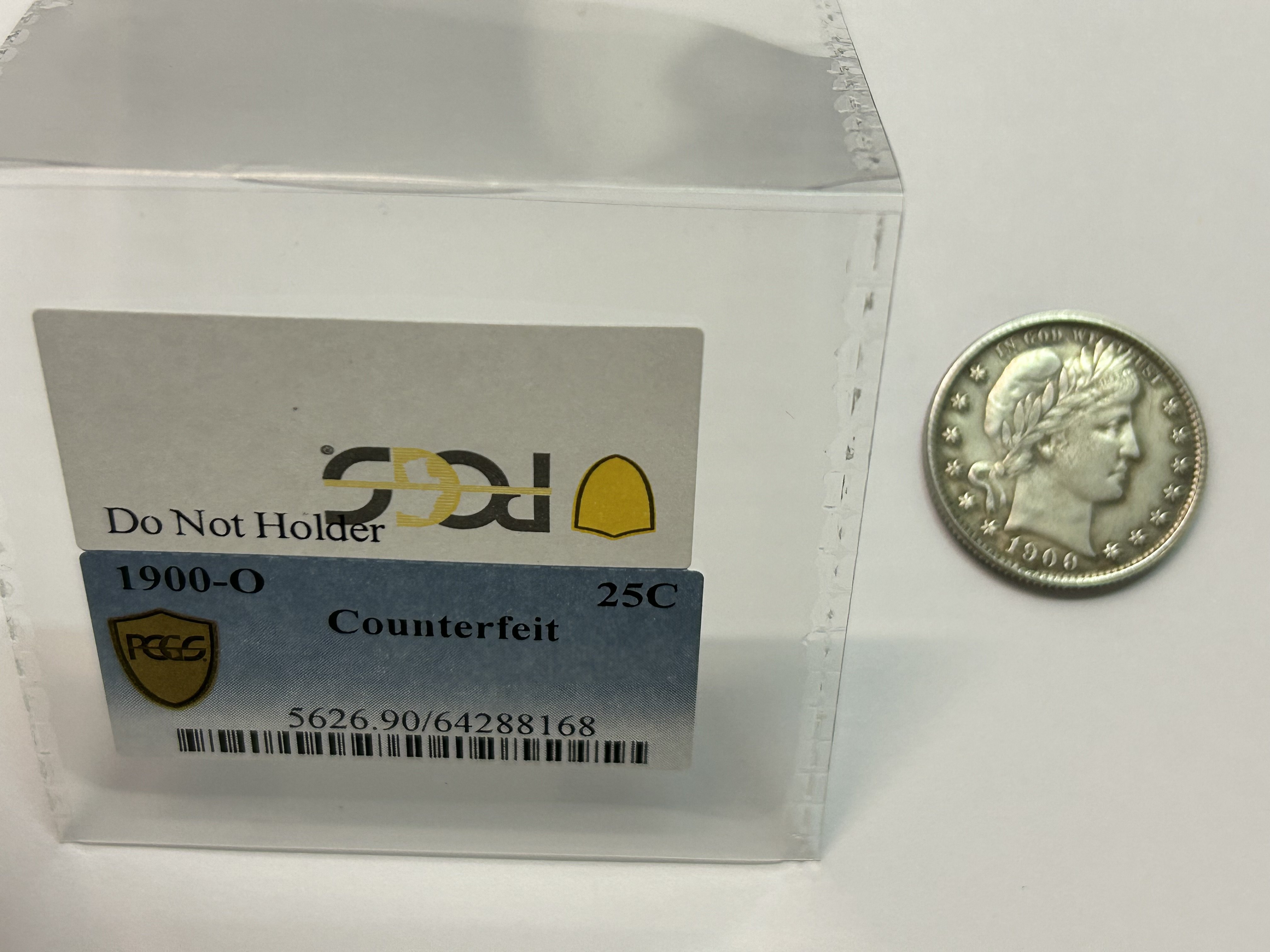
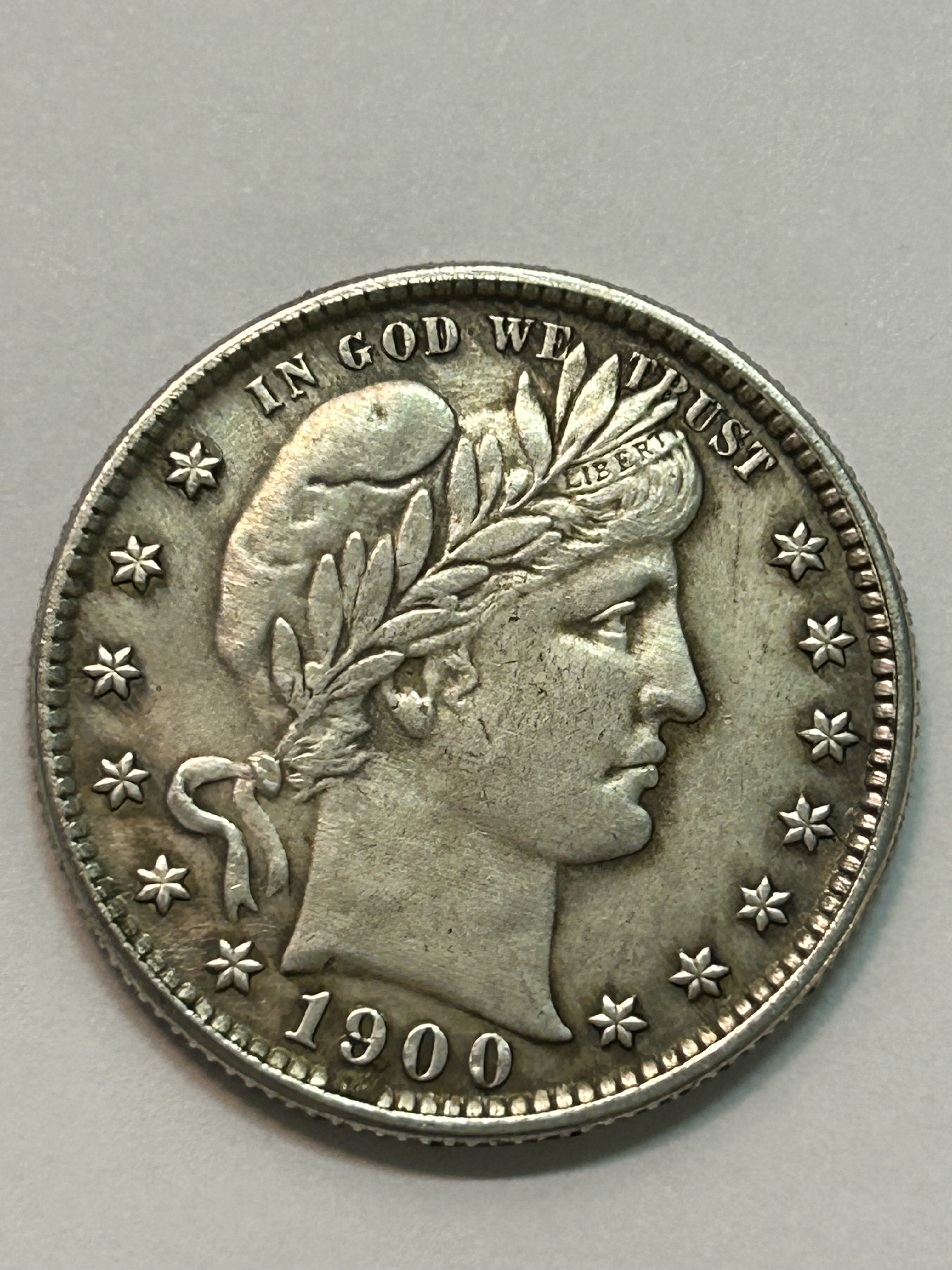
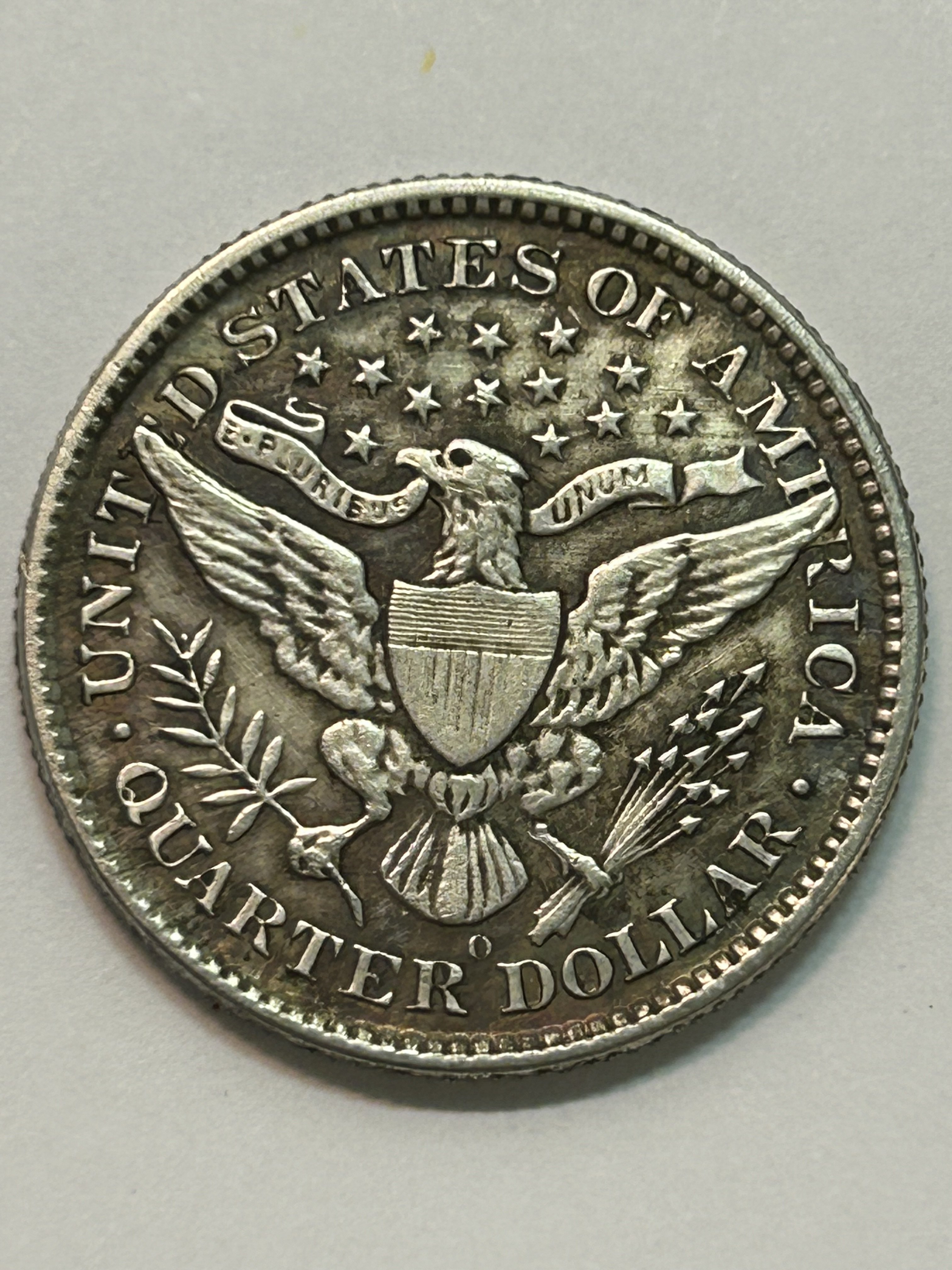
I attempted to list it on Ebay with the body bag and all above photos and they disallowed the listing (counterfeit is not in their criteria)
So my question is what do I do with it? Do people collect this type of coin. Any opinion's or ideas are welcome.
Thanks Rob
Rob
0
Comments
Use the word "bogus" instead of "counterfeit" on eBay and you should be fine.
Bogus 👎
Sorry to hear your coin is fake. Can't sell a modern counterfeit for any money. Toss it in a jar with other counterfeits for your future education or throw it in the garbage. It pays to educate yourself on counterfeits!
"But seek ye first the kingdom of God and His righteousness and all these things shall be added unto you" Matthew 6:33. Young fellow suffering from Bust Half fever.
BHNC #AN-10
JRCS #1606
That one doesn't scream to me like Chinese counterfeit. It might be contemporary.
I don't see it listed in @BadMetal's book that covers contemporary counterfeit Barber quarters.
Dare I say this???
What’s the Specific Gravity?
It DOES look like a Chinese counterfeit, right down to the applied dark "toning."
Not all Chinese counterfeits look bad. Some makers have these types of type coins down to a science.
Capt. Henway I had to google your question and it relates to density,therefor thud vs. ting might answer that LOL
Johnathan B-- I've never heard of Badmetals book,I'm curious
http://www.badmetalcoin.com, then follow links to the books. Excellent resource if you care about contemporary counterfeits, sort of not relevant otherwise. :-)
Thank you
It's a heavy burden.......
Did you test the coin with a magnet?
Whether it sticks to a magnet or not, it still remains a counterfeit.
It might pass a magnet test, 2 interesting areas of concern with a quick look.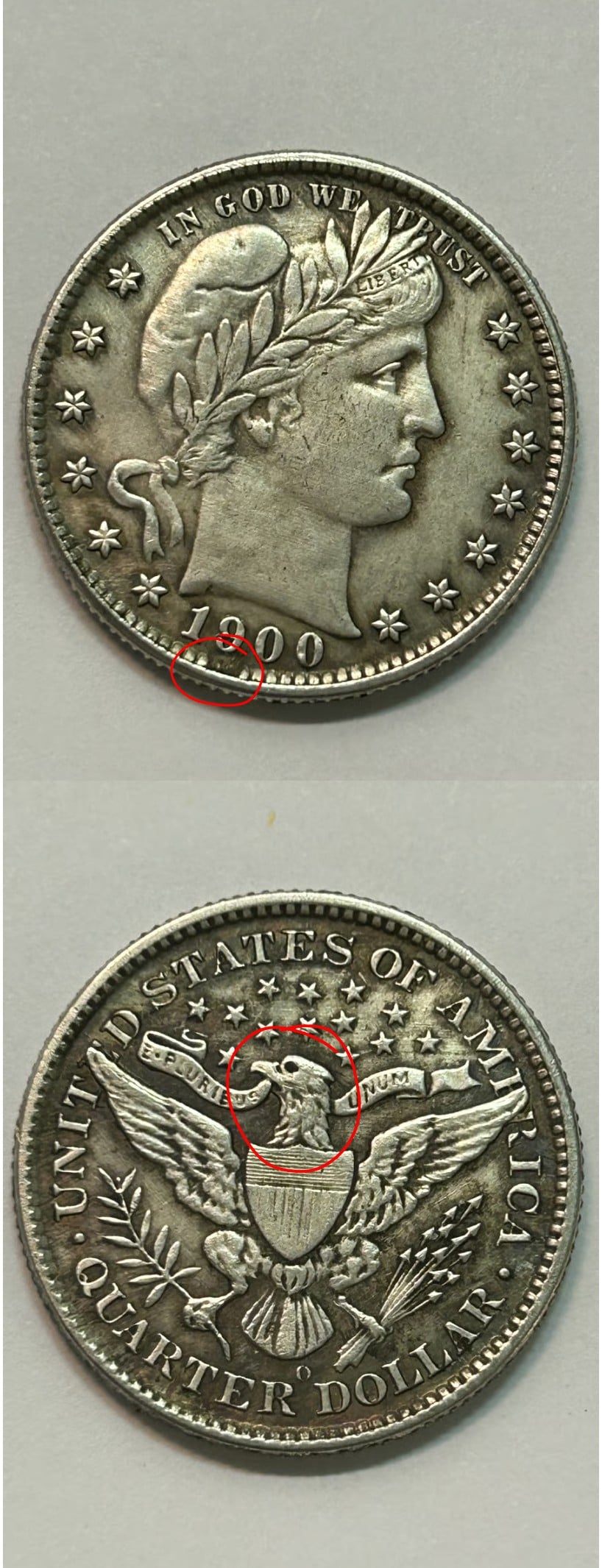
I'd take a file to it on the reeded edge.
That’s intuitively obvious.
Re: the "ping test".
The sound or "ring" that a coin makes depends on numerous factors, but fundamentally it is a "physical" test: it's looking at the physical properties of the object, rather than its chemical properties. In that sense, it's composition is not directly relevant - though finding a metal alloy with the same physical properties might be tricky, it's not theoretically impossible.
From a physics point of view, sound is just vibrations in air, so for a coin to "ring", it has to vibrate. If a piece of metal is going to vibrate when hit, it needs to be slightly elastic - it must bend back and forth slightly, without either snapping into pieces or simply squashing and deforming. A coin made of a soft metal (like lead) won't vibrate when struck, it will just deform and absorb the impact - giving us the familiar "thud" sound.
So the actual frequency a coin makes depends on three physical factors: shape, density and the metal's elasticity (it's Young's modulus, for the technically minded). For a coin, the "shape" should be a constant (though a fake that's too thick or too thin will "sound wrong", even if made of the correct metal). Density depends on the composition. So even if you were to find an alloy with the same elasticity as coinage silver, it would most likely have a different density, and so give a different sound.
One final note on the "ping test" has to do with shape: the "assumption of constant shape" is a very important component of the test's accuracy. A bell with a crack in it makes a completely different sound compared with an uncracked bell; that's because the shape of the object has been changed by the crack. Likewise, any crack, bubble, lamination flaw or similar imperfection inside or attached to a coin is going to change it's shape, and thus it's sound. This can make a perfectly genuine coin "sound wrong".
TLDR: the ping test is a good indicator tool, but it should not be used as the final word to either condemn or validate a coin; there are circumstances where a fake coin can "ring true" and a genuine coin can "sound fake".
Roman emperor Marcus Aurelius, "Meditations"
Apparently I have been awarded the DPOTD twice.
And it was probably intuitively obvious to @braddick, that there was no need to test the coin with a magnet, since it was counterfeit and a test would have been pointless.
Mark Feld* of Heritage Auctions*Unless otherwise noted, my posts here represent my personal opinions.
Some basic truths about the counterfeit detection game.
Some counterfeit coins are magnetic, MOST ARE NOT.
Most genuine coins have a good ring. Some do not because of planchet flaws.
Most die-struck counterfeits, which is the majority of the better quality counterfeits, will have a good ring because they were made the same way that genuine coins were made. Some will not.
Most genuine coins will have a proper weight, within Mint tolerances. Some will not.
Many counterfeit coins will have a proper weight, within Mint tolerances. Many will not.
Most genuine coins will have a correct specific gravity, except of course for error coins struck on planchets of a different composition, or coins with foreign objects struck into them. The wartime nickels have some variation in their specific gravity due to manganese oxide sometimes included in the melt.
The specific gravities of counterfeit coins may or may not be correct, depending on the skills and intents of the counterfeiter. Is he trying to fool a collector who will pay many times the value of the metal in the piece, or is he trying to fool a guy at the corner cigar store who might not notice that the coin is debased?
All of these tests are indications, that as a rule must be taken into account in toto. Try not to depend on just one, unless the results are painfully obvious.
Missing denticles below the 9 jumped out at me. With them present on either side somewhat strong.
Just an update...a fellow forum member contacted me about the coin,he asked if it was for sale,he wanted to add it for educational purposes with other counterfeits he has.