Wrote a book about classic commemoratives — a collector's guide from an unlikely place
 MarcinRotocki
Posts: 45 ✭✭✭
MarcinRotocki
Posts: 45 ✭✭✭
Hey everyone,
I'm Marcin, a collector from Warsaw, Poland. A while back I stumbled into classic commemoratives and never looked back. What got me hooked was simple — every single coin is different. Different story, different designer, different political scandal behind it. You can't say that about many series.
I now have over 20 pieces in my type set — Oregon, Texas, Norfolk, Columbian, Columbia MS67+ among them — and somewhere along the way I started taking notes. About the history, the grading traps, the drip strategies, the coins that are worth hunting and the ones that are dealer traps.
Those notes became a book. "Half a Dollar of History" — 50 chapters, one per type, Columbian through Carver-Washington. Grading guides, set-building strategy, auction values from April 2026, PCGS coin photography throughout.
This is entirely my own work — research, writing, editing, layout, publishing. No publisher, no editor, no team. Just a collector from Poland who got a little too obsessed.
I'm not a professional numismatist. English is not my first language. But my love for these coins is very much real.
Happy to talk commemoratives, answer questions, or just commiserate about the Oregon Trail situation. That chapter practically wrote itself.
Author of "Half a Dollar of History" — A collector's guide to the classic U.S. commemorative type set (1892–1954) | 50 chapters, PCGS photography, grading guides & auction values | amazon.com/dp/B0H6BZMQ6X
Comments
Good luck in your quest for a knock-out Lafayette.
Your book certainly sounds interesting!
(I'm going to pick up the Kindle version.)
Thank you so much!
Hope you enjoy the book, and feel free to reach out with any questions or feedback!
Author of "Half a Dollar of History" — A collector's guide to the classic U.S. commemorative type set (1892–1954) | 50 chapters, PCGS photography, grading guides & auction values | amazon.com/dp/B0H6BZMQ6X
you might get spamming comments. this thread will likely go that way.
but
no author should get spam complaints on these message boards
i hope it sells really well for you.
Thank you for the heads up — and for the kind words. I'll keep my fingers crossed.
As I mentioned, this book is really just a love letter to classic commemoratives. Three years of collecting, note-taking, and probably too much time on auction archives. Whether it sells ten copies or a thousand, I'm just glad I wrote it.
Author of "Half a Dollar of History" — A collector's guide to the classic U.S. commemorative type set (1892–1954) | 50 chapters, PCGS photography, grading guides & auction values | amazon.com/dp/B0H6BZMQ6X
Congrats on this achievement , I wish you all the best with your new endeavor and welcome to the forum!
Suggestion -followed, redacted post edit
And for clarity- it doesn’t bother me in the slightest personally, but I believe this to be the quickest and least amount of effort to prevent being bumped to the BST, and then i can subsequently edit this whole comment once you’re good to go as to not distract too much from the thread.
Founder- Peak Rarities
Website
Instagram
Facebook
Nice job on the grammar-- I would have never guessed ESL.
The link did not take me anywhere...Can you provide a title?
edit: disregard link comment. it worked the third time [once logged into site].
Thank you so much — both for the warm welcome and the very practical advice. Editing the post right now and moving the link to my signature. Appreciate the guidance, this community is exactly why I love this hobby.
Author of "Half a Dollar of History" — A collector's guide to the classic U.S. commemorative type set (1892–1954) | 50 chapters, PCGS photography, grading guides & auction values | amazon.com/dp/B0H6BZMQ6X
Thank you — that genuinely means a lot! I spent more time editing the English than writing the actual content, so it's good to know it paid off. 😄
Glad the link worked eventually — Amazon links can be finicky sometimes. Also you can just put my surname Rotocki in search field.
Details also can be find in my signature
Author of "Half a Dollar of History" — A collector's guide to the classic U.S. commemorative type set (1892–1954) | 50 chapters, PCGS photography, grading guides & auction values | amazon.com/dp/B0H6BZMQ6X
One question for the community — I've priced the paperback at $51.99. For a 272-page full-color collector's guide, is that reasonable for the US market? I honestly don't have a great feel for American book pricing, especially for niche numismatic publications. Any feedback welcome — I'd rather know now than wonder later.
Author of "Half a Dollar of History" — A collector's guide to the classic U.S. commemorative type set (1892–1954) | 50 chapters, PCGS photography, grading guides & auction values | amazon.com/dp/B0H6BZMQ6X
ignore the requests to remove sales locations.
keep them there
CaptHenway sold his book about 1922 cents right here on this forum.
the new guy can sell here too!
Thank you — really appreciate the support! This community has been incredibly welcoming for a first post. I'll leave everything as is and see how it goes.
Author of "Half a Dollar of History" — A collector's guide to the classic U.S. commemorative type set (1892–1954) | 50 chapters, PCGS photography, grading guides & auction values | amazon.com/dp/B0H6BZMQ6X
https://forums.collectors.com/discussion/1027585/1922-cent-varieties-book-6-22-26-photo-update
Did you bother to read my suggestion before you hastily suggested to “ignore” what I said? I’m assuming you just skipped it… and don’t recognize that it accomplishes exactly the same thing…but increases visibility by leaps and bounds with an Sig vs one discussion. With a simple change in framing, a warm welcome, and the friendliest possible presentation. Good thing OP decided not to practice suggested ignore-ance.
Founder- Peak Rarities
Website
Instagram
Facebook
I actually took the signature advice — great suggestion from earlier in the thread. And I appreciate everyone's support in keeping the post as is.
Author of "Half a Dollar of History" — A collector's guide to the classic U.S. commemorative type set (1892–1954) | 50 chapters, PCGS photography, grading guides & auction values | amazon.com/dp/B0H6BZMQ6X
Honestly, I have no clue what the average is, but based on my very limited knowledge about printing costs I would estimate that it cost at least $20-$25 to produce and ship a book like that. If I’m off, I doubt I’m that far off and I’m sure there’s other costs that easily add up where you’re not making much more than the kindle price as far as profit.
If someone feels that you don’t deserve to make $15 or even $25 on a book copy, I don’t think that “someone” would be a potential customer to begin with. Other reference books are over $100, and some out of print references that are very rare may be over $500 or even $1000.
If anything, I’d try the classic USA strategy and reduce by $3 to have a prettier and less imposing number , if you had the room to. Just the psychological effect of “49.99” v “more than $50 😮“ makes enough of a difference that it became a nationwide adopted practice for the majority of businesses. lol.
Founder- Peak Rarities
Website
Instagram
Facebook
That's incredibly helpful — thank you. Changing to $49.99 right now. Classic strategy, makes perfect sense!
Author of "Half a Dollar of History" — A collector's guide to the classic U.S. commemorative type set (1892–1954) | 50 chapters, PCGS photography, grading guides & auction values | amazon.com/dp/B0H6BZMQ6X
congratulations on your achievement ... looks like a very interesting reference. Thanks for sharing with the forum.
Top 10 Cal Fractional Type Set
successful BST with Ankurj, BigAl, Bullsitter, CommemKing, DCW(7), DesertMoon, Downtown1974, Elmerfusterpuck, Joelewis, Mach1ne, Minuteman810430, Modcrewman, Nankraut, Nederveit2, Philographer(5), Proofcollection, Realgator, Silverpop, SurfinxHI, TomB and Yorkshireman(3)
Thank you so much — means a lot coming from this community!
Author of "Half a Dollar of History" — A collector's guide to the classic U.S. commemorative type set (1892–1954) | 50 chapters, PCGS photography, grading guides & auction values | amazon.com/dp/B0H6BZMQ6X
Congratulations on turning your passion into a book for us collectors to enjoy.
I fell in love with a toned Lincoln-Illinois commem that I saw as a kid in my local brick and mortar store, but at $18 it was way beyond my means. There were also about 400 white morgan dollars in his cases, so I blame that for my negative bias against that series and white coins..
Commems and Early Type
Welcome to the forum. Nice to see a new member who is so passionate about the classic commemorative series.
Congratulations on your new book and wishing you success.
There are some of us on this forum, who have recently( within the last few years), been bitten by the classic bug. Personally, I’ve acquired over 40 beautiful pieces, all in PCGS holders in the MS65-67 range.
We share your passion.
Again welcome and much success.
Zack.
Thank you! And what a story — a toned Illinois as your gateway coin, I completely understand. There's a full chapter on the Illinois in the book, and toning gets serious attention throughout. As for the 400 white Morgans — I don't blame you at all 😄
Author of "Half a Dollar of History" — A collector's guide to the classic U.S. commemorative type set (1892–1954) | 50 chapters, PCGS photography, grading guides & auction values | amazon.com/dp/B0H6BZMQ6X
Thank you Zack — 40 pieces in MS65-67, that's a serious and beautiful collection. You clearly have a great eye.
It's funny — from Warsaw, Poland, I sometimes feel like I discovered a secret that most people around me don't know exists. Classic commemoratives are virtually unknown here. That's actually what pushed me to write the book — I wanted to share that passion with Polish collectors, but ended up writing it in English because the story deserves a wider audience.
We definitely share the passion. Hope you find something useful in the book — would love to hear your thoughts!
Author of "Half a Dollar of History" — A collector's guide to the classic U.S. commemorative type set (1892–1954) | 50 chapters, PCGS photography, grading guides & auction values | amazon.com/dp/B0H6BZMQ6X
I am curious about availability and where you buy classic USA commemoratives?
I buy mainly through GreatCollections and Heritage Auctions (though Heritage buyer's fees make me cry every time 😄), also from private sellers on Facebook groups and dealers like Northeast Numismatics. A few pieces came from eBay as well.
Buying from Poland is a logistical obstacle course, but I'm determined enough to make it work. I use myUS — a service that gives me a physical US address. Once a month, when coins from different sellers have accumulated, I ship everything together to Poland in one package. At the border I pay 8% import tax on coins and then I can finally enjoy them.
The biggest challenge is evaluating photos since I can't see the coin in person — but so far I've been happy with my purchases.
Author of "Half a Dollar of History" — A collector's guide to the classic U.S. commemorative type set (1892–1954) | 50 chapters, PCGS photography, grading guides & auction values | amazon.com/dp/B0H6BZMQ6X
same places I do - your import tax is less than my state's sales tax
Congrats.
Where did you gather your information for the book from?
Thank you! The information comes from a few different sources:
For auction values: I manually scraped GreatCollections results from 2023-2026, compiled everything into Excel, and calculated MS-65 medians for each type. A lot of spreadsheet work but worth it for accuracy.
For market data: Greysheet and PCGS Population Reports.
For historical background: Swiatek's reference work, numismatic forums, and a lot of time going down rabbit holes on the history of each issue.
For grading observations: years of following auction results closely and personally buying and collecting these coins.
Not the easiest research project for someone sitting in Warsaw, Poland — but that's exactly what made it interesting. 😄
Everything written from scratch — no AI, no ghostwriter. Just a collector from Poland with too many Excel tabs open.
Author of "Half a Dollar of History" — A collector's guide to the classic U.S. commemorative type set (1892–1954) | 50 chapters, PCGS photography, grading guides & auction values | amazon.com/dp/B0H6BZMQ6X
looks like we shop at the same places then! And honestly, 8% import tax doesn't sound so bad when you put it that way 😄
You're welcome to visit Poland anytime — beautiful country, no sales tax on coins, and I'll personally show you where to find a decent pierogi. Fair trade for a Lafayette tip? 😄
Author of "Half a Dollar of History" — A collector's guide to the classic U.S. commemorative type set (1892–1954) | 50 chapters, PCGS photography, grading guides & auction values | amazon.com/dp/B0H6BZMQ6X
Congratulations on your book. Might I invite you to join the Numismatic Bibliomania Society? Here is a link to their latest newsletter. Tell them that Tom DeLorey sent you.
Edited link: https://www.coinbooks.org/v29/esylum_v29n25.html
One of the most interesting things about the classic U.S. commemoratives is that for some of them there is disagreement as to which is the obverse and which is the reverse. Within this subset we have the beautiful Oregon Trail Half Dollar, clearly illustrated and described in the 1927 U.S. Mint Report as the Conestoga Wagon side being the obverse.
However, over the last century many people laying out pictures of the piece have thought that it would be "cute" to put the side with the Native American on the left, as if he were holding up his hand to tell the intruding wagon to "STOP!" Because coin pictures are traditionally laid out with the obverse on the left, this has fooled many people, and organizations, into incorrectly believing that the Native American side is the "obverse." It is not.
TD
Tom, thank you so much — both for the kind words and for this incredibly valuable correction. And what an honor to receive a comment from you personally.
I address the obverse/reverse confusion in the Oregon Trail chapter, but it appears I may have gotten it backwards from what the official 1927 Mint Report states. I relied on the numismatic literature which — as you correctly point out — has been perpetuating this error for decades. I should have gone deeper to the primary source. Lesson learned.
I'll be correcting this in the next revision of both the Kindle and paperback editions — which I'll be uploading shortly anyway for other minor corrections. Thank you for catching this early.
I suspect Oregon Trail may not be the only coin in the book where I followed the incorrect numismatic convention rather than the official Mint documentation. Would you be willing to point out any other types where this confusion exists? I'd rather fix them all at once than discover them one by one.
Regarding the Numismatic Bibliomania Society — I'd love to join! Though I think the link you shared leads back to this thread rather than their newsletter. Could you share the correct link?
And yes — tell me where to find that 1927 Mint Report. I want to read it myself.
Author of "Half a Dollar of History" — A collector's guide to the classic U.S. commemorative type set (1892–1954) | 50 chapters, PCGS photography, grading guides & auction values | amazon.com/dp/B0H6BZMQ6X
Try this link:
https://www.coinbooks.org/v29/esylum_v29n25.html
If you do a search for "U.S. Mint Reports," one of the hits will lead you to the Newman Numismatic Portal at Washington University in St. Louis. The page gives a list of Mint Reports by year, though of course those are fiscal years and fiscal years and calendar years often clash. For example, the 1926 Sesquicentennial Half is listed in the 1926 Mint Report because if came out in the first half of 1926, while the 1926 Oregon Trail is listed in the 1927 Mint Report because it came out in the second half of 1926.
The NNP is an amazing source of numismatic information, though it can be maddeningly difficult to navigate. Keep trying.
Tom, thank you — Newman Numismatic Portal is going straight into my bookmarks, I had no idea this resource existed.
The fiscal year detail is exactly the kind of thing that gets lost when you rely on secondary sources instead of going back to the original documents. My mistake, and a good lesson.
I've already uploaded corrected files to Amazon — Oregon Trail is fixed in both Kindle and paperback. I'll go through the Mint Reports for the other types as well and fix anything else that needs correcting.
Really appreciate you taking the time. This is exactly why I posted here.
Author of "Half a Dollar of History" — A collector's guide to the classic U.S. commemorative type set (1892–1954) | 50 chapters, PCGS photography, grading guides & auction values | amazon.com/dp/B0H6BZMQ6X
It’s also possible that people have made this mistake because (I think) it’s the only US coin where a human is on the reverse and something else is on the obverse.
Doggedly collecting coins of the Central American Republic.
Visit the Society of US Pattern Collectors at USPatterns.com.
That's a really interesting point — and probably one of the reasons this confusion has been so persistent. Our instinct is to put the human figure on the left, so we do, and then assume that must be the obverse. A century of habit built on a reasonable but incorrect assumption.
One more reason this coin deserves its own chapter. 😄
Author of "Half a Dollar of History" — A collector's guide to the classic U.S. commemorative type set (1892–1954) | 50 chapters, PCGS photography, grading guides & auction values | amazon.com/dp/B0H6BZMQ6X
Quick update for those following this thread — the first Amazon review just came in, and it made my week:
'I received this book a week ago and have not been able to put it down. It is my new go-to reference book for classic silver commemoratives and deserves a spot on every coin collector's shelf.'
Still can't quite believe this is real. Thank you to everyone here who encouraged and supported the project from the start — this community made it happen.
Author of "Half a Dollar of History" — A collector's guide to the classic U.S. commemorative type set (1892–1954) | 50 chapters, PCGS photography, grading guides & auction values | amazon.com/dp/B0H6BZMQ6X
Quick update for those following this thread — Amazon has just applied an automatic discount on the paperback edition, bringing it below $43 (from $49.99). This is Amazon's own promotion — I didn't set it and I don't know how long it will last.
If you've been on the fence, this might be a good moment.
Author of "Half a Dollar of History" — A collector's guide to the classic U.S. commemorative type set (1892–1954) | 50 chapters, PCGS photography, grading guides & auction values | amazon.com/dp/B0H6BZMQ6X
Small update for the thread:
the hardcover is done.
When the paperback came out, a few of you asked if there'd ever be a "real" edition — something that survives more than a season of being hauled to shows and shoved in a bag. Fair point. So I made one.
Case-laminate, premium color throughout. That last part matters more than it sounds. This whole series lives on toning, and a book that can't show you the color properly isn't worth the shelf space next to your Redbook. The PCGS plates finally look the way the coins actually look in hand. Same 272 pages, same 50 types, same April auction values — just built to outlast me.
To mark the release, I've lowered the paperback price. And if you'd rather just have the book on hand wherever you are, there's a Kindle edition for $9.99.
Everything's in my signature. Thanks to everyone in this thread — you sharpened this book more than any editor would have. Happy to talk commemoratives anytime.
Author of "Half a Dollar of History" — A collector's guide to the classic U.S. commemorative type set (1892–1954) | 50 chapters, PCGS photography, grading guides & auction values | amazon.com/dp/B0H6BZMQ6X
My wife and I are traveling to Poland at the end of this month, and staying until the second week of August.
I know Warsaw is a large city, yet if you're anywhere close it would be fun to (purchase) a signed copy of your book.
That would be a real pleasure. I'm right in Warsaw, so if your travels bring you through the city, I'd be glad to meet up, sign a copy, and talk commemoratives over coffee.
One bit of timing to flag: I head out on vacation on August 3rd for a week, so the window before then is best — anytime from the 28th through the 2nd works well on my end. If you'd rather meet after I'm back, I should be around again in the second week of August, though I know that may be cutting it close to your return home.
Let me know roughly when you'll be in Warsaw and we'll find a time. Looking forward to it.
Author of "Half a Dollar of History" — A collector's guide to the classic U.S. commemorative type set (1892–1954) | 50 chapters, PCGS photography, grading guides & auction values | amazon.com/dp/B0H6BZMQ6X
I immediately bought the Kindle version of it. I will be reading this on the airplane! Travelling in a few days.
Ha — exactly what the Kindle edition is for. Enjoy the flight, and I hope it holds up at 35,000 feet.
Whenever you've had a proper read, I'd love to hear your honest thoughts — and if you're inclined, a review on Amazon helps a small self-published book more than you'd think. Either way, safe travels.
Author of "Half a Dollar of History" — A collector's guide to the classic U.S. commemorative type set (1892–1954) | 50 chapters, PCGS photography, grading guides & auction values | amazon.com/dp/B0H6BZMQ6X
Hi Marcin!
This comes at the perfect time!
I only recently started collecting coins. I wasn't sure which direction to take, but somehow I was fascinated by "Classic Commemoratives" right from the start—ever since I bought a Booker T. Washington coin more or less by chance. Since I’m from Germany, the German forums don't offer much information. While looking for more details, I came across your book and am going to buy it right away.
Thanks—people like you are the ones who get people like me excited about collecting!
Greetings
Max
Max — thank you, this is genuinely why I wrote the book.
And I know your situation well, because it's mine too. Collecting American coins from Europe is a different sport. There's no local market to speak of — you can't walk into a shop and look at three Booker T. Washingtons side by side and pick the one you like. You buy from photographs, you learn to read toning off a screen, and then you wait two or three weeks for a package to cross the Atlantic. Every purchase is an act of faith in the images and the grade on the holder. That's why I leaned so hard on photography and grading detail in the book — for us, the picture often IS the coin until it lands.
Starting with a Booker T. Washington by accident is a good sign, by the way. It means you followed the coin rather than a price guide. That instinct will take you far in this series.
Ask me anything as you build it — always happy to talk commemoratives. Welcome aboard.
Marcin
Author of "Half a Dollar of History" — A collector's guide to the classic U.S. commemorative type set (1892–1954) | 50 chapters, PCGS photography, grading guides & auction values | amazon.com/dp/B0H6BZMQ6X
Hi Marcin!
Thanks a lot for your offer; I’ll certainly take you up on it. For now, I’m trying to keep things simple, seeing what the German market has to offer, and enjoying coins with lower grades as well. Today, for instance, I picked up a Monroe Doctrine with nice and honest patina for €50. Once I’ve taken a closer look at it, I’ll read the relevant chapter in your book.
Some quick feedback after the first few pages: I really like how clearly you explain the subject and different aspects of toning. It can be very confusing, especially for a beginner. Your writing style is entertaining and easy to follow, even for a non-native speaker like me. I will write a corresponding review on Amazon.
All the best!
Max
Max - good instinct, and a better buy than you may know. You can share your coin here if you want
And thank you for the words on the writing. English is my second language as well, so that one lands.
Author of "Half a Dollar of History" — A collector's guide to the classic U.S. commemorative type set (1892–1954) | 50 chapters, PCGS photography, grading guides & auction values | amazon.com/dp/B0H6BZMQ6X
Hi Marcin!
here is the coin. As I learned from your book, the Monroe Doctrine coin has the poorest strike quality. Because of its flatness, I took the photos from the side; in person, a few more details are visible than in the photos. A huge fingerprint stands out on the reverse side. The seller listed the condition as XF.
What are your thoughts on it?
Max - this is the best kind of message to get. You read the chapter, learned the Monroe is a flat-strike coin, and photographed it at an angle to compensate. That's exactly the instinct that separates collectors who improve from ones who don't.
Your observations are right. The soft centers are weak strike, not wear - the classic Monroe trap. The patina reads honest and original, and the reverse has some genuinely nice colour near the rims.
The fingerprint is real and, sadly, permanent - oils etched into the silver. It's the coin's main flaw, but at €50 for something to enjoy and study, I wouldn't lose sleep over it.
And I'll be honest - I've been looking for a nice Monroe myself for a few months, so yours at that price looks very good to me. An attractive one is harder to come by than the mintage would suggest.
I'll hold back on confirming the XF from photos - angled shots make grading unreliable, and the Monroe is genuinely one of the toughest to grade because the flatness reads like wear. If it matters to you, it's worth submitting. As a first Monroe to learn from, it's a good honest coin.
Marcin
Author of "Half a Dollar of History" — A collector's guide to the classic U.S. commemorative type set (1892–1954) | 50 chapters, PCGS photography, grading guides & auction values | amazon.com/dp/B0H6BZMQ6X
Thanks for sharing your valuable thoughts! I’ll most likely be visiting the MIF Paper and Money Fair in Maastricht in September, hoping to snag a few gems.
Cheers!
Max
Max,
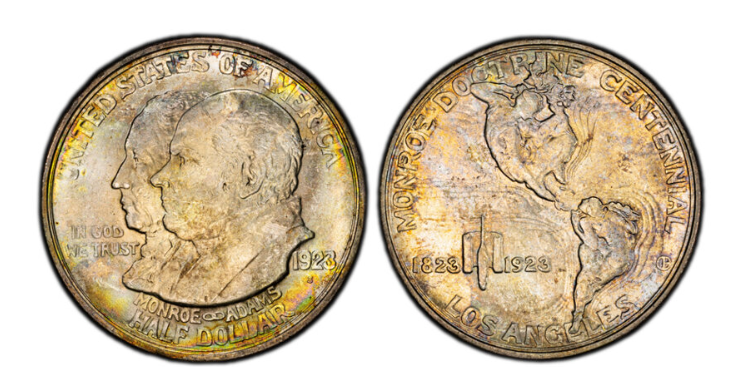
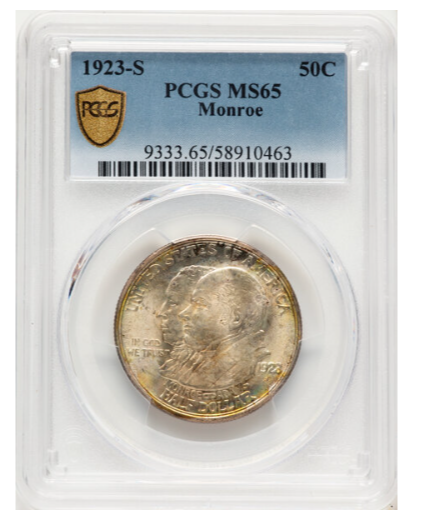
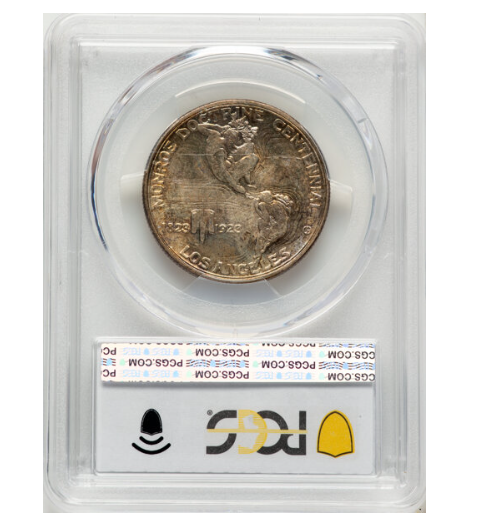
I finally found mine:)
Author of "Half a Dollar of History" — A collector's guide to the classic U.S. commemorative type set (1892–1954) | 50 chapters, PCGS photography, grading guides & auction values | amazon.com/dp/B0H6BZMQ6X