@JBK said:
The label will apparently read "Mint Error" with the heavy plating mentioned as the error.
I assume if it was PMP (post mint plating) then it would have been body bagged or listed as "damage" with the plating mentioned.
If, hypothetically, they missed the plating.
Professional Numismatist, Retired. 55 year member ANA. Former ANA Senior Authenticator. Winner of four ANA Heath Literary Awards; three Wayte and Olga Raymond Literary Awards; Numismatist of the Year Award 2009, and ANA Lifetime Achievement Award 2020. Winner of the PNG's 2026 Robert Friedberg Award for "The Enigmatic Lincoln Cents of 1922," Available now from Whitman or Amazon.
I appreciate how much sharing you have been with your journey. I have seen posts elsewhere too, so education provided elsewhere has enlightened others.
For me I have learned that with zinc dies struck on copper blanks I will now require SG results on slab. Over years I have seen "SG" number on slab a couple times. Earlier in this thread a $250 pcgs fee would have achieved your CRITICAL missing data point. You've saved me thousands & now I am confident how I will proceed in future with other similar offers. This can be $5k plus items in nice mint state that I passed on. Since 1982 I've seen maybe 8 of these for sale.
I do not buy damaged coins so yours with goofy reverse was always a no go from the get go. And weight spec is goofy too.
@CoinOM said:
I would have XRF tomorrow. I hope it will give some more answers.
Nope it will not. All that will do is spark your hopes and have you chasing down the rabbit hole again. Face it, you have a mint error just not the one you want it to be.
First time I saw SG including a number it confused me & I moved on. Second time I recalled 1st time seeing odd detail prior, but did not buy it either. Now I feel I have a handle on it as its a pcgs $250 service. Now I think I get it & understand it. I like errors I can recognize with my eyes. Copper struck by zinc dies have always been hard to visually verify 100% and they are pricey. Never owned one and for 5K plus likely never will. I remain hesitant so I stick with what feels right and I own several 5k plus error goodies. All are items I feel confident archiving.
Professional Numismatist, Retired. 55 year member ANA. Former ANA Senior Authenticator. Winner of four ANA Heath Literary Awards; three Wayte and Olga Raymond Literary Awards; Numismatist of the Year Award 2009, and ANA Lifetime Achievement Award 2020. Winner of the PNG's 2026 Robert Friedberg Award for "The Enigmatic Lincoln Cents of 1922," Available now from Whitman or Amazon.
That's actually not completely useless. If you take out the elements that we know aren't present, and then scale the rest up to 100%, the ratios match the reference lines fairly well.
Of course that only works if you know what elements are supposed to be present. for the OP's coin, it's probably safe to assume we're only talking about copper and zinc.
On the other hand, this whole discussion started because the XRF results aren't reliable when examining thickly plated coins. A new set of XRF results won't be any more reliable than the first ones. It's a shame that neither NGC nor PCGS got specific gravity values before slabbing.
The XRF done is useless. Crack it out and have XRF done again with shots on the obverse and reverse. Believe what the British Museum tells you……. You can’t do XRF through a slab. It can’t make sense of it and calls it 90% aluminum…which is Exactly what the XRF done for the OP indicated.
While it is possible to get XRF results through the slab, you can also get spurious results.
If it were Aluminum, it would be almost 3x thicker than a zinc coin and 3.5x thicker than copper.
It is absolutely 100% NOT aluminum.
Correct. Obviously.
If it were aluminum it would be struck on a planchet that was thicker, considering the stated weight.
My 1977 Aluminum Cent, that Heritage sold for $50k, only weighed 1 gram since it was the same thickness as a regular copper planchet.
mikebyers.com Dealer in Major Mint Errors, Die Trials & Patterns - Author of NLG Best World Coin Book World's Greatest Mint Errors - Publisher & Editor of minterrornews.com.
That's actually not completely useless. If you take out the elements that we know aren't present, and then scale the rest up to 100%, the ratios match the reference lines fairly well.
Of course that only works if you know what elements are supposed to be present. for the OP's coin, it's probably safe to assume we're only talking about copper and zinc.
On the other hand, this whole discussion started because the XRF results aren't reliable when examining thickly plated coins. A new set of XRF results won't be any more reliable than the first ones. It's a shame that neither NGC nor PCGS got specific gravity values before slabbing.
wrong is wrong. scaling up is improper as those can't be trusted either
Professional Numismatist, Retired. 55 year member ANA. Former ANA Senior Authenticator. Winner of four ANA Heath Literary Awards; three Wayte and Olga Raymond Literary Awards; Numismatist of the Year Award 2009, and ANA Lifetime Achievement Award 2020. Winner of the PNG's 2026 Robert Friedberg Award for "The Enigmatic Lincoln Cents of 1922," Available now from Whitman or Amazon.
Without commenting on the effort of anyone in particular, this whole exercise seems to me so far to have been a perfect example of how to not figure out much of anything useful at all.
i'll reiterate - if the copper plating is really that thick then an xrf will likely show a very high copper content
i've dissolved the zinc out of a zincoln with vinegar (acetic acid) and the thickness of the copper is thinner than a human hair. I forgot what it weighed but it was under 0.10 gram
Hopefully, for the OP, a nice cash payout for finding a significant Mint Error and persevering to get it certified. For everyone else, a real head scratcher, we look forward to seeing the outcome.
Ok to summarize the data I also collected data from a 2016 penny on its own and with it in a polystyrene case.
2016 penny no case
Cu: 49.82%
Zn: 50.14%
2016 penny in case
Cu: 41.48%
Zn: 58.12%
1983 penny in case
Al: 90.85%
Cu: 5.15%
Zn: 3.89%
I will try to collect some more data with the XRF. I would like to do a CT scan on it as well to see if we can see the coating.
@TomB said:
This is the thread that just keeps giving.
Yeah, but what?
Well, depends on whether watching a slow motion collision is amusing to you.
I don't know about a slow motion collision but I do find it a bit amusing that after 8 pages of comments discussing the possible composition of the coin, nobody has yet gotten around to actually figuring out what it's made of.
@TomB said:
This is the thread that just keeps giving.
Yeah, but what?
Well, depends on whether watching a slow motion collision is amusing to you.
I don't know about a slow motion collision but I do find it a bit amusing that after 8 pages of comments discussing the possible composition of the coin, nobody has yet gotten around to actually figuring out what it's made of.
If only there were an easy density test that involved the use of water!!!!
Professional Numismatist, Retired. 55 year member ANA. Former ANA Senior Authenticator. Winner of four ANA Heath Literary Awards; three Wayte and Olga Raymond Literary Awards; Numismatist of the Year Award 2009, and ANA Lifetime Achievement Award 2020. Winner of the PNG's 2026 Robert Friedberg Award for "The Enigmatic Lincoln Cents of 1922," Available now from Whitman or Amazon.
@TomB said:
This is the thread that just keeps giving.
Yeah, but what?
Well, depends on whether watching a slow motion collision is amusing to you.
I don't know about a slow motion collision but I do find it a bit amusing that after 8 pages of comments discussing the possible composition of the coin, nobody has yet gotten around to actually figuring out what it's made of.
If only there were an easy density test that involved the use of water!!!!
Ain't that the truth. Anything but that, though.
Maybe someone should put it in a ham sandwich and see what kind of XRF readings that generates...
@TomB said:
This is the thread that just keeps giving.
Yeah, but what?
Well, depends on whether watching a slow motion collision is amusing to you.
I don't know about a slow motion collision but I do find it a bit amusing that after 8 pages of comments discussing the possible composition of the coin, nobody has yet gotten around to actually figuring out what it's made of.
If only there were an easy density test that involved the use of water!!!!
yes!
and we can agree it's not aluminum without the test!
@TomB said:
This is the thread that just keeps giving.
Yeah, but what?
Well, depends on whether watching a slow motion collision is amusing to you.
I don't know about a slow motion collision but I do find it a bit amusing that after 8 pages of comments discussing the possible composition of the coin, nobody has yet gotten around to actually figuring out what it's made of.
If only there were an easy density test that involved the use of water!!!!
and i'm surprised the error maven at pcgs didn't do this test and put SG on the label
unfortunately your wisdom was not sought here on try #2
@CoinOM said:
Ok to summarize the data I also collected data from a 2016 penny on its own and with it in a polystyrene case.
2016 penny no case
Cu: 49.82%
Zn: 50.14%
2016 penny in case
Cu: 41.48%
Zn: 58.12%
1983 penny in case
Al: 90.85%
Cu: 5.15%
Zn: 3.89%
I will try to collect some more data with the XRF. I would like to do a CT scan on it as well to see if we can see the coating.
Oy. It's NOT aluminum.
You’ve GOT to crack it out. It’s impossible to do accurate XRF in a slab (a real PCGS slab. Believe the British Museum. While it’s out of the slab just for hoots and giggles, do a drop test and see if it clunks or rings.
@CoinOM said:
Ok to summarize the data I also collected data from a 2016 penny on its own and with it in a polystyrene case.
2016 penny no case
Cu: 49.82%
Zn: 50.14%
2016 penny in case
Cu: 41.48%
Zn: 58.12%
1983 penny in case
Al: 90.85%
Cu: 5.15%
Zn: 3.89%
I will try to collect some more data with the XRF. I would like to do a CT scan on it as well to see if we can see the coating.
Just looking at the 2016 cent you used as a test piece, it is coming back at almost equal parts copper and zinc. The XRF isn't reliable for showing the true composition of a plated coin.
@CoinOM said:
Ok to summarize the data I also collected data from a 2016 penny on its own and with it in a polystyrene case.
2016 penny no case
Cu: 49.82%
Zn: 50.14%
2016 penny in case
Cu: 41.48%
Zn: 58.12%
1983 penny in case
Al: 90.85%
Cu: 5.15%
Zn: 3.89%
I will try to collect some more data with the XRF. I would like to do a CT scan on it as well to see if we can see the coating.
Just looking at the 2016 cent you used as a test piece, it is coming back at almost equal parts copper and zinc. The XRF isn't reliable for showing the true composition of a plated coin.
and if the copper is really that thick it'll come back mostly copper
Professional Numismatist, Retired. 55 year member ANA. Former ANA Senior Authenticator. Winner of four ANA Heath Literary Awards; three Wayte and Olga Raymond Literary Awards; Numismatist of the Year Award 2009, and ANA Lifetime Achievement Award 2020. Winner of the PNG's 2026 Robert Friedberg Award for "The Enigmatic Lincoln Cents of 1922," Available now from Whitman or Amazon.
@CoinOM said:
Ok to summarize the data I also collected data from a 2016 penny on its own and with it in a polystyrene case.
2016 penny no case
Cu: 49.82%
Zn: 50.14%
2016 penny in case
Cu: 41.48%
Zn: 58.12%
1983 penny in case
Al: 90.85%
Cu: 5.15%
Zn: 3.89%
I will try to collect some more data with the XRF. I would like to do a CT scan on it as well to see if we can see the coating.
Just looking at the 2016 cent you used as a test piece, it is coming back at almost equal parts copper and zinc. The XRF isn't reliable for showing the true composition of a plated coin.
XRF is a surface test. That might be accurate for the surface of the plated coin.
Knowing the surface doesn't tell the whole story. To get a full picture of the coin, a specific gravity test is needed.
Comments
Fair enough, the rev looks especially off and the mushy poorly defined details are suspicious and could support the post mint replating suggestion.
My Collection of Old Holders
Never a slave to one plastic brand will I ever be.
The label will apparently read "Mint Error" with the heavy plating mentioned as the error.
I assume if it was PMP (post mint plating) then it would have been body bagged or listed as "damage" with the plating mentioned.
If, hypothetically, they missed the plating.
I would have XRF tomorrow. I hope it will give some more answers.
i would think it will be majority copper if the plating is so thick
the thing that needs to be done is a specific gravity test
I appreciate how much sharing you have been with your journey. I have seen posts elsewhere too, so education provided elsewhere has enlightened others.
For me I have learned that with zinc dies struck on copper blanks I will now require SG results on slab. Over years I have seen "SG" number on slab a couple times. Earlier in this thread a $250 pcgs fee would have achieved your CRITICAL missing data point. You've saved me thousands & now I am confident how I will proceed in future with other similar offers. This can be $5k plus items in nice mint state that I passed on. Since 1982 I've seen maybe 8 of these for sale.
I do not buy damaged coins so yours with goofy reverse was always a no go from the get go. And weight spec is goofy too.
Happy Tuesday !
certainly there was more on the slab. do you remember the text?
Nope it will not. All that will do is spark your hopes and have you chasing down the rabbit hole again. Face it, you have a mint error just not the one you want it to be.
My Collection of Old Holders
Never a slave to one plastic brand will I ever be.
First time I saw SG including a number it confused me & I moved on. Second time I recalled 1st time seeing odd detail prior, but did not buy it either. Now I feel I have a handle on it as its a pcgs $250 service. Now I think I get it & understand it. I like errors I can recognize with my eyes. Copper struck by zinc dies have always been hard to visually verify 100% and they are pricey. Never owned one and for 5K plus likely never will. I remain hesitant so I stick with what feels right and I own several 5k plus error goodies. All are items I feel confident archiving.
I would have my report tomorrow. The person who did the test said "we complete the test and coin was 90% aluminum"
Say what?
Ditto!
In honor of the memory of Cpl. Michael E. Thompson
Note similar results here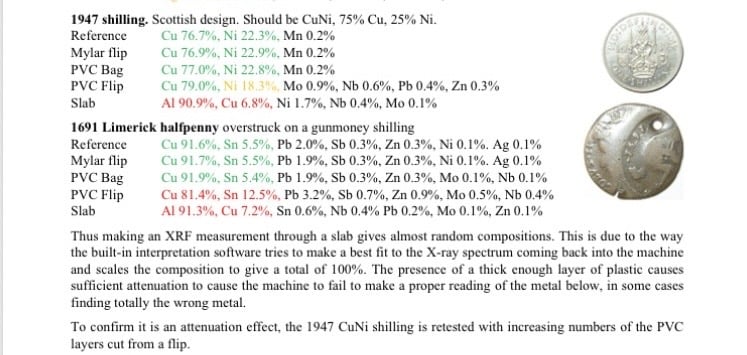
Here we go again.
My Collection of Old Holders
Never a slave to one plastic brand will I ever be.
This is a great thread!
If by, "90%" you mean 97.5% and if by, "aluminum" you mean zinc then I am in 100% agreement with you.
That's actually not completely useless. If you take out the elements that we know aren't present, and then scale the rest up to 100%, the ratios match the reference lines fairly well.
Of course that only works if you know what elements are supposed to be present. for the OP's coin, it's probably safe to assume we're only talking about copper and zinc.
On the other hand, this whole discussion started because the XRF results aren't reliable when examining thickly plated coins. A new set of XRF results won't be any more reliable than the first ones. It's a shame that neither NGC nor PCGS got specific gravity values before slabbing.
The XRF done is useless. Crack it out and have XRF done again with shots on the obverse and reverse. Believe what the British Museum tells you……. You can’t do XRF through a slab. It can’t make sense of it and calls it 90% aluminum…which is Exactly what the XRF done for the OP indicated.
aluminum is a lightweight material. lighter than zinc. i agree that it would have to be much thicker to be of the given weight.
https://en.wikipedia.org/wiki/1974_aluminum_cent
Mass 0.937 g
Correct. Obviously.
If it were aluminum it would be struck on a planchet that was thicker, considering the stated weight.
My 1977 Aluminum Cent, that Heritage sold for $50k, only weighed 1 gram since it was the same thickness as a regular copper planchet.
wrong is wrong. scaling up is improper as those can't be trusted either
Whoa. The British Museum data PROVES the XRF reads a slab as 90% aluminum. What part of this fact do you see not applying here???????
Somebody please repeat the test on an empty slab.
Without commenting on the effort of anyone in particular, this whole exercise seems to me so far to have been a perfect example of how to not figure out much of anything useful at all.
it could be gunned keeping it in the slab and just aim for the gasket part of the slab.
and while I'm here, the specific gravity appears not to have been done.
Aluminum . . . . . . . .. . . . . . 2.70
Copper (bronze .900) . . . . .8.94
Zinc (pure). . . . . . .. . . . . . .. .7.13
i'll reiterate - if the copper plating is really that thick then an xrf will likely show a very high copper content
i've dissolved the zinc out of a zincoln with vinegar (acetic acid) and the thickness of the copper is thinner than a human hair. I forgot what it weighed but it was under 0.10 gram
It should be possible to take an XRF shot into the deepest part of that “scratch”.
This is the thread that just keeps giving.
In honor of the memory of Cpl. Michael E. Thompson
Yeah, but what?
Hopefully, for the OP, a nice cash payout for finding a significant Mint Error and persevering to get it certified. For everyone else, a real head scratcher, we look forward to seeing the outcome.
Ok to summarize the data I also collected data from a 2016 penny on its own and with it in a polystyrene case.
2016 penny no case
Cu: 49.82%
Zn: 50.14%
2016 penny in case
Cu: 41.48%
Zn: 58.12%
1983 penny in case
Al: 90.85%
Cu: 5.15%
Zn: 3.89%
I will try to collect some more data with the XRF. I would like to do a CT scan on it as well to see if we can see the coating.
I don't know about a slow motion collision but I do find it a bit amusing that after 8 pages of comments discussing the possible composition of the coin, nobody has yet gotten around to actually figuring out what it's made of.
If only there were an easy density test that involved the use of water!!!!
Ain't that the truth. Anything but that, though.
Maybe someone should put it in a ham sandwich and see what kind of XRF readings that generates...
Would not the melting temperature be an indication?
yes!
and we can agree it's not aluminum without the test!
and i'm surprised the error maven at pcgs didn't do this test and put SG on the label
unfortunately your wisdom was not sought here on try #2
You’ve GOT to crack it out. It’s impossible to do accurate XRF in a slab (a real PCGS slab. Believe the British Museum. While it’s out of the slab just for hoots and giggles, do a drop test and see if it clunks or rings.
crack it out? figure out the specific gravity, then re-submit only for the to put it in the exact same holder?
they had an op to redo and just blanked everyone. and pcgs doesn't do much talking. if the auction gods couldn't get a write up, who can?
Just looking at the 2016 cent you used as a test piece, it is coming back at almost equal parts copper and zinc. The XRF isn't reliable for showing the true composition of a plated coin.
and if the copper is really that thick it'll come back mostly copper
back to the specific gravity test
From your mouth to God’s ear.
Depends. What is your definition of aluminum?
Knowing the surface doesn't tell the whole story. To get a full picture of the coin, a specific gravity test is needed.