Options
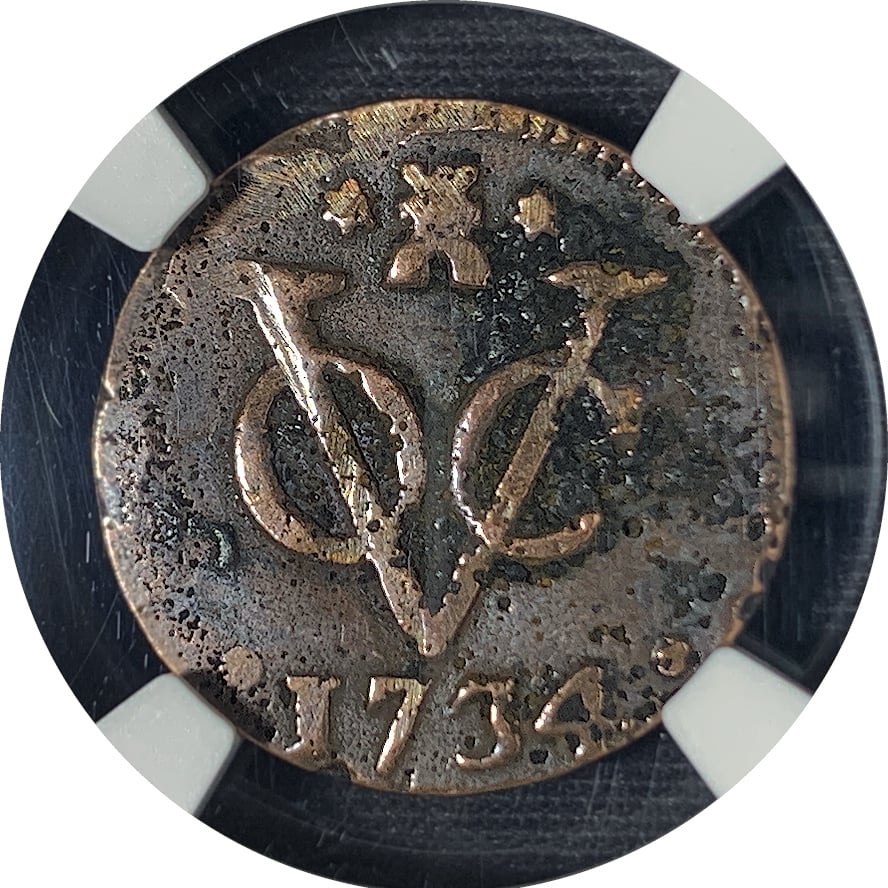
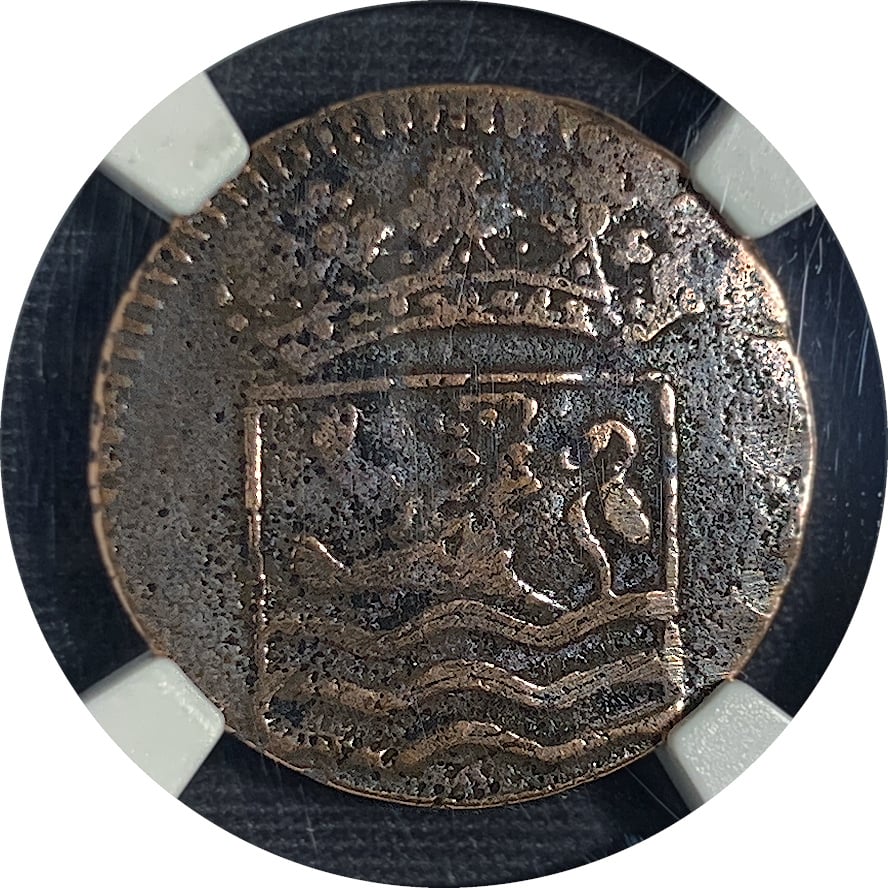
Do any U.S. collectors include the "New York Penny" as part of their collections? Photo included.
 TallahasseeCoinClub
Posts: 484 ✭✭✭✭
TallahasseeCoinClub
Posts: 484 ✭✭✭✭
Wondering - I bought a couple recently just for fun and realized it could be a highly intriguing set to work on. (In that case, I would pursue nicer examples than this one.)
Official PCGS account of:
www.TallahasseeCoinClub.com
2
Comments
That is a coin of the Dutch East Indies, so no.
I like 👍
I’ve included a duit in my collection of foreign coin types that circulated in the Colonies.
Other than the marketing hype associated with that coin, it is no more a part of the US series than dozens of other non-US coins that circulating in the US or colonies. Are you including all the various non-US coins?
All comments reflect the opinion of the author, even when irrefutably accurate.
PCGS has a defined registry set of foreign coins that circulated in the Colonies and there are many more that circulated here as legal tender until 1857. The PCGS list is a good place to start, but there are many many types that could be legitimately included in such a set. It’s a fascinating part of our history and great fun researching and assembling a set. Warning, it’s addictive. I probably have 300+ types in my set.
It would be a fun collection to work on, some study may turn up some rarer dates or varieties to look for. The whole New York penny thing is just a marketing ploy though, they have no more connection to New York than any other foreign coin and probably less connection than most. British, Spanish and French coins circulated much more heavily than Dutch. I did read about one of these found with a metal detector in the US though.
Thank you all for commenting. I was well aware that these were issued by the Netherlands ("Holland" I believe?) but the only potential connection to the U.S. that I was aware of was by way of their "New York Penny" nomenclature.
Official PCGS account of:
www.TallahasseeCoinClub.com
They probably did circulate, but the NY penny nomenclature is modern, I believe, not contemporary. Pure marketing.
All comments reflect the opinion of the author, even when irrefutably accurate.
“New York Penny” was/is used to sell these common coins because of the early Dutch settlement of New Amsterdam on Manhattan Island. The Dutch traded all over the world and these coins found their way here along with numerous other coins of the Netherlands. The whole N.Y. marketing aspect no doubt arose because these are very common and needed a little hyping. Nonetheless, they are legitimate “colonial” coins for anyone interested in that area of US numismatics.
BTW Holland is one of the lands in The Netherlands.
PS. I too would like to learn more about these little coins. No doubt they have a rich history and may include many types, varieties, and perhaps mints. The foreign guys might be a better hunting ground.
They are as common as dirt and almost as cheap. Well, they were until some genius decided to call them New York Pennies. Lol. It might have been Littleton.
I may start calling my English large pennies "Colonial Coppers" and see if i can raise the price a bit.
All comments reflect the opinion of the author, even when irrefutably accurate.
There are issues with calling your coin a "New York penny". For starters, the VOC (or any other Dutch colonial administration) did not make coins specifically for use in New Amsterdam; coinage circulating in the colony would have been mainly regular Dutch coinage, plus whatever Spanish and other foreign coinage came to hand (as with all the other European colonies in the Americas including the English ones, a shortage of official coinage was a permanent problem).
The other main issue is illustrated by this specific coin. New Amsterdam was founded in 1624 and was annexed by the English (becoming New York) in 1664, so it wasn't really "Dutch" for very long. The OP coin was struck in 1735, long after any possible Dutch influence in New York.
Finally, the "New York Penny" label seems to usually be attached specifically to these VOC coins. The VOC symbol is the badge of the "Dutch EAST India Company", not the "WEST India Company" which ran the American colonies; VOC coins were intended for circulation in what is now Indonesia, not the Americas. The exchange rate between the duit and the larger silver guilder was different in Indonesia compared to mainland Netherlands, so the VOC coins were only supposed to circulate in Asia and were not legal tender in Europe or the remaining Dutch colonies in the Americas.
Did Dutch duits (of north mainland and VOC types) circulate in colonial America? Probably; if any arrived, they would have been drafted into use as the colonies were so desperately short of small change. But there's no logical or historical reason to associate them with "New York" as opposed to any other of the colonies. Calling them "New York pennies" is just a marketing scam, a means by which someone with a hoard of these foreign coins could market them to highly parochial American collectors.
Roman emperor Marcus Aurelius, "Meditations"
Apparently I have been awarded the DPOTD twice.
Prior to the Napoleonic Wars of the late 1790s, the Netherlands was a confederation of provinces; each province was nominally autonomous and issued its own coinage. "Holland" is historically the richest and most populous province and the location of the capital city Amsterdam as well as the largest port Rotterdam, thus the reason why the names "Holland" and "The Netherlands" are often conflated by outsiders, in the same way that "England" and "Great Britain" are often conflated by non-British people.
The VOC was a trading company with half a dozen financial bases in the various provinces. While every province in the Netherlands issued its own coinage for local use, only a few provinces issued VOC coinage. The coin in the OP has the coat of arms of the province of Zeeland on it; you can tell it's Zeeland because the lion is half-underwater. Holland, Utrecht, Westfriesland and Zeeland are the most commonly encountered VOC duits.
Roman emperor Marcus Aurelius, "Meditations"
Apparently I have been awarded the DPOTD twice.
I thought it was well known that you can go to Britain, buy up some common, cheap 1700s British coins, bring them to America, and double your money by selling those exact same coins as "Colonial".
You can do much the same here in Australia. In 1800, the colonial governor of New South Wales colony issued a list of foreign coins with their officially accepted face values. The coins on this list are considered "Proclamation coins" here, and are marketed to collectors as "the first Australian coins" - even though they're perfectly normal coins in the lands where those coins came from and there's zero evidence that those specific coins had been in Australia all this time. They're even listed as such on the "Coins of Australia" Wikipedia page. Thus, you can go and import some Spanish dollars, or Indian rupees, or British shillings, and market them in Australia as "Proclamation coins" and double your money.
TLDR: Marketing is a powerful money-making tool. And all you need are the right words, and enough people to believe those words.
Roman emperor Marcus Aurelius, "Meditations"
Apparently I have been awarded the DPOTD twice.
I was kidding. "Colonial coppers" generally refer to coins struck here or for here. English pennies aren't usually included.
I just think it's interesting that they started marketing the Duits rather than the more common English pennies. One of the marketing firms must have gotten a bag of them and decided to move them.
All comments reflect the opinion of the author, even when irrefutably accurate.
A quick search shows some of these have been slabbed as "New York Penny" by PCGS, NGC & ICG.
Now That is disappointing to hear.
I first saw them in vinyl folios from some firm, maybe Littleton. It's kind of caught on, even though it's also ludicrous. They simply don't line up with the New Amsterdam period of New York, nor were they specifically produced for the colonies. They probably circulated here, like pretty much all European coinage of the period, but not specifically in NY nor more commonly than other coinage. Spanish/Mexican coinage would be a better choice for colonial connection as well as UK coins. But, definitely clever marketing.
All comments reflect the opinion of the author, even when irrefutably accurate.
Meh. They are slab companies not history books. If you search the internet, the name has become synonymous with the coin.
All comments reflect the opinion of the author, even when irrefutably accurate.
Your standards are clearly lower than mine.
I'm a realist. When a majority are using the term, it's become the correct name. Mercury dime is completely inaccurate, but it still gets used, throughout numismatic literature.
Why are 1856 flying Eagle patterns considered part of the series? 1913 Liberty nickels? We could even toss "continental dollars" into the discussion.
Seems like everyone's standards are a little low.
All comments reflect the opinion of the author, even when irrefutably accurate.
I guess my problem with the New York Penny moniker is that it’s misleading and crosses the line as purely a marketing gimmick that shouldn’t be perpetuated by a TPG. BTW the duit in my collection is slabbed without the goofy NYP designation. I wonder what the current TPG standard is.
There are a number of inaccurate or silly traditions that are tolerated because they didn’t originate as gimmicks (I think) and some are still open to debate. Not too sure about the Continental Dollar tho. May be time for a correction there.
I would assume you have to request the NY Penny designation. Most duits I've seen don't have it.
All comments reflect the opinion of the author, even when irrefutably accurate.
If "New York Penny" doesn't work for someone, how about "Boston Tea Party"? You can get those instead.
Is that a pedigree?
None of that makes sense. Lol. Unless someone came to Boston 25 years after the tea party to throw duits in the harbor to make a wish.
All comments reflect the opinion of the author, even when irrefutably accurate.
I don't know. I was just looking around on eBay and noticed the label.
Yeah. I just looked. There's a bunch of them. Lol. But despite the fact that earlier examples exist, all the ones i looked at are dated after the actual tea party. Lol
All comments reflect the opinion of the author, even when irrefutably accurate.
I suspect it's pretty much like Sapyx said...
"Calling them "New York pennies" [or "Boston Tea Party", for that matter] is just a marketing scam, a means by which someone with a hoard of these foreign coins could market them to highly parochial American collectors."
with "market them" meaning, "sell them for more than they could get without the label & plastic."
Are you referring to Imperial Motherland Coppers?
That specific coin is even more inaccurate because the coin in that slab isn't even a duit. It clearly says "1 Ct" on it, whereas duits have either no value or "5 1/16" - that "Boston Tea Party" coin is a Netherlands East Indies (Indonesia) cent from 1833-1840, and technically not a duit though the locals in Indonesia apparently treated them the same as the old duit coins. These coins were minted in Indonesia long after the US colonial period was over and the coins mostly stayed in Indonesia; I doubt any of them ever made it to circulation in the Americas.
Roman emperor Marcus Aurelius, "Meditations"
Apparently I have been awarded the DPOTD twice.
Not only that, the pictured coin is actually dated "1840" on the opposite side, so the label notation of "(1795-1840)" is only partially correct and they got lucky on the "1840" part since it happened to be the last date for the type.
QC at PCGS should probably be concerned.
This was such a great discussion. I am grateful to all participants.
Official PCGS account of:
www.TallahasseeCoinClub.com
Any fellow Old Timers out there remember a mail order dealer from the mid to late 60's, maybe early 70's that used to buy up lots of odd and unusual obsolete foreign coins and sell them with interesting stories? Pretty sure he was out of New York, and I THINK the name was Williams Trading Company, or something like that?
He might have been the origin of the "New York Penny" myth.
By the way, the unofficial criteria for being an "Old Timer" is a collector who remembers walking into a McDonalds with a dollar bill in his pocket, having lunch, and checking the dates on his change on the way out!
I remember getting groups of foreign coins and stamps as a child, by subscription. Likely a rip, but educational and got me started.
Maybe Williams Trading Post out of MA ? If it's who I'm thinking of, they might have specialized in "grab bags" but that was probably fifty years ago.
Official PCGS account of:
www.TallahasseeCoinClub.com
Could be.
I wish that the old Coin WOrld issues were available online so that I could browse them sometimes.
I got one just because I thought it interesting. Saw them 30+years ago and picked one up about the same condition as OP's.
Jim
When a man who is honestly mistaken hears the truth, he will either quit being mistaken or cease to be honest....Abraham Lincoln
Patriotism is supporting your country all the time, and your government when it deserves it.....Mark Twain