The RW card
 SoCalBigMark
Posts: 2,852 ✭✭✭✭✭
SoCalBigMark
Posts: 2,852 ✭✭✭✭✭
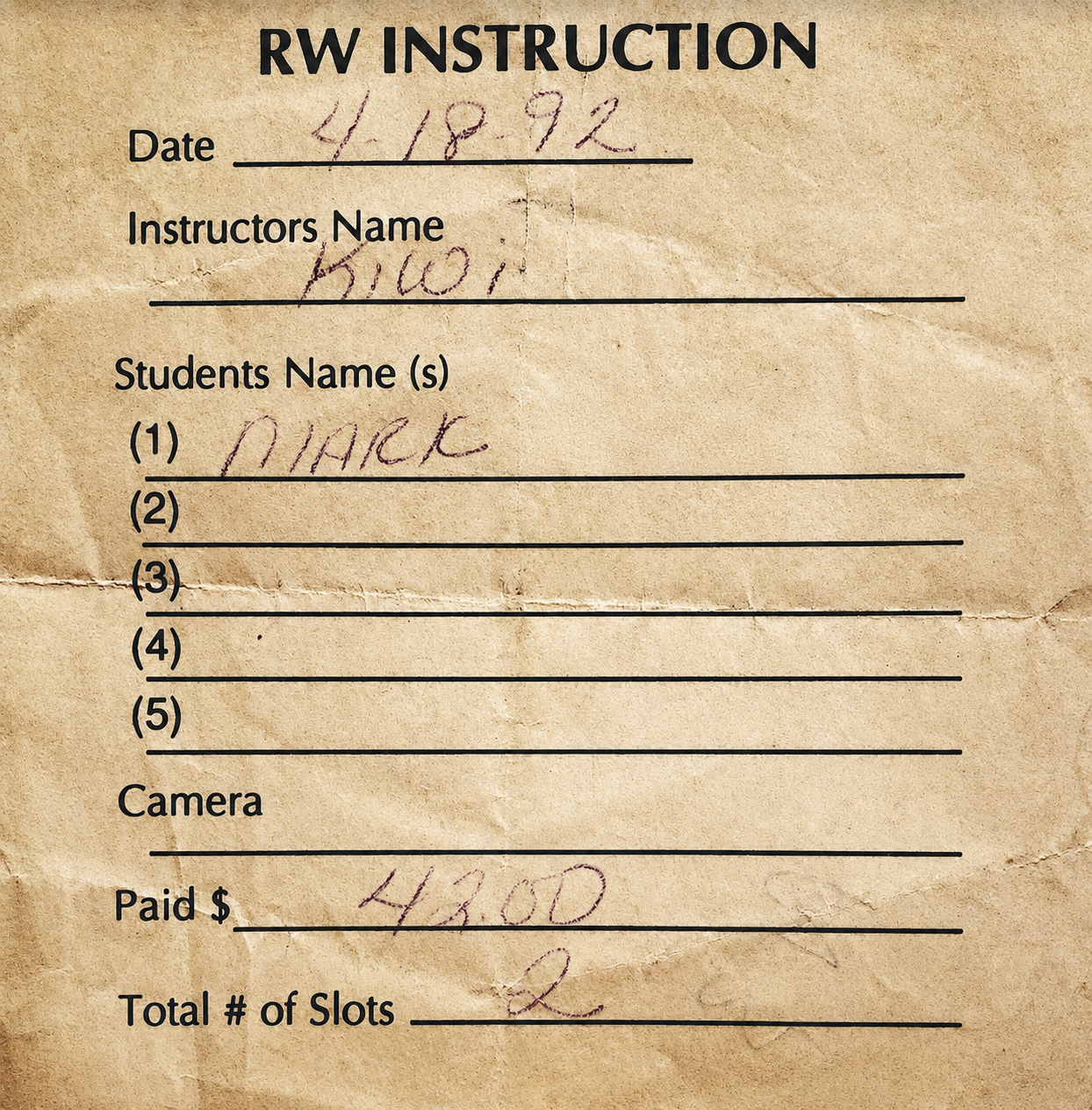
Among my old keepsakes is a small, worn card from 1992 labeled "RW Instruction."
Most people would see it as nothing more than an old training record. The paper is yellowed, the ink is fading, and the corners are bent from years of being tucked away in drawers and boxes.
To me, it is one of the most important pieces of paper I own.
The card records my 14th skydive.
At the time I was still a relatively new skydiver. I had completed Accelerated Freefall training, where students wear and operate their own parachute systems from the very first jump. Unlike tandem skydiving, where the instructor wears the parachute and the student is attached to them, AFF students are responsible for deploying and flying their own canopy. The equipment belongs to the drop zone, but the responsibility belongs to the student.
I had progressed to Relative Work, or RW, where experienced jumpers taught newer skydivers how to fly their bodies in relation to one another in freefall. It was an exciting time because I was finally moving beyond simply surviving a skydive and beginning to learn how to truly fly.
The instructor listed on my card was known as Kiwi.
He was from New Zealand, and I honestly can't remember ever seeing him in a bad mood. He always seemed happy. The only time he seemed even happier was when he was getting paid to make a skydive. The idea that somebody would hand him money to jump out of an airplane never stopped amusing him.
Kiwi loved skydiving.
You could see it every time he climbed into an aircraft.
On the day recorded on that card, he was teaching me RW skills. It was just another jump, another lesson, another ordinary day at the drop zone.
Neither of us knew it would be the last time.
Four days later, the airplane we had been jumping from crashed.
Sixteen jumpers were killed.
Kiwi was one of them.
Another was the jumper who had accompanied me on my very first skydive.
One week I was learning from them.
The next week they were gone.
The shock spread through the entire skydiving community. Losing one friend is hard enough. Losing sixteen people at once is something else entirely. The drop zone was filled with grief, disbelief, and empty spaces where familiar faces should have been.
For a while, every jump carried memories of the people who weren't there anymore.
Eventually, I returned to the sport.
I don't remember feeling brave.
I remember feeling determined.
Skydiving had become part of my life, and despite everything that had happened, I wanted to continue.
On my second jump back, I made a mistake.
I induced a malfunction in my main parachute.
As soon as I realized the canopy could not be safely flown, training took over. I executed emergency procedures and cut away the main canopy.
The malfunctioned parachute disappeared above me.
I immediately reached for my reserve handle.
Nothing happened.
I pulled harder.
Still nothing.
At first I couldn't understand what was wrong.
I knew the procedure.
I had practiced it countless times.
Yet I was falling through open sky with no functioning parachute above me.
What I didn't realize was that the reserve handle had shifted position. Instead of pulling the handle, I was pulling on the harness webbing beside it.
The reserve wasn't failing.
I was pulling the wrong thing.
But I didn't know that.
All I knew was that I was running out of altitude.
The ground was getting closer.
Time was disappearing.
Then a thought entered my mind with complete clarity.
I AM NOT GOING TO DIE.
It wasn't panic.
It wasn't a prayer.
It wasn't even anger.
It was simply a decision.
I stopped fighting the harness and looked again.
This time I saw the problem.
My hand moved only a few inches.
I found the actual reserve handle.
I pulled.
The reserve parachute exploded open above me.
Instantly, the chaos ended.
The silence that follows a parachute opening is something difficult to describe. One second there is noise, speed, and urgency. The next there is only the gentle sound of air moving through fabric.
I was alive.
As I flew toward the drop zone, I began to realize that people on the ground had probably witnessed the entire event. They had likely seen the cutaway. They had probably realized there was a delay before the reserve deployed.
Some of them were undoubtedly looking up and yelling for me to pull.
I never heard any of it.
My entire world had narrowed to the problem in front of me.
Approaching the landing area, I focused on flying the reserve.
Fueled by adrenaline and concentration, I made one of the best landings of my skydiving career—a perfect stand-up landing right in the accuracy pit in front of everyone.
The crowd applauded.
Under different circumstances I might have enjoyed it.
Maybe I would have smiled.
Maybe I would have accepted congratulations.
Maybe I would have exchanged a few high fives and laughed about it afterward.
Instead, I gathered up my reserve canopy and started walking back toward the office.
People were talking to me.
I barely noticed.
My head was down.
I wasn't thinking about the applause.
I wasn't thinking about the landing.
I wasn't thinking about how lucky I was.
I was thinking about how close I had come.
Only moments earlier I had been pulling on the wrong piece of webbing while falling toward the earth. The difference between walking across that packing area and never walking anywhere again had been a few inches and a few seconds.
As I passed through the packing area, I must have looked like I had seen a ghost.
The truth was, I had.
My own.
Most people would assume an experience like that would end a skydiving career.
For me, it didn't.
Over the years I accumulated about 350 jumps.
Some of my favorite jumps were from hot-air balloons.
Balloon jumps are unlike airplane jumps. There is no engine noise, no vibration, and no sensation of speed before exit. You simply step off into space.
For a brief moment it feels as though nothing is happening.
Then gravity takes hold.
Unlike an airplane jump, where you leave an aircraft already moving through the air, a balloon jump lets you feel and hear yourself accelerating. The wind starts softly and grows louder second by second. It is one of the purest sensations I have ever experienced.
I also made night jumps, watching towns become islands of light beneath me.
I made higher-altitude jumps that stretched freefall into long, unforgettable descents.
One of my favorite maneuvers was transitioning into a stand-up position during freefall. My speed increased dramatically, and the roar of the wind intensified. It felt less like falling and more like diving headfirst through the sky.
Those were wonderful experiences.
But when I think about my years in skydiving, I don't think first about the balloon jumps, the night jumps, or the total number of jumps in my logbook.
I think about people.
I think about Kiwi.
I think about his smile.
I think about how happy he was when somebody paid him to do something he loved.
I think about the sixteen jumpers who never came home.
And I think about a young skydiver hanging beneath a reserve parachute in 1992, looking at the world a little differently than he had a few minutes before.
The old RW card still sits among my keepsakes.
To everyone else it is just a piece of paper.
To me it is a reminder of friends, loss, survival, and a lesson I have carried ever since:
Life can change in a matter of seconds.
Sometimes those seconds take everything away.
Sometimes they give everything back.
Comments
Worry is the interest you pay on a debt you may not owe.
"Paper money eventually returns to its intrinsic value---zero."----Voltaire
"Everything you say should be true, but not everything true should be said."----Voltaire
fka renman95, Sep 2005, 7,000 posts
😉
That's an incredible story and write up. I remember the news covering that horrible crash.
Thanks for the compliments it means a lot to me, The reason it wasn't in the news longer were the LA riots.