The USS Indianapolis, commanded by Captain Charles Butler McVay III, carried 1,195 personnel when it set sail for the island of Tinian on July 16, 1945, to deliver components of the atomic bomb ‘‘Little Boy’’. After completing that mission, minutes after midnight on July 30, 1945, the ship was hit by two torpedoes from a Japanese submarine and sank quickly. After four days in the water, survivors were spotted and a rescue mission was executed. Only 316 men of the crew of 1,195 survived the ordeal and the survivors endured severe burns, exposure to the elements, extreme dehydration and shark attacks. The sacrifice, perseverance, and bravery of the crew of the USS Indianapolis should never be forgotten.
OBVERSE: The design depicts the USS Indianapolis with her 10 battle stars. Interspersed among a border of rivets are the inscriptions “USS INDIANAPOLIS CA-35” and her dates of service, “1932 – 1945”.
REVERSE: This design depicts a group of survivors clinging to a raft and offering support to each other during their ordeal. They have spotted either a plane or the spotlight from the USS Cecil J. Doyle, giving them a renewed sense of hope for their rescue. Sadly help came too late for so many of the crew. Inscriptions are “1195 SAILED,” “316 SURVIVED,” and “ACT OF CONGRESS 2018”.
The American Innovation $1 Coin representing Mississippi honors the first human lung transplant. On June 11, 1963, Dr. James D. Hardy and his collaborators, Watts R. Webb, Martin L. Dalton, Jr., and George R. Walker, Jr., at the University of Mississippi Medical Center performed the world's first human lung transplant.
Following the transplant, the patient lived for almost three weeks before succumbing to renal failure. The achievement, however, was undeniable. Dr. Hardy's initial procedure opened the way for exciting developments in human lung transplantation, and began a new era of therapy for lung disease in humans.
Characteristics
The obverse (heads) design features a dramatic representation of the Statue of Liberty in profile. The obverse also includes a privy mark of a stylized gear, representing industry and innovation.
The reverse (tails) design features a pair of human lungs in the background, while a surgical assistant passes forceps to the surgeon during the first lung transplant surgery.
Released on October 15, 2002, this is the 20th coin released in the 50 State Quarters Program and the fifth coin released in 2002. Mississippi, admitted into the Union on December 10, 1817, themed the coin, The Magnolia State. The quarter showcases the beauty and elegance of the state flower, combining the blossoms and leaves of two magnolias with the inscription "The Magnolia State."
The magnolia (Magnolia grandiflora), named for the French botanist Pierre Magnol, is strongly associated with the South where the flower became enormously popular after it was introduced from Asia. This association became strong enough that Mississippi adopted it as the state flower in 1952.
Characteristics
The obverse (heads) design features the familiar image of George Washington by John Flanagan, used on the quarter since 1932.
The reverse (tails) design features the state flower, combining the blossoms and leaves of two magnolias.
The 2011 Vicksburg National Military Park Quarter is the ninth coin in the America the Beautiful Quarters® Program.
The park commemorates one of the pivotal battles of the Civil War — the campaign, siege, and defense of Vicksburg, Miss. Surrender on July 4, 1863, coupled with the fall of Port Hudson, La., split the South, giving control of the Mississippi River to the North. The museum exhibits at the park depict the hardships of civilians and soldiers during the devastating 47-day siege of the city. More than 1,350 monuments, a national cemetery and the restored Union ironclad gunboat, the U.S.S. Cairo, mark the 16-mile tour road. The U.S.S. Cairo was the first warship sunk by an electronically detonated “torpedo,” which ushered in a new age of naval warfare. Vicksburg was first established as a national site on February 21, 1899 (30 Stat. 841).
Characteristics
The obverse (heads) design features the familiar image of George Washington by John Flanagan, used on the quarter since 1932. It has been restored to bring out subtle details and the beauty of the original.
The reverse (tails) image depicts the U.S.S. Cairo on the Yazoo River as it would have been seen when it served the U.S. Navy during the Civil War. Design candidates were developed in consultation with representatives of Vicksburg National Military Park.
Sales taxes, a regressive form of taxation enjoying new popularity among tax hikers across the country, owe their birth to the Great Depression. As income and therefore income tax receipts fell in the early 1930s, state after state turned to consumption taxes.
A problem, though, quickly developed. While a 1 percent tax on a $1 purchase worked out to an even cent, no smaller coin was available for the tax on amounts of less than $1.
To avoid overcharging people, 12 states – Alabama, Arizona, Colorado, Illinois, Kansas, Louisiana, Mississippi, Missouri, New Mexico, Oklahoma, Utah and Washington – issued their own tokens in denominations as small as 1/10th of a cent to make change.
The tokens – tiny in size and tiny in value – proved to be too much of a bother. Most states discontinued their usage before World War II, though Missouri tokens lasted into the early 1960s.
The tokens tend to be simple affairs – often with just the state’s name and denomination. New Mexico’s are noteworthy in that they show a saguaro cactus. Sales tax tokens were made in fiber, plastic, aluminum, zinc and bronze and were often holed.
The tokens are avidly sought after by a small group of collectors – many of whom are members of the American Tax Token Society. Sales tax tokens tend to be junk box material, often selling for a dime or so. Some rare varieties, though, have sold for as much as $500.
Elgin - Misleading Dates - The obverse bears the dates "1673" and "1936". While 1936 marks the coin's issue, 1673 actually honors French explorers Marquette and Joliet entering the territory—it has no historical connection to Elgin itself.
Lincoln - Although it completely sold out during its 1918 release, thousands of the coins inexplicably sat in storage. During the 1933 Bank Holiday, 30,000 of them were famously discovered in just one Illinois bank!
Steve
A day without fine wine and working on your coin collection is like a day without sunshine!!!
My collecting “Pride & Joy” is my PCGS Registry Dansco 7070 Set! Winner of the 2026 PCGS Registry Award for “The Best U.S. Type Set”!
@winesteven said: Elgin - Misleading Dates - The obverse bears the dates "1673" and "1936". While 1936 marks the coin's issue, 1673 actually honors French explorers Marquette and Joliet entering the territory—it has no historical connection to Elgin itself.
Lincoln - Although it completely sold out during its 1918 release, thousands of the coins inexplicably sat in storage. During the 1933 Bank Holiday, 30,000 of them were famously discovered in just one Illinois bank!
Steve
Steve, as always, your informative posts, continuously educate myself and others regarding these Classic Commem. issues. As you know this is a newly found interest of mine.
Do you or anyone else have a book which you would recommend on this subject? I find this series fascinating and your posts keep me coming back for more. Thanks, Zack.
@jfriedm56 , thanks for your kind words. Back in 2019, shortly after “completing” my Dansco 7070 Registry sets, my decades long numismatic interest, I asked myself, “So, what’s next?” I learned from others that the Classic Silver Commem 50-coin Type Set had super interesting stories behind each coin. I also liked that unlike most series where every coin is identical other than the date and mint mark, every one of these had a different design! I then looked at the approximate cost to fill each slot in the grades I would like, and found that I can obtain, over time, most of the coins for only three-figures each, with most of the others only slightly more.
We always hear, “Buy the book first”. So, to finally answer your question, I bought the Whitman book “A Guidebook of Commemorative Coins”. It’s chock full of interesting information about each coin. I was fascinated! Here’s a hot link:
I asked Steven to help, because I noticed he was up early or late and I wanted to see what his collection would offer. I appreciate @MsMorrisine adding essential and susbstantive material.
Edit: Thanks to all.
The coin design highlights how the state's agricultural traditions and business and financial climate — all the things that make Illinois a major hub of international commerce – rest on Lincoln's legacy of integrity and hard work. The Illinois quarter depicts a young Abraham Lincoln within the outline of the state. A farm scene and the Chicago skyline appear on opposite sides of the outline. The design also contains 21 stars and bears the inscriptions "21st State/Century" and "Land Of Lincoln."
Characteristics
The obverse (heads) design features the familiar image of George Washington by John Flanagan, used on the quarter since 1932.
The reverse (tails) design features an image of Abraham Lincoln within an outline of the state, a farm scene, and the Chicago skyline on the left and the right of the state's outline. There are twenty-one stars bordering the coin which signify Illinois as the 21st state admitted into the Union.
The Shawnee National Forest hosts the most acreage of any natural area in the state of Illinois. Its large, public open spaces offer many recreation opportunities including big-game hunting, long-distance pedestrian and equestrian trails, orienteering, bird watching, rock-climbing, beach recreation, and two National Scenic Byways: the Ohio River and the Great River Road. The forest also has some of the largest and most diverse blocks of mature hardwoods and forest interior habitats of national forests. An abundance of wetlands, floodplains and riparian areas enhances water quality and provides important wetland habitats for migrating waterfowl in the Mississippi flyway. It was established as a national site in 1939.
Characteristics
The obverse (heads) design features the familiar image of George Washington by John Flanagan, used on the quarter since 1932. It has been restored to bring out subtle details and the beauty of the original.
The reverse (tails) depicts a close view of Camel Rock with natural vegetation in the foreground and a red-tailed hawk soaring in the sky overhead. Design candidates were developed in consultation with representatives of Shawnee National Forest.
Riparian means anything relating to, living on, or located on the banks of a natural watercourse, such as a river, stream, or sometimes a lake.
The Illinois American innovation $1 Coin reverse (tails) design features a large steel plow blade affixed to a right-handed beam and braces. Behind the plow is a stand of Big Bluestem prairie grass and a field of soil below. Included inscriptions are “UNITED STATES OF AMERICA,” “STEEL PLOW,” and “ILLINOIS.”
Merchants had to pay sales tax to the state on the total amount of sales made by the merchant during each day's sales. You can imagine that if the sales tax rate is 3% and a child buys a 10c piece of candy there is no way to collect the three-tenths of one cent. If you rounded down that meant that the merchant could not collect anything for the tax. If you rounded up the state was gaining 7 tenths of a cent on every 10 cent sale. You can see that if the merchant sold 100 pieces of candy he was loosing 30 cents a day in tax revenues to the state, so the token was born. This allowed the merchant to take 11 cents for the first piece of candy and give change back in mills. The next time you wanted to buy a 10c candy you could present the merchant with the 10c and a token and complete the transaction. This allowed the merchant to collect the sales tax on each transaction.
https://salestaxtokens.org/price-guide
The State of Illinois issued a small square aluminum token as well as a small round token. These were the only ones issued by the state and they are very common and worth less than a dollar each; although one variety of the round token is slightly more difficult to find and may be worth a few dollars in higher grade. In addition to the state issued tax tokens, many counties and towns in Illinois had their own metal or paper (scrip) tokens. Some of the more common metal tokens can be found from: Arcola, Carbondale, Chandlerville, Charleston, Effingham, Jackson County, Jacksonville, Litchfield, Mercer County, Moline, New Boston, Paris, Pike County, Roanoke, Rock Island, St. Anne, Tazewell County, Toulon, Union County and Whiteside County. Metal tokens from these counties and towns are the most common and only worth a couple of dollars each. If you have a token from an Illinois county not listed here, it’s likely that it has a higher value. Feel free to contact us with details, and someone will help determine a potential value for you. If you have Illinois tax tokens printed on paper stock (called scrip), even for the counties listed above, then you have a much better item, highly sought after and which could bring in a high dollar amount, even as much as several hundred dollars or more, for the right piece.
First coin to feature a living person: It made history as the very first US coin to depict a recognizable living person. Governor Thomas Kilby is pictured alongside Alabama’s first governor, William Wyatt Bibb.
A famous female designer: The coin was designed by acclaimed sculptor Laura Gardin Fraser. With this commission, she became the first woman ever to design a US coin.
The "2x2" variety: To boost flagging sales, coin promoters convinced the Mint to add a "2x2" countermark to the obverse field at 3 O’clock on a newer version (The "2" stands for Alabama as the 22nd state, and the "x" represents the Saint Andrew's cross found on the Alabama state flag). You can see the 2X2 on my coin. This version tends to have a higher value.
Controversial timing: It was minted in 1921, but it was meant to commemorate the 100th anniversary of Alabama's statehood, which occurred two years prior in 1919. The delay was politically motivated so sponsors could feature a newly elected Republican president (Warren G. Harding) and the governor of their choice
Steve
A day without fine wine and working on your coin collection is like a day without sunshine!!!
My collecting “Pride & Joy” is my PCGS Registry Dansco 7070 Set! Winner of the 2026 PCGS Registry Award for “The Best U.S. Type Set”!
The Alabama quarter is the second to be released in 2003. Alabama became the 22nd state to be admitted into the Union on December 14, 1819. The Alabama quarter design features an image of Helen Keller with her name in English, and in a reduced–size version of braille. The Alabama quarter is the first U.S. circulating coin to feature braille. An Alabama long leaf pine branch and magnolias grace the sides of the design, and a "Spirit of Courage" banner underlines the central image.
Miss Keller was born at "Ivy Green" in Tuscumbia, Alabama, in 1880. When she was a small child, an illness destroyed her sight and hearing and, consequently, deprived her of the senses used in the development of speech. Despite her disabilities, she learned to speak and read using the raised and manual alphabets, as well as braille. Miss Keller also graduated with honors, receiving her Bachelor of Arts degree from Radcliffe. She went on to publish numerous books, articles and essays. Miss Keller lived out her life addressing social issues for disabled persons and women. Every year at "Ivy Green," a weeklong celebration is held to commemorate her lifetime of accomplishments and her "Spirit of Courage."
Characteristics
The obverse (heads) design features the familiar image of George Washington by John Flanagan, used on the quarter since 1932.
The reverse (tails) design features an image of Helen Keller with her name in English and in a reduced-size version of Braille, an Alabama long leaf pine branch wtih magnolias gracing the sides of the design, and the Spirit of Courage banner underlining the image.
The Tuskegee Airmen National Historic Site in Alabama commemorates the heroic actions and achievements of the famous Tuskegee Airmen. The term “Tuskegee Airmen” pertains to both men and women of diverse nationalities. They were composed of nearly 1,000 pilots and more than 15,000 support staff (including navigators, bombardiers, and mechanics). The site preserves five historic structures used during primary flight training in World War II.
Characteristics
The obverse (heads) design features the familiar image of George Washington by John Flanagan, used on the quarter since 1932. It has been restored to bring out subtle details and the beauty of the original.
The reverse (tails) design depicts a Tuskegee Airman pilot suiting up to join the fight during World War II with the Moton Field control tower in the background. The pilot looks upward with pride and confidence as two P-51 Mustangs pass overhead. The inscription “THEY FOUGHT TWO WARS” is arced across the top as a reference to the dual battles the Tuskegee Airmen fought–fascism abroad and racial discrimination at home.
The Congressional Gold Medal is the highest civilian recognition awarded by the U.S. Congress. This medal was presented to the Tuskegee Airmen, African American pilots flying for the U.S. Army Air Forces during World War II. Awarded on March 29, 2007, the medal recognized their “unique military record that inspired revolutionary reform in the Armed Forces.”
Helen Keller's Presidential Medal of Freedom
The highest civilian award in the United States, presented by Lyndon Baines Johnson on September 14, 1964. The medal is on a collar of blue, white and purple ribbon. The velvet lined presentation box also contains a miniature replica of the ribbon, a uniform ribbon, and a buttonhole ribbon.
Helen Keller's Oscar Award
Presented in 1955 for "Helen Keller in Her Story."
Migel Medals, the highest honor in the blindness field. The Migel Medal was established in 1937 by the late M.C. Migel, the first chairperson of AFB, to honor professionals and volunteers whose dedication and achievements have significantly improved the lives of people who are blind or visually impaired.
The American Innovation $1 Coin representing Alabama recognizes the invention of the Saturn V rocket. The Saturn V rocket was developed to support the Apollo space program for human exploration to the Moon. NASA launched 13 Saturn V rockets between 1967 and 1973.
The Saturn V rocket was designed and built at the George C. Marshall Space Flight Center in Huntsville, Alabama, under the supervision of aerospace engineer Wernher von Braun. The "Heavy Lift Vehicle" was 363 feet tall, the height of a 36-story building. During launch, the rocket generated 7.6 million pounds of thrust - more power than 85 Hoover Dams.
NASA launched the first Saturn V rocket for the Apollo 4 mission in 1967. The last Saturn V launched in 1973, without a crew, to carry the Skylab space station into Earth orbit.
Characteristics
The obverse (heads) design features a dramatic representation of the Statue of Liberty in profile. The obverse also includes a privy mark of a stylized gear, representing industry and innovation.
The reverse (tails) design depicts the power and force of the Saturn V rocket lifting off with the Moon in the background.
This medal commemorates the first launch of the Saturn V rocket on November 9, 1967. The Saturn V was the world's largest and most powerful rocket, and this launch was a successful test. From 1968 to the end of 1972, the Saturn V was used to launch a number of piloted and unpiloted Apollo spacecraft, including six successful missions to the Moon.
Space medal collector Thomas Becker donated this medal to the National Collection in 1972.
Comments
https://images.indianahistory.org/digital/collection/p16797coll4/id/50
https://www.usmint.gov/uss-indianapolis-ca-35-bronze-medal-MASTER_MLUS.html
The USS Indianapolis, commanded by Captain Charles Butler McVay III, carried 1,195 personnel when it set sail for the island of Tinian on July 16, 1945, to deliver components of the atomic bomb ‘‘Little Boy’’. After completing that mission, minutes after midnight on July 30, 1945, the ship was hit by two torpedoes from a Japanese submarine and sank quickly. After four days in the water, survivors were spotted and a rescue mission was executed. Only 316 men of the crew of 1,195 survived the ordeal and the survivors endured severe burns, exposure to the elements, extreme dehydration and shark attacks. The sacrifice, perseverance, and bravery of the crew of the USS Indianapolis should never be forgotten.
OBVERSE: The design depicts the USS Indianapolis with her 10 battle stars. Interspersed among a border of rivets are the inscriptions “USS INDIANAPOLIS CA-35” and her dates of service, “1932 – 1945”.
REVERSE: This design depicts a group of survivors clinging to a raft and offering support to each other during their ordeal. They have spotted either a plane or the spotlight from the USS Cecil J. Doyle, giving them a renewed sense of hope for their rescue. Sadly help came too late for so many of the crew. Inscriptions are “1195 SAILED,” “316 SURVIVED,” and “ACT OF CONGRESS 2018”.
https://www.nga.gov/artworks/177466-indiana-medal-admission-indiana-union-obverse
Friday June 4 - Mississippi
William Faulkner’s Nobel Prize for Literature
Jackson, MS was named after Andrew Jackson...so.....
Casual collector slowly building a collection....
The American Innovation $1 Coin representing Mississippi honors the first human lung transplant. On June 11, 1963, Dr. James D. Hardy and his collaborators, Watts R. Webb, Martin L. Dalton, Jr., and George R. Walker, Jr., at the University of Mississippi Medical Center performed the world's first human lung transplant.
Following the transplant, the patient lived for almost three weeks before succumbing to renal failure. The achievement, however, was undeniable. Dr. Hardy's initial procedure opened the way for exciting developments in human lung transplantation, and began a new era of therapy for lung disease in humans.
Characteristics
The obverse (heads) design features a dramatic representation of the Statue of Liberty in profile. The obverse also includes a privy mark of a stylized gear, representing industry and innovation.
The reverse (tails) design features a pair of human lungs in the background, while a surgical assistant passes forceps to the surgeon during the first lung transplant surgery.
Released on October 15, 2002, this is the 20th coin released in the 50 State Quarters Program and the fifth coin released in 2002. Mississippi, admitted into the Union on December 10, 1817, themed the coin, The Magnolia State. The quarter showcases the beauty and elegance of the state flower, combining the blossoms and leaves of two magnolias with the inscription "The Magnolia State."
The magnolia (Magnolia grandiflora), named for the French botanist Pierre Magnol, is strongly associated with the South where the flower became enormously popular after it was introduced from Asia. This association became strong enough that Mississippi adopted it as the state flower in 1952.
Characteristics
The obverse (heads) design features the familiar image of George Washington by John Flanagan, used on the quarter since 1932.
The reverse (tails) design features the state flower, combining the blossoms and leaves of two magnolias.
The 2011 Vicksburg National Military Park Quarter is the ninth coin in the America the Beautiful Quarters® Program.
The park commemorates one of the pivotal battles of the Civil War — the campaign, siege, and defense of Vicksburg, Miss. Surrender on July 4, 1863, coupled with the fall of Port Hudson, La., split the South, giving control of the Mississippi River to the North. The museum exhibits at the park depict the hardships of civilians and soldiers during the devastating 47-day siege of the city. More than 1,350 monuments, a national cemetery and the restored Union ironclad gunboat, the U.S.S. Cairo, mark the 16-mile tour road. The U.S.S. Cairo was the first warship sunk by an electronically detonated “torpedo,” which ushered in a new age of naval warfare. Vicksburg was first established as a national site on February 21, 1899 (30 Stat. 841).
Characteristics
The obverse (heads) design features the familiar image of George Washington by John Flanagan, used on the quarter since 1932. It has been restored to bring out subtle details and the beauty of the original.
The reverse (tails) image depicts the U.S.S. Cairo on the Yazoo River as it would have been seen when it served the U.S. Navy during the Civil War. Design candidates were developed in consultation with representatives of Vicksburg National Military Park.
Vicksburg, Mississippi Trade Token
Uncle Tom's Cabin / G.F. 12 1/2c In Trade
Biloxi, Mississippi Trade Token
GUS STEVENS SHOW LOUNGE $5.00
Sales taxes, a regressive form of taxation enjoying new popularity among tax hikers across the country, owe their birth to the Great Depression. As income and therefore income tax receipts fell in the early 1930s, state after state turned to consumption taxes.
A problem, though, quickly developed. While a 1 percent tax on a $1 purchase worked out to an even cent, no smaller coin was available for the tax on amounts of less than $1.
To avoid overcharging people, 12 states – Alabama, Arizona, Colorado, Illinois, Kansas, Louisiana, Mississippi, Missouri, New Mexico, Oklahoma, Utah and Washington – issued their own tokens in denominations as small as 1/10th of a cent to make change.
The tokens – tiny in size and tiny in value – proved to be too much of a bother. Most states discontinued their usage before World War II, though Missouri tokens lasted into the early 1960s.
The tokens tend to be simple affairs – often with just the state’s name and denomination. New Mexico’s are noteworthy in that they show a saguaro cactus. Sales tax tokens were made in fiber, plastic, aluminum, zinc and bronze and were often holed.
The tokens are avidly sought after by a small group of collectors – many of whom are members of the American Tax Token Society. Sales tax tokens tend to be junk box material, often selling for a dime or so. Some rare varieties, though, have sold for as much as $500.
1893 Col. Expo Medal
Saturday June 6 - Illinois
Elgin - Misleading Dates - The obverse bears the dates "1673" and "1936". While 1936 marks the coin's issue, 1673 actually honors French explorers Marquette and Joliet entering the territory—it has no historical connection to Elgin itself.
Lincoln - Although it completely sold out during its 1918 release, thousands of the coins inexplicably sat in storage. During the 1933 Bank Holiday, 30,000 of them were famously discovered in just one Illinois bank!
Steve
My collecting “Pride & Joy” is my PCGS Registry Dansco 7070 Set! Winner of the 2026 PCGS Registry Award for “The Best U.S. Type Set”!
https://www.pcgs.com/setregistry/type-sets/design-type-sets/complete-dansco-7070-modified-type-set-1796-date/publishedset/213996
Steve, as always, your informative posts, continuously educate myself and others regarding these Classic Commem. issues. As you know this is a newly found interest of mine.
Do you or anyone else have a book which you would recommend on this subject? I find this series fascinating and your posts keep me coming back for more. Thanks, Zack.
@jfriedm56 , thanks for your kind words. Back in 2019, shortly after “completing” my Dansco 7070 Registry sets, my decades long numismatic interest, I asked myself, “So, what’s next?” I learned from others that the Classic Silver Commem 50-coin Type Set had super interesting stories behind each coin. I also liked that unlike most series where every coin is identical other than the date and mint mark, every one of these had a different design! I then looked at the approximate cost to fill each slot in the grades I would like, and found that I can obtain, over time, most of the coins for only three-figures each, with most of the others only slightly more.
We always hear, “Buy the book first”. So, to finally answer your question, I bought the Whitman book “A Guidebook of Commemorative Coins”. It’s chock full of interesting information about each coin. I was fascinated! Here’s a hot link:
https://www.amazon.com/Guide-United-States-Commemorative-Official/dp/0794844197/ref=sr_1_2?crid=2P3CYRNM3WQGW&dib=eyJ2IjoiMSJ9.J7AlQBccNSF06AWowe55-m8Sxm72cmAQho0yBI17wrJk0Ghjzov4dXwLhw4FsEE3u_6-hiyKyvY8WFtovufnJDaChSnikZkb61GSdAf7LqAn9OLe14ilbEvMCRtnnEB7GOdG_apxNG6Ijf_C8H1Bdv6OsAxPealARzD6YnPbEokt2GlSkvOEjPDXg9lZ2beJW5xGXL7fCQH0hlp0SXDOHru0a4Bdt1HeTHsw8AMh4qo.QPMgpoyqFwMgjlXVta095934idJpBkJQ5pjIgtekVVI&dib_tag=se&keywords=Whitman+Commemorative+coins&qid=1780742185&sprefix=whitman+commemorative+coins,aps,666&sr=8-2
Continue with the wonderful Classic Silver Commem collection you started. Reading about each coin will give you even more enjoyment.
Your friend, Steve
My collecting “Pride & Joy” is my PCGS Registry Dansco 7070 Set! Winner of the 2026 PCGS Registry Award for “The Best U.S. Type Set”!
https://www.pcgs.com/setregistry/type-sets/design-type-sets/complete-dansco-7070-modified-type-set-1796-date/publishedset/213996
@winesteven, thank you Steve. Appreciate you. I will certainly purchase your book recommendation. Thanks again for all your help as always. Zack.
AU55
Casual collector slowly building a collection....
I asked Steven to help, because I noticed he was up early or late and I wanted to see what his collection would offer. I appreciate @MsMorrisine adding essential and susbstantive material.
Edit: Thanks to all.
Top 10 Cal Fractional Type Set
successful BST with Ankurj, BigAl, Bullsitter, CommemKing, DCW(7), DesertMoon, Downtown1974, Elmerfusterpuck, Joelewis, Mach1ne, Minuteman810430, Modcrewman, Nankraut, Nederveit2, Philographer(5), Proofcollection, Realgator, Silverpop, SurfinxHI, TomB and Yorkshireman(3)
The coin design highlights how the state's agricultural traditions and business and financial climate — all the things that make Illinois a major hub of international commerce – rest on Lincoln's legacy of integrity and hard work. The Illinois quarter depicts a young Abraham Lincoln within the outline of the state. A farm scene and the Chicago skyline appear on opposite sides of the outline. The design also contains 21 stars and bears the inscriptions "21st State/Century" and "Land Of Lincoln."
Characteristics
The obverse (heads) design features the familiar image of George Washington by John Flanagan, used on the quarter since 1932.
The reverse (tails) design features an image of Abraham Lincoln within an outline of the state, a farm scene, and the Chicago skyline on the left and the right of the state's outline. There are twenty-one stars bordering the coin which signify Illinois as the 21st state admitted into the Union.
The Shawnee National Forest hosts the most acreage of any natural area in the state of Illinois. Its large, public open spaces offer many recreation opportunities including big-game hunting, long-distance pedestrian and equestrian trails, orienteering, bird watching, rock-climbing, beach recreation, and two National Scenic Byways: the Ohio River and the Great River Road. The forest also has some of the largest and most diverse blocks of mature hardwoods and forest interior habitats of national forests. An abundance of wetlands, floodplains and riparian areas enhances water quality and provides important wetland habitats for migrating waterfowl in the Mississippi flyway. It was established as a national site in 1939.
Characteristics
The obverse (heads) design features the familiar image of George Washington by John Flanagan, used on the quarter since 1932. It has been restored to bring out subtle details and the beauty of the original.
The reverse (tails) depicts a close view of Camel Rock with natural vegetation in the foreground and a red-tailed hawk soaring in the sky overhead. Design candidates were developed in consultation with representatives of Shawnee National Forest.
Riparian means anything relating to, living on, or located on the banks of a natural watercourse, such as a river, stream, or sometimes a lake.
Mr_Spud
Lincoln Medal - Bela Lyon Pratt
Door at the Courthouse, Lincoln, IL
Lincoln's House
fka renman95, Sep 2005, 7,000 posts
The Illinois American innovation $1 Coin reverse (tails) design features a large steel plow blade affixed to a right-handed beam and braces. Behind the plow is a stand of Big Bluestem prairie grass and a field of soil below. Included inscriptions are “UNITED STATES OF AMERICA,” “STEEL PLOW,” and “ILLINOIS.”
http://www.taxtoken.org/faq.htm
Merchants had to pay sales tax to the state on the total amount of sales made by the merchant during each day's sales. You can imagine that if the sales tax rate is 3% and a child buys a 10c piece of candy there is no way to collect the three-tenths of one cent. If you rounded down that meant that the merchant could not collect anything for the tax. If you rounded up the state was gaining 7 tenths of a cent on every 10 cent sale. You can see that if the merchant sold 100 pieces of candy he was loosing 30 cents a day in tax revenues to the state, so the token was born. This allowed the merchant to take 11 cents for the first piece of candy and give change back in mills. The next time you wanted to buy a 10c candy you could present the merchant with the 10c and a token and complete the transaction. This allowed the merchant to collect the sales tax on each transaction.
https://salestaxtokens.org/price-guide
The State of Illinois issued a small square aluminum token as well as a small round token. These were the only ones issued by the state and they are very common and worth less than a dollar each; although one variety of the round token is slightly more difficult to find and may be worth a few dollars in higher grade. In addition to the state issued tax tokens, many counties and towns in Illinois had their own metal or paper (scrip) tokens. Some of the more common metal tokens can be found from: Arcola, Carbondale, Chandlerville, Charleston, Effingham, Jackson County, Jacksonville, Litchfield, Mercer County, Moline, New Boston, Paris, Pike County, Roanoke, Rock Island, St. Anne, Tazewell County, Toulon, Union County and Whiteside County. Metal tokens from these counties and towns are the most common and only worth a couple of dollars each. If you have a token from an Illinois county not listed here, it’s likely that it has a higher value. Feel free to contact us with details, and someone will help determine a potential value for you. If you have Illinois tax tokens printed on paper stock (called scrip), even for the counties listed above, then you have a much better item, highly sought after and which could bring in a high dollar amount, even as much as several hundred dollars or more, for the right piece.
Franklin Mint (The Franklin Mint), Wawa, Pennsylvania, United States (1964-2003)
Sunday June 7 - Alabama
The first organized Mardi Gras carnival in the Americas took place in Mobile.
NASA facilities in Huntsville.
Alabama Classic Commem:
Steve
My collecting “Pride & Joy” is my PCGS Registry Dansco 7070 Set! Winner of the 2026 PCGS Registry Award for “The Best U.S. Type Set”!
https://www.pcgs.com/setregistry/type-sets/design-type-sets/complete-dansco-7070-modified-type-set-1796-date/publishedset/213996
Vettes for Vets every Memorial Day weekend at Talladega
Top 10 Cal Fractional Type Set
successful BST with Ankurj, BigAl, Bullsitter, CommemKing, DCW(7), DesertMoon, Downtown1974, Elmerfusterpuck, Joelewis, Mach1ne, Minuteman810430, Modcrewman, Nankraut, Nederveit2, Philographer(5), Proofcollection, Realgator, Silverpop, SurfinxHI, TomB and Yorkshireman(3)
Casual collector slowly building a collection....
Mr_Spud
That is sweet.^^
.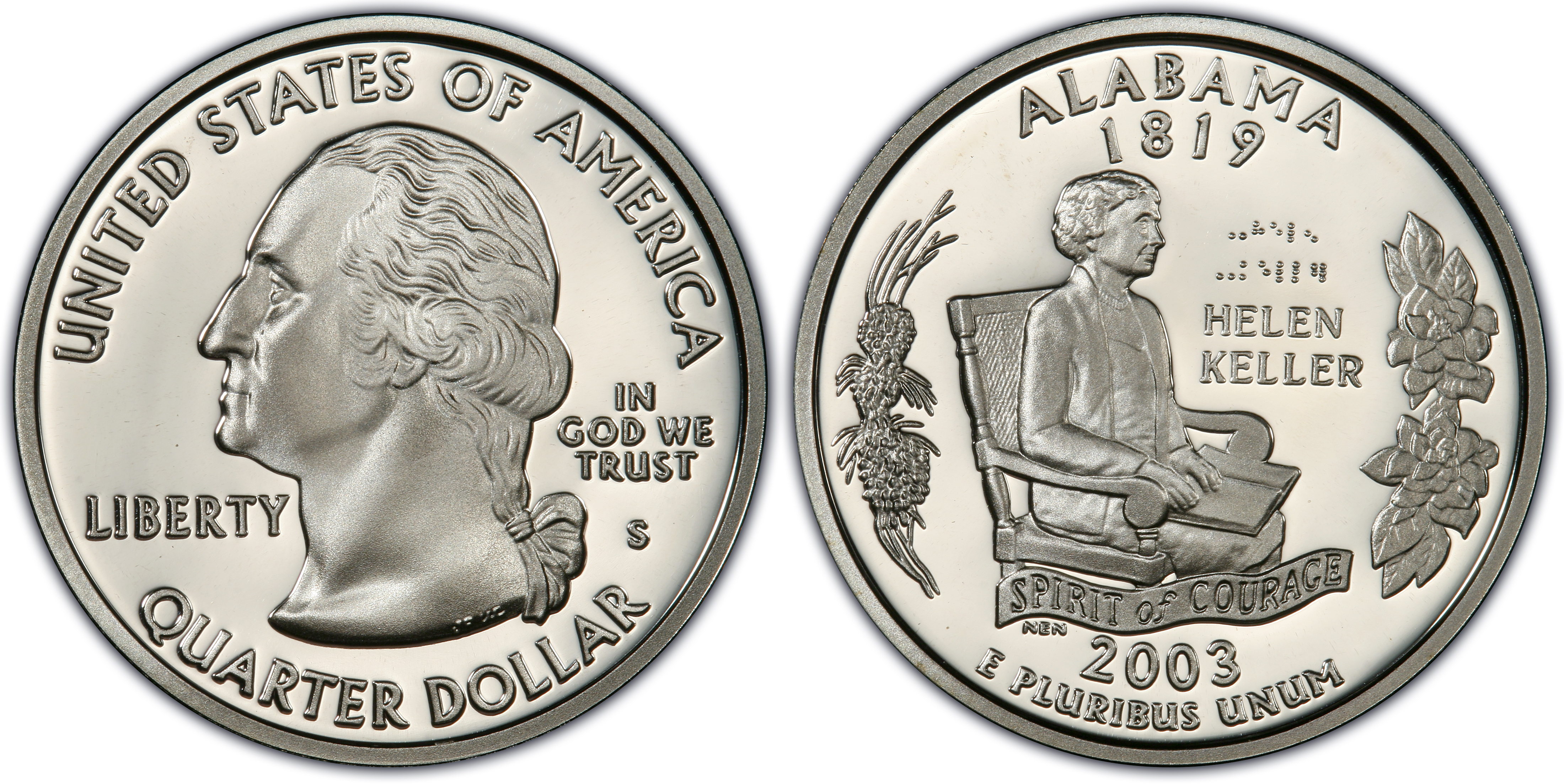
The Alabama quarter is the second to be released in 2003. Alabama became the 22nd state to be admitted into the Union on December 14, 1819. The Alabama quarter design features an image of Helen Keller with her name in English, and in a reduced–size version of braille. The Alabama quarter is the first U.S. circulating coin to feature braille. An Alabama long leaf pine branch and magnolias grace the sides of the design, and a "Spirit of Courage" banner underlines the central image.
Miss Keller was born at "Ivy Green" in Tuscumbia, Alabama, in 1880. When she was a small child, an illness destroyed her sight and hearing and, consequently, deprived her of the senses used in the development of speech. Despite her disabilities, she learned to speak and read using the raised and manual alphabets, as well as braille. Miss Keller also graduated with honors, receiving her Bachelor of Arts degree from Radcliffe. She went on to publish numerous books, articles and essays. Miss Keller lived out her life addressing social issues for disabled persons and women. Every year at "Ivy Green," a weeklong celebration is held to commemorate her lifetime of accomplishments and her "Spirit of Courage."
Characteristics
The obverse (heads) design features the familiar image of George Washington by John Flanagan, used on the quarter since 1932.
The reverse (tails) design features an image of Helen Keller with her name in English and in a reduced-size version of Braille, an Alabama long leaf pine branch wtih magnolias gracing the sides of the design, and the Spirit of Courage banner underlining the image.
The Tuskegee Airmen National Historic Site in Alabama commemorates the heroic actions and achievements of the famous Tuskegee Airmen. The term “Tuskegee Airmen” pertains to both men and women of diverse nationalities. They were composed of nearly 1,000 pilots and more than 15,000 support staff (including navigators, bombardiers, and mechanics). The site preserves five historic structures used during primary flight training in World War II.
Characteristics
The obverse (heads) design features the familiar image of George Washington by John Flanagan, used on the quarter since 1932. It has been restored to bring out subtle details and the beauty of the original.
The reverse (tails) design depicts a Tuskegee Airman pilot suiting up to join the fight during World War II with the Moton Field control tower in the background. The pilot looks upward with pride and confidence as two P-51 Mustangs pass overhead. The inscription “THEY FOUGHT TWO WARS” is arced across the top as a reference to the dual battles the Tuskegee Airmen fought–fascism abroad and racial discrimination at home.
The Congressional Gold Medal is the highest civilian recognition awarded by the U.S. Congress. This medal was presented to the Tuskegee Airmen, African American pilots flying for the U.S. Army Air Forces during World War II. Awarded on March 29, 2007, the medal recognized their “unique military record that inspired revolutionary reform in the Armed Forces.”
https://nmaahc.si.edu/object/nmaahc_2007.8
Helen Keller's Presidential Medal of Freedom
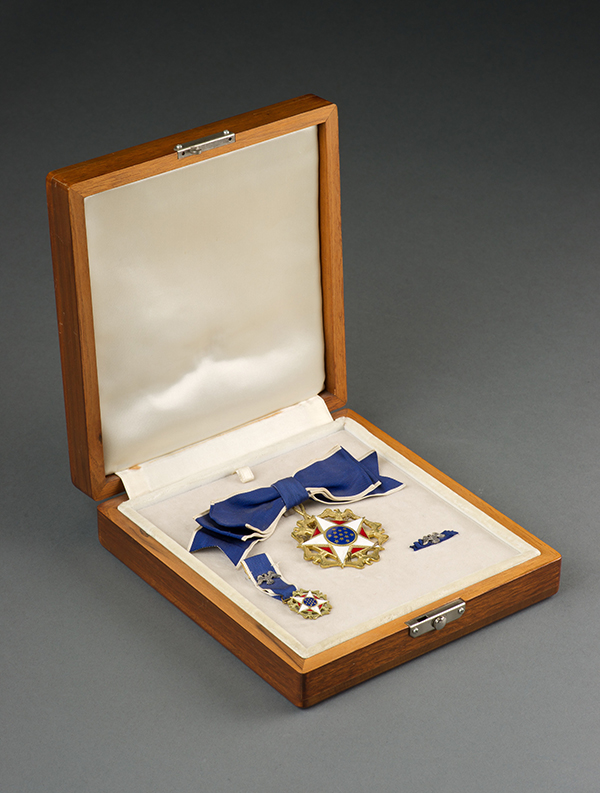
The highest civilian award in the United States, presented by Lyndon Baines Johnson on September 14, 1964. The medal is on a collar of blue, white and purple ribbon. The velvet lined presentation box also contains a miniature replica of the ribbon, a uniform ribbon, and a buttonhole ribbon.
Helen Keller's Oscar Award
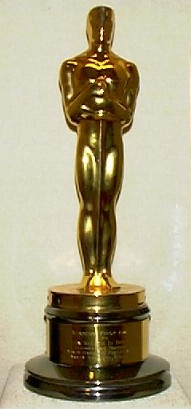
Presented in 1955 for "Helen Keller in Her Story."
Migel Medals, the highest honor in the blindness field. The Migel Medal was established in 1937 by the late M.C. Migel, the first chairperson of AFB, to honor professionals and volunteers whose dedication and achievements have significantly improved the lives of people who are blind or visually impaired.
The American Innovation $1 Coin representing Alabama recognizes the invention of the Saturn V rocket. The Saturn V rocket was developed to support the Apollo space program for human exploration to the Moon. NASA launched 13 Saturn V rockets between 1967 and 1973.
The Saturn V rocket was designed and built at the George C. Marshall Space Flight Center in Huntsville, Alabama, under the supervision of aerospace engineer Wernher von Braun. The "Heavy Lift Vehicle" was 363 feet tall, the height of a 36-story building. During launch, the rocket generated 7.6 million pounds of thrust - more power than 85 Hoover Dams.
NASA launched the first Saturn V rocket for the Apollo 4 mission in 1967. The last Saturn V launched in 1973, without a crew, to carry the Skylab space station into Earth orbit.
Characteristics
The obverse (heads) design features a dramatic representation of the Statue of Liberty in profile. The obverse also includes a privy mark of a stylized gear, representing industry and innovation.
The reverse (tails) design depicts the power and force of the Saturn V rocket lifting off with the Moon in the background.
This medal commemorates the first launch of the Saturn V rocket on November 9, 1967. The Saturn V was the world's largest and most powerful rocket, and this launch was a successful test. From 1968 to the end of 1972, the Saturn V was used to launch a number of piloted and unpiloted Apollo spacecraft, including six successful missions to the Moon.
Space medal collector Thomas Becker donated this medal to the National Collection in 1972.
https://www.si.edu/object/medal-commemorative-saturn-501:nasm_A19731522000
Monday June 8 - Maine
Thurston’s Lobster pound on Mt Desert
D. Carr’s Maine token
U.S.S. Maine
Bangor claims to be the birthplace of Paul Bunyan.