2000-D SAC $1 multiple errors
 dcfixer
Posts: 37 ✭✭
dcfixer
Posts: 37 ✭✭
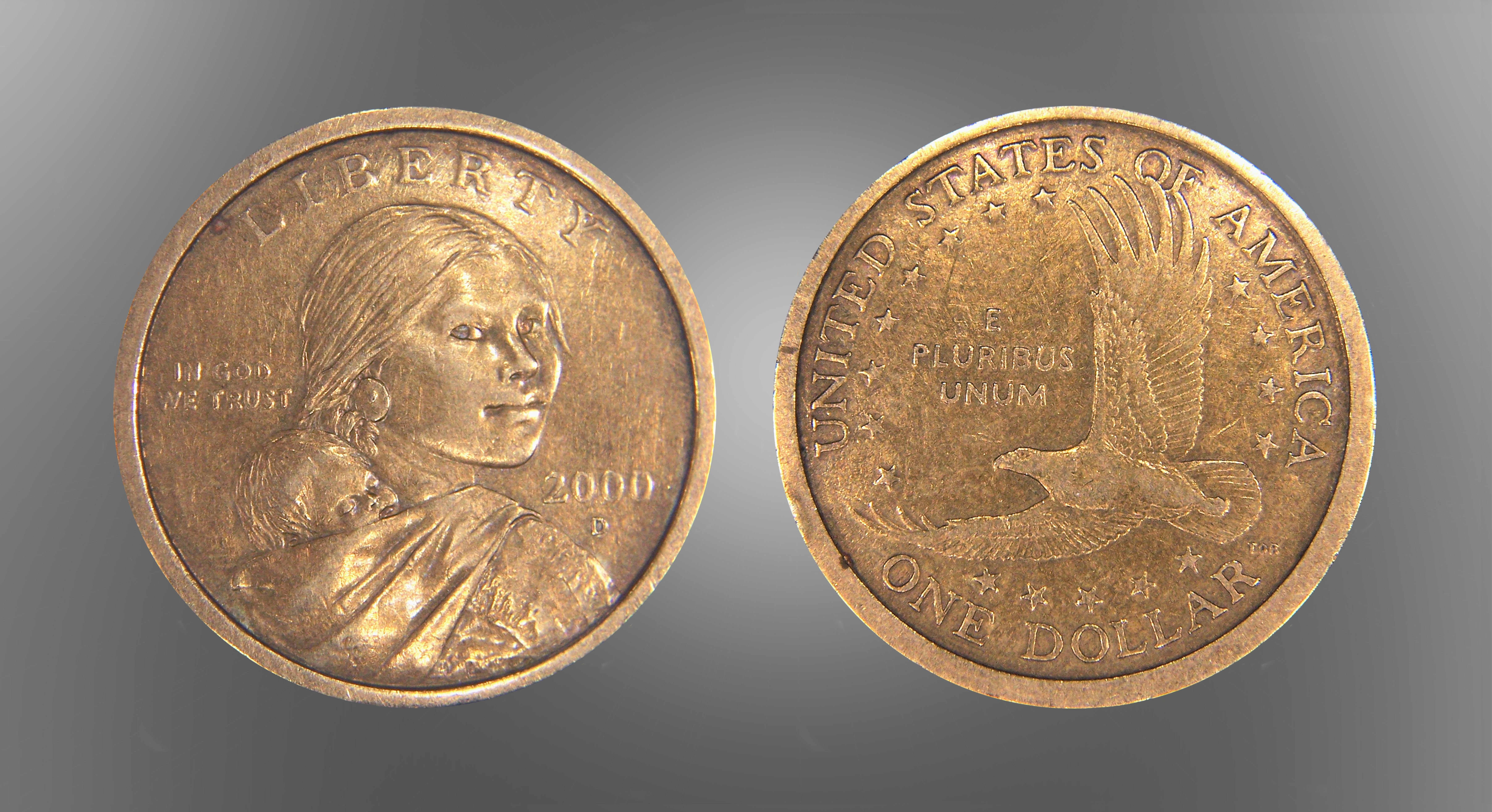
Hello everyone,
This is my first post here. I'm not a collector, but in 1979 I inherited my father's collection that is at least 60 years old. At some time after 2000, my wife received this beautiful AU lady as change. I shot both sides with a digital camera equipped with a macro lens attachment. Those images are white balanced. I composed the attached photo with Corel Paint Shop. The coin weighs 8.1 grams.
To get the discussion started, here's my mint errors description I did in my PCGS submissions draft:
2000-D Sacagawea $1 MULTI-ERROR: 1. Improperly Annealed Planchet (prominent copper migration & multi-colored blue/red/brown oxidation on obverse eyes and lips); 2. Misaligned Clad Layer Alignment (thin obverse cladding / thick reverse cladding); 3. Reverse MAD.
I'm submitting her, no matter what. I want the superior True View images; I want to see all of the rim, with only 1 band of copper (obverse/70%) and one band of cladding (reverse/30%); and I want it protected. But, I am not set on the service level, yet. That brings us to why I am here.
PCGS's documented policy of not recognizing anything that is not currently in their database and my experience with 5 other coins with them concerns me. If PCGS does not validate any of those errors, then I have just thrown more variety/error money and time at them for nothing. It would already be submitted, if I believed PCGS (NGC, too) are still discovering/publishing new varieties and errors, but after 4 other coins submitted to NGC, I'm feeling pretty frustrated at that this point. All observations/comments and any advice/help for this newbie would be greatly appreciated. I place a high value on learning.
Thank you for your time and expertise,
Don
Comments
Your coin has zero errors.
Fine, go ahead. It's your money.
That is exactly what you are doing.
No errors. All within normal tolerances.
this is what a improperly annealed planchet sac looks like
the blank punching process can smear the edge metal in such a way that it distorts what is seen Re: layers
i've seen coins where it looked like there was no candy copper center at all.
I'd love to hear about those 5 other coins. 🤔
the misalignment of the dies is so very minor that it's not worth a premium and so minor pcgs likely won't holder it as a error since there probably some leeway in the mint such that some misalignment is tolerated
Question #1: Do you know the difference between a variety and an error? You used both terms in your post. If you use the wrong one when you make a submission, you're not going to be happy with the results.
pcgs woun't put this in an error holder, not because "this type isn't n the database" but because you're wrong about 2 of them as errors and the other is a "no big deal" thing
As far as I can see, there is nothing of collector interest on that Sac Dollar. When these circulate there is no telling what color they might turn, and the reverse misaligned die is barely misaligned. These coins do not have clad layers. My mistake, seems they do.
If you submit this coin you are throwing money away.
Show us the other coins you reference, there's a good chance you were misdirected on those. We can certainly provide input for you.
Collector, occasional seller
here's a misaligned die from another "error trueview" thread
Yes, they do.
actually they do. the layers are hidden by metal flow on the edge on many coins
https://www.usmint.gov/learn/coins-and-medals/circulating-coins/sacagawea-golden-dollar
The coin's physical makeup is a three-layer clad construction - pure copper sandwiched between outer layers of manganese brass. Like any brass, its color eventually becomes darker, giving the coins an antique finish. If the coins are handled frequently, the darker "patina" may wear off the high points, leaving brighter highlights that give depth to Sacagawea against the darker background.
Manganese brass composition:
Golden Dollar's overall composition:
Dont forget to send it in for cac when it gets back from grading
Because there are 2 attributions, and I have already submitted Lincoln cents for variety attribution service, resulting in the frustrations. Trying to avoid more with mint errors.
I was thinking CONECA for a possible VSS label.
what do you think coneca needs to certify?
Ok, I will rephrase. You do not know the difference be a variety and an error.
If you think that statement is wrong, then try labelling what you think is a variety and what you think is an error.
You are not going to be happy with the results you get until you are using the same terms that everyone else expects to see.
They don't "need" to verify anything. In this case, mint errors of course. If I don't try, I will never know.
I don't see any die varieties on this coin.
I agree with that.
So, what do you consider to be an error?
Don't say, "anything less than perfection is an error." Nothing is perfect. If you define anything less than perfection as an error, then everyone is an error. That's not useful.
I listed listed the errors in my OP. Please don't get off subject.
That's not necessarily true. A tone-deaf person may be willing to learn to sing, but that doesn't mean they are able.
As others have already said, nothing in your OP is considered an error by anyone other than you.
CONECA and VSS are not the same company or thing.
My Collection of Old Holders
Never a slave to one plastic brand will I ever be.
you can learn here for the cost of your time and some photos. save you a lot of money. also, pcgs generally doesn't say why they made their determination. you can get why here, too
Now that I'm learning what I need to know, I will put it another way; "I listed listed the possible errors in my OP." > @MsMorrisine said:
I already have learned here.
Neither does NGC.
I am convinced that PCGS and NGC would not recognize any of those as an error. "They are within tolerance.". I don't know about ANACS, and don't care, in this case. I should have said, "I listed listed the possible errors in my OP.". My mistake.
Thank you, thank you all! I got what I need on this one. There will be more pieces with interesting variety type characteristics that I am looking forward to sharing here, and looking to learning much more. I hope someday, somehow, I can return the favor.
Take care out there,
Don
Just as some people do not have the ear for singing, some do not have the eye for varieties & errors. It's an analogy, Professor.
Gentlemen, I am ignorant about a lot of things, but I am not stupid. Four years of ME plus 1 year of EE at ISU and 30 years with General Atomics at the National Fusion Facility in San Diego has taught me and everyone I know that.
I have learned plenty here, more than you know, and I thank everyone for that. So, let's please cut the crap and move on to another topic and another coin.
That explains a lot. In my experience, this is a fairly common engineer’s mindset when approaching coins. Engineers are trained to analyze problems logically and work toward rational explanations, which is often a strength in numismatics as well. The problem is that, when that mindset is combined with limited experience in a specialized area, it can sometimes lead to false positives like this situation.
Once a conclusion seems logically consistent, it can also become difficult to accept contradictory evidence. In this case, the opinions from the major grading companies, along with the consistent feedback from several experienced collectors here, still have not been enough to outweigh the conviction that the coin must be an error.
chopmarkedtradedollars.com
I stand corrected, I guess they do have clad layers. I've never noticed and thought they were a solid alloy of some sort. Not a series I collect and I made an incorrect assumption.
Collector, occasional seller
"Give a blind man an acorn and he is a nut for life."
-Abraham Washington
"Give a deaf man a polo shirt and he's a zebra lover for life."
-Franklin D. Biden
“Lend a man an ear and you’ve got a friend”.
James K. Taylor.
"Goodbye to you, my trusted friend
We've known each other since we were nine or ten
Together we've climbed hills and trees
Learned of love and ABC's
Skinned our hearts and skinned our knees
Goodbye my friend, it's hard to die
When all the birds are singing in the sky
Now that the spring is in the air
Pretty girls are everywhere
Think of me and I'll be there"
-Terry Jacks
I'm saddened but not surprised that you and others here have assumed so much about me already. It's indicitive of a fairly common minset in these types of forums. I have been experiencing it for 20 years in model railroad forums, and don't have to even post a word, just my closeup photography of my HO scaled detailed passenger car interiors. I have to listen to it and work around fragil egos at the SDMR Musium, and what I do there is voluntary.
Altough I earned the honor of designing power I&C components and web database applications, I was not an engineer. I dropped out of ISU do seek my fortune in the Caifornia music industry. Didn't work out, thus GA.
This thread is only positive to me because I am learning. The problem is I haven't reached any conclusions, because I'm told I'm wrong, which is Ok, if I learn something from it. But nobody has explained how the heterochromia and Jean's lower lip formed and/or what did it. They just game along.
The opinions from the major grading companies I received were about Lincoln cent varieties, not mint errors. I have learned because of what has inspired me in this thread that PCGS handles mint errors very differently, especially one-offs like this SAC$1 might be.
I have learned that this SAC$1 MAD offset is not .050". Its not minor, but it's not 5 mils either. I was wrong about that.
I was wrong about the other errors. I'm now leaning toward a Planchet Defect / Rolling Mill Error, specifically an uneven glad layer. If you disagree, then I am more than ready to discuss how the obverse anomalies I clearly described and can be seen were created. Someone please teach and help me with that. berfore admin has to lock the circus up.
I will post the results of my PCGS mint error submission, with TrueView images. Then we can run up a tally of who learned what.
Someone please teach and help me with that. berfore admin has to lock the circus up.
"You Light Up My Life
So many nights
I'd sit by my window
Waiting for someone
To sing me his song
So many dreams
I've kept deep inside me
Alone in the dark
But now you've come along
And you
Light up my life"
-Daniel Boone
The colors you mention are just toning from circulation. The golden dollars in particular can take on all sorts of colors.
The clad layer issue is likely just the upper layer being dragged downward when the blank was punched from the strip.
How many clad coins have you scrutinized? I've never seen a clad coin with exactly even or consistent layers appearing at the edge.
You might not have liked Lermish's take on the matter, but it does seem to describe what is going on here. 🤷♂️
Opps.... "Likely" is a key word. We will find out.
some people here are argumentative
ignore them
I really meant "certainly" or "obviously" but I thought I'd go easy. Pick up a roll or two of clad coins (halfs would be easiest to see) and scritinuze them. It should be an enlightening experience.
I just saw that. Thanks.
I aim to entertain.
I don’t know if anyone’s mentioned it yet, but the rims on both sides of the OP coin are flattened – that looks like PMD on those rims to me.
And there is no error of any kind or type on either side of that coin. It’s all post minting damage and/or discoloration.
I love threads like these, op's that insist they are correct and feel entitled to a free education, these are the funniest reads.
My Collection of Old Holders
Never a slave to one plastic brand will I ever be.
Do the inexperienced members in that forum ask you about beat up train cars and then argue with you, as well?