The reverse of the Columbia half is dominated by the state’s symbol, the palmetto tree. Below it is a broken limb of oak, meant to symbolize the victory of South Carolina’s native palmetto (which formed the walls of Fort Moultrie in Charleston) over the oaken timbers of King George’s ships.
Steve
A day without fine wine and working on your coin collection is like a day without sunshine!!!
This medal is a replica of the gold medal presented to General Daniel Morgan by the Continental Congress for the victory at Cowpens during the American Revolutionary War, January 17, 1781. According to a hand-written note on its storage box, it was given on May 6, 1972 to the Honorable James E. Webb, the NASA Administrator from 1961-1968, in appreciation of his interest in history and his services to the nation. The presenter, Rep. Sam P. Manning of the South Carolina state legislature, was an attorney from Spartansburg, South Carolina and a longtime advocate for having the Cowpens battle site in South Carolina be recognized by the National Park Service (NPS) as a national battlefield. Since President Richard M. Nixon signed HR 10086 into law on April 11, 1972, making Cowpens a full-scale NPS battlefield, it may be that this medal was part of some celebration or recognition of that event.
It became a part of the Smithsonian Institution's national collection in 2002.
This is NOT my coin, but just a stock photo. Interesting concept for a coin.
The Ralph Baer American Innovation Dollar (2021): This dollar coin highlights New Hampshire and honors Ralph Baer—the "Father of Video Games"—who resided in Manchester, New Hampshire.
Steve
A day without fine wine and working on your coin collection is like a day without sunshine!!!
@winesteven said:
This is NOT my coin, but just a stock photo. Interesting concept for a coin.
The Ralph Baer American Innovation Dollar (2021): This dollar coin highlights New Hampshire and honors Ralph Baer—the "Father of Video Games"—who resided in Manchester, New Hampshire.
Steve
thanks for your post to remind me I had this example with linkage to NH !!
John Stark commemorative medal, 2019. Circular medal with silver finish. Obverse: relief portrait of John Stark, identified as "GEN. John Stark", with names of four battles (Bunker Hill, Saratoga, Trenton, and Bennington); blue enamel band around perimeter, with silver lettering: "LIVE FREE OR DIE / Death is Not the Greatest of Evils". Reverse: multi-colored enamel SAR seal in center; red enamel band around perimeter, with silver lettering: "NEW HAMPSHIRE SOCIETY / Sons of the American Revolution®". In rectangular cardboard box covered with purple velvet; hinged lid lined with white satin imprinted with gold SAR seal.
New Hampshire’s participation at Bunker Hill was led by John Stark of Amoskeag. His military career in the Revolution began after Concord and Lexington and found him in the thick of most of the important battles of the conflict.
However, his greatest fame, as recorded by Biographer Howard Parker Moore, is that he
“Held the line at Bunker Hill”
Immediately upon hearing the news of Concord and Lexington, Stark quit his sawmill at Amoskeag and led New Hampshire patriots to Cambridge. He was made Colonel of the first New Hampshire Regiment, which was formed into fifteen companies.
One of two Revolutionary War flags of the 2nd N.H. Regiment Continental Army captured by the British at Fort Anne, New York July 8, 1777. (Ninth Regiment of Foot of Burgoyne's Army). Flag made from two widths of fine shantung-type silk, seam across middle, done by hand, natural buff or yellow color. "Union Jack" silk applique in upper right corner, consists of eight triangles, alternately red and pale blue, which form an upright and a diagonal cross. Sunburst with thirteen rays, "WE ARE ONE." painted in center. Thirteen entwined circles painted gold surround the sunburst. Each circle has the name of a colony painted in black. Flag is currently framed; mahogany frame with acrylic glazing. Flag is sewn to a cotton canvas backing mounted on a wooden stretcher.
These flags, carried by the Second New Hampshire Continental Regiment, are the only known surviving stand, or set, of national and regimental flags from the Revolutionary War, but that is not the only remarkable thing about them. In fact they remained hidden for over a century and a half and crossed the Atlantic twice before they returned home to the Granite State.
The flags were sewn by Fanny Johonnot Williams, a milliner, and painted by decorative painter Daniel Rea Jr. in Boston in 1777. The blue regimental flag’s central design showcases the 2nd NH’s iconic motto, “the glory not the prey.” The buff flag was a national flag and bears an emblem of 13 interlocking rings, based on a design by Benjamin Franklin that was widely used in the early years of the war.
The flags were taken by the British Army as American forces retreated to Fort Anne, New York, in July 1777. The British commander brought them back to his home in England as a souvenir and they remained there in the possession of his descendants, nearly forgotten, until a researcher located and identified them in 1907. New Hampshire Governor Robert P. Bass solicited funds from the public to purchase the flags from their British owner, George Rogers, but the fundraising machinery moved too slowly and Rogers grew restless and started looking elsewhere for buyers. Finally, in 1912, New Hampshire native and philanthropist Edward Tuck, fearing that the flags would slip away and stay in private hands, purchased them for £200 and had them shipped home. The state of New Hampshire hoped that Tuck would allow the flags to be displayed at the State House, but instead he gave them to the New Hampshire Historical Society, believing the Society would be the better caretaker.
The flags have recently been conserved thanks to the generosity of the Museum of the American Revolution in Philadelphia and the Society of the Cincinnati. They are currently on loan to the MAR as part of Banners of Liberty: An Exhibition of Original Revolutionary War Flags, which will run from April 19 to August 10, 2025.
The reverse (tails) design shows the rock formation The Old Man in the Mountain and the state motto Live Free or Die. The nine stars represent New Hampshire as the ninth state to enter the Union.
The Old Man of the Mountain, also called the Great Stone Face and the Profile,[1][2] was a series of five granite cliff ledges on Cannon Mountain in Franconia, New Hampshire, United States, that appeared to be the jagged profile of a human face when viewed from the north. The rock formation, 1,200 feet (370 m) above Profile Lake, was 40 feet (12 m) tall and 25 feet (7.6 m) wide.
The Old Man of the Mountain is called "Stone Face" by the Abenaki and is a symbol within their culture.[3] It is also a symbol to the Mohawk people. The first written mention of the Old Man was in 1805. It became a landmark and a cultural icon for the state of New Hampshire, and has been featured as the Emblem of New Hampshire since 1945. It collapsed on May 3, 2003.[4] After its collapse, residents considered replacing it with a replica, but the idea was ultimately rejected. It remains a visual icon on the state's license plates and in other places.
The reverse (tails) depicts Mt. Chocorua, the easternmost peak of the Sandwich Range, framed by birch trees. It is an iconic view of the White Mountain National Forest system lands. Design candidates were developed in consultation with representatives of White Mountain National Forest.
i'm not from NH but believe there is no White Mountain in NH.
The reverse (tails) depicts Mt. Chocorua, the easternmost peak of the Sandwich Range, framed by birch trees. It is an iconic view of the White Mountain National Forest system lands. Design candidates were developed in consultation with representatives of White Mountain National Forest.
i'm not from NH but believe there is no White Mountain in NH.
I have three “legitimate “ ones, and a fourth one that is a “stretch”, but @Creg tells me this “stretching” technique is perfectly fine.
The Norfolk Commem - There are FIVE dates on the coin. The only one missing? 1937, the year these coins were actually struck, lol. Separately, for those that know how locals pronounce “Norfolk” (if you don’t know, “google it”), there is a college in Norfolk called Norfolk State University. They have several sports teams. Rumor has it that their cheerleaders regularly chant, “We don’t drink, we don’t smoke, Norfolk, Norfolk” 🤣.
The Lynchburg Commem - The coin was originally supposed to honor Lynchburg’s founder, John Lynch. However, designers couldn't find a single portrait or photograph of him, forcing the mint to choose someone else! Because they couldn't feature the founder, they opted to feature a native son and powerful U.S. Senator, Carter Glass. Because a law strictly forbade the living from being depicted on US money, Glass became one of the very few exceptions in U.S. history to have his face on a coin while still alive!
The Booker T. Washington Commem - He was born in Virginia. This holds a massive place in numismatic history. It was both the first U.S. coin to feature an African American and the first U.S. coin designed by a Black artist!
Here’s the stretch - The Roanoke Commem - This coin celebrates the “Lost Colony” on Roanoke Island, North Carolina! So what is the tie-in to Virginia? There are TWO! First, as many of you know, Roanoke is the name of a major city in Virginia! Second, the coin’s reverse depicts Eleanor Dare holding her infant daughter. What was her daughter’s name? Virginia! Virginia was the first child of English descent born in the American colonies!
Here they are. Show anything numismatic you have related to Virginia, including any of these Commems
Steve
A day without fine wine and working on your coin collection is like a day without sunshine!!!
these are challenge coins from the Virginia Sons of the Revolution
The Virginia Society, Sons of the American Revolution (Virginia SAR) is working to commemorate six key events associated with removing Royal colonial authority from the colony and replacing it with a democratically elected Patriot sponsored government, the First Virginia Commonwealth.
Released on October 16, 2000, this is the 10th coin released in the 50 State Quarters Program and the fifth released in 2000. Virginia was admitted into the Union on June 25, 1788 but this coin honors some of Virginia's earliest settlers. It recognizes the 400th anniversary of Jamestown, the first permanent English settlement in North America. The design featured images of Susan Constant, Godspeed, and Discovery, the three ships that brought the first English settlers to Jamestown.
Characteristics
The obverse (heads) design features the familiar image of George Washington by John Flanagan, used on the quarter since 1932.
The reverse (tails) design shows the three ships that carried settlers to Jamestown. Jamestown 1607-2007 and Quadricentennial are inscribed to honor the 400th anniversary of Jamestown.
The 2014 Shenandoah National Park Quarter is the 22nd coin in the America the Beautiful Quarters® Program.
The Shenandoah National Park quarter is the second of 2014 and the 22nd overall in the America the Beautiful Quarters® Program. Just 75 miles from Washington, D.C., Shenandoah National Park is an escape for travelers wanting a wide range of outdoor adventures. It features cascading waterfalls, spectacular vistas and quiet wooded hollows. Park visitors enjoy hiking, meandering along the scenic Skyline Drive, or camping and picnicking with family or friends. Park habitats provide a haven for black bear and numerous songbirds. Creation of the park was authorized by legislation in 1926 (44 Stat. 616) with formal establishment in 1935 and dedication by President Franklin D. Roosevelt in 1936.
Characteristics
The obverse (heads) design features the familiar image of George Washington by John Flanagan, used on the quarter since 1932. It has been restored to bring out subtle details and the beauty of the original.
The reverse (tails) depicts a day hiker taking in the view from Little Stony Man summit. Design candidates were developed in consultation with representatives of Shenandoah National Park.
Albany - In 1954, a local bank discovered and sold a forgotten hoard of over 2,000 pristine Albany half dollars at their original $2 issue price.
Hudson - With only 10,008 coins struck at the Philadelphia Mint, it is among the lowest mintage issues of the entire classic commemorative era (1892–1954). Though minted to celebrate a town of only 14,000 residents, it caused intense controversy. A single dealer reportedly purchased nearly 7,500 coins for 95 cents each and held them off the market. The coins sold out in just five days, causing prices to spike from the $1 issue price to $9 almost overnight—much to the anger of everyday collectors. The ship featured on the coin’s sailing side is the Half Moon, the flagship of Henry Hudson (whom the city is named after). I went to Tappan Zee High School, by the Hudson River, and our annual Yearbook was called The Half Moon for that reason!
New Rochelle - Although dated 1938 to mark the 250th anniversary of the city's settlement (1688), the entire mintage was actually struck in Philadelphia in April 1937. Nearly half the mintage was melted - Authorized for a maximum mintage of 25,000 pieces, the coins were sold for $2 each. Sales were so modest that 9,749 uncirculated coins were sent back to the Mint to be melted, leaving a net distribution of just 15,266 pieces.
Steve
A day without fine wine and working on your coin collection is like a day without sunshine!!!
pop 1/0 Charles A. LuhrsF-630AR-1do overstruck on a 1859 Indian Cent PCGS MS65. Ex. Q. David Bowers
An amazing overstrike! Struck over a copper nickel 1859 Cent, here is a lovely Gem grade beauty with colorful toning on both sides. The pictorial of the beer glass has always a popular motif with crossover appeal to collectors of breweriana.
1863 Token F-630BK-1do Copper-Nickel PE Ed. Schaff, Stk Over 1858 LL 1C NY MS65
Pop 1/0 A lot of people consider the quarter size Lindenmueller tokens quintessential to the CWT series. The iconic depiction of Gustavus Lindenmueller himself graces the obverse, sporting the Duck Dynasty beard. In copper, they have to be the most common Civil War token out there. Perhaps minted into the hundreds of thousands. Not so in brass, where examples like this one come few and far between with only a handful known. This has to be the finest example extant, a full MS65 gem loaded with eye appeal, and having been locked away in the personal collection of Rich Rossa and Q. David Bowers.
If you wanted just one example of this famous token for a special collection, this one would be hard to beat.
No Date Token F-630L-4do Copper-Nickel PE Broas Bros., Stk Over 1863 1C NY MS65
1/0 Purchased on PCGS BST from Dennis Wells (DCW) Dead Cat Waltz
This token was personally owned by Q. David Bowers. He had his collection of civil war tokens certified by PCGS in special labels with his likeness on the back of the slab and his facsimile autograph. It is also pedigreed back to R & T, which is the firm of Rossa and Tanenbaum. This was placed into Rich Rossa's personal collection long ago, and Dave had first pick.
It has been taken care of for 156 years!
Background
Released on January 2, 2001, this is the 11th coin released in the 50 State Quarters Program and the first released in 2001. New York, admitted into the Union on July 26, 1788, themed the coin, Gateway to Freedom. The phrase and the coin images recognize New York's role as a major port of entry for immigrants arriving to the United States.
Characteristics
The obverse (heads) design features the familiar image of George Washington by John Flanagan, used on the quarter since 1932.
The reverse (tails) design shows the Statue of Liberty, the outline of New York state, 11 stars that represents its position when admitted into the Union, and the words Gateway to Freedom.
The quarter pays tribute to New York's rich and influential history. Images of the Statue of Liberty superimposed over an outline of New York State — along with the inscription "Gateway to Freedom" — celebrate the role of New York in America's history. Lines tracing the Hudson River and Erie Canal are also etched into the state's outline. These two important waterways were not included in the original design. They were added at Governor Pataki's request to pay tribute to their importance in the state's development.
The Fidelity Medallion, also known as the "André Capture Medal," was created specifically for the three enlisted Westchester County militia men, Isaac Van Wart, John Paulding, and David Williams, who captured John André on September 23, 1780, and it was never presented again. It can be considered the oldest decoration in the U.S. military, preceding by nearly two years the Badge of Military Merit—the precursor to the modern Purple Heart Medal. The two-sided medal has a Latin inscription, which translates as “Love of Country Conquers” on one side, and “Fidelity” on the other. The Fidelity Medal: Treason at West Point delves into Major General Benedict Arnold’s betrayal of West Point during the American Revolution and British Major John André’s involvement in Arnold’s plot.
The medal is one of three ordered to be struck by the United States Congress on November 3, 1780 in gratitude for Van Wart’s role in the capture of André. The British spy was captured in Tarrytown on September 23, 1780 by Issac Van Wart, John Paulding and David Williams. André was carrying papers in the handwriting of American General Benedict Arnold intended to aid the British in an attack on the American fort at West Point. André’s capture led to the discovery of the Arnold’s treason.
The Roanoke Commem - This coin celebrates the “Lost Colony” on Roanoke Island, North Carolina. The coin’s reverse depicts Eleanor Dare holding her infant daughter Virginia. She was the first child of English descent born in the American colonies!
Steve
A day without fine wine and working on your coin collection is like a day without sunshine!!!
Comments
The reverse of the Columbia half is dominated by the state’s symbol, the palmetto tree. Below it is a broken limb of oak, meant to symbolize the victory of South Carolina’s native palmetto (which formed the walls of Fort Moultrie in Charleston) over the oaken timbers of King George’s ships.
Steve
My collecting “Pride & Joy” is my PCGS Registry Dansco 7070 Set:
https://www.pcgs.com/setregistry/type-sets/design-type-sets/complete-dansco-7070-modified-type-set-1796-date/publishedset/213996
Fort Moultrie
Charleston SC
where it all started with the first shot on Fort Sumter
Top 10 Cal Fractional Type Set
successful BST with Ankurj, BigAl, Bullsitter, CommemKing, DCW(7), DesertMoon, Downtown1974, Elmerfusterpuck, Joelewis, Mach1ne, Minuteman810430, Modcrewman, Nankraut, Nederveit2, Philographer(5), Proofcollection, Realgator, Silverpop, SurfinxHI, TomB and Yorkshireman(3)
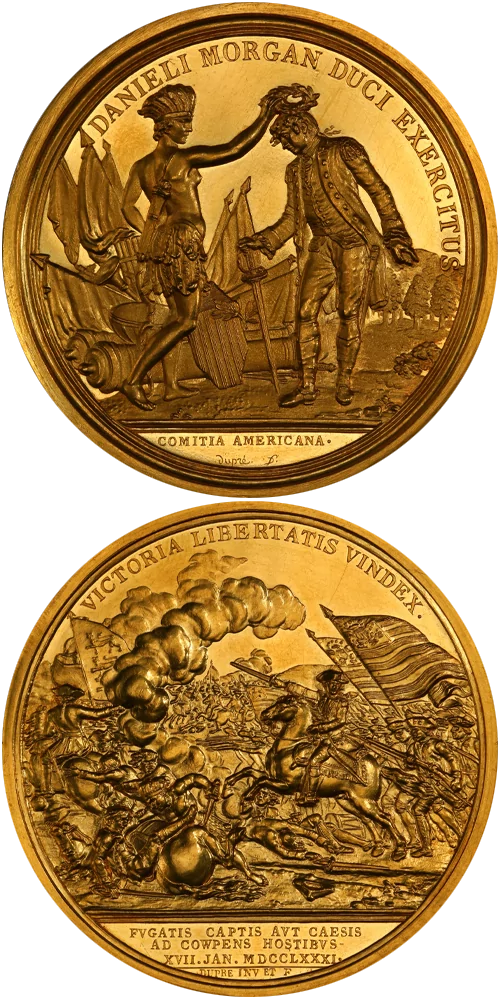
This medal is a replica of the gold medal presented to General Daniel Morgan by the Continental Congress for the victory at Cowpens during the American Revolutionary War, January 17, 1781. According to a hand-written note on its storage box, it was given on May 6, 1972 to the Honorable James E. Webb, the NASA Administrator from 1961-1968, in appreciation of his interest in history and his services to the nation. The presenter, Rep. Sam P. Manning of the South Carolina state legislature, was an attorney from Spartansburg, South Carolina and a longtime advocate for having the Cowpens battle site in South Carolina be recognized by the National Park Service (NPS) as a national battlefield. Since President Richard M. Nixon signed HR 10086 into law on April 11, 1972, making Cowpens a full-scale NPS battlefield, it may be that this medal was part of some celebration or recognition of that event.
It became a part of the Smithsonian Institution's national collection in 2002.
from Stack's Bowers:
Monday May 25 - New Hampshire
Liquor stores at rest areas!
This is NOT my coin, but just a stock photo. Interesting concept for a coin.
The Ralph Baer American Innovation Dollar (2021): This dollar coin highlights New Hampshire and honors Ralph Baer—the "Father of Video Games"—who resided in Manchester, New Hampshire.
Steve
My collecting “Pride & Joy” is my PCGS Registry Dansco 7070 Set:
https://www.pcgs.com/setregistry/type-sets/design-type-sets/complete-dansco-7070-modified-type-set-1796-date/publishedset/213996
Top 10 Cal Fractional Type Set
successful BST with Ankurj, BigAl, Bullsitter, CommemKing, DCW(7), DesertMoon, Downtown1974, Elmerfusterpuck, Joelewis, Mach1ne, Minuteman810430, Modcrewman, Nankraut, Nederveit2, Philographer(5), Proofcollection, Realgator, Silverpop, SurfinxHI, TomB and Yorkshireman(3)
thanks for your post to remind me I had this example with linkage to NH !!
Top 10 Cal Fractional Type Set
successful BST with Ankurj, BigAl, Bullsitter, CommemKing, DCW(7), DesertMoon, Downtown1974, Elmerfusterpuck, Joelewis, Mach1ne, Minuteman810430, Modcrewman, Nankraut, Nederveit2, Philographer(5), Proofcollection, Realgator, Silverpop, SurfinxHI, TomB and Yorkshireman(3)
Terrific Sword in Hand!
https://en.wikipedia.org/wiki/Saint-Gaudens_National_Historical_Park
John Stark commemorative medal, 2019. Circular medal with silver finish. Obverse: relief portrait of John Stark, identified as "GEN. John Stark", with names of four battles (Bunker Hill, Saratoga, Trenton, and Bennington); blue enamel band around perimeter, with silver lettering: "LIVE FREE OR DIE / Death is Not the Greatest of Evils". Reverse: multi-colored enamel SAR seal in center; red enamel band around perimeter, with silver lettering: "NEW HAMPSHIRE SOCIETY / Sons of the American Revolution®". In rectangular cardboard box covered with purple velvet; hinged lid lined with white satin imprinted with gold SAR seal.
New Hampshire’s participation at Bunker Hill was led by John Stark of Amoskeag. His military career in the Revolution began after Concord and Lexington and found him in the thick of most of the important battles of the conflict.
However, his greatest fame, as recorded by Biographer Howard Parker Moore, is that he
“Held the line at Bunker Hill”
Immediately upon hearing the news of Concord and Lexington, Stark quit his sawmill at Amoskeag and led New Hampshire patriots to Cambridge. He was made Colonel of the first New Hampshire Regiment, which was formed into fifteen companies.
One of two Revolutionary War flags of the 2nd N.H. Regiment Continental Army captured by the British at Fort Anne, New York July 8, 1777. (Ninth Regiment of Foot of Burgoyne's Army). Flag made from two widths of fine shantung-type silk, seam across middle, done by hand, natural buff or yellow color. "Union Jack" silk applique in upper right corner, consists of eight triangles, alternately red and pale blue, which form an upright and a diagonal cross. Sunburst with thirteen rays, "WE ARE ONE." painted in center. Thirteen entwined circles painted gold surround the sunburst. Each circle has the name of a colony painted in black. Flag is currently framed; mahogany frame with acrylic glazing. Flag is sewn to a cotton canvas backing mounted on a wooden stretcher.
These flags, carried by the Second New Hampshire Continental Regiment, are the only known surviving stand, or set, of national and regimental flags from the Revolutionary War, but that is not the only remarkable thing about them. In fact they remained hidden for over a century and a half and crossed the Atlantic twice before they returned home to the Granite State.
The flags were sewn by Fanny Johonnot Williams, a milliner, and painted by decorative painter Daniel Rea Jr. in Boston in 1777. The blue regimental flag’s central design showcases the 2nd NH’s iconic motto, “the glory not the prey.” The buff flag was a national flag and bears an emblem of 13 interlocking rings, based on a design by Benjamin Franklin that was widely used in the early years of the war.
The flags were taken by the British Army as American forces retreated to Fort Anne, New York, in July 1777. The British commander brought them back to his home in England as a souvenir and they remained there in the possession of his descendants, nearly forgotten, until a researcher located and identified them in 1907. New Hampshire Governor Robert P. Bass solicited funds from the public to purchase the flags from their British owner, George Rogers, but the fundraising machinery moved too slowly and Rogers grew restless and started looking elsewhere for buyers. Finally, in 1912, New Hampshire native and philanthropist Edward Tuck, fearing that the flags would slip away and stay in private hands, purchased them for £200 and had them shipped home. The state of New Hampshire hoped that Tuck would allow the flags to be displayed at the State House, but instead he gave them to the New Hampshire Historical Society, believing the Society would be the better caretaker.
The flags have recently been conserved thanks to the generosity of the Museum of the American Revolution in Philadelphia and the Society of the Cincinnati. They are currently on loan to the MAR as part of Banners of Liberty: An Exhibition of Original Revolutionary War Flags, which will run from April 19 to August 10, 2025.
The reverse (tails) design shows the rock formation The Old Man in the Mountain and the state motto Live Free or Die. The nine stars represent New Hampshire as the ninth state to enter the Union.
The Old Man of the Mountain, also called the Great Stone Face and the Profile,[1][2] was a series of five granite cliff ledges on Cannon Mountain in Franconia, New Hampshire, United States, that appeared to be the jagged profile of a human face when viewed from the north. The rock formation, 1,200 feet (370 m) above Profile Lake, was 40 feet (12 m) tall and 25 feet (7.6 m) wide.
The Old Man of the Mountain is called "Stone Face" by the Abenaki and is a symbol within their culture.[3] It is also a symbol to the Mohawk people. The first written mention of the Old Man was in 1805. It became a landmark and a cultural icon for the state of New Hampshire, and has been featured as the Emblem of New Hampshire since 1945. It collapsed on May 3, 2003.[4] After its collapse, residents considered replacing it with a replica, but the idea was ultimately rejected. It remains a visual icon on the state's license plates and in other places.
https://en.wikipedia.org/wiki/Old_Man_of_the_Mountain
The reverse (tails) depicts Mt. Chocorua, the easternmost peak of the Sandwich Range, framed by birch trees. It is an iconic view of the White Mountain National Forest system lands. Design candidates were developed in consultation with representatives of White Mountain National Forest.
i'm not from NH but believe there is no White Mountain in NH.
Its in New Hampshire, check your facts first
Tuesday May 26 - Virginia
Chesapeake Bay Bridge - Tunnel - Bridge - Tunnel - Bridge
It’s free to hang out as long as you can keep fishing poles in the water. I skip 95 and fish for a night when I go North.
I have three “legitimate “ ones, and a fourth one that is a “stretch”, but @Creg tells me this “stretching” technique is perfectly fine.
Here they are. Show anything numismatic you have related to Virginia, including any of these Commems
Steve
My collecting “Pride & Joy” is my PCGS Registry Dansco 7070 Set:
https://www.pcgs.com/setregistry/type-sets/design-type-sets/complete-dansco-7070-modified-type-set-1796-date/publishedset/213996
Roanoke Island was in “Virginia” in 1587.
Thanks, Steven, and everyone who has visited. I’m not one to tell people what they can imagine.
the classic first ironclad battle
this is a 1,0 CWT
F-239/421a, Our Little Monitor
Top 10 Cal Fractional Type Set
successful BST with Ankurj, BigAl, Bullsitter, CommemKing, DCW(7), DesertMoon, Downtown1974, Elmerfusterpuck, Joelewis, Mach1ne, Minuteman810430, Modcrewman, Nankraut, Nederveit2, Philographer(5), Proofcollection, Realgator, Silverpop, SurfinxHI, TomB and Yorkshireman(3)
My home state!
A broad struck VA quarter with nice toning. Sellers pics:
Mr_Spud
.
;
;
these are challenge coins from the Virginia Sons of the Revolution
The Virginia Society, Sons of the American Revolution (Virginia SAR) is working to commemorate six key events associated with removing Royal colonial authority from the colony and replacing it with a democratically elected Patriot sponsored government, the First Virginia Commonwealth.
read about each event on the society's page: https://www.virginiasar.org/virginia-road-to-revolution
it's good reading
here's a line from the conclusion
Released on October 16, 2000, this is the 10th coin released in the 50 State Quarters Program and the fifth released in 2000. Virginia was admitted into the Union on June 25, 1788 but this coin honors some of Virginia's earliest settlers. It recognizes the 400th anniversary of Jamestown, the first permanent English settlement in North America. The design featured images of Susan Constant, Godspeed, and Discovery, the three ships that brought the first English settlers to Jamestown.
Characteristics
The obverse (heads) design features the familiar image of George Washington by John Flanagan, used on the quarter since 1932.
The reverse (tails) design shows the three ships that carried settlers to Jamestown. Jamestown 1607-2007 and Quadricentennial are inscribed to honor the 400th anniversary of Jamestown.
The 2014 Shenandoah National Park Quarter is the 22nd coin in the America the Beautiful Quarters® Program.
The Shenandoah National Park quarter is the second of 2014 and the 22nd overall in the America the Beautiful Quarters® Program. Just 75 miles from Washington, D.C., Shenandoah National Park is an escape for travelers wanting a wide range of outdoor adventures. It features cascading waterfalls, spectacular vistas and quiet wooded hollows. Park visitors enjoy hiking, meandering along the scenic Skyline Drive, or camping and picnicking with family or friends. Park habitats provide a haven for black bear and numerous songbirds. Creation of the park was authorized by legislation in 1926 (44 Stat. 616) with formal establishment in 1935 and dedication by President Franklin D. Roosevelt in 1936.
Characteristics
The obverse (heads) design features the familiar image of George Washington by John Flanagan, used on the quarter since 1932. It has been restored to bring out subtle details and the beauty of the original.
The reverse (tails) depicts a day hiker taking in the view from Little Stony Man summit. Design candidates were developed in consultation with representatives of Shenandoah National Park.
I wanted a medal with Mt Vernon on it, but did not find a period piece.
the Mt Vernon organization did have this trial proof of a washington medal
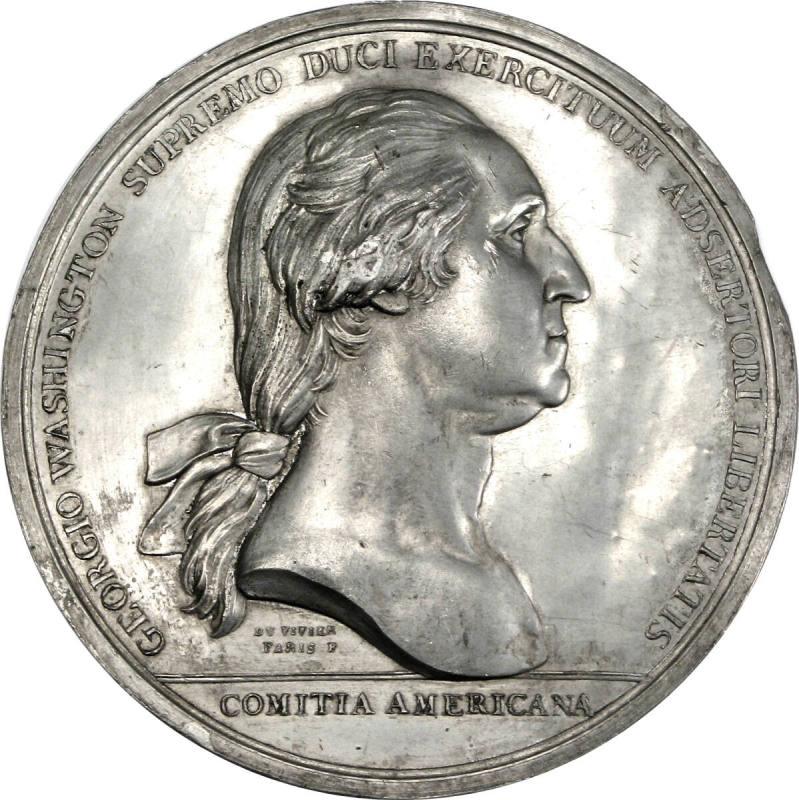
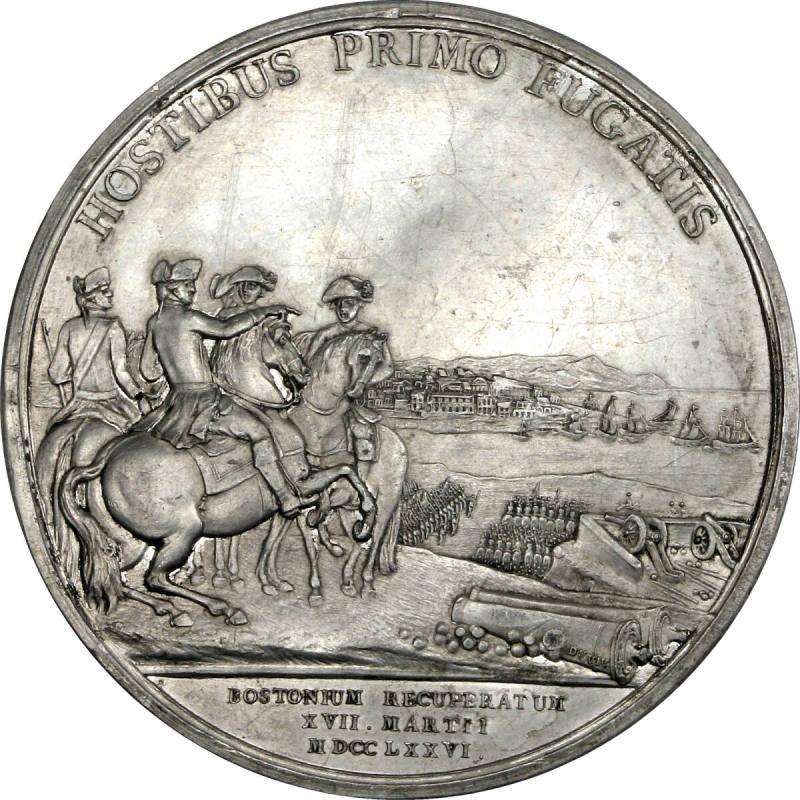
https://emuseum.mountvernon.org/objects/6585/trial-proof-of-washington-before-boston-medal
The original nickel design by Felix Oscar Schlag.
Wednesday May 27 - New York
From the “Traffic Jam” VW Show on Governor’s Island.
Albany - In 1954, a local bank discovered and sold a forgotten hoard of over 2,000 pristine Albany half dollars at their original $2 issue price.
Hudson - With only 10,008 coins struck at the Philadelphia Mint, it is among the lowest mintage issues of the entire classic commemorative era (1892–1954). Though minted to celebrate a town of only 14,000 residents, it caused intense controversy. A single dealer reportedly purchased nearly 7,500 coins for 95 cents each and held them off the market. The coins sold out in just five days, causing prices to spike from the $1 issue price to $9 almost overnight—much to the anger of everyday collectors. The ship featured on the coin’s sailing side is the Half Moon, the flagship of Henry Hudson (whom the city is named after). I went to Tappan Zee High School, by the Hudson River, and our annual Yearbook was called The Half Moon for that reason!
New Rochelle - Although dated 1938 to mark the 250th anniversary of the city's settlement (1688), the entire mintage was actually struck in Philadelphia in April 1937. Nearly half the mintage was melted - Authorized for a maximum mintage of 25,000 pieces, the coins were sold for $2 each. Sales were so modest that 9,749 uncirculated coins were sent back to the Mint to be melted, leaving a net distribution of just 15,266 pieces.
Steve
My collecting “Pride & Joy” is my PCGS Registry Dansco 7070 Set:
https://www.pcgs.com/setregistry/type-sets/design-type-sets/complete-dansco-7070-modified-type-set-1796-date/publishedset/213996
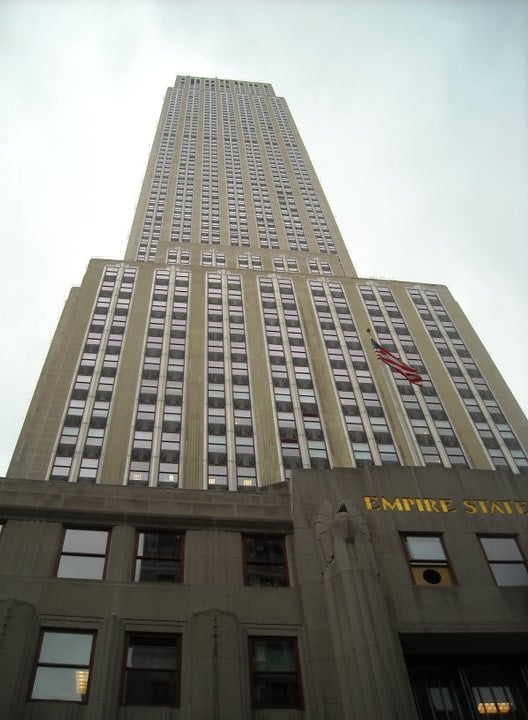
Worked in this building for many years
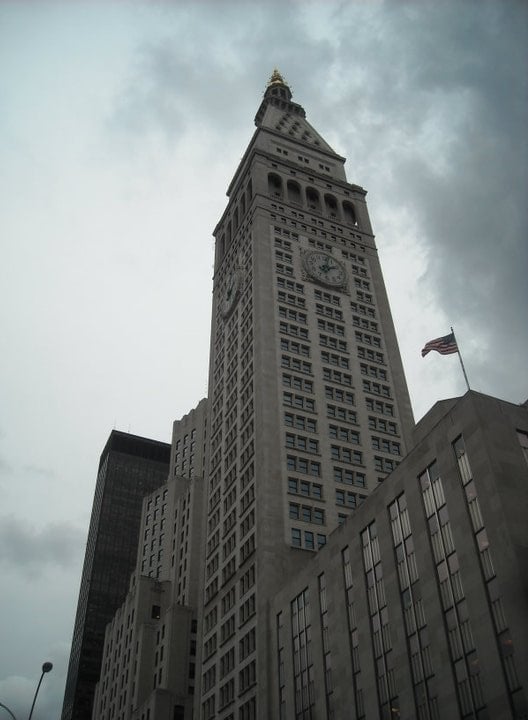
no comment necessary
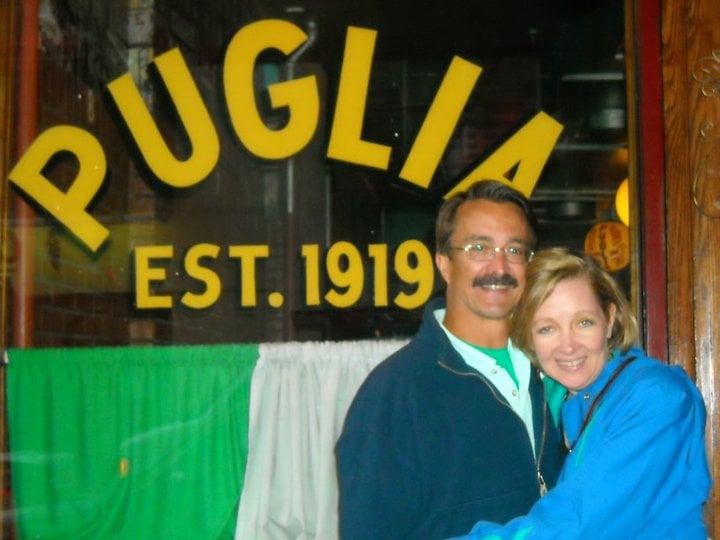
One of my favorite restaurants in Little Italy and my favorite sidekick !!
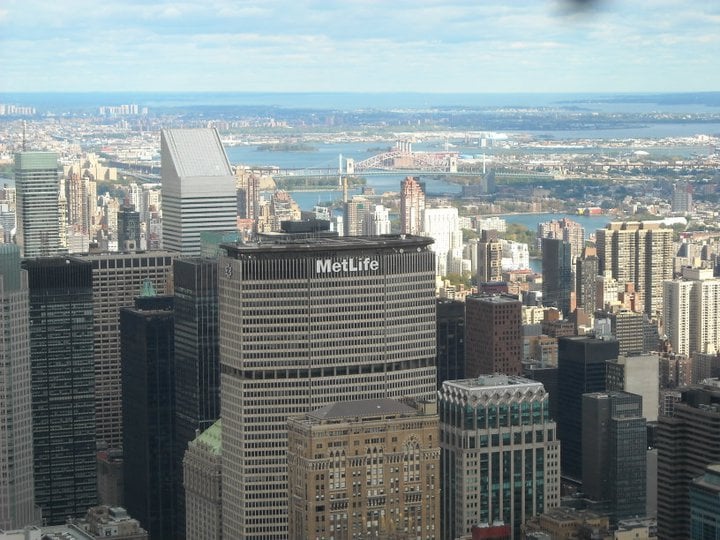
47 years and counting with this firm
Top 10 Cal Fractional Type Set
successful BST with Ankurj, BigAl, Bullsitter, CommemKing, DCW(7), DesertMoon, Downtown1974, Elmerfusterpuck, Joelewis, Mach1ne, Minuteman810430, Modcrewman, Nankraut, Nederveit2, Philographer(5), Proofcollection, Realgator, Silverpop, SurfinxHI, TomB and Yorkshireman(3)
Mr_Spud
pop 1/0 Charles A. LuhrsF-630AR-1do overstruck on a 1859 Indian Cent PCGS MS65. Ex. Q. David Bowers
An amazing overstrike! Struck over a copper nickel 1859 Cent, here is a lovely Gem grade beauty with colorful toning on both sides. The pictorial of the beer glass has always a popular motif with crossover appeal to collectors of breweriana.
1863 Token F-630BK-1do Copper-Nickel PE Ed. Schaff, Stk Over 1858 LL 1C NY MS65
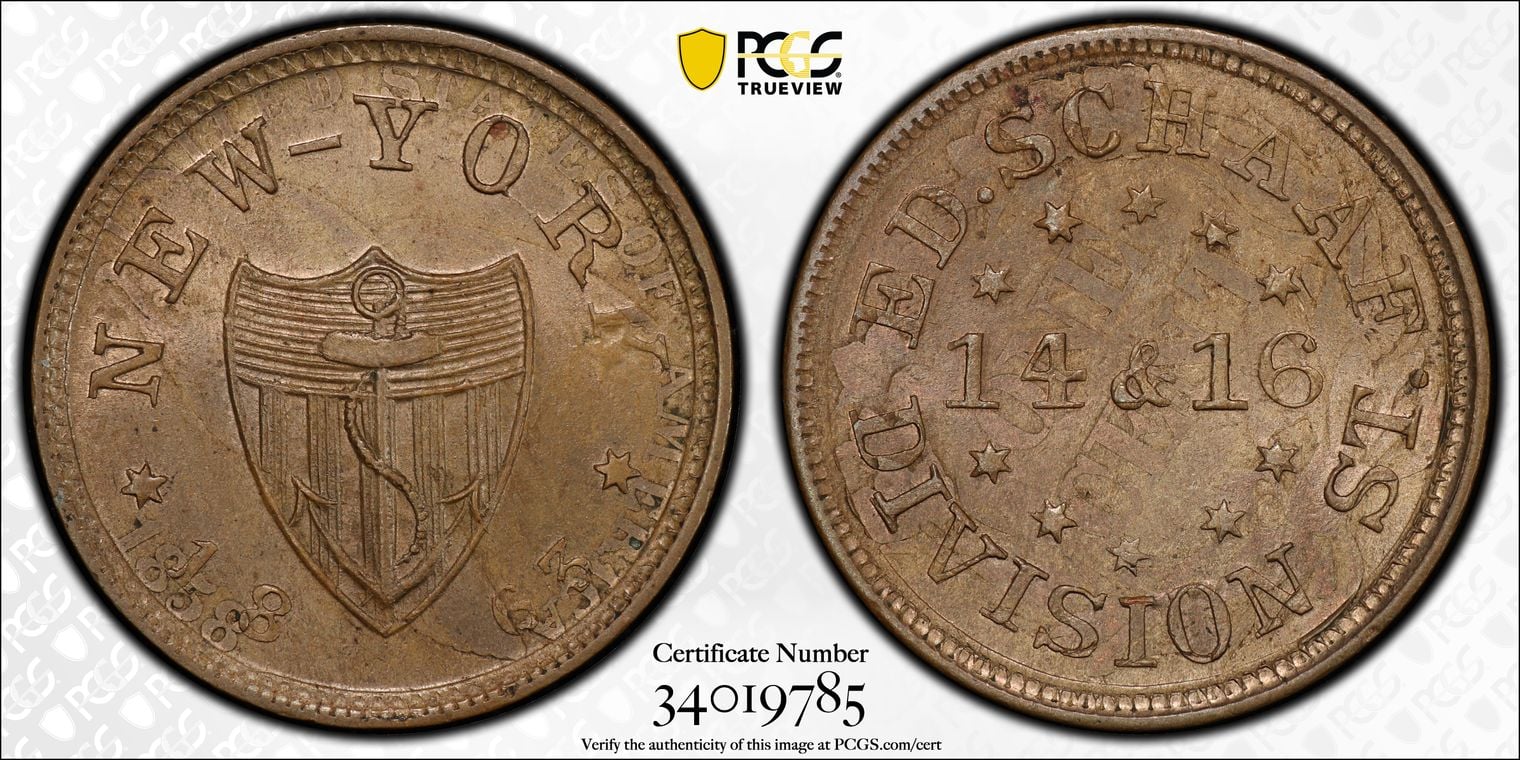
Pop 1/0 A lot of people consider the quarter size Lindenmueller tokens quintessential to the CWT series. The iconic depiction of Gustavus Lindenmueller himself graces the obverse, sporting the Duck Dynasty beard. In copper, they have to be the most common Civil War token out there. Perhaps minted into the hundreds of thousands. Not so in brass, where examples like this one come few and far between with only a handful known. This has to be the finest example extant, a full MS65 gem loaded with eye appeal, and having been locked away in the personal collection of Rich Rossa and Q. David Bowers.
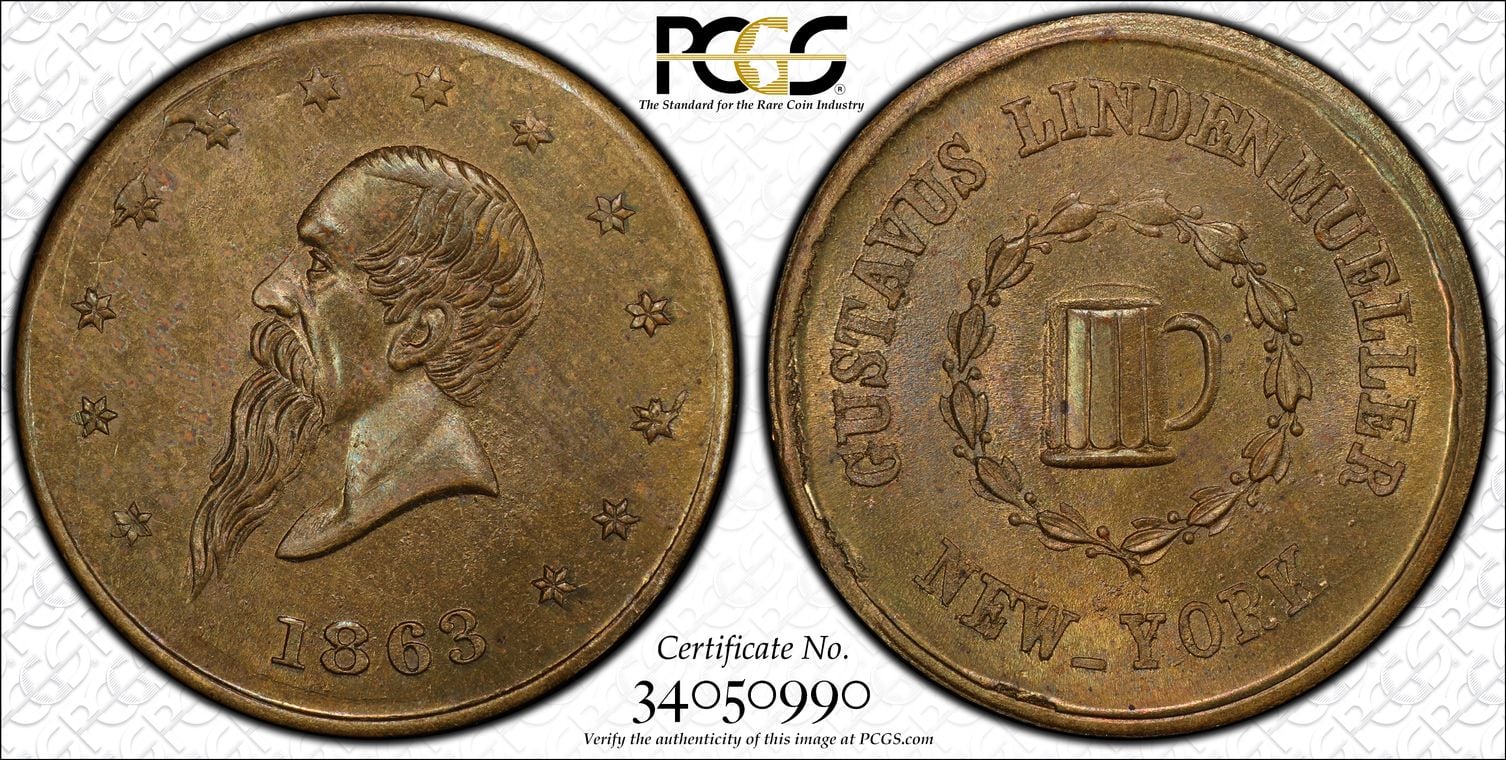
If you wanted just one example of this famous token for a special collection, this one would be hard to beat.
No Date Token F-630L-4do Copper-Nickel PE Broas Bros., Stk Over 1863 1C NY MS65
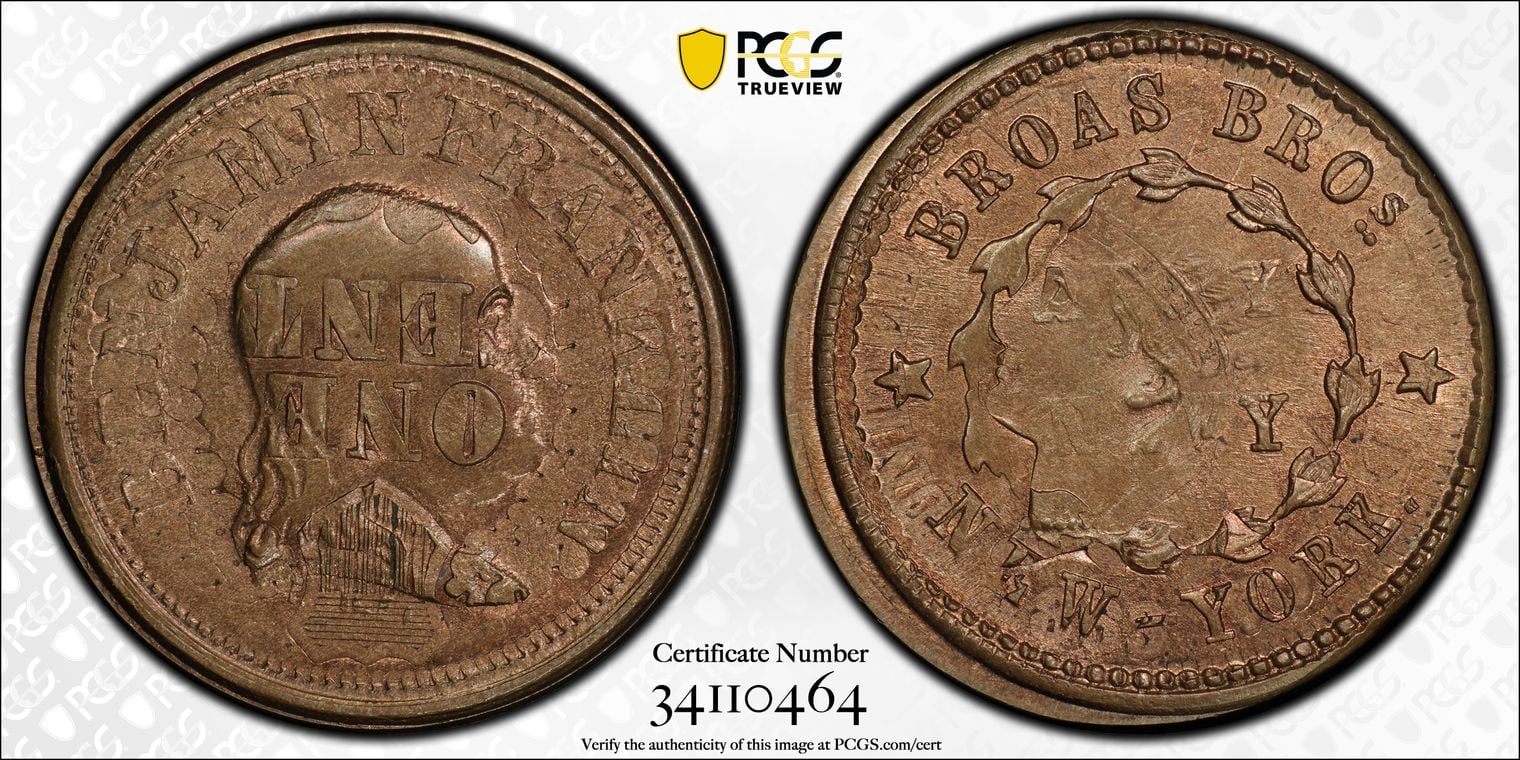
1/0 Purchased on PCGS BST from Dennis Wells (DCW) Dead Cat Waltz
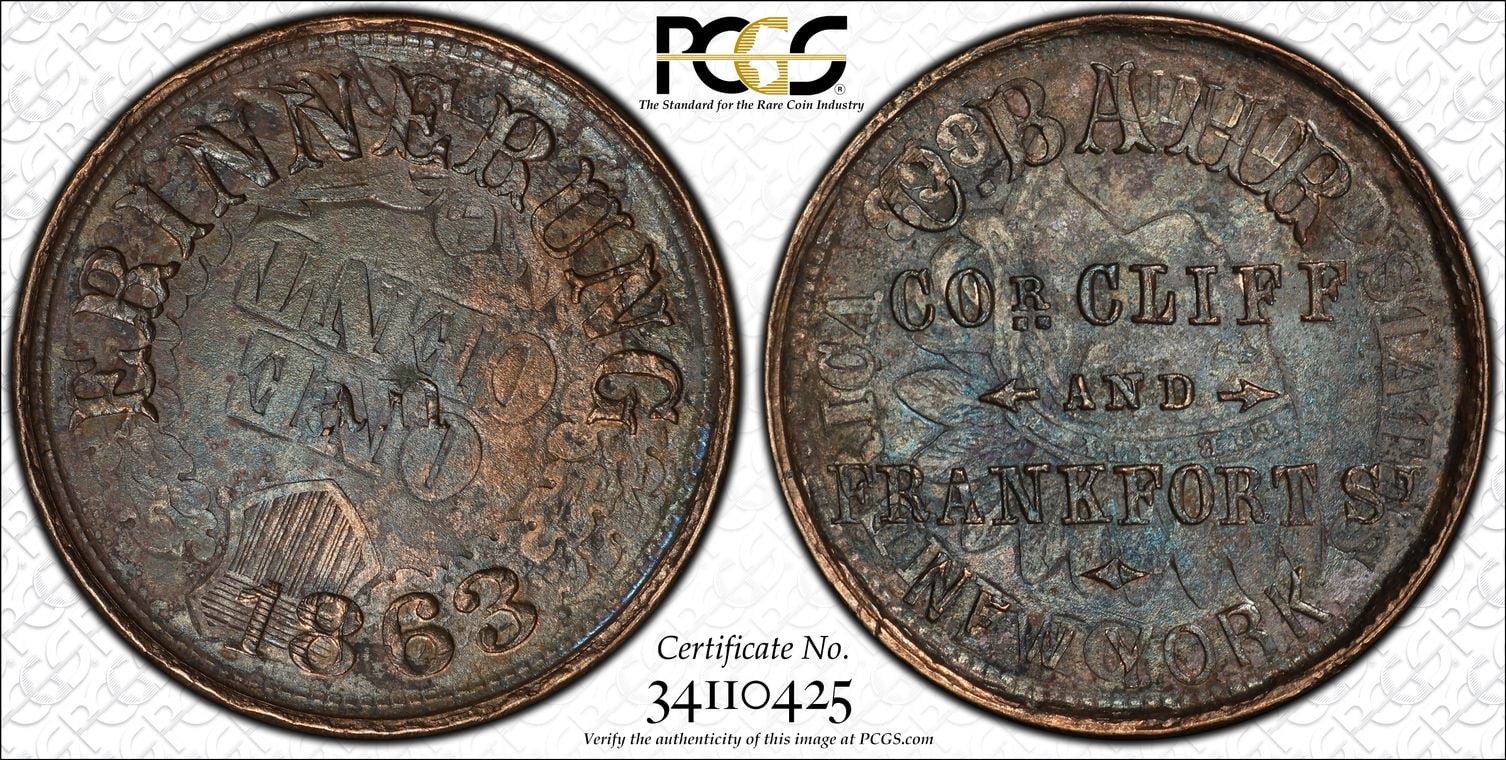
This token was personally owned by Q. David Bowers. He had his collection of civil war tokens certified by PCGS in special labels with his likeness on the back of the slab and his facsimile autograph. It is also pedigreed back to R & T, which is the firm of Rossa and Tanenbaum. This was placed into Rich Rossa's personal collection long ago, and Dave had first pick.
It has been taken care of for 156 years!
Top 10 Cal Fractional Type Set
successful BST with Ankurj, BigAl, Bullsitter, CommemKing, DCW(7), DesertMoon, Downtown1974, Elmerfusterpuck, Joelewis, Mach1ne, Minuteman810430, Modcrewman, Nankraut, Nederveit2, Philographer(5), Proofcollection, Realgator, Silverpop, SurfinxHI, TomB and Yorkshireman(3)
Background
Released on January 2, 2001, this is the 11th coin released in the 50 State Quarters Program and the first released in 2001. New York, admitted into the Union on July 26, 1788, themed the coin, Gateway to Freedom. The phrase and the coin images recognize New York's role as a major port of entry for immigrants arriving to the United States.
Characteristics
The obverse (heads) design features the familiar image of George Washington by John Flanagan, used on the quarter since 1932.
The reverse (tails) design shows the Statue of Liberty, the outline of New York state, 11 stars that represents its position when admitted into the Union, and the words Gateway to Freedom.
https://www.usmint.gov/news/press-releases/20010108-the-empire-state-shines-with-new-york-quarter
The quarter pays tribute to New York's rich and influential history. Images of the Statue of Liberty superimposed over an outline of New York State — along with the inscription "Gateway to Freedom" — celebrate the role of New York in America's history. Lines tracing the Hudson River and Erie Canal are also etched into the state's outline. These two important waterways were not included in the original design. They were added at Governor Pataki's request to pay tribute to their importance in the state's development.
The Fidelity Medallion, also known as the "André Capture Medal," was created specifically for the three enlisted Westchester County militia men, Isaac Van Wart, John Paulding, and David Williams, who captured John André on September 23, 1780, and it was never presented again. It can be considered the oldest decoration in the U.S. military, preceding by nearly two years the Badge of Military Merit—the precursor to the modern Purple Heart Medal. The two-sided medal has a Latin inscription, which translates as “Love of Country Conquers” on one side, and “Fidelity” on the other. The Fidelity Medal: Treason at West Point delves into Major General Benedict Arnold’s betrayal of West Point during the American Revolution and British Major John André’s involvement in Arnold’s plot.
https://nysm.nysed.gov/exhibitions/fidelity-medal-treason-west-point
https://www.rw250.org/news-events/exciting-news-and-an-opportunity-to-see-a-rare-1776-printing-of-the-declaration-of-independence
The medal is one of three ordered to be struck by the United States Congress on November 3, 1780 in gratitude for Van Wart’s role in the capture of André. The British spy was captured in Tarrytown on September 23, 1780 by Issac Van Wart, John Paulding and David Williams. André was carrying papers in the handwriting of American General Benedict Arnold intended to aid the British in an attack on the American fort at West Point. André’s capture led to the discovery of the Arnold’s treason.
Thursday May 28 - North Carolina
I’ve lived in several mineral rich areas of N.C. We pan in legal places, or take buckets home. It takes two of us a day to find a couple of flakes.
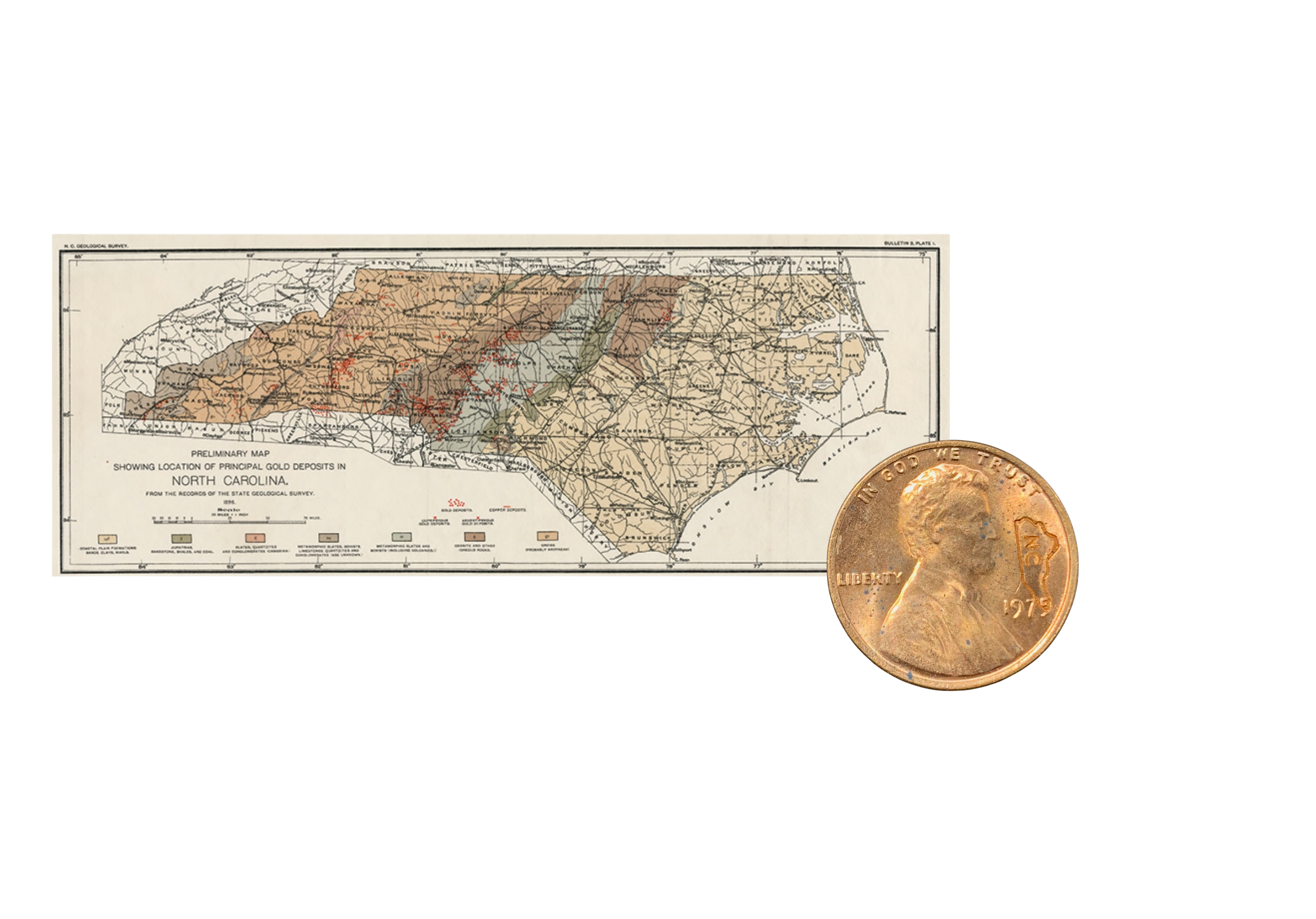
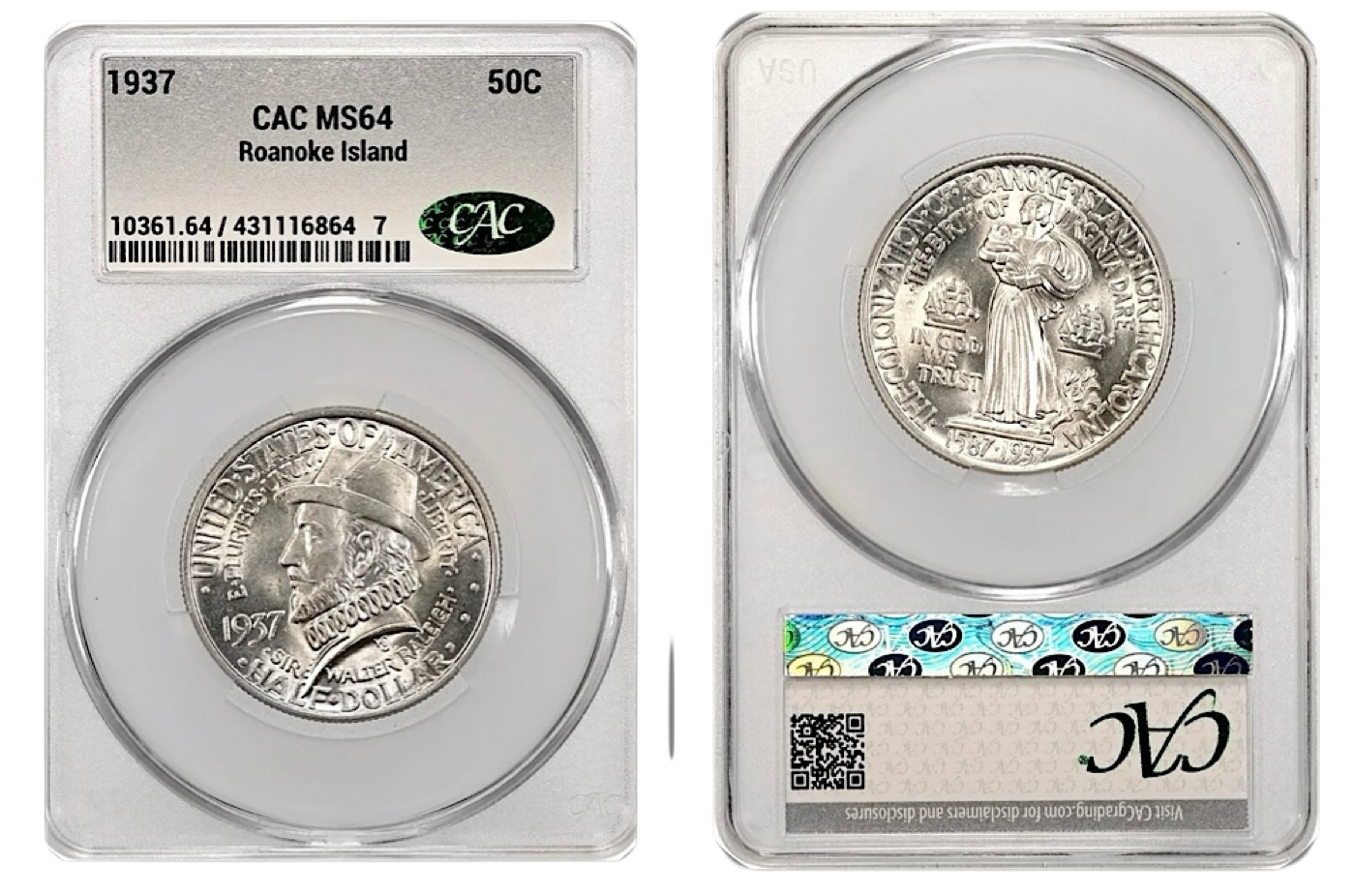
The Roanoke Commem - This coin celebrates the “Lost Colony” on Roanoke Island, North Carolina. The coin’s reverse depicts Eleanor Dare holding her infant daughter Virginia. She was the first child of English descent born in the American colonies!
Steve
My collecting “Pride & Joy” is my PCGS Registry Dansco 7070 Set:
https://www.pcgs.com/setregistry/type-sets/design-type-sets/complete-dansco-7070-modified-type-set-1796-date/publishedset/213996
Casual collector slowly building a collection....
minted "right up the road" from me
Top 10 Cal Fractional Type Set
successful BST with Ankurj, BigAl, Bullsitter, CommemKing, DCW(7), DesertMoon, Downtown1974, Elmerfusterpuck, Joelewis, Mach1ne, Minuteman810430, Modcrewman, Nankraut, Nederveit2, Philographer(5), Proofcollection, Realgator, Silverpop, SurfinxHI, TomB and Yorkshireman(3)
Mr_Spud
Mr_Spud
Friday May 29 - Rhode Island
Newport was an early whaling center.