Options
WHY MORE ERRORS/VARIETIES FROM PHILADELPHIA?
 Pete2226
Posts: 102 ✭✭✭
Pete2226
Posts: 102 ✭✭✭
I Offer an explanation here:
https://coinweek.com/philadelphia-mint-errors-why-they-outnumber-denver-varieties/
Tagged:
2
Comments
Sound like quality assurance problems . Hope they fix it soon
In my article I make the case that the problem is not Quality Control, but die geometry differences!
Better bars/pubs within walking distance of the mint in Philly?
Experience the World through Numismatics...it's more than you can imagine.
I always thought it was because generally they offer the highest mintages. More coins struck, more potential errors.
From 2012 Alternative Metals Report pdf p. 301 (referenced in @Pete2226's article):
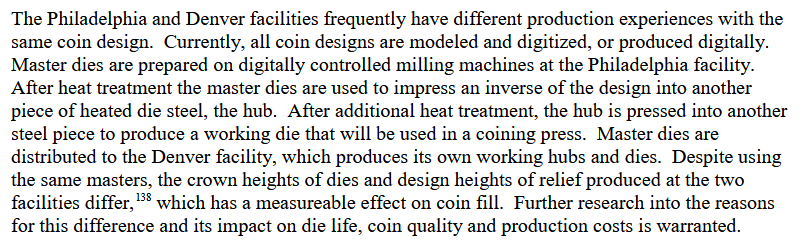
How is it possible for the Crown Height on the working hubs to differ?
I thought when the master die is used to create a working hub, the hub is an exact inverse surface of the master die.
I looked for footnote 138, but did not find a footnote list in the PDF.
Does the piece of steel used for the working hub vary in heat treatment / elasticity?
You gotta admire the midnight requisitions! 😉
They appear to have NO IDEA how it is that crown heights of working dies differ, and apparently planned more research!
I found no major difference in heat treatment processes between the 2 mints!
I have found nothing to indicate that the mints have different sources for their die steel.
For what it is worth, the mint uses these steel alloys:
Alloy 52100 used for Small diameter Coins (Rockwell C Hardness 64-66)
Alloy L6 used for quarters and up (Rockwell C Hardness = 62)
Footnote138 "2011 ATB PM DM Progression Strike Results and Narrative (Oct 2011 Die Manufacturing Conf).pdf provided by the United States Mint." ---> I have not been able to find that .pdf either!
It seems to me that:
With just over 90% of the events coming from Philadelphia, we would need Philadelphia producing 90% of the coins if the higher mintage theory was applicable.
I always said: Pickup every Denver mint employee and transfer them to Philly. Then pickup every Philly mint employee and transfer them to Denver..... See what happens..
And don't say it can't be done! 😉
I have found no evidence that the differences are simply a matter of employee carelessness or subpar work. If there is such, I would be interested in seeing it!
My preference is to use information I can document as being accurate and basing any conclusions on such.
I know where you can start and you can even document it as being accurate and base your conclusions on such. Put in a FOIA request for all Philly and Denver Mint employees performance appraisals and compare them. 😉
Since it is your idea, I think that would be a great idea for you to do that!

Let me know what you discover!
I thought about it. I laughed about it. They I forgot about it.
It must be something in the air, or lack thereof. ¯_(ツ)_/¯
The two Mints manufacture error coins.
How effective the Mint is in keeping them from getting out results in what we see or do not see.
Philly had many outlandish errors released in 2000.
Denver had some too in 2007. My image icon here is a 2007D 1c on severed feeder finger tip.
Some of my best errors are 2000P & 2007D.
Error releases were described to me as periods of time when the Mint was leaky.
“ The two Mints manufacture error coins”.
Here you go:
First struck as a proof in SF, then as a mint state in Phili.
@Byers So what's your opinion Mike on errors, Philly vs. Denver or vice versa?
I am a big fan of Coinweek and that looks like a comprehensive article. I haven’t read it yet but I will.
The article is comprehensive and presents a very logical senario and explanation. The Phildelphia Mint strikes more coins than Denver so there will be more mint errors, but Denver seems to have used more curvature as detailed in the article.
As a Cowboys fan I have a few theories, but I’ll bite my tongue.
I’ll comment here.
Because….
🎶 “We’re from Philly,
Phuckin Philly,
No one likes us,
We don’t care.” 🎶
IYKYK
🦅
Explanations for why there are more errors/varieties from Philadelphia frequently state that it is because Philadelphia produces more coins. This explanation is unsupported.
Over 90% of listed errors/varieties for the last 15 years are from Philadelphia.
Coin production for the last 15 years was 50.14% from Philadelphia.
The impression of Philadelphia producing more coins likely arises from experience with a few selected instances:
• Philadelphia 2024 nickels outnumbered their Denver counterparts three to one.
• 61% of the 2025 Juliette Gordon Low Quarters were struck at Philadelphia.
• 59% 0f the 2025 Althea Gibson Quarter were struck at Philadelphia.
• From 2011 to 2019 5% to 15% more of some specific denominations were struck at Philadelphia than at Denver.
Source: CoinNews.net (Links Available)
A study of Hertzian Contact Theory leads me to suspect that:
The article states a faulty syllogism that since the mint experienced die breakage and shorter die life using flat dies and in 1836 converted to spherical die faces thus extending die life, therefore Philadelphia, since they experience more die events, must have flatter dies than Denver.
I hope to have more data to work with to resolve that question when I complete my analysis from additional scans I have scheduled for the end of the month.