The Official NGC 3.0 Holder Identification, History and Information Thread
 TomB
Posts: 22,886 ✭✭✭✭✭
TomB
Posts: 22,886 ✭✭✭✭✭
What is the NGC 3.0 holder?
Using the slab numbering system for regular production slabs made popular through the work of Conder101, the NGC 3.0 holder was the first holder offered by NGC that paired the previously used gold embossed reverse NGC logo with a new obverse paper insert that incorporated the NGC scales logo. All known NGC 3.0 holders have the embossed reverse logo done on the outer side of the slab plastic such that the embossing can be felt with the fingers while the obverse side paper insert has been seen with ink color ranging anywhere from a brown-grey through a rather vivid lime green.
Images of four NGC 3.0 holders are shown below. The first pair of images is a comparison of the obverse from two slabs. The Roosevelt dime has the more commonly found brown-grey ink while the Mercury dime has the lass frequently seen vivid lime green ink. The second pair of images is a comparison of how the raised embossed logo might appear. The Washington quarter has a sharply raised embossed logo in deep gold while the Franklin half has a less vivid embossed logo in lighter gold.
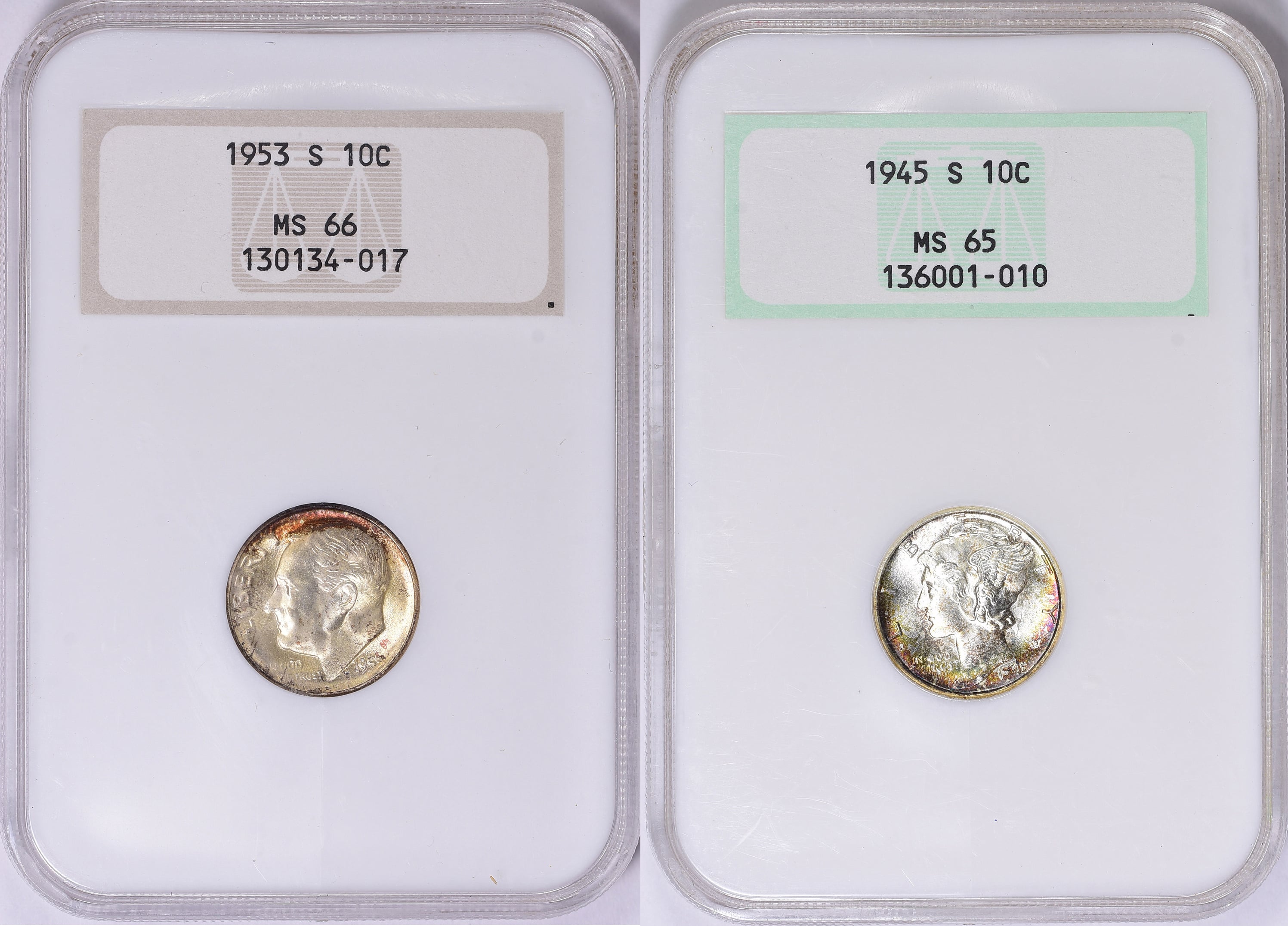
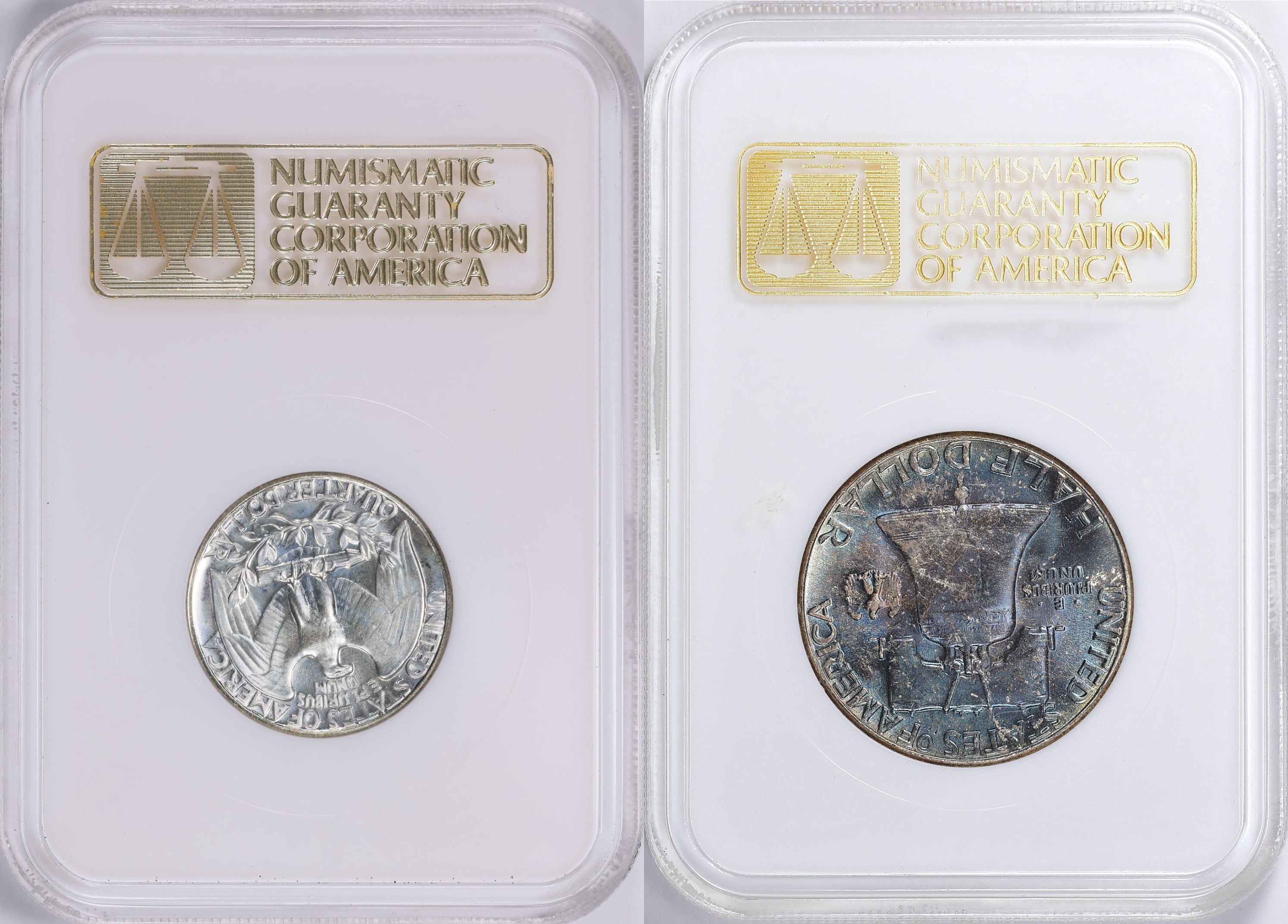
The difference in ink color has been attributed to ink degradation in combination with lot-to-lot variation in the stability of the ink used during insert printing. This has been confirmed in direct conversation with John Albanese, founder of NGC as well as CAC and CACG. Additionally, John Albanese stated on Episode 40-John Albanese Grades My Coins-CAC Grading from Cabbage Coins on YouTube that he “never had a green label at NGC” while referencing his previous conversations with me. The variation in embossing depth and color on the reverse appears to be due to wear as the upper reverse was a common area for dealer stickers and price codes to be placed and the removal of stickers as well as residual glue from them appears to have affected some slabs more than others.
So, all NGC 3.0 holders have a raised gold embossed NGC logo on the reverse paired with a paper insert incorporating the NGC scales logo on the obverse.
What is the timeline for NGC 3.0 slab production?
Conder101 had previously stated that NGC 3.0 slabs were produced from late 1987 (commonly accepted as December, 1987) through August, 1989. However, recent evidence from contemporary numismatic articles proves that the NGC 3.0 holder was phased out earlier and might have been retired by December, 1988. Thus, it can be stated that NGC 3.0 slabs were produced from sometime in December, 1987 until sometime in December, 1988. The evidence for the revised timeline is discussed below.
The August 10, 1988 issue of Coin World has multiple articles about the 1988 ANA show in Cincinnati as well as the counterfeit PCGS holder scheme that was discovered at the show. David Hall had “estimated that between 200 and 500 coins may be involved”. (1) Regarding NGC’s planned use of a hologram on its holder, John Albanese is attributed as stating “the new holders with the hologram will go into use within a few weeks”. (2) Later, in the October 26, 1988 issue of Coin World Laurie Sperber wrote an op/ed style article or advertisement and, when discussing features of NGC, stated “They have also gone to great lengths to insure that the holders are tamper proof (hologram)…”. (3) These Coin World articles infer the imminent use of a hologram on NGC holders in late 1988.
Secondly, the February 10, 1989 issue of the Certified Coin Dealer Newsletter (the Bluesheet) wrote about the California season of shows in January, 1989. They observed “The new ANACS slabs were in evidence on the bourse floor, as were the new holographically protected NGC slabs”. (4) This is definitive, contemporaneous proof that the NGC 4.0 holder, which had a reverse hologram and replaced the NGC 3.0 holder, was produced, distributed and on the bourse floor in January, 1989.
Additionally, the October, 1988 issue of COINage magazine reports that NGC announced at the ANA that a hologram holder was being developed for their use and “would be available within a few weeks”. NGC also announced that already certified coins could be sent back to NGC for reholder into the new hologram holder for minimal cost. (5) COINage magazine further reported in November, 1988 “it was revealed several hundred counterfeit PCGS slabs had slipped into circulation” and “In a press release distributed right on the floor of the ANA convention, NGC President John Albanese announced that the company would begin hot-stamping a hologram onto its slabs to deter counterfeiters”. It also states “The holograms would be added to older NGC slabs for a small charge”. (6) In the January, 1989 year-end review issue of COINage magazine it’s reported that “NGC announced the introduction of a protective hologram holder”. (7) In the January, 1989 issue, David Ganz listed predictions for the coming year. Prediction #5 is the increased use of holograms on slabs and it mentions that “The Numismatic Guarantee Corporation of America (NGC) has been in the forefront of this technology…”. (8) Photo evidence of the introduction of the NGC 4.0 slab with reverse hologram is provided by the May, 1989 issue of COINage magazine with the cover showing a selection of current slabs. The coins are all obverse side up and the NGC certified coin is a 1927 MS65 double eagle. Later, all the reverses are shown and the reverse of this NGC certified coin has the hologram found on the NGC 4.0 holder. (9) The images are shared below.
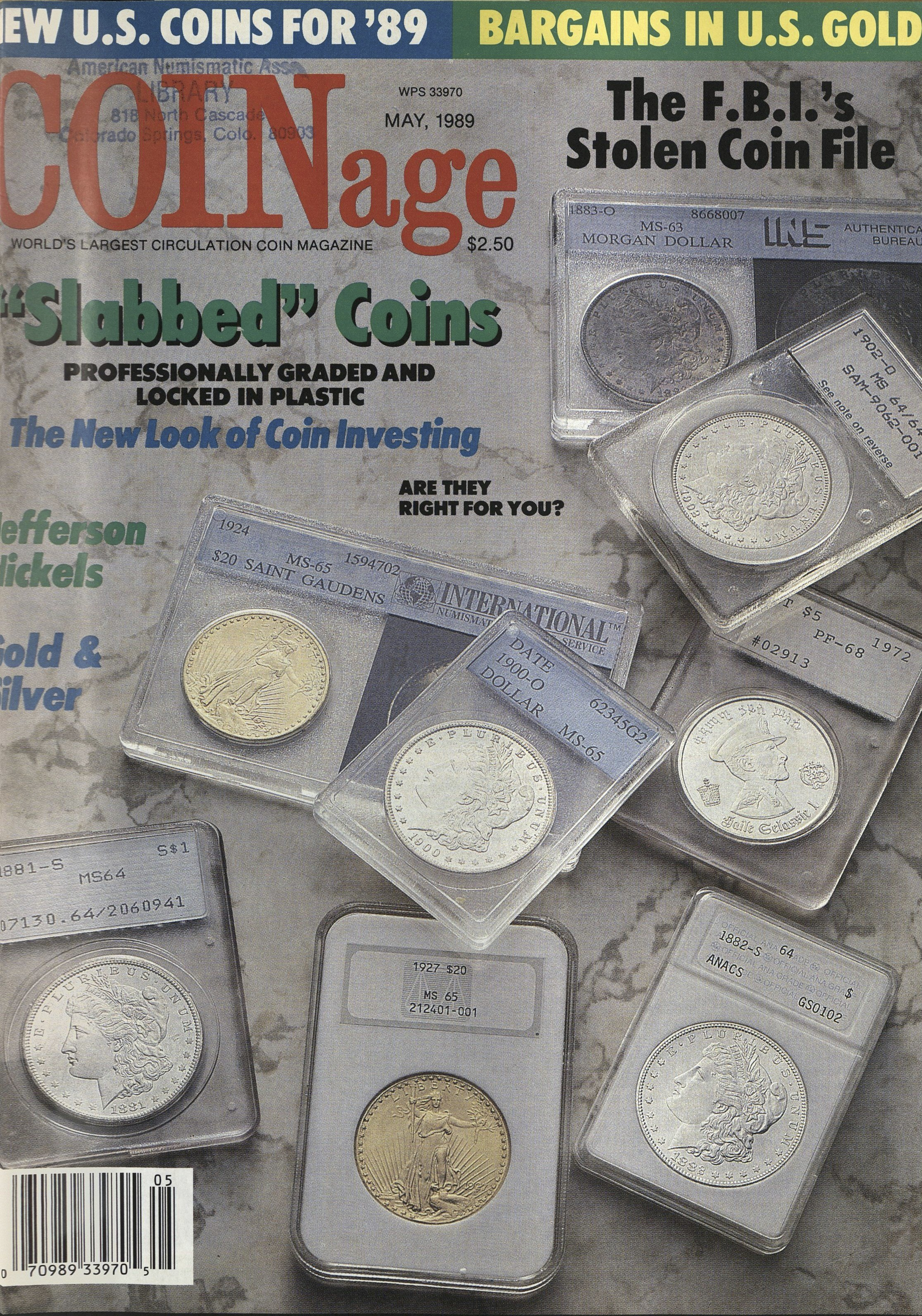
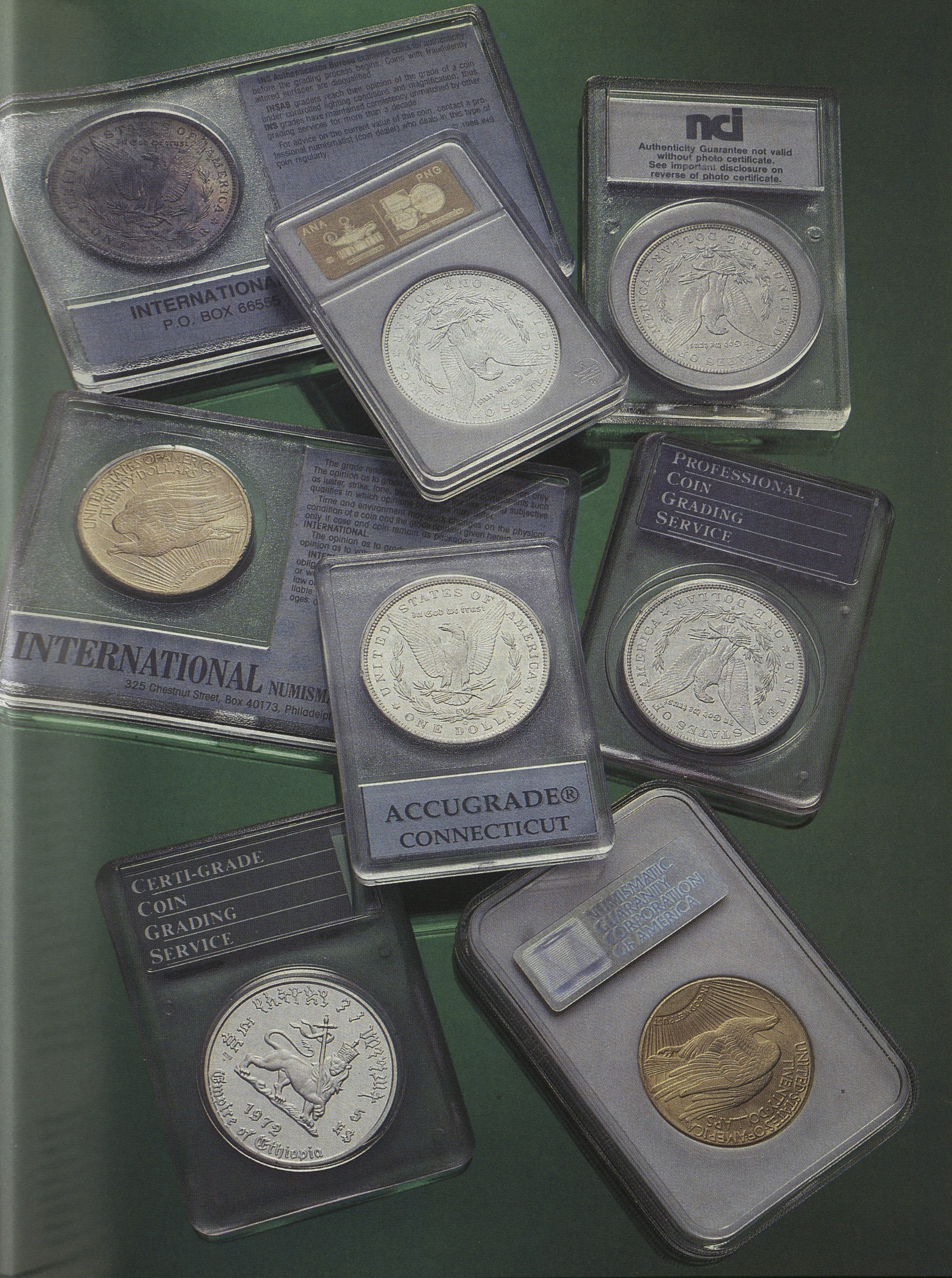
Taking the information in Coin World, the Bluesheet and COINage magazine together indicates that the industry knew by mid-August, 1988 that NGC was working to provide a hologram on its holder (the NGC 4.0 holder), the NGC 4.0 holder was written about in present tense and was reported as actively trading and selling on the bourse floor in January, 1989, and an image of the NGC 4.0 holder appeared by May, 1989, which would have meant that the image was taken no later than late March, 1989 in order for it to appear on the cover of COINage magazine.
Finally, I asked John Albanese directly if he recalled when the NGC 3.0 holder was phased out and when the NGC 4.0 holder was introduced and he told me directly that the NGC 4.0 holders were already being shipped in December, 1988. Therefore, it is logical to change the date of NGC 3.0 production to December, 1987 to December, 1988.
How many NGC 3.0 holders were originally produced?
The NGC population report was produced bi-monthly in the 1980s and at this time I have not been able to examine one. Therefore, a range for production must be made from contemporary evidence and this estimation of NGC 3.0 holder production is a bit on the geeky side, but for those interested it is shown as follows.
The February, 1988 issue of COINage magazine has an interview with John Albanese and it notes the first full month of grading was October, 1987 with 8,500 coins were graded. In November, 1987 11,000 coins were graded and by end of December, 1987 it was 3,000 coins per week. John Albanese estimated they would certify 121,000 coins in 1988. (10) This means that essentially 31,500 coins were graded by NGC in 1987 and, for the sake of estimation, we might consider these to be largely pre-NGC 3.0 holder coins.
In the May, 1989 issue of COINage magazine it’s reported that Mark Salzberg of NGC stated NGC was grading at that point 12,000-14,000 coins per month. (11) These numbers would have referenced NGC throughput by no later than late March, 1989 to be present in this issue of the magazine. This is after the NGC 3.0 holder was already replaced by the NGC 4.0 holder and gives a good estimation of likely upper end certification for NGC in 1988.
Taken together, the two articles in COINage support the idea that 120,000-130,000 NGC 3.0 holders were produced given John Albanese estimating 10,000 coins per month would be certified by NGC in 1988 and Mark Salzberg stating that upwards of 12,000-14,000 coins were being received by late March, 1989.
Since I have no population reports from this time period it might be difficult to get more precise or to even check the validity of the above. However, in the March, 1990 issue of COINage Scott Travers states 1,782,246 coins had been slabbed combined by PCGS and NGC as of January 1, 1990. (12) Further, the July, 1990 COINage issue contains a list of some of the most commonly certified coins by NGC and PCGS “as of April 1990” population data. (13) The data is remarkably robust and shows a sum of 28,988 coins graded by NGC for the basket of issues referenced vs. 158,731 coins certified by PCGS for the same coins. This comes out to 15.44% market share for NGC and 84.56% market share for PCGS within this basket. The numbers for market share appear realistic for the time period and mesh beautifully if we realize that PCGS certified its one millionth coin on December 21, 1988 (14) and that Patti Minassian of PCGS stated that PCGS was certifying approximately 45,000 coins per month in mid-1989. (11)
Given that these were stated to be some of the most commonly submitted coins to both PCGS and NGC, we can use market share percentages to infer how many coins were certified by each company as of January 1, 1990. If we take the market share from the most commonly submitted coins and apply it to the total cumulative population reports (1,782,246 coins) then we obtain 1,507,067 coins certified by PCGS and 275,179 coins certified by NGC as of January 1, 1990. Obviously, these numbers cannot be assumed to be absolutely correct, but at first glance they are extremely reasonable.
If we then take the number of coins certified by NGC in 1987, which would be largely if not completely before the NGC 3.0 holder was introduced, and subtract that number from the total inferred from the January 1, 1990 calculated total we get-
(275,179 total coins certified) - (31,500 coins certified in 1987) = 243,679 coins certified combined in 1988 and 1989
If we additionally realize the John Albanese estimation that NGC would likely certify 121,000 coins in 1988 we can see that what John Albanese had expected (121,000 per year) was pretty close to the average calculated for two years (243,679 coins over two years or 121,840 coins per year). Therefore, absent population reports, if is likely that NGC certified 120,000 +/- 10,000 coins in 1988 to give a realistic window of NGC 3.0 holder production of 110,000-130,000 coins.
(1) PCGS Officials Warn of “illicit” PCGS Holders. (1988 August 10). Coin World, 29(1478), 3-12.
(2) NGC Slabs to Use Hologram. (1988 August 10). Coin World, 29(1478), 3.
(3) Facts on NGC Certified Coins. (1988 October 26). Coin World, 29(1489), 25.
(4) Norweb 1893-S Morgan Graded PCGS-67. (1989 February 10). Certified Coin Dealer Newsletter, IV(6), 1.
(5) Green, P.M. (1988 October). Protecting the Slabs. COINage, 24(10), 57-62.
(6) Sussman, D. (1988 November). 3-D Protection. COINage, 24(11), 74-84.
(7) Travers, S.A. (1989). 12 Months Under the Glass. COINage, 86-88.
(8) Ganz, D.L. (1989 January). Ganz Crystal Ball. COINage, 25(1), 49-57.
(9) Thorne, M.G. (1989, May). “Slabbed” Coins. COINage, 25(5), 1-41.
(10) Lowney, J. (1988, February). Out to Make the Grade. COINage, 24(2), 116-118.
(11) Iddings, J. (1989, May). The Slab Era. COINage, 25(2), 49-52.
(12) Iddings, J. (1990, March). The Last Slab. COINage, 26(3), 58-60.
(13) Travers, S.A. (1990, July). 10 Most Slabbed Coins. COINage, 26(7), 58-66.
(14) Thanks A Million. (1989 April 21). Certified Coin Dealer Newsletter, IV(16), 6.
Comments
SUPER info! Thanks for your hard work in putting this all together. Not may take the time
Thanks for all the work @TomB !
I will update my site and histories with the new data soon.
Really thorough research and very informative. Thanks for sharing.
Wow. Impressive research. Thanks for sharing it.
Haven't seen any of them ins slabs in a long time. Great write up to
Excellent information! Thanks Tom
Wow! Stellar research, Tom. An informative addition to the hobby’s knowledge base.
Nothing is as expensive as free money.
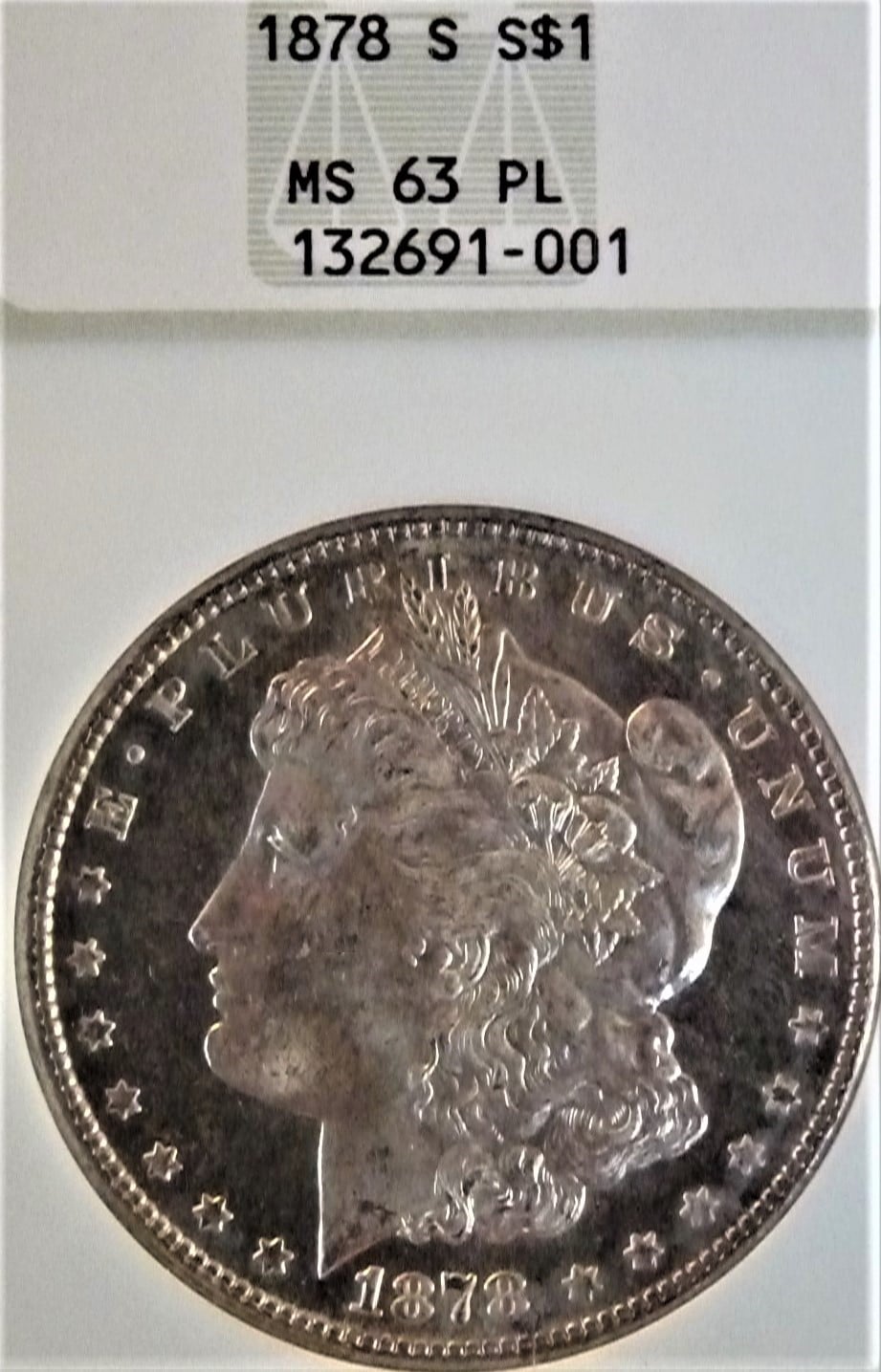
Great research and nice write-up. Thought I'd share my only Gen 3.
Great write up and research!
This line caught my eye:
It also states “The holograms would be added to older NGC slabs for a small charge”
Has anyone seen an example of this or have one?
I think what they did was simply put the coin in a new holder with a hologram, but I don't know if they kept the cert number. My gut feel is that they did not attempt to place a hologram directly over the embossed logo.
In honor of the memory of Cpl. Michael E. Thompson
Fantastic post!
Coin Photography