With all of your talk of unreliable verdicts on authenticity, how can you justify your chosen title for this thread???
It’s all documented but you have a point. Should the title be:
Is it counterfeit, questionable authenticity or genuine?
Mike, why not change the title to something like “NGC, PCGS and CACG all deemed this coin counterfeit, but…
?
Both you and Andy suggest a different title.
That’s fine with me.
The thread has grown to include other coins where the TPG services changed their minds…
mikebyers.com Dealer in Major Mint Errors, Die Trials & Patterns - Author of NLG Best World Coin Book World's Greatest Mint Errors - Publisher & Editor of minterrornews.com.
@Byers
However this all turns out, I've got a couple of takeaways:
1- This has not only been an extremely entertaining thread it is also an enlightening one along with being educational.
2- You really love this hobby and your contributions to it! Your affection and enthusiasm are contagious and makes me enjoy it even that much more. I'm sure others who have read and participated within would agree.
If enough readers want more stories, I could keep going…
mikebyers.com Dealer in Major Mint Errors, Die Trials & Patterns - Author of NLG Best World Coin Book World's Greatest Mint Errors - Publisher & Editor of minterrornews.com.
@Byers
However this all turns out, I've got a couple of takeaways:
1- This has not only been an extremely entertaining thread it is also an enlightening one along with being educational.
2- You really love this hobby and your contributions to it! Your affection and enthusiasm are contagious and makes me enjoy it even that much more. I'm sure others who have read and participated within would agree.
If enough readers want more stories, I could keep going…
Yes! Your stories are very well written and quite interesting.
Worry is the interest you pay on a debt you may not owe.
"Paper money eventually returns to its intrinsic value---zero."----Voltaire
"Everything you say should be true, but not everything true should be said."----Voltaire
@Byers
However this all turns out, I've got a couple of takeaways:
1- This has not only been an extremely entertaining thread it is also an enlightening one along with being educational.
2- You really love this hobby and your contributions to it! Your affection and enthusiasm are contagious and makes me enjoy it even that much more. I'm sure others who have read and participated within would agree.
If enough readers want more stories, I could keep going…
I will look forward to more of these types of stories.
Successful transactions:Tookybandit. "Everyone is equal, some are more equal than others".
Ok give me a couple of hours. I need to locate a couple of images and finish my next story. It’s about transfer dies overstruck on coins.
mikebyers.com Dealer in Major Mint Errors, Die Trials & Patterns - Author of NLG Best World Coin Book World's Greatest Mint Errors - Publisher & Editor of minterrornews.com.
Some of this is old news, but many may not know about it. And it’s a perfect example of transfer dies overstruck on U.S. gold coins and U.S. Territorial gold coins. PCGS, Don Kagin, the experts (and myself) all believed that these were genuine.
25 years ago at a Long Beach coin show, I stopped by at Don Kagin’s table. Yes, THAT Don Kagin. Don Kagin, holds a Doctorate Degree in Numismatics, is a world renowned expert in U.S. Territorial gold coins, and has authored award winning books.
Since I specialize in mint errors, die trials and patterns, I scope out the dealers who carry expensive exotic items like these.
Don showed me an incredible PCGS certified, 1861 $20 Clark Gruber struck OVER a 1849 or 1850 U.S. $10 gold piece. There were two known, one over a 1849 $10 and the other over a 1850 $10. They both look very similiar, positioned at 6 o’clock and showing both dates. For the life of me , I can’t remember if the one that he showed me was dated 1849 or 1850.
This coin stopped me in my tracks! A gold off-metal! A Clark Gruber $20 over a struck U.S. $10 Liberty. Omg wow! It was displayed in his show case with a couple of other mind-blowing Clark Gruber pieces like this one.
Even though this was 25 years ago, I had already handled an Indian Head Cent in gold struck on a $2 1/2 gold planchet, and the unique 1851 $20 struck on a Large Cent blank, both way back in 1975. And many other 5 and 6 figure coins, so I didn’t blink an eye when he quoted me $250k.
I had never heard of a Clark Gruber $20 like this one, so I very seriously considered purchasing it.
Then in 2002, Heritage Auctions sold a 1861 $20 Clark Gruber struck over a $20 Assay piece for $66,125. certified by PCGS MS 63. In the auction description is a list of the known pieces at the time, and attributed to Don Kagin’s book. So far so good.
A few years later, at a different Long Beach coin show, Don approached me and told me PCGS and many other experts including himself were wrong. These were made from transfer dies. And PCGS was now designating them ‘Fantasty’. He showed me the same one that had been certified genuine at $250k a few years ago, for $25k as a transfer die ‘Fantasy’. Full disclosure from Don- thank you. I purchased it and sold it to a customer for a small profit.
Then in 2011, StacksBowers auctioned off a $20 Clark Gruber over a 1850 $10 as struck with transfer dies, with a description and explanation of its origin.
So this is another great example of transfer dies fooling everybody, this time overstruck on genuine U.S. gold coins and Territorial gold coins. And since the host coin was genuine, it is sometimes tricky to determine the overstrike ( authentic or transfer dies).
Once again, I must repeat that in my opinion PCGS and NGC do a wonderful job authenticating and grading. But occasionally mistakes are made.
Below are the images and links to:
•My 1975 catalog with the gold Indian Head Cent and $20 Liberty on a Large Cent planchet.
•The 2002 Heritage Auction of the $20 Clark Gruber 1861 struck over a Assay $20 PCGS MS 63.
•Mint Error News cover in 2005 of a $20 1861 Clark Gruber Double Struck, that I handled, certified by PCGS and still in their database as a genuine double struck. So I assume that this one is a genuine double struck $20 1861 Clark Gruber mint error, and not a transfer die double struck or a transfer die struck over a genuine one.
•The 2011 StacksBowers Auction of the $20 Clark Gruber 1861 struck over a 1850 $10 as a transfer die, PCGS.
mikebyers.com Dealer in Major Mint Errors, Die Trials & Patterns - Author of NLG Best World Coin Book World's Greatest Mint Errors - Publisher & Editor of minterrornews.com.
Some of this is old news, but many may not know about it. And it’s a perfect example of transfer dies overstruck on U.S. gold coins and U.S. Territorial gold coins. PCGS, Don Kagin, the experts (and myself) all believed that these were genuine.
25 years ago at a Long Beach coin show, I stopped by at Don Kagin’s table. Yes, THAT Don Kagin. Don Kagin, holds a Doctorate Degree in Numismatics, is a world renowned expert in U.S. Territorial gold coins, and has authored award winning books.
Since I specialize in mint errors, die trials and patterns, I scope out the dealers who carry expensive exotic items like these.
Don showed me an incredible PCGS certified, 1861 $20 Clark Gruber struck OVER a 1849 or 1850 U.S. $10 gold piece. There were two known, one over a 1849 $10 and the other over a 1850 $10. They both look very similiar, positioned at 6 o’clock and showing both dates. For the life of me , I can’t remember if the one that he showed me was dated 1849 or 1850.
This coin stopped me in my tracks! A gold off-metal! A Clark Gruber $20 over a struck U.S. $10 Liberty. Omg wow! It was displayed in his show case with a couple of other mind-blowing Clark Gruber pieces like this one.
Even though this was 25 years ago, I had already handled an Indian Head Cent in gold struck on a $2 1/2 gold planchet, and the unique 1851 $20 struck on a Large Cent blank, both way back in 1975. And many other 5 and 6 figure coins, so I didn’t blink an eye when he quoted me $250k.
I had never heard of a Clark Gruber $20 like this one, so I very seriously considered purchasing it.
Then in 2002, Heritage Auctions sold a 1861 $20 Clark Gruber struck over a $20 Assay piece for $66,125. certified by PCGS MS 63. In the auction description is a list of the known pieces at the time, and attributed to Don Kagin’s book. So far so good.
A few years later, at a different Long Beach coin show, Don approached me and told me PCGS and many other experts including himself were wrong. These were made from transfer dies. And PCGS was now designating them ‘Fantasty’. He showed me the same one that had been certified genuine at $250k a few years ago, for $25k as a transfer die ‘Fantasy’. Full disclosure from Don- thank you. I purchased it and sold it to a customer for a small profit.
Then in 2011, StacksBowers auctioned off a $20 Clark Gruber over a 1850 $10 as struck with transfer dies, with a description and explanation of its origin.
So this is another great example of transfer dies fooling everybody, this time overstruck on genuine U.S. gold coins and Territorial gold coins. And since the host coin was genuine, it is sometimes tricky to determine the overstrike ( authentic or transfer dies).
Once again, I must repeat that in my opinion PCGS and NGC do a wonderful job authenticating and grading. But occasionally mistakes are made.
I never really understood the “fantasy” designation, and which coins should be labeled as such. Is it reserved strictly for counterfeits, or should it be used for some mint made items as well? For example, would it be proper to call something like a 2000 Cent struck on a Sacagawea $1 a fantasy instead of a “Mint Error”? How about a 1913 Liberty Nickel? And for that matter, what about some of the Dan Carr creations? Seems like many of them should qualify, but PCGS doesn’t grade any of them. I’m confused…
Andy Lustig
Doggedly collecting coins of the Central American Republic. Visit the Society of US Pattern Collectors at USPatterns.com.
Some of this is old news, but many may not know about it. And it’s a perfect example of transfer dies overstruck on U.S. gold coins and U.S. Territorial gold coins. PCGS, Don Kagin, the experts (and myself) all believed that these were genuine.
25 years ago at a Long Beach coin show, I stopped by at Don Kagin’s table. Yes, THAT Don Kagin. Don Kagin, holds a Doctorate Degree in Numismatics, is a world renowned expert in U.S. Territorial gold coins, and has authored award winning books.
Since I specialize in mint errors, die trials and patterns, I scope out the dealers who carry expensive exotic items like these.
Don showed me an incredible PCGS certified, 1861 $20 Clark Gruber struck OVER a 1849 or 1850 U.S. $10 gold piece. There were two known, one over a 1849 $10 and the other over a 1850 $10. They both look very similiar, positioned at 6 o’clock and showing both dates. For the life of me , I can’t remember if the one that he showed me was dated 1849 or 1850.
This coin stopped me in my tracks! A gold off-metal! A Clark Gruber $20 over a struck U.S. $10 Liberty. Omg wow! It was displayed in his show case with a couple of other mind-blowing Clark Gruber pieces like this one.
Even though this was 25 years ago, I had already handled an Indian Head Cent in gold struck on a $2 1/2 gold planchet, and the unique 1851 $20 struck on a Large Cent blank, both way back in 1975. And many other 5 and 6 figure coins, so I didn’t blink an eye when he quoted me $250k.
I had never heard of a Clark Gruber $20 like this one, so I very seriously considered purchasing it.
Then in 2002, Heritage Auctions sold a 1861 $20 Clark Gruber struck over a $20 Assay piece for $66,125. certified by PCGS MS 63. In the auction description is a list of the known pieces at the time, and attributed to Don Kagin’s book. So far so good.
A few years later, at a different Long Beach coin show, Don approached me and told me PCGS and many other experts including himself were wrong. These were made from transfer dies. And PCGS was now designating them ‘Fantasty’. He showed me the same one that had been certified genuine at $250k a few years ago, for $25k as a transfer die ‘Fantasy’. Full disclosure from Don- thank you. I purchased it and sold it to a customer for a small profit.
Then in 2011, StacksBowers auctioned off a $20 Clark Gruber over a 1850 $10 as struck with transfer dies, with a description and explanation of its origin.
So this is another great example of transfer dies fooling everybody, this time overstruck on genuine U.S. gold coins and Territorial gold coins. And since the host coin was genuine, it is sometimes tricky to determine the overstrike ( authentic or transfer dies).
Once again, I must repeat that in my opinion PCGS and NGC do a wonderful job authenticating and grading. But occasionally mistakes are made.
Below are the images and links to:
•My 1975 catalog with the gold Indian Head Cent and $20 Liberty on a Large Cent planchet.
•The 2002 Heritage Auction of the $20 Clark Gruber 1861 struck over a Assay $20 PCGS MS 63.
•Mint Error News cover in 2005 of a $20 1861 Clark Gruber Double Struck, that I handled, certified by PCGS and still in their database as a genuine double struck. So I assume that this one is a genuine double struck $20 1861 Clark Gruber mint error, and not a transfer die double struck or a transfer die struck over a genuine one.
•The 2011 StacksBowers Auction of the $20 Clark Gruber 1861 struck over a 1850 $10 as a transfer die, PCGS.
I never really understood the “fantasy” designation, and which coins should be labeled as such. Is it reserved strictly for counterfeits, or should it be used for some mint made items as well? For example, would it be proper to call something like a 2000 Cent struck on a Sacagawea $1 a fantasy instead of a “Mint Error”? How about a 1913 Liberty Nickel? And for that matter, what about some of the Dan Carr creations? Seems like many of them should qualify, but PCGS doesn’t grade any of them. I’m confused…
Andy- all of those that you described are fantasy items. The real question is the origin:
Fantasy U.S. Mint made
Fantasy Private Mint
Fantasy counterfeits
mikebyers.com Dealer in Major Mint Errors, Die Trials & Patterns - Author of NLG Best World Coin Book World's Greatest Mint Errors - Publisher & Editor of minterrornews.com.
Some of this is old news, but many may not know about it. And it’s a perfect example of transfer dies overstruck on U.S. gold coins and U.S. Territorial gold coins. PCGS, Don Kagin, the experts (and myself) all believed that these were genuine.
25 years ago at a Long Beach coin show, I stopped by at Don Kagin’s table. Yes, THAT Don Kagin. Don Kagin, holds a Doctorate Degree in Numismatics, is a world renowned expert in U.S. Territorial gold coins, and has authored award winning books.
Since I specialize in mint errors, die trials and patterns, I scope out the dealers who carry expensive exotic items like these.
Don showed me an incredible PCGS certified, 1861 $20 Clark Gruber struck OVER a 1849 or 1850 U.S. $10 gold piece. There were two known, one over a 1849 $10 and the other over a 1850 $10. They both look very similiar, positioned at 6 o’clock and showing both dates. For the life of me , I can’t remember if the one that he showed me was dated 1849 or 1850.
This coin stopped me in my tracks! A gold off-metal! A Clark Gruber $20 over a struck U.S. $10 Liberty. Omg wow! It was displayed in his show case with a couple of other mind-blowing Clark Gruber pieces like this one.
Even though this was 25 years ago, I had already handled an Indian Head Cent in gold struck on a $2 1/2 gold planchet, and the unique 1851 $20 struck on a Large Cent blank, both way back in 1975. And many other 5 and 6 figure coins, so I didn’t blink an eye when he quoted me $250k.
I had never heard of a Clark Gruber $20 like this one, so I very seriously considered purchasing it.
Then in 2002, Heritage Auctions sold a 1861 $20 Clark Gruber struck over a $20 Assay piece for $66,125. certified by PCGS MS 63. In the auction description is a list of the known pieces at the time, and attributed to Don Kagin’s book. So far so good.
A few years later, at a different Long Beach coin show, Don approached me and told me PCGS and many other experts including himself were wrong. These were made from transfer dies. And PCGS was now designating them ‘Fantasty’. He showed me the same one that had been certified genuine at $250k a few years ago, for $25k as a transfer die ‘Fantasy’. Full disclosure from Don- thank you. I purchased it and sold it to a customer for a small profit.
Then in 2011, StacksBowers auctioned off a $20 Clark Gruber over a 1850 $10 as struck with transfer dies, with a description and explanation of its origin.
So this is another great example of transfer dies fooling everybody, this time overstruck on genuine U.S. gold coins and Territorial gold coins. And since the host coin was genuine, it is sometimes tricky to determine the overstrike ( authentic or transfer dies).
Once again, I must repeat that in my opinion PCGS and NGC do a wonderful job authenticating and grading. But occasionally mistakes are made.
>
I never really understood the “fantasy” designation, and which coins should be labeled as such. Is it reserved strictly for counterfeits, or should it be used for some mint made items as well? For example, would it be proper to call something like a 2000 Cent struck on a Sacagawea $1 a fantasy instead of a “Mint Error”? How about a 1913 Liberty Nickel? And for that matter, what about some of the Dan Carr creations? Seems like many of them should qualify, but PCGS doesn’t grade any of them. I’m confused…
Andy- all of those that you described are fantasy items. The real question is the origin:
Fantasy U.S. Mint made
Fantasy Private Mint
Fantasy counterfeits
Are you suggesting that PCGS should slab all of these things and describe them this way?
Andy Lustig
Doggedly collecting coins of the Central American Republic. Visit the Society of US Pattern Collectors at USPatterns.com.
Some of this is old news, but many may not know about it. And it’s a perfect example of transfer dies overstruck on U.S. gold coins and U.S. Territorial gold coins. PCGS, Don Kagin, the experts (and myself) all believed that these were genuine.
25 years ago at a Long Beach coin show, I stopped by at Don Kagin’s table. Yes, THAT Don Kagin. Don Kagin, holds a Doctorate Degree in Numismatics, is a world renowned expert in U.S. Territorial gold coins, and has authored award winning books.
Since I specialize in mint errors, die trials and patterns, I scope out the dealers who carry expensive exotic items like these.
Don showed me an incredible PCGS certified, 1861 $20 Clark Gruber struck OVER a 1849 or 1850 U.S. $10 gold piece. There were two known, one over a 1849 $10 and the other over a 1850 $10. They both look very similiar, positioned at 6 o’clock and showing both dates. For the life of me , I can’t remember if the one that he showed me was dated 1849 or 1850.
This coin stopped me in my tracks! A gold off-metal! A Clark Gruber $20 over a struck U.S. $10 Liberty. Omg wow! It was displayed in his show case with a couple of other mind-blowing Clark Gruber pieces like this one.
Even though this was 25 years ago, I had already handled an Indian Head Cent in gold struck on a $2 1/2 gold planchet, and the unique 1851 $20 struck on a Large Cent blank, both way back in 1975. And many other 5 and 6 figure coins, so I didn’t blink an eye when he quoted me $250k.
I had never heard of a Clark Gruber $20 like this one, so I very seriously considered purchasing it.
Then in 2002, Heritage Auctions sold a 1861 $20 Clark Gruber struck over a $20 Assay piece for $66,125. certified by PCGS MS 63. In the auction description is a list of the known pieces at the time, and attributed to Don Kagin’s book. So far so good.
A few years later, at a different Long Beach coin show, Don approached me and told me PCGS and many other experts including himself were wrong. These were made from transfer dies. And PCGS was now designating them ‘Fantasty’. He showed me the same one that had been certified genuine at $250k a few years ago, for $25k as a transfer die ‘Fantasy’. Full disclosure from Don- thank you. I purchased it and sold it to a customer for a small profit.
Then in 2011, StacksBowers auctioned off a $20 Clark Gruber over a 1850 $10 as struck with transfer dies, with a description and explanation of its origin.
So this is another great example of transfer dies fooling everybody, this time overstruck on genuine U.S. gold coins and Territorial gold coins. And since the host coin was genuine, it is sometimes tricky to determine the overstrike ( authentic or transfer dies).
Once again, I must repeat that in my opinion PCGS and NGC do a wonderful job authenticating and grading. But occasionally mistakes are made.
>
I never really understood the “fantasy” designation, and which coins should be labeled as such. Is it reserved strictly for counterfeits, or should it be used for some mint made items as well? For example, would it be proper to call something like a 2000 Cent struck on a Sacagawea $1 a fantasy instead of a “Mint Error”? How about a 1913 Liberty Nickel? And for that matter, what about some of the Dan Carr creations? Seems like many of them should qualify, but PCGS doesn’t grade any of them. I’m confused…
Andy- all of those that you described are fantasy items. The real question is the origin:
Fantasy U.S. Mint made
Fantasy Private Mint
Fantasy counterfeits
Are you suggesting that PCGS should slab all of these things and describe them this way?
Andy - you are making me think on a holiday weekend lol.
Mint errors struck in the U.S. Mint with genuine dies should be labeled as mint errors. If intentionally struck, they should say intentional or assisted mint errors.
Tokens, medals, and fantasy ‘coins’ struck by private mints should be designated as such. Each TPG service describes them differently and there is no standard.
Counterfeit coins should not be slabbed.
Just my two cents worth.
mikebyers.com Dealer in Major Mint Errors, Die Trials & Patterns - Author of NLG Best World Coin Book World's Greatest Mint Errors - Publisher & Editor of minterrornews.com.
Some of this is old news, but many may not know about it. And it’s a perfect example of transfer dies overstruck on U.S. gold coins and U.S. Territorial gold coins. PCGS, Don Kagin, the experts (and myself) all believed that these were genuine.
25 years ago at a Long Beach coin show, I stopped by at Don Kagin’s table. Yes, THAT Don Kagin. Don Kagin, holds a Doctorate Degree in Numismatics, is a world renowned expert in U.S. Territorial gold coins, and has authored award winning books.
Since I specialize in mint errors, die trials and patterns, I scope out the dealers who carry expensive exotic items like these.
Don showed me an incredible PCGS certified, 1861 $20 Clark Gruber struck OVER a 1849 or 1850 U.S. $10 gold piece. There were two known, one over a 1849 $10 and the other over a 1850 $10. They both look very similiar, positioned at 6 o’clock and showing both dates. For the life of me , I can’t remember if the one that he showed me was dated 1849 or 1850.
This coin stopped me in my tracks! A gold off-metal! A Clark Gruber $20 over a struck U.S. $10 Liberty. Omg wow! It was displayed in his show case with a couple of other mind-blowing Clark Gruber pieces like this one.
Even though this was 25 years ago, I had already handled an Indian Head Cent in gold struck on a $2 1/2 gold planchet, and the unique 1851 $20 struck on a Large Cent blank, both way back in 1975. And many other 5 and 6 figure coins, so I didn’t blink an eye when he quoted me $250k.
I had never heard of a Clark Gruber $20 like this one, so I very seriously considered purchasing it.
Then in 2002, Heritage Auctions sold a 1861 $20 Clark Gruber struck over a $20 Assay piece for $66,125. certified by PCGS MS 63. In the auction description is a list of the known pieces at the time, and attributed to Don Kagin’s book. So far so good.
A few years later, at a different Long Beach coin show, Don approached me and told me PCGS and many other experts including himself were wrong. These were made from transfer dies. And PCGS was now designating them ‘Fantasty’. He showed me the same one that had been certified genuine at $250k a few years ago, for $25k as a transfer die ‘Fantasy’. Full disclosure from Don- thank you. I purchased it and sold it to a customer for a small profit.
Then in 2011, StacksBowers auctioned off a $20 Clark Gruber over a 1850 $10 as struck with transfer dies, with a description and explanation of its origin.
So this is another great example of transfer dies fooling everybody, this time overstruck on genuine U.S. gold coins and Territorial gold coins. And since the host coin was genuine, it is sometimes tricky to determine the overstrike ( authentic or transfer dies).
Once again, I must repeat that in my opinion PCGS and NGC do a wonderful job authenticating and grading. But occasionally mistakes are made.
I never really understood the “fantasy” designation, and which coins should be labeled as such. Is it reserved strictly for counterfeits, or should it be used for some mint made items as well? For example, would it be proper to call something like a 2000 Cent struck on a Sacagawea $1 a fantasy instead of a “Mint Error”? How about a 1913 Liberty Nickel? And for that matter, what about some of the Dan Carr creations? Seems like many of them should qualify, but PCGS doesn’t grade any of them. I’m confused…
NGC and PCGS do on occasion, choose not to designate ‘mint error’ on the insert, when it is 100% obvious that the mint error was assisted. A great example is this one:
A unique 1978-P Mint State Eisenhower Dollar overstruck on a 1978-S PROOF Eisenhower Dollar!
mikebyers.com Dealer in Major Mint Errors, Die Trials & Patterns - Author of NLG Best World Coin Book World's Greatest Mint Errors - Publisher & Editor of minterrornews.com.
Some of this is old news, but many may not know about it. And it’s a perfect example of transfer dies overstruck on U.S. gold coins and U.S. Territorial gold coins. PCGS, Don Kagin, the experts (and myself) all believed that these were genuine.
25 years ago at a Long Beach coin show, I stopped by at Don Kagin’s table. Yes, THAT Don Kagin. Don Kagin, holds a Doctorate Degree in Numismatics, is a world renowned expert in U.S. Territorial gold coins, and has authored award winning books.
Since I specialize in mint errors, die trials and patterns, I scope out the dealers who carry expensive exotic items like these.
Don showed me an incredible PCGS certified, 1861 $20 Clark Gruber struck OVER a 1849 or 1850 U.S. $10 gold piece. There were two known, one over a 1849 $10 and the other over a 1850 $10. They both look very similiar, positioned at 6 o’clock and showing both dates. For the life of me , I can’t remember if the one that he showed me was dated 1849 or 1850.
This coin stopped me in my tracks! A gold off-metal! A Clark Gruber $20 over a struck U.S. $10 Liberty. Omg wow! It was displayed in his show case with a couple of other mind-blowing Clark Gruber pieces like this one.
Even though this was 25 years ago, I had already handled an Indian Head Cent in gold struck on a $2 1/2 gold planchet, and the unique 1851 $20 struck on a Large Cent blank, both way back in 1975. And many other 5 and 6 figure coins, so I didn’t blink an eye when he quoted me $250k.
I had never heard of a Clark Gruber $20 like this one, so I very seriously considered purchasing it.
Then in 2002, Heritage Auctions sold a 1861 $20 Clark Gruber struck over a $20 Assay piece for $66,125. certified by PCGS MS 63. In the auction description is a list of the known pieces at the time, and attributed to Don Kagin’s book. So far so good.
A few years later, at a different Long Beach coin show, Don approached me and told me PCGS and many other experts including himself were wrong. These were made from transfer dies. And PCGS was now designating them ‘Fantasty’. He showed me the same one that had been certified genuine at $250k a few years ago, for $25k as a transfer die ‘Fantasy’. Full disclosure from Don- thank you. I purchased it and sold it to a customer for a small profit.
Then in 2011, StacksBowers auctioned off a $20 Clark Gruber over a 1850 $10 as struck with transfer dies, with a description and explanation of its origin.
So this is another great example of transfer dies fooling everybody, this time overstruck on genuine U.S. gold coins and Territorial gold coins. And since the host coin was genuine, it is sometimes tricky to determine the overstrike ( authentic or transfer dies).
Once again, I must repeat that in my opinion PCGS and NGC do a wonderful job authenticating and grading. But occasionally mistakes are made.
>
I never really understood the “fantasy” designation, and which coins should be labeled as such. Is it reserved strictly for counterfeits, or should it be used for some mint made items as well? For example, would it be proper to call something like a 2000 Cent struck on a Sacagawea $1 a fantasy instead of a “Mint Error”? How about a 1913 Liberty Nickel? And for that matter, what about some of the Dan Carr creations? Seems like many of them should qualify, but PCGS doesn’t grade any of them. I’m confused…
Andy- all of those that you described are fantasy items. The real question is the origin:
Fantasy U.S. Mint made
Fantasy Private Mint
Fantasy counterfeits
Are you suggesting that PCGS should slab all of these things and describe them this way?
Andy - you are making me think on a holiday weekend lol.
Mint errors struck in the U.S. Mint with genuine dies should be labeled as mint errors. If intentionally struck, they should say intentional or assisted mint errors.
>
It’s often impossible to know if an error was intentional, so they really can’t go there.
Andy Lustig
Doggedly collecting coins of the Central American Republic. Visit the Society of US Pattern Collectors at USPatterns.com.
Some of this is old news, but many may not know about it. And it’s a perfect example of transfer dies overstruck on U.S. gold coins and U.S. Territorial gold coins. PCGS, Don Kagin, the experts (and myself) all believed that these were genuine.
25 years ago at a Long Beach coin show, I stopped by at Don Kagin’s table. Yes, THAT Don Kagin. Don Kagin, holds a Doctorate Degree in Numismatics, is a world renowned expert in U.S. Territorial gold coins, and has authored award winning books.
Since I specialize in mint errors, die trials and patterns, I scope out the dealers who carry expensive exotic items like these.
Don showed me an incredible PCGS certified, 1861 $20 Clark Gruber struck OVER a 1849 or 1850 U.S. $10 gold piece. There were two known, one over a 1849 $10 and the other over a 1850 $10. They both look very similiar, positioned at 6 o’clock and showing both dates. For the life of me , I can’t remember if the one that he showed me was dated 1849 or 1850.
This coin stopped me in my tracks! A gold off-metal! A Clark Gruber $20 over a struck U.S. $10 Liberty. Omg wow! It was displayed in his show case with a couple of other mind-blowing Clark Gruber pieces like this one.
Even though this was 25 years ago, I had already handled an Indian Head Cent in gold struck on a $2 1/2 gold planchet, and the unique 1851 $20 struck on a Large Cent blank, both way back in 1975. And many other 5 and 6 figure coins, so I didn’t blink an eye when he quoted me $250k.
I had never heard of a Clark Gruber $20 like this one, so I very seriously considered purchasing it.
Then in 2002, Heritage Auctions sold a 1861 $20 Clark Gruber struck over a $20 Assay piece for $66,125. certified by PCGS MS 63. In the auction description is a list of the known pieces at the time, and attributed to Don Kagin’s book. So far so good.
A few years later, at a different Long Beach coin show, Don approached me and told me PCGS and many other experts including himself were wrong. These were made from transfer dies. And PCGS was now designating them ‘Fantasty’. He showed me the same one that had been certified genuine at $250k a few years ago, for $25k as a transfer die ‘Fantasy’. Full disclosure from Don- thank you. I purchased it and sold it to a customer for a small profit.
Then in 2011, StacksBowers auctioned off a $20 Clark Gruber over a 1850 $10 as struck with transfer dies, with a description and explanation of its origin.
So this is another great example of transfer dies fooling everybody, this time overstruck on genuine U.S. gold coins and Territorial gold coins. And since the host coin was genuine, it is sometimes tricky to determine the overstrike ( authentic or transfer dies).
Once again, I must repeat that in my opinion PCGS and NGC do a wonderful job authenticating and grading. But occasionally mistakes are made.
>
I never really understood the “fantasy” designation, and which coins should be labeled as such. Is it reserved strictly for counterfeits, or should it be used for some mint made items as well? For example, would it be proper to call something like a 2000 Cent struck on a Sacagawea $1 a fantasy instead of a “Mint Error”? How about a 1913 Liberty Nickel? And for that matter, what about some of the Dan Carr creations? Seems like many of them should qualify, but PCGS doesn’t grade any of them. I’m confused…
Andy- all of those that you described are fantasy items. The real question is the origin:
Fantasy U.S. Mint made
Fantasy Private Mint
Fantasy counterfeits
Are you suggesting that PCGS should slab all of these things and describe them this way?
Andy - you are making me think on a holiday weekend lol.
Mint errors struck in the U.S. Mint with genuine dies should be labeled as mint errors. If intentionally struck, they should say intentional or assisted mint errors.
>
It’s often impossible to know if an error was intentional, so they really can’t go there.
Andy- I agree. That’s why I then posted the Ike Dollar from 2 Mints with 2 mintmarks.
mikebyers.com Dealer in Major Mint Errors, Die Trials & Patterns - Author of NLG Best World Coin Book World's Greatest Mint Errors - Publisher & Editor of minterrornews.com.
There was also this "1861" Clark Gruber "fantasy" struck over an 1808 Irish silver piece. I would have bid more, but I knew that a friend of mine was bidding, so I dropped out rather than bid against them. It was struck by the same non-original dies as the other "fantasy" strikes of this item, and the same dies struck in gold passed as genuine coins for many years. Those normal gold strikes are now clearly identified as counterfeit and not "fantasy". It seems the dies have to be struck on something odd to be considered "fantasy".
@FlyingAl said: @Rexford makes the most convincing argument. A look at Proof QEs of the time frame will tell you everything you need to know.
Below are a selection of reverses from several Proof QEs. Notice how none of them show device polish, and they are all fully struck.
I need to recheck my sources here, but I'm fairly certain the die polishing process for pre-1909 Proofs made it nearly impossible to polish relief areas on Proof coins. That became an issue later on when the curvature of the dies more closely matched that of the devices, which didn't happen until 1909 or so (hence the Matte and Satin/Sandblast Proofs). The die trial here shows extensive polishing of the relief areas, something that would have almost certainly rejected the die and is inconsistent with genuine US Mint work.
.
I disagree that @Rexford makes a convincing argument at all.
With the possible exception of some die over-polishing, everything shown in their posts and your post is consistent with the normal Quarter Eagle reverse hub of about 1881 to 1907. And some die over-polishing does not exclude authenticity. I have over-polished dies, made a test trike to two for study, and then discarded said dies.
Here is a genuine 1906 proof reverse with a little bit of over-polishing of the deeper feathers (between the legs and around the arrow feather):
@dcarr said:
There was also this "1861" Clark Gruber "fantasy" struck over an 1808 Irish silver piece. I would have bid more, but I knew that a friend of mine was bidding, so I dropped out rather than bid against them. It was struck by the same non-original dies as the other "fantasy" strikes of this item, and the same dies struck in gold passed as genuine coins for many years. Those normal gold strikes are now clearly identified as counterfeit and not "fantasy". It seems the dies have to be struck on something odd to be considered "fantasy".
Another great example of a transfer strike.
Jack Klauson was getting more creative in his counterfeiting…
mikebyers.com Dealer in Major Mint Errors, Die Trials & Patterns - Author of NLG Best World Coin Book World's Greatest Mint Errors - Publisher & Editor of minterrornews.com.
@asheland said:
I gotta say, this is the most interesting thread I’ve read in quite some time!
I hope Fred Weinberg posts some stories in here, too!
I look forward to coming back and seeing what is posted going forward from here…
I will post a new story today. This one is about genuine Mint dies, taken out of the Mint, and were struck over struck coins. They were certified without the proper designation, since they were not struck inside the Mint. Eventually it was determined what exactly they were. (Yes, I handled these too).
mikebyers.com Dealer in Major Mint Errors, Die Trials & Patterns - Author of NLG Best World Coin Book World's Greatest Mint Errors - Publisher & Editor of minterrornews.com.
Back in 2005 at a major coin show, I stopped at Tom Caldwell’s table (NorthEast Numismatics). I have known Tom for 40 years. He is very knowledgeable and a well liked and respected rare coin dealer.
He had displayed in his showcase a set of (9) different Paraguay overstrikes in gold, silver and copper, certified by NGC.
I purchased this set and it was the cover of Mint Error News way back in 2005.
Alot of new information eventually surfaced, which challenged whether these were pattern dies, and more importantly, established that these were struck a century later by a coin dealer. This means that these were private strikes from a genuine mint die.
This was new news to the numismatic community, the grading services and the auction houses.
These were Buenos Aires Mint unfinished dies, missing the last 2 digits of the date, taken out of the Mint A CENTURY LATER , and CLANDESTINELY struck over various gold, silver and copper coins.
The dies that were used could have been pattern dies but that is NOT definitive.
Paraguay struck this exact design as a pattern in 1888, but also struck a regular issued silver Peso, dated 1889 from this exact design.
Until it was discovered how these overstrikes came to be, it was widely accepted in the numismatic community that the Mint took an unfinished pattern die and struck it over struck coins, similiar to die trials.
Auction houses described these as pattern dies which is not definitive. And the TPG services certified these as struck over a (whatever the host coin was).
Later on, after the true origin of these came to light, auction houses still described them as restrikes, which may not be correct, but at least mention:
“An unofficial restrike from Pattern dies of the Bueno Aires mint, struck in the latter part of the 20th century.”
The TPG services need to identify these as ‘private strikes from genuine mint die’ on the inserts!
Once again, I must repeat that in my opinion PCGS and NGC do a wonderful job authenticating and grading. But occasionally mistakes are made.
mikebyers.com Dealer in Major Mint Errors, Die Trials & Patterns - Author of NLG Best World Coin Book World's Greatest Mint Errors - Publisher & Editor of minterrornews.com.
Back in 2005 at a major coin show, I stopped at Tom Caldwell’s table (NorthEast Numismatics). I have known Tom for 40 years. He is very knowledgeable and a well liked and respected rare coin dealer.
He had displayed in his showcase a set of (9) different Paraguay overstrikes in gold, silver and copper, certified by NGC.
I purchased this set and it was the cover of Mint Error News way back in 2005.
Alot of new information eventually surfaced, which challenged whether these were pattern dies, and more importantly, established that these were struck a century later by a coin dealer. This means that these were private strikes from a genuine mint die.
This was new news to the numismatic community, the grading services and the auction houses.
These were Buenos Aires Mint unfinished dies, missing the last 2 digits of the date, taken out of the Mint A CENTURY LATER , and CLANDESTINELY struck over various gold, silver and copper coins.
The dies that were used could have been pattern dies but that is NOT definitive.
Paraguay struck this exact design as a pattern in 1888, but also struck a regular issued silver Peso, dated 1889 from this exact design.
Until it was discovered how these overstrikes came to be, it was widely accepted in the numismatic community that the Mint took an unfinished pattern die and struck it over struck coins, similiar to die trials.
Auction houses described these as pattern dies which is not definitive. And the TPG services certified these as struck over a (whatever the host coin was).
Later on, after the true origin of these came to light, auction houses still described them as restrikes, which may not be correct, but at least mention:
“An unofficial restrike from Pattern dies of the Bueno Aires mint, struck in the latter part of the 20th century.”
The TPG services need to identify these as ‘private strikes from genuine mint die’ on the inserts!
Considering that they were struck 100 years after the creation of the dies, and that they were not officially sanctioned by the government in any way, does it really matter where they were struck? I mean, why should we care if they were struck in the mint by a rogue employee, or struck outside of the mint by a friend of a rogue mint (or museum) employee?
Andy Lustig
Doggedly collecting coins of the Central American Republic. Visit the Society of US Pattern Collectors at USPatterns.com.
Back in 2005 at a major coin show, I stopped at Tom Caldwell’s table (NorthEast Numismatics). I have known Tom for 40 years. He is very knowledgeable and a well liked and respected rare coin dealer.
He had displayed in his showcase a set of (9) different Paraguay overstrikes in gold, silver and copper, certified by NGC.
I purchased this set and it was the cover of Mint Error News way back in 2005.
Alot of new information eventually surfaced, which challenged whether these were pattern dies, and more importantly, established that these were struck a century later by a coin dealer. This means that these were private strikes from a genuine mint die.
This was new news to the numismatic community, the grading services and the auction houses.
These were Buenos Aires Mint unfinished dies, missing the last 2 digits of the date, taken out of the Mint A CENTURY LATER , and CLANDESTINELY struck over various gold, silver and copper coins.
The dies that were used could have been pattern dies but that is NOT definitive.
Paraguay struck this exact design as a pattern in 1888, but also struck a regular issued silver Peso, dated 1889 from this exact design.
Until it was discovered how these overstrikes came to be, it was widely accepted in the numismatic community that the Mint took an unfinished pattern die and struck it over struck coins, similiar to die trials.
Auction houses described these as pattern dies which is not definitive. And the TPG services certified these as struck over a (whatever the host coin was).
Later on, after the true origin of these came to light, auction houses still described them as restrikes, which may not be correct, but at least mention:
“An unofficial restrike from Pattern dies of the Bueno Aires mint, struck in the latter part of the 20th century.”
The TPG services need to identify these as ‘private strikes from genuine mint die’ on the inserts!
Considering that they were struck 100 years after the creation of the dies, and that they were not officially sanctioned by the government in any way, does it really matter where they were struck? I mean, why should we care if they were struck in the mint by a rogue employee, or struck outside of the mint by a friend of a rogue mint (or museum) employee?
Andy… it makes a HUGE difference in my opinion. Some of my customers only want coins struck INSIDE the Mint, whether it’s a restrike, or a mint error ( accidentally or made intentionally) or a piece de caprice.
It’s not 100 years later as in your example. But I highly doubt that if the ‘rogue employee’ had struck the 1913 Liberty Head Nickels in his basement with a Mint die, instead of striking them INSIDE the Mint, they would be worth anywhere near the millions that they realize.
mikebyers.com Dealer in Major Mint Errors, Die Trials & Patterns - Author of NLG Best World Coin Book World's Greatest Mint Errors - Publisher & Editor of minterrornews.com.
Back in 2005 at a major coin show, I stopped at Tom Caldwell’s table (NorthEast Numismatics). I have known Tom for 40 years. He is very knowledgeable and a well liked and respected rare coin dealer.
He had displayed in his showcase a set of (9) different Paraguay overstrikes in gold, silver and copper, certified by NGC.
I purchased this set and it was the cover of Mint Error News way back in 2005.
Alot of new information eventually surfaced, which challenged whether these were pattern dies, and more importantly, established that these were struck a century later by a coin dealer. This means that these were private strikes from a genuine mint die.
This was new news to the numismatic community, the grading services and the auction houses.
These were Buenos Aires Mint unfinished dies, missing the last 2 digits of the date, taken out of the Mint A CENTURY LATER , and CLANDESTINELY struck over various gold, silver and copper coins.
The dies that were used could have been pattern dies but that is NOT definitive.
Paraguay struck this exact design as a pattern in 1888, but also struck a regular issued silver Peso, dated 1889 from this exact design.
Until it was discovered how these overstrikes came to be, it was widely accepted in the numismatic community that the Mint took an unfinished pattern die and struck it over struck coins, similiar to die trials.
Auction houses described these as pattern dies which is not definitive. And the TPG services certified these as struck over a (whatever the host coin was).
Later on, after the true origin of these came to light, auction houses still described them as restrikes, which may not be correct, but at least mention:
“An unofficial restrike from Pattern dies of the Bueno Aires mint, struck in the latter part of the 20th century.”
The TPG services need to identify these as ‘private strikes from genuine mint die’ on the inserts!
Considering that they were struck 100 years after the creation of the dies, and that they were not officially sanctioned by the government in any way, does it really matter where they were struck? I mean, why should we care if they were struck in the mint by a rogue employee, or struck outside of the mint by a friend of a rogue mint (or museum) employee?
It’s not 100 years later, and it isn’t even a coin, but even PCGS made a point saying that this electotype was said to be made at the Mint!
And even put it on the insert!
It makes a huge difference if it is a Mint product!
mikebyers.com Dealer in Major Mint Errors, Die Trials & Patterns - Author of NLG Best World Coin Book World's Greatest Mint Errors - Publisher & Editor of minterrornews.com.
Back in 2005 at a major coin show, I stopped at Tom Caldwell’s table (NorthEast Numismatics). I have known Tom for 40 years. He is very knowledgeable and a well liked and respected rare coin dealer.
He had displayed in his showcase a set of (9) different Paraguay overstrikes in gold, silver and copper, certified by NGC.
I purchased this set and it was the cover of Mint Error News way back in 2005.
Alot of new information eventually surfaced, which challenged whether these were pattern dies, and more importantly, established that these were struck a century later by a coin dealer. This means that these were private strikes from a genuine mint die.
This was new news to the numismatic community, the grading services and the auction houses.
These were Buenos Aires Mint unfinished dies, missing the last 2 digits of the date, taken out of the Mint A CENTURY LATER , and CLANDESTINELY struck over various gold, silver and copper coins.
The dies that were used could have been pattern dies but that is NOT definitive.
Paraguay struck this exact design as a pattern in 1888, but also struck a regular issued silver Peso, dated 1889 from this exact design.
Until it was discovered how these overstrikes came to be, it was widely accepted in the numismatic community that the Mint took an unfinished pattern die and struck it over struck coins, similiar to die trials.
Auction houses described these as pattern dies which is not definitive. And the TPG services certified these as struck over a (whatever the host coin was).
Later on, after the true origin of these came to light, auction houses still described them as restrikes, which may not be correct, but at least mention:
“An unofficial restrike from Pattern dies of the Bueno Aires mint, struck in the latter part of the 20th century.”
The TPG services need to identify these as ‘private strikes from genuine mint die’ on the inserts!
Considering that they were struck 100 years after the creation of the dies, and that they were not officially sanctioned by the government in any way, does it really matter where they were struck? I mean, why should we care if they were struck in the mint by a rogue employee, or struck outside of the mint by a friend of a rogue mint (or museum) employee?
Andy… it makes a HUGE difference in my opinion. Some of my customers only want coins struck INSIDE the Mint, whether it’s a restrike, mint error ( accidentally or intentionally) or a piece de caprice.
Case in point, I highly doubt that if the ‘rogue employee’ had struck the 1913 Liberty Head Nickels in his basement with a Mint die, instead of striking them INSIDE the Mint, they would be worth anywhere near the millions that they realize.
Not a fair analogy. The Paraguay “fantasy pieces” were struck a century after the dies were meant to be used. The 1913 Nickels were struck in 1913. For something more realistic, think about if this hub was used now to produce some 1964 Morgan Dollars.
Andy Lustig
Doggedly collecting coins of the Central American Republic. Visit the Society of US Pattern Collectors at USPatterns.com.
Back in 2005 at a major coin show, I stopped at Tom Caldwell’s table (NorthEast Numismatics). I have known Tom for 40 years. He is very knowledgeable and a well liked and respected rare coin dealer.
He had displayed in his showcase a set of (9) different Paraguay overstrikes in gold, silver and copper, certified by NGC.
I purchased this set and it was the cover of Mint Error News way back in 2005.
Alot of new information eventually surfaced, which challenged whether these were pattern dies, and more importantly, established that these were struck a century later by a coin dealer. This means that these were private strikes from a genuine mint die.
This was new news to the numismatic community, the grading services and the auction houses.
These were Buenos Aires Mint unfinished dies, missing the last 2 digits of the date, taken out of the Mint A CENTURY LATER , and CLANDESTINELY struck over various gold, silver and copper coins.
The dies that were used could have been pattern dies but that is NOT definitive.
Paraguay struck this exact design as a pattern in 1888, but also struck a regular issued silver Peso, dated 1889 from this exact design.
Until it was discovered how these overstrikes came to be, it was widely accepted in the numismatic community that the Mint took an unfinished pattern die and struck it over struck coins, similiar to die trials.
Auction houses described these as pattern dies which is not definitive. And the TPG services certified these as struck over a (whatever the host coin was).
Later on, after the true origin of these came to light, auction houses still described them as restrikes, which may not be correct, but at least mention:
“An unofficial restrike from Pattern dies of the Bueno Aires mint, struck in the latter part of the 20th century.”
The TPG services need to identify these as ‘private strikes from genuine mint die’ on the inserts!
Considering that they were struck 100 years after the creation of the dies, and that they were not officially sanctioned by the government in any way, does it really matter where they were struck? I mean, why should we care if they were struck in the mint by a rogue employee, or struck outside of the mint by a friend of a rogue mint (or museum) employee?
Andy… it makes a HUGE difference in my opinion. Some of my customers only want coins struck INSIDE the Mint, whether it’s a restrike, mint error ( accidentally or intentionally) or a piece de caprice.
Case in point, I highly doubt that if the ‘rogue employee’ had struck the 1913 Liberty Head Nickels in his basement with a Mint die, instead of striking them INSIDE the Mint, they would be worth anywhere near the millions that they realize.
Not a fair analogy. The Paraguay “fantasy pieces” were struck a century after the dies were meant to be used. The 1913 Nickels were struck in 1913. For something more realistic, think about if this hub was used now to produce some 1964 Morgan Dollars.
Andy- this is my thread so my analogy is ok. Lol
2025 strikes from a 1964 hub?
Were these:
Struck inside the Mint officially and offered for sale publicly?
Struck by a midnight minter, unauthorized and taken out of the Mint?
The hub removed from the Mint and someone struck some on silver round blanks in their garage?
mikebyers.com Dealer in Major Mint Errors, Die Trials & Patterns - Author of NLG Best World Coin Book World's Greatest Mint Errors - Publisher & Editor of minterrornews.com.
Back in 2005 at a major coin show, I stopped at Tom Caldwell’s table (NorthEast Numismatics). I have known Tom for 40 years. He is very knowledgeable and a well liked and respected rare coin dealer.
He had displayed in his showcase a set of (9) different Paraguay overstrikes in gold, silver and copper, certified by NGC.
I purchased this set and it was the cover of Mint Error News way back in 2005.
Alot of new information eventually surfaced, which challenged whether these were pattern dies, and more importantly, established that these were struck a century later by a coin dealer. This means that these were private strikes from a genuine mint die.
This was new news to the numismatic community, the grading services and the auction houses.
These were Buenos Aires Mint unfinished dies, missing the last 2 digits of the date, taken out of the Mint A CENTURY LATER , and CLANDESTINELY struck over various gold, silver and copper coins.
The dies that were used could have been pattern dies but that is NOT definitive.
Paraguay struck this exact design as a pattern in 1888, but also struck a regular issued silver Peso, dated 1889 from this exact design.
Until it was discovered how these overstrikes came to be, it was widely accepted in the numismatic community that the Mint took an unfinished pattern die and struck it over struck coins, similiar to die trials.
Auction houses described these as pattern dies which is not definitive. And the TPG services certified these as struck over a (whatever the host coin was).
Later on, after the true origin of these came to light, auction houses still described them as restrikes, which may not be correct, but at least mention:
“An unofficial restrike from Pattern dies of the Bueno Aires mint, struck in the latter part of the 20th century.”
The TPG services need to identify these as ‘private strikes from genuine mint die’ on the inserts!
Considering that they were struck 100 years after the creation of the dies, and that they were not officially sanctioned by the government in any way, does it really matter where they were struck? I mean, why should we care if they were struck in the mint by a rogue employee, or struck outside of the mint by a friend of a rogue mint (or museum) employee?
Andy… it makes a HUGE difference in my opinion. Some of my customers only want coins struck INSIDE the Mint, whether it’s a restrike, mint error ( accidentally or intentionally) or a piece de caprice.
Case in point, I highly doubt that if the ‘rogue employee’ had struck the 1913 Liberty Head Nickels in his basement with a Mint die, instead of striking them INSIDE the Mint, they would be worth anywhere near the millions that they realize.
Not a fair analogy. The Paraguay “fantasy pieces” were struck a century after the dies were meant to be used. The 1913 Nickels were struck in 1913. For something more realistic, think about if this hub was used now to produce some 1964 Morgan Dollars.
Andy- this is my thread so my analogy is ok. Lol
2025 strikes from a 1964 hub?
Were these:
Struck inside the Mint officially and offered for sale publicly?
Struck by a midnight minter, unauthorized and taken out of the Mint?
The hub removed from the Mint and someone struck some on silver round blanks in their garage?
Up to you. Like you said, it’s your thread!
Andy Lustig
Doggedly collecting coins of the Central American Republic. Visit the Society of US Pattern Collectors at USPatterns.com.
Back in 2005 at a major coin show, I stopped at Tom Caldwell’s table (NorthEast Numismatics). I have known Tom for 40 years. He is very knowledgeable and a well liked and respected rare coin dealer.
He had displayed in his showcase a set of (9) different Paraguay overstrikes in gold, silver and copper, certified by NGC.
I purchased this set and it was the cover of Mint Error News way back in 2005.
Alot of new information eventually surfaced, which challenged whether these were pattern dies, and more importantly, established that these were struck a century later by a coin dealer. This means that these were private strikes from a genuine mint die.
This was new news to the numismatic community, the grading services and the auction houses.
These were Buenos Aires Mint unfinished dies, missing the last 2 digits of the date, taken out of the Mint A CENTURY LATER , and CLANDESTINELY struck over various gold, silver and copper coins.
The dies that were used could have been pattern dies but that is NOT definitive.
Paraguay struck this exact design as a pattern in 1888, but also struck a regular issued silver Peso, dated 1889 from this exact design.
Until it was discovered how these overstrikes came to be, it was widely accepted in the numismatic community that the Mint took an unfinished pattern die and struck it over struck coins, similiar to die trials.
Auction houses described these as pattern dies which is not definitive. And the TPG services certified these as struck over a (whatever the host coin was).
Later on, after the true origin of these came to light, auction houses still described them as restrikes, which may not be correct, but at least mention:
“An unofficial restrike from Pattern dies of the Bueno Aires mint, struck in the latter part of the 20th century.”
The TPG services need to identify these as ‘private strikes from genuine mint die’ on the inserts!
Considering that they were struck 100 years after the creation of the dies, and that they were not officially sanctioned by the government in any way, does it really matter where they were struck? I mean, why should we care if they were struck in the mint by a rogue employee, or struck outside of the mint by a friend of a rogue mint (or museum) employee?
It’s not 100 years later, and it isn’t even a coin, but even PCGS made a point saying that this electotype was said to be made at the Mint!
And even put it on the insert!
It makes a huge difference if it is a Mint product!
“Said to be…” is not a confidence instilling phrase when it comes to matters of authenticity.
Andy Lustig
Doggedly collecting coins of the Central American Republic. Visit the Society of US Pattern Collectors at USPatterns.com.
Back in 2005 at a major coin show, I stopped at Tom Caldwell’s table (NorthEast Numismatics). I have known Tom for 40 years. He is very knowledgeable and a well liked and respected rare coin dealer.
He had displayed in his showcase a set of (9) different Paraguay overstrikes in gold, silver and copper, certified by NGC.
I purchased this set and it was the cover of Mint Error News way back in 2005.
Alot of new information eventually surfaced, which challenged whether these were pattern dies, and more importantly, established that these were struck a century later by a coin dealer. This means that these were private strikes from a genuine mint die.
This was new news to the numismatic community, the grading services and the auction houses.
These were Buenos Aires Mint unfinished dies, missing the last 2 digits of the date, taken out of the Mint A CENTURY LATER , and CLANDESTINELY struck over various gold, silver and copper coins.
The dies that were used could have been pattern dies but that is NOT definitive.
Paraguay struck this exact design as a pattern in 1888, but also struck a regular issued silver Peso, dated 1889 from this exact design.
Until it was discovered how these overstrikes came to be, it was widely accepted in the numismatic community that the Mint took an unfinished pattern die and struck it over struck coins, similiar to die trials.
Auction houses described these as pattern dies which is not definitive. And the TPG services certified these as struck over a (whatever the host coin was).
Later on, after the true origin of these came to light, auction houses still described them as restrikes, which may not be correct, but at least mention:
“An unofficial restrike from Pattern dies of the Bueno Aires mint, struck in the latter part of the 20th century.”
The TPG services need to identify these as ‘private strikes from genuine mint die’ on the inserts!
Considering that they were struck 100 years after the creation of the dies, and that they were not officially sanctioned by the government in any way, does it really matter where they were struck? I mean, why should we care if they were struck in the mint by a rogue employee, or struck outside of the mint by a friend of a rogue mint (or museum) employee?
Andy… it makes a HUGE difference in my opinion. Some of my customers only want coins struck INSIDE the Mint, whether it’s a restrike, mint error ( accidentally or intentionally) or a piece de caprice.
Case in point, I highly doubt that if the ‘rogue employee’ had struck the 1913 Liberty Head Nickels in his basement with a Mint die, instead of striking them INSIDE the Mint, they would be worth anywhere near the millions that they realize.
Not a fair analogy. The Paraguay “fantasy pieces” were struck a century after the dies were meant to be used. The 1913 Nickels were struck in 1913. For something more realistic, think about if this hub was used now to produce some 1964 Morgan Dollars.
Andy- this is my thread so my analogy is ok. Lol
2025 strikes from a 1964 hub?
Were these:
Struck inside the Mint officially and offered for sale publicly?
Struck by a midnight minter, unauthorized and taken out of the Mint?
The hub removed from the Mint and someone struck some on silver round blanks in their garage?
Up to you. Like you said, it’s your thread!
All kidding put aside, regardless of where and how they were struck, having a closer connection to the Mint can’t hurt.
mikebyers.com Dealer in Major Mint Errors, Die Trials & Patterns - Author of NLG Best World Coin Book World's Greatest Mint Errors - Publisher & Editor of minterrornews.com.
Here is an exonumia overstrike made at the same time as the original exonumia striking (as shown by the date at which both the original Elder medals and various overstrikes appeared in Elder's auction catalogues.)
Had to own it because my first great collection was of coins from Honduras and my second great collection was of Thomas Elder tokens and medals. Now, several Elder dies from this era are still extant. If I could just get the owner of the dies to overstrike a 1922-D cent for me, I could die a happy man!
Professional Numismatist, Retired. 55 year member ANA. Former ANA Senior Authenticator. Winner of four ANA Heath Literary Awards; three Wayte and Olga Raymond Literary Awards; Numismatist of the Year Award 2009, and ANA Lifetime Achievement Award 2020. Winner of the PNG's 2026 Robert Friedberg Award for "The Enigmatic Lincoln Cents of 1922," Available now from Whitman or Amazon.
@CaptHenway said:
Here is an exonumia overstrike made at the same time as the original exonumia striking (as shown by the date at which both the original Elder medals and various overstrikes appeared in Elder's auction catalogues.)
Had to own it because my first great collection was of coins from Honduras and my second great collection was of Thomas Elder tokens and medals. Now, several Elder dies from this era are still extant. If I could just get the owner of the dies to overstrike a 1922-D cent for me, I could die a happy man!
Very cool!!
mikebyers.com Dealer in Major Mint Errors, Die Trials & Patterns - Author of NLG Best World Coin Book World's Greatest Mint Errors - Publisher & Editor of minterrornews.com.
Speaking of overstrikes involving 2 countries, years apart, different denominations, intentionally made and certified, here is a Mexico 1916 Oaxaca Gold 60 Pesos struck on a U.S. $10 Liberty (1838-1907).
The 1916 Gold 60 Pesos were struck in Oaxaca, Mexico and are extremely rare. The original dies for the 1916 60 Pesos were impounded at the ANS over a century ago.
mikebyers.com Dealer in Major Mint Errors, Die Trials & Patterns - Author of NLG Best World Coin Book World's Greatest Mint Errors - Publisher & Editor of minterrornews.com.
Back in 2005 at a major coin show, I stopped at Tom Caldwell’s table (NorthEast Numismatics). I have known Tom for 40 years. He is very knowledgeable and a well liked and respected rare coin dealer.
He had displayed in his showcase a set of (9) different Paraguay overstrikes in gold, silver and copper, certified by NGC.
I purchased this set and it was the cover of Mint Error News way back in 2005.
Alot of new information eventually surfaced, which challenged whether these were pattern dies, and more importantly, established that these were struck a century later by a coin dealer. This means that these were private strikes from a genuine mint die.
This was new news to the numismatic community, the grading services and the auction houses.
These were Buenos Aires Mint unfinished dies, missing the last 2 digits of the date, taken out of the Mint A CENTURY LATER , and CLANDESTINELY struck over various gold, silver and copper coins.
The dies that were used could have been pattern dies but that is NOT definitive.
Paraguay struck this exact design as a pattern in 1888, but also struck a regular issued silver Peso, dated 1889 from this exact design.
Until it was discovered how these overstrikes came to be, it was widely accepted in the numismatic community that the Mint took an unfinished pattern die and struck it over struck coins, similiar to die trials.
Auction houses described these as pattern dies which is not definitive. And the TPG services certified these as struck over a (whatever the host coin was).
Later on, after the true origin of these came to light, auction houses still described them as restrikes, which may not be correct, but at least mention:
“An unofficial restrike from Pattern dies of the Bueno Aires mint, struck in the latter part of the 20th century.”
The TPG services need to identify these as ‘private strikes from genuine mint die’ on the inserts!
Considering that they were struck 100 years after the creation of the dies, and that they were not officially sanctioned by the government in any way, does it really matter where they were struck? I mean, why should we care if they were struck in the mint by a rogue employee, or struck outside of the mint by a friend of a rogue mint (or museum) employee?
Andy… it makes a HUGE difference in my opinion. Some of my customers only want coins struck INSIDE the Mint, whether it’s a restrike, mint error ( accidentally or intentionally) or a piece de caprice.
Case in point, I highly doubt that if the ‘rogue employee’ had struck the 1913 Liberty Head Nickels in his basement with a Mint die, instead of striking them INSIDE the Mint, they would be worth anywhere near the millions that they realize.
Not a fair analogy. The Paraguay “fantasy pieces” were struck a century after the dies were meant to be used. The 1913 Nickels were struck in 1913. For something more realistic, think about if this hub was used now to produce some 1964 Morgan Dollars.
Do we know that? Didn't they first surface 5 or 6 years after 1913?
Could have been something after 1913. Never really thought about it.
Andy Lustig
Doggedly collecting coins of the Central American Republic. Visit the Society of US Pattern Collectors at USPatterns.com.
Back in 2005 at a major coin show, I stopped at Tom Caldwell’s table (NorthEast Numismatics). I have known Tom for 40 years. He is very knowledgeable and a well liked and respected rare coin dealer.
He had displayed in his showcase a set of (9) different Paraguay overstrikes in gold, silver and copper, certified by NGC.
I purchased this set and it was the cover of Mint Error News way back in 2005.
Alot of new information eventually surfaced, which challenged whether these were pattern dies, and more importantly, established that these were struck a century later by a coin dealer. This means that these were private strikes from a genuine mint die.
This was new news to the numismatic community, the grading services and the auction houses.
These were Buenos Aires Mint unfinished dies, missing the last 2 digits of the date, taken out of the Mint A CENTURY LATER , and CLANDESTINELY struck over various gold, silver and copper coins.
The dies that were used could have been pattern dies but that is NOT definitive.
Paraguay struck this exact design as a pattern in 1888, but also struck a regular issued silver Peso, dated 1889 from this exact design.
Until it was discovered how these overstrikes came to be, it was widely accepted in the numismatic community that the Mint took an unfinished pattern die and struck it over struck coins, similiar to die trials.
Auction houses described these as pattern dies which is not definitive. And the TPG services certified these as struck over a (whatever the host coin was).
Later on, after the true origin of these came to light, auction houses still described them as restrikes, which may not be correct, but at least mention:
“An unofficial restrike from Pattern dies of the Bueno Aires mint, struck in the latter part of the 20th century.”
The TPG services need to identify these as ‘private strikes from genuine mint die’ on the inserts!
Considering that they were struck 100 years after the creation of the dies, and that they were not officially sanctioned by the government in any way, does it really matter where they were struck? I mean, why should we care if they were struck in the mint by a rogue employee, or struck outside of the mint by a friend of a rogue mint (or museum) employee?
Andy… it makes a HUGE difference in my opinion. Some of my customers only want coins struck INSIDE the Mint, whether it’s a restrike, mint error ( accidentally or intentionally) or a piece de caprice.
Case in point, I highly doubt that if the ‘rogue employee’ had struck the 1913 Liberty Head Nickels in his basement with a Mint die, instead of striking them INSIDE the Mint, they would be worth anywhere near the millions that they realize.
Not a fair analogy. The Paraguay “fantasy pieces” were struck a century after the dies were meant to be used. The 1913 Nickels were struck in 1913. For something more realistic, think about if this hub was used now to produce some 1964 Morgan Dollars.
Do we know that? Didn't they first surface 5 or 6 years after 1913?
Could have been something after 1913. Never really thought about it.
This is the story I remember:
I have always wondered if this illustrious individual also concocted this unique rarity. A couple of my associates looked into it but hit a brick wall. Since he advertised the 1913 Nickels, he likely would have done the same with this gold Buffalo. It belonged to one family for over a century undiscovered. So unlikely that they are connected.
mikebyers.com Dealer in Major Mint Errors, Die Trials & Patterns - Author of NLG Best World Coin Book World's Greatest Mint Errors - Publisher & Editor of minterrornews.com.
Fred had unique opportunity for a hands examination of up to five 1913 V nickels and determined the ones he looked at shared same collar die marker, thus he decided those in hand were struck at same point in time. I do not recall what this specific collar marker was but he seemed satisfied with his conclusion.
Personally I would assume they were struck in 1913 as that's where eventual 1919 owner/seller of all 5 worked at in 1913 era Philly Mint.
Mint die production access is key, deep pocket numismatists in Philly were the goal. Use an obverse die with 191 and add the fourth number, the 3. Then load it in press and stamp out 5. Then go find a new job. So many fun things were created at Philly in 1860s for collectors, so there was a history of shenanigans for profit to look back on. I think all five remained together after that transaction.
@MrEureka said:
Considering when Brown left his position at the Mint, I think we can safely say the 1913 Nickels were struck in 1913.
Probably, but we cannot rule out very late 1912.
Professional Numismatist, Retired. 55 year member ANA. Former ANA Senior Authenticator. Winner of four ANA Heath Literary Awards; three Wayte and Olga Raymond Literary Awards; Numismatist of the Year Award 2009, and ANA Lifetime Achievement Award 2020. Winner of the PNG's 2026 Robert Friedberg Award for "The Enigmatic Lincoln Cents of 1922," Available now from Whitman or Amazon.
Back in 2005 at a major coin show, I stopped at Tom Caldwell’s table (NorthEast Numismatics). I have known Tom for 40 years. He is very knowledgeable and a well liked and respected rare coin dealer.
He had displayed in his showcase a set of (9) different Paraguay overstrikes in gold, silver and copper, certified by NGC.
I purchased this set and it was the cover of Mint Error News way back in 2005.
Alot of new information eventually surfaced, which challenged whether these were pattern dies, and more importantly, established that these were struck a century later by a coin dealer. This means that these were private strikes from a genuine mint die.
This was new news to the numismatic community, the grading services and the auction houses.
These were Buenos Aires Mint unfinished dies, missing the last 2 digits of the date, taken out of the Mint A CENTURY LATER , and CLANDESTINELY struck over various gold, silver and copper coins.
The dies that were used could have been pattern dies but that is NOT definitive.
Paraguay struck this exact design as a pattern in 1888, but also struck a regular issued silver Peso, dated 1889 from this exact design.
Until it was discovered how these overstrikes came to be, it was widely accepted in the numismatic community that the Mint took an unfinished pattern die and struck it over struck coins, similiar to die trials.
Auction houses described these as pattern dies which is not definitive. And the TPG services certified these as struck over a (whatever the host coin was).
Later on, after the true origin of these came to light, auction houses still described them as restrikes, which may not be correct, but at least mention:
“An unofficial restrike from Pattern dies of the Bueno Aires mint, struck in the latter part of the 20th century.”
The TPG services need to identify these as ‘private strikes from genuine mint die’ on the inserts!
Considering that they were struck 100 years after the creation of the dies, and that they were not officially sanctioned by the government in any way, does it really matter where they were struck? I mean, why should we care if they were struck in the mint by a rogue employee, or struck outside of the mint by a friend of a rogue mint (or museum) employee?
Andy… it makes a HUGE difference in my opinion. Some of my customers only want coins struck INSIDE the Mint, whether it’s a restrike, mint error ( accidentally or intentionally) or a piece de caprice.
Case in point, I highly doubt that if the ‘rogue employee’ had struck the 1913 Liberty Head Nickels in his basement with a Mint die, instead of striking them INSIDE the Mint, they would be worth anywhere near the millions that they realize.
Not a fair analogy. The Paraguay “fantasy pieces” were struck a century after the dies were meant to be used. The 1913 Nickels were struck in 1913. For something more realistic, think about if this hub was used now to produce some 1964 Morgan Dollars.
Do we know that? Didn't they first surface 5 or 6 years after 1913?
Could have been something after 1913. Never really thought about it.
Lindy, I was able to hold three of them that were raw – the other two were in PCGS holders at the time.
I aligned them so that they were all in the same position and then I checked the plain edge and found what I have always called “ballistic“ lines, which are fine vertical lines in the collar that will sometimes show up on a struck plain edge coin – and they did, on all three pieces in exactly the same position, showing that they were struck at the same time in the same collar.
One of the raw pieces was the Smithsonian specimen, and I’ll never forget the two large guards that were standing behind me as I held their coin with the others raw in my hand – these guys were so big they made NFL lineman look like petite ballerinas….
Retired Collector & Dealer in Major Mint Error Coins & Currency since the 1960's.Co-Author of Whitman's "100 Greatest U.S. Mint Error Coins", and the Error Coin Encyclopedia, Vols., III & IV. Retired Authenticator for Major Mint Errors for PCGS. A 50+ Year PNG Member.A full-time numismatist since 1972, retired in 2022.
Fred had unique opportunity for a hands examination of up to five 1913 V nickels and determined the ones he looked at shared same collar die marker, thus he decided those in hand were struck at same point in time. I do not recall what this specific collar marker was but he seemed satisfied with his conclusion.
Personally I would assume they were struck in 1913 as that's where eventual 1919 owner/seller of all 5 worked at in 1913 era Philly Mint.
Mint die production access is key, deep pocket numismatists in Philly were the goal. Use an obverse die with 191 and add the fourth number, the 3. Then load it in press and stamp out 5. Then go find a new job. So many fun things were created at Philly in 1860s for collectors, so there was a history of shenanigans for profit to look back on. I think all five remained together after that transaction.
Happy Monday Fred !
The collar for the 1913 Liberty Head Nickel was a 3 part segmented collar. There were 3 raised collar marks equidistance from eachother. All of the 1913 Liberty Head Nickels had these collar marks, which helped to authenticate the ‘missing’ coin and helped authenticate all of them being struck at the same time. Fred would have a better story/account/explanation since he viewed them all together.
mikebyers.com Dealer in Major Mint Errors, Die Trials & Patterns - Author of NLG Best World Coin Book World's Greatest Mint Errors - Publisher & Editor of minterrornews.com.
Fred had unique opportunity for a hands examination of up to five 1913 V nickels and determined the ones he looked at shared same collar die marker, thus he decided those in hand were struck at same point in time. I do not recall what this specific collar marker was but he seemed satisfied with his conclusion.
Personally I would assume they were struck in 1913 as that's where eventual 1919 owner/seller of all 5 worked at in 1913 era Philly Mint.
Mint die production access is key, deep pocket numismatists in Philly were the goal. Use an obverse die with 191 and add the fourth number, the 3. Then load it in press and stamp out 5. Then go find a new job. So many fun things were created at Philly in 1860s for collectors, so there was a history of shenanigans for profit to look back on. I think all five remained together after that transaction.
Happy Monday Fred !
The collar for the 1913 Liberty Head Nickel was a 3 part segmented collar. There were 3 raised collar marks equidistance from eachother. All of the 1913 Liberty Head Nickels had these collar marks, which helped to authenticate the ‘missing’ coin and helped authenticate all of them being struck at the same time. Fred would have a better story/account/explanation since he viewed them all together.
Did your gold Buffalo have similar markings?
Andy Lustig
Doggedly collecting coins of the Central American Republic. Visit the Society of US Pattern Collectors at USPatterns.com.
Comments
Inconsistent with what could have been possible at the place it should have been made = counterfeit.
Edited to add that the shown die trial also matches the characteristics of counterfeits of a known production process.
Coin Photography
MrEureka said
Mike, why not change the title to something like “NGC, PCGS and CACG all deemed this coin counterfeit, but…
?
Mark Feld* of Heritage Auctions*Unless otherwise noted, my posts here represent my personal opinions.
...but read this thread
Both you and Andy suggest a different title.
That’s fine with me.
The thread has grown to include other coins where the TPG services changed their minds…
the op is about a specific J number. i'd put that in the title too
may as well not mince titles about it
I have more s> @RedRocket said:
If enough readers want more stories, I could keep going…
Yes! Your stories are very well written and quite interesting.
Worry is the interest you pay on a debt you may not owe.
"Paper money eventually returns to its intrinsic value---zero."----Voltaire
"Everything you say should be true, but not everything true should be said."----Voltaire
I will look forward to more of these types of stories.
Ok give me a couple of hours. I need to locate a couple of images and finish my next story. It’s about transfer dies overstruck on coins.
Here is my next story.
Some of this is old news, but many may not know about it. And it’s a perfect example of transfer dies overstruck on U.S. gold coins and U.S. Territorial gold coins. PCGS, Don Kagin, the experts (and myself) all believed that these were genuine.
25 years ago at a Long Beach coin show, I stopped by at Don Kagin’s table. Yes, THAT Don Kagin. Don Kagin, holds a Doctorate Degree in Numismatics, is a world renowned expert in U.S. Territorial gold coins, and has authored award winning books.
Since I specialize in mint errors, die trials and patterns, I scope out the dealers who carry expensive exotic items like these.
Don showed me an incredible PCGS certified, 1861 $20 Clark Gruber struck OVER a 1849 or 1850 U.S. $10 gold piece. There were two known, one over a 1849 $10 and the other over a 1850 $10. They both look very similiar, positioned at 6 o’clock and showing both dates. For the life of me , I can’t remember if the one that he showed me was dated 1849 or 1850.
This coin stopped me in my tracks! A gold off-metal! A Clark Gruber $20 over a struck U.S. $10 Liberty. Omg wow! It was displayed in his show case with a couple of other mind-blowing Clark Gruber pieces like this one.
Even though this was 25 years ago, I had already handled an Indian Head Cent in gold struck on a $2 1/2 gold planchet, and the unique 1851 $20 struck on a Large Cent blank, both way back in 1975. And many other 5 and 6 figure coins, so I didn’t blink an eye when he quoted me $250k.
I had never heard of a Clark Gruber $20 like this one, so I very seriously considered purchasing it.
Then in 2002, Heritage Auctions sold a 1861 $20 Clark Gruber struck over a $20 Assay piece for $66,125. certified by PCGS MS 63. In the auction description is a list of the known pieces at the time, and attributed to Don Kagin’s book. So far so good.
A few years later, at a different Long Beach coin show, Don approached me and told me PCGS and many other experts including himself were wrong. These were made from transfer dies. And PCGS was now designating them ‘Fantasty’. He showed me the same one that had been certified genuine at $250k a few years ago, for $25k as a transfer die ‘Fantasy’. Full disclosure from Don- thank you. I purchased it and sold it to a customer for a small profit.
Then in 2011, StacksBowers auctioned off a $20 Clark Gruber over a 1850 $10 as struck with transfer dies, with a description and explanation of its origin.
So this is another great example of transfer dies fooling everybody, this time overstruck on genuine U.S. gold coins and Territorial gold coins. And since the host coin was genuine, it is sometimes tricky to determine the overstrike ( authentic or transfer dies).
Once again, I must repeat that in my opinion PCGS and NGC do a wonderful job authenticating and grading. But occasionally mistakes are made.
Below are the images and links to:
•My 1975 catalog with the gold Indian Head Cent and $20 Liberty on a Large Cent planchet.
•The 2002 Heritage Auction of the $20 Clark Gruber 1861 struck over a Assay $20 PCGS MS 63.
•Mint Error News cover in 2005 of a $20 1861 Clark Gruber Double Struck, that I handled, certified by PCGS and still in their database as a genuine double struck. So I assume that this one is a genuine double struck $20 1861 Clark Gruber mint error, and not a transfer die double struck or a transfer die struck over a genuine one.
•The 2011 StacksBowers Auction of the $20 Clark Gruber 1861 struck over a 1850 $10 as a transfer die, PCGS.
https://mikebyers.com/1975catalog.html
https://coins.ha.com/itm/territorial-gold/1861-20-clark-gruber-and-co-twenty-dollar-k-8-struck/a/300-9008.s
http://auctions.stacksbowers.com/lots/view/3-2YR3T/18611850-clark-gruber-co-20-from-transfer-dies-overstruck-on-an-1850-eagle-circa-1960s-ms-63-pcgs
I never really understood the “fantasy” designation, and which coins should be labeled as such. Is it reserved strictly for counterfeits, or should it be used for some mint made items as well? For example, would it be proper to call something like a 2000 Cent struck on a Sacagawea $1 a fantasy instead of a “Mint Error”? How about a 1913 Liberty Nickel? And for that matter, what about some of the Dan Carr creations? Seems like many of them should qualify, but PCGS doesn’t grade any of them. I’m confused…
Doggedly collecting coins of the Central American Republic.
Visit the Society of US Pattern Collectors at USPatterns.com.
Andy- all of those that you described are fantasy items. The real question is the origin:
Fantasy U.S. Mint made
Fantasy Private Mint
Fantasy counterfeits
Are you suggesting that PCGS should slab all of these things and describe them this way?
Doggedly collecting coins of the Central American Republic.
Visit the Society of US Pattern Collectors at USPatterns.com.
_
PCGS already does slab the first and the second (example: Moonlight Mint "1964" Peace dollars), not the third.
Andy - you are making me think on a holiday weekend lol.
Mint errors struck in the U.S. Mint with genuine dies should be labeled as mint errors. If intentionally struck, they should say intentional or assisted mint errors.
Tokens, medals, and fantasy ‘coins’ struck by private mints should be designated as such. Each TPG service describes them differently and there is no standard.
Counterfeit coins should not be slabbed.
Just my two cents worth.
NGC and PCGS do on occasion, choose not to designate ‘mint error’ on the insert, when it is 100% obvious that the mint error was assisted. A great example is this one:
A unique 1978-P Mint State Eisenhower Dollar overstruck on a 1978-S PROOF Eisenhower Dollar!
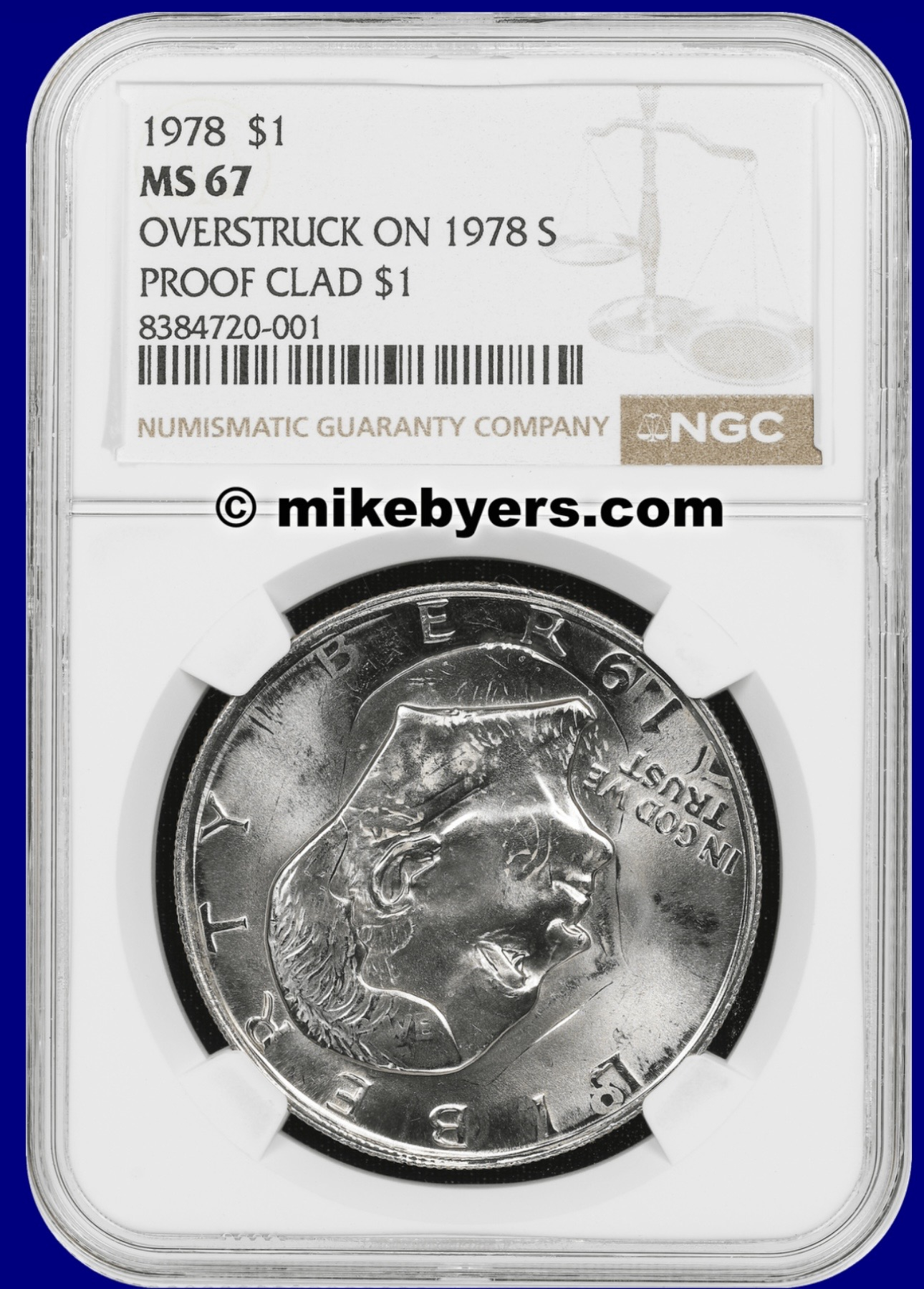
>
It’s often impossible to know if an error was intentional, so they really can’t go there.
Doggedly collecting coins of the Central American Republic.
Visit the Society of US Pattern Collectors at USPatterns.com.
Andy- I agree. That’s why I then posted the Ike Dollar from 2 Mints with 2 mintmarks.
There was also this "1861" Clark Gruber "fantasy" struck over an 1808 Irish silver piece. I would have bid more, but I knew that a friend of mine was bidding, so I dropped out rather than bid against them. It was struck by the same non-original dies as the other "fantasy" strikes of this item, and the same dies struck in gold passed as genuine coins for many years. Those normal gold strikes are now clearly identified as counterfeit and not "fantasy". It seems the dies have to be struck on something odd to be considered "fantasy".
https://coins.ha.com/itm/a/1341-4261.s
.
I disagree that @Rexford makes a convincing argument at all.
With the possible exception of some die over-polishing, everything shown in their posts and your post is consistent with the normal Quarter Eagle reverse hub of about 1881 to 1907. And some die over-polishing does not exclude authenticity. I have over-polished dies, made a test trike to two for study, and then discarded said dies.
Here is a genuine 1906 proof reverse with a little bit of over-polishing of the deeper feathers (between the legs and around the arrow feather):
Subject item above, for comparison.
.
I gotta say, this is the most interesting thread I’ve read in quite some time!
I hope Fred Weinberg posts some stories in here, too!
I look forward to coming back and seeing what is posted going forward from here…
My YouTube Channel
Another great example of a transfer strike.
Jack Klauson was getting more creative in his counterfeiting…
I will post a new story today. This one is about genuine Mint dies, taken out of the Mint, and were struck over struck coins. They were certified without the proper designation, since they were not struck inside the Mint. Eventually it was determined what exactly they were. (Yes, I handled these too).
Ok here is my next story.
Back in 2005 at a major coin show, I stopped at Tom Caldwell’s table (NorthEast Numismatics). I have known Tom for 40 years. He is very knowledgeable and a well liked and respected rare coin dealer.
He had displayed in his showcase a set of (9) different Paraguay overstrikes in gold, silver and copper, certified by NGC.
I purchased this set and it was the cover of Mint Error News way back in 2005.
Alot of new information eventually surfaced, which challenged whether these were pattern dies, and more importantly, established that these were struck a century later by a coin dealer. This means that these were private strikes from a genuine mint die.
This was new news to the numismatic community, the grading services and the auction houses.
These were Buenos Aires Mint unfinished dies, missing the last 2 digits of the date, taken out of the Mint A CENTURY LATER , and CLANDESTINELY struck over various gold, silver and copper coins.
The dies that were used could have been pattern dies but that is NOT definitive.
Paraguay struck this exact design as a pattern in 1888, but also struck a regular issued silver Peso, dated 1889 from this exact design.
Until it was discovered how these overstrikes came to be, it was widely accepted in the numismatic community that the Mint took an unfinished pattern die and struck it over struck coins, similiar to die trials.
Auction houses described these as pattern dies which is not definitive. And the TPG services certified these as struck over a (whatever the host coin was).
Later on, after the true origin of these came to light, auction houses still described them as restrikes, which may not be correct, but at least mention:
“An unofficial restrike from Pattern dies of the Bueno Aires mint, struck in the latter part of the 20th century.”
The TPG services need to identify these as ‘private strikes from genuine mint die’ on the inserts!
Once again, I must repeat that in my opinion PCGS and NGC do a wonderful job authenticating and grading. But occasionally mistakes are made.
https://minterrornews.com/
https://coins.ha.com/itm/paraguay/paraguay-republic-gold-pattern-peso-18-/a/3009-22469.s
Considering that they were struck 100 years after the creation of the dies, and that they were not officially sanctioned by the government in any way, does it really matter where they were struck? I mean, why should we care if they were struck in the mint by a rogue employee, or struck outside of the mint by a friend of a rogue mint (or museum) employee?
Doggedly collecting coins of the Central American Republic.
Visit the Society of US Pattern Collectors at USPatterns.com.
Andy… it makes a HUGE difference in my opinion. Some of my customers only want coins struck INSIDE the Mint, whether it’s a restrike, or a mint error ( accidentally or made intentionally) or a piece de caprice.
It’s not 100 years later as in your example. But I highly doubt that if the ‘rogue employee’ had struck the 1913 Liberty Head Nickels in his basement with a Mint die, instead of striking them INSIDE the Mint, they would be worth anywhere near the millions that they realize.
It’s not 100 years later, and it isn’t even a coin, but even PCGS made a point saying that this electotype was said to be made at the Mint!
And even put it on the insert!
It makes a huge difference if it is a Mint product!
Not a fair analogy. The Paraguay “fantasy pieces” were struck a century after the dies were meant to be used. The 1913 Nickels were struck in 1913. For something more realistic, think about if this hub was used now to produce some 1964 Morgan Dollars.
Doggedly collecting coins of the Central American Republic.
Visit the Society of US Pattern Collectors at USPatterns.com.
Andy- this is my thread so my analogy is ok. Lol
2025 strikes from a 1964 hub?
Were these:
Struck inside the Mint officially and offered for sale publicly?
Struck by a midnight minter, unauthorized and taken out of the Mint?
The hub removed from the Mint and someone struck some on silver round blanks in their garage?
Up to you. Like you said, it’s your thread!
Doggedly collecting coins of the Central American Republic.
Visit the Society of US Pattern Collectors at USPatterns.com.
“Said to be…” is not a confidence instilling phrase when it comes to matters of authenticity.
Doggedly collecting coins of the Central American Republic.
Visit the Society of US Pattern Collectors at USPatterns.com.
All kidding put aside, regardless of where and how they were struck, having a closer connection to the Mint can’t hurt.
Here is an exonumia overstrike made at the same time as the original exonumia striking (as shown by the date at which both the original Elder medals and various overstrikes appeared in Elder's auction catalogues.)
Had to own it because my first great collection was of coins from Honduras and my second great collection was of Thomas Elder tokens and medals. Now, several Elder dies from this era are still extant. If I could just get the owner of the dies to overstrike a 1922-D cent for me, I could die a happy man!
Very cool!!
Speaking of overstrikes involving 2 countries, years apart, different denominations, intentionally made and certified, here is a Mexico 1916 Oaxaca Gold 60 Pesos struck on a U.S. $10 Liberty (1838-1907).
The 1916 Gold 60 Pesos were struck in Oaxaca, Mexico and are extremely rare. The original dies for the 1916 60 Pesos were impounded at the ANS over a century ago.
Chalk me up as another fan of this topic, great stories!
I bought this knowing what it was, but I think it’s such a neat design in gold. This one is struck over a Rosas 2 escudos from Argentina.
Could have been something after 1913. Never really thought about it.
Doggedly collecting coins of the Central American Republic.
Visit the Society of US Pattern Collectors at USPatterns.com.
I have always wondered if this illustrious individual also concocted this unique rarity. A couple of my associates looked into it but hit a brick wall. Since he advertised the 1913 Nickels, he likely would have done the same with this gold Buffalo. It belonged to one family for over a century undiscovered. So unlikely that they are connected.
.
>
Interesting
This was the Samuel Brown ad in the Dec 1919 Numismatist
OMG ... My Mother was Right about Everything!
I wake up with a Good Attitude Every Day. Then … Idiots Happen!
Considering when Brown left his position at the Mint, I think we can safely say the 1913 Nickels were struck in 1913.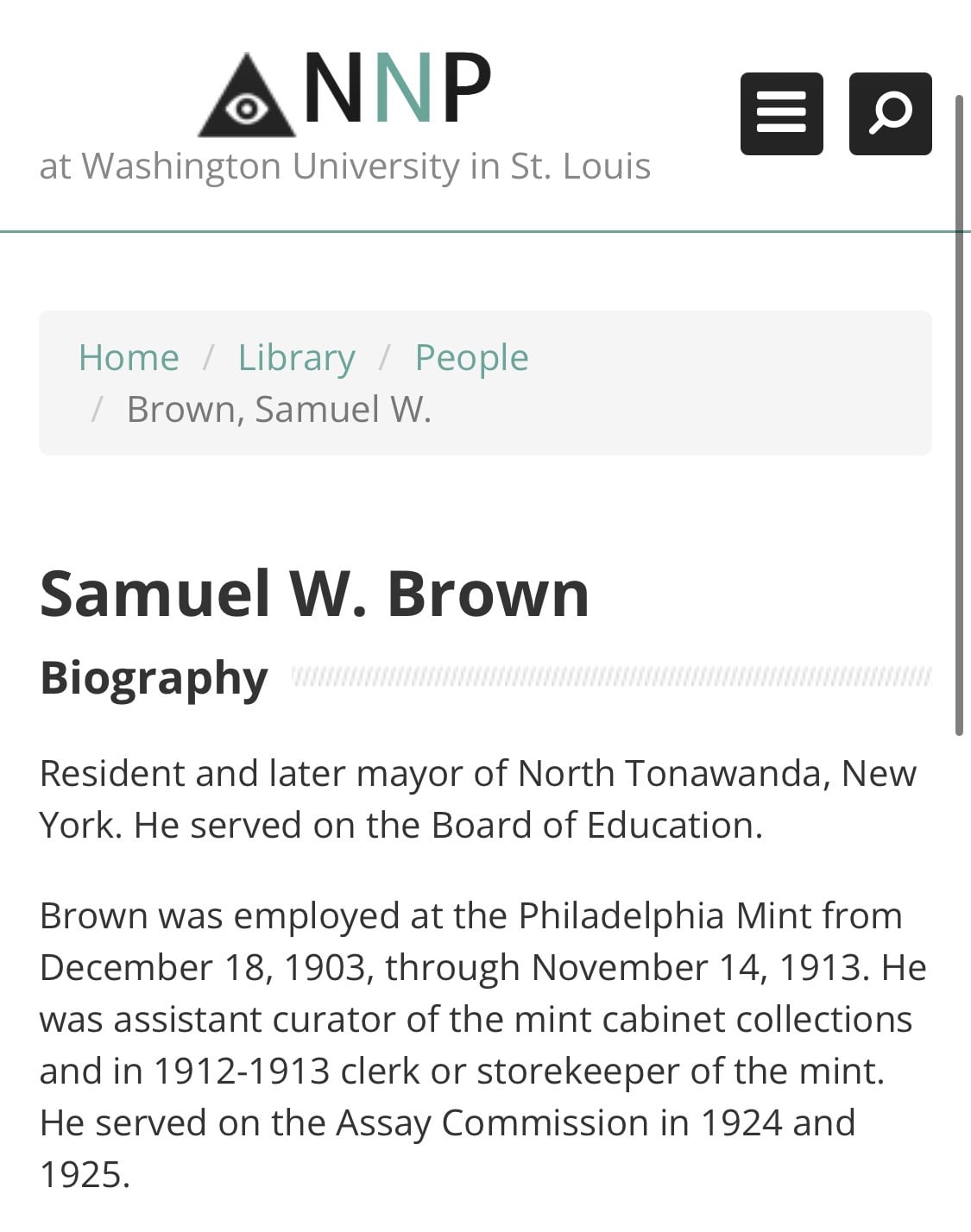
Doggedly collecting coins of the Central American Republic.
Visit the Society of US Pattern Collectors at USPatterns.com.
I recall @FredWeinberg posted something like:
Fred had unique opportunity for a hands examination of up to five 1913 V nickels and determined the ones he looked at shared same collar die marker, thus he decided those in hand were struck at same point in time. I do not recall what this specific collar marker was but he seemed satisfied with his conclusion.
Personally I would assume they were struck in 1913 as that's where eventual 1919 owner/seller of all 5 worked at in 1913 era Philly Mint.
Mint die production access is key, deep pocket numismatists in Philly were the goal. Use an obverse die with 191 and add the fourth number, the 3. Then load it in press and stamp out 5. Then go find a new job. So many fun things were created at Philly in 1860s for collectors, so there was a history of shenanigans for profit to look back on. I think all five remained together after that transaction.
Happy Monday Fred !
Probably, but we cannot rule out very late 1912.
I remember that story as well
Lindy, I was able to hold three of them that were raw – the other two were in PCGS holders at the time.
I aligned them so that they were all in the same position and then I checked the plain edge and found what I have always called “ballistic“ lines, which are fine vertical lines in the collar that will sometimes show up on a struck plain edge coin – and they did, on all three pieces in exactly the same position, showing that they were struck at the same time in the same collar.
One of the raw pieces was the Smithsonian specimen, and I’ll never forget the two large guards that were standing behind me as I held their coin with the others raw in my hand – these guys were so big they made NFL lineman look like petite ballerinas….
The collar for the 1913 Liberty Head Nickel was a 3 part segmented collar. There were 3 raised collar marks equidistance from eachother. All of the 1913 Liberty Head Nickels had these collar marks, which helped to authenticate the ‘missing’ coin and helped authenticate all of them being struck at the same time. Fred would have a better story/account/explanation since he viewed them all together.
Did your gold Buffalo have similar markings?
Doggedly collecting coins of the Central American Republic.
Visit the Society of US Pattern Collectors at USPatterns.com.