@Byers said:
And the lowest price realized was $1880. in a Heritage Auction for a environmentally damaged coin.
It says "Stk on Pre 1983 CU Plan" and doesn't say "Bronze" and weight is not declared.
Jmlanzaf beat me to it:
The words mean the same thing. CU is "copper" and "transitional wrong plan" means it's a pre-1983 bronze (copper) planchet.
It is a transitional Cent and sold for $1880. in Heritage.
Yours is damaged (scratched) and the one that sold for $1880. is damaged (environmental damage).
(That is IF yours turns out to be a transitional).
Selling rare coins is always a lottery. As Ecclesiastes said : "Time and chance." Therefore, the sole proof—and the answer to all questions—will be the final sale price at the close of bidding.
I think so. Selling a rare coin at auction can feel like a lottery because the final price depends on who shows up and how they compete in that moment, but unlike a true lottery, the outcome can be influenced by factors such as the coin’s quality, grading, presentation, and choice of platform—making it a market with elements of chance rather than pure randomness.
I wonder if the scratch was someone else' attempt at seeing if there was zinc under that plating. Just for some anecdotal evidence I scratched a 2021 Lincoln to about the same depth based on the OP photos, and I can clearly see silver color showing in the scratch. Granted if the OP coin had extra heavy plating, the scratch may have not made it into the zinc.
Need a Barber Half with ANACS photo certificate. If you have one for sale please PM me. Current Ebay auctions
PCGS confirmed that the delay is related to imaging backlog. They are currently processing images and the cert should be available once that’s completed.
@CoinOM said:
PCGS confirmed that the delay is related to imaging backlog. They are currently processing images and the cert should be available once that’s completed.
I don't doubt that they told you that. The front of the line customer service are notoriously clueless. By design; they are nice enough people for the most part but they are kept in the dark on purpose.
However, you have been lied to, intentionally or not. Your cert WAS live and now no longer is; this is not an imaging process issue.
In this thread and the similar 2017 2.87 oddity I have learned transitionals are not verified with specific gravity unless a $299 fee is paid.
What ???
Seriously, I did not know that !
Authentication without actual verifications is a bit of plastic fantastic word salad.
Lots of bucks to pay for an error yet it's something that's not fully certified.
I own zero USA transitionals and I NOW will never buy one unless its on the label verified with a $299 specific gravity test. No SG included means hard pass for me.
How can I tell if Slab coin has had an additional $299 SG Fee paid for 100% authentication ???
@CoinOM said:
PCGS confirmed that the delay is related to imaging backlog. They are currently processing images and the cert should be available once that’s completed.
I don't doubt that they told you that. The front of the line customer service are notoriously clueless. By design; they are nice enough people for the most part but they are kept in the dark on purpose.
However, you have been lied to, intentionally or not. Your cert WAS live and now no longer is; this is not an imaging process issue.
@CoinOM said:
PCGS confirmed that the delay is related to imaging backlog. They are currently processing images and the cert should be available once that’s completed.
I don't doubt that they told you that. The front of the line customer service are notoriously clueless. By design; they are nice enough people for the most part but they are kept in the dark on purpose.
However, you have been lied to, intentionally or not. Your cert WAS live and now no longer is; this is not an imaging process issue.
I appreciate you sharing the image — that’s actually helpful.
At this point, I’m not making any assumptions about the cause. I did receive a response from PCGS stating that their imaging team is currently behind, and I’ve followed up with them for clarification specifically regarding the cert visibility.
You’re absolutely right that the images were previously accessible, and that’s part of what I’m trying to understand as well. For now, I think the most reasonable approach is to wait for a direct response from PCGS rather than speculate on whether it’s a system issue, an update in progress, or something else.
Either way, the coin exists in a PCGS holder with a valid certification number, and I’ll share any official update once I receive it.
Either way, the coin exists in a PCGS holder with a valid certification number, and I’ll share any official update once I receive it.
I'm not sure why you keep saying it has a valid cert number when others have said it is no longer active.
In any case, time will tell. I suspect there is possibly a raging internal debate going on.
My guess, and this might just be the pessimistic side of me showing through, is that any "raging internal debate going on" would have to do with what is cheaper and easier; either do proper coinage testing of anything remotely questionable or take the hit in numismatic reputation and public relations by punting grossly questionable decisions. Remember, PCGS is in this to make money.
In this thread and the similar 2017 2.87 oddity I have learned transitionals are not verified with specific gravity unless a $299 fee is paid.
What ???
Seriously, I did not know that !
Authentication without actual verifications is a bit of plastic fantastic word salad.
Lots of bucks to pay for an error yet it's something that's not fully certified.
I own zero USA transitionals and I NOW will never buy one unless its on the label verified with a $299 specific gravity test. No SG included means hard pass for me.
How can I tell if Slab coin has had an additional $299 SG Fee paid for 100% authentication ???
$299 is for the XRF (x-ray) test. a specific gravity test is just weighing the thing in water and out of water
after all of this, it is easy to say what needs to be done, but a lot of people would have looked at it and not thought to do a specific gravity test and to thinkeven an xrf would be good enough
after all of this we may need to do both as a matter of practice for wrong planchet errors. seems kind of extreme, but here we are
We will soon know (maybe), but the day may soon arrive when underweight bronze transitional errors will need to have heavily plated zinc planchet ruled out.
In this thread and the similar 2017 2.87 oddity I have learned transitionals are not verified with specific gravity unless a $299 fee is paid.
What ???
Seriously, I did not know that !
Authentication without actual verifications is a bit of plastic fantastic word salad.
Lots of bucks to pay for an error yet it's something that's not fully certified.
I own zero USA transitionals and I NOW will never buy one unless its on the label verified with a $299 specific gravity test. No SG included means hard pass for me.
How can I tell if Slab coin has had an additional $299 SG Fee paid for 100% authentication ???
$299 is for the XRF (x-ray) test. a specific gravity test is just weighing the thing in water and out of water
after all of this, it is easy to say what needs to be done, but a lot of people would have looked at it and not thought to do a specific gravity test and to thinkeven an xrf would be good enough
after all of this we may need to do both as a matter of practice for wrong planchet errors. seems kind of extreme, but here we are
I don't think we know what the $299 test is. They never said.
That would equate to $100 per second to test with the ray-gun. Extreme.
On the other hand, such as this coin - cracking it, testing it, and reholdering it would be a bit more reasonable.
Here’s something we learn in coin collecting 101. How to tell a copper from zinc cent
That being said, I ask the OP Did You Try This? And a yes or no will do. Be Truthful.
In this thread and the similar 2017 2.87 oddity I have learned transitionals are not verified with specific gravity unless a $299 fee is paid.
What ???
Seriously, I did not know that !
Authentication without actual verifications is a bit of plastic fantastic word salad.
Lots of bucks to pay for an error yet it's something that's not fully certified.
I own zero USA transitionals and I NOW will never buy one unless its on the label verified with a $299 specific gravity test. No SG included means hard pass for me.
How can I tell if Slab coin has had an additional $299 SG Fee paid for 100% authentication ???
$299 is for the XRF (x-ray) test. a specific gravity test is just weighing the thing in water and out of water
after all of this, it is easy to say what needs to be done, but a lot of people would have looked at it and not thought to do a specific gravity test and to thinkeven an xrf would be good enough
after all of this we may need to do both as a matter of practice for wrong planchet errors. seems kind of extreme, but here we are
I don't think we know what the $299 test is. They never said.
That would equate to $100 per second to test with the ray-gun. Extreme.
On the other hand, such as this coin - cracking it, testing it, and reholdering it would be a bit more reasonable.
Cracking and reholdering with the distinct possibility of a totally different (unmagical) description on the new label appearing? SG test is imperative otherwise the truth will never be known. Does this piece have a zinc core? That is the question to be answered.
“Never let yesterday use up too much of today.”
Will Rogers
In this thread and the similar 2017 2.87 oddity I have learned transitionals are not verified with specific gravity unless a $299 fee is paid.
What ???
Seriously, I did not know that !
Authentication without actual verifications is a bit of plastic fantastic word salad.
Lots of bucks to pay for an error yet it's something that's not fully certified.
I own zero USA transitionals and I NOW will never buy one unless its on the label verified with a $299 specific gravity test. No SG included means hard pass for me.
How can I tell if Slab coin has had an additional $299 SG Fee paid for 100% authentication ???
$299 is for the XRF (x-ray) test. a specific gravity test is just weighing the thing in water and out of water
after all of this, it is easy to say what needs to be done, but a lot of people would have looked at it and not thought to do a specific gravity test and to thinkeven an xrf would be good enough
after all of this we may need to do both as a matter of practice for wrong planchet errors. seems kind of extreme, but here we are
I don't think we know what the $299 test is. They never said.
That would equate to $100 per second to test with the ray-gun. Extreme.
On the other hand, such as this coin - cracking it, testing it, and reholdering it would be a bit more reasonable.
Cracking and reholdering with the distinct possibility of a totally different (unmagical) description on the new label appearing? SG test is imperative otherwise the truth will never be known. Does this piece have a zinc core? That is the question to be answered.
I didn't specify one test or the other, and the totally different (unmagical) description might be happening, given the cert is dead...
My guess, and this might just be the pessimistic side of me showing through, is that any "raging internal debate going on" would have to do with what is cheaper and easier; either do proper coinage testing of anything remotely questionable or take the hit in numismatic reputation and public relations by punting grossly questionable decisions. Remember, PCGS is in this to make money.
Excellent points. I'd only also state PCGS is also in this to find the truth.
Truth = credibility.
Credibility is what drives collectors and dealers to pay the submission fees.
One of my annoyances is when critical weight is not included on slab label. I've passed on slabbed errors due to missing information. There's no way I will ever buy a zinc cent era struck on a copper planchet without specific gravity confirmation on label. May have considered it before, but now, after the two recent threads, no way.
Most wrong planchet errors are easy to determine via weight & observation alone. Unless they reside in older non prong holders, without seeing coin's edge is another reason I pass on wrong planchet errors when available for sale.
In this thread and the similar 2017 2.87 oddity I have learned transitionals are not verified with specific gravity unless a $299 fee is paid.
What ???
Seriously, I did not know that !
Authentication without actual verifications is a bit of plastic fantastic word salad.
Lots of bucks to pay for an error yet it's something that's not fully certified.
I own zero USA transitionals and I NOW will never buy one unless its on the label verified with a $299 specific gravity test. No SG included means hard pass for me.
How can I tell if Slab coin has had an additional $299 SG Fee paid for 100% authentication ???
$299 is for the XRF (x-ray) test. a specific gravity test is just weighing the thing in water and out of water
after all of this, it is easy to say what needs to be done, but a lot of people would have looked at it and not thought to do a specific gravity test and to thinkeven an xrf would be good enough
after all of this we may need to do both as a matter of practice for wrong planchet errors. seems kind of extreme, but here we are
We didn't do it on all wrong planchet coins. Cents on dime planchets were easy if the weights were right and you could see the edge in clad years. Likewise nickels on cent planchets and quarters on nickel planchets.
I did do it if I thought that there might be a foreign planchet involved, and of course the wartime era off metals and a few 1942 brassy pieces that we never could reach a conclusion on.
Back at Collectors Clearinghouse we had in the discovery pieces of the 1974-D and 1977-D 40% silver Ikes. The weights were right for the 40% silver but I did the S.G.'s anyways. Ditto the 1976 No S 40% Silver Proof Variety Two Ike.
At ANACS I once used an SEM spectrographic analysis to confirm a Specific Gravity test. Somebody had sent in an alleged "Yoachum Dollar," purportedly a primitive local coinage made in the Ozark Mountains in the early 1820's from raw, unrefined native silver. My S.G. indicated Sterling Silver, and the SEM indicated something like .92499 Silver and .07501 Copper with ZERO trace elements. In other words, somebody could have melted down a few old sterling silver spoons for their source material for their hoax.
Professional Numismatist, Retired. 55 year member ANA. Former ANA Senior Authenticator. Winner of four ANA Heath Literary Awards; three Wayte and Olga Raymond Literary Awards; Numismatist of the Year Award 2009, and ANA Lifetime Achievement Award 2020. Winner of the PNG's 2026 Robert Friedberg Award for "The Enigmatic Lincoln Cents of 1922," Available now from Whitman or Amazon.
I found a short clip in my video folder where I filmed the thickness of this coin in comparison with a cent from the same year—but one with the standard composition of copper-plated zinc: https://www.youtube.com/shorts/kNF_VWn0KbI
@CoinOM said:
I found a short clip in my video folder where I filmed the thickness of this coin in comparison with a cent from the same year—but one with the standard composition of copper-plated zinc: https://www.youtube.com/shorts/kNF_VWn0KbI
That is a terrific video. Thanks for sharing. I watched it a few times, back-to-back.
(I'd recommend to anyone else, turn down the volume first. The soundtrack to this video is a bit disturbing.)
@CoinOM said:
I found a short clip in my video folder where I filmed the thickness of this coin in comparison with a cent from the same year—but one with the standard composition of copper-plated zinc: https://www.youtube.com/shorts/kNF_VWn0KbI
I assume the brighter one is the correct composition? If so, that video proves it's not a bronze planchet.
No, the other one is the coin we are talking about here.
@CoinOM said:
I found a short clip in my video folder where I filmed the thickness of this coin in comparison with a cent from the same year—but one with the standard composition of copper-plated zinc: https://www.youtube.com/shorts/kNF_VWn0KbI
I assume the brighter one is the correct composition? If so, that video proves it's not a bronze planchet.
No, the other one is the coin we are talking about here.
The top one?
It would be really useful to know which is which. Lol.
@CoinOM said:
I found a short clip in my video folder where I filmed the thickness of this coin in comparison with a cent from the same year—but one with the standard composition of copper-plated zinc: https://www.youtube.com/shorts/kNF_VWn0KbI
I assume the brighter one is the correct composition? If so, that video proves it's not a bronze planchet.
No, the other one is the coin we are talking about here.
The top one?
It would be really useful to know which is which. Lol.
The darkest one
Thank you for your patience on this thread.
I am suspicious there may be one or two among us that are toying with you and being disingenous.
(Not me.)
Here's to you continuing your quest in proving the naysayers wrong.
@CoinOM said:
I found a short clip in my video folder where I filmed the thickness of this coin in comparison with a cent from the same year—but one with the standard composition of copper-plated zinc: https://www.youtube.com/shorts/kNF_VWn0KbI
I assume the brighter one is the correct composition? If so, that video proves it's not a bronze planchet.
No, the other one is the coin we are talking about here.
The top one?
It would be really useful to know which is which. Lol.
The darkest one
Thank you for your patience on this thread.
I am suspicious there may be one or two among us that are toying with you and being disingenous.
(Not me.)
Here's to you continuing your quest in proving the naysayers wrong.
Perhaps. Nevertheless, I am grateful to everyone for the opinions expressed, because—as is well known—the form of an object is shaped by both light and shadow.
@CoinOM said:
I found a short clip in my video folder where I filmed the thickness of this coin in comparison with a cent from the same year—but one with the standard composition of copper-plated zinc: https://www.youtube.com/shorts/kNF_VWn0KbI
I assume the brighter one is the correct composition? If so, that video proves it's not a bronze planchet.
No, the other one is the coin we are talking about here.
The top one?
It would be really useful to know which is which. Lol.
The darkest one
Thank you for your patience on this thread.
I am suspicious there may be one or two among us that are toying with you and being disingenous.
(Not me.)
Here's to you continuing your quest in proving the naysayers wrong.
Perhaps. Nevertheless, I am grateful to everyone for the opinions expressed, because—as is well known—the form of an object is by both light and shadow.
@ambro51 said:
So…. care to answer the direct question —— Did You do the “ring test” on the coin? Yes or No will do. .Then we will proceed.
Works on silver, not copper.
Ok. You’re wrong. Summary
Yes, a zinc cent sounds different from a copper cent during the ring test.
Sound Characteristics
Copper Cents: When flipped or dropped, copper cents produce a higher-pitched, melodious ringing sound. This is due to their denser material composition.
Zinc Cents: In contrast, zinc cents emit a dull, flat sound, often described as a "thud" or "clunk" when they hit a hard surface
.
Testing Method
To perform the test, simply flip the coin or drop it onto a hard surface and listen for the sound. With practice, the difference becomes quite noticeable
.
Accuracy
While the sound test is effective, it is recommended to use multiple methods for accurate identification, such as weight comparisons
@ambro51 said:
So…. care to answer the direct question —— Did You do the “ring test” on the coin? Yes or No will do. .Then we will proceed.
Works on silver, not copper.
Ok. You’re wrong. Summary
Yes, a zinc cent sounds different from a copper cent during the ring test.
Sound Characteristics
Copper Cents: When flipped or dropped, copper cents produce a higher-pitched, melodious ringing sound. This is due to their denser material composition.
Zinc Cents: In contrast, zinc cents emit a dull, flat sound, often described as a "thud" or "clunk" when they hit a hard surface
.
Testing Method
To perform the test, simply flip the coin or drop it onto a hard surface and listen for the sound. With practice, the difference becomes quite noticeable
.
Accuracy
While the sound test is effective, it is recommended to use multiple methods for accurate identification, such as weight comparisons
@ambro51 said:
So…. care to answer the direct question —— Did You do the “ring test” on the coin? Yes or No will do. .Then we will proceed.
Works on silver, not copper.
Ok. You’re wrong. Summary
Yes, a zinc cent sounds different from a copper cent during the ring test.
Sound Characteristics
Copper Cents: When flipped or dropped, copper cents produce a higher-pitched, melodious ringing sound. This is due to their denser material composition.
Zinc Cents: In contrast, zinc cents emit a dull, flat sound, often described as a "thud" or "clunk" when they hit a hard surface
.
Testing Method
To perform the test, simply flip the coin or drop it onto a hard surface and listen for the sound. With practice, the difference becomes quite noticeable
.
Accuracy
While the sound test is effective, it is recommended to use multiple methods for accurate identification, such as weight comparisons
@ambro51 said:
So…. care to answer the direct question —— Did You do the “ring test” on the coin? Yes or No will do. .Then we will proceed.
Works on silver, not copper.
Ok. You’re wrong. Summary
Yes, a zinc cent sounds different from a copper cent during the ring test.
Sound Characteristics
Copper Cents: When flipped or dropped, copper cents produce a higher-pitched, melodious ringing sound. This is due to their denser material composition.
Zinc Cents: In contrast, zinc cents emit a dull, flat sound, often described as a "thud" or "clunk" when they hit a hard surface
.
Testing Method
To perform the test, simply flip the coin or drop it onto a hard surface and listen for the sound. With practice, the difference becomes quite noticeable
.
Accuracy
While the sound test is effective, it is recommended to use multiple methods for accurate identification, such as weight comparisons
We will have to agree to disagree.
NO. This is a FACT.
Your "facts" (read: speculation)
There are other more accurate interpretations.
@ambro51 said:
So…. care to answer the direct question —— Did You do the “ring test” on the coin? Yes or No will do. .Then we will proceed.
Works on silver, not copper.
Ok. You’re wrong. Summary
Yes, a zinc cent sounds different from a copper cent during the ring test.
Sound Characteristics
Copper Cents: When flipped or dropped, copper cents produce a higher-pitched, melodious ringing sound. This is due to their denser material composition.
Zinc Cents: In contrast, zinc cents emit a dull, flat sound, often described as a "thud" or "clunk" when they hit a hard surface
.
Testing Method
To perform the test, simply flip the coin or drop it onto a hard surface and listen for the sound. With practice, the difference becomes quite noticeable
.
Accuracy
While the sound test is effective, it is recommended to use multiple methods for accurate identification, such as weight comparisons
We will have to agree to disagree.
You have, simultaneously, the most agrees and the most disagrees
Even with copper plating a zincoln is going to make a dull thud when dropped onto a hard surface such as a glass tabletop. It's a fact. One could even do this test scientifically using an oscilloscope to see the difference in the audio waveform made, bronze (3.1g) vs. zinc core (2.5g).
“Never let yesterday use up too much of today.”
Will Rogers
A drop test might be somewhat effective but might also be damaging to the coin.
A short drop of a small coin on a moderately hard surface might not be much of an issue, but at some point someone will take the advice and drop a heavy gold coin from chest high onto a granite floor. 😬
There are less risky tests that are more definitive.
@JBK said:
A drop test might be somewhat effective but might also be damaging to the coin.
A short drop of a small coin on a moderately hard surface might not be much of an issue, but at some point someone will take the advice and drop a heavy gold coin from chest high onto a granite floor. 😬
There are less risky tests that are more definitive.
Having firsthand experience, a Drop Test can also damage the PCGS slab.
Your photo of a goldfish reminds me of winning one once at a carnival as a kid. Sadly, it didn't live long enough to make it home.
A tough lesson for an eight year old.
I could have done a sound test. This will be a lesson for me. Next time, I’ll record more video tests—or, at any rate, everything I can manage to do on my own.
Comments
Selling rare coins is always a lottery. As Ecclesiastes said : "Time and chance." Therefore, the sole proof—and the answer to all questions—will be the final sale price at the close of bidding.
Selling by auction is a lottery?
I think so. Selling a rare coin at auction can feel like a lottery because the final price depends on who shows up and how they compete in that moment, but unlike a true lottery, the outcome can be influenced by factors such as the coin’s quality, grading, presentation, and choice of platform—making it a market with elements of chance rather than pure randomness.
I wonder if the scratch was someone else' attempt at seeing if there was zinc under that plating. Just for some anecdotal evidence I scratched a 2021 Lincoln to about the same depth based on the OP photos, and I can clearly see silver color showing in the scratch. Granted if the OP coin had extra heavy plating, the scratch may have not made it into the zinc.
PCGS confirmed that the delay is related to imaging backlog. They are currently processing images and the cert should be available once that’s completed.
I don't doubt that they told you that. The front of the line customer service are notoriously clueless. By design; they are nice enough people for the most part but they are kept in the dark on purpose.
However, you have been lied to, intentionally or not. Your cert WAS live and now no longer is; this is not an imaging process issue.
Additionally, the trueview is still live, there is no imaging backlog relating to your coin. Here it is -> https://d1htnxwo4o0jhw.cloudfront.net/cert/193746278/KP9ArgupvU6VUl_dqMAbVA.jpg
chopmarkedtradedollars.com
Awesome imagery @lermish ! Thank You Very Much !
In this thread and the similar 2017 2.87 oddity I have learned transitionals are not verified with specific gravity unless a $299 fee is paid.
What ???
Seriously, I did not know that !
Authentication without actual verifications is a bit of plastic fantastic word salad.
Lots of bucks to pay for an error yet it's something that's not fully certified.
I own zero USA transitionals and I NOW will never buy one unless its on the label verified with a $299 specific gravity test. No SG included means hard pass for me.
How can I tell if Slab coin has had an additional $299 SG Fee paid for 100% authentication ???
Happy Friday !
Lindy
I appreciate you sharing the image — that’s actually helpful.
At this point, I’m not making any assumptions about the cause. I did receive a response from PCGS stating that their imaging team is currently behind, and I’ve followed up with them for clarification specifically regarding the cert visibility.
You’re absolutely right that the images were previously accessible, and that’s part of what I’m trying to understand as well. For now, I think the most reasonable approach is to wait for a direct response from PCGS rather than speculate on whether it’s a system issue, an update in progress, or something else.
Either way, the coin exists in a PCGS holder with a valid certification number, and I’ll share any official update once I receive it.
I'm not sure why you keep saying it has a valid cert number when others have said it is no longer active.
In any case, time will tell. I suspect there is possibly a raging internal debate going on.
My guess, and this might just be the pessimistic side of me showing through, is that any "raging internal debate going on" would have to do with what is cheaper and easier; either do proper coinage testing of anything remotely questionable or take the hit in numismatic reputation and public relations by punting grossly questionable decisions. Remember, PCGS is in this to make money.
In honor of the memory of Cpl. Michael E. Thompson
$299 is for the XRF (x-ray) test. a specific gravity test is just weighing the thing in water and out of water
after all of this, it is easy to say what needs to be done, but a lot of people would have looked at it and not thought to do a specific gravity test and to thinkeven an xrf would be good enough
after all of this we may need to do both as a matter of practice for wrong planchet errors. seems kind of extreme, but here we are
We will soon know (maybe), but the day may soon arrive when underweight bronze transitional errors will need to have heavily plated zinc planchet ruled out.
That would equate to $100 per second to test with the ray-gun. Extreme.
On the other hand, such as this coin - cracking it, testing it, and reholdering it would be a bit more reasonable.
Here’s something we learn in coin collecting 101. How to tell a copper from zinc cent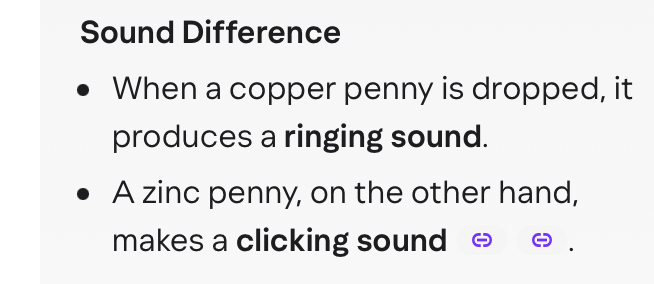
That being said, I ask the OP Did You Try This? And a yes or no will do. Be Truthful.
Cracking and reholdering with the distinct possibility of a totally different (unmagical) description on the new label appearing? SG test is imperative otherwise the truth will never be known. Does this piece have a zinc core? That is the question to be answered.
“Never let yesterday use up too much of today.”
Will Rogers
I didn't specify one test or the other, and the totally different (unmagical) description might be happening, given the cert is dead...
Excellent points. I'd only also state PCGS is also in this to find the truth.
Truth = credibility.
Credibility is what drives collectors and dealers to pay the submission fees.
One of my annoyances is when critical weight is not included on slab label. I've passed on slabbed errors due to missing information. There's no way I will ever buy a zinc cent era struck on a copper planchet without specific gravity confirmation on label. May have considered it before, but now, after the two recent threads, no way.
Most wrong planchet errors are easy to determine via weight & observation alone. Unless they reside in older non prong holders, without seeing coin's edge is another reason I pass on wrong planchet errors when available for sale.
We didn't do it on all wrong planchet coins. Cents on dime planchets were easy if the weights were right and you could see the edge in clad years. Likewise nickels on cent planchets and quarters on nickel planchets.
I did do it if I thought that there might be a foreign planchet involved, and of course the wartime era off metals and a few 1942 brassy pieces that we never could reach a conclusion on.
Back at Collectors Clearinghouse we had in the discovery pieces of the 1974-D and 1977-D 40% silver Ikes. The weights were right for the 40% silver but I did the S.G.'s anyways. Ditto the 1976 No S 40% Silver Proof Variety Two Ike.
At ANACS I once used an SEM spectrographic analysis to confirm a Specific Gravity test. Somebody had sent in an alleged "Yoachum Dollar," purportedly a primitive local coinage made in the Ozark Mountains in the early 1820's from raw, unrefined native silver. My S.G. indicated Sterling Silver, and the SEM indicated something like .92499 Silver and .07501 Copper with ZERO trace elements. In other words, somebody could have melted down a few old sterling silver spoons for their source material for their hoax.
I found a short clip in my video folder where I filmed the thickness of this coin in comparison with a cent from the same year—but one with the standard composition of copper-plated zinc:
https://www.youtube.com/shorts/kNF_VWn0KbI
That is a terrific video. Thanks for sharing. I watched it a few times, back-to-back.
(I'd recommend to anyone else, turn down the volume first. The soundtrack to this video is a bit disturbing.)
@CoinOM
You have created more videos than you have followers.
Fingers crossed this thread turns those stats around.
No, the other one is the coin we are talking about here.
Thanks, I love what I'm doing. .
The darkest one
Thank you for your patience on this thread.
I am suspicious there may be one or two among us that are toying with you and being disingenous.
(Not me.)
Here's to you continuing your quest in proving the naysayers wrong.
Perhaps. Nevertheless, I am grateful to everyone for the opinions expressed, because—as is well known—the form of an object is shaped by both light and shadow.
Standing by for @jmlanzaf rebuttal...
So…. care to answer the direct question —— Did You do the “ring test” on the coin? Yes or No will do. .Then we will proceed.
Works on silver, not copper.
NO
Ok. You’re wrong. Summary
Yes, a zinc cent sounds different from a copper cent during the ring test.
Sound Characteristics
Copper Cents: When flipped or dropped, copper cents produce a higher-pitched, melodious ringing sound. This is due to their denser material composition.
Zinc Cents: In contrast, zinc cents emit a dull, flat sound, often described as a "thud" or "clunk" when they hit a hard surface
.
Testing Method
To perform the test, simply flip the coin or drop it onto a hard surface and listen for the sound. With practice, the difference becomes quite noticeable
.
Accuracy
While the sound test is effective, it is recommended to use multiple methods for accurate identification, such as weight comparisons
We will have to agree to disagree.
NO. This is a FACT.
Your "facts" (read: speculation)
There are other more accurate interpretations.
I know.
I've got to work on that.
Even with copper plating a zincoln is going to make a dull thud when dropped onto a hard surface such as a glass tabletop. It's a fact. One could even do this test scientifically using an oscilloscope to see the difference in the audio waveform made, bronze (3.1g) vs. zinc core (2.5g).
“Never let yesterday use up too much of today.”
Will Rogers
A drop test might be somewhat effective but might also be damaging to the coin.
A short drop of a small coin on a moderately hard surface might not be much of an issue, but at some point someone will take the advice and drop a heavy gold coin from chest high onto a granite floor. 😬
There are less risky tests that are more definitive.
Having firsthand experience, a Drop Test can also damage the PCGS slab.
Your photo of a goldfish reminds me of winning one once at a carnival as a kid. Sadly, it didn't live long enough to make it home.
A tough lesson for an eight year old.
I could have done a sound test. This will be a lesson for me. Next time, I’ll record more video tests—or, at any rate, everything I can manage to do on my own.