$299 fee for metals composition test is a bargain. Sounds like the technology allows for tests much more sophisticated than a specific gravity test or doing the s.g.test without having to immerse the piece in water. Win-Win. My advise is to go for it.
"Two things are infinite: human stupidity and the universe; and I'm not sure about the universe."
-Albert Einstein-
Mistakes are natural. But repeated mistakes without reflection are something else. That may be the “stupidity” he was referring to. In research, he admitted uncertainty openly. “If we knew what it was we were doing, it would not be called research, would it?” This shows humility. Even a Nobel laureate accepted doubt. That humility makes the quote less cynical and more observational.
@mr1931S said:
$299 fee for metals composition test is a bargain. Sounds like the technology allows for tests much more sophisticated than a specific gravity test or doing the s.g.test without having to immerse the piece in water. Win-Win. My advise is to go for it.
How much does the piece weigh? 2.87g(PCGS)? I've seen a couple weight numbers from the OP?
2.9 and most recently 3? Can't be both. In any event, the piece has to come out of it's holder to do any further tests on it.
"Two things are infinite: human stupidity and the universe; and I'm not sure about the universe."
-Albert Einstein-
Mistakes are natural. But repeated mistakes without reflection are something else. That may be the “stupidity” he was referring to. In research, he admitted uncertainty openly. “If we knew what it was we were doing, it would not be called research, would it?” This shows humility. Even a Nobel laureate accepted doubt. That humility makes the quote less cynical and more observational.
Unanswered questions remain that a test could answer, but there is too much downside so let's get it to auction! 🤑🤑🤑
I sent request to PCGS and they replied with: "Looking over order, we do not see that you requested the metal composition test.
If you would like that information, you are welcome to resubmit the item and request the metal composition test, which will be a $299 service fee."
Serious question. Do they offer a specific gravity test where they take it out of the holder, do the specific gravity and then reholder it?
Professional Numismatist, Retired. 55 year member ANA. Former ANA Senior Authenticator. Winner of four ANA Heath Literary Awards; three Wayte and Olga Raymond Literary Awards; Numismatist of the Year Award 2009, and ANA Lifetime Achievement Award 2020. Winner of the PNG's 2026 Robert Friedberg Award for "The Enigmatic Lincoln Cents of 1922," Available now from Whitman or Amazon.
@mr1931S said:
$299 fee for metals composition test is a bargain. Sounds like the technology allows for tests much more sophisticated than a specific gravity test or doing the s.g.test without having to immerse the piece in water. Win-Win. My advise is to go for it.
A metals composition test tests the composition at the SURFACE (and some microscopic depth). Since there is no question that the surface is copper, that would not have much value.
A specific gravity test evaluates the entire object to its center. The specific gravity of copper is very different from the specific gravity of zinc and would be the definitive test for whether a possibly-zinc is in fact copper throughout.
(I'm just restating what many people have already said)
@mr1931S said:
$299 fee for metals composition test is a bargain. Sounds like the technology allows for tests much more sophisticated than a specific gravity test or doing the s.g.test without having to immerse the piece in water. Win-Win. My advise is to go for it.
A metals composition test tests the composition at the SURFACE (and some microscopic depth). Since there is no question that the surface is copper, that would not have much value.
A specific gravity test evaluates the entire object to its center. The specific gravity of copper is very different from the specific gravity of zinc and would be the definitive test for whether a possibly-zinc is in fact copper throughout.
(I'm just restating what many people have already said)
To be fair, I wouldn't equate "metal composition test" with "XRF testing". While that is the most common non-destructive test, it isn't the only one. Especially if the only question is whether it is plated or not, I think you could do eddy current testing, for example. At $299, I'm not sure they are doing XRF which would be much cheaper.
All comments reflect the opinion of the author, even when irrefutably accurate.
This and the other one like it (2.87grams) are The Hot Potato Misattributed "underweight copper transitional" in a PCGS Slab.
Who will pay out the guarantee when reality strikes ?
Seller, the submitter will get the home run, while encapsulation will owe those reimbursements to the unlucky buyer.
Embarrassing ? Learn & move along. I learned about this whole situation without dropping a Dime.
Facebook is loaded up with endless clickbait nonsense error coins.
I never click that bait.
I read that clicks alone equal dollars for the content creators.
I see the birth of another clicity~boo since it slipped thru the gauntlet of the informed numismatists and got the plastic fantastic seal of approval. Then someone who has relied on others to know better will then compensate unlucky buyer. And all laid out in the open by the submitter/consigner of the odd duck to Heritage lot in this thread.
Heritage has pulled offers I followed over the years. Just the other day I followed a 1964 5c on 1c slabbed as 1984 copper cent in an auction that got pulled a few days ago, #54103. That was obvious nonsense but I never posted about it. Nice to see there are safeguards in place.
No home run transaction on this odd duck has occurred, yet.
Well, at least there is NO debate about THIS 1990D Lincoln Cent. It’s struck on a 3.1G COPPER Cent planchet!
mikebyers.com Dealer in Major Mint Errors, Die Trials & Patterns - Author of NLG Best World Coin Book World's Greatest Mint Errors - Publisher & Editor of minterrornews.com.
mikebyers.com Dealer in Major Mint Errors, Die Trials & Patterns - Author of NLG Best World Coin Book World's Greatest Mint Errors - Publisher & Editor of minterrornews.com.
@mr1931S said:
$299 fee for metals composition test is a bargain. Sounds like the technology allows for tests much more sophisticated than a specific gravity test or doing the s.g.test without having to immerse the piece in water. Win-Win. My advise is to go for it.
A metals composition test tests the composition at the SURFACE (and some microscopic depth). Since there is no question that the surface is copper, that would not have much value.
A specific gravity test evaluates the entire object to its center. The specific gravity of copper is very different from the specific gravity of zinc and would be the definitive test for whether a possibly-zinc is in fact copper throughout.
(I'm just restating what many people have already said)
To be fair, I wouldn't equate "metal composition test" with "XRF testing". While that is the most common non-destructive test, it isn't the only one. Especially if the only question is whether it is plated or not, I think you could do eddy current testing, for example. At $299, I'm not sure they are doing XRF which would be much cheaper.
Certainly PCGS could do other types of testing. I don't see anything that says that they actually do.
NGC charges $150 for Metallurgic Analysis. That's less than quoted by PCGS, but in the same ballpark.
It's a separate question whether either of those prices are reasonable. Winston Zack @BadMetal charges $5 (or less) per scan, see https://www.badmetalcoin.com/shop?Category=XRF%20Analysis. At $5 per scan, I'm very happy with his service. At $150-$300, I'm not going to find out if I'm happy with services elsewhere.
But that does not tell you the density, which can tell you if it has a zinc core or not.
Professional Numismatist, Retired. 55 year member ANA. Former ANA Senior Authenticator. Winner of four ANA Heath Literary Awards; three Wayte and Olga Raymond Literary Awards; Numismatist of the Year Award 2009, and ANA Lifetime Achievement Award 2020. Winner of the PNG's 2026 Robert Friedberg Award for "The Enigmatic Lincoln Cents of 1922," Available now from Whitman or Amazon.
@CoinOM said:
I WANTED TO SHARE AN INTERESTING EXPERIENCE AND GET SOME OPINIONS FROM THE COMMUNITY.
While doing a routine search through Lincoln cents (something I often record on my YouTube channel), I came across a 1983 cent that immediately caught my attention.
The first thing that stood out was the weight: about 2.87 grams.
As most collectors know, normal 1983 cents are copper-plated zinc and should weigh about 2.5 grams. The coin also had a noticeable granular texture on the reverse, which made me suspect something unusual about the metal.
Naturally, I decided to submit the coin for grading.
First submission: Numismatic Guaranty Company (NGC).
The coin came back labeled UNC Details – Obverse Scratched, with no mint error attribution. When I followed up with them, they explained that based on their standards the coin did not qualify as a mint error.
However, the weight and appearance still seemed unusual to me, so I decided to try a second opinion.
I submitted the coin to Professional Coin Grading Service (PCGS).
After their review, PCGS certified the coin as:
Lincoln Cent – Defective Bronze Planchet (AU Details)
So essentially the two major grading services reached different conclusions about the same coin.
I’m not posting this to criticize either company — grading and error attribution can be complex, especially with unusual metal anomalies. But I thought this case was interesting and worth sharing with other collectors.
A couple questions for the community:
• Have you ever had a coin where NGC and PCGS reached different conclusions?
• If one grading service does not attribute an error, do you ever try resubmitting it elsewhere?
• And what do you think could explain the 2.87 g weight on a 1983 cent?
Looking forward to hearing your thoughts.
interestingly enough, ngc recognizes minor defects on their labels moreso than pcgs. a small grease filled die or strike-through can be obvious on the coin but if small, it won't be on a pcgs error label
curious if the weight is withing tolerances for zincoln planchets
Pure water is the standard of density at 1.0. One cubic centimeter weighs 1 gram. Copper is 8.92 times as dense as water so 1 cc of copper weighs 8.92 grams. Silver 10.49, etc.
Water buoys up an object and reduces its weight by the weight of the water it displaces. Weigh an item dry, then weigh it suspended in water, and subtract the wet weight from the dry weight. The difference is the weight of the water which at a density of 1.0 is also the volume. Divide that back into the dry weight and you have the density of the object.
Professional Numismatist, Retired. 55 year member ANA. Former ANA Senior Authenticator. Winner of four ANA Heath Literary Awards; three Wayte and Olga Raymond Literary Awards; Numismatist of the Year Award 2009, and ANA Lifetime Achievement Award 2020. Winner of the PNG's 2026 Robert Friedberg Award for "The Enigmatic Lincoln Cents of 1922," Available now from Whitman or Amazon.
The density of zinc is only 7.14, so a zinc core with a heavy copper plating might average out around 7.4 - 7.5, well under the 8.89 or so of a 95% copper planchet.
Professional Numismatist, Retired. 55 year member ANA. Former ANA Senior Authenticator. Winner of four ANA Heath Literary Awards; three Wayte and Olga Raymond Literary Awards; Numismatist of the Year Award 2009, and ANA Lifetime Achievement Award 2020. Winner of the PNG's 2026 Robert Friedberg Award for "The Enigmatic Lincoln Cents of 1922," Available now from Whitman or Amazon.
Pure water is the standard of density at 1.0. One cubic centimeter weighs 1 gram. Copper is 8.92 times as dense as water so 1 cc of copper weighs 8.92 grams. Silver 10.49, etc.
Water buoys up an object and reduces its weight by the weight of the water it displaces. Weigh an item dry, then weigh it suspended in water, and subtract the wet weight from the dry weight. The difference is the weight of the water which at a density of 1.0 is also the volume. Divide that back into the dry weight and you have the density of the object.
@mr1931S said:
$299 fee for metals composition test is a bargain. Sounds like the technology allows for tests much more sophisticated than a specific gravity test or doing the s.g.test without having to immerse the piece in water. Win-Win. My advise is to go for it.
A metals composition test tests the composition at the SURFACE (and some microscopic depth). Since there is no question that the surface is copper, that would not have much value.
A specific gravity test evaluates the entire object to its center. The specific gravity of copper is very different from the specific gravity of zinc and would be the definitive test for whether a possibly-zinc is in fact copper throughout.
(I'm just restating what many people have already said)
To be fair, I wouldn't equate "metal composition test" with "XRF testing". While that is the most common non-destructive test, it isn't the only one. Especially if the only question is whether it is plated or not, I think you could do eddy current testing, for example. At $299, I'm not sure they are doing XRF which would be much cheaper.
Certainly PCGS could do other types of testing. I don't see anything that says that they actually do.
NGC charges $150 for Metallurgic Analysis. That's less than quoted by PCGS, but in the same ballpark.
It's a separate question whether either of those prices are reasonable. Winston Zack @BadMetal charges $5 (or less) per scan, see https://www.badmetalcoin.com/shop?Category=XRF%20Analysis. At $5 per scan, I'm very happy with his service. At $150-$300, I'm not going to find out if I'm happy with services elsewhere.
You can send it out at $300 per sample, which is the reason I leave open the possibility that it isn't just XRF or nothing. Certainly, they appear to have done XRF on the 2017 in the other thread. My correction was mostly over equating "metals composition test" with XRF. It could be but doesn't have to be. There's gamma tests, neutron tests, conductivity tests, etc.
All comments reflect the opinion of the author, even when irrefutably accurate.
@mr1931S said:
$299 fee for metals composition test is a bargain. Sounds like the technology allows for tests much more sophisticated than a specific gravity test or doing the s.g.test without having to immerse the piece in water. Win-Win. My advise is to go for it.
A metals composition test tests the composition at the SURFACE (and some microscopic depth). Since there is no question that the surface is copper, that would not have much value.
A specific gravity test evaluates the entire object to its center. The specific gravity of copper is very different from the specific gravity of zinc and would be the definitive test for whether a possibly-zinc is in fact copper throughout.
(I'm just restating what many people have already said)
The gold composition testing device used by bullion and jewelry buyers is the same thing as a metal compositions tester at PCGS? If so, how do gold jewelry buyers avoid buying gold plated pieces if the test is merely a surface test?
"Two things are infinite: human stupidity and the universe; and I'm not sure about the universe."
-Albert Einstein-
Mistakes are natural. But repeated mistakes without reflection are something else. That may be the “stupidity” he was referring to. In research, he admitted uncertainty openly. “If we knew what it was we were doing, it would not be called research, would it?” This shows humility. Even a Nobel laureate accepted doubt. That humility makes the quote less cynical and more observational.
Pure water is the standard of density at 1.0. One cubic centimeter weighs 1 gram. Copper is 8.92 times as dense as water so 1 cc of copper weighs 8.92 grams. Silver 10.49, etc.
Water buoys up an object and reduces its weight by the weight of the water it displaces. Weigh an item dry, then weigh it suspended in water, and subtract the wet weight from the dry weight. The difference is the weight of the water which at a density of 1.0 is also the volume. Divide that back into the dry weight and you have the density of the object.
Interesting, Thanks!
You are welcome.
Professional Numismatist, Retired. 55 year member ANA. Former ANA Senior Authenticator. Winner of four ANA Heath Literary Awards; three Wayte and Olga Raymond Literary Awards; Numismatist of the Year Award 2009, and ANA Lifetime Achievement Award 2020. Winner of the PNG's 2026 Robert Friedberg Award for "The Enigmatic Lincoln Cents of 1922," Available now from Whitman or Amazon.
@mr1931S said:
$299 fee for metals composition test is a bargain. Sounds like the technology allows for tests much more sophisticated than a specific gravity test or doing the s.g.test without having to immerse the piece in water. Win-Win. My advise is to go for it.
A metals composition test tests the composition at the SURFACE (and some microscopic depth). Since there is no question that the surface is copper, that would not have much value.
A specific gravity test evaluates the entire object to its center. The specific gravity of copper is very different from the specific gravity of zinc and would be the definitive test for whether a possibly-zinc is in fact copper throughout.
(I'm just restating what many people have already said)
The gold composition testing device used by bullion and jewelry buyers is the same thing as a metal compositions tester at PCGS? If so, how do gold jewelry buyers avoid buying gold plated pieces if the test is merely a surface test?
If you're talking about the XRF and not the sigma, they often scratch the jewelry to get through the plating. But most plating on jewelry or coins is think enough for the XRF to see through it.
All comments reflect the opinion of the author, even when irrefutably accurate.
@MsMorrisine said:
curious if the weight is withing tolerances for zincoln planchets
No, the accepted tolerance for a zinc cent is .1 gram. So the acceptable range for a zinc cent is 2.4g - 2.6g. The acceptable tolerance for a pre 82 copper planchet is .13g which yields an acceptable range of 2.98g - 3.24g. According to the PCGS label the op's coin falls between both of these acceptable ranges. The weight alone does not provide any meaningful data in this case; a specific gravity test will provide the answer.
@MsMorrisine said:
curious if the weight is withing tolerances for zincoln planchets
No, the accepted tolerance for a zinc cent is .1 gram. So the acceptable range for a zinc cent is 2.4g - 2.6g. The acceptable tolerance for a pre 82 copper planchet is .13g which yields an acceptable range of 2.98g - 3.24g. According to the PCGS label the op's coin falls between both of these acceptable ranges. The weight alone does not provide any meaningful data in this case; a specific gravity test will provide the answer.
where i'm going with the weight is that ngc graders didn't find anything notable despite it not being within tolerances of either
@MsMorrisine said:
curious if the weight is withing tolerances for zincoln planchets
No, the accepted tolerance for a zinc cent is .1 gram. So the acceptable range for a zinc cent is 2.4g - 2.6g. The acceptable tolerance for a pre 82 copper planchet is .13g which yields an acceptable range of 2.98g - 3.24g. According to the PCGS label the op's coin falls between both of these acceptable ranges. The weight alone does not provide any meaningful data in this case; a specific gravity test will provide the answer.
where i'm going with the weight is that ngc graders didn't find anything notable despite it not being within tolerances of either
Interesting, who at NGC informed you that NGC did not find anything notable? It sounds like you are making an assumption here, just because NGC did not notate a weight on the label does not automatically equate to them finding or not finding it out of weight tolerance. The fact is that due to the lack of transparency from the TPG's no one here (not even the OP) actually knows what testing was done or not done by either firm. So much data is missing, what is the diameter, what is the thickness, what is the specific gravity, so much is unknown.
You and others may have missed this post from page two of this thread, I personally found this to be an intriguing possibility due to how the rev of this coin looks.
@CaptHenway said:
Looking at this picture again, a thought just popped into my head. Over the years I have seen a few copper electrotype shells, where the coin side of the shell was nice and smooth but the back of the shell was rather rough and pebbly. I am now wondering if perhaps this coin was electroplated.
@MsMorrisine said:
curious if the weight is withing tolerances for zincoln planchets
No, the accepted tolerance for a zinc cent is .1 gram. So the acceptable range for a zinc cent is 2.4g - 2.6g. The acceptable tolerance for a pre 82 copper planchet is .13g which yields an acceptable range of 2.98g - 3.24g. According to the PCGS label the op's coin falls between both of these acceptable ranges. The weight alone does not provide any meaningful data in this case; a specific gravity test will provide the answer.
where i'm going with the weight is that ngc graders didn't find anything notable despite it not being within tolerances of either
Interesting, who at NGC informed you that NGC did not find anything notable?
@MsMorrisine said:
curious if the weight is withing tolerances for zincoln planchets
No, the accepted tolerance for a zinc cent is .1 gram. So the acceptable range for a zinc cent is 2.4g - 2.6g. The acceptable tolerance for a pre 82 copper planchet is .13g which yields an acceptable range of 2.98g - 3.24g. According to the PCGS label the op's coin falls between both of these acceptable ranges. The weight alone does not provide any meaningful data in this case; a specific gravity test will provide the answer.
where i'm going with the weight is that ngc graders didn't find anything notable despite it not being within tolerances of either
Interesting, who at NGC informed you that NGC did not find anything notable?
@MsMorrisine said:
i guess i didn't recall correctly. it's that they didn't consider it an error
all the small errors (s-t, gfd) that make it on a label and this one... nothing
I have seen that sometimes NGC does not always note multiple issues on the label, they pick one and go with that. The op has posted some newish (week old) correspondence with NGC who is now indicating the NGC label was a mechanical error. What a new label would read is not clear from the correspondence that he posted but maybe they are now willing to consider this as a mint error also.
But what is still completely unknown is what testing either firm did to arrive at the opinion.
going back to grading time, ngc had an oversight and pcgs may have done the xrf just not put it on the label. but pcgs needed to do more to the 2017 and this one to ensure the planchets were indeed bronze.
perhaps the error was created with help, but also on a foreign blank. don't laugh until after you've seen the struck-in spring
so, now we know to do specific gravity tests too when encountering an unknown planchet
@MsMorrisine said:
curious if the weight is withing tolerances for zincoln planchets
No, the accepted tolerance for a zinc cent is .1 gram. So the acceptable range for a zinc cent is 2.4g - 2.6g. The acceptable tolerance for a pre 82 copper planchet is .13g which yields an acceptable range of 2.98g - 3.24g. According to the PCGS label the op's coin falls between both of these acceptable ranges. The weight alone does not provide any meaningful data in this case; a specific gravity test will provide the answer.
where i'm going with the weight is that ngc graders didn't find anything notable despite it not being within tolerances of either
We don't really know why. Coins can be out of tolerance and not be on the wrong planchet. Did they PROVE it was on the right planchet or just assume?
All comments reflect the opinion of the author, even when irrefutably accurate.
@MsMorrisine said:
curious if the weight is withing tolerances for zincoln planchets
No, the accepted tolerance for a zinc cent is .1 gram. So the acceptable range for a zinc cent is 2.4g - 2.6g. The acceptable tolerance for a pre 82 copper planchet is .13g which yields an acceptable range of 2.98g - 3.24g. According to the PCGS label the op's coin falls between both of these acceptable ranges. The weight alone does not provide any meaningful data in this case; a specific gravity test will provide the answer.
where i'm going with the weight is that ngc graders didn't find anything notable despite it not being within tolerances of either
Interesting, who at NGC informed you that NGC did not find anything notable? It sounds like you are making an assumption here, just because NGC did not notate a weight on the label does not automatically equate to them finding or not finding it out of weight tolerance. The fact is that due to the lack of transparency from the TPG's no one here (not even the OP) actually knows what testing was done or not done by either firm. So much data is missing, what is the diameter, what is the thickness, what is the specific gravity, so much is unknown.
You and others may have missed this post from page two of this thread, I personally found this to be an intriguing possibility due to how the rev of this coin looks.
@CaptHenway said:
Looking at this picture again, a thought just popped into my head. Over the years I have seen a few copper electrotype shells, where the coin side of the shell was nice and smooth but the back of the shell was rather rough and pebbly. I am now wondering if perhaps this coin was electroplated.
TD
I think that's way too heavy for an electrotype shell.
All comments reflect the opinion of the author, even when irrefutably accurate.
@MsMorrisine said:
curious if the weight is withing tolerances for zincoln planchets
No, the accepted tolerance for a zinc cent is .1 gram. So the acceptable range for a zinc cent is 2.4g - 2.6g. The acceptable tolerance for a pre 82 copper planchet is .13g which yields an acceptable range of 2.98g - 3.24g. According to the PCGS label the op's coin falls between both of these acceptable ranges. The weight alone does not provide any meaningful data in this case; a specific gravity test will provide the answer.
where i'm going with the weight is that ngc graders didn't find anything notable despite it not being within tolerances of either
Interesting, who at NGC informed you that NGC did not find anything notable? It sounds like you are making an assumption here, just because NGC did not notate a weight on the label does not automatically equate to them finding or not finding it out of weight tolerance. The fact is that due to the lack of transparency from the TPG's no one here (not even the OP) actually knows what testing was done or not done by either firm. So much data is missing, what is the diameter, what is the thickness, what is the specific gravity, so much is unknown.
You and others may have missed this post from page two of this thread, I personally found this to be an intriguing possibility due to how the rev of this coin looks.
@CaptHenway said:
Looking at this picture again, a thought just popped into my head. Over the years I have seen a few copper electrotype shells, where the coin side of the shell was nice and smooth but the back of the shell was rather rough and pebbly. I am now wondering if perhaps this coin was electroplated.
TD
I think that's way too heavy for an electrotype shell.
I was just suggesting the possibility that the hypothetical heavy copper plating might have been deposited via electroplating. The rough texture of the alleged plating reminds me of the rough texture typically seen on the back of an electrotype shell/
Professional Numismatist, Retired. 55 year member ANA. Former ANA Senior Authenticator. Winner of four ANA Heath Literary Awards; three Wayte and Olga Raymond Literary Awards; Numismatist of the Year Award 2009, and ANA Lifetime Achievement Award 2020. Winner of the PNG's 2026 Robert Friedberg Award for "The Enigmatic Lincoln Cents of 1922," Available now from Whitman or Amazon.
@MsMorrisine said:
curious if the weight is withing tolerances for zincoln planchets
No, the accepted tolerance for a zinc cent is .1 gram. So the acceptable range for a zinc cent is 2.4g - 2.6g. The acceptable tolerance for a pre 82 copper planchet is .13g which yields an acceptable range of 2.98g - 3.24g. According to the PCGS label the op's coin falls between both of these acceptable ranges. The weight alone does not provide any meaningful data in this case; a specific gravity test will provide the answer.
where i'm going with the weight is that ngc graders didn't find anything notable despite it not being within tolerances of either
Interesting, who at NGC informed you that NGC did not find anything notable? It sounds like you are making an assumption here, just because NGC did not notate a weight on the label does not automatically equate to them finding or not finding it out of weight tolerance. The fact is that due to the lack of transparency from the TPG's no one here (not even the OP) actually knows what testing was done or not done by either firm. So much data is missing, what is the diameter, what is the thickness, what is the specific gravity, so much is unknown.
You and others may have missed this post from page two of this thread, I personally found this to be an intriguing possibility due to how the rev of this coin looks.
@CaptHenway said:
Looking at this picture again, a thought just popped into my head. Over the years I have seen a few copper electrotype shells, where the coin side of the shell was nice and smooth but the back of the shell was rather rough and pebbly. I am now wondering if perhaps this coin was electroplated.
TD
I think that's way too heavy for an electrotype shell.
Here is the NGC letter I received after I asked them to review the coin:
@MsMorrisine said:
curious if the weight is withing tolerances for zincoln planchets
No, the accepted tolerance for a zinc cent is .1 gram. So the acceptable range for a zinc cent is 2.4g - 2.6g. The acceptable tolerance for a pre 82 copper planchet is .13g which yields an acceptable range of 2.98g - 3.24g. According to the PCGS label the op's coin falls between both of these acceptable ranges. The weight alone does not provide any meaningful data in this case; a specific gravity test will provide the answer.
where i'm going with the weight is that ngc graders didn't find anything notable despite it not being within tolerances of either
Interesting, who at NGC informed you that NGC did not find anything notable? It sounds like you are making an assumption here, just because NGC did not notate a weight on the label does not automatically equate to them finding or not finding it out of weight tolerance. The fact is that due to the lack of transparency from the TPG's no one here (not even the OP) actually knows what testing was done or not done by either firm. So much data is missing, what is the diameter, what is the thickness, what is the specific gravity, so much is unknown.
You and others may have missed this post from page two of this thread, I personally found this to be an intriguing possibility due to how the rev of this coin looks.
@CaptHenway said:
Looking at this picture again, a thought just popped into my head. Over the years I have seen a few copper electrotype shells, where the coin side of the shell was nice and smooth but the back of the shell was rather rough and pebbly. I am now wondering if perhaps this coin was electroplated.
TD
I think that's way too heavy for an electrotype shell.
I was just suggesting the possibility that the hypothetical heavy copper plating might have been deposited via electroplating. The rough texture of the alleged plating reminds me of the rough texture typically seen on the back of an electrotype shell/
2 things
this possibly could have been potentially made in school?
what do you think about the surfaces of the 2017 coin?
The certification number for this coin is not showing up on PCGS's website, which leads me to believe they pulled it.
This is common when a coin has been certified in error, but could also just be an issue on my end. Can anyone else pull the cert page for this coin up?
Okay, now it shows up as inactive for me, too, while coins that I own show up as active. That would indicate to me that PCGS is at least taking a look at how they may have clusterf***ed the initial certification.
@TomB said:
Okay, now it shows up as inactive for me, too, while coins that I own show up as active. That would indicate to me that PCGS is at least taking a look at how they may have clusterf***ed the initial certification.
Agreed, and it is the same for me. It should be easy to get Heritage to pull the coin at least until the cert page is reactivated.
The absence of the cert page right now doesn’t necessarily mean PCGS is “hiding” anything. It’s quite common for newly graded or unusual items—especially mint errors—to take time before they appear in the online Cert Verification system. There’s often a lag between encapsulation and database visibility, and error attributions are sometimes slower to populate. The coin already exists in a PCGS holder with a valid cert number, which is what matters most. If anything, this looks more like a routine update delay than any deliberate action.
@CoinOM said:
The absence of the cert page right now doesn’t necessarily mean PCGS is “hiding” anything. It’s quite common for newly graded or unusual items—especially mint errors—to take time before they appear in the online Cert Verification system. There’s often a lag between encapsulation and database visibility, and error attributions are sometimes slower to populate. The coin already exists in a PCGS holder with a valid cert number, which is what matters most. If anything, this looks more like a routine update delay than any deliberate action.
None of that statement is accurate. PCGS has definitely pulled the certification, whether temporarily or permanently we don't know. Presumably you would hear first as the submitter.
But certs don't go live and then disappear for no reason. As of this moment, your coin is in a holder but it's just a chunk of plastic and the certification is invalid.
@CoinOM said:
The absence of the cert page right now doesn’t necessarily mean PCGS is “hiding” anything. It’s quite common for newly graded or unusual items—especially mint errors—to take time before they appear in the online Cert Verification system. There’s often a lag between encapsulation and database visibility, and error attributions are sometimes slower to populate. The coin already exists in a PCGS holder with a valid cert number, which is what matters most. If anything, this looks more like a routine update delay than any deliberate action.
Sometimes, it is better to admit you don't know rather than make things up. You're talking to a group of experienced coin people. You're not going to fool anyone.
All comments reflect the opinion of the author, even when irrefutably accurate.
@CoinOM said:
The absence of the cert page right now doesn’t necessarily mean PCGS is “hiding” anything. It’s quite common for newly graded or unusual items—especially mint errors—to take time before they appear in the online Cert Verification system. There’s often a lag between encapsulation and database visibility, and error attributions are sometimes slower to populate. The coin already exists in a PCGS holder with a valid cert number, which is what matters most. If anything, this looks more like a routine update delay than any deliberate action.
No it was already active and now is not, that is a deliberate action and the proper one until this is fully vetted and understood. I hope for you that this is verified and is legit, but this coin like the 2017 cent in another thread both have more questions than answers at this point.
Bty, I thought this seemed very familiar from the beginning, seeing your name on the NGC correspondence (different than the name you are using here) brought it home and I now remember when you posted this on the NGC forum.
@FlyingAl said:
FWIW, the only two times I have seen cert pages pulled is when I had provided evidence that those coins were improperly labeled to the TPGs.
In both of those instances the coins were called back to the TPG and the certification error was subsequently corrected.
This is the third instance of a cert page being pulled that I have personally witnessed.
I've seen and been responsible for a dozen or so trade dollars certs being pulled and been involved with a couple of Japanese Kobans also.
One of the Kobans was mine and the PCGS error would have resulted in about a $40k (erroneous) increase in value. Unfortunately, I was the submitter on that one.
I’d like to clarify one important point, as I’ve seen some concerns raised.
There is absolutely no intention here to mislead anyone. I’ve simply shared the coin exactly as it exists, along with its full grading history — including both NGC and PCGS outcomes. In fact, the entire discussion is based on transparency, not on selective presentation.
The coin is currently in a PCGS holder with the stated attribution, and that is the basis on which it is being presented. At the same time, I fully understand that this is an unusual piece, and I welcome serious discussion, questions, and even skepticism — that’s part of how these discoveries are properly evaluated.
Regarding the certification lookup: temporary or delayed visibility in online databases is not unheard of, especially with recently processed or complex attributions. I’ve reached out to PCGS for clarification, and I expect that to be resolved in due course.
At the end of the day, the coin will be presented at auction, where the market — informed collectors and specialists — will ultimately determine how it is viewed and valued.
@CoinOM said:
The absence of the cert page right now doesn’t necessarily mean PCGS is “hiding” anything. It’s quite common for newly graded or unusual items—especially mint errors—to take time before they appear in the online Cert Verification system. There’s often a lag between encapsulation and database visibility, and error attributions are sometimes slower to populate. The coin already exists in a PCGS holder with a valid cert number, which is what matters most. If anything, this looks more like a routine update delay than any deliberate action.
Sometimes, it is better to admit you don't know rather than make things up. You're talking to a group of experienced coin people. You're not going to fool anyone.
Fair point — and I appreciate you calling that out.
I’m not trying to present speculation as fact, and if my wording sounded too certain, that’s on me. My intention was simply to offer a possible explanation, not a definitive one.
To be clear: I don’t know yet why the cert isn’t currently visible online. I’ve already reached out to PCGS to clarify, and I’ll share whatever they confirm once I hear back.
What I do know is that the coin is in a PCGS holder with the stated attribution, and I’ve presented both grading outcomes (NGC and PCGS) as they occurred — nothing has been hidden or selectively shown.
I completely understand the skepticism here, especially with a coin like this. That’s exactly why I’ve been open about the entire process and welcome informed discussion.
At the end of the day, the auction will give the clearest answer as to how the market views it.
Comments
$299 fee for metals composition test is a bargain. Sounds like the technology allows for tests much more sophisticated than a specific gravity test or doing the s.g.test without having to immerse the piece in water. Win-Win. My advise is to go for it.
"Two things are infinite: human stupidity and the universe; and I'm not sure about the universe."
-Albert Einstein-
Mistakes are natural. But repeated mistakes without reflection are something else. That may be the “stupidity” he was referring to. In research, he admitted uncertainty openly. “If we knew what it was we were doing, it would not be called research, would it?” This shows humility. Even a Nobel laureate accepted doubt. That humility makes the quote less cynical and more observational.
How much does the piece weigh? 2.87g(PCGS)? I've seen a couple weight numbers from the OP?
2.9 and most recently 3? Can't be both. In any event, the piece has to come out of it's holder to do any further tests on it.
"Two things are infinite: human stupidity and the universe; and I'm not sure about the universe."
-Albert Einstein-
Mistakes are natural. But repeated mistakes without reflection are something else. That may be the “stupidity” he was referring to. In research, he admitted uncertainty openly. “If we knew what it was we were doing, it would not be called research, would it?” This shows humility. Even a Nobel laureate accepted doubt. That humility makes the quote less cynical and more observational.
I think he's just using the term colloquially.
Should be exciting when everyone tries to get Heritage to pull the coin from the auction.
All comments reflect the opinion of the author, even when irrefutably accurate.
Serious question. Do they offer a specific gravity test where they take it out of the holder, do the specific gravity and then reholder it?
I can NOT I sent it to Heritage already.
Heritage can send it to PCGS
All comments reflect the opinion of the author, even when irrefutably accurate.
A metals composition test tests the composition at the SURFACE (and some microscopic depth). Since there is no question that the surface is copper, that would not have much value.
A specific gravity test evaluates the entire object to its center. The specific gravity of copper is very different from the specific gravity of zinc and would be the definitive test for whether a possibly-zinc is in fact copper throughout.
(I'm just restating what many people have already said)
To be fair, I wouldn't equate "metal composition test" with "XRF testing". While that is the most common non-destructive test, it isn't the only one. Especially if the only question is whether it is plated or not, I think you could do eddy current testing, for example. At $299, I'm not sure they are doing XRF which would be much cheaper.
All comments reflect the opinion of the author, even when irrefutably accurate.
This and the other one like it (2.87grams) are The Hot Potato Misattributed "underweight copper transitional" in a PCGS Slab.
Who will pay out the guarantee when reality strikes ?
Seller, the submitter will get the home run, while encapsulation will owe those reimbursements to the unlucky buyer.
Embarrassing ? Learn & move along. I learned about this whole situation without dropping a Dime.
Facebook is loaded up with endless clickbait nonsense error coins.
I never click that bait.
I read that clicks alone equal dollars for the content creators.
I see the birth of another clicity~boo since it slipped thru the gauntlet of the informed numismatists and got the plastic fantastic seal of approval. Then someone who has relied on others to know better will then compensate unlucky buyer. And all laid out in the open by the submitter/consigner of the odd duck to Heritage lot in this thread.
Heritage has pulled offers I followed over the years. Just the other day I followed a 1964 5c on 1c slabbed as 1984 copper cent in an auction that got pulled a few days ago, #54103. That was obvious nonsense but I never posted about it. Nice to see there are safeguards in place.
No home run transaction on this odd duck has occurred, yet.
Oopsie !
Fun thread !
Well, at least there is NO debate about THIS 1990D Lincoln Cent. It’s struck on a 3.1G COPPER Cent planchet!
Here is the 1989D as well:
PCGS does perform XRF testing. See for example https://coinweek.com/from-the-pcgs-coin-grading-room-how-x-ray-technology-helps-authenticate-coins/ or https://www.pcgs.com/news/two-unique-prototype-eisenhower-dollars-certified-by-pcgs
Certainly PCGS could do other types of testing. I don't see anything that says that they actually do.
NGC charges $150 for Metallurgic Analysis. That's less than quoted by PCGS, but in the same ballpark.
It's a separate question whether either of those prices are reasonable. Winston Zack @BadMetal charges $5 (or less) per scan, see https://www.badmetalcoin.com/shop?Category=XRF%20Analysis. At $5 per scan, I'm very happy with his service. At $150-$300, I'm not going to find out if I'm happy with services elsewhere.
But that does not tell you the density, which can tell you if it has a zinc core or not.
@CaptHenway, out of curiosity how does the test work?
Micah Langford - https://www.oldglorycoinsandcurrency.com/
interestingly enough, ngc recognizes minor defects on their labels moreso than pcgs. a small grease filled die or strike-through can be obvious on the coin but if small, it won't be on a pcgs error label
curious if the weight is withing tolerances for zincoln planchets
Pure water is the standard of density at 1.0. One cubic centimeter weighs 1 gram. Copper is 8.92 times as dense as water so 1 cc of copper weighs 8.92 grams. Silver 10.49, etc.
Water buoys up an object and reduces its weight by the weight of the water it displaces. Weigh an item dry, then weigh it suspended in water, and subtract the wet weight from the dry weight. The difference is the weight of the water which at a density of 1.0 is also the volume. Divide that back into the dry weight and you have the density of the object.
The density of zinc is only 7.14, so a zinc core with a heavy copper plating might average out around 7.4 - 7.5, well under the 8.89 or so of a 95% copper planchet.
Interesting, Thanks!
Micah Langford - https://www.oldglorycoinsandcurrency.com/
You can send it out at $300 per sample, which is the reason I leave open the possibility that it isn't just XRF or nothing. Certainly, they appear to have done XRF on the 2017 in the other thread. My correction was mostly over equating "metals composition test" with XRF. It could be but doesn't have to be. There's gamma tests, neutron tests, conductivity tests, etc.
All comments reflect the opinion of the author, even when irrefutably accurate.
The gold composition testing device used by bullion and jewelry buyers is the same thing as a metal compositions tester at PCGS? If so, how do gold jewelry buyers avoid buying gold plated pieces if the test is merely a surface test?
"Two things are infinite: human stupidity and the universe; and I'm not sure about the universe."
-Albert Einstein-
Mistakes are natural. But repeated mistakes without reflection are something else. That may be the “stupidity” he was referring to. In research, he admitted uncertainty openly. “If we knew what it was we were doing, it would not be called research, would it?” This shows humility. Even a Nobel laureate accepted doubt. That humility makes the quote less cynical and more observational.
You are welcome.
If you're talking about the XRF and not the sigma, they often scratch the jewelry to get through the plating. But most plating on jewelry or coins is think enough for the XRF to see through it.
All comments reflect the opinion of the author, even when irrefutably accurate.
No, the accepted tolerance for a zinc cent is .1 gram. So the acceptable range for a zinc cent is 2.4g - 2.6g. The acceptable tolerance for a pre 82 copper planchet is .13g which yields an acceptable range of 2.98g - 3.24g. According to the PCGS label the op's coin falls between both of these acceptable ranges. The weight alone does not provide any meaningful data in this case; a specific gravity test will provide the answer.
My Collection of Old Holders
Never a slave to one plastic brand will I ever be.
where i'm going with the weight is that ngc graders didn't find anything notable despite it not being within tolerances of either
Interesting, who at NGC informed you that NGC did not find anything notable? It sounds like you are making an assumption here, just because NGC did not notate a weight on the label does not automatically equate to them finding or not finding it out of weight tolerance. The fact is that due to the lack of transparency from the TPG's no one here (not even the OP) actually knows what testing was done or not done by either firm. So much data is missing, what is the diameter, what is the thickness, what is the specific gravity, so much is unknown.
You and others may have missed this post from page two of this thread, I personally found this to be an intriguing possibility due to how the rev of this coin looks.
My Collection of Old Holders
Never a slave to one plastic brand will I ever be.
https://forums.collectors.com/discussion/comment/14068796/#Comment_14068796
i guess i didn't recall correctly. it's that they didn't consider it an error
all the small errors (s-t, gfd) that make it on a label and this one... nothing
Attached is my last correspondence with NGC representative:
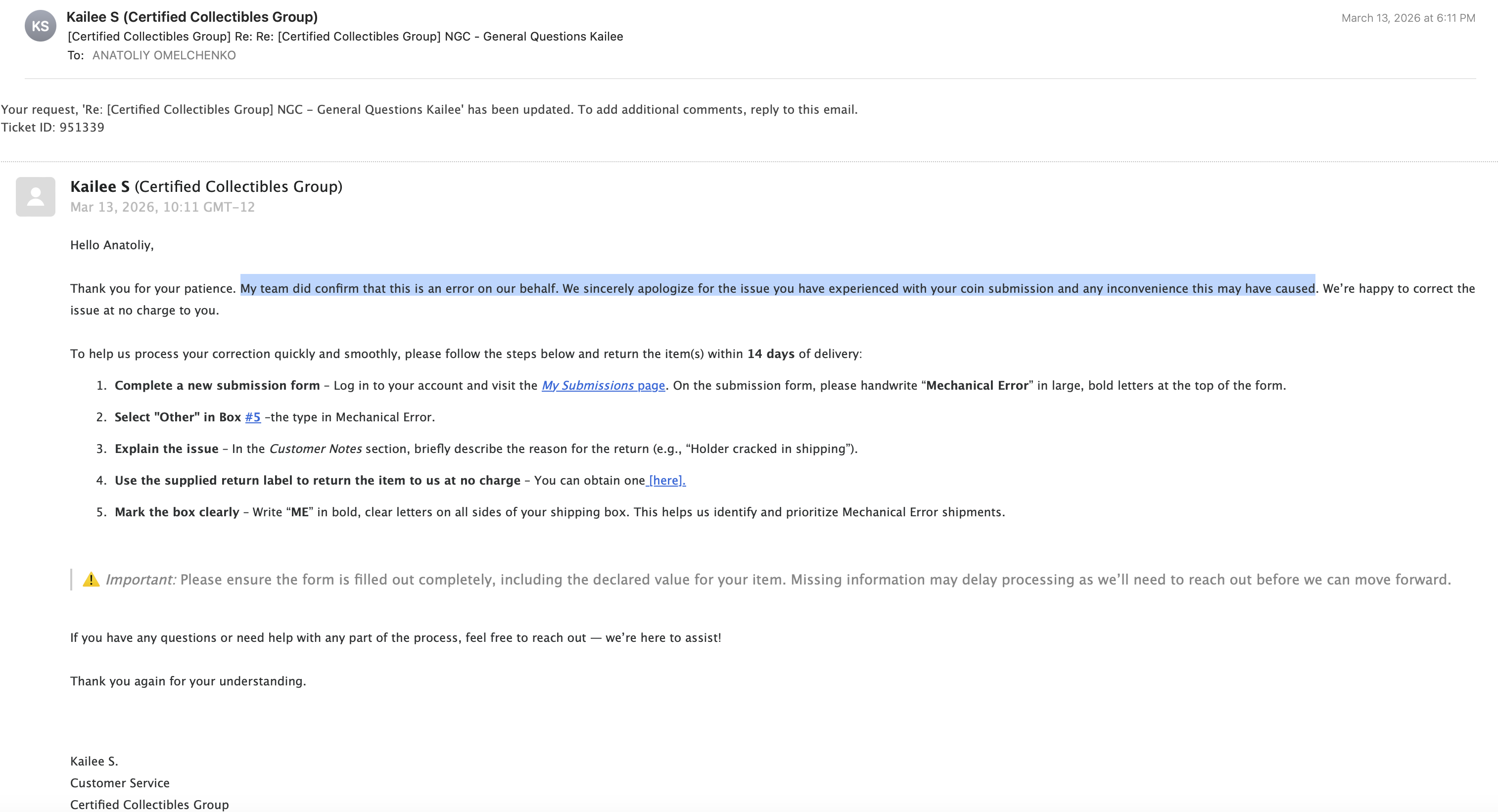
I have seen that sometimes NGC does not always note multiple issues on the label, they pick one and go with that. The op has posted some newish (week old) correspondence with NGC who is now indicating the NGC label was a mechanical error. What a new label would read is not clear from the correspondence that he posted but maybe they are now willing to consider this as a mint error also.
But what is still completely unknown is what testing either firm did to arrive at the opinion.
My Collection of Old Holders
Never a slave to one plastic brand will I ever be.
going back to grading time, ngc had an oversight and pcgs may have done the xrf just not put it on the label. but pcgs needed to do more to the 2017 and this one to ensure the planchets were indeed bronze.
perhaps the error was created with help, but also on a foreign blank. don't laugh until after you've seen the struck-in spring
so, now we know to do specific gravity tests too when encountering an unknown planchet
We don't really know why. Coins can be out of tolerance and not be on the wrong planchet. Did they PROVE it was on the right planchet or just assume?
All comments reflect the opinion of the author, even when irrefutably accurate.
I think that's way too heavy for an electrotype shell.
All comments reflect the opinion of the author, even when irrefutably accurate.
I was just suggesting the possibility that the hypothetical heavy copper plating might have been deposited via electroplating. The rough texture of the alleged plating reminds me of the rough texture typically seen on the back of an electrotype shell/
Here is the NGC letter I received after I asked them to review the coin:
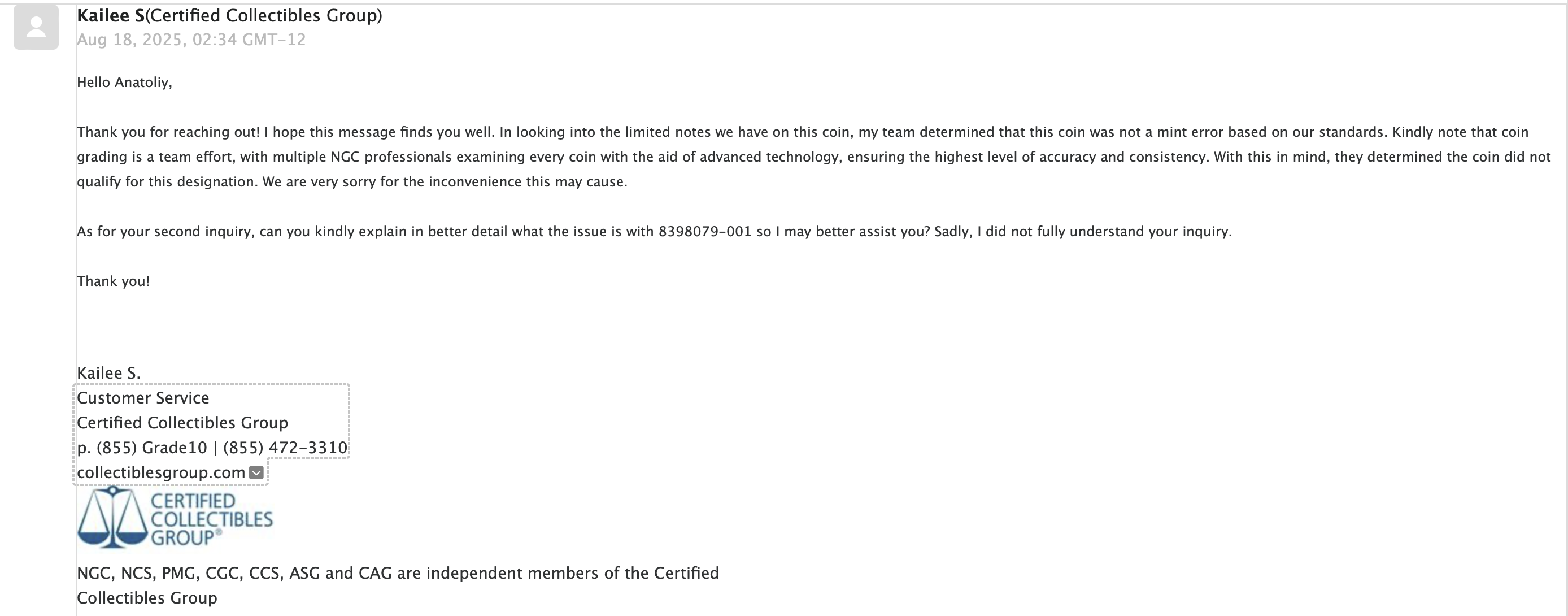
2 things
this possibly could have been potentially made in school?
what do you think about the surfaces of the 2017 coin?
The certification number for this coin is not showing up on PCGS's website, which leads me to believe they pulled it.
This is common when a coin has been certified in error, but could also just be an issue on my end. Can anyone else pull the cert page for this coin up?
Coin Photography
I think his coin broke the PCGS cert verification site. The entire cert verification system won't come up for me right now.
In honor of the memory of Cpl. Michael E. Thompson
Okay, now it shows up as inactive for me, too, while coins that I own show up as active. That would indicate to me that PCGS is at least taking a look at how they may have clusterf***ed the initial certification.
In honor of the memory of Cpl. Michael E. Thompson
Agreed, and it is the same for me. It should be easy to get Heritage to pull the coin at least until the cert page is reactivated.
Coin Photography
It would be the height of irony if this thread lead to the cert being pulled.
All comments reflect the opinion of the author, even when irrefutably accurate.
If it's pulled I'd assume it was a direct result of this thread.
Could be. Or indirectly from someone at heritage seeing it.
Could also be one of Heritage's own people was suspicious of the weight.
Either way it happened, ot is an interesting outcome residual after the 2017 also appears to have been pulled, at least temporarily.
All comments reflect the opinion of the author, even when irrefutably accurate.
The absence of the cert page right now doesn’t necessarily mean PCGS is “hiding” anything. It’s quite common for newly graded or unusual items—especially mint errors—to take time before they appear in the online Cert Verification system. There’s often a lag between encapsulation and database visibility, and error attributions are sometimes slower to populate. The coin already exists in a PCGS holder with a valid cert number, which is what matters most. If anything, this looks more like a routine update delay than any deliberate action.
None of that statement is accurate. PCGS has definitely pulled the certification, whether temporarily or permanently we don't know. Presumably you would hear first as the submitter.
But certs don't go live and then disappear for no reason. As of this moment, your coin is in a holder but it's just a chunk of plastic and the certification is invalid.
The true view is still accessible though -> https://d1htnxwo4o0jhw.cloudfront.net/cert/193746278/KP9ArgupvU6VUl_dqMAbVA.jpg
chopmarkedtradedollars.com
Sometimes, it is better to admit you don't know rather than make things up. You're talking to a group of experienced coin people. You're not going to fool anyone.
All comments reflect the opinion of the author, even when irrefutably accurate.
If someone looks up a cert number and it doesn't show up online, I'd imagine there would be some suspicion the coin/holder is not legitimate.
Show of hands- who here would pay a significant amount of money for a coin like that?
No it was already active and now is not, that is a deliberate action and the proper one until this is fully vetted and understood. I hope for you that this is verified and is legit, but this coin like the 2017 cent in another thread both have more questions than answers at this point.
Bty, I thought this seemed very familiar from the beginning, seeing your name on the NGC correspondence (different than the name you are using here) brought it home and I now remember when you posted this on the NGC forum.
My Collection of Old Holders
Never a slave to one plastic brand will I ever be.
FWIW, the only two times I have seen cert pages pulled is when I had provided evidence that those coins were improperly labeled to the TPGs.
In both of those instances the coins were called back to the TPG and the certification error was subsequently corrected.
This is the third instance of a cert page being pulled that I have personally witnessed.
Coin Photography
I've seen and been responsible for a dozen or so trade dollars certs being pulled and been involved with a couple of Japanese Kobans also.
One of the Kobans was mine and the PCGS error would have resulted in about a $40k (erroneous) increase in value. Unfortunately, I was the submitter on that one.
chopmarkedtradedollars.com
I’d like to clarify one important point, as I’ve seen some concerns raised.
There is absolutely no intention here to mislead anyone. I’ve simply shared the coin exactly as it exists, along with its full grading history — including both NGC and PCGS outcomes. In fact, the entire discussion is based on transparency, not on selective presentation.
The coin is currently in a PCGS holder with the stated attribution, and that is the basis on which it is being presented. At the same time, I fully understand that this is an unusual piece, and I welcome serious discussion, questions, and even skepticism — that’s part of how these discoveries are properly evaluated.
Regarding the certification lookup: temporary or delayed visibility in online databases is not unheard of, especially with recently processed or complex attributions. I’ve reached out to PCGS for clarification, and I expect that to be resolved in due course.
At the end of the day, the coin will be presented at auction, where the market — informed collectors and specialists — will ultimately determine how it is viewed and valued.
Fair point — and I appreciate you calling that out.
I’m not trying to present speculation as fact, and if my wording sounded too certain, that’s on me. My intention was simply to offer a possible explanation, not a definitive one.
To be clear: I don’t know yet why the cert isn’t currently visible online. I’ve already reached out to PCGS to clarify, and I’ll share whatever they confirm once I hear back.
What I do know is that the coin is in a PCGS holder with the stated attribution, and I’ve presented both grading outcomes (NGC and PCGS) as they occurred — nothing has been hidden or selectively shown.
I completely understand the skepticism here, especially with a coin like this. That’s exactly why I’ve been open about the entire process and welcome informed discussion.
At the end of the day, the auction will give the clearest answer as to how the market views it.