Options
How did this get graded?
 bluhmp123
Posts: 8 ✭
bluhmp123
Posts: 8 ✭
Did PCGS really grade this as a genuine 1959-D? 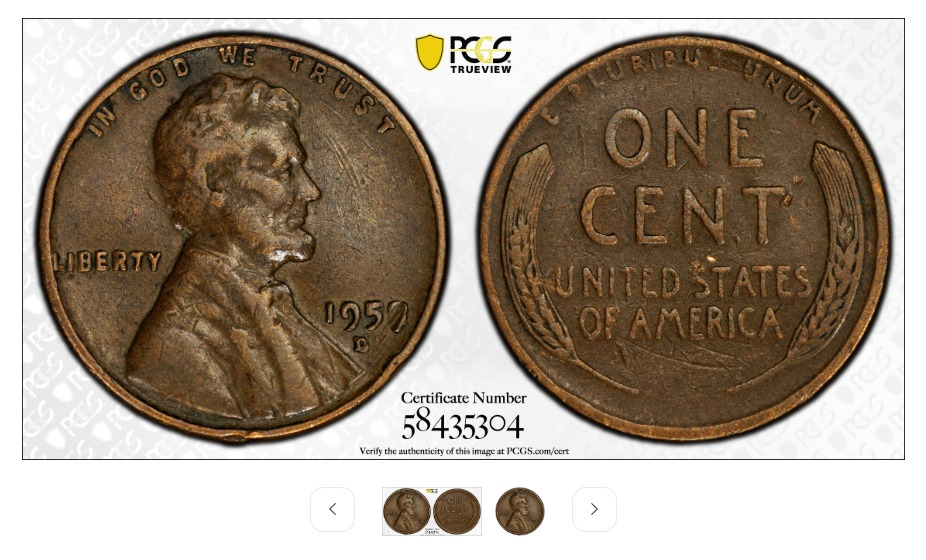
0
This discussion has been closed.
Comments
It’s not genuine?
VF, Damaged, seems about right. That’s what they do when someone sends them a coin to grade.
My question is why would anyone spend the money and bother?
Other passions include golf, Moto Guzzi motorcycles, and Euro motorcycles in general.
Chris
It should be a Memorial reverse.
"Those who would give up essential Liberty, to purchase a little temporary Safety, deserve neither Liberty nor Safety," --- Benjamin Franklin
Heard there's one certified. More then likely someone messing around at the mint, just sayin
(Theres no vested interest in it here)
It should not be a wheat reverse if it is a 1959-D.
It is just a damaged date on a wheat cent. The metal has been displaced.
The coin itself, yes
The cert number checks as OK. The only other such coin that I am aware of is a Mint State example that was owned by Mr. Blay.
"Those who would give up essential Liberty, to purchase a little temporary Safety, deserve neither Liberty nor Safety," --- Benjamin Franklin
There is zero chance this is a genuine 1959-D mule cent. It should have never been holdered as such. PCGS does not even label it as a mule error. Someone messed up and now the owner is convinced they have a million dollar coin!
Oh jeez, I totally missed that…
Other passions include golf, Moto Guzzi motorcycles, and Euro motorcycles in general.
Chris
To be clear, are you saying that Stewart Blay owned a PCGS graded mint state mule Lincoln Cent of this type? If so, I’d greatly appreciate a link to any article, post or sale link for it. Thank you.
I’ve never heard of one that was certified by a major grading company.
Mark Feld* of Heritage Auctions*Unless otherwise noted, my posts here represent my personal opinions.
The 1959-D Lincoln cent mule is one of the most famous and controversial "ghost" coins in American numismatics. It features a 1959-D obverse (heads) paired with a "Wheat" reverse (tails), despite the U.S. Mint officially replacing the Wheat design with the Lincoln Memorial reverse in 1959.
Key Facts & History
The Discovery: Only one specimen is currently known to exist. It was discovered in 1986 by Leon Baller, a retired police officer, who purchased it for roughly $1,500.
The Conflict: The U.S. Treasury Department’s Forensic Services Division examined the coin in 1987 and 2002, declaring it genuine based on its composition and lack of tool marks.
The Skepticism: Major third-party grading services like PCGS and NGC refuse to certify it. Experts argue that since only one exists, it was likely a "clandestine" strike by a mint employee or a highly sophisticated forgery.
Forger Claims: Convicted forger Mark Hofmann once claimed he created the coin using a "spark erosion" process, though the Secret Service found no merit to this specific claim.
Auction Value
Despite its disputed status, the coin has commanded massive prices at auction through Goldberg Auctioneers:
2003: Sold for $48,300.
2010: Resold for $31,050 (with a "not guaranteed" disclaimer).
2019: Most recently sold for $50,000.
The coin in question is NOT a genuine 1959-D mule cent.
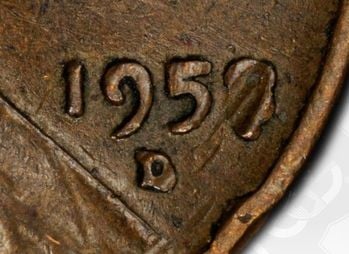
Are we thinking thats an 8 ?
11.5$ Southern Dollars, The little “Big Easy” set
That's what I'm thinking after enlarging the area around the date... it's listed in the Cert Verification page as a 1959-D, but I think I'm seeing the lower loop of an 8 off the the right of where metal has been displaced...
Successful BST transactions with: SilverEagles92; Ahrensdad; Smitty; GregHansen; Lablade; Mercury10c; copperflopper; whatsup; KISHU1; scrapman1077, crispy, canadanz, smallchange, robkool, Mission16, ranshdow, ibzman350, Fallguy, Collectorcoins, SurfinxHI, jwitten, Walkerguy21D, dsessom.
Maybe the most interesting mechanical error I've seen. It should be worth a few bucks just for that reason.
Damaged 58-D. I assume our hosts will kill the cert on this one and notify the submitter. The cert number seems recent.
Keeper of the VAM Catalog • Professional Coin Imaging • Prime Number Set • World Coins in Early America • British Trade Dollars • Variety Attribution
@HeatherBoyd,
The subject coin is a bad mechanical error that would probably be a seven-figure item if it were correct.
Mark Feld* of Heritage Auctions*Unless otherwise noted, my posts here represent my personal opinions.
Agree that it’s an obvious, mechanical error –
And as far as “the other one” – I have never believed it was genuine whatsoever,
And I would not authenticate it/certify it when it was presented to PCGS as a mint error.
This is actually common mechanical damage. Coin rolling damage, gumball machines, etc. can cause this type of displaced metal damage.
The OP coin is just a damaged coin of some other date.
It is possible that the TPG certified it without realizing that a 1959-dated Lincoln cent should have a Memorial reverse. It has happened before. See this thread:
https://forums.collectors.com/discussion/1083378/1959-wheat-cent-accidentally-certified-by-anacs-back-in-1973-certificate-5022#latest
No shame.
PCGS missed it too.
The "mechanical error" he is referring to is the incorrect label, not the damage to the coin.
May I suggest for the sake of people looking for this thread in the future that you edit the thread title to include "1959-D Wheat Cent"
Oh I am almost certain that is the case but I doubt the owner will be convinced. BTW love the book!!!!
Thank you for the clarification. I guess as an error coin nerd when I see mechanical my brain goes in a different direction.
For better viewing:
chopmarkedtradedollars.com
Thank you for bringing this to our attention, we are investigating and taking the appropriate actions.
Heather Boyd
PCGS Senior Director of Marketing