Options
The early acceptance of Tooling in the early US Coin Market
 gashmios
Posts: 504 ✭✭✭
gashmios
Posts: 504 ✭✭✭
https://www.numismaticnews.net/making-the-grade-coin-tooling-vs-smoothing-why-words-matter
__
“Tooling” is anything done in a strictly mechanical fashion to the surface of a coin by a person with an object (the tool) hard enough to change its surface. That eliminates any form of cleaning with an abrasive substance. Tooling takes many forms with separate names. Amazingly, a very long time ago, some of these practices were considered acceptable to collectors.__
So many immigrant groups have swept through our town that Brooklyn, like Atlantis, reaches mythological proportions in the mind of the world - RI Safir 1998
0
Comments
https://coinweek.com/from-the-brink-to-the-dark-side-early-american-copper-struck-counterfeits-damaged-source-coins/
_As introduction, a member of Early American Coppers (EAC) posted on the club’s Facebook page “Dark Side”, a fake 1796 “S-85” that he astutely identified from a recent internet listing, and as follow-up to that discussion I was able to post images of the discovered source coin apparently used to create the dies and the following struck “clones”.
In that ensuing discussion I stated it is interesting how our research has evolved and paradigms have shifted through time; the first time I saw a “repaired” source coin was from the research of the fake 1793 “S-5” wreaths (Penny-Wise, July 2016). That opened my eyes to look for more, to the point I now look for severely damaged/ holed examples- explains the odd lettering and spacing we see on many of these! As always, the research continues to be a collaborative effort with many participating EAC members and friends participating._
Tooling sure has cime a long way, amazing
THE PROGRESSION OF A COUNTERFEIT, OR
WHAT WOULD YOU CALL THESE 1796 S-85 LARGE CENTS?
https://eacs.org/wp-content/uploads/2022-2-Apr-Penny-Wise.pdf
THE PROGRESSION OF A COUNTERFEIT, OR
WHAT WOULD YOU CALL THESE 1796 S-85 LARGE CENTS?
Jack D. Young
In this detailed discussion, I will illustrate the
production of one of the latest struck counterfeits and
the two possible “die states.” As in all of these we have
documented, the “family” starts with a genuine coin as
the source used to make the counterfeit dies to strike
the “clones.” In the image above I have circled in red
several circulation marks (ignoring the obvious hole!)
visible on this example—minor impairments that should
be unique to this coin and thus identifiers on any copy
derived from it. Starting with the obverse, there are
several prominent dings and dents including an apparent
dig in the dentils above Liberty’s cap. The dentillation
is mostly missing under the lower hair curls, under the
date and extending to the bust tip. Keep in mind, repair
of the hole would require tooling to re-engrave the
missing hair details! The reverse also shows its share
of dents and dings.
The last person who posts in this thread is a fool.

Modern Conservation and the changing of ethics
https://coinagemag.com/wp-content/uploads/2012/02/Conservation-vs.-Restorationreduced_size.pdf
Obviously, we accept tools on the forum.
All comments reflect the opinion of the author, even when irrefutably accurate.
And trolls?
Edit:
Okay, the seal is broken, the thread is on—biggest fool— wins the turkey.
Some the early dealerw who either deal wit tooled coins and tool improved coins via tooling
The Chapman Brothers (S.H. and Henry Chapman):
Philadelphia in the late 1800s.
Auction catalogs often used descriptions of coins that today would be considered altered surfaces or re-engraved details.
Edward Cogan
During his time period dealers would often physically clean or "smooth" coins display in showcases and cabinets.
John W. Haseltine
His catalogs are often cited in pedigree research. He had a euphorism ==> "cabinet friction removal"
Much of this behavior was influenced from the collectors of Ancient Coins which had a whole other issue with conservation
see: https://www.reddit.com/r/AncientCoins/comments/17jhi7z/cleaning_restoration_vs_smoothing_and_tooling_on/
https://uscoins.com/how-coin-grading-evolved/
_The Wild West of Early Numismatics
Coin Grading in the Early 1800s
In the early days of coin collecting, grading was informal and inconsistent. Coins were commonly described using basic terms such as “new,” “used,” or “worn.” These descriptions offered little precision and left wide room for interpretation.
A coin described as “Fine” by one dealer could be labeled “Good” by another. Pricing varied wildly, and collectors often relied on personal relationships or in-person inspection to feel confident in a purchase.
_
I just had a tooled coin straight graded by CACG.
Note the scratch in the right field and the perpendicular markings to reduce the appearance of that scratch.
To the left of the date there was a spot that someone attempted to scratch off the coin. CAC didn't have a problem with that tooling.
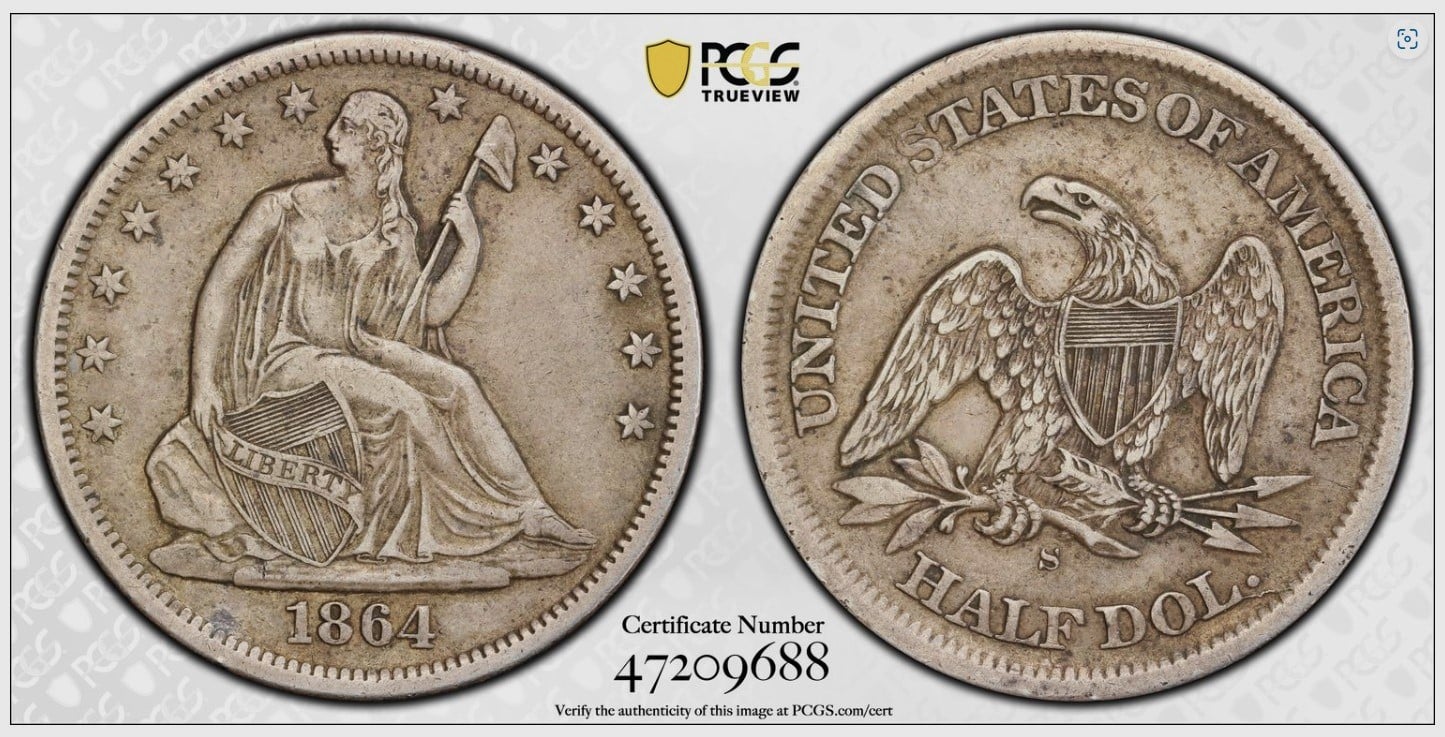
1864-S PCGS VF35 CAC
Did you talk to them about either of these coins. I read, years ago, that especaiiyl with older coins that the graders are tolerant of minor tooling... which I thought was astonishing.
what was this graded?
what was this graded?
I looked it up on CAC and it seems the second one was graded XF45. Did you expect it to come back detailed or whatever cac does in situations where the coins are altered?
If CAC deemed it acceptable why don't you?
Micah Langford - https://www.oldglorycoinsandcurrency.com/
I wouldn't either. I despise tooling. I don't mind a little cleaning, but I have zero tolerance for tooling, no matter who seems it acceptable.
Do we know they actually deemed it acceptable or just missed it?
All comments reflect the opinion of the author, even when irrefutably accurate.