The Genuine Value of OGH's and CAC Stickers
 bammbamm
Posts: 186 ✭✭✭✭
bammbamm
Posts: 186 ✭✭✭✭
There have been a lot of discussions on this forum about whether there is added value in OGH's and CAC stickers. Many collectors prefer to have the coins in their collections in OGH's and/or with CAC stickers. But do OGH's and CAC stickers add value to a coin collection above and beyond the value of the coins they contain?
.
Yesterday the latest Heritage Early Holders Auction closed. Reviewing the results gives a clear indication that OGH's and CAC stickers do indeed add genuine value to the coins they contain.
.
An excellent example of comparing apples to apples is three 1923 Standing Liberty Quarters that were in the auction.
-- All three were in OGH's
-- All three were graded MS66
-- One had a Gold CAC sticker
-- One had a Green CAC sticker
-- One did not have a CAC sticker
-- The CDN Retail price for the coin in MS66 grade is $675
-- The CDN Greysheet price for the coin in MS66 grade is $525
.
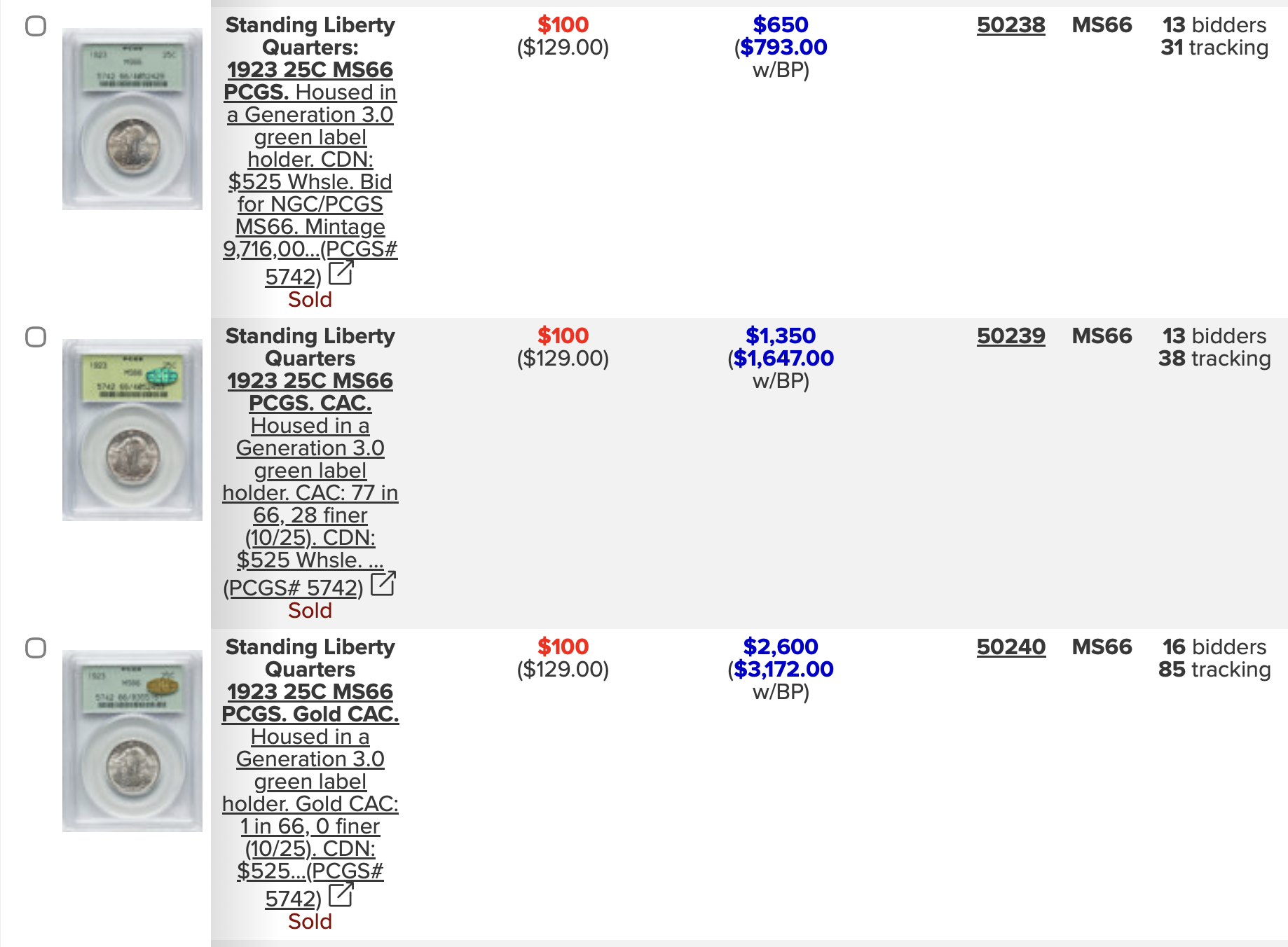
Attached is a screenshot showing what the three coins realized in the auction. The OGH without a sticker sold for 50% more than Greysheet. The coin with a Green CAC sticker sold for double the price of the OGH coin without a sticker, and the coin with a Gold CAC sticker sold for double that -- or six times Greysheet!
.
Comments
✅there ya go !
That's pretty decisive. Wow.
Wow indeed, nice contrast and compare
It's all about what the people want...
With the caveat that the sticker is not necessarily adding the value, but rather the quality of the coin is adding the value. I am of the opinion that a green sticker on an obviously high-quality old holder coin is not necessarily a good thing.
The big unknown in your premise and the posted results is how much of the higher selling prices for the green and gold-stickered coins was due to the stickers and how much was due to differences in the quality and/or eye-appeal of the coins.
Mark Feld* of Heritage Auctions*Unless otherwise noted, my posts here represent my personal opinions.
If this was an online only auction with little to no in-person viewing, then much of the difference in quality and/or eye-appeal is inferred by the presence of the stickers.
Keeper of the VAM Catalog • Professional Coin Imaging • Prime Number Set • World Coins in Early America • British Trade Dollars • Variety Attribution
I agree, though we still don’t know how much “much of the difference” was. Also, the original post provided sale results for three coins, which could be representative or have understated or overstated typical premiums for the presence of green and gold stickers.
Mark Feld* of Heritage Auctions*Unless otherwise noted, my posts here represent my personal opinions.
The OP did some very good work on this
The GOLD stickered pop for the date is 3 with the auctioned example the highest graded gold stickered coin for the date.
There are 77 stickered coins for the date and it is unknown what holders are represented.
"She comes out of the sun in a silk dress,
running like a water color in the rain...."
A valid point was made that this was an online only auction therefore the stickers mattered more. With that said, I don’t think it’s particularly difficult to sort these 3 according to quality off the images
With all due respect, given the only way for me and probably all of the rest of the bidders on these three coins were able to view the coins was based on the quality of the online images, judging quality and eye-appeal is not the same as having them in hand. But being able to zoom in with the new software, and inspect the coins as well as possible, all three of the coins looked really nice for their MS66 grade. In fact, I wondered why the coin without a sticker didn't have one -- maybe it failed or maybe it had never been submitted.
I think it pretty obvious why one didn’t sticker and one got the gold. Collectors spend too much time looking for bag marks and not enough time assessing the bloom on the central surfaces
A] this color in yellow area is weird
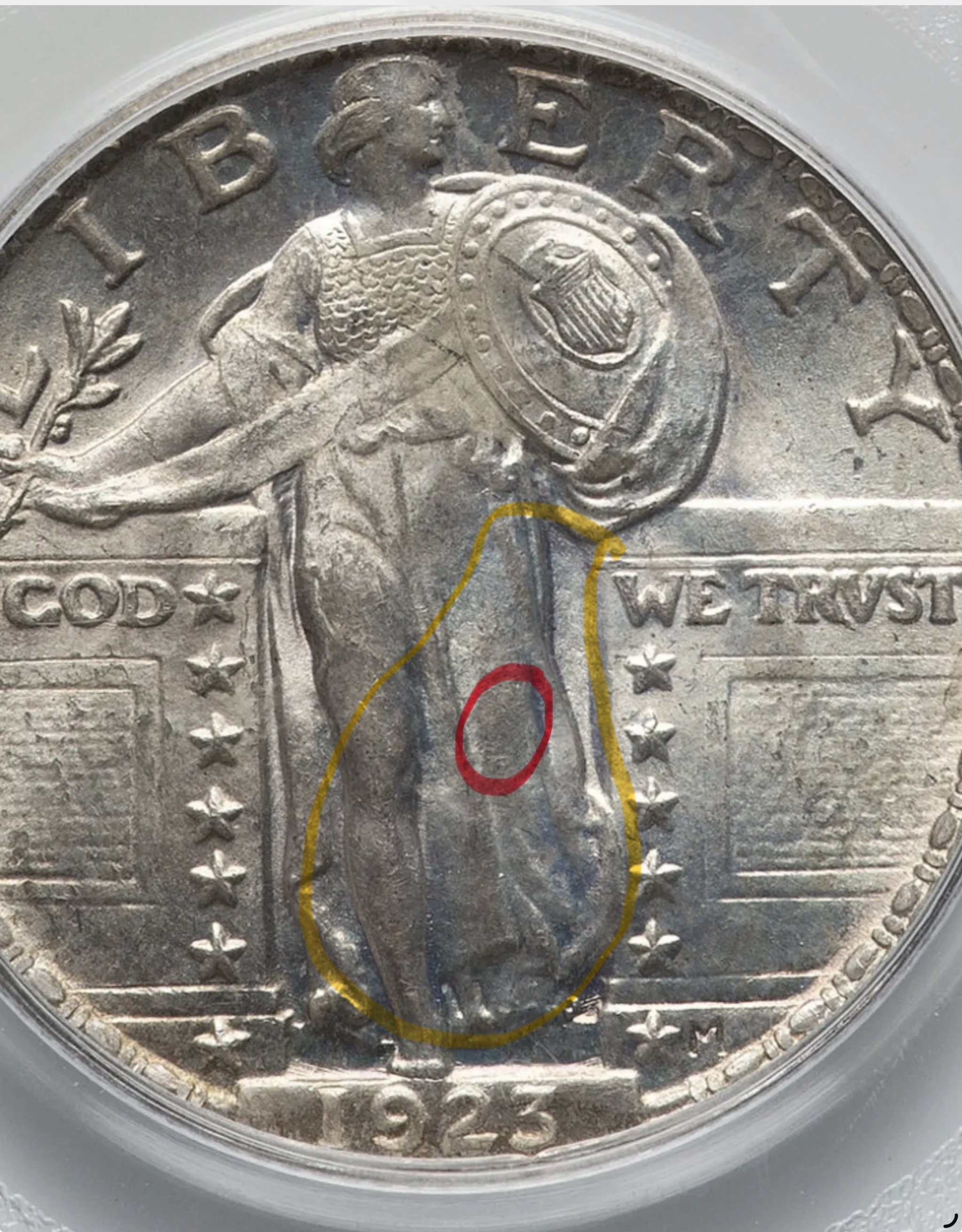
B] this highpoint stacking friction in red area is extensive
Yes, but I could have posted any of the coins in this auction that had Gold CAC stickers. All sold for significant premiums. The point of posting these three was the apples to apples comparison of three coins of the same date, of the same series, with the same grade.
Of course we have to take into account the small sample size, but if we take into consideration the venue (internet only auction, no real ability for most buyers to examine in-hand and good but not great images) then I think there is something here.
We also should keep in mind how often the particular issue has a green or gold CAC sticker as well as how prevalent these stickers are within the given series. I have not looked up that data, but it might shed some light on the pricing dynamics. Additionally, base price might affect percentage increase in a sensitive manner, but again I have not studied this. Lastly, I agree with @tradedollarnut that the original bloom of surfaces is often discounted by buyers when in fact it is something important. I have for decades called this "the fabric of the coin" and have written that on these boards since the 1990s.
I think the thread is interesting.
In honor of the memory of Cpl. Michael E. Thompson
I can make sense of the 66 OGH no sticker (generic), and the 66 OGH gold sticker (superb all there 67). But the 66 OGH green sticker probably wouldn't sticker every time through imo.
66 green stickered OBV is a bit scruffy with considerable grazing and some high point friction. The reverse has considerable milk spotting/staining, field marks, and overall scruffiness. Looks like a very average to lower end coin to me. But it realized 2X the price of the non-stickered coin which to me shows value assigned by the sticker.....not so much the quality of the actual coin.....which helps to support the OP's original supposition.
I appreciate your efforts and understand your point. Mine is simply that, while green and gold-stickered coins can bring significant premiums of the type you presented, 1) we can’t necessarily know all of the reasons for the price differences and 2) the premiums can vary to a very large degree.
Mark Feld* of Heritage Auctions*Unless otherwise noted, my posts here represent my personal opinions.
The other missing data point here is how much these coins sold for in new holders. Obviously, we can't know this unless the coins are reholdered, restickered, and then sold, preferably one after another in the same auction. That would tell us how much value the holders had.
Keeper of the VAM Catalog • Professional Coin Imaging • Prime Number Set • World Coins in Early America • British Trade Dollars • Variety Attribution
Really nice coins.
Well done analysis.
Obviously auction demand was high.
Interesting
Perhaps players will see this and use this data / photos in pricing their stickered SLQ material for their bourse table. Or at least develop a feel what really nice material can bring.
I have been looking for some gold coins with BOTH OGH and CAC.
Not so much for the added value, but because they would hopefully confirm what I have seen with my eyes.
Namely....that a couple of coins that are notorious for a blase look....not having great eye appeal....and a somewhat dull look....are among the few that stand out for having a better "strike" (CAC). The OGH is from a different time period so I can't say it's as important, more of an oldtimer novelty.
I wouldn’t assume that CAC examples will tend to exhibit better strikes.
Mark Feld* of Heritage Auctions*Unless otherwise noted, my posts here represent my personal opinions.
>
Would you please explain that further.
Give me the same high quality gorgeous looking 66 coin in two rattlers one with sticker and the other without.
With no sticker, the mind runs wild - is this a lock 67? A shot 68? How much of a percentage of the next grade up are you going to pay for this beauty? 110%?
Same coin with a green sticker means it’s nice but no upgrade probably. Sure, it will fetch a premium over an ordinary 66 due to the old holder and sticker - but as much of a premium? My personal opinion is no on that.
I have a "few" of these, OGH/CAC combos, that I'm hoping will pay off when the time comes to let them go.
I believe they will do just fine.
Here - I’ll illustrate. Here’s a coin in an ogh with a green sticker that looks amazing. If this was in a rattler group with no stickers, I’d be thinking 62+ , shot 63 as the current grade.
With the green sticker, it’s currently for sale for $23k. Shrug
So it’s technically possible for a green sticker to hold back a realized value. That’s all I’m saying.
Wait, people actually look at the coins they buy? I thought everyone just looked at the slab grade and whether there was a sticker there.
Good thread and discussion, thanks for posting!
Collector of Capped Bust Halves, SLQ's, Commems, and random cool stuff! @davidv_numismatics on Instagram
What’s the coin graded?
Mark Feld* of Heritage Auctions*Unless otherwise noted, my posts here represent my personal opinions.
Respectfully, that’s not true. Green stickered Coins upgrade routinely. Not every time, of course, but I’ve seen it happen a lot.
Sometimes, it’s better to be LUCKY than good. 🍀 🍺👍
My Full Walker Registry Set (1916-1947):
https://www.ngccoin.com/registry/competitive-sets/16292/
I think what TDN was getting at is that an older holder containing a wonderful coin has the possibility of being a "lottery ticket" if it hasn't yet gone to CAC, or if the potential buyer doesn't believe it has gone to CAC. Whereas if it has a green CAC sticker on it then that is like having the lottery ticket scratched off already.
That is my interpretation of what TDN was writing about in this case.
In honor of the memory of Cpl. Michael E. Thompson
I don’t know how you define “routinely” or “a lot”, but my impression is that green-stickered coins don’t upgrade as often as one might think from reading your post.
Regardless, I happen to agree with @tradedollarnut. And so do the coin sellers I know who sometimes remove green CAC stickers from holders, becaise they believe that they (as opposed to gold stickers) cap the marketability and value of the coins. Doing so makes it easier for some potential buyers to see more potential upside in resubmitting the coins.
Mark Feld* of Heritage Auctions*Unless otherwise noted, my posts here represent my personal opinions.
Well, you certainly would have a better barometer than me, because you deal with hundreds, if not thousands of coins on a daily basis, so I likewise respect your opinion. I’ll just say that I’ve seen it happen more than a few times.
Sometimes, it’s better to be LUCKY than good. 🍀 🍺👍
My Full Walker Registry Set (1916-1947):
https://www.ngccoin.com/registry/competitive-sets/16292/
@MFeld, the coin in question is in a 61 OGH CAC holder.
Collector of Capped Bust Halves, SLQ's, Commems, and random cool stuff! @davidv_numismatics on Instagram
Thank you.
Mark Feld* of Heritage Auctions*Unless otherwise noted, my posts here represent my personal opinions.
>
There is no way I have your ability to grade; however, if I could get a PCGS green sticker into a CACG +, I'd be a happy camper. It's not financial; but, confirming I'm able to pick out really nice coins.
Exactly
Absolutely
And I don’t necessarily disagree with you all I’m saying is a green sticker on a beautiful old holder coin limits the value in my mind and in many buyers mind
I attended the winter ANA show on a Saturday instead of a Thursday or Friday. I located a 1855-S $20 Liberty in a PCGS OGH holder graded XF-40 (my fourth one!) which happened to look much nicer than XF-40 . It had a CAC sticker. I jumped on it at a reasonable price and thought about bringing back to CAC for a reconsideration. I then realized the last second that it was gold stickered. It then made sense to me.
Really ? Even though JA himself has said numerous times that luster is a key determinant in getting or not getting stickered, Mark ?
They should.....I'd like to think so, having just added a few....and yet....if gold and silver continue to rise, you wonder if everything short of an MS-67 will trade like bullion, maybe with an extra $100 tacked on for the OGH/CAC combo.
With Type 1's hot....with gold hot....and with Gold Stickers hot for a few years now....I'm surprised you didn't have to pay through the nose.
Congrats !!
My comment pertained to “strike” (which you had also mentioned) not “luster”.
Mark Feld* of Heritage Auctions*Unless otherwise noted, my posts here represent my personal opinions.
Glancing at the provided thumbnail photos, they all look the same to me.
I understand the logic, but see two issues with it:
First, if I see a beautiful old holder coin (especially a higher-end coin) without a CAC sticker, I may assume the coin has been to CAC and failed, unless there is some plausible story about the coin being recently unearthed, etc. I may value it less.
Second, I'll often run cert #s of coins I am buying through CAC's database anyway. So I'll see that it has a green sticker anyway, and potentially grow suspicious of the seller if I suspect it was intentionally removed to goad me into paying more for it.
Superb collections are built more by omission than by addition.
Luster and strike are not correlated in a one-to-one manner. Take for example the early 1950s S-mint WQs. They have perhaps the best luster within the entire classic silver WQ series, yet are often found like they are struck in oatmeal. And those coins receive CAC stickers.
In honor of the memory of Cpl. Michael E. Thompson
If I may add to my earlier post. In my experience purchasing coins from Heritage and Great Collections, it is impossible to know how the coin will look in hand until it is in hand, regardless of the quality of the images seen online -- and Heritage and GC both provide high quality, easy to zoom in on images.
.
I can give you a good example. I purchased a better-date MS63 Buffalo nickel in an OGH from Heritage a few years ago. Studying the images online, it looked like a honestly graded, attractive coin, but nothing special. Others viewing and bidding on it must have thought the same because I won it for a really good price. When it arrived in the mail and I had it in hand, I was blown away. The coin was stunningly beautiful! It was the opposite of the stories you hear about online dating, where in the online photo the person is gorgeous, but when seen in person, he or she is just average.
.
I later submitted this Buffalo nickel to CAC for stickering and it was given a gold sticker. So CAC thought the same as me when they had the coin in hand.
.
My point being, it is impossible to accurately grade a coin or really see its luster or lack thereof in online pictures, no matter the quality of the images. So when bidding on coins online, most of us rely on the trust of an older holder and green and gold CAC stickers.
The ones I have will have no reflection on the metals pricing.
"So when bidding on coins online, most of us rely on the trust of an older holder and green and gold CAC stickers."
While I understand the points you've made, one does need to be careful assuming and trusting that an OGH with a green sticker is something special. I've seen plenty run-of-the-mill CAC coins despite whatever the plastic it is in.
"She comes out of the sun in a silk dress,
running like a water color in the rain...."
Yes, maybe that can be the case, but that's not what I purchased in my example. The coin in my example was in an OGH , yes, but it had no sticker. I picked it up for a good price -- Greysheet -- I didn't pay a premium. Then I submitted it to CAC and it received a gold sticker. Yes, what drew it to me in the first place was that it was in a PCGS OGH. But I didn't purchase it blindly just because it was in an OGH. As I said, "it looked like a honestly graded, attractive coin," after reviewing it with its online images, so I put a bid on it and won it. I didn't solely bid on it because it was in an OGH, and I didn't place a premium bid on it. My point was that online images don't give a true representation of what a coin really looks like in hand. Grading and judging the three coins in my OP, based by the images provided by Heritage -- although high quality -- is futile unless you actually have the coins in hand. So online bidders like me (a collector) rely on whether or not a coin has a green or gold CAC sticker. CAC stickers are sought after by many collectors -- myself and many of my collecting friends. To remove them from a holder, in particular an old holder (PCGS or NGC), or to crack out and resubmit a coin with a CAC sticker in order to get a plus grade or possibly one grade higher, is sacrilege. To me and many of my collecting friends, if that is done, that coin is now less desirable and not worth what it was in the early holder with a CAC sticker -- most especially if it had a gold sticker. But, hey, I'm just a collector who purchases coins, I'm not a dealer.
“Grading and judging the three coins in my OP, based by the images provided by Heritage -- although high quality -- is futile unless you actually have the coins in hand.”
Not if you know what you’re looking for - they aren’t proofs where hairlines are paramount and impossible to evaluate from an image
I know in my mind and I think in the mind of other collectors, any higher end coin without a sticker at a venue or dealer with a reasonable audience, has already been tried. There is just too much money on the table to not send it. Unless, like others have said, it is absolutely fresh.
Personal example:
Purchased a fresh rattler 1798 $5 AU55 from a small estate auction. It brought $42k. I sent to CAC and it was denied. I auctioned it through Stacks at a major sale and it realized $28k. (Buyer dipped it and got it into 61 CAC and sold for $108k….still sour about that)