Jim Palmer best of the 70s?? How to incorporate IP into the run saving equation to get true value
 1948_Swell_Robinson
Posts: 2,468 ✭✭✭✭✭
1948_Swell_Robinson
Posts: 2,468 ✭✭✭✭✭
We have these discussions all the time. Joe Blow was better because his ERA was 2.40 compared to Joe Schmoe who had a 2.66 ERA. Then someone says, but Joe Schmoe threw 40 more innings and where is that value being accounted for? The IP factor is a legitimate and key question. But how much of those extra IP translate in the terms of the value? Is 40 more IP at a slightly lower ERA going to lead to more value? At what point does such a good ERA make it not even matter if someone else threw 40 more IP?? If Joe Blow's ERA was 1.88 make the extra 40 innings that Joe Schmoe threw irrelevant? Most of the time we can eyeball it and come close....but many of times you need a little more accuracy.
The more innings you can pitch at a better than league average run prevention(or at a similar elite level run prevention), then the more runs you are saving for your team. I think most understand and agree with that so I will leave that factor as it stands as a given.
This method is not new news. It was published in the book Total Baseball. Back in the early 80's the stat of Pitcher Runs was created using that simple concept. The pitchers ERA compared to the league ERA and then valued according to the amount of Innings pitched by the player.
What has followed since is that when WAR was invented and that formula started to attempt to incorporate the quality of the defenders behind the pitcher, the teams they pitched against, and the ballpark factor. WAR cannot even accurately determine an individual's defensive contribution let alone even attempt to isolate an entire teams defenisve ability from that of the pitchers contribution...and that is one of the reasons why you get a lot of head scratching results when looking at a pitchers WAR for a season. It doesn't pass the intuition test.
Palmer got a lot of easy pop outs and lazy fly balls and Ryan got a lot of K's....that is them, not the defenders. WAR tries to diminish Palmer's pop outs and gives that credit to Belanger instead.
The following figures are straight up the pitchers ERA compared to the league and adding the value of their IP. It does not even account for ballpark factor. This is straight no adjustments(other than the league's ERA comparison).
For example. It is widely accepted that the best pitching season of the 1970s was Ron Guidry's 1978 season. According to the Pitcher Runs, it was.
Guidry was 61.6 runs saved above the league average in 1978 was the best mark of the 1970s
Second best was Jim Palmer in 1975 with 60.6 runs saved above average. Palmer's inclusion might surprise people it might not.
Palmer threw 323 innings that year with a 2.09 ERA. Guidry threw 273 innings with a 1.74 ERA.
Neither of those figures are park adjusted. They do account for the league ERA though, but those were 3.78 and 3.76 respectively. It was the IP that had Palmer close the gap in their ERA's.
BaseballReference does not have the Pitcher Runs numbers. What they have are the ones that incorporate the defense behind them. Those are the ones that are giving wonky results.
The quick formula is simple: IP/9 x (Individual ERA - League ERA) and that gives you Pitcher Runs that incorporates the value of the IP and the league ERA. You might be off a half run or run since you aren't using the 3.794928290 ERA and just 3.79 etc...but you can do it for any player in any league you know the league ERA, the players ERA and their IP. All easy to find.
So what I wanted to talk about was Jim Palmer. He won three Cy Young awards and won 20+ games all the time in the 70's. He is certainly not undervalued by people who watched him back then with their frame of statistical reference.
He is however underrated with WAR. WAR is saying Mark Belanger, Brooks, and Grich are the reason why Palmer had great ERA's...even though Palmer was a fly ball pitcher. I believe those fielders were good...but the Pitcher is the one earning and when a pitcher has continued to excel with other players at those same positions, then it should show you right there it is the pitcher.
So back to the best of the 1970s. Tom Seaver is almost universally said to be the best of the 1970s. Here is a real simple ranking of the best Pitcher Runs of the entire 1970s'
Palmer 339
Seaver 312
Perry 243
Blyleven 217
Carlton 164
Ryan 160
For their careers:
Seaver 422
Palmer 378
Perry 315
Ryan 314
Carlton 240
So clearly at their peak it is Palmer and Seaver at number one and two and not really anyone else to challenge.
The career actually surprises a little that Palmer is still close to Seaver and ahed of Ryan(with Ryan's known longevity dominance).
Also considering Palmer missed all of 1968 with an injury and only had 49 IP in 1967.
Just thought I would give Jim Palmer the due he received back then but is getting unfairly dinged by a newer metric that is simply not accurate in defining defensive value and not giving the pitcher proper credit for inducing easy or routine outs. As I showed before, the reserves for Bill Mazeroski and Ozzie Smith on those same teams got to the same amount of balls as they did...so they can't even get that part right.
Giving Palmer his due even if WAR does not get it right.
Comments
If you use a more nitty gritty formula based on pure run prevention, then Run Expectacncy 24(which includes all the base runners/out situations).
1970s Leaders...and then their career total.
Palmer 368.....career 426
Seaver 358.....career 514
Carlton 168.....career 275
Blyleven 166....career 361
Ryan 146.....career 282
Basically mirrors the basic Pitcher Runs.
Palmer was best of the 70s and only trails Seaver career wise for 70s pitchers.
Win Probability for career
Seaver 56.4
Palmer 45.5
Ryan 34.1
Blyleven 30.2
Carlton 28.1
I can safely say that the only 1970s pitcher better than Palmer was Seaver for their entire careers. If looking only at the decade of the 70s then Palmer is the top dog.
I love this type of discussion. I have always been a Seaver guy (I prefer power pitchers) but during the 70s, i think you may be correct. Jim may have the advantage, slight though it may be! it is funny, Seaver has an advantage in k's and BB's, and hits allowed, but palmer gave up fewer home runs even though he pitched more innings. without doing the research, I wonder if generally seaver was the harder pitcher to hit/get on base against, but gave up more home runs with men on base? that may explain the slight ERA difference between the 2?
I also think a big feather in Palmers cap is that he pitched in the AL where they had the DH for most of the decade. I am sure Seaver got to throw to far more pitchers than palmer did.
even though their approaches to pitching were different, the 2 guys had remarkably similar results. they both had 2 down years (for them) during the decade of the 70s. the crazy thing is, they were both during the same seasons! 74 and 79.
jim was definitely more of a workhorse in the decade, but i think that really hurt his longevity. He was pretty much washed after age 32. I wish Weaver would have protected him a little more and I bet he could have been a very good pitcher well into the 80s. they protected Seaver throughout his career. i think he almost exclusively pitched in a 5 man rotation. it really showed as he was still a good pitcher into his late 30s.
I remember palmers comeback attempt. was it in 91? he gave it a shot, but just didnt have it.
George Brett, Roger Clemens and Tommy Brady.
@craig44 Yes, comeback attempt in 1991. He tore a muscle and that was it.
Yes, the DH Palmer faced in the 70s did factor into the equation.
The one neat factoid that was always bantered about back then was that Palmer never gave up a grand slam...that would factor in the Run Expectancy.
Palmer gets lost in the discussions now(prolly due to the very faulty WAR measurement), but as we can see, he prevented runs at the same rate as Seaver, and threw more innings(in the 70s).
It is amazing how forgotten he has become. Lifetime 2.86 ERA, three Cy Young awards, won three world series in three different decades(actually has a WS win in three different decades). Played in a total of six world series.
He was famous then for all of this...and the underwear ads. Now? Not so much.
Never saw his name mentioned on these boards. His cards are relatively cheap comparatively.
Best Run preventer of the 1970s and only Seaver bests him for a career from a 1970s pitcher.
@craig44 Jim Palmer was an artist. He threw hard the first half of his career but he pitched to contact. Soft contact. He was trying to induce routine outs and he did! Now WAR doesn't recognize this. WAR for pitchers focuses on K/BB.
Here is what is interesting for me:
Look at how Palmer's K/BB ratio and strikeout ratio changed with men on base compared to nobody on base.
Palmer K/BB ratio with nobody on base: 1.57
Palmer K/BB ratio with men on base: 1.87
Palmer OPS against with men on base: .622
Palmer strikeout totals with nobody on base/Men on base expressed in a full season of facing 1,200 batters:
Strikeouts with nobody on base: 153 strikeouts in a full year.
Strikeouts with Men on base: 183 strikeouts in a full year.
So Palmer did pitch to SOFT contact for most of the time but it certainly seems he was capable of going for strikeouts more when needed with men on base. He was an artist.
Compared to Blyleven:
Blyleven K/BB ratio with nobody on base: 3.05
Blyleven K/BB ratio with Men on base: 2.49
Blyleven OPS against with men on base: .679
Ryan K/BB ratio with nobody on base: 2.15
Ryan K/BB ratio with Men on base: 1.89
Ryan OPS against with men on base: .645
For some context, here are the American League averages:
1975:
K/BB ratio nobody on base 1.51
K/BB ratio with men on base 1.32
1976 nobody on 1.55
1976 men on 1.43
1977 nobody on 1.67
1977 men on 1.41
So as one can see with the League Averages, and with the other elite pitchers from that time, that increasing your K/BB ratio with men on base compared to nobody on, is unique!
Palmer did just that because he was an artist and he indeed was capable of more strikeouts per year(as he did when he needed them with men on base compared to nobody on base). Palmer had artistry to get easy pop ups and fly outs and ground outs, which he utilized greatly in all spots so he can pitch more innings. He also had the stuff to get more strikeouts when needed...which he did. As such, WAR does not recognize this and unjustly penalizes Palmer even though he was the absolute best run preventer of the 1970s.
>
>
I really like Jim Palmer. One of the best pitchers of his time.
If you limit the debate to the years 1970-1979, the best you can do for Palmer is a tie. Jim averaged less than 1 more start per year, 35.2 to 34.5, less than 10 more innings pitched per year, 274.5 to 265.2, he led in ERA by 0.03 and ERA+ by 1. Seaver led in WHIP 1.073 to 1,142.
The DH is an interesting point, but if you are going to start bringing that up, I think you need to factor in the other 8 batters these guys were facing. Seems to me there were better hitters in the NL.
Career wise he's CLEARLY NOT better, or really even very close to Tom Seaver.
Let's look at the 11 years that Palmer threw for more than 200 innings;
He averaged 36 starts per year, 279 innings pitched and lasted 7.66 innings per start. Could have won the Cy Young in 1970 to go with the three he won in 1973, 1975, and 1976.
Now lets look at Tom's top 11 years;
He averaged 35 starts per year 272 innings pitched and 7.78 innings per start. Could/should have won Cy Young in 1970, 71 and 76 to go with the three he won in 1969, 1973 and 1975.
Now add 5 seasons over 200 innings where Tom averaged 231 innings 33 starts and 7 innings pitched, to none for Jim.
Palmer did have the only years where either guy threw for over 300 innings with 4, but in those years he threw for an average of 30 innings per year more than Seaver. Tom averaged 286.5 IP in his top 4 years.
As you mentioned, Seaver was more of a power pitcher. He was throwing just about as many innings AND throwing harder.
I wonder if Palmer threw more pitches per start, but I am not sure where to find that number.
If you're going to claim the 30 extra innings Palmer threw for his top 4 years hurt him, I can't prove you wrong, but I doubt that was it. I think Tom Seaver was the absolute best pitcher of his generation if you look at both quality and longevity.
Joe, I did mention Seaver was the best for the career.
Seaver also had the better peak if you look at their best peaks and not limit it to just 1970s years.
Palmer was one of my favorites. I would be curious how Bob Gibson stacked up to Seaver and Palmer with some of those advanced stats.
I’ve mentioned this but last year I was watching a game of the 1971 World Series and Palmer was pitching. He would get the ball back from the catcher and you would think it was a hot potato he was pitching so fast. And the Pirate pitcher was doing the same. It made me remember how baseball used to be and how necessary the pitch clock is in today’s game.
Seaver and Palmer and Gibson not only were outstanding pitchers but they were smart enough to know what pitch they wanted to throw next as the ball was coming back to them from the catcher.
Palmer's WAR could be under-estimated because he played on better teams than Seaver. Potential cannot be assumed, but when Palmer had to pitch in pressure situations he had another gear. It's not an unfair fight when considering who was better which is more interesting to me than the need to have consensus as to who was better.
>
Gibson and Palmer are about as equal as two pitchers can be. I would give a slight edge to Gibson. VERY slight.
Bob didn't become a full time starter until he was 25, while Jim had 3 full seasons by the time he was 25.
Gibson's best years were when he was old, 32-37. Palmer's last great year was when he was 32.
That "feels" about right. Win Shares uses a very similar "runs saved" formula in it's calculations, so I thought I'd check this list against that list. By Win Shares, the top 10 of the 1970's:
>
1. Palmer 235
2. Seaver 230
3. Perry 222
4. Niekro 214
5. Jenkins 204
6. Carlton 202
7. Blyleven 192
8. Sutton 168
9. Ryan 161
10. Hunter 157
Swell, I don't know if your list was a top 6, or just 6 pitchers you thought of, so I don't know if it means anything that Niekro and Jenkins aren't on your list. Both of them were more "very good" than "great" for the decade, but they did pitch a lot of innings.
Win Shares does also put a little weight on some other things (like hitting), but they don't generally amount to anything significant. I suspect park adjustments account for most of the differences (order, spacing) between your 6 and the same 6 on the Win Shares list.
The list was more of the off the cuff variety. I did have Niekro initially in mind but didn't feel like typing anymore(or doing the calculations needed) to put him on the post. I forgot about Jenkins while making the post.
I see WinShares has Palmer very high too.
Who was the best of the 60s? Marichal?
When I went down this rabbit hole years ago, I had the top three as Palmer(1), Seaver(2), Perry(3).
Good question. I was sick on the couch when I looked at this 70's topic, lol. Hopefully I am not sick again for a while so I may leave that question up to you.
>
>
>
I would say Juan Marichal. 2550 Innings Pitched from 1960-69. ERA 2.57, ERA+ 136, WHIP 1.045, 197 complete games!
You could also argue Koufax. 1807 Innings Pitched from 1960-66. ERA 2.36, ERA+ 147, WHIP 1.005, 122 complete games.
Bob Gibson was great too. 2447 Innings Pitched from 1960-69. ERA 2.74, ERA+ 135, WHIP 1.147, 164 complete games.
Next (?) Don Drysdale. 2629 Innings Pitched from 1960-69. ERA 2.83, ERA+ 119, WHIP 1.118, 135 complete games.
Whitey Ford the best in AL? 1608 Innings Pitched from 1960-67. ERA 2.83, ERA+ 127, WHIP 1.173, 62 complete games.
Jim Bunning was very good. 2590 Innings Pitched from 1960-69. ERA 3.01, ERA+ 121, WHIP 1.142, 108 complete games.
Sam McDowell was also good. 1583 Innings Pitched from 1962-69. ERA 2.97, ERA+ 117, WHIP 1.255, 70 complete games.
Koufax had his best stuff in the 1960's BUT if you compare Juan's best 7 years, you get;
2020 Innings Pitched from 1963-69. ERA 2.34, ERA+ 146, WHIP 1.001, 164 complete games. Better than Koufax's best!
During those 7 years Marichal walked only 1.5 hitters a game. Lower than any of the listed pitchers.
McDowell was the only pitcher other than Koufax to strike out more than a batter per IP, 9.4 to Sandy's incredible 9.5.
When the mood, or the virus, strikes... let me know what you think. I don't think there's a right answer between the obvious 3, but I personally have Marichal at top-spot. The perspective is the interesting part for me.
>
>
>
Smashing John Roseboro in the head with his bat MIGHT have hurt his reputation.
Without running the full array of numbers, I suspect that Marichal is going to have a lead over Koufax for the entire decade, but the lead is going to be small enough that when we see Koufax accomplished his in three less years due to early retirement, I'm likely to be inclined that Koufax gets the nod in my eyes.
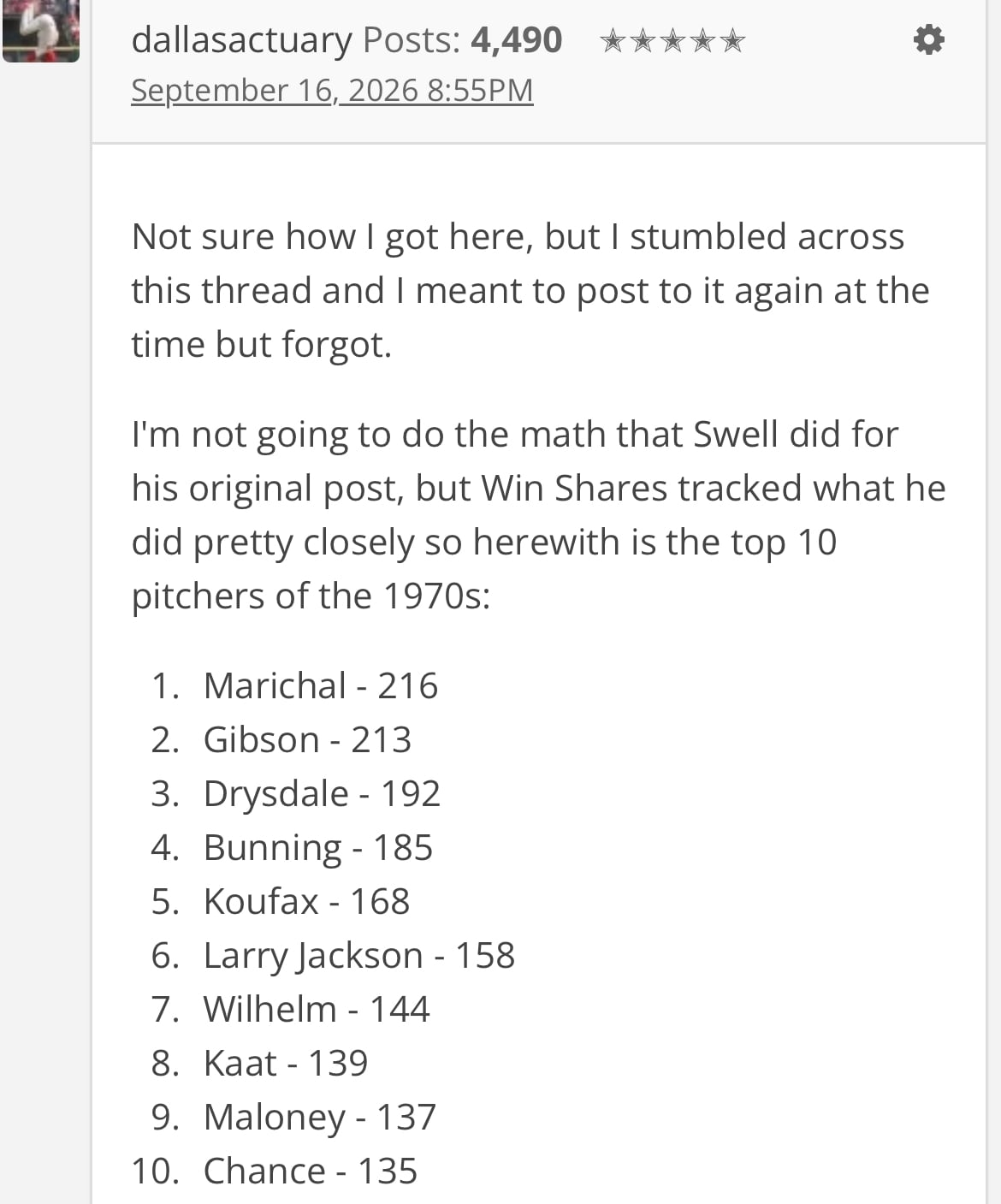
Not sure how I got here, but I stumbled across this thread and I meant to post to it again at the time but forgot.
I'm not going to do the math that Swell did for his original post, but Win Shares tracked what he did pretty closely so herewith is the top 10 pitchers of the 1970s:
Other than an occasional appearance on one of my ridiculously long lists, I think this is the first time I've mentioned Larry Jackson (who I should go add to the underrated thread). I forgot about Jackson so completely that I think I never even included him among the pitchers better than Catfish Hunter and Jack Morris (which he obviously was).
It takes some fancy footwork to get Koufax to the top of the best Dodger pitcher of the 1960s list, but I don't think you can get him to the top of the MLB list.
My list would be way different starting with Seaver at number 1.
Koufax wouldn’t be on my list because I don’t even think he pitched in the seventies.
I assumed he meant the 60s there.
Maybe Dallas and basebal21 could get together and hire a good proof reader.