Take a break from the fights for a moment, this is an awesome card, 1951 Topps Ringside Rocky Castellani. Notice on the back of this card it says Castellani was with the 3rd Marines on Guam, he actually fought in the battle of Iwo Jima, one of the bloodiest and most horrific battles in history. I would imagine that after surviving Iwo Jima, boxing was nothing.
Rocky Castellani and Kid Gavilan in 1949, Gavilan floored Castellani twice but couldn't put him away, the tough Italian finished on his feet. One thing about Castellani, you could hurt him, but if he still had a heartbeat he was going to get up, he reminds me of Fernando Vargas in that regard. A tough gladiator.
GAVILAN CONQUERS CASTELLANI EASILY; Cuban Gains Decision in Ten Rounds After Flooring Rival Twice in Garden Ring
By Joseph C. Nichols
Sept. 10, 1949
Kid Gavilan had a much rougher time than he expected with Rocky Castellani, courageous middleweight from Luzerne, Pa., in the ten-round bout that featured the return of boxing to Madison Square Garden last night.
The Cuban, who holds the welterweight championship of his native land, won all right, receiving the unanimous decision. But, from the way things went early in the battle, it was evident that the Cuban hawk was not in there just to win. His aim was to win by a knockout, And in the second round it appeared as if Gavilan would realize his aim, for he had Rocky on the floor under the force of two fast rights to the jaw, and if ever a fighter appeared to be out for the night, it was Rocky. He didn't move at all as Referee Petey Scalzo called off eight seconds. The crowd of 11,243 was satisfied that everything was over, and Gavilan was prepared to accept the plaudits of his handlers.
Beats Knockout Count
Then, just at the count of 9, the light came back into Rocky's eyes and he jumped to his feet in time to beat the knockout count. Succeeding in staying out of harm through the rest of the second round, Rocky seemed well recovered in the third, and traded willingly until late in the session. Then Gavilan clipped him with a left to the head, and Rocky went down again. He was not too befuddled, and quickly got to his knees, prepared to take the full count. That was unnecessary, for at four the bell rang. Scalzo failed to hear it, and went on to six before he realized that the session was over. When Rocky came out for the fourth, Gavilan punished him severely, and it appeared certain that the Cuban would register his knockout. But Castellani survived somehow and for the next three rounds he boxed so skillfully as to cause his followers to think he might pull even with the Cuban.
Scores in Last Two Rounds
But Gavilan's greater strength told. In the last two rounds he clearly outpunched his game rival. Scalzo voted for Gavilan, seven rounds to two, with one even. Judge Jack Gordon had it six, three and one, and Judge Tom Guilfoyle scored it six and four for Gavilan. The winner, a 3-1 favorite, weighed 150 pounds and Castellani scaled 154. The receipts amounted to $31,736.
This is a wild story. For a brief period of time, Rocky Castellani was managed by Thomas "Tommy Ryan" Eboli, he was the boss of the Genovese Crime Family in New York City, a powerful mob family. This was back in the 1950s when the mob had it's tentacles firmly wrapped around the sport. Anyway, in 1950, Rocky Castellani fought Ernie "The Rock" Durando, he was a dangerous punching middleweight. During the fight, Durando caught Castellani with an uppercut, knocked him down but Castellani got back up, he always got back up, and was on rubber legs, so the referee Ray Miller stopped the fight. Castellani's manager, mob boss Thomas Eboli, became infuriated at referee Ray Miller for stopping the fight and jumped in the ring and attacked Miller. The funny thing about it is, if Miller wanted to he could have beat the crap out of Eboli, but he knew better than to hit a powerful mob boss. Ray Miller was an ex-fighter that had a brutal left hook in his fighting days, Miller is famous for being the only man in history to knockout the great Jimmy Mclarnin, that should tell you how hard Miller could punch, but he showed restraint with Eboli because of his mafia ties. After the incident in the ring, Eboli then proceeded to go back to Castellani's locker room and attack the fight promoter.
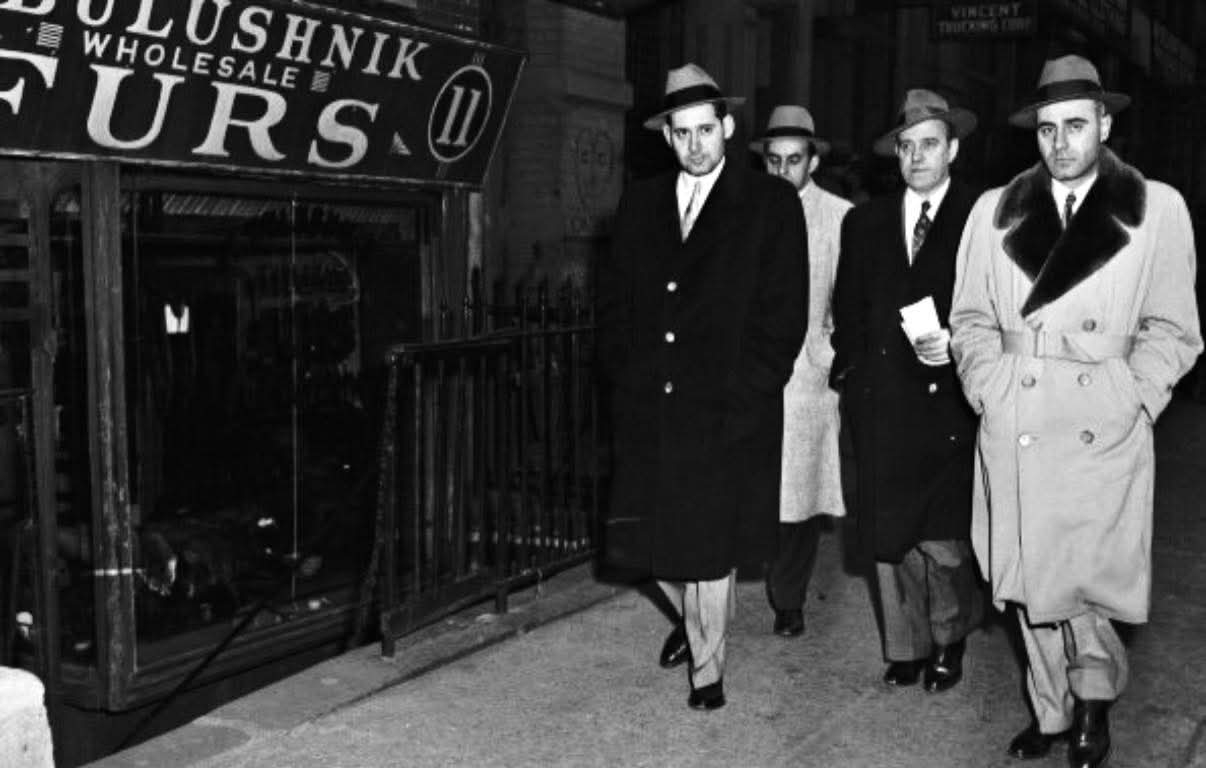
The Brothers Eboli, Genovese Family mobsters former acting boss Thomas "Tommy Ryan" (right) and captain Pasquale "Patsy Ryan" (left) Eboli, they are pictured accompanied by detectives following their booking at Elizabeth Street Precinct in New York City
In the early 1950s, Tommy Eboli handled Rocky Castellani, an up and coming middleweight boxer from Pennsylvania who fought mostly in New York. In the January of 1951, Castellani would face the limited but dangerous Ernie Durando in a Madison Square Garden main event fight that would draw fewer than eight thousand spectators.
After six rounds of a dull performance in the ring. A nimble Castellani was dancing underneath the lights while Durando merely plodded around. In the seventh round, however, Durando surprisingly struck a devastating blow, he wasn’t the brightest of boxers but when he hit you, you stayed hit. He caught Castellani with a glancing uppercut that nearly knocked him out cold. Castellani managed to beat the refs count though, but he was so disorientated that Referee Ray Miller decided to have mercy and called an end to the fight.
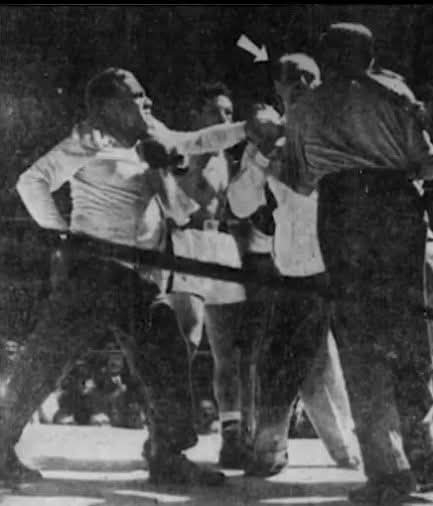
Shortly after is when the real fireworks began. As soon as Miller had called a halt to the fight, Tommy Ryan ducked through the ropes and charged for the referee. He took several swings at Miller before the ruckus broke up. It is likely an indication of just how notorious Tommy Ryan was back then that Miller refrained from hitting him back, being an accomplished featherweight back in the 1920’s he could have easily hung Tommy out to dry. Later he would testify to a grand jury: “He started throwing punches, but I was not struck a blow.”
Still foaming from the mouth Tommy would continue his rampage in the dressing room. This time his victim would be the IBC matchmaker Al Weill, best known as the undercover manager of Rocky Marciano. When Weill visited the dressing room after the fight, he was immediately attacked by Tommy and his brother Patsy. He would later have difficulty in identifying his attackers. He quoted “My glasses were knocked off and busted right away,” he said, “and I couldn’t see anything but a lot of fists flying.”
On January 23, 1952, Tommy was indicted on two counts of assault following the boxing incident. Then on May 26, 1952, he pleaded guilty to reduced charges and was later sentenced to 60 days in prison, his only incarceration during a life of crime. The New York State Athletic Commission also banned him from the sport of boxing for life.
Genovese Mob boss Thomas "Tommy Ryan" Eboli attacks Ray Miller
Looking at photos of Thomas "Tommy Ryan" Eboli, the thing that jumps out at me is his eyes, he has deadpan, emotionless, cold eyes, like he's looking right through you. A stone cold killer.
Thomas "Tommy Ryan" Eboli, was murdered on July 16, 1972, in Brooklyn, New York. He was shot five times in the head and neck at close range by a gunman in a passing truck while sitting in his parked Cadillac, dying instantly, he was found on the sidewalk next to his car. As is the case with a lot of gangland hits, no one was ever charged with his killing.
This photo from the Eboli family shows Rocky Castellani (on the far right) with his arms around Xavier Eboli, Thomas "Tommy Ryan" Eboli's son. The man on the far left is former world boxing middleweight title contender, Walter Cartier.
You know, it's sad that boxing was poisoned by the mob for so many years, they slithered their way into the sport and fixed a lot of fights for betting purposes, and ruined a lot of fights in the process. God only knows how many greats fights were ruined because of the mob's crooked influence. And these two men right here were behind it all, Lucchese Crime Family Soldier Frankie "Mr. Fury" Carbo and his sidekick Frank "Blinky" Palermo. Carbo was nicknamed "Mr. Fury" because of his fiery temper, he could go from friendly to homicidal in an instant. Carbo was a scary guy, a stone cold killer, heaven knows how many people he killed or had killed during his reign of terror. Carbo started off his career as a hitman for the infamous Murder Inc. Some theories suggest that Carbo was the triggerman in the murder of famous mobster Benjamin "Bugsy" Siegel in Las Vegas in 1947. Frank "Blinky" Palermo was an associate of the Philadelphia Crime Family and a close ally of Carbo. Both Carbo and Palermo controlled quite a few fighters, Sonny Liston, Ike Williams, Johnny Saxton, Jimmy Carter just to name a few.
Back to Rocky Castellani, after Thomas "Tommy Ryan" Eboli was banned from boxing for life after attacking Ray Miller, Tex Sullivan took over management for Castellani. I just want to say this, the fighters that were managed by these mobsters shouldn't be blamed for any of this, the mob was no joke, if you didn't play ball with them you just might come home one day and find your wife dead. The mob was ruthless and wouldn't hesitate to kill you or a member of your family if you rejected them. They were low-life scum, money and power was all that mattered to them. If you were a fighter back then, it was a tough and dangerous jungle to navigate.
These photos are from the Rocky Castellani vs Ernie "The Rock" Durango fight. The second photo is wicked, Castellani catching Durango flush with a brutal left hook, Durango's face looks like a damn Michael Myers mask.
I can't seem to find any photos from the fight, but Rocky Castellani also holds a win over the legendary Joey Giardello, beat him in a 10-round decision on November 14th, 1951. Giardello was a tough, tough Italian with a granite chin, could box and slug, an all-time great middleweight. Here's an image of Joey Giardello.
I haven't read this book about Rocky Castellani yet, sounds like a good one.
A Marine with who fought in the battles of Guam and Iwo Jima, including the attacks on Guam, Iwo Jima, Mount Suribachi, Hill 382, and Hill 362, Rocky Castellani began his boxing career on a return visit to Guam. Word soon spread about young Rocky’s prowess as a boxer that he quickly found himself being sent to China as a boxer representing the Army. His name established, he returned to America to begin his famous boxing career. Except for Rocky Marciano, the Heavyweight Champion of the World, who did not make a come¬back after retiring undefeated, Attilio Rocky Castellani made an unsuccessful comeback for the Middleweight Crown. In his quest for that title, he fought a courageous bout with the legendary Sugar Ray Robinson, whom Rocky knocked down for a nine count in the sixth round. Sugar Ray, nevertheless, was able to hang on and to win the bout by a split decision. In this biography, we learn about Rocky’s youth, and about his education background; we are also privy to his limited English-speaking immigrants, and their impact on this precocious young man destined to enter the world of competitive boxing.
Final thoughts about Rocky Castellani. He fought everyone in the strongest era in middleweight history and either beat them or held his own. He fought for his country in Guam and Iwo Jima, two of the bloodiest and most terrifying battles in history, the man went through things that we couldn't imagine going through, he literally walked through hell. I've enjoyed learning about him and watching him fight on film and I appreciate his service to our country. I will be collecting whatever items I can find of him, he was a bada$$.
Greats shots of Marvin Hagler bleeding. You know, Marvin Hagler famously stated his lack of fear regarding blood, noting it sometimes empowered him during fights. A well-known quote attributed to him is:
"I'm not scared of blood. Matter of fact, it turns me on sometimes. The monster comes out."
Hey, let's do a profile on Oscar "Battling" Nelson, aka "The Durable Dane", aka "The Abysmal Brute", he certainly deserves it. He was a lightweight in the early 1900s, world lightweight champion from 1908 to 1910, my favorite lightweight of all-time as a matter of fact, and the reason being is that he had a hellish mindset, he was legitimately one of the toughest men to ever live. He was made in hell. Put him in any era and there will be blood. One of my dream matchups would be Floyd Mayweather vs Battling Nelson, Mayweather would have nightmares about Nelson for years after they fought.
''I'd rather fight than eat. That's the secret of my success.''
- Battling Nelson
Hell on Earth: The Bloody Wars of Battling Nelson in The Old West
By: Mike Casey
The story is old but it still chills the blood upon its retelling. Ad Wolgast, the former lightweight champion of the world was out doing his running when a curious patrol cop stopped him by the roadside. Wolgast was an incongruous addition to the sprawling landscape and the cop knew it.
Do fans really want Usyk vs. Wilder, or is that matchup...
“Hey, Ad, what are you doing?”
“Doing my training for the Nelson fight,” Wolgast replied, “and I’m gonna lick the son of a bitch!”
Nothing wrong with that, you might think. Just another pumped up fighter getting in the zone. Except that Wolgast was training for a fight with Battling Nelson that had taken place years before.
Ad was lucky that day. The cop was kind and cared about his welfare. Other figures of authority were not so compassionate to the great old champion as he descended slowly into madness in the later years of his hard life. He was once savagely beaten by a couple of would-be toughs who wanted to brag to their friends that they had thrashed the great Ad Wolgast.
Ad was already suffering from significant brain damage before his violent fighting career was over. The man they called the Michigan Wildcat knew no other way to fight than to attack his prey with hell-for-leather, kamikazi-like rushes. He would rip into his opponents and smash away with everything he had. Over the years, the injuries piled up. Wolgast suffered numerous breakages to his hands, arms and ribs. He broke a bone in his right arm in his 1914 fight with Freddie Welsh and fought Cy Smith a year later with a damaged right hand. In a 1916 brawl with Chet Neff at the Dreamland Rink in Seattle, Ad’s ears were so badly bashed up that he later required surgery.
By the time Ad finally quit fighting in 1920, his mind was scattered to the point where he still believed he was back in the glory days. California promoter Jack Doyle was appointed his official guardian and allowed Wolgast to train for imaginary fights.
No amount of fights were enough for Wolgast, even though he had tested his mettle against just about everybody who was somebody during his fourteen-year, 142-fight career. Indeed, Ad’s record is a handy short cut for getting a line on who was who in a tough era that teemed with outstanding talent.
The Wildcat waged war with Owen Moran, Frankie Neil, Abe Attell, Harlem Tommy Murphy and Matty Baldwin. He duelled with Mexican Joe Rivers, Willie Ritchie, Leach Cross, Frankie Burns and Ever Hammer.
Yet it was the incredible Oscar ‘Battling’ Nelson who penetrated and lingered in Ad’s clouded and tortured mind after all the years had passed and all the wars had been fought. Nelson continued to haunt a great many of his opponents in similar fashion. It didn’t matter whether he had beaten them or they had beaten him. The impression he burned on men was indelible.
There was nothing strikingly obvious in Battling Nelson’s physique or countenance that marked him out as the extraordinarily tough and resilient man that he was. Yet his nickname of the Durable Dane was thoroughly fitting. He was blond, lean and muscular, but certainly not a physical superman or an immediately daunting vision to behold. The genuinely tough men rarely are.
They are simply hard and unyielding all the way through, blessed with that fighting spirit and special armour that is simply indefinable.
Nelson couldn’t compare to George Chuvalo for his ability to stay upright. Bat was knocked down and sent reeling many times. He didn’t have the rugged and uniquely oily skin of the astonishing Joe Grim, which staved off cuts and welts. Nelson, like Wolgast, spilled more blood and collected more bruises than was good for him. But just once in his magnificent career was Bat Nelson knocked out, and only then after fourteen years of brutally hard campaigning. Liverpool’s Owen Moran, known simply as Fearless and a kindred spirit of Nelson in his quietly terrifying demeanour, turned the unique trick when he aced Bat in the eleventh round of their 1910 battle in San Francisco.
By that time, Bat had given and received the kind of punishment that we can only imagine in the mercifully more compassionate era of the present day. He was getting involved in storybook brawls from the earliest stages of his career and making headlines in other ways too. He scored one of the fastest knockouts in history when he despatched William Rossler in just twelve seconds at Harvey, Illinois, in 1902. But it seemed that Nelson always had to pay the piper on those rare occasions when he had it easy.
In December of that year, he locked horns with Christy Williams at Hot Springs in Arkansas in a free-hitting brawl which featured a remarkable fifty-one knockdowns. Nelson decked Christy forty-two times but visited the canvas nine times himself before posting a seventeenth round knockout.
It soon became apparent that Nelson was a dangerous man of destiny who cared little for his welfare in his dangerous pursuit of glory. Such are the special and sometimes frightening qualities that separate the true fighting men from the safe and the compliant. There are no safety nets for such warriors, no carefully structured career paths or get-out clauses, no pension plans to soften a sudden fall. They measure their distance from the starting gate and simply run pell-mell for the finishing line.
This potent drug in Nelson’s system would never be flushed from his bloodstream, as he readily acknowledged during the latter stages of his career when he kept coming back for more against all good advice. “You just can’t quit, that’s all,” Bat explained. “They say a criminal is drawn back irresistibly to the scene of his crime. Well, so is a fighter drawn back to the old rings, to the old crowds and to the old excitement.”
On the march
By 1904, Battling Nelson was on the march. In September of that year, he survived a shuddering knockdown to take a 20-rounds decision from the formidable Mexican Aurelio Herrera in a punishing fight at Butte, Montana. Bat ran into something of a soul brother in the ferocious Herrera, who attacked with similar viciousness and could hit with terrific force.
Two months after that unrelenting slugfest, Nelson stopped Young Corbett in ten rounds at San Francisco, which secured him a match with the skilful Jimmy Britt for the vacant world lightweight crown. Britt proved too slick for Bat in boxing his way to a points victory at the Mechanics Pavilion in San Francisco, but Nelson had arrived in the big time and his reputation as a man to be feared had spread far and wide.To Bat, fighting meant one thing: winning at all costs and bringing into play any tactics that would get the job done. He was dangerously reckless, to himself and to his opponents, but was unswerving in his belief that fighting was a dog-eat-dog business.
Nelson would willingly sacrifice his head to draw fire and test his adversary’s power of punch. He would batter his way forward, firing all the time and weakening the other man with persistent body punching. Bat’s left hook was a debilitating weapon and he would extend his thumb and forefinger upon delivery to heighten its penetration.
Much is made of how Harry Greb and Sandy Saddler would beef up their attack with imaginative twists of the Marquis of Queensberry rules. Nelson was a master of such guerrilla warfare, although considerably less subtle and apologetic. Gouging, elbow smashes to the face and the odd knee to the groin were all among the spicy ingredients that Bat added to his eclectic recipe.
Nelson was ready when he got his second chance at Jimmy Britt in the great old fight town of Colma on the San Francisco peninsula, in 1905. Colma was always a fittingly eerie location for life and death battles. To this day, its seventeen cemeteries still occupy more than seventy per cent of its land area.
Nelson tried everything he knew to put Britt in the ground, but masterful Jimmy boxed and side-stepped beautifully for the first sixteen rounds as Nelson chased and hustled and tried to goad the champion into trench warfare. In the eighteenth, Britt made his big mistake. Nelson charged out of his corner in his frustration to trap his evasive foe and make some kind of definitive impact. Bat got his break. Staggering Jimmy with a hard left, Nelson jumped on his man with a hail of follow-up blows. In his distress, Britt allowed himself to be sucked into the eye of the storm as he began to trade. Opening up with both fists, he tried to slow the manic Nelson by punishing his body with a volley of punches.
It was a situation in which Bat revelled. Far from being discouraged, he upped his work rate and soon had Britt’s knees buckling as the crowd roared. Nelson was a terrific in-fighter who simply wouldn’t relent once he had established his foothold. Britt, the ring scientist, the beautiful boxer, was suddenly swinging wildly and crudely in his final fling at taming the madman who seemed to be eating him from the waist up.
In later years, ringsiders would describe this frenetic round of ceaseless hitting as one of the toughest and most violent in ring history. It ended spectacularly when Nelson nailed Britt with a right to the heart and knocked him out with a final left hook.
Goldfield
There is a commemorative plaque in the once thriving mining town of Goldfield to the Herculean struggle that took place there between Battling Nelson and Joe Gans in September, 1906. Just a simple plaque, baking in the sun and the deadly quietness.
On one of my trips there in 1980, almost seventy-four years to the day after that great fight, I remember a trucker jumping down from his rig and announcing to the local coffee shop proprietor that it was 102 degrees that morning and rising. Even the natives were having trouble staying upright in the unforgiving heat. I kept wondering how two men of even the exceptional qualities of Nelson and Gans could have fought each other for some forty rounds in that furnace.
At that time, Goldfield was a wondrous and rollicking hub of activity, the biggest town in Nevada with a population of some thirty thousand. Stores and saloons abounded. The biggest saloon was Tex Rickard’s Northern, whose mighty bar required eighty tenders to man it. The imposing Goldfield Hotel was the most opulent establishment of its kind between Kansas City and San Francisco.
But the heat didn’t keep too many people in the shade when Battling Nelson squared off with Joe Gans. Bat knew exactly what he was up against in the man they called the Old Master. Gans wasn’t merely a revelation, he was a genuine boxing revolutionary, a man of multiple skills whose planning and strategy were far ahead of his time. To this day, Joe is still reckoned by many to be one of the most complete and accomplished ring mechanics there has ever been. Just as one struggles to highlight a significant weakness in the perfect welterweight package that was Sugar Ray Robinson, so the ghost of Gans continues to teasingly invite us to spot the slightest smears in his make-up. There were certainly none to make a great fuss about, save for his general fitness, which was not on a par with that of his great all-time rivals Benny Leonard and Roberto Duran.
Joe contracted tuberculosis late in his career, and it is not known when exactly the true effects of that then deadly illness began to sap his strength and strip him of his powers. Those powers were awesome. A master at holding the centre of the ring and handling any given situation, Gans was a sublime boxer and a tremendous hitter. He was one of the first genuine combination punchers and his speed of hand and foot was arguably unexcelled. He could counter punch with precision, work the body and was a wizard at slipping, feinting and blocking.
At Goldfield, Joe fought heroically against Nelson and prevailed in controversial circumstances. Gans had already reigned long and successfully as world champion and was still claiming the title. Nelson begged to differ.
What unfolded was a titanic battle of wills, in which the science of Gans was pitted against the all out aggression and high octane punching of Nelson. Joe’s clever mind calculated the most prudent game plan, which he followed with his usual, measured discipline. Bat rushed him as only Bat knew how, but the Old Master was always one step ahead of the game as he jabbed solidly and made himself an elusive target. Ringsiders marvelled at Joe’s footwork and the cool way in which he feinted Nelson into making errors. A 20-rounds fight that day would have been a stroll in the park for Gans and a comfortable points victory. But this was the long haul territory in which the tireless Nelson revelled and excelled. Many lesser men would have been demoralised into giving up the chase, yet the stinging punches of Gans seemed to refresh and galvanise Bat like splashes of cold water. He just kept coming, never missing a chance to hammer away with his renowned half-arm punches when he could get inside.
Was this man Nelson human?
That was the question that even the worldly Gans must have been asking himself as the brutal fight wore on. The correctness of Joe’s punching was a thing of beauty as he snapped back Bat’s head with monotonous regularity. What right minded human being could have possibly enjoyed such punishment? Everything about Nelson’s demeanour conveyed the message that he was in his own special heaven.
Both men had been severely beaten and drained by the time they staggered into the home stretch beneath the Goldfield sun, but Nelson’s sheer persistence now had Gans teetering on the brink of defeat. After forty-one torrid rounds, Joe had to feel his way back to his corner like a blind man as the last reserves of his strength leaked away. Nelson had him. Gans reeled and stumbled around the ring in the forty-second as Nelson eagerly rushed for the kill. But then Bat delivered the punch that would deprive him of certain victory and make him resentful of Gans for a long time afterwards.
The controversial blow was Bat’s speciality and he had delivered it perfectly so many times before: a half scissor hook to the liver whose journey seldom amounted to more than six inches.
It was a terrible, paralysing blow, and Joe dropped like a man who was dying. Then referee George Siler dropped a bomb of his own. After hesitating, he ruled the blow illegal and declared Gans the winner on a foul. Nelson was furious and dedicated himself to levelling the score.
He had to wait patiently for two years before exacting his revenge and knocking out the jaded genius in seventeen rounds at Colma. Three months later, at the same venue, Bat confirmed his position as the world’s top lightweight when he knocked out Joe in the twenty-first. Over two years and the incredible span of eighty rounds, the two titans of the game had finally concluded their business.
Wolgast at Point Richmond
For all the punches he had taken, the injuries he had sustained and the blood he had spilled, Battling Nelson had still to approach the cathedral of his marathon wars in the Old West. There, at Point Richmond in California on February 22 1910, he would scale the giddiest heights of all against a man of similarly unshakeable resolve in Ad Wolgast.
The descriptions of that long and violent fight continue to ricochet and echo through the corridors of time. Historian Nat Fleischer described it simply as ‘a truly Homeric engagement’.
Nelson tried his heart out against Wolgast that day, but the Durable Dane finally slammed into the buffers against a mirror image of bloody-minded tenacity. Bat started fast, which he didn’t usually do, probably goaded by Wolgast’s pre-fight taunts. The two men detested each other and Nelson would scathingly refer to Wolgast in later years as “… the cheapest man I ever met.”
The rules of boxing simply vanished as the two warriors tore at each other with the apparent blessing of referee Edward Smith. Nelson shook Wolgast with some meaty rights in the early rounds as Ad countered and concentrated on pounding Bat’s body in close. The fighters butted each other all the way through, punched low, gouged each other’s eyes and threw in more than the occasional elbow smash to the face for good measure. In the sixteenth round, Nelson locked Wolgast’s head with his left arm and banged him to the kidneys with a succession of vicious rights.
But nothing would deflect Ad from his task. He was the younger man by six years at twenty-two, while Bat was already a grizzled veteran at twenty-eight. After thirty-seven rounds of savage fighting, Nelson was all but done and even referee Smith didn’t want to see any more. He asked the champion if he wanted to continue, but Bat typically waved him away. The head and body shots from Wolgast had reduced Nelson to a pitiful state. His legs could barely hold him up and blood ran from his nose and ears. Finally, after nearly collapsing from a Wolgast smash to the chin in the fortieth round, Bat was rescued and the fight was halted.
Both courageous battlers were smeared in blood at the end. Both were bruised and swollen. Battling Nelson could barely see out of the two slits of his eyes. The gruesome vision he presented said everything about his fighting heart and spirit.
He looked as if he had been in a gunfight. And how else was a devil-may-care gunslinger supposed to look in the thunderous theatre of the Old West?
One thing about Battling Nelson, the guy was inhuman, he was able to take ungodly amounts of punishment and keep fighting, they didn't call him "The Durable Dane" for nothing. This is absolute gold. It talks about how Battling Nelson was able to take the kind of punishment he was able to take.
Battling Nelson's most brilliant fight may have come outside of the ring.
Remembering Battling Nelson and his greatest fight
In a discussion about boxing's keenest wits, the name of Oscar Matthew Battling Nelson - the early 20th century lightweight champion - isn't likely to come up. But he was no mere mindless boxing brute.
By: Pete Ehrmann
Special to OnMilwaukee.com
In a discussion about boxing’s keenest wits, the name of Oscar Matthew Battling Nelson isn’t likely to come up. The conventional wisdom about the early 20th century lightweight champion is that he used his head mostly as a target for opponents to strike at will until the futility of it wore them down and made them easy pickings for the fighter known as "The Durable Dane."
"He defeated most of the men he met by simply taking everything they could deliver," wrote referee Charley White in 1911. "Take the time he fought the great Joe Gans at Goldfield (Nevada). In that fight Nelson took enough punishment to have beaten 10 men; still, there was never a time but that he believed he’d beat the Negro."
A 1915 newspaper article posited that "Nelson was struck more blows than any other fighter ever received in the ring," and reported that "doctors who examined him said he was of subnormal nervous organism, meaning his nerves were less sensitive than those of ordinary men, and did not carry shock to the brain in the normal way."
Nelson was less clinical. "When I go into the ring, I want to get in as many punches on the other fellow in places where they will do the most good," he said, "and in order to do this, I’m willing to take a few hard raps myself. And I know I can stand them."
Richard S. Davis, later a Pulitzer Prize-winning reporter for The Milwaukee Journal, was in Colma, California on Feb. 22, 1910, when Nelson lost his title to Ad Wolgast in 40 blood soaked rounds. "Nelson took punch after punch in the face and ribs until he looked like a great chunk of round steak down as far as the belt," Davis recollected 43 years later.
By the 39th round, Davis said, whenever a Wolgast punch landed on Nelson’s gory face, "it was almost like a child pushing his fists into a moist mud pie."
Nelson derided Wolgast as a "cheese champion" because he was still on his feet when the referee stopped the fight. Nine months later, when Owen Moran became the first (and only) man to put Nelson down for the count, Bat grudgingly hailed the Britisher as "a greater discoverer than [Frederick] Cook or [Robert] Peary. These two fellows claimed they found the North Pole, but Moran discovered beyond a doubt that I am a human being."
(Interesting enough, Nelson and heavyweight champ Jim Jeffries, that era’s other totem of impregnability in the ring, both wanted nothing to do with the burgeoning [and then very lethal] sport of football because it was too violent. "It’s a great sport," said Nelson in 1904, "but excuse ‘Bat’ from mixing it up with that bunch of murderers. Those fellows seem to be enjoying themselves, but mine with the padded mitts and a referee that won’t let ‘em kick when I’m down ... ").
While duly impressed with the Battler’s stamina and brute instinct in the ring, historians haven’t given Nelson sufficient credit for the fact that his battered noggin contained an active and surprisingly facile noodle.
He was a frustrated writer, among other things. Nelson produced an autobiography, "Battling Nelson -- His Life, Battles and Career," but he knew his literary limitations and relied on newspaperman Vincent Treanor for help over the rough patches.
Treanor recalled being asked by Nelson during their collaboration, "What is the exact meaning of the word ‘notorious’?"
When Treanor explained that it "implied fame for bad deeds rather than for good ones," Nelson was relieved.
"It’s all right then," he said. "I wanted to call Jack London a ‘notorious writer’ for having wrote me up as ‘The Abysmal Brute,’ and I was afraid I might slip him a boost by mistake."
Both Nelson and the typewriter got their start in Milwaukee, and according to Manning Vaughan of The Journal, the former had "a mania" for the latter.
"He never failed to pay us a visit … after becoming a champion," wrote Vaughan in 1927, "and five minutes after he was in the office he would sit down and write that well known beginner’s line: ‘Now is the time for all good men, etc.’ over and over again."
When Nelson visited the sports department on the eve of a fight and was done with his typing, he’d stand up and declare, apropos of the impending contest, "This will be no pink tea party." Hemingway couldn’t have put it better.
Maybe the Battler’s canniest achievement, for which he deserves at least honorable mention in a discussion of great boxing wits, occurred 104 years ago today. The occasion was the Dec. 8, 1913 fight in Milwaukee between lightweight contender Packey McFarland and future welterweight champion Jack Britton.
Boxing had been legalized in Wisconsin earlier that year, and 8,000 fans packed the Auditorium for the much-anticipated 10-round no-decision match. They left holding their noses.
McFarland got the nod from the newspapers the next day, but Manning Vaughan wrote, "he boxed so poorly and showed so little inclination to force matters that he was booed and hissed throughout the 10 tame rounds."
When Battling Nelson died on Feb. 7, 1954, The Journal’s Sam Levy, who knew Nelson and covered many of his bouts, disclosed one of the reasons McFarland looked so bad against Britton.
As the fighters were being introduced, Nelson sat down next to Levy at ringside and tore a handful of blank pages from the latter’s notebook.
"I hate that guy McFarland," said the Battler. "Watch me get him crazy."
At the end of every round, Nelson grabbed Levy’s pencil and scribbled on one of the notebook pages, then folded and tossed it into Britton’s corner.
"What are you writing?" asked Levy after this had gone on for a while.
"Nothing," sneered Nelson. "I don’t have to tell Britton how to fight. He’s one of the smartest in the business. But keep an eye on McFarland. He’ll go crazy."
Wrote Levy: "Packey, the crafty boxer, was so mad at Nelson that he couldn’t fight."
This article says it all, the 42-round fight between Battling Nelson and "The Old Master" Joe Gans in Goldfield, Nevada, 1906 was one for the ages. Can you imagine going 42-rounds in the hot desert sun, it was hot as hell that day, an inferno, and the fighters must have felt like they were fighting in an oven. Joe Gans is one, if not the greatest, lightweight in boxing history. Joe Gans earned the nickname "Old Master" for his incredibly advanced, cerebral, and fundamentally flawless boxing style that made him appear far more experienced than his opponents, despite gaining the moniker early in his career. As the first African-American boxing champion, he was a master of ring generalship, timing, and strategy.
1906 Gans-Nelson fight was one for the ages
By: JOHN L. SMITH LAS VEGAS REVIEW-JOURNAL
These days it’s just a junk-strewn lot off U.S. Highway 95 in the heart of Goldfield.
For true boxing fans, the site of the Sept. 3, 1906, lightweight championship fight between Joe Gans and Oscar “Battling” Nelson ought to be sacred ground. Not only was it where the longest fight in modern boxing history took place — 42 rounds! — it also helped propel outlaw Nevada into prominence as a haven for the “sweet science.”
Historians and scribes can justifiably point to other Nevada matches as holding importance in the history of the fight game in the state, but for many aficionados the answer is Gans-Nelson — the “Old Master” vs. the “Durable Dane.”
Rumors of a possible Gans-Nelson fight began more than a year before the Goldfield bout. The men may be largely lost to popular history, but they were well known to boxing fans in the feisty years following the turn of the last century. Boxing was still illegal in many areas of the country and notorious in most.
“Gans has been training faithfully of late in the hope of getting another crack at (Jimmy) Britt and his manager, Al Hertford, would rather see his brown protege take Britt on than the battling Dane,” the Los Angeles Examiner observed March 3, 1905. “Nelson also professes to wish for another chance to turn the tables upon Britt.”
Gans had beaten Britt on a disqualification a few months earlier in San Francisco, but as the days passed attention turned to a big promotion in Goldfield. The town’s promoters, Northern Saloon owner and future Madison Square Garden promoter George “Tex” Rickard chief among many. More than $30,000 was put up for a championship match, an arena was built of pitchy pine, and soon enough word went out far and wide that a lightweight championship bout pitting Gans against the bruising Nelson was on. Nevada political powerhouse George Wingfield and stock hustler George Graham Rice helped promote the event with an eye on increasing their list of investors in mines of undetermined worth. The image of the black man fighting the white man was irresistible to sports writers of the era and captured the public’s fascination.
Thousands flocked from all points of the map to Goldfield, then a center of mining discovery both real and imagined. Goldfield was too big for its britches from the start. Its promising ore deposits were lusty if eventually illusory, and promoters made as much of their fortunes from investors from the East who dreamed of the rush for gold and silver to be found in the West. The Gans-Nelson fight worked not only as a phenomenal feat of fisticuffs, but also as a great way to put the wonders of booming Goldfield in bold type in newspapers across the country.
The best sports writers made the trip to Nevada, and even the famous Jack London was at ringside to record the bout and collect material for future stories. (After watching Nelson and Gans, he was moved to write the short story “The Abysmal Brute” about a character very much like the Dane.)
The mostly white crowd started out in Nelson’s corner, but in short order came to admire Gans for his unflappable grace despite heaps of ridicule and race baiting. By fight day, newspapers that initially had portrayed him a cowardly caricature admitted he was game and showed admirable skill despite the weather that topped 100 degrees and a steady harangue from Nelson and his entourage.
These days, Esmeralda County Justice of the Peace Juanita Colvin occasionally is asked to answer questions about the fight’s history. She’s still amazed how the town accommodated an additional 15,000 boxing fans and national media, the local telegraph office chirping out round-by-round results.
“The amazing thing for me was how quickly the promoters put that together with limited communications,” Colvin says. “They had telegraph and some telephone service. And within about two months they had gold coins stacked up, the arena built, and the advertisements out. It drew a crowd of thousands of people.”
Joe Gans would do most of his talking in the ring.
On fight day, with the weather sweltering and President Teddy Roosevelt’s son Kermit, at ringside, referee George Siler brought the men together at center ring. Despite holding the world lightweight title, Gans was set to receive just $11,000 for the fight with Nelson grabbing the greater share of the purse at $22,500. Gans didn’t quibble much; a recent divorce had left him nearly penniless. He needed the money.
Former Washington Post reporter William Gildea wrote a book on Gans called “The Longest Fight,” in which he highlights the Goldfield experience. Gans was America’s first African-American champion, holding the lightweight title from 1902-08.
Gildea writes: “The sun beat down from a cloudless sky. Heat shimmered off the desert floor. The air was so hot it seemed as if it could turn reality inside out and make wide-open space seem claustrophobic. You almost had to concentrate to breathe.”
The Nelson fight in Goldfield would be the 31-year-old Gans’ 187th as a professional. Nelson, at 24, was in his tenacious prime.
And they were off. Nelson was indeed durable, and peppered his punches with the occasional low blow and errant elbow. Gans was by far the more skilled practitioner, but his sojourn was complicated when he broke his right hand in the 33rd round. He fought the rest of the fight almost one handed, still kept Nelson on his heels, and at one point even helped the Dane to his feet after a knockdown. Nelson returned the favor with another low blow, and by the 42nd round Siler had seen enough. Gans won on a disqualification.
Nelson, badly beaten, bruised almost beyond recognition, and yet bitter, barked for a return match. He would get two and win both at a time Gans, unbeknownst to many, was suffering from a terminal case of tuberculosis. By 1910 he’d be gone, dead in his hometown of Baltimore at age 35.
For his part, Nelson never seemed to quite get over his loss to Gans that day. Although he’d actually defeat the Old Master twice in the next couple years, revenge would not be sweet. When he penned his autobiography some years later, it was clear he was still stinging from his experience in the Nevada desert.
The Dane fought in Havana and Juarez late in his career and lived until 1954. He never again fought in the Silver State.
The 42-rounder in Goldfield would go down in boxing history not only as the longest fight and an early battle of the races — ironically, with the black man coming out as a crowd favorite — but it was also the first major bout captured on film.
Goldfield’s mineral fortunes have risen and fallen in the century since the Gans-Nelson fight, but the town’s golden place in boxing history is secure.
Another great article about that 1906 fight between Battling Nelson and Joe Gans. Great photo right here of Battling Nelson arriving in Goldfield Nevada prior to his first fight with Joe Gans. You can see the famous fight promoter Tex Rickard with the number 3 on him.
This article appeared at East Side Boxing Sept 2. 2006
Goldfield’s Golden Battle
The Centennial Anniversary of Joe Gans – Battling Nelson
Labor Day Sep 3, 1906
By: Monte D. Cox
Labor day 2006 observes the 100 year centennial anniversary of the famous battle between Joe Gans and Battling Nelson for the lightweight championship of the world in Goldfield, Nevada. The fight was an original one, among the last of the great finish fights. It was in fact the longest championship bout ever contested with boxing gloves.
Joe Gans, hailed as “The Old Master” by his contemporaries, was the epitome of the classic boxer puncher. Gans possessed both remarkable speed and punching power. His jab was straight and accurate, his right hand deadly from 6 inches out, his left hook a life taker. He had grace, balance and impeccable defense, being perhaps the greatest fighter ever at blocking punches and countering. His opponents often thought he was a mind reader, sensing what they were going to do next.
Battling Nelson, “The Durable Dane”, was a rough and tumble pressure fighter who was aggressive and unyielding in the relentless, dogged pursuit of his opponents. One writer said of him that, “Nelson carries in his head the thickest skull bones of any human being since Neanderthal man.” Like a torrential rain Bat was a force of nature that just wouldn’t stop coming no matter what one threw at him.
This classic confrontation between the masterful boxer and the rugged, savage swarmer took place in Goldfield, which was a popular western mining camp town. The bout was promoted by Tex Rickard in his first great effort. The purse was $33,500 of which Gans was to receive $11,000 and Nelson $22,500. The gate receipt was $76,000 the largest ever realized for a prizefight up to that time. The official attendance was 6,200. The odds at ringside were 2-1 Gans. The referee was George Siler. According to the agreed upon contract Gans weighed in 3 times, the last time before the start of the fight at 3 O’clock.
Gans weight was a big issue prior to the fight. Gans had not defended the lightweight title in two years and it was believed he would have trouble making 133 pounds, then the lightweight limit. Nelson’s manager Billy Nolan tried to gain Nelson an advantage over Gans by trying to force the great champion to weigh in dressed in his full fighting gear. The San Francisco Chronicle reported, “Nelson’s manager insists that Gans make 133 in his fighting togs, which really means 129 stripped.”
Jimmy Howard, an ex-trainer of both Gans and Nelson said that “Nolan’s tactics are very unfair, but Joe had to accede to everything to get Nelson to fight.”
Although Gans was recognized as champion by the fans and virtually every newspaper of the period, Nelson’s manager threatened to pull Nelson out of the fight if Gans would not cede to his extra demands. The general consensus of newspapermen and sportsmen alike was that the black man had been forced to take the worst of all of the arrangements.
If one watches the film of the fight the first thing one notices as the fighters head for the ring is that Gans is carrying an umbrella to keep off the scorching Nevada sun. Between rounds the corner men are furiously fanning the fighters. It was very hot that day. Although Gans appeared to be strong, the dehydration and weight draining, combined with the searing heat had to take a toll on Gans body. It is believed by some historians, including this writer that Gans bout with tuberculosis, which would shortly take his life, began due to the circumstances of this contest.
Before the fight the two fighters pose for a series of photographs. One of the most famous photos, shown in many boxing magazines (see photo top), is actually inverted. That picture shows them as southpaws. The film proves they are both posing in an orthodox stance.
At the beginning of the fight Gans took an early lead. Just as Muhammad Ali did in his fights with Joe Frazier, Gans dominated the opening rounds. By the end of the first round Nelson is bleeding from both ears. Joe Gans threw a 5-punch flurry in round 2, crushing the myth that fighters of this era did not throw combinations. Gans, in fact, often throws combinations at Nelson with frightening accuracy. They are most often landed when Gans is catching Nelson coming in. Gans is primarily a counter-puncher, but he has a fantastic jab and often leads with it to create openings. Gans swept the early rounds out-boxing and outfoxing his pugnacious opponent. Gans scored a flash knockdown of the iron-chinned Nelson in the 7th. It was a stinging right to the cheek followed by a powerful left hook that momentarily drops Nelson on his knees. The Chronicle reported, “Nelson’s face looked more like scrambled beefsteak than a human countenance by this time.”
The most impressive aspect of Gans in this fight is his footwork. Not a lot of jumping around but in spite of Nelsons strong aggression and constant pressure inside, he never is able to trap Gans against the ropes. Gans, turns, slips and never gets caught against the ropes. He is very evasive with deft moves. Whenever Nelson tries to bull Gans to the ropes, Joe lowers his center of gravity, holds his ground then turns and keeps the fight in ring center at all times. On the rare instance his back does touch the ropes he is only there a split second before slipping away. This is very impressive. You absolutely cannot get Gans back to the ropes. Gans also demonstrated that he could move in and out and was very evasive with his upper body. Gans also showed that he could even dance a little bit, circling and dancing out of danger when necessary, although not too much of this in a scheduled 45 round fight.
Nelson is clearly the aggressor, putting on constant pressure and going to the body while throwing a lot of punches. There is a consistent work rate by both men. Most of the action takes place up close. Gans inside work is comparable to Pernell Whitaker against Julio Cesar Chavez. There is excellent blocking, slipping, sidestepping, evasion, and counter-punching by Gans, simply outstanding defense. Nelson comes on beginning in the 9th round with a strong body attack. He has excellent body -punching, left hooks to the body and a Tyson like right to the side that was described as "peach" of a shot.
Nelson’s tough as nails and keeps coming no matter what with a George Chuvalo like chin against Muhammad Ali. Nelson seemed impervious to punishment and came in all the time, often leading with his head, which caused Referee Siler to constantly warn Nelson for fouls. The Chicago Record Herald, Sept 4, 1906 reported that Nelsons manager was actually calling for his fighter to use head butts, “Bunt him, bunt him, don’t let him get away" he cried. This would quickly get a fighter disqualified today.
Gans seems equally comfortable outside or inside, though he lands his hardest blows from the outside. Gans straight right hand is thrown short, compact and explosive much like that of Joe Louis. Nelson tries to crowd him (he just can't seem to get him to the ropes!) Gradually Nelson is able go to work on the inside. He won his first round in the 10th cutting Gans mouth and pounding away to the body. The next four rounds were fairly close as the tide began to turn slightly in Nelsons favor as he kept up the pressure. Then in the 15th Gans explodes flooring Nelson suddenly with a sizzling right. Nelson was shaky as he arose on unsteady legs and covered up at close quarters to avoid any of Gans long ranged straight shots.
Nelson, callous and undeterred rallied to take rounds 16-19. Gans roared back to take the 20th round nearly kayoing Nelson with a ferocious flurry of punches, punctuated by a final horrific right cross to the head that had Nelson pitching forward out on his feet at the bell. The bell saved Nelson from a certain knockout and if this had occurred today the fight surely would have been stopped! Gans seemed to be in control now and won the next couple of rounds. Nelson Rallied in the 23rd with a series of body shots and a hard right to the head that shook Gans. By the 25th round both men began to tire and the pace slowed. Then in the 28th Nelson tried to open things up and force Gans to the ropes. Gans, like a rejuvenated man, drove Nelson back with several fearful power shots to the jaw, the first of which had Nelson careening around the ring like a drunken sailor. Gans kept after Nelson who was on the verge of being kayoed at the bell.
In the 30th round the Dane intentionally hit Gans after the bell which caused the crowd to rise at once in protest. In the 33rd round Gans broke his right hand with a terrific blow on the top on Nelson's hard head. It may have seemed like the "break" Nelson was waiting for. Gans however continued to box brilliantly beating Nelson with his great left jab.
Nelson withered in the heat unable to penetrate the defense of the "Old Master". The Battler absorbed a frightful beating. He was bleeding from his ears, mouth, and nose, as well as from cuts on his face. With his left eye already closed Nelson had enough. The Dane, who had been warned throughout by Referee Siler for low blows, fouled out in the 42nd round. The foul punch is very obvious on the film. The blow was clearly observed by everyone in the arena and there was not a murmur of dissent from the spectators. In the post fight Gans said that he would have put Nelson out in a few more rounds had he not been fouled. "I was playing for his right eye", he declared, Chicago Record Herald, Sept. 5, 1906, "once I closed that, with his other eye closed too, he would have been my chicken." The two gladiators had fought 2 hours and 50 minutes; the longest championship battle ever fought with gloves under Marquis of Queensbury rules. The "Durable Dane" couldn't take any more punishment. The AP reported that it was a "deliberate foul to prevent a knockout" and wrote "Nelson strikes Gans in groin when defeat seemed certain."
Here are some comments from ringside eyewitnesses:
"It looks as though Nelson, who was a very badly beaten man, took an easy way to quit."--Frankie Neil, former bantamweight champion.
"If ever a fair decision was rendered, George Siler gave one when he awarded the fight to Gans."--Jim Coffroth, fight promoter.
"Battling Nelson took an awful beating in one of the greatest fights I have ever seen."--Kid (Joe) Egan.
"I watched the fight carefully and Gans had the best of it all the way. I think Nelson is the gamest and toughest man to ever step in the ring. There is not one man in a thousand who could have stood the punishment that the Dane took"--Jack Welsh, boxing referee.
"Never in the history of boxing have lightweights put up such a performance as at Goldfield."--Ben Benjamin, sportswriter San Francisco Chronicle.
A large monument visible in Goldfield from U.S. Highway 45 commemorates one of the great fights of all time, Gans-Nelson 1, today.
Ok, let me see if I can get some photos from the 1906 fight between Battling Nelson and Joe Gans posted here. This is an actual program from the fight.
This is so cool, these are actual tickets from the Battling Nelson-Joe Gans fight in 1906. Notice on the flip it says "Nelson DQ'D in RD 42." The ticket on the top is an original stubless ticket which names the fighters, date and venue. A Reserve Seat stubless ticket. The ticket on the bottom is an original, on site, ticket stub which names the fighters, date and venue. A Gallery ticket stub.
This is awesome, actual highlights from the Battling Nelson-Joe Gans fight in Goldfield, Nevada, in 1906. It's just amazing, they went at it for over two hours, 42 rounds, in the Nevada heat.
Battling Nelson and Joe Gans fought twice more after their infamous 1906, 42 round showdown in the boiler room of hell, Battling Nelson won both fights. These shots are from the second Battling Nelson-Joe Gans fight on July 4th, 1908, in Colma, California, at the Mission Street Athletic Club, which Nelson won by knockout in the 17th round, ending Joe Gans reign as lightweight champion. Battling Nelson was officially the world lightweight champion.
This is an on-site poster for the second Battling Nelson-Joe Gans fight on July 4th, 1908. You know, it's amazing, looking at this advertisement, the fight is scheduled for 45 rounds, that's insane, they were certainly built different back then.
This is a poster for the third and final Battling Nelson-Joe Gans fight on September 9th, 1908, which Nelson won by knockout in the 21st round and it's also advertised for 45 rounds, crazy.
The next Battling Nelson rivalry fight I want to talk about is his rivalry with "The Michigan Wildcat" Ad Wolgast, much like Nelson, Wolgast was a damn savage, able to take ungodly amounts of punishment, and he was called "The Michigan Wildcat" because he fought like a wildcat, viciously tearing away at opponents. In particular, I want to talk about the second meeting between Nelson and Wolgast, a truly apocalyptic encounter that scarred both men for life. The fight took place on February 22, 1910, at the Arena in Point Richmond, California. Wolgast defeated Nelson via technical knockout (TKO) in the 40th round of a scheduled 45-round bout, the fight was a bloodbath.
The Fight City
Boxiana
Feb. 22, 1910: Nelson vs Wolgast II - A legendary battle
By: Kenneth Bridgham
There have been few brawlers whose willingness to do whatever it took to win matched that of Oscar Nelson or Adolphus Wolgast. The careers of both Hall of Fame warriors consisted of one torturous marathon fight after another. Individually, their nigh-superhuman displays of endurance were responsible for herculean dramas that astonished fans. That these two bloodthirsty champions inhabited the lightweight division at the same time was either a godsend or a curse, depending on how much of a stomach one had for prehistoric savagery. Whenever a prizefight had the billing of Nelson vs Wolgast, a scene of inhuman mayhem was virtually inevitable.
Born Oscar Nielsen in Copenhagen, Denmark in 1882, Nelson moved with his parents to Chicago, Illinois when very young and it was there that he first stepped through the ropes. He turned pro at 14 and by his early twenties had built a national reputation as “Battling Nelson,” one of the dirtiest and toughest customers boxing had ever known. The papers called him “The Durable Dane” and in one 1904 bout, legend has it, an opponent hit him so hard that he did a somersault, yet Nelson still fought on to win. He once won a fifteen round fight despite a broken arm. A merciless body puncher, his favorite target was the liver. A conspicuous cauliflower right ear testified to the hard wars he had seen over the years.
Ad Wolgast
Nelson lost a hard-fought title challenge against Jimmy Britt in December 1904, but rebounded with a knockout in the rematch nine months later to secure the world championship. In a 1906 mega-promotion that drew a then-astonishing $100,000 gate, Nelson accepted a challenge from the ultra-skilled ex-champ Joe Gans. In a fight to the finish, Nelson rose from multiple knockdowns and eventually lost by disqualification in the forty-second round after nearly three hours of fighting under the Nevada sun. Again showing his resilience, Nelson got revenge in two more thrilling bouts with Gans, winning both by knockout to become a two-time world champ.
It seemed there was no man alive who could go tooth-and-nail with the ruthless Battling Nelson until Michigan’s Ad Wolgast emerged as a top featherweight contender while plying his trade in the talent-rich rings of California. He was five years younger and, at just under 5’5″, three inches shorter than Nelson. Otherwise, Nelson must have felt he was looking in a mirror when they met. Wolgast’s bravery and aggression seemed limitless as he tore into opponents with a fury the press could only compare with the champion and which inspired the moniker “The Michigan Wildcat.”
By the summer of 1909, 21-year-old Nelson had a record of 40–1–8, with 17 knockouts. He had also fought seven bouts in jurisdictions where official decisions were illegal and not rendered, including bouts against future Hall of Famers Owen Moran and Abe Attell. The sportswriters felt that he had lost to Moran but drew with Attell, who was the reigning featherweight champion at the time.
Battling Nelson
Naturally a featherweight, Wolgast added on a few pounds to challenge Nelson for the 135 pound title at the Naud Junction Pavilion in Los Angeles in 1909. This first encounter was scheduled for ten rounds, and since decisions were illegal in California, Ad could only win the title by knockout. It was the immovable object meeting the unstoppable force, neither man giving an inch. Wolgast, “beat the title holder, Bat Nelson, in ten rounds of as fierce a battle as any fight bug has seen in this city for months,” declared The Los Angeles Times, as both it and The Herald saw Wolgast the clear victor, but he could neither put the champion down nor knock him out, and a bloodied Nelson left the ring still holding the championship belt.
Obviously, a rematch was in order. Promoters in various cities vied for the fight and the rumored site of the match moved from Los Angeles to San Francisco to Alameda and finally to Richmond, California, which was conveniently close to both San Francisco and Alameda. Nelson’s title would once more be on the line, and this time the fighters would have forty-five scheduled rounds to try and secure the knockout. Some fifteen thousand attended the showdown, reportedly paying $37,750 to do so.
The champion kept his challenger waiting in the ring for fifteen minutes before he made his appearance. According to Alexander Johnston’s 1927 book Ten-and Out!, both despised the other after their first encounter, and “they glared at each other like two wildcats” from across the ring at the start of the rematch. In truth, Wolgast was in a jovial mood, cracking jokes with his cornermen. Johnston said that both men had agreed with the referee Eddie Smith that neither fighter could be penalized or disqualified for fouling in the match.
From the beginning, it was clear that Wolgast was adopting a cautious approach to the long fight, something his manager Tom Jones had advised. Despite being the noticeably shorter man, he focussed on jabs and combinations from the outside while the champion waded in with hooks to both the head and body, occasionally driving Wolgast to the ropes in the early rounds. In round two, Wolgast’s jabs drew first blood from Nelson’s mouth. Nelson returned the favor a round later, pounding blood out of Wolgast’s nose. Just before the bell ended round four, the challenger badly hurt the champion with a right to the gut, literally turning his body with the shot. By round five, the hard fighting turned dirty as the men exchanged repeated headbutts. “If he butts, I’ll butt,” Nelson shouted at the ref. “You’re both butting,” a frustrated Smith snapped back.
After five rounds, The Alameda Evening Times-Star had the fight even, with one round for Nelson, one for Wolgast, and three drawn rounds, and by the sixth, the torrid pace had both men already showing signs of fatigue. Nelson’s mouth hung open as he desperately sucked air, but he continued to deliver as good as he received. In the middle of round nine, two of his left hooks to the head staggered the challenger and dominated the rest of that frame. By the end of round ten, blood cascaded from Wolgast’s cauliflower ear, but The Times-Star had him up four rounds to two, with the rest even.
Despite the fatigue of both men, “More damage was done in the last thirty seconds of [round eleven] than during the entire ten rounds preceding,” with Wolgast badly battering Nelson. Rounds eleven and twelve both descended into butting contests. At one point, Nelson is said to have turned to Smith and shouted, “Don’t we have any rules at all?”
By now, Wolgast was ignoring his manager’s pleas to fight on the outside, and both men tore into each other “like tigers” in round twelve. Nelson’s face was grotesque, already looking worse than it had after forty-five rounds with Joe Gans years earlier. A head butt from him angered the crowd in round sixteen, and referee Eddie Smith warned Wolgast for butting twice in round eighteen. Nelson remained the aggressor in the fight, but his features were unrecognizable, and Wolgast seemed to be taking control. After round twenty, The Times-Star had it seven rounds for Wolgast, four for Nelson, and the rest even.
Just when it seemed Nelson was completely gassed, he staggered the challenger with a hard right in round twenty-two, then crowded him to the ropes and got home another right to the chin that dropped Wolgast “as if he had been hit with an axe.” Nelson waved confidently to his corner to signal he knew the fight was over. Then he turned around and was astonished to see Wolgast somehow rising to his feet.
Wisely covering up, Wolgast resumed his original evasive tactics, frustrating Nelson, who desperately tried for the knockout. The fighters had placed a side wager before the match, Nelson betting he could knock his challenger out by round twenty-five. He pushed hard to win the money in that frame, but Wolgast was in full retreat, focused on winning the bet for himself, which he did. In fact, it was Ad who staggered the champion with three successive rights in the middle of the round. The fans who had also bet on Wolgast to last the twenty-five rounds howled with delight as the bell tolled to end the round.
As the battle wore on, no one could blame the fighters for the occasional lull in the action, and both men began missing more often. Nelson attempted a taunting smile in round twenty-six, but all it showed was the bloody mess his mouth had become. Besides, of the two, Wolgast was now obviously the more active fighter. After thirty rounds, the paper had scored fourteen rounds for Wolgast, six for Nelson, and ten drawn rounds.
When he returned to his corner after round thirty, Nelson was told to switch tactics and back off of his challenger. “The Durable Dane” did nothing of the sort, and both men fought the next round mostly on the inside, Wolgast landing an illegal backhand blow in the mix. By the thirty-first round, some felt Nelson had seen enough and cries of “Stop it!” were cascading down from the stands.
The rounds ticked by and the fighters now frequently fell into clinches. Wolgast still came up with the occasional combination, while an exhausted and mangled Nelson was mostly missing. Toward the end of the thirty-fourth round, Nelson did the unthinkable: he took his first backward step under a Wolgast attack. To the writer for The San Francisco Examiner, he now looked “dead on his feet” and by the end of round thirty-five his face, shoulders, and chest were smeared with his own blood, while Wolgast looked still sharp as he boxed on the outside against his aging, bloodied foe, who slowly plodded after him.
In round thirty-nine, Wolgast could smell victory imminent. Unleashing everything he could muster from his fatigued arms, he sent the champion reeling from pillar to post. Despite three solid minutes of pounding to his head, Nelson refused to go down. After he wobbled to his corner, referee Smith pleaded with him to quit. “No,” replied the proud champion, “I’ll fight it out.”
Legend has it that, at the start of round forty, Battling Nelson was so badly blinded by his own gore that he rose from his stool, accidentally got turned around, and faced the wrong direction, having no idea where his opponent was, and this forced the referee to stop the action. This is not true. The ringside accounts say that Nelson came straight at Wolgast during the round, but received such terrible punishment that Smith was forced to stop the fight. As “The Michigan Wildcat” teed off on him, Nelson’s hands hung helplessly at his sides. When Smith intervened, Nelson tried to fight on and did not relent in going after Wolgast until the police forced him.
“The fallen champion was a pitiable spectacle, wrote The Times-Star. “His face was pummeled beyond recognition. His nose was horribly cut. The left side of his face resembled a huge boil. His cauliflower ear was cut into ribbons and his mouth was swollen to the size of a calf’s liver.” By comparison, Wolgast was relatively unmarked, aside from some minor swelling and scrapes, but he had endured head-butts, a knockdown, and two-and-a-half hours of brutal fighting with a relentless champion.
“I fought a careful battle,” Wolgast told the paper afterward. Only a battle-hardened slugger like him would call what just occurred ‘careful.’ “I was fresh at the finish and could have fought many more rounds,” he continued.
Nelson, too, said he could have continued on for the forty-five-round distance had he been allowed. “Wolgast’s blows were not hurting me,” he insisted. But referee Smith explained his reasoning to reporters, saying, “I did not want to take any chances, as there might have been a tragedy if the fight had gone further.” Smith said the great Nelson was clearly beyond his prime, and he was. He never again fought for a championship but remained in boxing for seven more years before finally hanging up the gloves.
Ad Wolgast was an exciting new champion, but his brutal fighting style and the frequency with which he fought burned him out quickly. He defended his belt seven times in less than three years before losing it in the second of two classic slugfests with Willie Ritchie. Down on the floor from a hard right, Wolgast reached up to land two low blows straight into Ritchie’s groin, forcing the ref to award the fight to the challenger. By twenty-five years of age, Ad Wolgast was already washed up; he just didn’t know it. He fought on until 1920, by which time he was already a physical and mental wreck.
Nelson and Wolgast fought for a third time in 1913, a no-decision bout in Milwaukee. The papers said Wolgast won, but it mattered little. Both men were badly faded and both would die pitied and penniless, Nelson in 1954 and Wolgast a year later. Wolgast in particular was a sad victim of the sport, spending the last three decades of his life suffering from dementia, and what we now recognize as CTE, his condition incurred from years of toil and punishment in his brutal profession.
These photos from the Battling Nelson-Ad Wolgast fight in 1910 deserve another look, such a legendary fight, I would love to have been there, when dinosaurs roamed the Earth, two carnivores. This is an image from round 27.
Good shots from the Nelson-Wolgast fight. One thing that sticks out is the size of the gloves they used, the gloves were much smaller and thinly padded than boxing gloves today, which means that the punishment inflicted must have been absolutely brutal.
Comments
Take a break from the fights for a moment, this is an awesome card, 1951 Topps Ringside Rocky Castellani. Notice on the back of this card it says Castellani was with the 3rd Marines on Guam, he actually fought in the battle of Iwo Jima, one of the bloodiest and most horrific battles in history. I would imagine that after surviving Iwo Jima, boxing was nothing.
A couple of photos of Rocky Castellani and Johnny "Honey Boy" Bratton, they fought twice in 1952, Castellani won both fights by decision.
These are the highlights from Rocky Castellani-Johnny Bratton 2, you can hear the pop from the punches landing, a cracking fight, two great fighters.
Rocky Castellani and Kid Gavilan in 1949, Gavilan floored Castellani twice but couldn't put him away, the tough Italian finished on his feet. One thing about Castellani, you could hurt him, but if he still had a heartbeat he was going to get up, he reminds me of Fernando Vargas in that regard. A tough gladiator.
GAVILAN CONQUERS CASTELLANI EASILY; Cuban Gains Decision in Ten Rounds After Flooring Rival Twice in Garden Ring
By Joseph C. Nichols
Sept. 10, 1949
Kid Gavilan had a much rougher time than he expected with Rocky Castellani, courageous middleweight from Luzerne, Pa., in the ten-round bout that featured the return of boxing to Madison Square Garden last night.
The Cuban, who holds the welterweight championship of his native land, won all right, receiving the unanimous decision. But, from the way things went early in the battle, it was evident that the Cuban hawk was not in there just to win. His aim was to win by a knockout, And in the second round it appeared as if Gavilan would realize his aim, for he had Rocky on the floor under the force of two fast rights to the jaw, and if ever a fighter appeared to be out for the night, it was Rocky. He didn't move at all as Referee Petey Scalzo called off eight seconds. The crowd of 11,243 was satisfied that everything was over, and Gavilan was prepared to accept the plaudits of his handlers.
Beats Knockout Count
Then, just at the count of 9, the light came back into Rocky's eyes and he jumped to his feet in time to beat the knockout count. Succeeding in staying out of harm through the rest of the second round, Rocky seemed well recovered in the third, and traded willingly until late in the session. Then Gavilan clipped him with a left to the head, and Rocky went down again. He was not too befuddled, and quickly got to his knees, prepared to take the full count. That was unnecessary, for at four the bell rang. Scalzo failed to hear it, and went on to six before he realized that the session was over. When Rocky came out for the fourth, Gavilan punished him severely, and it appeared certain that the Cuban would register his knockout. But Castellani survived somehow and for the next three rounds he boxed so skillfully as to cause his followers to think he might pull even with the Cuban.
Scores in Last Two Rounds
But Gavilan's greater strength told. In the last two rounds he clearly outpunched his game rival. Scalzo voted for Gavilan, seven rounds to two, with one even. Judge Jack Gordon had it six, three and one, and Judge Tom Guilfoyle scored it six and four for Gavilan. The winner, a 3-1 favorite, weighed 150 pounds and Castellani scaled 154. The receipts amounted to $31,736.
This is a wild story. For a brief period of time, Rocky Castellani was managed by Thomas "Tommy Ryan" Eboli, he was the boss of the Genovese Crime Family in New York City, a powerful mob family. This was back in the 1950s when the mob had it's tentacles firmly wrapped around the sport. Anyway, in 1950, Rocky Castellani fought Ernie "The Rock" Durando, he was a dangerous punching middleweight. During the fight, Durando caught Castellani with an uppercut, knocked him down but Castellani got back up, he always got back up, and was on rubber legs, so the referee Ray Miller stopped the fight. Castellani's manager, mob boss Thomas Eboli, became infuriated at referee Ray Miller for stopping the fight and jumped in the ring and attacked Miller. The funny thing about it is, if Miller wanted to he could have beat the crap out of Eboli, but he knew better than to hit a powerful mob boss. Ray Miller was an ex-fighter that had a brutal left hook in his fighting days, Miller is famous for being the only man in history to knockout the great Jimmy Mclarnin, that should tell you how hard Miller could punch, but he showed restraint with Eboli because of his mafia ties. After the incident in the ring, Eboli then proceeded to go back to Castellani's locker room and attack the fight promoter.
The Brothers Eboli, Genovese Family mobsters former acting boss Thomas "Tommy Ryan" (right) and captain Pasquale "Patsy Ryan" (left) Eboli, they are pictured accompanied by detectives following their booking at Elizabeth Street Precinct in New York City
In the early 1950s, Tommy Eboli handled Rocky Castellani, an up and coming middleweight boxer from Pennsylvania who fought mostly in New York. In the January of 1951, Castellani would face the limited but dangerous Ernie Durando in a Madison Square Garden main event fight that would draw fewer than eight thousand spectators.
After six rounds of a dull performance in the ring. A nimble Castellani was dancing underneath the lights while Durando merely plodded around. In the seventh round, however, Durando surprisingly struck a devastating blow, he wasn’t the brightest of boxers but when he hit you, you stayed hit. He caught Castellani with a glancing uppercut that nearly knocked him out cold. Castellani managed to beat the refs count though, but he was so disorientated that Referee Ray Miller decided to have mercy and called an end to the fight.
Shortly after is when the real fireworks began. As soon as Miller had called a halt to the fight, Tommy Ryan ducked through the ropes and charged for the referee. He took several swings at Miller before the ruckus broke up. It is likely an indication of just how notorious Tommy Ryan was back then that Miller refrained from hitting him back, being an accomplished featherweight back in the 1920’s he could have easily hung Tommy out to dry. Later he would testify to a grand jury: “He started throwing punches, but I was not struck a blow.”
Still foaming from the mouth Tommy would continue his rampage in the dressing room. This time his victim would be the IBC matchmaker Al Weill, best known as the undercover manager of Rocky Marciano. When Weill visited the dressing room after the fight, he was immediately attacked by Tommy and his brother Patsy. He would later have difficulty in identifying his attackers. He quoted “My glasses were knocked off and busted right away,” he said, “and I couldn’t see anything but a lot of fists flying.”
On January 23, 1952, Tommy was indicted on two counts of assault following the boxing incident. Then on May 26, 1952, he pleaded guilty to reduced charges and was later sentenced to 60 days in prison, his only incarceration during a life of crime. The New York State Athletic Commission also banned him from the sport of boxing for life.
Genovese Mob boss Thomas "Tommy Ryan" Eboli attacks Ray Miller
This is a better photo of Rocky Castellani's one-time manager, Genovese Crime Family boss Thomas "Tommy Ryan" Eboli.
Looking at photos of Thomas "Tommy Ryan" Eboli, the thing that jumps out at me is his eyes, he has deadpan, emotionless, cold eyes, like he's looking right through you. A stone cold killer.
Thomas "Tommy Ryan" Eboli, was murdered on July 16, 1972, in Brooklyn, New York. He was shot five times in the head and neck at close range by a gunman in a passing truck while sitting in his parked Cadillac, dying instantly, he was found on the sidewalk next to his car. As is the case with a lot of gangland hits, no one was ever charged with his killing.
This photo from the Eboli family shows Rocky Castellani (on the far right) with his arms around Xavier Eboli, Thomas "Tommy Ryan" Eboli's son. The man on the far left is former world boxing middleweight title contender, Walter Cartier.
You know, it's sad that boxing was poisoned by the mob for so many years, they slithered their way into the sport and fixed a lot of fights for betting purposes, and ruined a lot of fights in the process. God only knows how many greats fights were ruined because of the mob's crooked influence. And these two men right here were behind it all, Lucchese Crime Family Soldier Frankie "Mr. Fury" Carbo and his sidekick Frank "Blinky" Palermo. Carbo was nicknamed "Mr. Fury" because of his fiery temper, he could go from friendly to homicidal in an instant. Carbo was a scary guy, a stone cold killer, heaven knows how many people he killed or had killed during his reign of terror. Carbo started off his career as a hitman for the infamous Murder Inc. Some theories suggest that Carbo was the triggerman in the murder of famous mobster Benjamin "Bugsy" Siegel in Las Vegas in 1947. Frank "Blinky" Palermo was an associate of the Philadelphia Crime Family and a close ally of Carbo. Both Carbo and Palermo controlled quite a few fighters, Sonny Liston, Ike Williams, Johnny Saxton, Jimmy Carter just to name a few.
Frankie "Mr. Gray" Carbo
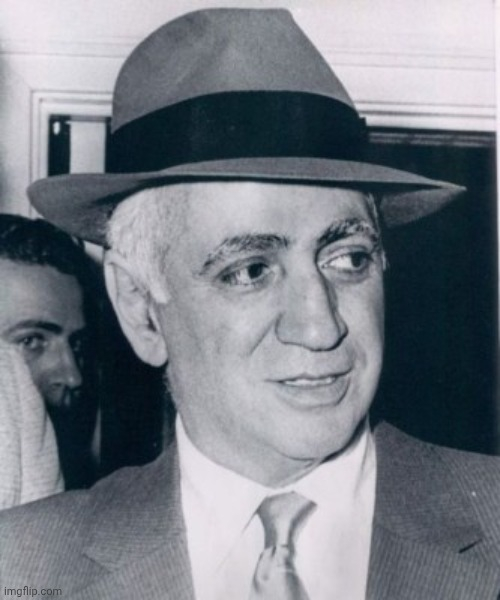
Frank "Blinky" Palermo
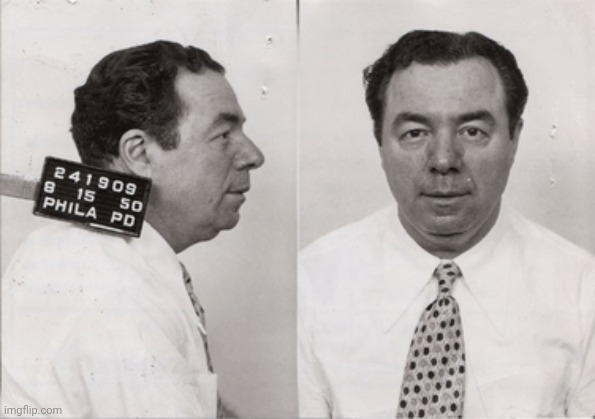
Frankie Carbo had a frightening presence, an aura of menace, his stare was genuinely frightening. He wasn't a guy you wanted to cross.
Here are a couple of more photos of Rocky Castellani with his manager Thomas "Tommy Ryan" Eboli.
Back to Rocky Castellani, after Thomas "Tommy Ryan" Eboli was banned from boxing for life after attacking Ray Miller, Tex Sullivan took over management for Castellani. I just want to say this, the fighters that were managed by these mobsters shouldn't be blamed for any of this, the mob was no joke, if you didn't play ball with them you just might come home one day and find your wife dead. The mob was ruthless and wouldn't hesitate to kill you or a member of your family if you rejected them. They were low-life scum, money and power was all that mattered to them. If you were a fighter back then, it was a tough and dangerous jungle to navigate.
These photos are from the Rocky Castellani vs Ernie "The Rock" Durango fight. The second photo is wicked, Castellani catching Durango flush with a brutal left hook, Durango's face looks like a damn Michael Myers mask.
I can't seem to find any photos from the fight, but Rocky Castellani also holds a win over the legendary Joey Giardello, beat him in a 10-round decision on November 14th, 1951. Giardello was a tough, tough Italian with a granite chin, could box and slug, an all-time great middleweight. Here's an image of Joey Giardello.
Cool autographed Rocky Castellani post card.
Rocky Castellani and Billy Graham at a pre-fight medical exam.
Cool sequence of Rocky Castellani training in 1953, love these photos with the fighters wearing the mask head gear.
Rocky Castellani on the cover of Boxing and Wrestling magazine.
Awesome shot of Rocky Castellani in the middle of a ring battle.
Another good shot of Rocky Castellani in the middle of a ring battle
Rocky Castellani on the front page of The Ringside Reporter, a prestigious boxing publication.
Rocky Castellani training.
I haven't read this book about Rocky Castellani yet, sounds like a good one.
A Marine with who fought in the battles of Guam and Iwo Jima, including the attacks on Guam, Iwo Jima, Mount Suribachi, Hill 382, and Hill 362, Rocky Castellani began his boxing career on a return visit to Guam. Word soon spread about young Rocky’s prowess as a boxer that he quickly found himself being sent to China as a boxer representing the Army. His name established, he returned to America to begin his famous boxing career. Except for Rocky Marciano, the Heavyweight Champion of the World, who did not make a come¬back after retiring undefeated, Attilio Rocky Castellani made an unsuccessful comeback for the Middleweight Crown. In his quest for that title, he fought a courageous bout with the legendary Sugar Ray Robinson, whom Rocky knocked down for a nine count in the sixth round. Sugar Ray, nevertheless, was able to hang on and to win the bout by a split decision. In this biography, we learn about Rocky’s youth, and about his education background; we are also privy to his limited English-speaking immigrants, and their impact on this precocious young man destined to enter the world of competitive boxing.
Rocky Castellani in his later years.
Final thoughts about Rocky Castellani. He fought everyone in the strongest era in middleweight history and either beat them or held his own. He fought for his country in Guam and Iwo Jima, two of the bloodiest and most terrifying battles in history, the man went through things that we couldn't imagine going through, he literally walked through hell. I've enjoyed learning about him and watching him fight on film and I appreciate his service to our country. I will be collecting whatever items I can find of him, he was a bada$$.
Music time.
Greats shots of Marvin Hagler bleeding. You know, Marvin Hagler famously stated his lack of fear regarding blood, noting it sometimes empowered him during fights. A well-known quote attributed to him is:
"I'm not scared of blood. Matter of fact, it turns me on sometimes. The monster comes out."
Hey, let's do a profile on Oscar "Battling" Nelson, aka "The Durable Dane", aka "The Abysmal Brute", he certainly deserves it. He was a lightweight in the early 1900s, world lightweight champion from 1908 to 1910, my favorite lightweight of all-time as a matter of fact, and the reason being is that he had a hellish mindset, he was legitimately one of the toughest men to ever live. He was made in hell. Put him in any era and there will be blood. One of my dream matchups would be Floyd Mayweather vs Battling Nelson, Mayweather would have nightmares about Nelson for years after they fought.
''I'd rather fight than eat. That's the secret of my success.''
Hell on Earth: The Bloody Wars of Battling Nelson in The Old West
By: Mike Casey
The story is old but it still chills the blood upon its retelling. Ad Wolgast, the former lightweight champion of the world was out doing his running when a curious patrol cop stopped him by the roadside. Wolgast was an incongruous addition to the sprawling landscape and the cop knew it.
Do fans really want Usyk vs. Wilder, or is that matchup...
“Hey, Ad, what are you doing?”
“Doing my training for the Nelson fight,” Wolgast replied, “and I’m gonna lick the son of a bitch!”
Nothing wrong with that, you might think. Just another pumped up fighter getting in the zone. Except that Wolgast was training for a fight with Battling Nelson that had taken place years before.
Ad was lucky that day. The cop was kind and cared about his welfare. Other figures of authority were not so compassionate to the great old champion as he descended slowly into madness in the later years of his hard life. He was once savagely beaten by a couple of would-be toughs who wanted to brag to their friends that they had thrashed the great Ad Wolgast.
Ad was already suffering from significant brain damage before his violent fighting career was over. The man they called the Michigan Wildcat knew no other way to fight than to attack his prey with hell-for-leather, kamikazi-like rushes. He would rip into his opponents and smash away with everything he had. Over the years, the injuries piled up. Wolgast suffered numerous breakages to his hands, arms and ribs. He broke a bone in his right arm in his 1914 fight with Freddie Welsh and fought Cy Smith a year later with a damaged right hand. In a 1916 brawl with Chet Neff at the Dreamland Rink in Seattle, Ad’s ears were so badly bashed up that he later required surgery.
By the time Ad finally quit fighting in 1920, his mind was scattered to the point where he still believed he was back in the glory days. California promoter Jack Doyle was appointed his official guardian and allowed Wolgast to train for imaginary fights.
No amount of fights were enough for Wolgast, even though he had tested his mettle against just about everybody who was somebody during his fourteen-year, 142-fight career. Indeed, Ad’s record is a handy short cut for getting a line on who was who in a tough era that teemed with outstanding talent.
The Wildcat waged war with Owen Moran, Frankie Neil, Abe Attell, Harlem Tommy Murphy and Matty Baldwin. He duelled with Mexican Joe Rivers, Willie Ritchie, Leach Cross, Frankie Burns and Ever Hammer.
Yet it was the incredible Oscar ‘Battling’ Nelson who penetrated and lingered in Ad’s clouded and tortured mind after all the years had passed and all the wars had been fought. Nelson continued to haunt a great many of his opponents in similar fashion. It didn’t matter whether he had beaten them or they had beaten him. The impression he burned on men was indelible.
There was nothing strikingly obvious in Battling Nelson’s physique or countenance that marked him out as the extraordinarily tough and resilient man that he was. Yet his nickname of the Durable Dane was thoroughly fitting. He was blond, lean and muscular, but certainly not a physical superman or an immediately daunting vision to behold. The genuinely tough men rarely are.
They are simply hard and unyielding all the way through, blessed with that fighting spirit and special armour that is simply indefinable.
Nelson couldn’t compare to George Chuvalo for his ability to stay upright. Bat was knocked down and sent reeling many times. He didn’t have the rugged and uniquely oily skin of the astonishing Joe Grim, which staved off cuts and welts. Nelson, like Wolgast, spilled more blood and collected more bruises than was good for him. But just once in his magnificent career was Bat Nelson knocked out, and only then after fourteen years of brutally hard campaigning. Liverpool’s Owen Moran, known simply as Fearless and a kindred spirit of Nelson in his quietly terrifying demeanour, turned the unique trick when he aced Bat in the eleventh round of their 1910 battle in San Francisco.
By that time, Bat had given and received the kind of punishment that we can only imagine in the mercifully more compassionate era of the present day. He was getting involved in storybook brawls from the earliest stages of his career and making headlines in other ways too. He scored one of the fastest knockouts in history when he despatched William Rossler in just twelve seconds at Harvey, Illinois, in 1902. But it seemed that Nelson always had to pay the piper on those rare occasions when he had it easy.
In December of that year, he locked horns with Christy Williams at Hot Springs in Arkansas in a free-hitting brawl which featured a remarkable fifty-one knockdowns. Nelson decked Christy forty-two times but visited the canvas nine times himself before posting a seventeenth round knockout.
It soon became apparent that Nelson was a dangerous man of destiny who cared little for his welfare in his dangerous pursuit of glory. Such are the special and sometimes frightening qualities that separate the true fighting men from the safe and the compliant. There are no safety nets for such warriors, no carefully structured career paths or get-out clauses, no pension plans to soften a sudden fall. They measure their distance from the starting gate and simply run pell-mell for the finishing line.
This potent drug in Nelson’s system would never be flushed from his bloodstream, as he readily acknowledged during the latter stages of his career when he kept coming back for more against all good advice. “You just can’t quit, that’s all,” Bat explained. “They say a criminal is drawn back irresistibly to the scene of his crime. Well, so is a fighter drawn back to the old rings, to the old crowds and to the old excitement.”
On the march
By 1904, Battling Nelson was on the march. In September of that year, he survived a shuddering knockdown to take a 20-rounds decision from the formidable Mexican Aurelio Herrera in a punishing fight at Butte, Montana. Bat ran into something of a soul brother in the ferocious Herrera, who attacked with similar viciousness and could hit with terrific force.
Two months after that unrelenting slugfest, Nelson stopped Young Corbett in ten rounds at San Francisco, which secured him a match with the skilful Jimmy Britt for the vacant world lightweight crown. Britt proved too slick for Bat in boxing his way to a points victory at the Mechanics Pavilion in San Francisco, but Nelson had arrived in the big time and his reputation as a man to be feared had spread far and wide.To Bat, fighting meant one thing: winning at all costs and bringing into play any tactics that would get the job done. He was dangerously reckless, to himself and to his opponents, but was unswerving in his belief that fighting was a dog-eat-dog business.
Nelson would willingly sacrifice his head to draw fire and test his adversary’s power of punch. He would batter his way forward, firing all the time and weakening the other man with persistent body punching. Bat’s left hook was a debilitating weapon and he would extend his thumb and forefinger upon delivery to heighten its penetration.
Much is made of how Harry Greb and Sandy Saddler would beef up their attack with imaginative twists of the Marquis of Queensberry rules. Nelson was a master of such guerrilla warfare, although considerably less subtle and apologetic. Gouging, elbow smashes to the face and the odd knee to the groin were all among the spicy ingredients that Bat added to his eclectic recipe.
Nelson was ready when he got his second chance at Jimmy Britt in the great old fight town of Colma on the San Francisco peninsula, in 1905. Colma was always a fittingly eerie location for life and death battles. To this day, its seventeen cemeteries still occupy more than seventy per cent of its land area.
Nelson tried everything he knew to put Britt in the ground, but masterful Jimmy boxed and side-stepped beautifully for the first sixteen rounds as Nelson chased and hustled and tried to goad the champion into trench warfare. In the eighteenth, Britt made his big mistake. Nelson charged out of his corner in his frustration to trap his evasive foe and make some kind of definitive impact. Bat got his break. Staggering Jimmy with a hard left, Nelson jumped on his man with a hail of follow-up blows. In his distress, Britt allowed himself to be sucked into the eye of the storm as he began to trade. Opening up with both fists, he tried to slow the manic Nelson by punishing his body with a volley of punches.
It was a situation in which Bat revelled. Far from being discouraged, he upped his work rate and soon had Britt’s knees buckling as the crowd roared. Nelson was a terrific in-fighter who simply wouldn’t relent once he had established his foothold. Britt, the ring scientist, the beautiful boxer, was suddenly swinging wildly and crudely in his final fling at taming the madman who seemed to be eating him from the waist up.
In later years, ringsiders would describe this frenetic round of ceaseless hitting as one of the toughest and most violent in ring history. It ended spectacularly when Nelson nailed Britt with a right to the heart and knocked him out with a final left hook.
Goldfield
There is a commemorative plaque in the once thriving mining town of Goldfield to the Herculean struggle that took place there between Battling Nelson and Joe Gans in September, 1906. Just a simple plaque, baking in the sun and the deadly quietness.
On one of my trips there in 1980, almost seventy-four years to the day after that great fight, I remember a trucker jumping down from his rig and announcing to the local coffee shop proprietor that it was 102 degrees that morning and rising. Even the natives were having trouble staying upright in the unforgiving heat. I kept wondering how two men of even the exceptional qualities of Nelson and Gans could have fought each other for some forty rounds in that furnace.
At that time, Goldfield was a wondrous and rollicking hub of activity, the biggest town in Nevada with a population of some thirty thousand. Stores and saloons abounded. The biggest saloon was Tex Rickard’s Northern, whose mighty bar required eighty tenders to man it. The imposing Goldfield Hotel was the most opulent establishment of its kind between Kansas City and San Francisco.
But the heat didn’t keep too many people in the shade when Battling Nelson squared off with Joe Gans. Bat knew exactly what he was up against in the man they called the Old Master. Gans wasn’t merely a revelation, he was a genuine boxing revolutionary, a man of multiple skills whose planning and strategy were far ahead of his time. To this day, Joe is still reckoned by many to be one of the most complete and accomplished ring mechanics there has ever been. Just as one struggles to highlight a significant weakness in the perfect welterweight package that was Sugar Ray Robinson, so the ghost of Gans continues to teasingly invite us to spot the slightest smears in his make-up. There were certainly none to make a great fuss about, save for his general fitness, which was not on a par with that of his great all-time rivals Benny Leonard and Roberto Duran.
Joe contracted tuberculosis late in his career, and it is not known when exactly the true effects of that then deadly illness began to sap his strength and strip him of his powers. Those powers were awesome. A master at holding the centre of the ring and handling any given situation, Gans was a sublime boxer and a tremendous hitter. He was one of the first genuine combination punchers and his speed of hand and foot was arguably unexcelled. He could counter punch with precision, work the body and was a wizard at slipping, feinting and blocking.
At Goldfield, Joe fought heroically against Nelson and prevailed in controversial circumstances. Gans had already reigned long and successfully as world champion and was still claiming the title. Nelson begged to differ.
What unfolded was a titanic battle of wills, in which the science of Gans was pitted against the all out aggression and high octane punching of Nelson. Joe’s clever mind calculated the most prudent game plan, which he followed with his usual, measured discipline. Bat rushed him as only Bat knew how, but the Old Master was always one step ahead of the game as he jabbed solidly and made himself an elusive target. Ringsiders marvelled at Joe’s footwork and the cool way in which he feinted Nelson into making errors. A 20-rounds fight that day would have been a stroll in the park for Gans and a comfortable points victory. But this was the long haul territory in which the tireless Nelson revelled and excelled. Many lesser men would have been demoralised into giving up the chase, yet the stinging punches of Gans seemed to refresh and galvanise Bat like splashes of cold water. He just kept coming, never missing a chance to hammer away with his renowned half-arm punches when he could get inside.
Was this man Nelson human?
That was the question that even the worldly Gans must have been asking himself as the brutal fight wore on. The correctness of Joe’s punching was a thing of beauty as he snapped back Bat’s head with monotonous regularity. What right minded human being could have possibly enjoyed such punishment? Everything about Nelson’s demeanour conveyed the message that he was in his own special heaven.
Both men had been severely beaten and drained by the time they staggered into the home stretch beneath the Goldfield sun, but Nelson’s sheer persistence now had Gans teetering on the brink of defeat. After forty-one torrid rounds, Joe had to feel his way back to his corner like a blind man as the last reserves of his strength leaked away. Nelson had him. Gans reeled and stumbled around the ring in the forty-second as Nelson eagerly rushed for the kill. But then Bat delivered the punch that would deprive him of certain victory and make him resentful of Gans for a long time afterwards.
The controversial blow was Bat’s speciality and he had delivered it perfectly so many times before: a half scissor hook to the liver whose journey seldom amounted to more than six inches.
It was a terrible, paralysing blow, and Joe dropped like a man who was dying. Then referee George Siler dropped a bomb of his own. After hesitating, he ruled the blow illegal and declared Gans the winner on a foul. Nelson was furious and dedicated himself to levelling the score.
He had to wait patiently for two years before exacting his revenge and knocking out the jaded genius in seventeen rounds at Colma. Three months later, at the same venue, Bat confirmed his position as the world’s top lightweight when he knocked out Joe in the twenty-first. Over two years and the incredible span of eighty rounds, the two titans of the game had finally concluded their business.
Wolgast at Point Richmond
For all the punches he had taken, the injuries he had sustained and the blood he had spilled, Battling Nelson had still to approach the cathedral of his marathon wars in the Old West. There, at Point Richmond in California on February 22 1910, he would scale the giddiest heights of all against a man of similarly unshakeable resolve in Ad Wolgast.
The descriptions of that long and violent fight continue to ricochet and echo through the corridors of time. Historian Nat Fleischer described it simply as ‘a truly Homeric engagement’.
Nelson tried his heart out against Wolgast that day, but the Durable Dane finally slammed into the buffers against a mirror image of bloody-minded tenacity. Bat started fast, which he didn’t usually do, probably goaded by Wolgast’s pre-fight taunts. The two men detested each other and Nelson would scathingly refer to Wolgast in later years as “… the cheapest man I ever met.”
The rules of boxing simply vanished as the two warriors tore at each other with the apparent blessing of referee Edward Smith. Nelson shook Wolgast with some meaty rights in the early rounds as Ad countered and concentrated on pounding Bat’s body in close. The fighters butted each other all the way through, punched low, gouged each other’s eyes and threw in more than the occasional elbow smash to the face for good measure. In the sixteenth round, Nelson locked Wolgast’s head with his left arm and banged him to the kidneys with a succession of vicious rights.
But nothing would deflect Ad from his task. He was the younger man by six years at twenty-two, while Bat was already a grizzled veteran at twenty-eight. After thirty-seven rounds of savage fighting, Nelson was all but done and even referee Smith didn’t want to see any more. He asked the champion if he wanted to continue, but Bat typically waved him away. The head and body shots from Wolgast had reduced Nelson to a pitiful state. His legs could barely hold him up and blood ran from his nose and ears. Finally, after nearly collapsing from a Wolgast smash to the chin in the fortieth round, Bat was rescued and the fight was halted.
Both courageous battlers were smeared in blood at the end. Both were bruised and swollen. Battling Nelson could barely see out of the two slits of his eyes. The gruesome vision he presented said everything about his fighting heart and spirit.
He looked as if he had been in a gunfight. And how else was a devil-may-care gunslinger supposed to look in the thunderous theatre of the Old West?
One thing about Battling Nelson, the guy was inhuman, he was able to take ungodly amounts of punishment and keep fighting, they didn't call him "The Durable Dane" for nothing. This is absolute gold. It talks about how Battling Nelson was able to take the kind of punishment he was able to take.
Battling Nelson's most brilliant fight may have come outside of the ring.
Remembering Battling Nelson and his greatest fight
In a discussion about boxing's keenest wits, the name of Oscar Matthew Battling Nelson - the early 20th century lightweight champion - isn't likely to come up. But he was no mere mindless boxing brute.
By: Pete Ehrmann
Special to OnMilwaukee.com
In a discussion about boxing’s keenest wits, the name of Oscar Matthew Battling Nelson isn’t likely to come up. The conventional wisdom about the early 20th century lightweight champion is that he used his head mostly as a target for opponents to strike at will until the futility of it wore them down and made them easy pickings for the fighter known as "The Durable Dane."
"He defeated most of the men he met by simply taking everything they could deliver," wrote referee Charley White in 1911. "Take the time he fought the great Joe Gans at Goldfield (Nevada). In that fight Nelson took enough punishment to have beaten 10 men; still, there was never a time but that he believed he’d beat the Negro."
A 1915 newspaper article posited that "Nelson was struck more blows than any other fighter ever received in the ring," and reported that "doctors who examined him said he was of subnormal nervous organism, meaning his nerves were less sensitive than those of ordinary men, and did not carry shock to the brain in the normal way."
Nelson was less clinical. "When I go into the ring, I want to get in as many punches on the other fellow in places where they will do the most good," he said, "and in order to do this, I’m willing to take a few hard raps myself. And I know I can stand them."
Richard S. Davis, later a Pulitzer Prize-winning reporter for The Milwaukee Journal, was in Colma, California on Feb. 22, 1910, when Nelson lost his title to Ad Wolgast in 40 blood soaked rounds. "Nelson took punch after punch in the face and ribs until he looked like a great chunk of round steak down as far as the belt," Davis recollected 43 years later.
By the 39th round, Davis said, whenever a Wolgast punch landed on Nelson’s gory face, "it was almost like a child pushing his fists into a moist mud pie."
Nelson derided Wolgast as a "cheese champion" because he was still on his feet when the referee stopped the fight. Nine months later, when Owen Moran became the first (and only) man to put Nelson down for the count, Bat grudgingly hailed the Britisher as "a greater discoverer than [Frederick] Cook or [Robert] Peary. These two fellows claimed they found the North Pole, but Moran discovered beyond a doubt that I am a human being."
(Interesting enough, Nelson and heavyweight champ Jim Jeffries, that era’s other totem of impregnability in the ring, both wanted nothing to do with the burgeoning [and then very lethal] sport of football because it was too violent. "It’s a great sport," said Nelson in 1904, "but excuse ‘Bat’ from mixing it up with that bunch of murderers. Those fellows seem to be enjoying themselves, but mine with the padded mitts and a referee that won’t let ‘em kick when I’m down ... ").
While duly impressed with the Battler’s stamina and brute instinct in the ring, historians haven’t given Nelson sufficient credit for the fact that his battered noggin contained an active and surprisingly facile noodle.
He was a frustrated writer, among other things. Nelson produced an autobiography, "Battling Nelson -- His Life, Battles and Career," but he knew his literary limitations and relied on newspaperman Vincent Treanor for help over the rough patches.
Treanor recalled being asked by Nelson during their collaboration, "What is the exact meaning of the word ‘notorious’?"
When Treanor explained that it "implied fame for bad deeds rather than for good ones," Nelson was relieved.
"It’s all right then," he said. "I wanted to call Jack London a ‘notorious writer’ for having wrote me up as ‘The Abysmal Brute,’ and I was afraid I might slip him a boost by mistake."
Both Nelson and the typewriter got their start in Milwaukee, and according to Manning Vaughan of The Journal, the former had "a mania" for the latter.
"He never failed to pay us a visit … after becoming a champion," wrote Vaughan in 1927, "and five minutes after he was in the office he would sit down and write that well known beginner’s line: ‘Now is the time for all good men, etc.’ over and over again."
When Nelson visited the sports department on the eve of a fight and was done with his typing, he’d stand up and declare, apropos of the impending contest, "This will be no pink tea party." Hemingway couldn’t have put it better.
Maybe the Battler’s canniest achievement, for which he deserves at least honorable mention in a discussion of great boxing wits, occurred 104 years ago today. The occasion was the Dec. 8, 1913 fight in Milwaukee between lightweight contender Packey McFarland and future welterweight champion Jack Britton.
Boxing had been legalized in Wisconsin earlier that year, and 8,000 fans packed the Auditorium for the much-anticipated 10-round no-decision match. They left holding their noses.
McFarland got the nod from the newspapers the next day, but Manning Vaughan wrote, "he boxed so poorly and showed so little inclination to force matters that he was booed and hissed throughout the 10 tame rounds."
When Battling Nelson died on Feb. 7, 1954, The Journal’s Sam Levy, who knew Nelson and covered many of his bouts, disclosed one of the reasons McFarland looked so bad against Britton.
As the fighters were being introduced, Nelson sat down next to Levy at ringside and tore a handful of blank pages from the latter’s notebook.
"I hate that guy McFarland," said the Battler. "Watch me get him crazy."
At the end of every round, Nelson grabbed Levy’s pencil and scribbled on one of the notebook pages, then folded and tossed it into Britton’s corner.
"What are you writing?" asked Levy after this had gone on for a while.
"Nothing," sneered Nelson. "I don’t have to tell Britton how to fight. He’s one of the smartest in the business. But keep an eye on McFarland. He’ll go crazy."
Wrote Levy: "Packey, the crafty boxer, was so mad at Nelson that he couldn’t fight."
This article says it all, the 42-round fight between Battling Nelson and "The Old Master" Joe Gans in Goldfield, Nevada, 1906 was one for the ages. Can you imagine going 42-rounds in the hot desert sun, it was hot as hell that day, an inferno, and the fighters must have felt like they were fighting in an oven. Joe Gans is one, if not the greatest, lightweight in boxing history. Joe Gans earned the nickname "Old Master" for his incredibly advanced, cerebral, and fundamentally flawless boxing style that made him appear far more experienced than his opponents, despite gaining the moniker early in his career. As the first African-American boxing champion, he was a master of ring generalship, timing, and strategy.
1906 Gans-Nelson fight was one for the ages
By: JOHN L. SMITH LAS VEGAS REVIEW-JOURNAL
These days it’s just a junk-strewn lot off U.S. Highway 95 in the heart of Goldfield.
For true boxing fans, the site of the Sept. 3, 1906, lightweight championship fight between Joe Gans and Oscar “Battling” Nelson ought to be sacred ground. Not only was it where the longest fight in modern boxing history took place — 42 rounds! — it also helped propel outlaw Nevada into prominence as a haven for the “sweet science.”
Historians and scribes can justifiably point to other Nevada matches as holding importance in the history of the fight game in the state, but for many aficionados the answer is Gans-Nelson — the “Old Master” vs. the “Durable Dane.”
Rumors of a possible Gans-Nelson fight began more than a year before the Goldfield bout. The men may be largely lost to popular history, but they were well known to boxing fans in the feisty years following the turn of the last century. Boxing was still illegal in many areas of the country and notorious in most.
“Gans has been training faithfully of late in the hope of getting another crack at (Jimmy) Britt and his manager, Al Hertford, would rather see his brown protege take Britt on than the battling Dane,” the Los Angeles Examiner observed March 3, 1905. “Nelson also professes to wish for another chance to turn the tables upon Britt.”
Gans had beaten Britt on a disqualification a few months earlier in San Francisco, but as the days passed attention turned to a big promotion in Goldfield. The town’s promoters, Northern Saloon owner and future Madison Square Garden promoter George “Tex” Rickard chief among many. More than $30,000 was put up for a championship match, an arena was built of pitchy pine, and soon enough word went out far and wide that a lightweight championship bout pitting Gans against the bruising Nelson was on. Nevada political powerhouse George Wingfield and stock hustler George Graham Rice helped promote the event with an eye on increasing their list of investors in mines of undetermined worth. The image of the black man fighting the white man was irresistible to sports writers of the era and captured the public’s fascination.
Thousands flocked from all points of the map to Goldfield, then a center of mining discovery both real and imagined. Goldfield was too big for its britches from the start. Its promising ore deposits were lusty if eventually illusory, and promoters made as much of their fortunes from investors from the East who dreamed of the rush for gold and silver to be found in the West. The Gans-Nelson fight worked not only as a phenomenal feat of fisticuffs, but also as a great way to put the wonders of booming Goldfield in bold type in newspapers across the country.
The best sports writers made the trip to Nevada, and even the famous Jack London was at ringside to record the bout and collect material for future stories. (After watching Nelson and Gans, he was moved to write the short story “The Abysmal Brute” about a character very much like the Dane.)
The mostly white crowd started out in Nelson’s corner, but in short order came to admire Gans for his unflappable grace despite heaps of ridicule and race baiting. By fight day, newspapers that initially had portrayed him a cowardly caricature admitted he was game and showed admirable skill despite the weather that topped 100 degrees and a steady harangue from Nelson and his entourage.
These days, Esmeralda County Justice of the Peace Juanita Colvin occasionally is asked to answer questions about the fight’s history. She’s still amazed how the town accommodated an additional 15,000 boxing fans and national media, the local telegraph office chirping out round-by-round results.
“The amazing thing for me was how quickly the promoters put that together with limited communications,” Colvin says. “They had telegraph and some telephone service. And within about two months they had gold coins stacked up, the arena built, and the advertisements out. It drew a crowd of thousands of people.”
Joe Gans would do most of his talking in the ring.
On fight day, with the weather sweltering and President Teddy Roosevelt’s son Kermit, at ringside, referee George Siler brought the men together at center ring. Despite holding the world lightweight title, Gans was set to receive just $11,000 for the fight with Nelson grabbing the greater share of the purse at $22,500. Gans didn’t quibble much; a recent divorce had left him nearly penniless. He needed the money.
Former Washington Post reporter William Gildea wrote a book on Gans called “The Longest Fight,” in which he highlights the Goldfield experience. Gans was America’s first African-American champion, holding the lightweight title from 1902-08.
Gildea writes: “The sun beat down from a cloudless sky. Heat shimmered off the desert floor. The air was so hot it seemed as if it could turn reality inside out and make wide-open space seem claustrophobic. You almost had to concentrate to breathe.”
The Nelson fight in Goldfield would be the 31-year-old Gans’ 187th as a professional. Nelson, at 24, was in his tenacious prime.
And they were off. Nelson was indeed durable, and peppered his punches with the occasional low blow and errant elbow. Gans was by far the more skilled practitioner, but his sojourn was complicated when he broke his right hand in the 33rd round. He fought the rest of the fight almost one handed, still kept Nelson on his heels, and at one point even helped the Dane to his feet after a knockdown. Nelson returned the favor with another low blow, and by the 42nd round Siler had seen enough. Gans won on a disqualification.
Nelson, badly beaten, bruised almost beyond recognition, and yet bitter, barked for a return match. He would get two and win both at a time Gans, unbeknownst to many, was suffering from a terminal case of tuberculosis. By 1910 he’d be gone, dead in his hometown of Baltimore at age 35.
For his part, Nelson never seemed to quite get over his loss to Gans that day. Although he’d actually defeat the Old Master twice in the next couple years, revenge would not be sweet. When he penned his autobiography some years later, it was clear he was still stinging from his experience in the Nevada desert.
The Dane fought in Havana and Juarez late in his career and lived until 1954. He never again fought in the Silver State.
The 42-rounder in Goldfield would go down in boxing history not only as the longest fight and an early battle of the races — ironically, with the black man coming out as a crowd favorite — but it was also the first major bout captured on film.
Goldfield’s mineral fortunes have risen and fallen in the century since the Gans-Nelson fight, but the town’s golden place in boxing history is secure.
Another great article about that 1906 fight between Battling Nelson and Joe Gans. Great photo right here of Battling Nelson arriving in Goldfield Nevada prior to his first fight with Joe Gans. You can see the famous fight promoter Tex Rickard with the number 3 on him.
This article appeared at East Side Boxing Sept 2. 2006
Goldfield’s Golden Battle
The Centennial Anniversary of Joe Gans – Battling Nelson
Labor Day Sep 3, 1906
By: Monte D. Cox
Labor day 2006 observes the 100 year centennial anniversary of the famous battle between Joe Gans and Battling Nelson for the lightweight championship of the world in Goldfield, Nevada. The fight was an original one, among the last of the great finish fights. It was in fact the longest championship bout ever contested with boxing gloves.
Joe Gans, hailed as “The Old Master” by his contemporaries, was the epitome of the classic boxer puncher. Gans possessed both remarkable speed and punching power. His jab was straight and accurate, his right hand deadly from 6 inches out, his left hook a life taker. He had grace, balance and impeccable defense, being perhaps the greatest fighter ever at blocking punches and countering. His opponents often thought he was a mind reader, sensing what they were going to do next.
Battling Nelson, “The Durable Dane”, was a rough and tumble pressure fighter who was aggressive and unyielding in the relentless, dogged pursuit of his opponents. One writer said of him that, “Nelson carries in his head the thickest skull bones of any human being since Neanderthal man.” Like a torrential rain Bat was a force of nature that just wouldn’t stop coming no matter what one threw at him.
This classic confrontation between the masterful boxer and the rugged, savage swarmer took place in Goldfield, which was a popular western mining camp town. The bout was promoted by Tex Rickard in his first great effort. The purse was $33,500 of which Gans was to receive $11,000 and Nelson $22,500. The gate receipt was $76,000 the largest ever realized for a prizefight up to that time. The official attendance was 6,200. The odds at ringside were 2-1 Gans. The referee was George Siler. According to the agreed upon contract Gans weighed in 3 times, the last time before the start of the fight at 3 O’clock.
Gans weight was a big issue prior to the fight. Gans had not defended the lightweight title in two years and it was believed he would have trouble making 133 pounds, then the lightweight limit. Nelson’s manager Billy Nolan tried to gain Nelson an advantage over Gans by trying to force the great champion to weigh in dressed in his full fighting gear. The San Francisco Chronicle reported, “Nelson’s manager insists that Gans make 133 in his fighting togs, which really means 129 stripped.”
Jimmy Howard, an ex-trainer of both Gans and Nelson said that “Nolan’s tactics are very unfair, but Joe had to accede to everything to get Nelson to fight.”
Although Gans was recognized as champion by the fans and virtually every newspaper of the period, Nelson’s manager threatened to pull Nelson out of the fight if Gans would not cede to his extra demands. The general consensus of newspapermen and sportsmen alike was that the black man had been forced to take the worst of all of the arrangements.
If one watches the film of the fight the first thing one notices as the fighters head for the ring is that Gans is carrying an umbrella to keep off the scorching Nevada sun. Between rounds the corner men are furiously fanning the fighters. It was very hot that day. Although Gans appeared to be strong, the dehydration and weight draining, combined with the searing heat had to take a toll on Gans body. It is believed by some historians, including this writer that Gans bout with tuberculosis, which would shortly take his life, began due to the circumstances of this contest.
Before the fight the two fighters pose for a series of photographs. One of the most famous photos, shown in many boxing magazines (see photo top), is actually inverted. That picture shows them as southpaws. The film proves they are both posing in an orthodox stance.
At the beginning of the fight Gans took an early lead. Just as Muhammad Ali did in his fights with Joe Frazier, Gans dominated the opening rounds. By the end of the first round Nelson is bleeding from both ears. Joe Gans threw a 5-punch flurry in round 2, crushing the myth that fighters of this era did not throw combinations. Gans, in fact, often throws combinations at Nelson with frightening accuracy. They are most often landed when Gans is catching Nelson coming in. Gans is primarily a counter-puncher, but he has a fantastic jab and often leads with it to create openings. Gans swept the early rounds out-boxing and outfoxing his pugnacious opponent. Gans scored a flash knockdown of the iron-chinned Nelson in the 7th. It was a stinging right to the cheek followed by a powerful left hook that momentarily drops Nelson on his knees. The Chronicle reported, “Nelson’s face looked more like scrambled beefsteak than a human countenance by this time.”
The most impressive aspect of Gans in this fight is his footwork. Not a lot of jumping around but in spite of Nelsons strong aggression and constant pressure inside, he never is able to trap Gans against the ropes. Gans, turns, slips and never gets caught against the ropes. He is very evasive with deft moves. Whenever Nelson tries to bull Gans to the ropes, Joe lowers his center of gravity, holds his ground then turns and keeps the fight in ring center at all times. On the rare instance his back does touch the ropes he is only there a split second before slipping away. This is very impressive. You absolutely cannot get Gans back to the ropes. Gans also demonstrated that he could move in and out and was very evasive with his upper body. Gans also showed that he could even dance a little bit, circling and dancing out of danger when necessary, although not too much of this in a scheduled 45 round fight.
Nelson is clearly the aggressor, putting on constant pressure and going to the body while throwing a lot of punches. There is a consistent work rate by both men. Most of the action takes place up close. Gans inside work is comparable to Pernell Whitaker against Julio Cesar Chavez. There is excellent blocking, slipping, sidestepping, evasion, and counter-punching by Gans, simply outstanding defense. Nelson comes on beginning in the 9th round with a strong body attack. He has excellent body -punching, left hooks to the body and a Tyson like right to the side that was described as "peach" of a shot.
Nelson’s tough as nails and keeps coming no matter what with a George Chuvalo like chin against Muhammad Ali. Nelson seemed impervious to punishment and came in all the time, often leading with his head, which caused Referee Siler to constantly warn Nelson for fouls. The Chicago Record Herald, Sept 4, 1906 reported that Nelsons manager was actually calling for his fighter to use head butts, “Bunt him, bunt him, don’t let him get away" he cried. This would quickly get a fighter disqualified today.
Gans seems equally comfortable outside or inside, though he lands his hardest blows from the outside. Gans straight right hand is thrown short, compact and explosive much like that of Joe Louis. Nelson tries to crowd him (he just can't seem to get him to the ropes!) Gradually Nelson is able go to work on the inside. He won his first round in the 10th cutting Gans mouth and pounding away to the body. The next four rounds were fairly close as the tide began to turn slightly in Nelsons favor as he kept up the pressure. Then in the 15th Gans explodes flooring Nelson suddenly with a sizzling right. Nelson was shaky as he arose on unsteady legs and covered up at close quarters to avoid any of Gans long ranged straight shots.
Nelson, callous and undeterred rallied to take rounds 16-19. Gans roared back to take the 20th round nearly kayoing Nelson with a ferocious flurry of punches, punctuated by a final horrific right cross to the head that had Nelson pitching forward out on his feet at the bell. The bell saved Nelson from a certain knockout and if this had occurred today the fight surely would have been stopped! Gans seemed to be in control now and won the next couple of rounds. Nelson Rallied in the 23rd with a series of body shots and a hard right to the head that shook Gans. By the 25th round both men began to tire and the pace slowed. Then in the 28th Nelson tried to open things up and force Gans to the ropes. Gans, like a rejuvenated man, drove Nelson back with several fearful power shots to the jaw, the first of which had Nelson careening around the ring like a drunken sailor. Gans kept after Nelson who was on the verge of being kayoed at the bell.
In the 30th round the Dane intentionally hit Gans after the bell which caused the crowd to rise at once in protest. In the 33rd round Gans broke his right hand with a terrific blow on the top on Nelson's hard head. It may have seemed like the "break" Nelson was waiting for. Gans however continued to box brilliantly beating Nelson with his great left jab.
Nelson withered in the heat unable to penetrate the defense of the "Old Master". The Battler absorbed a frightful beating. He was bleeding from his ears, mouth, and nose, as well as from cuts on his face. With his left eye already closed Nelson had enough. The Dane, who had been warned throughout by Referee Siler for low blows, fouled out in the 42nd round. The foul punch is very obvious on the film. The blow was clearly observed by everyone in the arena and there was not a murmur of dissent from the spectators. In the post fight Gans said that he would have put Nelson out in a few more rounds had he not been fouled. "I was playing for his right eye", he declared, Chicago Record Herald, Sept. 5, 1906, "once I closed that, with his other eye closed too, he would have been my chicken." The two gladiators had fought 2 hours and 50 minutes; the longest championship battle ever fought with gloves under Marquis of Queensbury rules. The "Durable Dane" couldn't take any more punishment. The AP reported that it was a "deliberate foul to prevent a knockout" and wrote "Nelson strikes Gans in groin when defeat seemed certain."
Here are some comments from ringside eyewitnesses:
"It looks as though Nelson, who was a very badly beaten man, took an easy way to quit."--Frankie Neil, former bantamweight champion.
"If ever a fair decision was rendered, George Siler gave one when he awarded the fight to Gans."--Jim Coffroth, fight promoter.
"Battling Nelson took an awful beating in one of the greatest fights I have ever seen."--Kid (Joe) Egan.
"I watched the fight carefully and Gans had the best of it all the way. I think Nelson is the gamest and toughest man to ever step in the ring. There is not one man in a thousand who could have stood the punishment that the Dane took"--Jack Welsh, boxing referee.
"Never in the history of boxing have lightweights put up such a performance as at Goldfield."--Ben Benjamin, sportswriter San Francisco Chronicle.
A large monument visible in Goldfield from U.S. Highway 45 commemorates one of the great fights of all time, Gans-Nelson 1, today.
Ok, let me see if I can get some photos from the 1906 fight between Battling Nelson and Joe Gans posted here. This is an actual program from the fight.
A poster commemorating the fight.
Battling Nelson and Joe Gans weighing in before the fight.
Battling Nelson and Joe Gans facing off before the start of the fight.
Photos taken from a distance of the Battling Nelson-Joe Gans fight in 1906.
Great shots of Battling Nelson and Joe Gans during the fight.
This is so cool, these are actual tickets from the Battling Nelson-Joe Gans fight in 1906. Notice on the flip it says "Nelson DQ'D in RD 42." The ticket on the top is an original stubless ticket which names the fighters, date and venue. A Reserve Seat stubless ticket. The ticket on the bottom is an original, on site, ticket stub which names the fighters, date and venue. A Gallery ticket stub.
This is awesome, actual highlights from the Battling Nelson-Joe Gans fight in Goldfield, Nevada, in 1906. It's just amazing, they went at it for over two hours, 42 rounds, in the Nevada heat.
Some cool postcards commemorating the Battling Nelson-Joe Gans fight in 1906, with the $30k bag of money between them.
Another cool postcard commemorating the fight.
A coin commemorating the fight.
Battling Nelson and Joe Gans fought twice more after their infamous 1906, 42 round showdown in the boiler room of hell, Battling Nelson won both fights. These shots are from the second Battling Nelson-Joe Gans fight on July 4th, 1908, in Colma, California, at the Mission Street Athletic Club, which Nelson won by knockout in the 17th round, ending Joe Gans reign as lightweight champion. Battling Nelson was officially the world lightweight champion.
This is an on-site poster for the second Battling Nelson-Joe Gans fight on July 4th, 1908. You know, it's amazing, looking at this advertisement, the fight is scheduled for 45 rounds, that's insane, they were certainly built different back then.
This is a poster for the third and final Battling Nelson-Joe Gans fight on September 9th, 1908, which Nelson won by knockout in the 21st round and it's also advertised for 45 rounds, crazy.
The next Battling Nelson rivalry fight I want to talk about is his rivalry with "The Michigan Wildcat" Ad Wolgast, much like Nelson, Wolgast was a damn savage, able to take ungodly amounts of punishment, and he was called "The Michigan Wildcat" because he fought like a wildcat, viciously tearing away at opponents. In particular, I want to talk about the second meeting between Nelson and Wolgast, a truly apocalyptic encounter that scarred both men for life. The fight took place on February 22, 1910, at the Arena in Point Richmond, California. Wolgast defeated Nelson via technical knockout (TKO) in the 40th round of a scheduled 45-round bout, the fight was a bloodbath.
The Fight City
Boxiana
Feb. 22, 1910: Nelson vs Wolgast II - A legendary battle
By: Kenneth Bridgham
There have been few brawlers whose willingness to do whatever it took to win matched that of Oscar Nelson or Adolphus Wolgast. The careers of both Hall of Fame warriors consisted of one torturous marathon fight after another. Individually, their nigh-superhuman displays of endurance were responsible for herculean dramas that astonished fans. That these two bloodthirsty champions inhabited the lightweight division at the same time was either a godsend or a curse, depending on how much of a stomach one had for prehistoric savagery. Whenever a prizefight had the billing of Nelson vs Wolgast, a scene of inhuman mayhem was virtually inevitable.
Born Oscar Nielsen in Copenhagen, Denmark in 1882, Nelson moved with his parents to Chicago, Illinois when very young and it was there that he first stepped through the ropes. He turned pro at 14 and by his early twenties had built a national reputation as “Battling Nelson,” one of the dirtiest and toughest customers boxing had ever known. The papers called him “The Durable Dane” and in one 1904 bout, legend has it, an opponent hit him so hard that he did a somersault, yet Nelson still fought on to win. He once won a fifteen round fight despite a broken arm. A merciless body puncher, his favorite target was the liver. A conspicuous cauliflower right ear testified to the hard wars he had seen over the years.
Ad Wolgast
Nelson lost a hard-fought title challenge against Jimmy Britt in December 1904, but rebounded with a knockout in the rematch nine months later to secure the world championship. In a 1906 mega-promotion that drew a then-astonishing $100,000 gate, Nelson accepted a challenge from the ultra-skilled ex-champ Joe Gans. In a fight to the finish, Nelson rose from multiple knockdowns and eventually lost by disqualification in the forty-second round after nearly three hours of fighting under the Nevada sun. Again showing his resilience, Nelson got revenge in two more thrilling bouts with Gans, winning both by knockout to become a two-time world champ.
It seemed there was no man alive who could go tooth-and-nail with the ruthless Battling Nelson until Michigan’s Ad Wolgast emerged as a top featherweight contender while plying his trade in the talent-rich rings of California. He was five years younger and, at just under 5’5″, three inches shorter than Nelson. Otherwise, Nelson must have felt he was looking in a mirror when they met. Wolgast’s bravery and aggression seemed limitless as he tore into opponents with a fury the press could only compare with the champion and which inspired the moniker “The Michigan Wildcat.”
By the summer of 1909, 21-year-old Nelson had a record of 40–1–8, with 17 knockouts. He had also fought seven bouts in jurisdictions where official decisions were illegal and not rendered, including bouts against future Hall of Famers Owen Moran and Abe Attell. The sportswriters felt that he had lost to Moran but drew with Attell, who was the reigning featherweight champion at the time.
Battling Nelson
Naturally a featherweight, Wolgast added on a few pounds to challenge Nelson for the 135 pound title at the Naud Junction Pavilion in Los Angeles in 1909. This first encounter was scheduled for ten rounds, and since decisions were illegal in California, Ad could only win the title by knockout. It was the immovable object meeting the unstoppable force, neither man giving an inch. Wolgast, “beat the title holder, Bat Nelson, in ten rounds of as fierce a battle as any fight bug has seen in this city for months,” declared The Los Angeles Times, as both it and The Herald saw Wolgast the clear victor, but he could neither put the champion down nor knock him out, and a bloodied Nelson left the ring still holding the championship belt.
Obviously, a rematch was in order. Promoters in various cities vied for the fight and the rumored site of the match moved from Los Angeles to San Francisco to Alameda and finally to Richmond, California, which was conveniently close to both San Francisco and Alameda. Nelson’s title would once more be on the line, and this time the fighters would have forty-five scheduled rounds to try and secure the knockout. Some fifteen thousand attended the showdown, reportedly paying $37,750 to do so.
The champion kept his challenger waiting in the ring for fifteen minutes before he made his appearance. According to Alexander Johnston’s 1927 book Ten-and Out!, both despised the other after their first encounter, and “they glared at each other like two wildcats” from across the ring at the start of the rematch. In truth, Wolgast was in a jovial mood, cracking jokes with his cornermen. Johnston said that both men had agreed with the referee Eddie Smith that neither fighter could be penalized or disqualified for fouling in the match.
From the beginning, it was clear that Wolgast was adopting a cautious approach to the long fight, something his manager Tom Jones had advised. Despite being the noticeably shorter man, he focussed on jabs and combinations from the outside while the champion waded in with hooks to both the head and body, occasionally driving Wolgast to the ropes in the early rounds. In round two, Wolgast’s jabs drew first blood from Nelson’s mouth. Nelson returned the favor a round later, pounding blood out of Wolgast’s nose. Just before the bell ended round four, the challenger badly hurt the champion with a right to the gut, literally turning his body with the shot. By round five, the hard fighting turned dirty as the men exchanged repeated headbutts. “If he butts, I’ll butt,” Nelson shouted at the ref. “You’re both butting,” a frustrated Smith snapped back.
After five rounds, The Alameda Evening Times-Star had the fight even, with one round for Nelson, one for Wolgast, and three drawn rounds, and by the sixth, the torrid pace had both men already showing signs of fatigue. Nelson’s mouth hung open as he desperately sucked air, but he continued to deliver as good as he received. In the middle of round nine, two of his left hooks to the head staggered the challenger and dominated the rest of that frame. By the end of round ten, blood cascaded from Wolgast’s cauliflower ear, but The Times-Star had him up four rounds to two, with the rest even.
Despite the fatigue of both men, “More damage was done in the last thirty seconds of [round eleven] than during the entire ten rounds preceding,” with Wolgast badly battering Nelson. Rounds eleven and twelve both descended into butting contests. At one point, Nelson is said to have turned to Smith and shouted, “Don’t we have any rules at all?”
By now, Wolgast was ignoring his manager’s pleas to fight on the outside, and both men tore into each other “like tigers” in round twelve. Nelson’s face was grotesque, already looking worse than it had after forty-five rounds with Joe Gans years earlier. A head butt from him angered the crowd in round sixteen, and referee Eddie Smith warned Wolgast for butting twice in round eighteen. Nelson remained the aggressor in the fight, but his features were unrecognizable, and Wolgast seemed to be taking control. After round twenty, The Times-Star had it seven rounds for Wolgast, four for Nelson, and the rest even.
Just when it seemed Nelson was completely gassed, he staggered the challenger with a hard right in round twenty-two, then crowded him to the ropes and got home another right to the chin that dropped Wolgast “as if he had been hit with an axe.” Nelson waved confidently to his corner to signal he knew the fight was over. Then he turned around and was astonished to see Wolgast somehow rising to his feet.
Wisely covering up, Wolgast resumed his original evasive tactics, frustrating Nelson, who desperately tried for the knockout. The fighters had placed a side wager before the match, Nelson betting he could knock his challenger out by round twenty-five. He pushed hard to win the money in that frame, but Wolgast was in full retreat, focused on winning the bet for himself, which he did. In fact, it was Ad who staggered the champion with three successive rights in the middle of the round. The fans who had also bet on Wolgast to last the twenty-five rounds howled with delight as the bell tolled to end the round.
As the battle wore on, no one could blame the fighters for the occasional lull in the action, and both men began missing more often. Nelson attempted a taunting smile in round twenty-six, but all it showed was the bloody mess his mouth had become. Besides, of the two, Wolgast was now obviously the more active fighter. After thirty rounds, the paper had scored fourteen rounds for Wolgast, six for Nelson, and ten drawn rounds.
When he returned to his corner after round thirty, Nelson was told to switch tactics and back off of his challenger. “The Durable Dane” did nothing of the sort, and both men fought the next round mostly on the inside, Wolgast landing an illegal backhand blow in the mix. By the thirty-first round, some felt Nelson had seen enough and cries of “Stop it!” were cascading down from the stands.
The rounds ticked by and the fighters now frequently fell into clinches. Wolgast still came up with the occasional combination, while an exhausted and mangled Nelson was mostly missing. Toward the end of the thirty-fourth round, Nelson did the unthinkable: he took his first backward step under a Wolgast attack. To the writer for The San Francisco Examiner, he now looked “dead on his feet” and by the end of round thirty-five his face, shoulders, and chest were smeared with his own blood, while Wolgast looked still sharp as he boxed on the outside against his aging, bloodied foe, who slowly plodded after him.
In round thirty-nine, Wolgast could smell victory imminent. Unleashing everything he could muster from his fatigued arms, he sent the champion reeling from pillar to post. Despite three solid minutes of pounding to his head, Nelson refused to go down. After he wobbled to his corner, referee Smith pleaded with him to quit. “No,” replied the proud champion, “I’ll fight it out.”
Legend has it that, at the start of round forty, Battling Nelson was so badly blinded by his own gore that he rose from his stool, accidentally got turned around, and faced the wrong direction, having no idea where his opponent was, and this forced the referee to stop the action. This is not true. The ringside accounts say that Nelson came straight at Wolgast during the round, but received such terrible punishment that Smith was forced to stop the fight. As “The Michigan Wildcat” teed off on him, Nelson’s hands hung helplessly at his sides. When Smith intervened, Nelson tried to fight on and did not relent in going after Wolgast until the police forced him.
“The fallen champion was a pitiable spectacle, wrote The Times-Star. “His face was pummeled beyond recognition. His nose was horribly cut. The left side of his face resembled a huge boil. His cauliflower ear was cut into ribbons and his mouth was swollen to the size of a calf’s liver.” By comparison, Wolgast was relatively unmarked, aside from some minor swelling and scrapes, but he had endured head-butts, a knockdown, and two-and-a-half hours of brutal fighting with a relentless champion.
“I fought a careful battle,” Wolgast told the paper afterward. Only a battle-hardened slugger like him would call what just occurred ‘careful.’ “I was fresh at the finish and could have fought many more rounds,” he continued.
Nelson, too, said he could have continued on for the forty-five-round distance had he been allowed. “Wolgast’s blows were not hurting me,” he insisted. But referee Smith explained his reasoning to reporters, saying, “I did not want to take any chances, as there might have been a tragedy if the fight had gone further.” Smith said the great Nelson was clearly beyond his prime, and he was. He never again fought for a championship but remained in boxing for seven more years before finally hanging up the gloves.
Ad Wolgast was an exciting new champion, but his brutal fighting style and the frequency with which he fought burned him out quickly. He defended his belt seven times in less than three years before losing it in the second of two classic slugfests with Willie Ritchie. Down on the floor from a hard right, Wolgast reached up to land two low blows straight into Ritchie’s groin, forcing the ref to award the fight to the challenger. By twenty-five years of age, Ad Wolgast was already washed up; he just didn’t know it. He fought on until 1920, by which time he was already a physical and mental wreck.
Nelson and Wolgast fought for a third time in 1913, a no-decision bout in Milwaukee. The papers said Wolgast won, but it mattered little. Both men were badly faded and both would die pitied and penniless, Nelson in 1954 and Wolgast a year later. Wolgast in particular was a sad victim of the sport, spending the last three decades of his life suffering from dementia, and what we now recognize as CTE, his condition incurred from years of toil and punishment in his brutal profession.
These photos from the Battling Nelson-Ad Wolgast fight in 1910 deserve another look, such a legendary fight, I would love to have been there, when dinosaurs roamed the Earth, two carnivores. This is an image from round 27.
Good shots from the Nelson-Wolgast fight. One thing that sticks out is the size of the gloves they used, the gloves were much smaller and thinly padded than boxing gloves today, which means that the punishment inflicted must have been absolutely brutal.
You can see the cuts and blood on Nelson's face in these photos as the damage started piling up.