Options
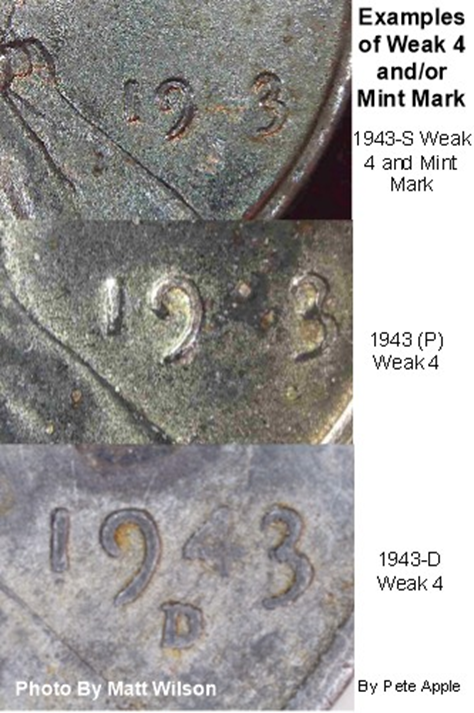
Researching if there are any 1943/2-S cents with a filled in 4
 Tahquamenon
Posts: 27 ✭
Tahquamenon
Posts: 27 ✭
Hello all,
I am trying to see if there are any 1943/2-S overdate cents with a filled in or ghosted 4. The 1943 steel cents had a lot of the filled in 4 digit and or mintmarks. I am trying to see if the overdate cent suffers the same issue.
Thanks
Tagged:
1
Comments
got pictures? full pics and close-up
Probably. A grease-filled die is a random occurrence. It would likely decrease the value of the coin, however, not increase it.
All comments reflect the opinion of the author, even when irrefutably accurate.
There are a couple articles about how the zinc filled the 4 and or mintmark at the point of where the basining of the die is. The 1943 cents are notorious for this.
this sounds like a die chip
There are currently 74 listings in ebay for missing or weak 4 for the 1943 cents. This occurs for all the mints.
that's filled die
it happens and not impossible for any coin
if you found one for a coin, you'd need more features filled to make it worth anything
don't know one for specifically 3/2s. even if found, just missing the 4 isn't particularly special price wise but would be nice to look at
I am not looking for a price. I know it is a filled die. I am just looking to see if there are any for the specific die that made the overdate for the 1943-S steel cents.
.
All comments reflect the opinion of the author, even when irrefutably accurate.
.
All comments reflect the opinion of the author, even when irrefutably accurate.
don't know one for specifically 3/2s. even if found, just missing the 4 isn't particularly special - potentially not memorable even if found. and the 3/2 is recently, relatively, discovered. not sure if anyone would notice before that.
good luck
Ah.............nevermind.
Best to stop asking so that you can continue looking.
Interesting
I find the question most interesting! I am absolutely convinced that the weak 4/mintmark area on 43 cents is NOT the typical grease filled die which should exhibit a much more randomly placed expression.
Answers to this question, in focusing on one specific, easily recognizable, die may contribute to our understanding both of the overdates and also to the phenomena of the weak 4/mintmark area on these cents.
I have had the opportunity to peruse Roger Burdett’s book: United States Pattern & Experimental Pieces of World War II.
In this book he reports on research by the mint into alternate coinage metal for 1943. The Zinc coated steel cent was ultimately chosen despite excessive difficulties with the zinc coating coming off the blanks and filling in the recesses of the dies. They also had difficulty with the steel blanks “cupping.”
I have previously postulated that the reason the 1943 steel cents frequently saw a weak 4 in the date was because of the shape (sharp corners) and size (larger than letters in LIBERTY) of the 4 and the curvature of the die [see my paper in ErrorScope, May - June 2022, Page 25-26]. At this point, I am less certain of the need to postulate friction welding of the zinc, although with the acceleration of metal (a requirement for friction welding) due to curvature of the die as the flow moves outwards it is another factor focusing on the area of the 4 for weakness.
Roger quotes Coiner William Bartholomew as being more direct than others with his assessment of the zinc-steel blanks. Referring to the American Rolling Mill product, he noted:
”Considerable difficulty was experienced in stamping due to the zinc coating coming off the blanks and filling in the recesses of the dies. We coined about 100 pieces and the dies started to fill at about 25 pieces, and by the time the 100th piece was coined the lettering was so filled that it looked blurred on the finished piece. We did not coin any more of them on this account, but returned the die to the engravers to be cleaned. It was necessary to dig out the deposits in the letters.” Page 104
The mint seems to have partially solved these problems, but looks like they were not completely solved. Had I known about this difficulty encountered by the mint, I would have certainly mentioned it in my Errorscope paper.
I hope someone might be able to post images of a weak 4/mintmark on this overdate! Of course, the absence of examples could still be somewhat instructive. The complete absence of examples, even though an argument from nothing, might still be indicative of a more shallow basining of the overdate die than those dies with weak 4/mintmarks. Die basining at the time was not so exact and I suspect a considerable variance of die curvatures in the 43 cents existed.
PCGS Coin Facts doesn't list an 1943/2 overdate cent from any mint. Does someone have a close-up pic of the date?
Worry is the interest you pay on a debt you may not owe.
"Paper money eventually returns to its intrinsic value---zero."----Voltaire
"Everything you say should be true, but not everything true should be said."----Voltaire
I confess to being somewhat baffled as to why there are so many 1943-dated steel cents with the 4 partially filled in on the dies, and maybe the mint mark, though I never really studied them. The theory that some of the zinc plating was eroding off of the planchets and accumulating in the 4 is quite plausible, though one must wonder why it would accumulate only there and not in the 9 and/or the 3.
FWIW, die erosion across the face of the obverse die is definitely not uniform. In my book on the cents of 1922 I discuss metal flow within a planchet during striking, and how this affected die erosion, at least within the 1922-D cent universe I was studying.
Short summary: During a strike SOME of the metal in the planchet, that which is closest to the collar, flows OUTWARDS to fill in the tiny gap between the edge of the planchet and the collar, as well as moving both up and down and forming the rims on the coin. The upsetting of the rims of the planchet helps facilitate the metal flow into the rims in the dies, though it probably work hardens the edge of the planchet a bit.
SOME of the metal, closest to the center of the dies, flows INWARDS to build up the mound of metal that is Lincoln's head. That metal has to come from somewhere, so the obverse die sucks it in from the fields.
In between is a no-mans-land where it is possible that the metal flows BOTH WAYS, starting outwards towards the collar during the microsecond when the highest parts of the obverse die (those which form the "bay" under Lincoln's chin and the angle at the back of his neck) first touch the planchet, and then reversing back inwards towards the recess that forms the head as that part of the design strikes up.
On the 1922-D and/or "No D" cents, this no-mans-land tended to fall under the 9 in the date and the R of LIBERTY. Multiple dies show these two characters eroded in all directions, while the nearby 1 (one) and Y are basically normal. On the dies used the longest this erosion sometimes spreads to the first 2 in the date and the E of LIBERTY, and maybe the left side of the T.
IF (and this is a mighty big IF) the 1943-dated cents experienced a similar back and forth die erosion at the 4, then the dislodged zinc MIGHT have tended to accumulate there instead of being swept away towards the edge. I offer this as a theory only, and would appreciate any comments. I would also like to know if any of the weak 4 coins also show any weakness near the center of LIBERTY.
TD
P.S.: As for why the 9 was affected on the 1922-D coins and the 4 on the 1943 coins, this might be because of differences in the upsetting of the planchets, differences in the relief of Lincoln's head, the hardness of the steel or the shape of the 4, or any combination of these factors.
I have attached a study of the weak 4/mintmark I made. I think that die basining and the exact curvature of the basin convexity as it approaches the periphery is of major influence in the filling of the 4/mintmark area. As I mentioned earlier, I had not found Burdette's comments at that time, and would certainly include that perspective.
For this thread, the important question is whether there are examples of the weakness showing on the overdate die.
Cool anomaly. I actually collect these. Maybe not worth a lot of money but I don't think spending $2-$3 for something like this is a big deal. I have a 1907 IHC where the first 3 digits of the date are very weak but the "7" is bold.
Not necessarily a random occurrence methinks. I found a 1909-S V.D.B. in the PCGS image library that exhibits characteristics of grease filled mintmark AND grease filled V.D.B. My theory is grease was deliberately introduced into these areas of the dies by a mint worker in either Philadelphia or San Francisco, prior to striking coins. The example I saw i consider is a lovely example of the "mess of an 'S' " 1909-S V.D.B. and it's worth a lot of money.
@Pete2226 and @CaptHenway Thank you for taking the time to share. Interesting reads
Scoffers gonna scoff. I found a "mess of an 'S'" 1909-S V.D.B. and also think I found a 5th 'S' position for 1909-S V.D.B.
Harsche says it's counterfeit
All comments reflect the opinion of the author, even when irrefutably accurate.
Please do not hijack the thread, which is about 1943/2-S cents.
I sent this to NGC/NCS 2006. It came back altered surfaces. I haven’t bothered to look at it until I saw this thread.
- Bob -

MPL's - Lincolns of Color
Central Valley Roosevelts
The altered surface isn't the "4"
All comments reflect the opinion of the author, even when irrefutably accurate.
educational
Yes. I was responding to the cadre of scoffers whose hobby is following me around from thread to thread. I temporarily stepped out of line. My apologies and my last post here.