1963 US Mint Proof Set Spotting - Is it Restorable?
 ProofCollection
Posts: 7,583 ✭✭✭✭✭
ProofCollection
Posts: 7,583 ✭✭✭✭✭
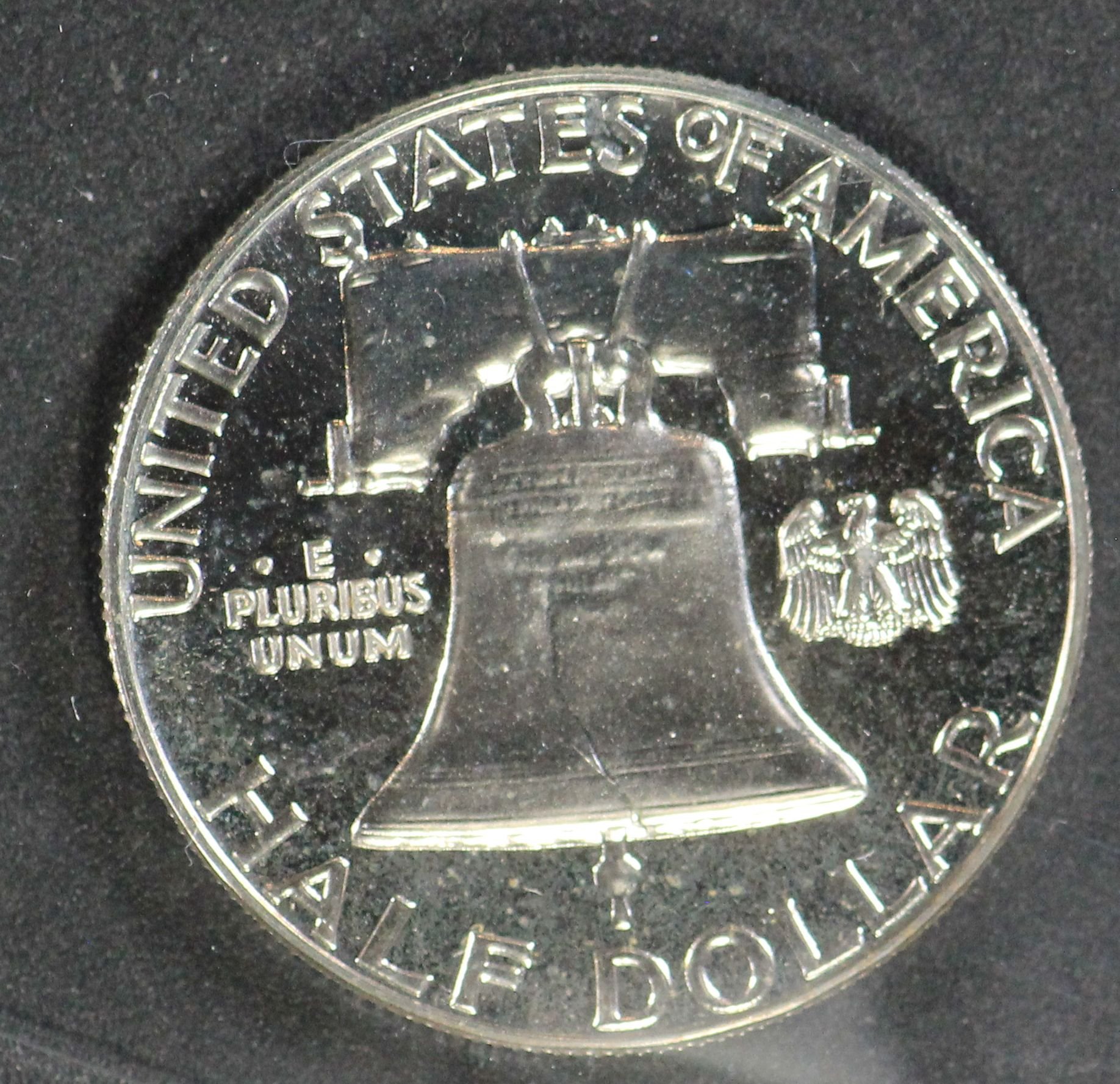
I freed this half dollar from a 1963 Proof Set. It was coated with toning and haze so I gave it a quick dip in EZ-est and then acetone. Unfortunately all of these spots remain. Are these spots permanent or do I need more time in acetone? Can PCGS or NGC do any better? Surely some of you have dealt with this before, what are your experiences?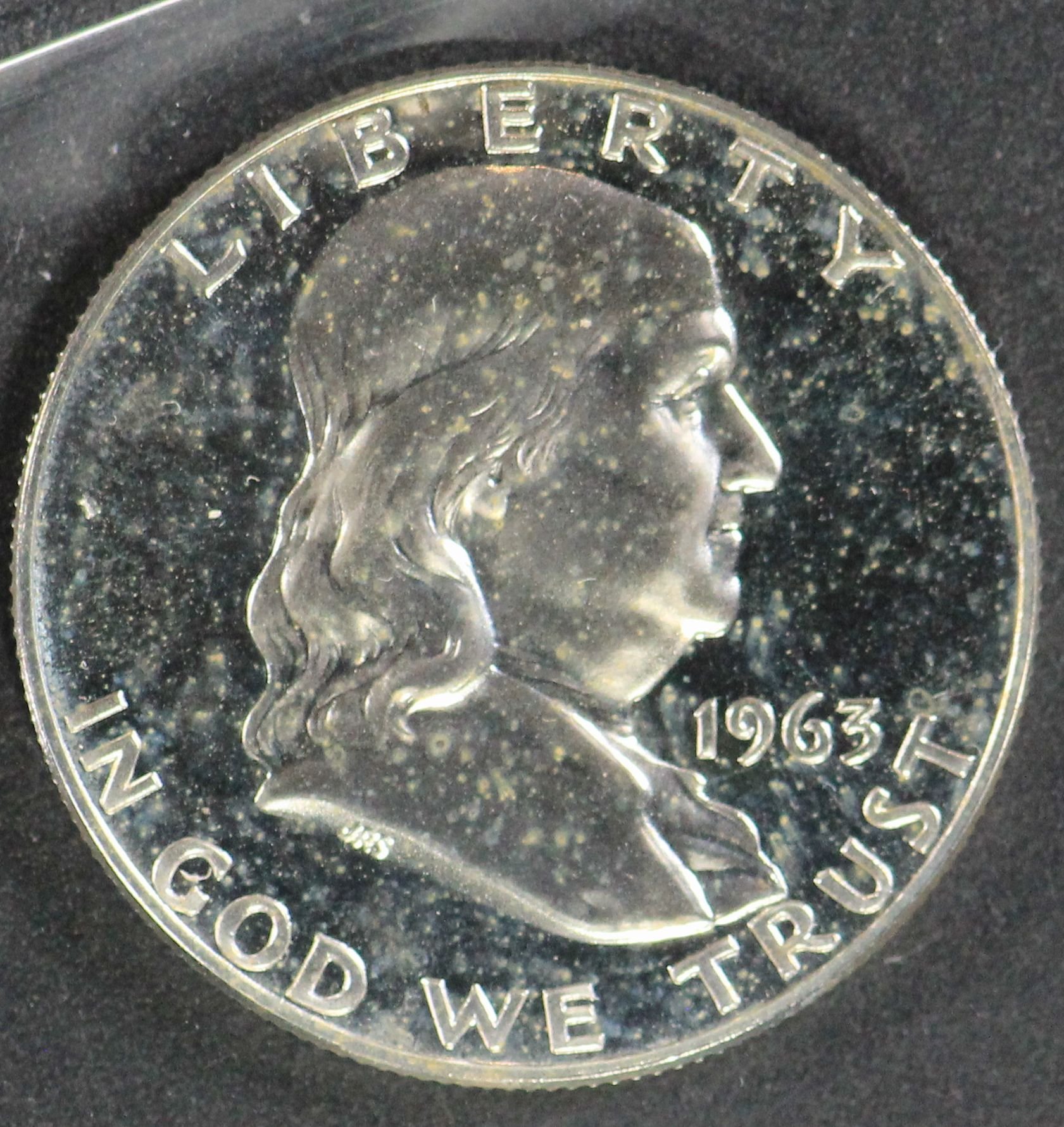
1
Comments
I have similar proof Franklins that look like yours. My experience is that nothing can be done to remove the spotting, leaving the coin in junk silver status.
When it's in acetone the spots mostly disappear. They only reappear when dry....
"Acid blast wash. Turn and burn. Sell at 5 points over spot".
-Cougar1978 probably.
Dip is one way and there are other ways also
I don't think spots of that color can be removed. If you do figure it out please let us know.
Collector, occasional seller
Nothing can save that coin, so sell as junk silver
coins for sale (like anyone cares after all not what they want won't give them wealth or status)
https://photos.app.goo.gl/VXLHL2FJNaNq5KYq7
How much would it cost to have PCGS or NGC try? How much would it cost to buy a problem-free example?
From what I have heard is those are spots of soap that did not wash off at the mint before strike. so it was struck with the soap and from what I've heard the spots will not come off. I have some coins with bigger spots that are actually graded.
I have one also.... :'(

.
https://www.pcgs.com/forms
.
I'm not a chemist, but those spots appear to have etched into the surface of the silver, and I would say nothing can remedy that.
Those early 'milk spots' must have taken acid in the 60's.

And turned mine into "Bugs Bunny".
Wow what a junk coin. My gosh all those spots ……Try a couple quick dips see what happens. Maybe make it into a gem.
My worst experience was a roll of peace dollars which had some nice dates guy walked up to my table at show. Probably stored in his garage over decades. Many were very dark had to work them w q tip soaked w jewel luster. A better date sent in after my process straight graded. Over time did well with all of them but took some time move them.
I'd ask @SanctionII as I believe he has seen quite a few like this and has a good idea on the ones which might be saved and those that really can't be saved....
I've been told I tolerate fools poorly...that may explain things if I have a problem with you. Current ebay items - Nothing at the moment
A slightly different but very cheap method is the clear ammonia soak, with water rinse and tamp dry with high nap white cotton towel. I have written a couple of posts about this....
Well, just Love coins, period.
Far out. Groovy.
Pete
I'm of the opinion, they're there for the long haul. 1963 proofs are plentiful, shouldn't be any challenge to find a clean coin.
Bummer but thats one you shouldn't bring to the dance.
Student of numismatics and collector of Morgan dollars
Successful BST transactions with: Namvet Justindan Mattniss RWW olah_in_MA
Dantheman984 Toyz4geo SurfinxHI greencopper RWW bigjpst bretsan MWallace logger7 JWP BruceS bigjpst
No, these are not impossible to find. I'm not great at grading these but without spots I think it could be a 68DCAM which is a $500 coin of which only 1 or 2 come to market every year. Of course it's possible my grading is optimistic. If this is a $500 coin and there's a way to fix it, I want to explore that possibility.
Buy some E zest and use that coin to experiment on.
I've submitted a lot of proofs to PCGS, and I have a hard time seeing that one making DCAM from your photos especially if any spotting remains. Here's a coin SanctionII submitted a couple years ago that graded PR65CAM, though it certainly appears to have DCAM frost and fields.
In addition, I submitted this coin and it failed to receive even a CAM designation.
Worry not- I don't think that coin had any shot at DCAM based on what we can see here.
Collector, occasional seller
Here is a 1959 proof half and a 1960 proof half that have similar spots. They graded PF63. I could not remove the spots from either coin.
Here are 1960, 1961, 1962 and 1963 proof halves that did not receive a Cameo designation. They graded PF67, PF67, PF67 and PF68 respectively.
it's tough to grade the op coin with those pics
That wasn't the intent of the photos so I didn't try hard or expect anyone to grade them. I find proofs really hard to grade by photo anyway.
What methods did you try?
As I noted above, when in the acetone the spots are hardly visible, they disappear. That makes me think there's got to be some way to diminish the appearance of the spots.
I appreciate the examples. I can see on each one why I believe they would fail to get CAM or DCAM designations. On this coin the frost is thick and even on all device surfaces. I acknowledge that I didn't take the best photos as I was intending only to show the spots and not light it for a sweet DCAM photo.
And what it grades isn't the point really. Everyone here is quick to spend my money and tell me to just go buy a problem free coin, but what if I can spend $50 or so and get what I want from a coin I already have? What if I like messing around and trying to solve problems in a hobby I enjoy? It would be a hoot if someone replied and had a magic bullet that you could lay a piece of duct tape on the coin and rip it off and then clean it with acetone and be all good. Maybe someone knows a secret for this common problem. Let's figure it out!
If the spots actually disappear when treated with the correct chemical then I would think there should be a permament chemical answer. I would think the incentive to solve this problem might bring a few chemists out of the woodwork. I have seen many, many modern coins that lose all eye appeal because of these milk spots. I hope someone way smarter than me comes across this problem. james
I tried to remove the spots on the 1959 and 1960 proof halves pictured in my prior post using E-Zest and Tarnax.
My suggestion is that if you believe that your half dollar is of DCAM quality you should send it it to our host for restoration and grading. For a single coin the cost (shipping, restoration fee and grading fee) would be something you can afford. You may end up hitting a home run (spots removed and the coin grading PF68DCAM or better, resulting in your ownership of a coin worth much more than your cost basis); or you may end up owning a coin that you are underwater on.
How receptive are you to rolling the dice and hoping you get a 7 or an 11, instead of snake eyes? If you are receptive, go for it and have some fun. If you are not receptive, look around for an example of this coin that does not have the spotting.
Good luck and let us know what you decide to do.