@IkesT said:
Breaking Mint rules didn't necessarily mean breaking the law. Although the rule requiring old obverse dies to be destroyed had been in place since 1866 (under Director James Pollock), it wasn't written into law until it was included in the Coinage Act of 1873.
Yup. And restrikes were still regularly appearing in 1874 and on.
@tradedollarnut said:
40 years of medal press technology improvement?
When the mint fully switched to the new Thonnelier-type "steam" presses in 1839, records show the mint's two most powerful screw presses, the Howell and Rush-Muhlenberg presses, were moved to the medal dept. and the die room. These two presses had been used for decades to strike medals and proofs and hub dies. The continued to be used for those purposes into the 20th century when they were eventually replaced by hydraulic presses. In fact, the pic of the Die Room in the 1902 mint report shows one of the presses, probably the RM press given the design.
The new stem presses were not used to strike proofs and patterns since they could not make a single-strike. Thus, all of the proofs, patterns, and the restrikes were produced on the screw presses.
@JCH22 said:
How are you able to rule out Hill's machine given its capabilities?
Legend says Class IIs were first struck in 1858. If as you theorize, Class IIIs were as well, what explains the 20 year gap between striking, and their sudden appearance en mass around 1878? The examples confiscated in 1868, were they in the Mint Cabinet up until that time--or in other hands--or pockets? Exactly how many ClassII/IIIs were struck in the single run? Why include a Thaler--test strike of sorts, or last one for the heck of it....
BTW, respectfully disagree about the cutoff date for a bona fide Mint issue --which is probably controlled by the Circular(s), and other existing regulations/laws..
As far as excluding Hill's engraving Machine, Reverse Y was used for both the Class II and Class III dollars. The Class II dollars appeared circa 1859 to 1860 and were confiscated by the mint by 1861. The Class III dollars first appeared in `1864. Thus, both appeared prior to the arrival of the Hill machine.
Further, the Hill machine was not used to reproduce full dies. Rather, it was used to produce the central device with peripheral devices such as letters, numerals, stars, etc. being added by hand to the master dies. Further, none of the reducing machines, including the improved Janvier, produced a "read-to-use die." It still had to be hand-touched by the engraver where necessary and then lapped to remove metal pushed up by machining and set the final basin. Those are two of the key ways die specialists are able to identify new master dies and new working dies.
One should be careful reading period statements by mint officials which often tend to be quite hyperbolic. Politics was the same back then as now and officials routinely made utterly lofty statements about the great improvements they introduced.
In this vein, the 1867 circular you cited is by none other than Henry Linderman, the most prolific restriker the mint has ever seen. The number of "cabinet coins" he had struck and that he sold via various agents is legendary. For example, Judd-80 and 81 using an 1838 obv and a reverse that did not exist until the 1860s. The first one appeared at auction in 1875. Pattern and Seated researchers, including Andrew Pollack, attribute these strikes to dies made from pattern hubs discovered by A. Loudon Snowden and noted in his letter published in the January 1872 issue of Mason’s Monthly Coin Collectors Magazine.
Then we have pattern 1863 one-cent pieces, Judd-301 through 304, struck in bronze, copper-nickel, oroide, and aluminum using a reverse that did not exist until 1871. We also have have several 1864 pattern half dollars, Judd-396 (silver) and Judd-397 (copper) which use a “With Motto” reverse that was first used on 1871 proofs and patterns. Additionally, there is at least one 1864 “No Motto” pattern restrike, Judd-395, with the obverse fields bulging as on the latest 396 and 397 strikes, so that too was struck sometime circa 1871 or 1872.
Finally, we have the 1887 mint report by then Director James Kimball. Beginning on page 180, Kimball cites numerous examples of post-1867 and 1873 restrikes including an illegally produced encased set of 1868 of regular issue coins in aluminum had “passed into other hands.” Those “hands” obviously belonged to Henry Linderman since the set was listed in Lyman Lowe’s 1887 sale catalog of his collection. It was subsequently seized with other aluminum and off-metal pieces.
Kimball's report also specifically cited three lists, one compiled by the curator of the Mint Cabinet, another by Robert Coulton Davis, Curator of Numismatics for the Numismatic and Antiquarian Society of Philadelphia, with the third being an unnamed “printed list of another collection.” Kimball went onto state that the lists showed numerous examples of off-metal strikes from both pattern and regular issue dies, mules, and other “whim pieces” that did not exist in the Mint Cabinet. He specifically stated that one of the lists showed 57 different pieces dated 1873 through 1885 and that the third list contained 78 different off-metal strikes dated 1873 through 1885.
Simply put, criminals do not pay attention to laws or rules or regulations, even ones they write themselves as a smoke screen for their own illicit activates. That's why they are criminals. They break the law.
As an aside, Henry Linderman was under investigation for several improprieties while he was in office including a pump-and-dump stock swindle which included placing false statements in an official mint report, kickbacks, paying relatives to perform mint work that could have been done by employees, and manipulating and misreporting official accounts to cover up excess expenditures and excess bullion wastage at some mints. He died before formal charges could be brought.
His partner in crime, A. Loudon Snowden was also under investigation for misuse of funds, etc., but he left office and took off for Europe before he could be indicted.
Thanks much. My info on the capabilities of Hill's machine differs from what you wrote. Looking a little more into its use in London & Paris so I can more comprehensively respond.
A quick look at the Low catalogue is sure telling. Corruption during that period, gilded age, unregulated wall street... Creatures of their times.
In the February, 1858 inventory of the Cabinet, one 1804 is noted--followed by the abrev. "R.R.R." Guessing maybe a reference to a Class I?
Came across some info (attached as a pdf), which I thought might possibly be of some use for your "grand unified theory of striking" of Class IIs & IIIS.
Apparently Mickley was well into the inner circle by 1858..... That story of his obtaining his example ( deposited with a bank clerk who was his friend, and who Mickley had specifically asked to look out for an 1804 )... always seemed just a bit fantastical. Have no further context for the attached docs at the moment---what specifically the U.S. Attorney was then investigating /his original letter. May or may not be "1804" related. Just passing along......
VERY Interesting!
I get the gist of the letters. Would anyone care to attempt a complete transcription?
Professional Numismatist, Retired. 55 year member ANA. Former ANA Senior Authenticator. Winner of four ANA Heath Literary Awards; three Wayte and Olga Raymond Literary Awards; Numismatist of the Year Award 2009, and ANA Lifetime Achievement Award 2020. Winner of the PNG's 2026 Robert Friedberg Award for "The Enigmatic Lincoln Cents of 1922," Available now from Whitman or Amazon.
Thanks much. My info on the capabilities of Hill's machine differs from what you wrote. Looking a little more into its use in London & Paris so I can more comprehensively respond.
A quick look at the Low catalogue is sure telling. Corruption during that period, gilded age, unregulated wall street... Creatures of their times.
In the February, 1858 inventory of the Cabinet, one 1804 is noted--followed by the abrev. "R.R.R." Guessing maybe a reference to a Class I?
Came across some info (attached as a pdf), which I thought might possibly be of some use for your "grand unified theory of striking" of Class IIs & IIIS.
Apparently Mickley was well into the inner circle by 1858..... That story of his obtaining his example ( deposited with a bank clerk who was his friend, and who Mickley had specifically asked to look out for an 1804 )... always seemed just a bit fantastical. Have no further context for the attached docs at the moment---what specifically the U.S. Attorney was then investigating /his original letter. May or may not be "1804" related. Just passing along......
VERY Interesting!
I get the gist of the letters. Would anyone care to attempt a complete transcription?
Absolutely not, but I’ll certainly let Grok give it a go 😅-
Transcription of "1858 Letters.pdf"
Based on the scanned pages provided in the document, this appears to be a collection of three short handwritten letters from 1858, likely related to a legal or numismatic matter involving the U.S. Mint in Philadelphia, electrotyping processes for coins, and expert testimony. The handwriting is 19th-century cursive, which is challenging to read perfectly due to flourishes, smudges, and fading. I've transcribed them as faithfully as possible, using standard modern English spelling and punctuation for clarity while noting uncertain words in [brackets]. The document seems to have 3 pages (with some repetition in the scan, possibly due to duplex printing or scan artifacts).
Page 1: Letter dated July 19, 1858 (from Philadelphia, likely to a colleague or official regarding mint processes and witnesses)
Phila. July 19, 1858
Dear Sir,
Mr. Booth in behalf [of the matter? or of it]
one [man? or none?] in the mint capable
of explaining to full satisfaction
the electrotype process, and he
[is] himself [acquainted] with as [much]
of the [other? throat?] process
producing [his? him?] [most? with?] [taking?],
The [writer? appears?] Mr. [Elkfeldt? or Elkfeldt]
[after?] [James?] [or?] [Glunt?],
as [in?] [former?] [purpose? or ?],
Mr. Mickley, I have no doubt,
[will] with pleasure [answer] any [inquiry],
with [his?] [parts? cheerful?] [assistance?]. He
understands that he will be
well [paid? or compensated].
Yours [truly? etc.],
[ Jno. ? ]
[ ? ]
Col. [Vandegrift? or Vandyke?]
[ U.S. ? ]
[ Brit. ? or Dist. Atty.? ]
[ ? ]
(Note: The signature and closing lines are particularly illegible. "Jno." likely stands for "John." The reference to "Col. Vande[grift?]" may be a misreading or a name like "Vandyke," tying to the district attorney mentioned later. The content seems to recommend Mr. Booth as an expert on electrotyping at the mint and suggests Mr. Mickley as a reliable witness.)
Page 2: Short note dated September 7, 1858 (from J.B. McCleary, U.S. District Attorney, possibly a memo or endorsement)
J. B. McCleary Esq. U.S. Dist. Atty
Sir,
Mr. Mickley as
a [friend? or proper?] person
[for?] [testimony? or in]
[ ? ]
[ ? ]
Sept. 7, 1858.
(Note: This page is very brief and faded. It appears to be a quick endorsement or note recommending Mr. Mickley, possibly in the context of the same case. The lines after "person" are nearly illegible, possibly "for the purpose" or similar. The "+" may be a mark or flourish.)
Page 3: Letter dated September 17, 1858 (from the Navy Office, recommending Mr. Mickley as an expert witness to U.S. District Attorney James B. Vandyke)
For James B. Vandyke Esq., U.S. Dist. Atty.,
Dear Sir
Mr. Joseph J. Mickley,
Market St. below Tenth,
North side, is perfectly
familiar with the coating
of coins by electrotype
process, [and] would no doubt
take pleasure in giving
any testimony required.
Navy office,
Sept. 17, 1858
[ P. ? or Signature illegible ]
(Note: This is the clearest page. Joseph J. Mickley was a well-known Philadelphia numismatist and coin collector in the 19th century. James B. Vandyke was the U.S. District Attorney for the Eastern District of Pennsylvania at the time. This letter explicitly offers Mickley as an expert on electrotyping coins, likely for a court case involving counterfeiting or mint processes. The signature may be from a Navy official, perhaps "P. F. Smith" or similar, but it's unclear.)
Additional Context
These letters appear to be part of correspondence related to a potential legal proceeding in 1858 Philadelphia, possibly a counterfeiting trial where electrotyping (an early electrochemical process for copying metal objects like coins) was at issue. The U.S. Mint in Philadelphia was central to such matters, and references to "Mr. Booth" (possibly a mint employee) and Mickley (a prominent coin expert) suggest they were being lined up as witnesses. No exact match for these specific letters was found in public archives, but they align with historical numismatic activities around electrotype copies of rare coins like the 1804 dollar, which were produced around this era.
If this transcription needs refinement or if you have higher-resolution scans/clarifications for illegible parts, let me know!
@JCH22 said:
In the February, 1858 inventory of the Cabinet, one 1804 is noted--followed by the abrev. "R.R.R." Guessing maybe a reference to a Class I?
Came across some info (attached as a pdf), which I thought might possibly be of some use for your "grand unified theory of striking" of Class IIs & IIIS.
Apparently Mickley was well into the inner circle by 1858..... That story of his obtaining his example ( deposited with a
R.R.R. does not refer to the Class of 1804s. A review of the inventory should give you a clue.
@JCH22 said:
Hope the below JPEGS are easier on the eyes. Didn’t want to expand thread with attachments, so posted as a reduced pdf----which I failed to realize was of such poor quality!
A better person would have been Franklin Peale, even tho' he was "retired" by 58. Peale created the first galvano (electrotype) in 1840, It survives to this day in a private collection..
But---putting on a cynic's hat-- offering up Mickley...
That would certainly been a waste of time since the Peale galvano had been publicized many years before.
You've got the surface docs. Keep digging and you'll eventually come up with the real stories. Shouldn't be hard, I and others have published the docs for the last 30 years.
@JCH22 said:
Hope the below JPEGS are easier on the eyes. Didn’t want to expand thread with attachments, so posted as a reduced pdf----which I failed to realize was of such poor quality!
Thank you so much for the better copies.
In the last one, I am curious about the word "coating." The second letter is definitely an "o" comparing it to other words with an "o." However, it seems to be an odd use of the word, as the "coating of coins" sounds to me like the "electroplating of existing coins" rather than the "making of electrotype copies of coins.".
I am wondering if perhaps this word might be a secretary's transcription error for the word "creating." That would seem to be more likely in context, but of course this is just a guess. As I (barely) understand the process, there is a step where the negative impression is coated with powdered copper (?) to provide a base that subsequent metal is electrically deposited onto. This might be a perfectly innocent explanation for the use of the word "coating."
TD
Professional Numismatist, Retired. 55 year member ANA. Former ANA Senior Authenticator. Winner of four ANA Heath Literary Awards; three Wayte and Olga Raymond Literary Awards; Numismatist of the Year Award 2009, and ANA Lifetime Achievement Award 2020. Winner of the PNG's 2026 Robert Friedberg Award for "The Enigmatic Lincoln Cents of 1922," Available now from Whitman or Amazon.
@Rittenhouse . My question is off topic but considering the authority you speak with, do you know the reasons and actions that were taken to removed thousands of New Orleans mint dollars and then stash them for a Century? James
@seatedlib3991 said: @Rittenhouse . My question is off topic but considering the authority you speak with, do you know the reasons and >actions that were taken to removed thousands of New Orleans mint dollars and then stash them for a Century? James
>
No, sorry, I haven't done any studies on the NO mint. You might try some of the folks in LSCC or perhaps Kevin Flynn has some info.
@Rittenhouse . Thank you for answering back. Don't feel too bad about not knowing. I am a member of the LSCC and have probably asked this question more than a dozen times. (Mr. Flynn might be one I don't remember).
The standard answers are, "I have no idea." and "Try the Newman Portal."
I wish I was more gifted at using that source but the only anaology that applies is:
"You say you need some tuna?" Well all you need is the correct bait & tackle. Pick a coast and head fore the high seas. Easy Peasy." Thank you again. James
@seatedlib3991 said: @Rittenhouse . My question is off topic but considering the authority you speak with, do you know the reasons and actions that were taken to removed thousands of New Orleans mint dollars and then stash them for a Century? James
Rather than hijack this thread, how about starting another one we can discuss this in?
Professional Numismatist, Retired. 55 year member ANA. Former ANA Senior Authenticator. Winner of four ANA Heath Literary Awards; three Wayte and Olga Raymond Literary Awards; Numismatist of the Year Award 2009, and ANA Lifetime Achievement Award 2020. Winner of the PNG's 2026 Robert Friedberg Award for "The Enigmatic Lincoln Cents of 1922," Available now from Whitman or Amazon.
@CaptHenway . No hijacking and I have brought this very question up at least 6 times in the last 3 years. Crickets. So would be very short discussion. James
This is certainly the origin of the story that Adam Eckfeldt's grandson, commonly assumed to be Theodore, secretly struck 1804 dollars and sold them for his own profit. (This is the "Midnight Minter" story, NOT made up by Breen, though he may have come up with the "Midnight Minter name). Likewise, it is the origin of the story that they were recovered and destroyed, although I suspect that the destruction part was a lie.
The story that a third striking took place circa 1868 could be a cover story for the common belief that the Class II coins were edge lettered and re-sold as what are now called Class III coins in the late 1860s, though at least one of them may have been so sold circa 1864, perhaps to test the waters to see if the circa 1858 scandal had been forgotten. All of this more or less aligns with what Newman and Bressett wrote in "The Fantastic 1804 Dollar."
All of that said, reading the larger document (and do you have the beginning of it?) my B.S. Detector is ringing at the five alarm level. I have long been a believer in the Midnight Minter theory, but its very presence in this document now makes me doubt it.
THAT said, I am still at a loss as to who struck the multiple PLAIN EDGE Class II 1804 Dollars (one of them an overstrike) circa 1858. The lack of the edge lettering was a monstrous faux pas, Rittenhouse has some very definite ideas about this, and I look forward to reading what he and JD have to say about the subject.
Professional Numismatist, Retired. 55 year member ANA. Former ANA Senior Authenticator. Winner of four ANA Heath Literary Awards; three Wayte and Olga Raymond Literary Awards; Numismatist of the Year Award 2009, and ANA Lifetime Achievement Award 2020. Winner of the PNG's 2026 Robert Friedberg Award for "The Enigmatic Lincoln Cents of 1922," Available now from Whitman or Amazon.
…Class 1s were not struck as diplomatic presentation pieces. There is zero evidence for that theory--just liberal and illogical inferences. That whole cover story was created and publicly circulated by the Inner Mint Cabinet Circle after public notice was first taken in the 1850s regarding the 1804s-- struck in the 1840s, e.g. Stickney's statement. The origin time line of that story was easy to trace. It was well after 1834-5, and after the start of the Mint Cabinet…
So, you’re saying that contrary to what’s been published, there wasn’t a November 11, 1834 Department of State request for special sets of coinage to be made for presentation purposes?
Mark Feld* of Heritage Auctions*Unless otherwise noted, my posts here represent my personal opinions.
…Class 1s were not struck as diplomatic presentation pieces. There is zero evidence for that theory--just liberal and illogical inferences. That whole cover story was created and publicly circulated by the Inner Mint Cabinet Circle after public notice was first taken in the 1850s regarding the 1804s-- struck in the 1840s, e.g. Stickney's statement. The origin time line of that story was easy to trace. It was well after 1834-5, and after the start of the Mint Cabinet…
So, are you saying that contrary to what’s been published, there wasn’t a November 11, 1834 Department of State request for special sets of coinage to be made for presentation purposes?
Not at all. I posted the letter myself on this thread. There were sets struck, and there is documentation that a set was given to the Sultan of Muscat. He did not think much of them accordingly to the Whalers with insight into his court. There is no inventory of the coins struck for the presentation sets. No account of the presentation specifies what the sets contained--nor any other known document. None are described in the log of the Peacock. The coins were not mentioned when the Sultan's emissary paid a reciprocal visit to the U.S not long after.
The sets were requested by Woodbury from Moore. There is no written documentation by Jackson. The specific language in the November 11, 1834 letter was for "duplicate specimens of each kind now in use." It is this language, and this language alone, upon which the legend was spun. More precisely, the theory goes that this language caused the MInt to re-strike coins last produced 30 years previously (in violation of current law for the Eagle) That is one big leap for which there is zero evidence. Only speculation. which is Illogical given the Bank War that Jackson was deeply immersed in at that time. Also, it makes little sense given eagles and silver dollars had long since vanished from any kind of then "current use." There is also no evidence they were actually struck in 1834-35. There is evidence, if Stickney is to be believed, they were first known to exist in the 1840s--only after Dubois & Eckfeldt started the Mint Cabinet/ Eckfeldt published his book.
There is, however, very clear evidence the tale of inclusion in the presentation sets first arose only after Class I's first came to the nascent numismatic community's attention---in the late 1840s/early 1850 Much evidence. Only Woodbury's general request was offered in support when the tale was first spun. I myself would say contorted. Some vocal advocates seemed to be financially interested. That is origin of the folktale which has come down to us today.
The 1804 Plain 4 Eagle legend was first spun in 1962. There also is zero inference free evidence they were included in the sets presented, and it would would have been in violation of then current law to strike them late '34, early '35. As far as I know, the King of Siam case was never authenticated, was "missing pieces." and contained dups ( motto , no motto---not sure the Sultan or Kings would understand the difference but there was a hole so.... ). As a side note, there were other requests from the State Dept to the Mint in the mid to late 19th for boxed presentation coins. But I haven't matched the holes to denominations struck in any particular year in which those many sets were requested.
The Plain 4 Eagles were said to have been all struck ( in violation of the Coinage Act) for 4 presentation sets. Two were delivered (Muscat/Siam), 2 could not be presented (Cochin & Japan). Lore says the later two were returned to the State Department. No State Department record for same has been produced. The Plain 4 did appear long before the King & I movie, but without the legend of it being part of the presentation sets. When the 'Siam Set' made its debut in 1962, the Eagle was folded into the inferences made about 1804 Class I. The inference about the Eagle is even more dubious given Jackson's express desire to strike eagles, and the then existing Coinage Act law which would make their striking illegal.
Nanny from the King & I was a fabulist. She was not in Siam in 1835-6, and she was not a nanny to the King the set was presented to (Rama III), She was in subsequent King Rama IV's, household from 1862-1867. While she was still on leave in the UK, Rama died in 1868, mentioning her in his will, but leaving her nothing. But I guess the legend must include an inference the subsequent King gifted a British, Indian born nanny a set of American coins given to his predecessor before she departed for leave to the UK in 1867- then died leaving her nothing more. That, to put it mildly, is a major grand canyon like leap which makes zero logical sense. I guess it was a nice story to contemporary audiences of the popular King & I film released in 1956.
Much more than you asked for. The story is so convoluted by time that longer answers are necessary for completeness.
The letter you asked about was the springboard for a lot of story telling, perhaps cover for other less savory conduct. The letter itself doe not prove in any way Class Is or Plain 4 Eagles were struck for inclusion in the sets.
If, as you agree, the letter I asked about was written, sets were struck and one was given to the Sultan of Muscat, what coins were in that set, if not the ones claimed to be?
Mark Feld* of Heritage Auctions*Unless otherwise noted, my posts here represent my personal opinions.
If, as you agree, the letter I asked about was written, sets were struck and one was given to the Sultan of Muscat, what coins were in that set, if not the ones claimed to be?
Neither 1804 Eagles nor Dollars based on what I have already posted—with likely much more documentation to follow here, or perhaps elsewhere.
With respect, your question is a collateral one as it assumes I am making a particular claim. Burdens both of production and persuasion are on the proponents that denominations last struck more than 30 years earlier, one since becoming illegal just months before, were backdated and included. The letter is insufficient for either. Have gone far beyond what is due such unproven extraordinary claims under the gratis asseritur, gratis negatur razor.
Do you think those who proposed and perpetuated such tale, have met both of their burdens of production and persuasion for---- their---- extraordinary claims? If so, any direct evidence you can point to?
"Particular" or otherwise, you did make cliams, as follows: "class 1s were not struck as diplomatic presentation pieces. There is zero evidence for that theory--just liberal and illogical inferences. That whole cover story was created and publicly circulated by the Inner Mint Cabinet Circle after public notice was first taken in the 1850s regarding the 1804s-- struck in the 1840s, e.g. Stickney's statement. The origin time line of that story was easy to trace. It was well after 1834-5, and after the start of the Mint Cabinet…"
I questioned you, merely because you're the one who posted claims here. I only wish that those who proposed "such tale" were alive and posting here with us.
Mark Feld* of Heritage Auctions*Unless otherwise noted, my posts here represent my personal opinions.
If, as you agree, the letter I asked about was written, sets were struck and one was given to the Sultan of Muscat, what coins were in that set, if not the ones claimed to be?
Neither 1804 Eagles nor Dollars based on what I have already posted—with likely much more documentation to follow here, or perhaps elsewhere.
With respect, your question is a collateral one as it assumes I am making a particular claim. Burdens both of production and persuasion are on the proponents that denominations last struck more than 30 years earlier, one since becoming illegal just months before, were backdated and included. The letter is insufficient for either. Have gone far beyond what is due such unproven extraordinary claims under the gratis asseritur, gratis negatur razor.
Do you think those who proposed and perpetuated such tale, have met both of their burdens of production and persuasion for---- their---- extraordinary claims? If so, any direct evidence you can point to?
You are the one presenting a theory here. I believe that the burden of proof is on you to prove your theory.
Professional Numismatist, Retired. 55 year member ANA. Former ANA Senior Authenticator. Winner of four ANA Heath Literary Awards; three Wayte and Olga Raymond Literary Awards; Numismatist of the Year Award 2009, and ANA Lifetime Achievement Award 2020. Winner of the PNG's 2026 Robert Friedberg Award for "The Enigmatic Lincoln Cents of 1922," Available now from Whitman or Amazon.
Robert W. Julian is, IMHO, the greatest living numismatic researcher. I thought to ask him what information he had on the 1834-35 Diplomatic Proof Sets, and he referred me to his article in The Numismatist in January, 1970. I highly recommend that every ANA member here read it in the ANA Archives. If you are not a member of the ANA, join. Access to the archives online is a fabulous member benefit.
Here are a few screencaps from the article:
Beyond any doubt, the first Class I 1804 dollars, and the Diplomatic Proof sets they were made for, were made in 1834-1835.
TD
Professional Numismatist, Retired. 55 year member ANA. Former ANA Senior Authenticator. Winner of four ANA Heath Literary Awards; three Wayte and Olga Raymond Literary Awards; Numismatist of the Year Award 2009, and ANA Lifetime Achievement Award 2020. Winner of the PNG's 2026 Robert Friedberg Award for "The Enigmatic Lincoln Cents of 1922," Available now from Whitman or Amazon.
Here is Mint paperwork accounting for the coins in the Diplomatic Proof Sets, including Dollars and Eagles.
Professional Numismatist, Retired. 55 year member ANA. Former ANA Senior Authenticator. Winner of four ANA Heath Literary Awards; three Wayte and Olga Raymond Literary Awards; Numismatist of the Year Award 2009, and ANA Lifetime Achievement Award 2020. Winner of the PNG's 2026 Robert Friedberg Award for "The Enigmatic Lincoln Cents of 1922," Available now from Whitman or Amazon.
I believe that Eric used the word "suggestions," not "corrections."
Eric was one of our Consultants while I was at ANACS. He was always willing to help.
I was able to return the favor by helping him in his ultimately successful campaign to get the U.S.A.O.G. $20 counterfeits commonly associated with Paul Franklin and/or John J. Ford condemned in the hobby as counterfeits.
TD
Professional Numismatist, Retired. 55 year member ANA. Former ANA Senior Authenticator. Winner of four ANA Heath Literary Awards; three Wayte and Olga Raymond Literary Awards; Numismatist of the Year Award 2009, and ANA Lifetime Achievement Award 2020. Winner of the PNG's 2026 Robert Friedberg Award for "The Enigmatic Lincoln Cents of 1922," Available now from Whitman or Amazon.
@DMWJR said:
$8mm today would have been approximately $650k in 1951. That's zero profit, just riding inflation. We will see if it was a good family plan or not.
According to your dates and prices, it would have taken approx. 20,000 ounces of gold to purchase this coin in 1951 and today it would take only 2,100 ounces of gold.
Put another way, if sold in 1951 for gold and then converted to cash today, the piggy bank would have 75 million $$.
Proving that gold is a better investment than even the rarest US coin of all time.
"Gold is money, and nothing else" (JP Morgan, 1912)
"“Those who sacrifice liberty for security/safety deserve neither.“(Benjamin Franklin)
@DMWJR said:
$8mm today would have been approximately $650k in 1951. That's zero profit, just riding inflation. We will see if it was a good family plan or not.
According to your dates and prices, it would have taken approx. 20,000 ounces of gold to purchase this coin in 1951 and today it would take only 2,100 ounces of gold.
Put another way, if sold in 1951 for gold and then converted to cash today, the piggy bank would have 75 million $$.
Proving that gold is a better investment than even the rarest US coin of all time.
What do you think is “the rarest US coin of all time”? It’s certainly isn’t the 1804 dollar.
And your comparison doesn’t prove that gold is a better investment, as you’re talking about the past, not the present.
Mark Feld* of Heritage Auctions*Unless otherwise noted, my posts here represent my personal opinions.
@DMWJR said:
$8mm today would have been approximately $650k in 1951. That's zero profit, just riding inflation. We will see if it was a good family plan or not.
According to your dates and prices, it would have taken approx. 20,000 ounces of gold to purchase this coin in 1951 and today it would take only 2,100 ounces of gold.
Put another way, if sold in 1951 for gold and then converted to cash today, the piggy bank would have 75 million $$.
Proving that gold is a better investment than even the rarest US coin of all time.
What do you think is “the rarest US coin of all time”? It’s certainly isn’t the 1804 dollar.
And your comparison doesn’t prove that gold is a better investment, as you’re talking about the past, not the present.
Maybe I should have said the 1804 dollar is the most well known 'rare' US coin.
Regardless of its stature on the US 'rare' coin scale, if it doesn't hold up well as an investment when compared to gold, I think that says a great deal of either the lack of coins as being a strong investment or the strength of gold as being a strong investment over time.
Lastly, your comment about past or present investments makes no sense to me as of course we don't know the future of any investment, but I can only go on the well known saying, "know your history to know your future" ie., gold is an extremely wise choice to invest your money.
"Gold is money, and nothing else" (JP Morgan, 1912)
"“Those who sacrifice liberty for security/safety deserve neither.“(Benjamin Franklin)
@DMWJR said:
$8mm today would have been approximately $650k in 1951. That's zero profit, just riding inflation. We will see if it was a good family plan or not.
According to your dates and prices, it would have taken approx. 20,000 ounces of gold to purchase this coin in 1951 and today it would take only 2,100 ounces of gold.
Put another way, if sold in 1951 for gold and then converted to cash today, the piggy bank would have 75 million $$.
Proving that gold is a better investment than even the rarest US coin of all time.
What do you think is “the rarest US coin of all time”? It’s certainly isn’t the 1804 dollar.
And your comparison doesn’t prove that gold is a better investment, as you’re talking about the past, not the present.
Maybe I should have said the 1804 dollar is the most well known 'rare' US coin.
Regardless of its stature on the US 'rare' coin scale, if it doesn't hold up well as an investment when compared to gold, I think that says a great deal of either the lack of coins as being a strong investment or the strength of gold as being a strong investment over time.
Lastly, your comment about past or present investments makes no sense to me as of course we don't know the future of any investment, but I can only go on the well known saying, "know your history to know your future" ie., gold is an extremely wise choice to invest your money.
You’re comparing a single 1804 dollar’s price performance to that of gold when it’s very close to historic highs, after a huge run-up. That doesn’t begin to prove that gold’s a better investment than rare coins.
And to me, there’s a big difference between saying that something is a better investment vs. has been one. The former is making a prediction, while the latter is past history.
Mark Feld* of Heritage Auctions*Unless otherwise noted, my posts here represent my personal opinions.
@CaptHenway said:
Robert W. Julian is, IMHO, the greatest living numismatic researcher. I thought to ask him what information he had on the 1834-35 Diplomatic Proof Sets, and he referred me to his article in The Numismatist in January, 1970. I highly recommend that every ANA member here read it in the ANA Archives. If you are not a member of the ANA, join. Access to the archives online is a fabulous member benefit.
Here are a few screencaps from the article:
Beyond any doubt, the first Class I 1804 dollars, and the Diplomatic Proof sets they were made for, were made in 1834-1835.
TD
$31.00 for the cases??
Thats what I want to see...
@CaptHenway said:
Robert W. Julian is, IMHO, the greatest living numismatic researcher. I thought to ask him what information he had on the 1834-35 Diplomatic Proof Sets, and he referred me to his article in The Numismatist in January, 1970. I highly recommend that every ANA member here read it in the ANA Archives. If you are not a member of the ANA, join. Access to the archives online is a fabulous member benefit.
Here are a few screencaps from the article:
Beyond any doubt, the first Class I 1804 dollars, and the Diplomatic Proof sets they were made for, were made in 1834-1835.
TD
$31.00 for the cases??
Thats what I want to see...
Professional Numismatist, Retired. 55 year member ANA. Former ANA Senior Authenticator. Winner of four ANA Heath Literary Awards; three Wayte and Olga Raymond Literary Awards; Numismatist of the Year Award 2009, and ANA Lifetime Achievement Award 2020. Winner of the PNG's 2026 Robert Friedberg Award for "The Enigmatic Lincoln Cents of 1922," Available now from Whitman or Amazon.
@CaptHenway said:
Robert W. Julian is, IMHO, the greatest living numismatic researcher. I thought to ask him what information he had on the 1834-35 Diplomatic Proof Sets, and he referred me to his article in The Numismatist in January, 1970. I highly recommend that every ANA member here read it in the ANA Archives. If you are not a member of the ANA, join. Access to the archives online is a fabulous member benefit.
Here are a few screencaps from the article:
Beyond any doubt, the first Class I 1804 dollars, and the Diplomatic Proof sets they were made for, were made in 1834-1835.
TD
$31.00 for the cases??
Thats what I want to see...
Are there any illustrations of the "Caskets"? I bet they were magnificent.
Are there any illustrations of the "Caskets"? I bet they were magnificent.
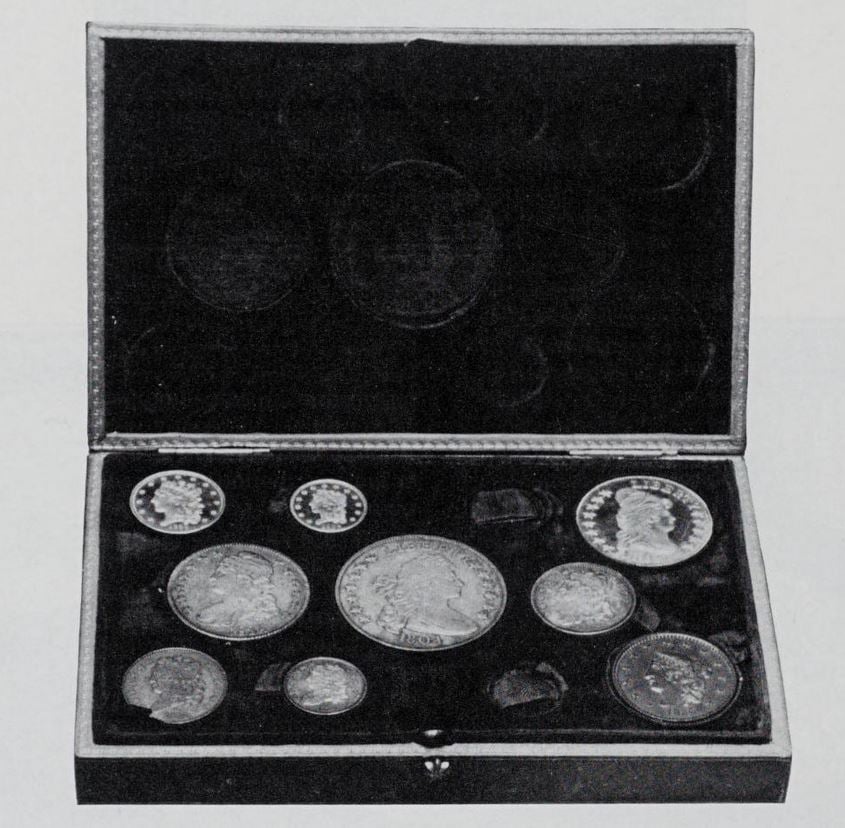
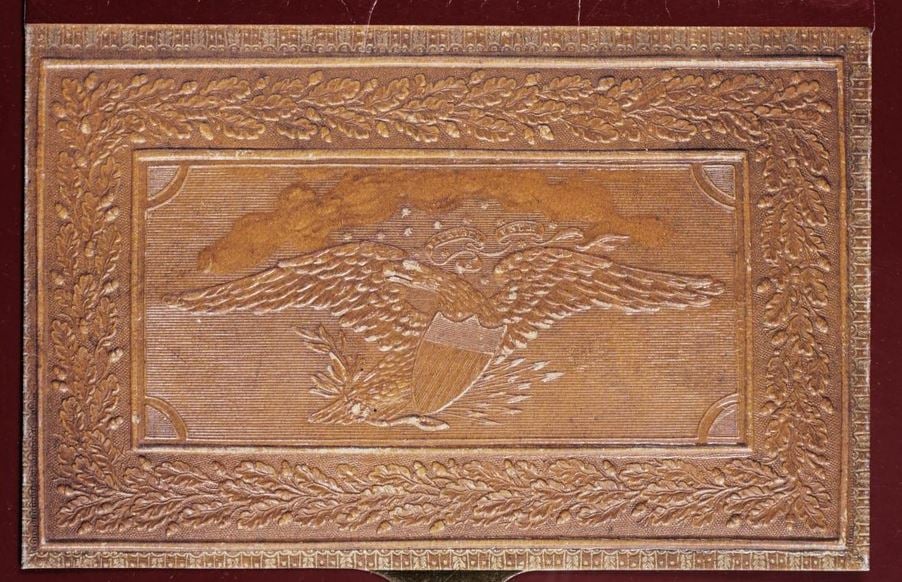
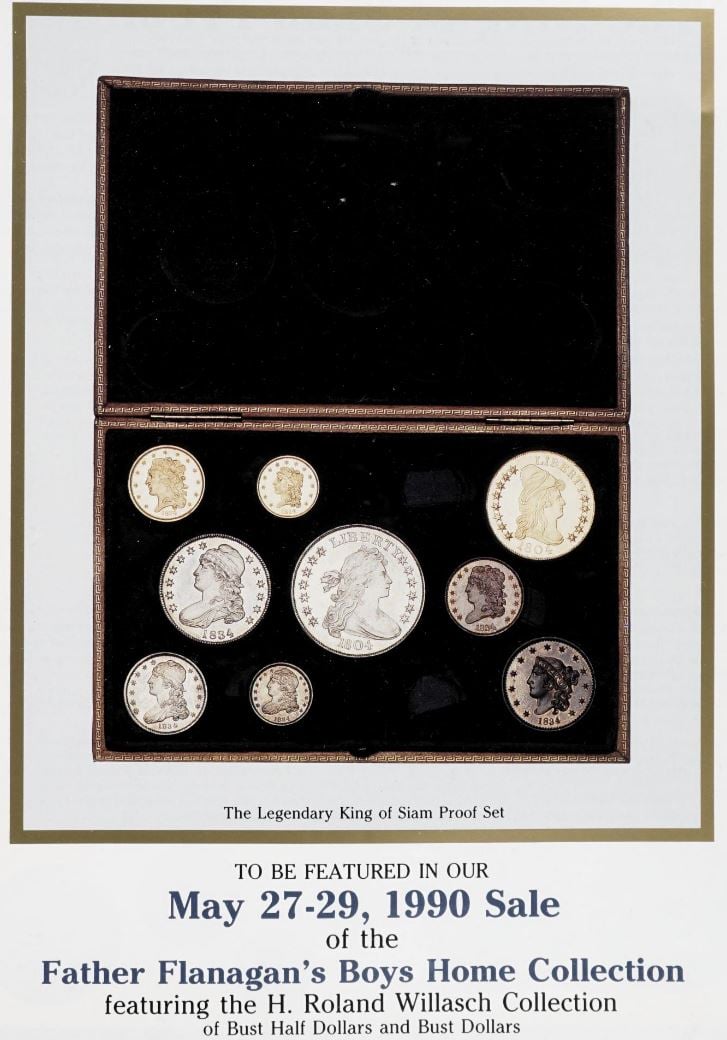
Here are some photos of the "King of Siam" set in the box from two auction catalog appearances. There are probably better photos somewhere else but I did not find better ones of the lid.
The black and white photo is from a Bowers and Merena October 1987 auction where it did not meet the $2.2 Million
reserve.
Note that two holes are empty as when it surfaced in 1962 and were later filled with a Proof half dime and a Proof 1833 Andrew Jackson gold medal. Was a medal really there originally? I notice the letter posted above on September 26, 2025 12:29PM by CaptHenway appears to order 4 quarter eagles rather than two for the 2 sets.
There is a 2004 article by PCGS that mentions the medal.
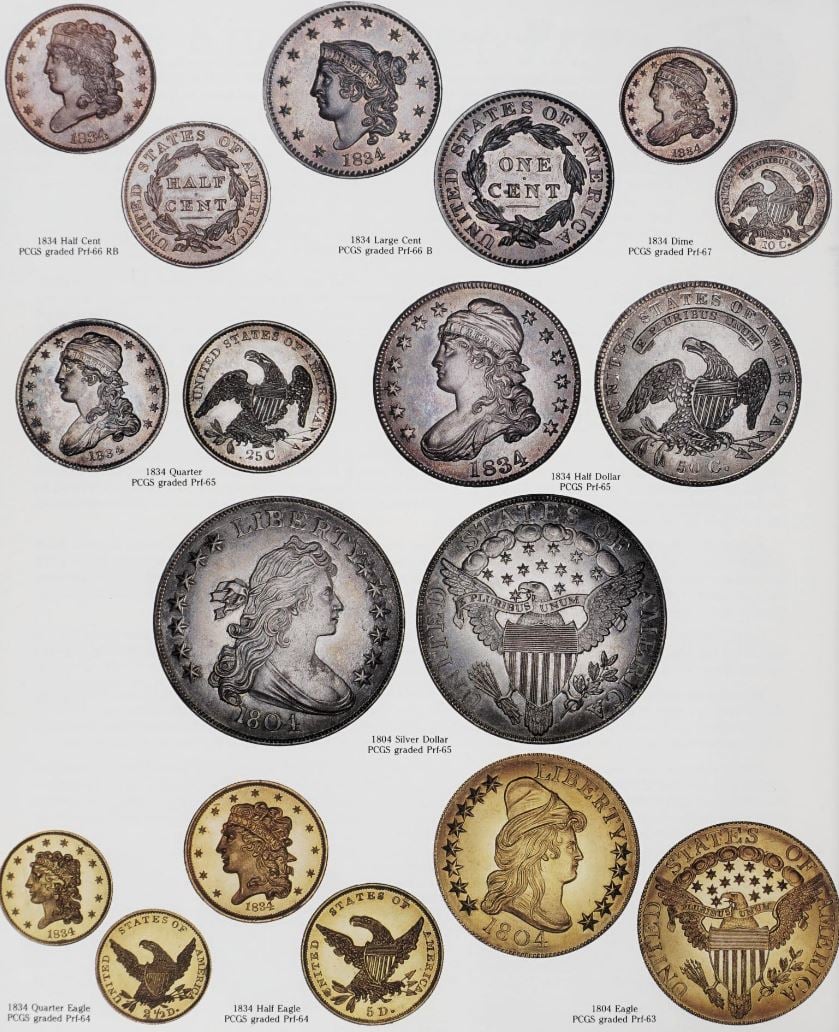
Also included the photos of the coins with their PCGS grades from the 1990 sale. They were raw in 1987 and slabbed in rattler holders for 1990, as pictured in that sale. They later went to NGC and then back to PCGS again. Grades went up a point or two on some since 1990.
Yes, from the Julian article it would appear that the extra hole in the top row was for an 1834 With Motto $2-1/2 Proof, not a Jackson gold medal.
Edited to add: Upon reflection. I wonder if there is any possibility that there was simply two No Motto Quarter Eagles in the set, one to show the Eagle?
Professional Numismatist, Retired. 55 year member ANA. Former ANA Senior Authenticator. Winner of four ANA Heath Literary Awards; three Wayte and Olga Raymond Literary Awards; Numismatist of the Year Award 2009, and ANA Lifetime Achievement Award 2020. Winner of the PNG's 2026 Robert Friedberg Award for "The Enigmatic Lincoln Cents of 1922," Available now from Whitman or Amazon.
@CaptHenway said:
Yes, from the Julian article it would appear that the extra hole in the top row was for an 1834 With Motto $2-1/2 Proof, not a Jackson gold medal.
Edited to add: Upon reflection. I wonder if there is any possibility that there was simply two No Motto Quarter Eagles in the set, one to show the Eagle?
Had wondered about that possibility also. If so, they could have used a silver coin. But may have chosen the smallest gold coin over silver considering the purpose of the set.
"To Be Esteemed Be Useful" - 1792 Birch Cent --- "I personally think we developed language because of our deep need to complain." - Lily Tomlin
Are there any illustrations of the "Caskets"? I bet they were magnificent.
Here are some photos of the "King of Siam" set in the box from two auction catalog appearances. There are probably better photos somewhere else but I did not find better ones of the lid.
The black and white photo is from a Bowers and Merena October 1987 auction where it did not meet the $2.2 Million
reserve.
Note that two holes are empty as when it surfaced in 1962 and were later filled with a Proof half dime and a Proof 1833 Andrew Jackson gold medal. Was a medal really there originally? I notice the letter posted above on September 26, 2025 12:29PM by CaptHenway appears to order 4 quarter eagles rather than two for the 2 sets.
There is a 2004 article by PCGS that mentions the medal.
Also included the photos of the coins with their PCGS grades from the 1990 sale. They were raw in 1987 and slabbed in rattler holders for 1990, as pictured in that sale. They later went to NGC and then back to PCGS again. Grades went up a point or two on some since 1990.
@CaptHenway said:
Yes, from the Julian article it would appear that the extra hole in the top row was for an 1834 With Motto $2-1/2 Proof, not a Jackson gold medal.
Edited to add: Upon reflection. I wonder if there is any possibility that there was simply two No Motto Quarter Eagles in the set, one to show the Eagle?
Had wondered about that possibility also. If so, they could have used a silver coin. But may have chosen the smallest gold coin over silver considering the purpose of the set.
Different Eagle? Who knows. It's just a guess. But it could explain why all of the $2-1/2 coins were invoiced at the new style gold contents.
Professional Numismatist, Retired. 55 year member ANA. Former ANA Senior Authenticator. Winner of four ANA Heath Literary Awards; three Wayte and Olga Raymond Literary Awards; Numismatist of the Year Award 2009, and ANA Lifetime Achievement Award 2020. Winner of the PNG's 2026 Robert Friedberg Award for "The Enigmatic Lincoln Cents of 1922," Available now from Whitman or Amazon.
Comments
Yup. And restrikes were still regularly appearing in 1874 and on.
When the mint fully switched to the new Thonnelier-type "steam" presses in 1839, records show the mint's two most powerful screw presses, the Howell and Rush-Muhlenberg presses, were moved to the medal dept. and the die room. These two presses had been used for decades to strike medals and proofs and hub dies. The continued to be used for those purposes into the 20th century when they were eventually replaced by hydraulic presses. In fact, the pic of the Die Room in the 1902 mint report shows one of the presses, probably the RM press given the design.
The new stem presses were not used to strike proofs and patterns since they could not make a single-strike. Thus, all of the proofs, patterns, and the restrikes were produced on the screw presses.
.
As far as excluding Hill's engraving Machine, Reverse Y was used for both the Class II and Class III dollars. The Class II dollars appeared circa 1859 to 1860 and were confiscated by the mint by 1861. The Class III dollars first appeared in `1864. Thus, both appeared prior to the arrival of the Hill machine.
Further, the Hill machine was not used to reproduce full dies. Rather, it was used to produce the central device with peripheral devices such as letters, numerals, stars, etc. being added by hand to the master dies. Further, none of the reducing machines, including the improved Janvier, produced a "read-to-use die." It still had to be hand-touched by the engraver where necessary and then lapped to remove metal pushed up by machining and set the final basin. Those are two of the key ways die specialists are able to identify new master dies and new working dies.
One should be careful reading period statements by mint officials which often tend to be quite hyperbolic. Politics was the same back then as now and officials routinely made utterly lofty statements about the great improvements they introduced.
In this vein, the 1867 circular you cited is by none other than Henry Linderman, the most prolific restriker the mint has ever seen. The number of "cabinet coins" he had struck and that he sold via various agents is legendary. For example, Judd-80 and 81 using an 1838 obv and a reverse that did not exist until the 1860s. The first one appeared at auction in 1875. Pattern and Seated researchers, including Andrew Pollack, attribute these strikes to dies made from pattern hubs discovered by A. Loudon Snowden and noted in his letter published in the January 1872 issue of Mason’s Monthly Coin Collectors Magazine.
Then we have pattern 1863 one-cent pieces, Judd-301 through 304, struck in bronze, copper-nickel, oroide, and aluminum using a reverse that did not exist until 1871. We also have have several 1864 pattern half dollars, Judd-396 (silver) and Judd-397 (copper) which use a “With Motto” reverse that was first used on 1871 proofs and patterns. Additionally, there is at least one 1864 “No Motto” pattern restrike, Judd-395, with the obverse fields bulging as on the latest 396 and 397 strikes, so that too was struck sometime circa 1871 or 1872.
Finally, we have the 1887 mint report by then Director James Kimball. Beginning on page 180, Kimball cites numerous examples of post-1867 and 1873 restrikes including an illegally produced encased set of 1868 of regular issue coins in aluminum had “passed into other hands.” Those “hands” obviously belonged to Henry Linderman since the set was listed in Lyman Lowe’s 1887 sale catalog of his collection. It was subsequently seized with other aluminum and off-metal pieces.
Kimball's report also specifically cited three lists, one compiled by the curator of the Mint Cabinet, another by Robert Coulton Davis, Curator of Numismatics for the Numismatic and Antiquarian Society of Philadelphia, with the third being an unnamed “printed list of another collection.” Kimball went onto state that the lists showed numerous examples of off-metal strikes from both pattern and regular issue dies, mules, and other “whim pieces” that did not exist in the Mint Cabinet. He specifically stated that one of the lists showed 57 different pieces dated 1873 through 1885 and that the third list contained 78 different off-metal strikes dated 1873 through 1885.
Simply put, criminals do not pay attention to laws or rules or regulations, even ones they write themselves as a smoke screen for their own illicit activates. That's why they are criminals. They break the law.
As an aside, Henry Linderman was under investigation for several improprieties while he was in office including a pump-and-dump stock swindle which included placing false statements in an official mint report, kickbacks, paying relatives to perform mint work that could have been done by employees, and manipulating and misreporting official accounts to cover up excess expenditures and excess bullion wastage at some mints. He died before formal charges could be brought.
His partner in crime, A. Loudon Snowden was also under investigation for misuse of funds, etc., but he left office and took off for Europe before he could be indicted.
Those guys were gems.
.
VERY Interesting!
I get the gist of the letters. Would anyone care to attempt a complete transcription?
Absolutely not, but I’ll certainly let Grok give it a go 😅-
Transcription of "1858 Letters.pdf"
Based on the scanned pages provided in the document, this appears to be a collection of three short handwritten letters from 1858, likely related to a legal or numismatic matter involving the U.S. Mint in Philadelphia, electrotyping processes for coins, and expert testimony. The handwriting is 19th-century cursive, which is challenging to read perfectly due to flourishes, smudges, and fading. I've transcribed them as faithfully as possible, using standard modern English spelling and punctuation for clarity while noting uncertain words in [brackets]. The document seems to have 3 pages (with some repetition in the scan, possibly due to duplex printing or scan artifacts).
Page 1: Letter dated July 19, 1858 (from Philadelphia, likely to a colleague or official regarding mint processes and witnesses)
Phila. July 19, 1858
Dear Sir,
Mr. Booth in behalf [of the matter? or of it]
one [man? or none?] in the mint capable
of explaining to full satisfaction
the electrotype process, and he
[is] himself [acquainted] with as [much]
of the [other? throat?] process
producing [his? him?] [most? with?] [taking?],
The [writer? appears?] Mr. [Elkfeldt? or Elkfeldt]
[after?] [James?] [or?] [Glunt?],
as [in?] [former?] [purpose? or ?],
Mr. Mickley, I have no doubt,
[will] with pleasure [answer] any [inquiry],
with [his?] [parts? cheerful?] [assistance?]. He
understands that he will be
well [paid? or compensated].
Yours [truly? etc.],
[ Jno. ? ]
[ ? ]
Col. [Vandegrift? or Vandyke?]
[ U.S. ? ]
[ Brit. ? or Dist. Atty.? ]
[ ? ]
(Note: The signature and closing lines are particularly illegible. "Jno." likely stands for "John." The reference to "Col. Vande[grift?]" may be a misreading or a name like "Vandyke," tying to the district attorney mentioned later. The content seems to recommend Mr. Booth as an expert on electrotyping at the mint and suggests Mr. Mickley as a reliable witness.)
Page 2: Short note dated September 7, 1858 (from J.B. McCleary, U.S. District Attorney, possibly a memo or endorsement)
J. B. McCleary Esq.
U.S. Dist. Atty
Sir,
Mr. Mickley as
a [friend? or proper?] person
[for?] [testimony? or in]
[ ? ]
[ ? ]
Sept. 7, 1858.
(Note: This page is very brief and faded. It appears to be a quick endorsement or note recommending Mr. Mickley, possibly in the context of the same case. The lines after "person" are nearly illegible, possibly "for the purpose" or similar. The "+" may be a mark or flourish.)
Page 3: Letter dated September 17, 1858 (from the Navy Office, recommending Mr. Mickley as an expert witness to U.S. District Attorney James B. Vandyke)
For James B. Vandyke Esq.,
U.S. Dist. Atty.,
Dear Sir
Mr. Joseph J. Mickley,
Market St. below Tenth,
North side, is perfectly
familiar with the coating
of coins by electrotype
process, [and] would no doubt
take pleasure in giving
any testimony required.
Navy office,
Sept. 17, 1858
[ P. ? or Signature illegible ]
(Note: This is the clearest page. Joseph J. Mickley was a well-known Philadelphia numismatist and coin collector in the 19th century. James B. Vandyke was the U.S. District Attorney for the Eastern District of Pennsylvania at the time. This letter explicitly offers Mickley as an expert on electrotyping coins, likely for a court case involving counterfeiting or mint processes. The signature may be from a Navy official, perhaps "P. F. Smith" or similar, but it's unclear.)
Additional Context
These letters appear to be part of correspondence related to a potential legal proceeding in 1858 Philadelphia, possibly a counterfeiting trial where electrotyping (an early electrochemical process for copying metal objects like coins) was at issue. The U.S. Mint in Philadelphia was central to such matters, and references to "Mr. Booth" (possibly a mint employee) and Mickley (a prominent coin expert) suggest they were being lined up as witnesses. No exact match for these specific letters was found in public archives, but they align with historical numismatic activities around electrotype copies of rare coins like the 1804 dollar, which were produced around this era.
If this transcription needs refinement or if you have higher-resolution scans/clarifications for illegible parts, let me know!
Founder- Peak Rarities
Website
Instagram
Facebook
.
R.R.R. does not refer to the Class of 1804s. A review of the inventory should give you a clue.
Mickley was "inner circle" long before 58.
A better person would have been Franklin Peale, even tho' he was "retired" by 58. Peale created the first galvano (electrotype) in 1840, It survives to this day in a private collection..
the
That would certainly been a waste of time since the Peale galvano had been publicized many years before.
You've got the surface docs. Keep digging and you'll eventually come up with the real stories. Shouldn't be hard, I and others have published the docs for the last 30 years.
the
Thank you so much for the better copies.
In the last one, I am curious about the word "coating." The second letter is definitely an "o" comparing it to other words with an "o." However, it seems to be an odd use of the word, as the "coating of coins" sounds to me like the "electroplating of existing coins" rather than the "making of electrotype copies of coins.".
I am wondering if perhaps this word might be a secretary's transcription error for the word "creating." That would seem to be more likely in context, but of course this is just a guess. As I (barely) understand the process, there is a step where the negative impression is coated with powdered copper (?) to provide a base that subsequent metal is electrically deposited onto. This might be a perfectly innocent explanation for the use of the word "coating."
TD
@Rittenhouse . My question is off topic but considering the authority you speak with, do you know the reasons and actions that were taken to removed thousands of New Orleans mint dollars and then stash them for a Century? James
the
>
No, sorry, I haven't done any studies on the NO mint. You might try some of the folks in LSCC or perhaps Kevin Flynn has some info.
@Rittenhouse . Thank you for answering back. Don't feel too bad about not knowing. I am a member of the LSCC and have probably asked this question more than a dozen times. (Mr. Flynn might be one I don't remember).
The standard answers are, "I have no idea." and "Try the Newman Portal."
I wish I was more gifted at using that source but the only anaology that applies is:
"You say you need some tuna?" Well all you need is the correct bait & tackle. Pick a coast and head fore the high seas. Easy Peasy." Thank you again. James
Rather than hijack this thread, how about starting another one we can discuss this in?
@CaptHenway . No hijacking and I have brought this very question up at least 6 times in the last 3 years. Crickets. So would be very short discussion. James
the
the
Thank you for those two document.
This is certainly the origin of the story that Adam Eckfeldt's grandson, commonly assumed to be Theodore, secretly struck 1804 dollars and sold them for his own profit. (This is the "Midnight Minter" story, NOT made up by Breen, though he may have come up with the "Midnight Minter name). Likewise, it is the origin of the story that they were recovered and destroyed, although I suspect that the destruction part was a lie.
The story that a third striking took place circa 1868 could be a cover story for the common belief that the Class II coins were edge lettered and re-sold as what are now called Class III coins in the late 1860s, though at least one of them may have been so sold circa 1864, perhaps to test the waters to see if the circa 1858 scandal had been forgotten. All of this more or less aligns with what Newman and Bressett wrote in "The Fantastic 1804 Dollar."
All of that said, reading the larger document (and do you have the beginning of it?) my B.S. Detector is ringing at the five alarm level. I have long been a believer in the Midnight Minter theory, but its very presence in this document now makes me doubt it.
THAT said, I am still at a loss as to who struck the multiple PLAIN EDGE Class II 1804 Dollars (one of them an overstrike) circa 1858. The lack of the edge lettering was a monstrous faux pas, Rittenhouse has some very definite ideas about this, and I look forward to reading what he and JD have to say about the subject.
the
So, you’re saying that contrary to what’s been published, there wasn’t a November 11, 1834 Department of State request for special sets of coinage to be made for presentation purposes?
Mark Feld* of Heritage Auctions*Unless otherwise noted, my posts here represent my personal opinions.
the
By Gahd man, Did JCH just expose the origins 1804 dollar for everyone?
I'm sure we've all been that guy once or twice, a few too many and ruin Thanksgiving for the family....right guys?
Founder- Peak Rarities
Website
Instagram
Facebook
If, as you agree, the letter I asked about was written, sets were struck and one was given to the Sultan of Muscat, what coins were in that set, if not the ones claimed to be?
Mark Feld* of Heritage Auctions*Unless otherwise noted, my posts here represent my personal opinions.
the
"Particular" or otherwise, you did make cliams, as follows: "class 1s were not struck as diplomatic presentation pieces. There is zero evidence for that theory--just liberal and illogical inferences. That whole cover story was created and publicly circulated by the Inner Mint Cabinet Circle after public notice was first taken in the 1850s regarding the 1804s-- struck in the 1840s, e.g. Stickney's statement. The origin time line of that story was easy to trace. It was well after 1834-5, and after the start of the Mint Cabinet…"
I questioned you, merely because you're the one who posted claims here. I only wish that those who proposed "such tale" were alive and posting here with us.
Mark Feld* of Heritage Auctions*Unless otherwise noted, my posts here represent my personal opinions.
You are the one presenting a theory here. I believe that the burden of proof is on you to prove your theory.
the
Robert W. Julian is, IMHO, the greatest living numismatic researcher. I thought to ask him what information he had on the 1834-35 Diplomatic Proof Sets, and he referred me to his article in The Numismatist in January, 1970. I highly recommend that every ANA member here read it in the ANA Archives. If you are not a member of the ANA, join. Access to the archives online is a fabulous member benefit.
Here are a few screencaps from the article:
Beyond any doubt, the first Class I 1804 dollars, and the Diplomatic Proof sets they were made for, were made in 1834-1835.
TD
Here is Mint paperwork accounting for the coins in the Diplomatic Proof Sets, including Dollars and Eagles.
the
I believe that Eric used the word "suggestions," not "corrections."
Eric was one of our Consultants while I was at ANACS. He was always willing to help.
I was able to return the favor by helping him in his ultimately successful campaign to get the U.S.A.O.G. $20 counterfeits commonly associated with Paul Franklin and/or John J. Ford condemned in the hobby as counterfeits.
TD
According to your dates and prices, it would have taken approx. 20,000 ounces of gold to purchase this coin in 1951 and today it would take only 2,100 ounces of gold.
Put another way, if sold in 1951 for gold and then converted to cash today, the piggy bank would have 75 million $$.
Proving that gold is a better investment than even the rarest US coin of all time.
"“Those who sacrifice liberty for security/safety deserve neither.“(Benjamin Franklin)
"I only golf on days that end in 'Y'" (DE59)
What do you think is “the rarest US coin of all time”? It’s certainly isn’t the 1804 dollar.
And your comparison doesn’t prove that gold is a better investment, as you’re talking about the past, not the present.
Mark Feld* of Heritage Auctions*Unless otherwise noted, my posts here represent my personal opinions.
the
Maybe I should have said the 1804 dollar is the most well known 'rare' US coin.
Regardless of its stature on the US 'rare' coin scale, if it doesn't hold up well as an investment when compared to gold, I think that says a great deal of either the lack of coins as being a strong investment or the strength of gold as being a strong investment over time.
Lastly, your comment about past or present investments makes no sense to me as of course we don't know the future of any investment, but I can only go on the well known saying, "know your history to know your future" ie., gold is an extremely wise choice to invest your money.
"“Those who sacrifice liberty for security/safety deserve neither.“(Benjamin Franklin)
"I only golf on days that end in 'Y'" (DE59)
You’re comparing a single 1804 dollar’s price performance to that of gold when it’s very close to historic highs, after a huge run-up. That doesn’t begin to prove that gold’s a better investment than rare coins.
And to me, there’s a big difference between saying that something is a better investment vs. has been one. The former is making a prediction, while the latter is past history.
Mark Feld* of Heritage Auctions*Unless otherwise noted, my posts here represent my personal opinions.
$31.00 for the cases??
Thats what I want to see...
Are there any illustrations of the "Caskets"? I bet they were magnificent.
Here are some photos of the "King of Siam" set in the box from two auction catalog appearances. There are probably better photos somewhere else but I did not find better ones of the lid.
The black and white photo is from a Bowers and Merena October 1987 auction where it did not meet the $2.2 Million
reserve.
https://archive.org/details/kingofsiamsale0000bowe/page/66/mode/2up
The color photos are from the May 1990 Superior auction where the set sold for $3,190,000.
https://archive.org/details/fatherflanagansb1990supe/mode/2up
Note that two holes are empty as when it surfaced in 1962 and were later filled with a Proof half dime and a Proof 1833 Andrew Jackson gold medal. Was a medal really there originally? I notice the letter posted above on September 26, 2025 12:29PM by CaptHenway appears to order 4 quarter eagles rather than two for the 2 sets.
There is a 2004 article by PCGS that mentions the medal.
https://pcgs.com/news/legendary-king-of-siam-proof-set-in-pcgs-holders-for
Also included the photos of the coins with their PCGS grades from the 1990 sale. They were raw in 1987 and slabbed in rattler holders for 1990, as pictured in that sale. They later went to NGC and then back to PCGS again. Grades went up a point or two on some since 1990.
https://archive.org/details/fatherflanagansb1990supe/page/192/mode/2up
https://ngccoin.com/news/article/6364/king-of-siam-proof-set/
.
.
"To Be Esteemed Be Useful" - 1792 Birch Cent --- "I personally think we developed language because of our deep need to complain." - Lily Tomlin
Yes, from the Julian article it would appear that the extra hole in the top row was for an 1834 With Motto $2-1/2 Proof, not a Jackson gold medal.
Edited to add: Upon reflection. I wonder if there is any possibility that there was simply two No Motto Quarter Eagles in the set, one to show the Eagle?
Had wondered about that possibility also. If so, they could have used a silver coin. But may have chosen the smallest gold coin over silver considering the purpose of the set.
"To Be Esteemed Be Useful" - 1792 Birch Cent --- "I personally think we developed language because of our deep need to complain." - Lily Tomlin
Thank you..
That Eagle is something else.
Different Eagle? Who knows. It's just a guess. But it could explain why all of the $2-1/2 coins were invoiced at the new style gold contents.
the