Hooked on Roman Coins?

I just received this Nummis 325-326 Cyzicus (Kyzikos), Constance II in hand.
Funnily enough this was spotted when searching for a much different Roman coin but the images looked good and it looks great in hand.
This coin will inspire me to do some digging at prior to this purchase I had only purchased one Roman coin (Byzantine Gold).
No doubt I will get into this series and spend too much time and money researching and buying.
I might be hooked on Roman coins, are you? 


Peace
Comments
-
I like them too, it is a huge area of interest, get some good books for info.
3 -
My kids just bought me a book on "The History of Ancient Rome in 12 Coins" I told them that it will probsbly reduce the cash they get in their inheritance
8 -
I surely am an addict of the Empire - both at Rome and later at Constantinople.


 NO END IN SIGHT Liberty Head $2 1/2 Gold Basic Set, Circulation Strikes (1840-1907)
https://www.pcgs.com/setregistry/gold/liberty-head-2-1-gold-major-sets/liberty-head-2-1-gold-basic-set-circulation-strikes-1840-1907/publishedset/15628
March of Time - 27 Centuries in Gold
https://coins.www.collectors-society.com/WCM/CoinCustomSetView.aspx?s=3659011 -
For sure I am
A couple of Severan Dynasty ladies
"Inspiration exists, but it has to find you working" Pablo Picasso
6 -
Roman coins are far more interesting than US coins.
All glory is fleeting.7 -
After collecting US coins for a decade, I dipped my toes into ancient coins in 2018. I've dabbled in various categories of ancient coinage such as Greek, Roman Republic, Roman Imperial, Roman Provincial, Byzantine, Persian/Parthian etc. My main collecting focus are Roman Republic denarii. I find Roman Republican coins to be more interesting than Roman Imperial coins due to the variety of coin types produced by the moneyers. I currently own 50 coins in my Roman Republic set. Collecting Roman Republican denarii can be quite addicting! Here are some examples from my collection:
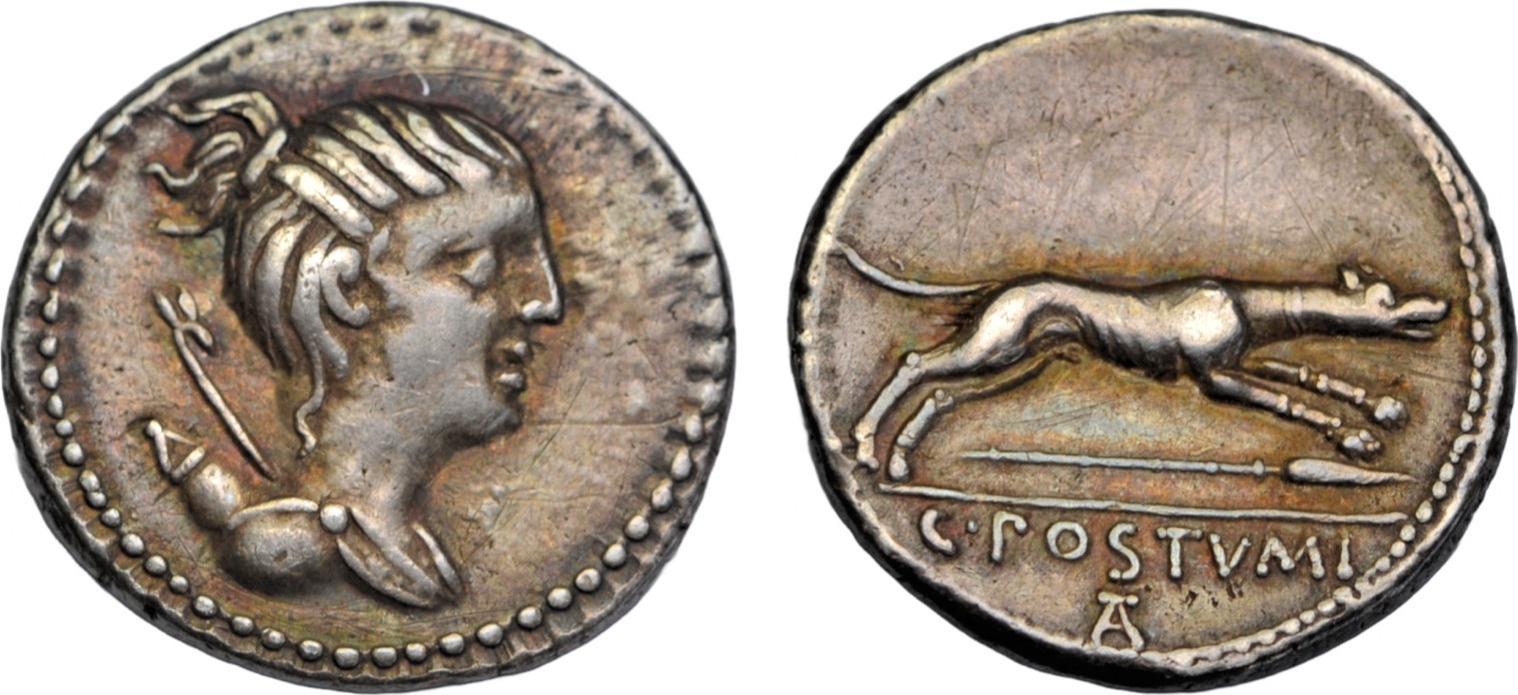
Roman Republic, C. Postumius, silver denarius c. 73 BC, Diana facing right with bow and quiver/hound bounding to right, spear below. VF+, old collection tone, minor surface marks. Cr. 394/1a. From the collection of Rudolf Hoesch (1904-1990).
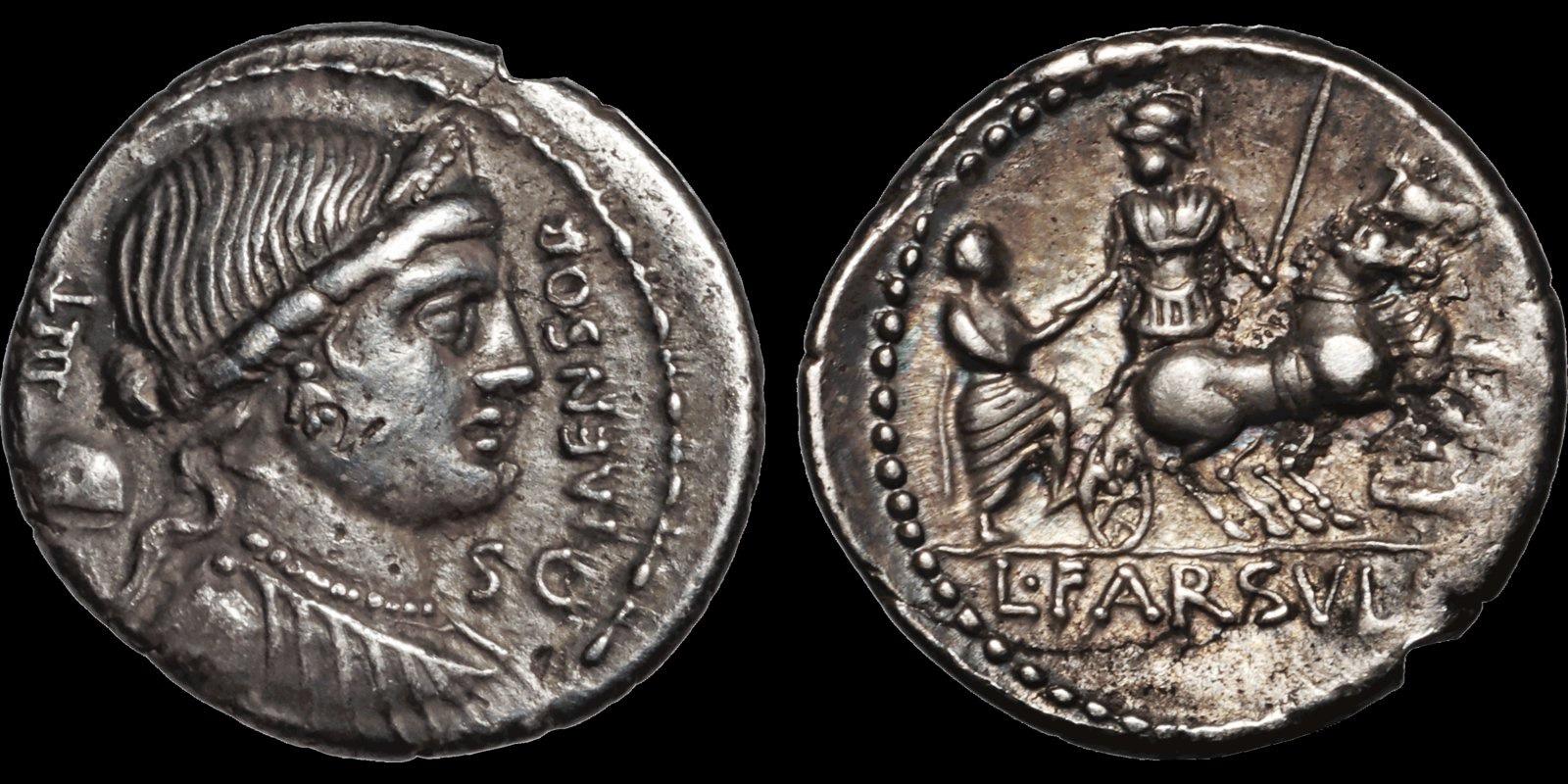
ROMAN REPUBLICAN. L. Farsuleius Mensor. 76 B.C. AR denarius. 3.8 gm. 19.5 mm. Rome mint. Diademed and draped bust of Libertas right; LIII (control number) and pileus behind, MENSOR S C before / Roma holding spear and reins in biga, assisting togate figure into chariot; scorpion below; L FARSVLEI in exergue. Crawford 392/1a. Sydenham 789a. RSC Farsuleia 1. Good Very Fine; deep old collection toning, with underlying iridescence on reverse; small banker's mark on obverse cheek; small edge test cut at 1' obverse. Noble Roman Imperial female bust of fine style.
Purchased from Davissons Ltd.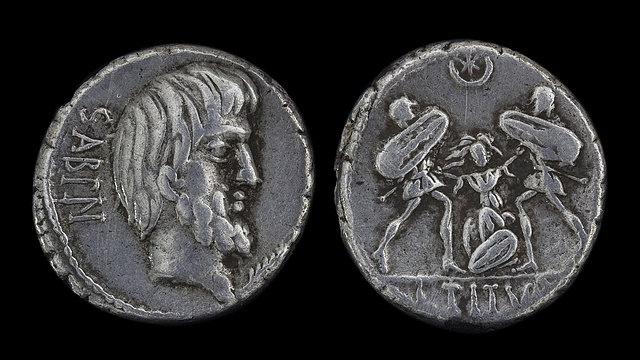
ROMAN REPUBLIC L. Titurius Sabinus Moneyer, 85 BC AR Denarius. 3.89g, 18.2mm MINTED: Rome mint, 89 BC REF: Crawford 344/2b; Sydenham 699 OBVERSE: SABIN, bare head of King Tatius right; palm to lower right. REVERSE: Tarpeia, facing, buried in shields, raising both hands in protest; to left and right, two soldiers about to cast shields at her; star in crescent above; L.TITVRI in exergue. Good Very Fine. Well-struck, centered and complete.
Purchased from Minotaur Coins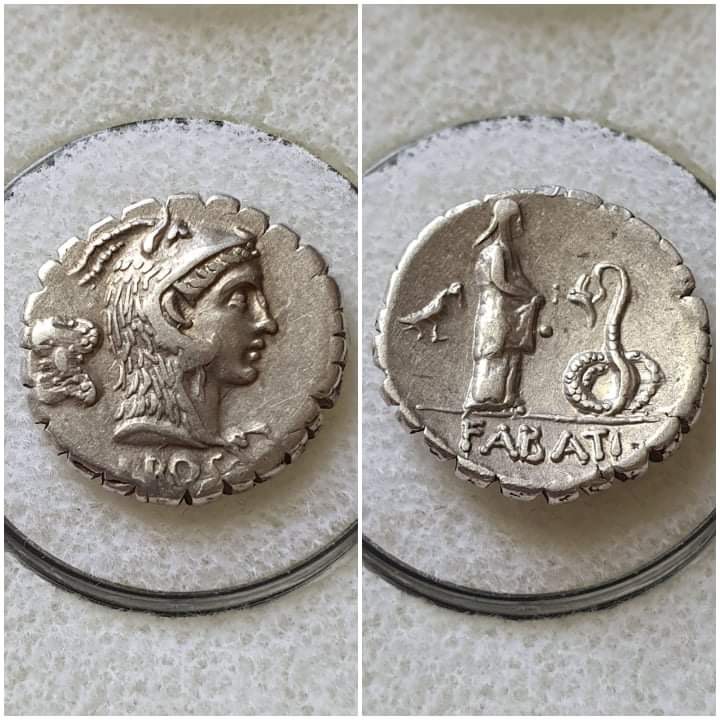
L. Roscius Fabatus AR Serrate Denarius. Rome, 64 BC. Head of Juno Sospita right, wearing goat-skin headdress; control mark behind, L•ROSCI below. Female standing right facing serpent; control symbol 106 in left field, FABATI in exergue. Crawford 412/1; RSC Roscia 3. 3.90g, 18mm, 6h.
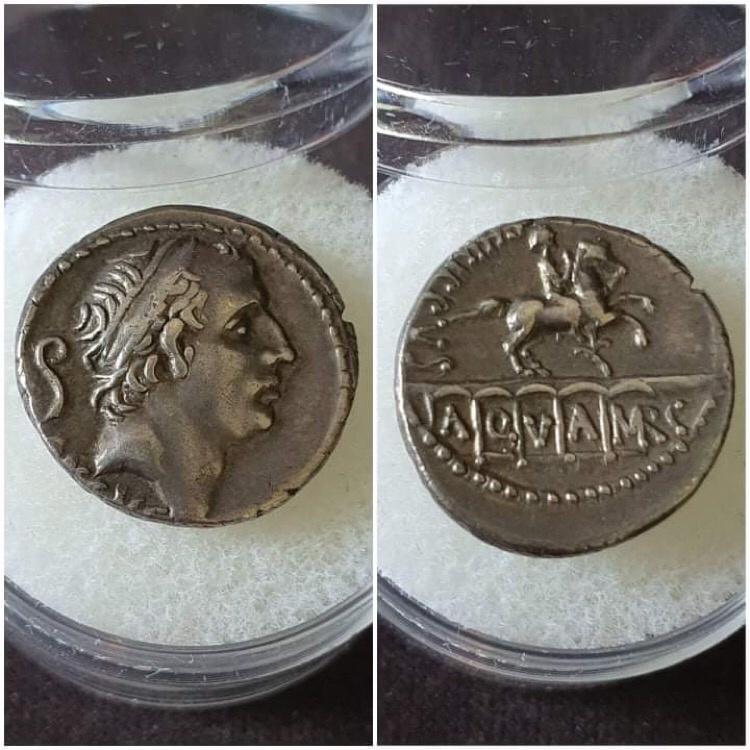
AR denarius L. Marcius Philippus, Rome 56 BC. 3.97 g, 16.50 mm Obv: ANCVS below, diademed head of Ancus Marcius right; behind, lituus Rev: PHILIPPVS on left, equestrian statue right on arcade of five arches; within arches, AQVA (MAR)
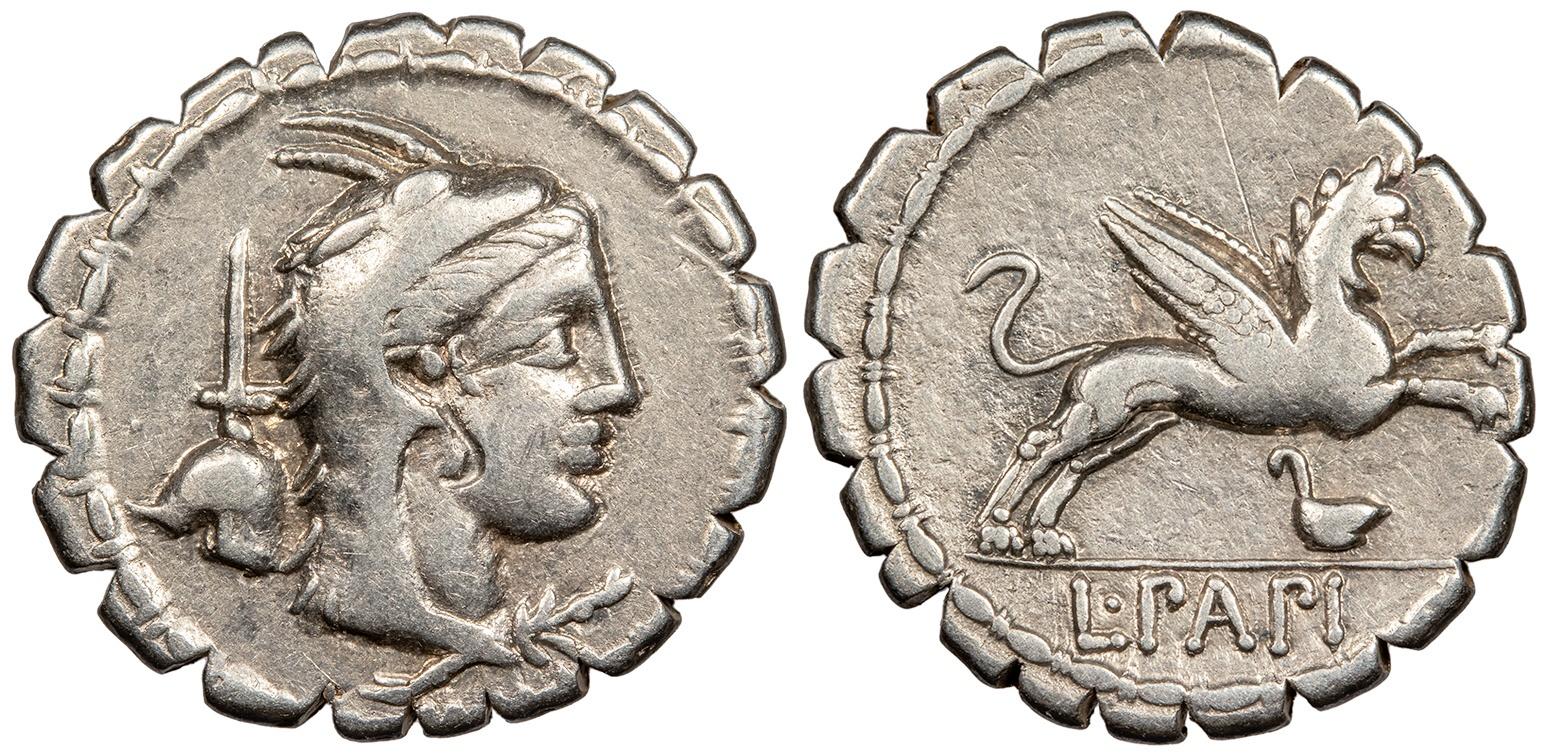
AR Serrate Denarius 18mm. 3.80g. Rome Mint. Head of Juno Sospita r., wearing goat's skin; helmet and sword behind. Gryphon springing r., ladle(?) below; In ex.: L.PAPI.
RSC I Papia 1; Craw 384/1
Purchased from Civitas Galleries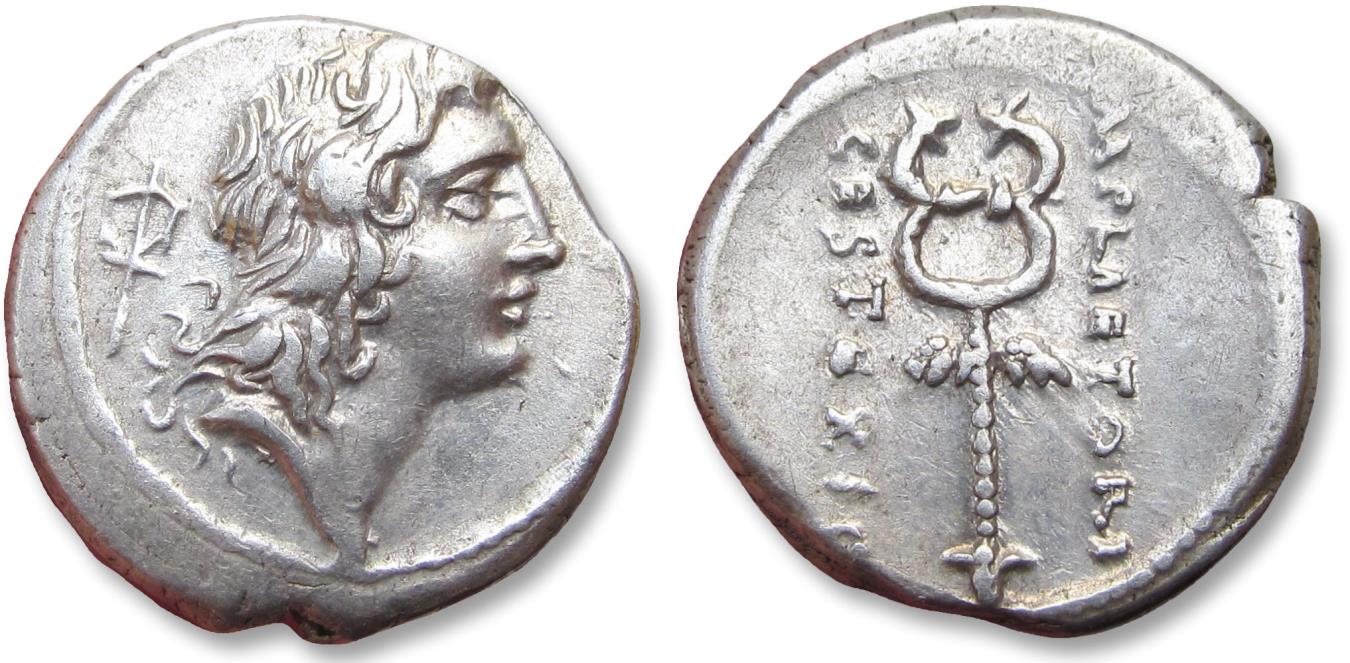
Roman Republic AR denarius, M. Plaetorius Cestianus, 69 BC
Grade: VF+ nice bright silver coin
Material: Silver
Weight: 3.92 g
Diameter: 18,50 mm
Ref.: Crawford 405/5
Obverse: Male head with flowing hair right, control-mark behind
Reverse: M. PLAETORI CEST. EX S. C, winged caduceus
Purchased from Germania Inferior Numismatics
AR Denarius 17mm. 3.90g. Rome Mint
Head of young Hercules, wearing lion's skin, r.
The Erymanthian Boar running r.; In ex.: M. VOLTEI. M.F.
RSC I Volteia 2
Purchased from Civitas Galleries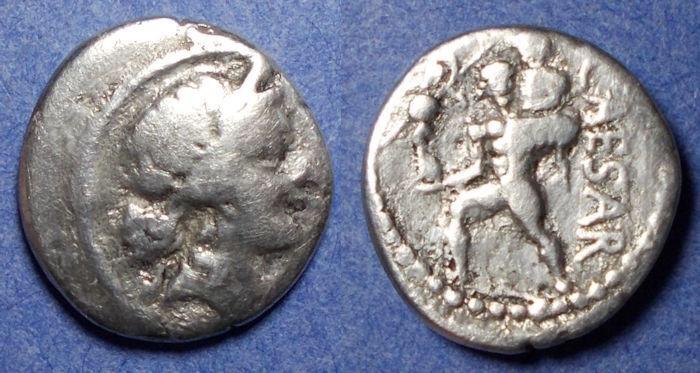
Julius Caesar AR denarius 48-47 BC
3.16g, 17mm Diademed head of Venus right Aeneas advancing left, holding plladium and carrying Anchises on his shoulder. "CAESAR" RSC 12
Purchased from Aegean Numismatics8 -
@291fifth said:
Roman coins are far more interesting than US coins.Roman coins are definitely more interesting than US coins from a historical standpoint. After all, the designs of Roman coinage served as political propaganda. Every Roman coin design served to transmit a message to a citizen. I can't say the same for US coins. Most US coins are the same old Lady Liberty or Native American on the obverse and eagle on the reverse. Examining a Morgan dollar teaches me nothing about the history of the Old West. In contrast, I have a greater connection with history when I hold a Roman denarius due to the symbolic imagery on the coin.
An example of a coin of mine that's connected to a historical event is this silver Denarius struck by Marc Antony before the Battle of Actium minted using silver supplied by Cleopatra. Marc Antony struck silver denarii for each of his legions. My coin was issued for the 21st Legion:
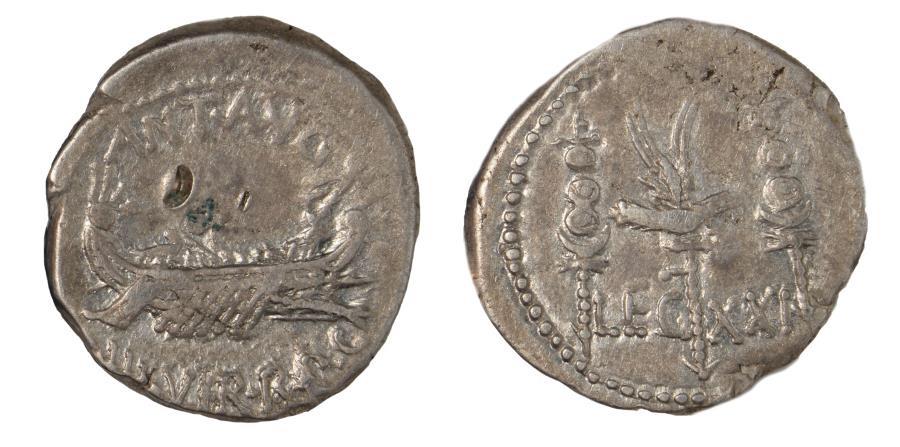
Mark Antony Legionary Ar denarius, 32-31 BC. Military mint moving with Antony. ANT AVG[III] VI R.R.P.C, praetorian galley to r., rev., Aquila between two signa; LEG XXI across fields (RSC 58). 3.5g, diameter 18mm
5 -
Great coins MonkeySwag. Which book would you recommend for the series?
Peace
0 -
@Coinlover101 said:
Great coins MonkeySwag. Which book would you recommend for the series?It depends on which field of Roman coins you're interested in. There are four categories of Roman coinage: Roman Republic, Roman Imperial, Roman Provincial, and Byzantine. Each category has their own reference book. Oftentimes, the books can be more expensive than the coin as some books are no longer in print.
The earliest Roman coinage were minted during the Republican period. The first silver Denarii were struck during the Punic Wars. The standard reference guide for Roman Republic coins is "Roman Republican Coins" (RRC) by Michael Crawford. The Crawford book is sold in two volumes and retails for over $600:
Roman Imperial coins are coins struck during the Roman Empire, starting with Augustus Caesar and ending with the Eastern emperor Zeno. The standard reference guide for Roman Imperial coins is "Roman Imperial Coinage" (RIC) by Harold Mattingly. The RIC consists of 10 volumes, with each volume costing several hundred dollars. The most current version of RIC is published by Spink:
https://spinkbooks.com/collections/roman-imperial-coinage-series-ric
Roman Provincial coins refer to coins struck by the local governments of the provinces, rather than the central Roman government. Most Roman Provincial coins have Greek legends rather than Latin, as most of the cities issuing these coins were located in Greek speaking provinces. Provincial coinage tend to have different denominations from Republic/Imperial coinage. For example the most common silver coins in the Roman Provinces are the Tetradrachm, Didrachm, and Drachm which were denominations previously used by Alexander the Great's empire. The standard reference for Roman Provincial coins is "Roman Provincial Coinage" (RPC). The RPC exists as a printed book and an online database. The online version is more up to date than the printed book:
Byzantine coins refer to coins struck by the Eastern Roman Empire after the collapse of the Western Roman Empire in 476 AD. The so called "Byzantine Empire" was the surviving remnant of the Roman Empire centered at the city of Constantinople and consisting of the Greek speaking eastern provinces. The emperor Anastasius reformed the Eastern Roman Empire's monetary system in 498 AD. Anastasius's reforms marked the end of Roman Imperial coinage and the beginning of Byzantine coinage. Byzantine coins have more overtly Christian symbolism compared to the previous Roman Imperial coins. The standard reference book of Byzantine coins is the "Dumbarton Oaks Catalogue" (DOC), which consists of five volumes and is quite expensive. A more affordable book is "Byzantine Coins & their Values" by David Sear:
https://www.casemateacademic.com/9780713477405/byzantine-coins-and-their-values/
I mostly collect Roman silver coinage. My favorite book series is Roman Silver Coins (RSC) by David Sear. The RSC consists of five volumes and are comparatively less expensive compared to other guidebooks. Book 1 covers the silver Denarii of the Roman Republic. Volumes 2 and 3 covers the silver Denarii struck during the Roman Empire's "golden age". Volume 4 covers the debased silver Antoninianii struck during the 3rd Century Crisis. Volume 5 focuses on the last silver coinage minted before the collapse of the Western Roman Empire in 476 AD.
2 -
I am hooked to a point. I tried to get at least one coin for each emperor. I did pretty well until the mid 400s when the coins get rare and almost unobtainable. I have some really tough ones, like Gordian I and II.
I built two notebooks on the history of each emperior. It's been a fun ride.
My main references are the David Sear books which were listed in the previous post and the Internet website, "Wildwinds."
Retired dealer and avid collector of U.S. type coins, 19th century presidential campaign medalets and selected medals. In recent years I have been working on a set of British coins - at least one coin from each king or queen who issued pieces that are collectible. I am also collecting at least one coin for each Roman emperor from Julius Caesar to ... ?1 -
I'm very much a "coin generalist" - ancient, medaieval, modern, world, I'll take one of everything, thanks.
And "Roman" is very much a large part of what's out there in terms of sheer abundance of ancient coins. I have two albums of ancient coins: one for "Roman", and one for "everybody else". They're about the same size.
Specializations within the Roman series I'm interested in pursuing are:
- One from every Emperor - a fairly standard collector series lots of people try to aim for. I;ve got all the easy ones and several of the harder ones.
- One from every mintmark-city - the Late Roman series has nice, neat, obvious mintamrks on them - and a couple dozen cities across the Empire hosted mints. I think I've now got most of them, except for Barcino (now known as Barcelona, Spain).
- "Astronomical" reverses -featuring sun/moon/stars designs, and/or depicting deities for whom planets/asteroids/etc have now been named. Coins depicting Jupiter, Venus and Mars are easy; coins depicting Saturn and Pluto, much less so.
Waste no more time arguing what a good man should be. Be one.
Roman emperor Marcus Aurelius, "Meditations"
Apparently I have been awarded the DPOTD twice. 5
5 -
@BillJones said:
I am hooked to a point. I tried to get at least one coin for each emperor. I did pretty well until the mid 400s when the coins get rare and almost unobtainable. I have some really tough ones, like Gordian I and II.I built two notebooks on the history of each emperior. It's been a fun ride.
My main references are the David Sear books which were listed in the previous post and the Internet website, "Wildwinds."
Yeah, Gordians I and II are quite scarce. After all, they reigned for only 22 days. Some of my "tougher" emperors & empresses are:
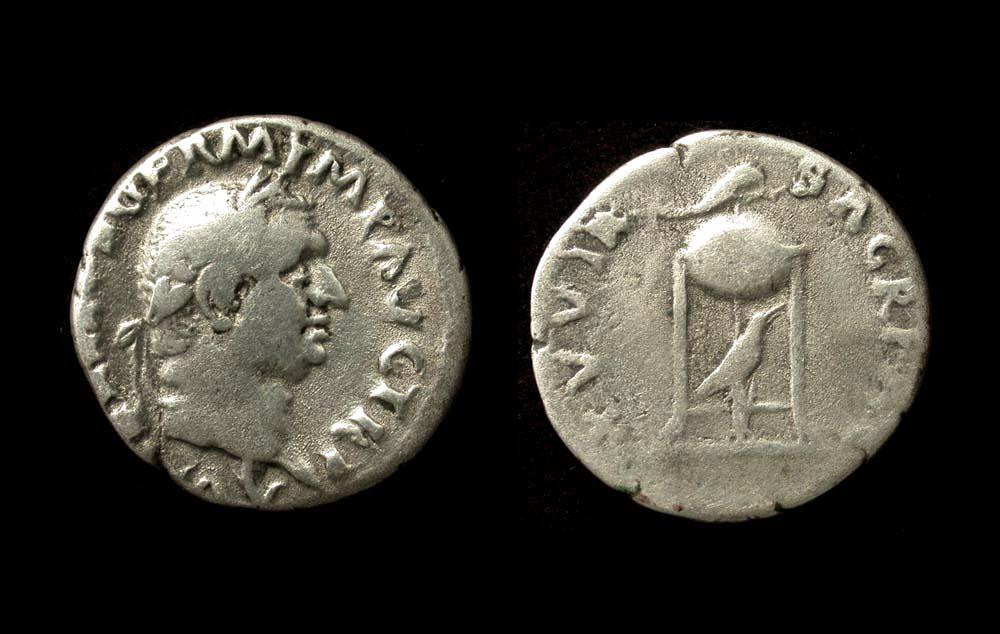
Vitellius, AR denarius, Civil War Issue AR 18mm/3.1gm Rome mint c. 69 AD Con/ Slightly off-struck to left, otherwise, Very Fine. Obv/ [A VITELLIVS] GERM IMP AVG TR P; laureate head right Rev/ XV VIR SACR FAC; Tripod-lebes with dolphin laying right above and raven standing right below Ref/ RIC Vol One, 109, RSC111, BCM39
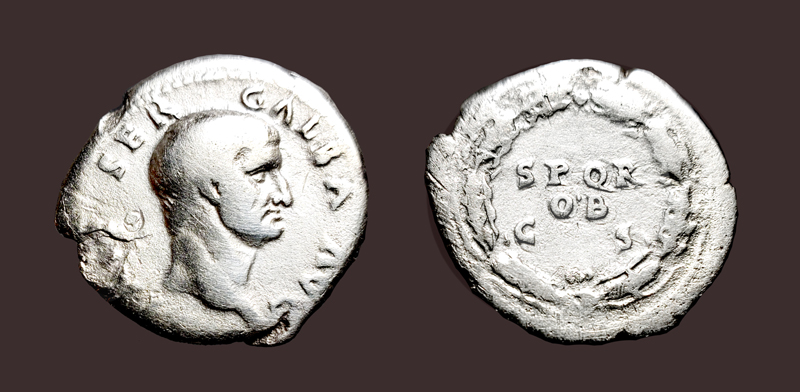
Galba. 68-69 AD. AR Denarius (19mm; 2.84 gm; 6h). Rome mint. Struck August-October 68 AD. Obv: IMP SER GALBA AVG, bare head right. Rev: SPQR/OB/CS in three lines within oak-wreath. RIC I 167; RSC 287.
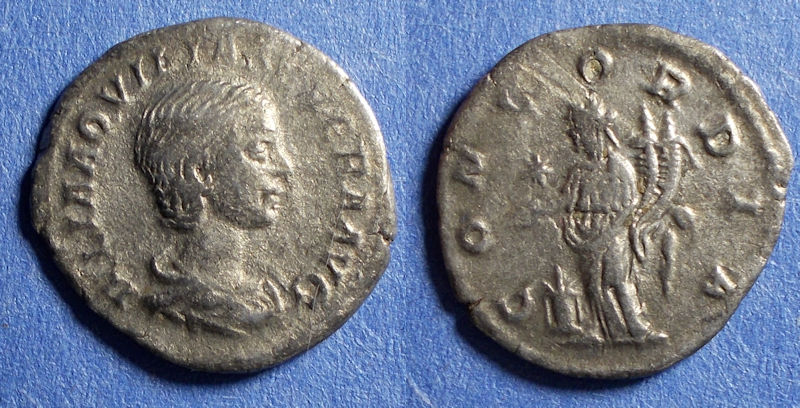
Roman Empire, Aquilia Severa 220 AD, Silver Denarius
2.45g, 19mm
Draped bust of Aquilia Severa right "IVLIA AQVILIA SEVERA AVG"
Concordia standing left, sacrificing out of a patera over an altar and holding double cornucopiae, star to left. "CONCORDIA"
RSC 2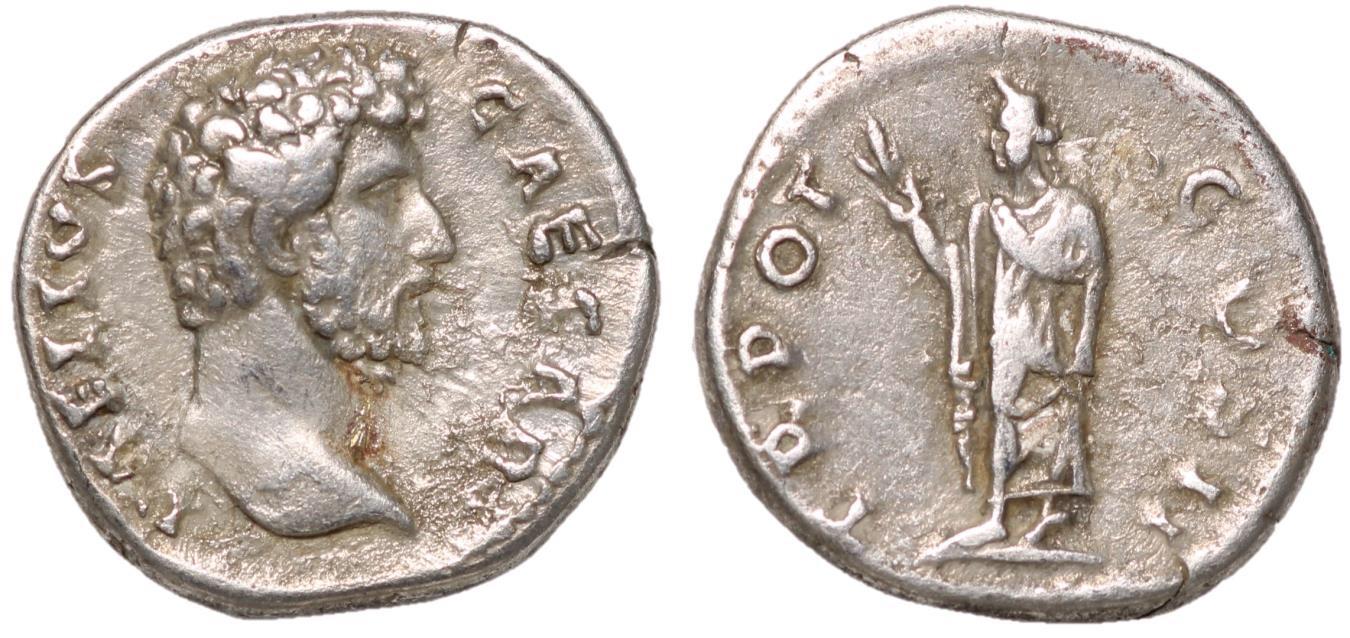
Aelius Caesar, 136 - 138 AD Silver Denarius, Rome Mint, 19mm, 3.01 grams Obverse: L AELIVS CAESAR, Bare head of Aelius right. Reverse: TR POT COS II, Spes advancing left holding flower and raising hem of dress. RIC 2648
3 -
I sure am hooked !
Below is a virtual tray of 3rd century sestertii (some of them are not mine anymore, but all have been at some point)
 7
7 -
@Cucumbor said:
I sure am hooked !Below is a virtual tray of 3rd century sestertii (some of them are not mine anymore, but all have been at some point)
Beautiful green patinas on the sestertii! My favorite ones are the Maximus Caesar and Pupienus!
2 -
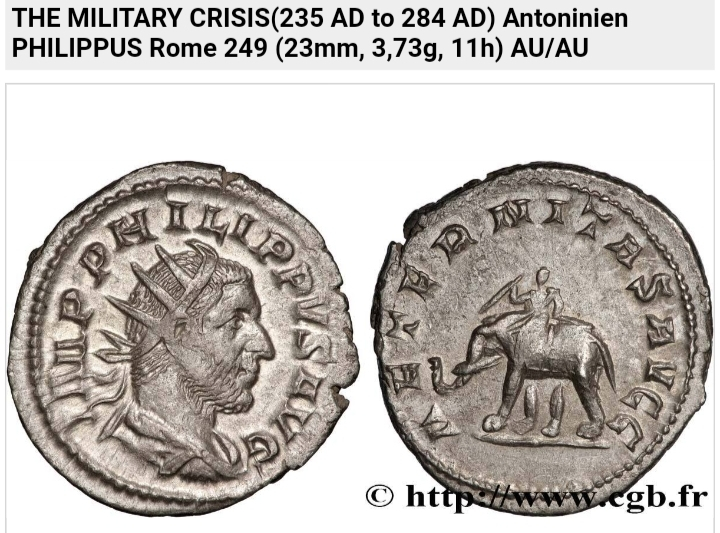
My latest purchase. Hope that it looks good in hand.
Peace
4 -
@Coinlover101 said:
My latest purchase. Hope that it looks good in hand.That's a really nice example of Emperor Philip's "elephant rider" silver Antoninianus. Philip was emperor during Rome's 1000th anniversary. He struck a series of coins commemorating the Secular Games that celebrated Rome's millennium. The coins depicted the various exotic beasts that were showcased during the Secular Games. Your "elephant rider" Antoninianus was one of the coins that commemorated the Secular Games. I own a couple of Secular Games coins:
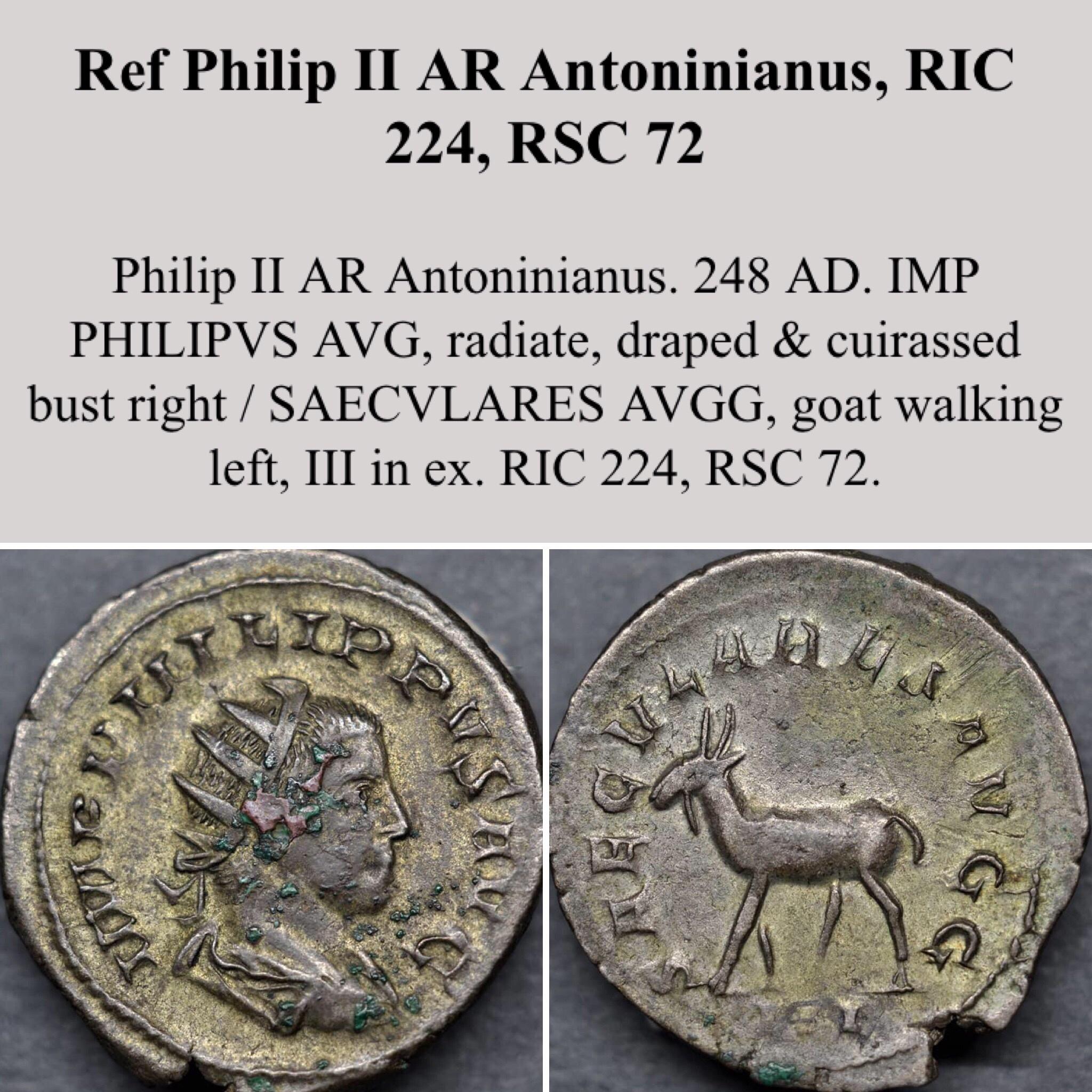
Roman Imperial AR antoninianus, emperor Philip II
Obverse: IMP PHILIPPVS AVG, Radiate, draped and cuirassed bust of Philip II facing right.
Reverse: SAECVLARES AVGG, Goat or Elk standing left, officina mark III in ex.
RIC: 224. Sear: 9275. [Rome, AD 248]. Diameter: 23 mm. Weight: 4.1 g.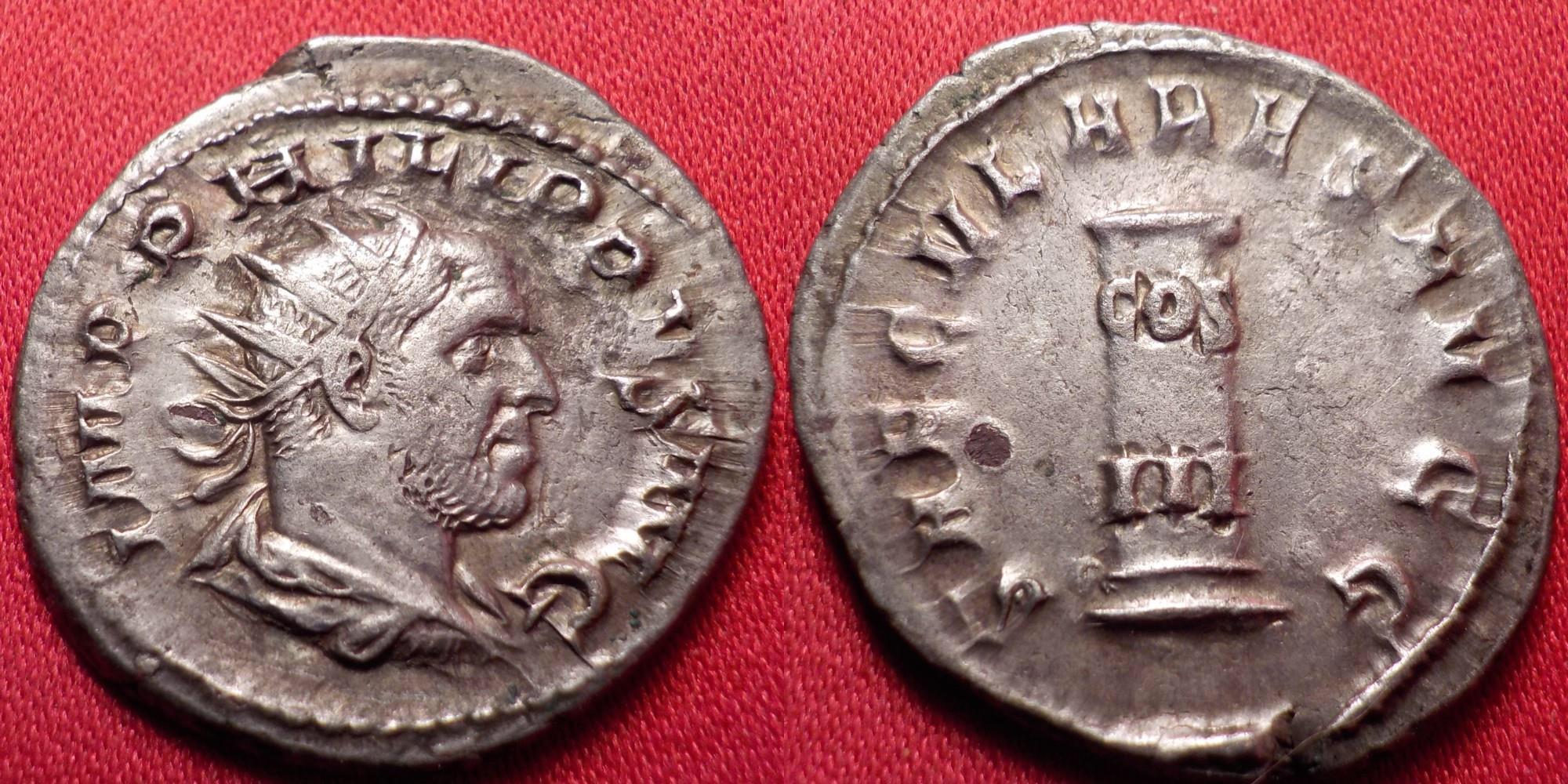
PHILIP I THE ARAB AR silver antoninianus. Rome mint. IMP PHILIPPVS AVG, radiate, draped bust right. Reverse - SAECVLARES AVGG, cippus inscribed COS III. RIC 24c, RCV 8961. 23mm, 4.2g.
1 -
Can’t go wrong with Roman coins. This is my only one for now. Hope to get more in the future.


 4
4 -
@markelman1125 said:
Can’t go wrong with Roman coins. This is my only one for now. Hope to get more in the future.Your coin has an attractively engraved portrait style. Some examples of your coin type can have crudely engraved, cartoonish portraits. Your coin is also well struck and centered for the type.
5 -
I've been hooked on Roman coins and history for more than 40 years now.
I live very close to the Limes, the fortified line separating Germania Inferior and Superior from the Germanic tribes, so this has given an added perspective to my interest for Roman coins.
As far as Roman coinage is concerned, my focus is primarily the period between the 1st to the 3rd century A.D, specifically sestertii, but also denarii.
Here are some examples from my collection: denarii from Julius Caesar to Trajanus.
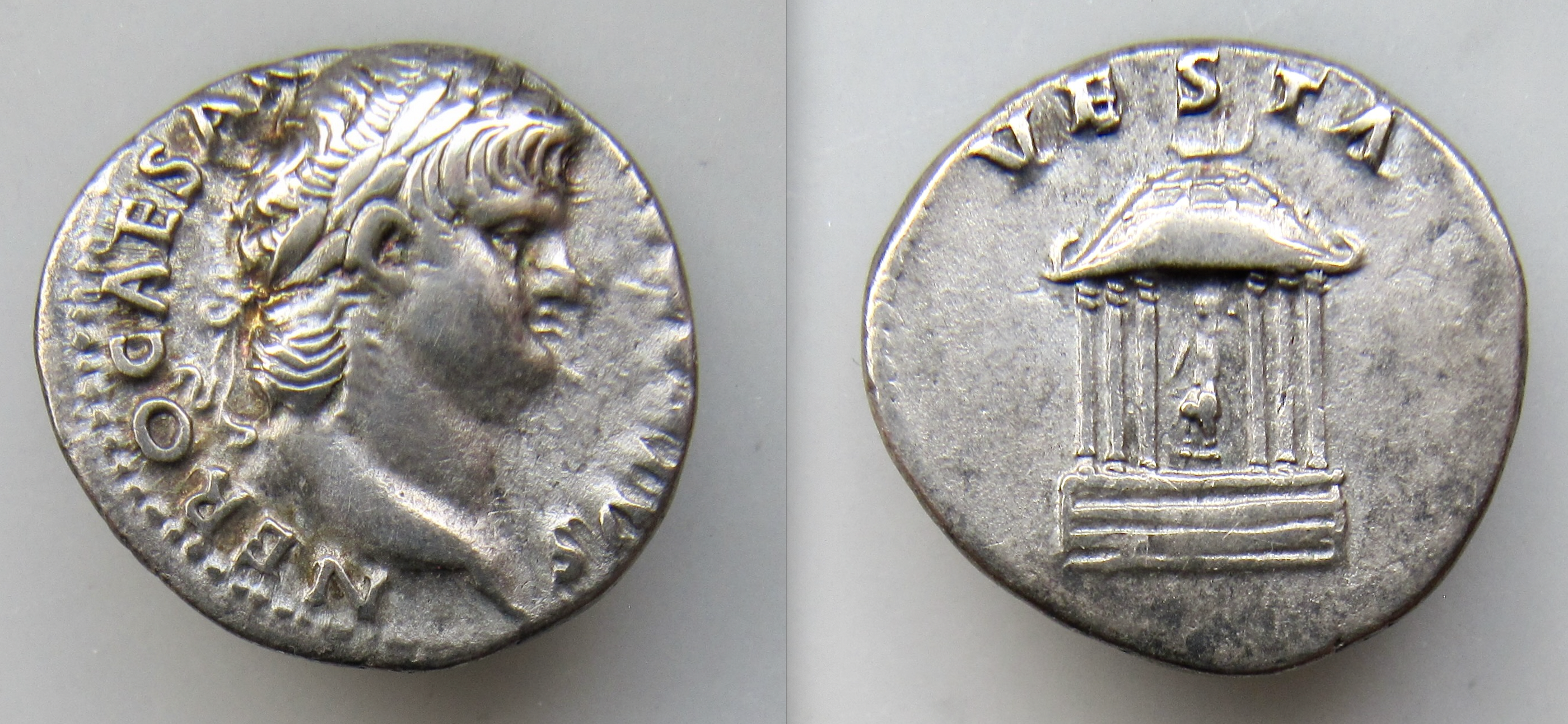


 10
10 -
I know little about them but have a great interest and want to start grabbing a few. Your right, coinage of Rome just blows a History nut away.
1 -
@MrMonkeySwag96 said:
@markelman1125 said:
Can’t go wrong with Roman coins. This is my only one for now. Hope to get more in the future.Your coin has an attractively engraved portrait style. Some examples of your coin type can have crudely engraved, cartoonish portraits. Your coin is also well struck and centered for the type.
Lovely coins. Congrats.
1 -
From The Man himself:

Antoninus Pius Denarius Salus
Silver, 18 mm, 3.52 gm
Struck: AD 156-157 Rome
Obverse: Antoninus Pius facing right, ANTONINVS AVG PIVS PP IMP II
Reverse: Salus seated left feeding serpent, TR POT XX COS IIIIhttps://www.brianrxm.com
The Mysterious Egyptian Magic Coin
Coins in Movies
Coins on Television2 -
Starting to have an interest in Diocletianus coins after a genealogy research result (wife's 49 great-grandfather) pointed this out (see partial screenshot from FamilySearch.org).
 1
1 -
I will admit my primary interest is US coins, but I find Roman coins fascinating.
I had a few examples a few years ago, but kind of consolidated back to my US collecting, I do have this one though, and possibly would be open to buying more in the future…I found it a pretty solid purchase for 100 bucks:

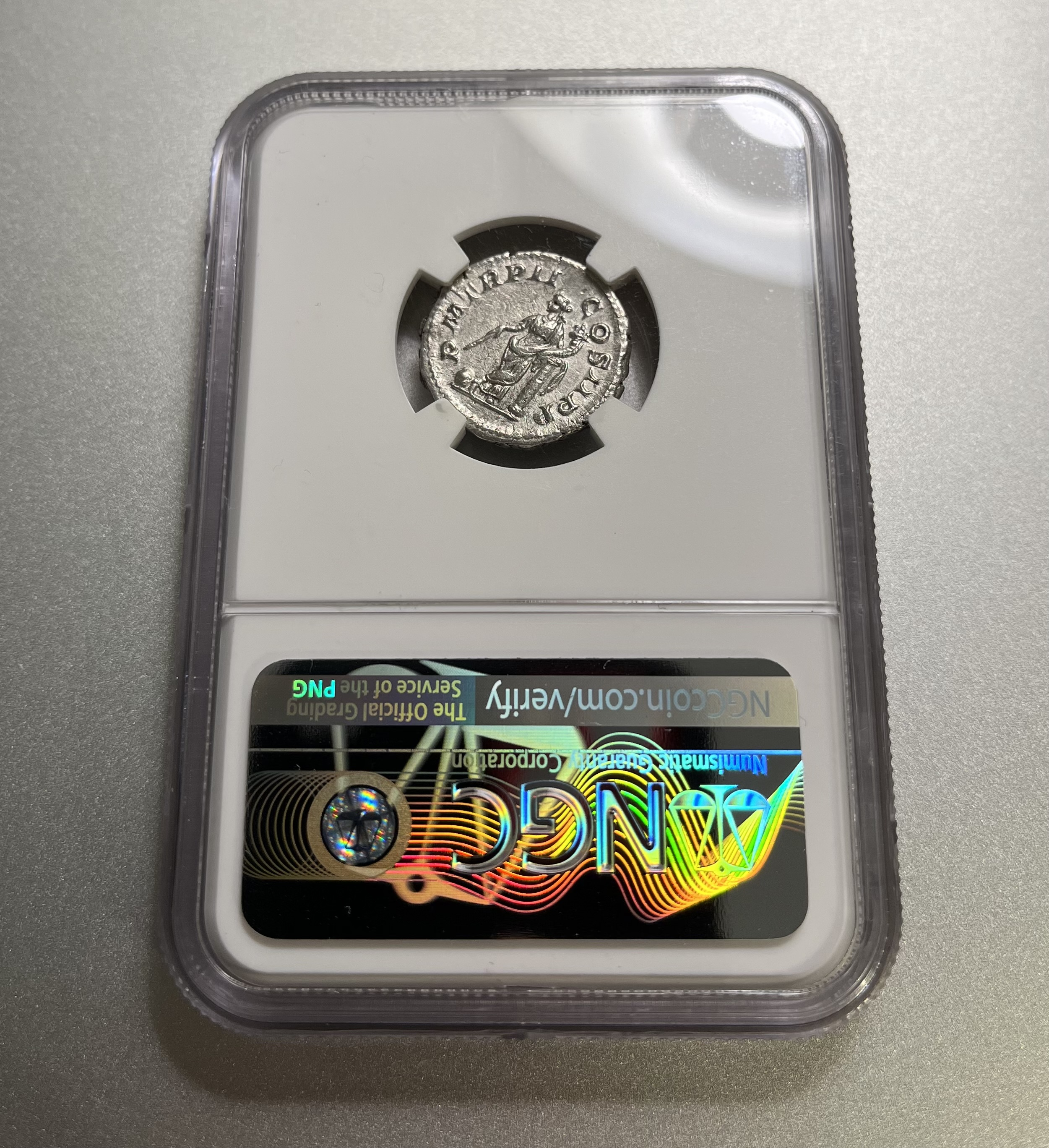 1
1


Categories
- All Categories
- 520.1K Coins and Currency - PCGS
- 328.5K U.S. Coin Forum
- 14.8K PCGS Set Registry Forum
- 5.2K Q & A Forum
- 41.4K World & Ancient Coins Forum
- 3K U.S. & World Currency Forum
- 96.4K Buy, Sell, & Trade - U.S. Coins
- 7.3K Buy, Sell & Trade - World & Ancient Coins
- 1.5K Buy, Sell & Trade - Currency
- 60 Random
- 246.2K Trading Cards, Autographs and Memorabilia - PSA
- 90.3K Trading Cards & Memorabilia Forum
- 1.7K Autographs Forum
- 16.4K PSA Set Registry Forum
- 22K Sports Talk
- 115K Buy, Sell & Trade - Cards & Memorabilia
- 663 Buy, Sell & Trade - Autographs
- 2.2K Stamps
- 1.5K Stamps Forum
- 670 Buy, Sell & Trade - Stamps
- 83 Coin Shows
- 83 General Coin Show Information and Discussion
- 11.9K Misc
- 11.9K Testing Forum