An old holder question.
 keets
Posts: 25,351 ✭✭✭✭✭
keets
Posts: 25,351 ✭✭✭✭✭
As early as 2000-2005 collectors were all a-buzz over the old holders from PCGS, mainly rattlers and OGH's. That was roughly 15 years after inception and the first PCGS holders. Why has there never been any clamoring for the earliest Blue Holder Generations which I'm thinking started around 1996??
To a large extent all the excitement about rattlers and OGH's was the perceived(or hyped) notion that the grading was more strict and left LowHangingFruit for the astute Numismatist to pick. Now, I claim no superior knowledge but I've been here since 2002 and have been around the block a few times, heard the talk of changes in grading, blah, blah, blah. Quite a bit of that took place between 2000 and 2012 when there were subtle yet notable changes in the PCGS capsule/insert combination. Why has there never been a generation that gets pigeon-holed like rattlers and OGH's??
Al H.
Comments
The OGH was retired in the fall of 1998, not 1996. The first one I received from PCGS was in October, 1998 and it was the first example any dealer I knew had seen, either.
I had always assumed that it was easier to visually pick out rattlers and OGHs than the various generations of blue insert holders. Therefore, one might scan a case quickly and pick out the rattlers and OGHs without having to scrutinize if a blue insert had the series number or barcode or variously shaped hologram on the back.
In honor of the memory of Cpl. Michael E. Thompson
Grading was generally perceived to be looser during the initial blue label era. Also the labels were not particularly aesthetically pleasing. Because collector interest was never really piqued, many probably got cracked without a second thought.
Just some random thoughts.
Probably partly an echo chamber effect. People kept going on and on about rattlers and OGH and so it got picked up and repeated. I think we can see all the services having looser and stricter periods as they tried to find their footing. But that’s by today’s standards, really. As more info comes in and more time passes the standards should stabilize as much as they can currently.
Personally, I look at the older holders not so much for “strict” or “loose” but stability. For example, if a copper coin has stayed the same since OGH or the early blue days then it’s probably stable enough and enough time has passed that if something was to turn or be retoned badly it would be more evident.
Good post @TurtleCat . That's how I look at the old holders too.
It's funny but I was thinking the exact same question yesterday and was going to post the same questions. Thanks for taking the time to ask the questions for me!
It's a combo of factors that have been mentioned.
~The rattlers were the first generation and there is often more interest for the first of something
~Rattlers (and for that matter Regency holders) look vastly different from the other generations and thus stick out more
~Echo chamber as others said (this echo chamber is prominent in many aspects of coins)
Also some people do look for the blue holders (and other various prior generations); it just hasn't gained the same traction as rattlers or OGH.
If you didn't take part in cracking out OGH's from 1988-2004 (and raw coin submissions as well) you really don't have anything to go by except what you heard from others...much of it probably not even true. I first started cracking out OGH rattlers in 1988. Must have done a hundred by 1990. And I was only a little fish. Worthy coins back then weren't going to wait 10-20 yrs to be cracked out....it was getting done as soon as they were graded....leaving not many fresh ones to continue into the early 2000's. Colonel Jessup, Little Eric, Martin Paul, Bill Nagle and other big fish can talk about the pile of crack outs they did in those early years. I also did some from 1992-1994 but the recession and much lower coin prices tended to negate some of that. Buyers were scarce too. The market stunk from 1991-1995.
The next wave of OGH crack outs began with the Pittman and Eliasberg Auctions in 1996-1998, partly due to the market perking up for the first time since 1990. The recession had basically ended and prime collectibles from all areas started a fresh ascent (1996-2007). Word was out that those Pittman and Eliasberg coins were getting some pretty "easy" grades. In a way, it was time for the TPG's to start using the entire grading spectrum, esp. MS/PF 66-68. And those "gem" 64's with the tiniest of flaws, were upgrading to 65/66's if they had eye appeal. Everything was changing again.
I was advised by a couple dealers I trusted to resubmit all my better, higher end type coins for regrading....take part in the Eliasberg coat tail effects. My very best coins went in first to NGC in 1997 and they nearly all upgraded from 65/66 to one pt higher. One of my best dealer inside sources told me he was getting about 80% upgrades on coins he submitted to NGC....doing a dozen or more coins every month. He was digging deep into his inventory and safe deposit boxes to find coins to send back. In fact, NGC was soliciting their dealer network for resubmissions, offering reduced rates. It was win-win for them. They needed the fees....dealers wanted the upgrades and 100% gains. That 1998-2002 period was interesting. But....none of us then knew of the push back yet to come from CAC, gold stickers and old holder premiums that would surge from 2009-2014. In fact JA has previously stated that his concern for the looser grading in the coin market began in that 1998-2004 Bonanza period....the spark that eventually became CAC.
I recall a purchase I made "sight unseen" at a Stacks Auction on lots of rattler choice $20 Saint Gaudens around 2003-2004. I bought several lots numbering around 50 coins total (63's and 64's). As it turned out, these were fresh, unpicked through coins. Gold was still only around $300/oz...so few cared. I picked out the best half for resubmissions and about half upgraded the first time. Some I flipped for 50% premiums as is. Some I kept. In hindsight, I should have kept them in the rattlers....going the gold sticker route years later.
That's what happened to all the "good" rattler, ogh's, and old fatties. By 2004-2008 a lot of what remained were picked over coins. Fresh stuff was hard to keep past the 2006-2008 market peak (generic gem gold peak in Nov 2009). But what many here probably don't realize is that the OGH/rattler cracking out began almost as soon as the TPG's were formed. My very first submission to NGC in early 1998 was brutal. Most every coin came back 1-2 points lower than I knew it was. Paid strong money for those coins raw from 1977-1987. So all of them went back....most going a point higher the next time through. It was pretty clear the "grading problem" was not yet fully solved....but it sure opened up some great buying opportunities and windfalls for those who could grade to approx TPG standards. I submitted almost exclusively with NGC from 1988-2008 because they would get me the grades I thought the coins deserved. In that regard I learned TPG grading "feedback" under JA's early reign.
Aren't the 1st Blue Holders the ones that have the coin number on them?
So before I was born
In my searches, many of the Rattlers/OGH holders have maxed out coins or have problem coins these days, but on occasion I've found some gems. I have had better luck over the last few years finding undergraded coins/gems in NGC "fatties/soapbox" holders, but its getting tougher each day to find good coins in those type of slabs.
You and Dick share a few nice fatty gems with me a few years ago at the Mansfield coin show. Still dream of that 25c, haha!
I had always assumed that it was easier to visually pick out rattlers and OGHs
first post, Bingo!!! that's part of how I've thought, when collectors are looking through cases at a show their eyes will typically stop at one of those and look closer, I do it myself. in a sense it turns the old adage, buy the coin not the holder, up-side-down. collectors have been hype washed into thinking upgrade so they see the holder before the coin.
this and more are dirty little secrets we deny, sort of human nature.
And that OGH passion is an aspect of CRO’s successful business strategy.
"She comes out of the sun in a silk dress,
running like a water color in the rain...."
I have some rattlers & old fatties, haven't looked at them in ages
BHNC #203
I wonder what people think of the grading of the last PNG hologram blue label holder and the one after which had the St Gaudens on the hologram.
The blue labels began around 1999/2000. All the earlier rattlers and NGC fatties did not designate CAM/DCAM/UCAM
on PR coins on vintage coins so there was a grading play with this also. I can't remember exactly when both services began using this designations for them, but with PCGS I think it was around the start of these light blue label, non bar code labels.
Maybe someone can help with the timeline on this?
The blue labels came into play in the fall of 1998. I don't know when PCGS started with CAM and DCAM, but this generation of OGH (see below) was replaced in 1994 or so and has it for the proof WQ-
In honor of the memory of Cpl. Michael E. Thompson
They used CAM/DCAM that early with non Vintage coins early, but with Vintage Coins this came later.
Sad they must be feeling lonely and neglected.
My Collection of Old Holders
Never a slave to one plastic brand will I ever be.
Anyone have a CAM/DCAM PR Barber coin in a 1st or 2nd Generation PCGS holder? Seated Coin? Trade Dollar?
I am sure, but every time I look for them they hide from me
BHNC #203
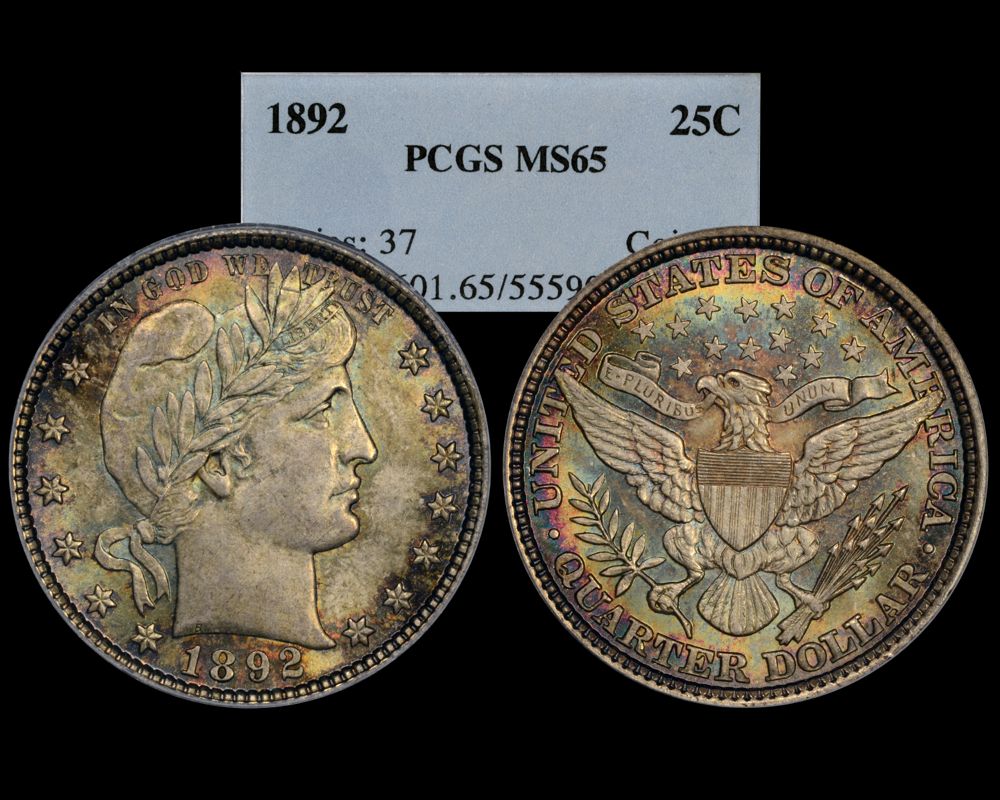
This is the first blue label holder from 1998. Since the OGHs have become much harder to find, I look for coins in this first blue label holder as I have an instinctive but unproven belief that they are also conservatively graded.
Commems and Early Type