Day 3 (Saturday) of NYINC 2017

Saturday was a dead day for me -- meaning that I was dead tired. Got up late, ate a huge brunch with my wife and got to the show around noon. BTW, the "prime" burger I got was the second most delicious burger I've eaten in my life (topped by the "steak" burger in Jackson, WY, late last year). Great meat matters.
Dragged myself to the show and didn't know what to do. I picked up my coins from BluCC (Todd), which included the 19th century fantasy striking of a 1644 silver half-pound coin with a Rawlins crown obverse type and a typical "declaration" type reverse. Nap was with me, and three guys from CNG huddled around Nap and me and said a bunch of things really fast that I just couldn't process. I think @Nap will post a regurgitation of that huddle tomorrow. The conclusion I remember: I got a lot of research to do!
Walked around the tables a bunch more time, looking at the same old stuff. Zohar had convinced someone to buy a really nice piece from Sonntag that I actually wanted. Gee, thanks, @Zohar! Not cool, bro.
At 4pm, I sat in on a talk sponsored by the British Numismatic Society. Given by David Guest of CNG, it was about the coins of James VI of Scotland; specifically, it was about the key design elements of his coins.
At 5pm, I made my way to Andy's table to have wine, cheese and crackers. Nice way to unwind. Paid for my next year membership to the BNS, and got a nice quote on that thrymsa mentioned in Nap's show report. Hopefully. Hopefully...
Came back to the hotel at around 6pm with my wife still at the Met Museum. Much later, we ate at nearby Japanese ramen joint. My wife really loves that stuff (I'm ambivalent), and we can't easily get it in NJ, so I figure I'll let her get her fill of it while it's available!
Not sure if I'll be back at the show on Sunday... (Checkout is at noon.)
How does one get a hater to stop hating?
I can be reached at evillageprowler@gmail.com
Comments
So..
Regarding EVP's fantasy piece:
https://forums.collectors.com/discussion/971489/baltimore-nov-2016
This is a fantasy Oxford halfpound of Charles I from 1644, right smack within the first English Civil War. It is considered a fantasy piece rather than a reproduction, as halfpounds are not known with the picture of the king on horseback above the city.
When I saw the coin in EVP's original thread, my thought was that it could be a 19th century electrotype produced by Robert Ready, who copied coins in the British Museum's collection. These are sometimes marked as copies (but sometimes aren't).
EVP decided to take the coin to CNG's experts who really are wise guys. I came merely as an observer. but I can try to re-call the main points of the discussion:
There was never any consideration that the coin would have been an authentic 17th century piece, for a variety of reasons. The crux of the discussion came down to:
1) Was the coin struck or cast/electrotype?
2) Is the coin old (>100 years) or modern?
For the first question, there were a couple of things to consider. The most obvious one is that the obverse of the coin (but not the reverse) is double struck. Second, the edge did not show evidence of a casting seam (though there are ways to mitigate this). Third is the evenness of the strike, something that may vary greatly on hammered coins but would be more consistent on more modern coins.
When examining the coins, the consensus was that the coin likely was not cast but rather "press struck" using something like a tabletop screw press or fly press, but not struck with the kind of force as a modern coin. I was a little unclear as to how they came to this conclusion. but I suspect it had to do with softness of strike.
The next thing to tackle was the issue of the double striking. I mentioned that there are no Oxford cityscape halfpounds known, making this a fantasy piece rather than a reproduction. However, there are Oxford cityscape crowns. They are patterns produced by a guy named Rawlins. The crown denomination differs in size by about 5mm; it's theoretically possible that the die used to strike the fantasy piece was a transfer die from a real crown. We kind of debunked this, given certain features of the coin. The real Rawlins crowns are "signed" with a floriated cross prior to the king's name, something the fantasy coin does not have (it has a plume). In addition, the Rawlins crowns are extremely rare, with less than 10 known and they are all from only one set of dies. This coin is obviously not from those dies, as it differs in many significant ways, including the style of the cross, the presence of the plume in the field behind the horseman, and other more subtle features of the design.
So in the end, I think the consensus was that the obverse of the coin may have been a transfer die from a fantasy piece, in other words a counterfeit of a fantasy. Or it could just be a double-struck fantasy piece, but it is certainly not from a double struck real coin. The reverse die leaves room for further study; it was not really discussed.
The final question about whether the coin was a modern or old fantasy: the experts thought modern but didn't elaborate much on that.
The most comprehensive collection for coins of Charles I (that I'm aware of) is the John Brooker collection which is fully illustrated in SCBI 33. I have the catalog and may look into the reverse dies of the halfpounds to see if there are any matches. Looking through the catalog is neat in and of itself; the guy had no less than 14 triple unites!!
Thanks for the write-up, @EVillageProwler and @Nap . I was wondering what happened to that Charles I piece posted last November.
Follow-up:
DNW sold a similar fantasy piece here:
https://dnw.co.uk/auction-archive/lot-archive/lot.php?department=Coins&lot_id=285385
I think it is a match to your coin.
DNW called theirs "cast". Importantly it does not have the same double strike.
But if yours is the same diagnostics and double struck then it is either made from transfer dies from the cast copy, or the "cast" coin was really die struck. I am nearly convinced that your coin is die struck, though the possibility of being "pressed" rather than "struck" is certainly there.
The reverse die does not seem to match any real dies of Charles I Oxford halfpounds, nor of the Rawlins crown.
Thanks, @Nap for the write up about the fantasy 'half-pound' piece.
Let me see if I can offer some not-too-unintelligent contribution to this...
First, I want to not that my piece's edge is fully rough, unlike Zohar's 3T edge which is only 1/2-way rough. Does that matter? @Zohar, do you know how the 3T was made? Why is your coin's edge only 1/2-way rough?
[Zohar's 3T edge]

Second, the 3-person CNG contingent was really two contributors (Bill Dalzell didn't say much). David Guest is one of their GB experts, and he assumed the coin was 19th Century product based on having seen these before. The other CNG guy whose name I forget guessed 20th Century because he is not a GB specialist, has no prior experience with these fantasy pieces and is therefore not subject to the same bias that maybe David Guest has. He felt it could've been 20th Century due to the quality of manufacture (explaining the other "defects" based on how the dies were made).
However, I wonder why my piece has a die rotation of 7h when the standard rotation for GB coins is 12h. Maybe this is not a significant observation. You'll note that the DNW piece appears to have a rotation of 12h.
Regarding how the piece was made, it is unclear to me how 'casting' is done. Anyone have any good pointers for me? I have an engineering background, so I am perfectly fine if someone wants to get very detailed with me. If the coin was struck, then the softness of the details can be explained by the die manufacturing.
The piece itself has smooth, PL-ish fields (and mark-free). Yet, the details look to be of uneven sharpness: on the obverse, the peripheral details are very soft, but the central details are better and more raised. The reverse details are fairly uniform and decent. The rims show some signs of a knife edge.
IMO, there are two main questions and one secondary question (and one subsidiary question):
1. How were the dies made (obverse and reverse can have different answers, assuming struck not cast)
2. How was the piece made from the dies
3. When was the coin made
4. Who made it
I think we need to try to answer those questions in that order, because (1) implies (2), which can imply (3) and maybe (4). Need Sherlock Holmes!!!
[my piece, CNG image]
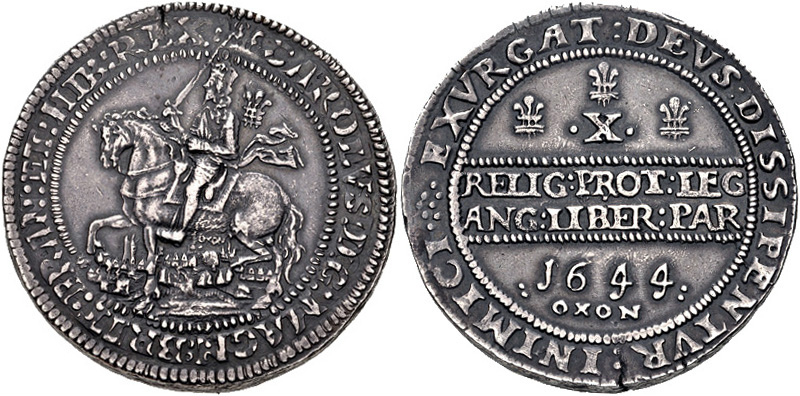

[DNW piece]
How does one get a hater to stop hating?
I can be reached at evillageprowler@gmail.com
My understanding is that the "cookie cutter" die which punches out the planchet goes down part way into the metal leaving the smooth section and than the metal shears off (not sure if that's the right word) due to the force. Where the metal shears or breaks is the rough part. I'm no metallurgist though.
And the edges of these were not prepared in any way as on modern coins (upsetting mills or edge lettering mills). It appears it wasn't even struck in a collar.
@pruebas - Ahh, that makes sense. The Charles I pound in Sov's case has fully rough edges, and that is a 4T whose diameter is similar to the half-pound coin's diameter. So, perhaps the edge roughness is not relevant unless that method of cutting the planchets can be dated, and thus offer some more hint?
How does one get a hater to stop hating?
I can be reached at evillageprowler@gmail.com