Question on die polish/die damage
Options

worldcoinguy
Posts: 3,066 ✭✭✭✭✭
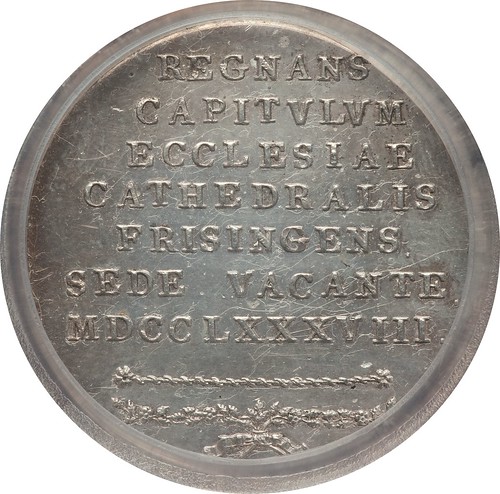
Can anybody shed some light on die polish vs. die scratches (pre strike) vs. planchet damage? I have a medal on the way that has clear scratches on the fields, but I suspect they were either on the planchet before the strike or they were part of a damaged die. Note the scratches appear to be underneath the letters in the closeup - see the X in particular. Any ideas?
Detail:

Detail:
0
Comments
-
Another closeup
 0
0 -
If die scratches, then the marks would be raised on the coin. If planchet scratches, then we should see signs of obliteration (from striking).
Are these marking raised or not?How does one get a hater to stop hating?
I can be reached at evillageprowler@gmail.com0 -
EVP - that is a good common sense observation that i cannot yet answer. Medal will be in hand next week so I will report back.
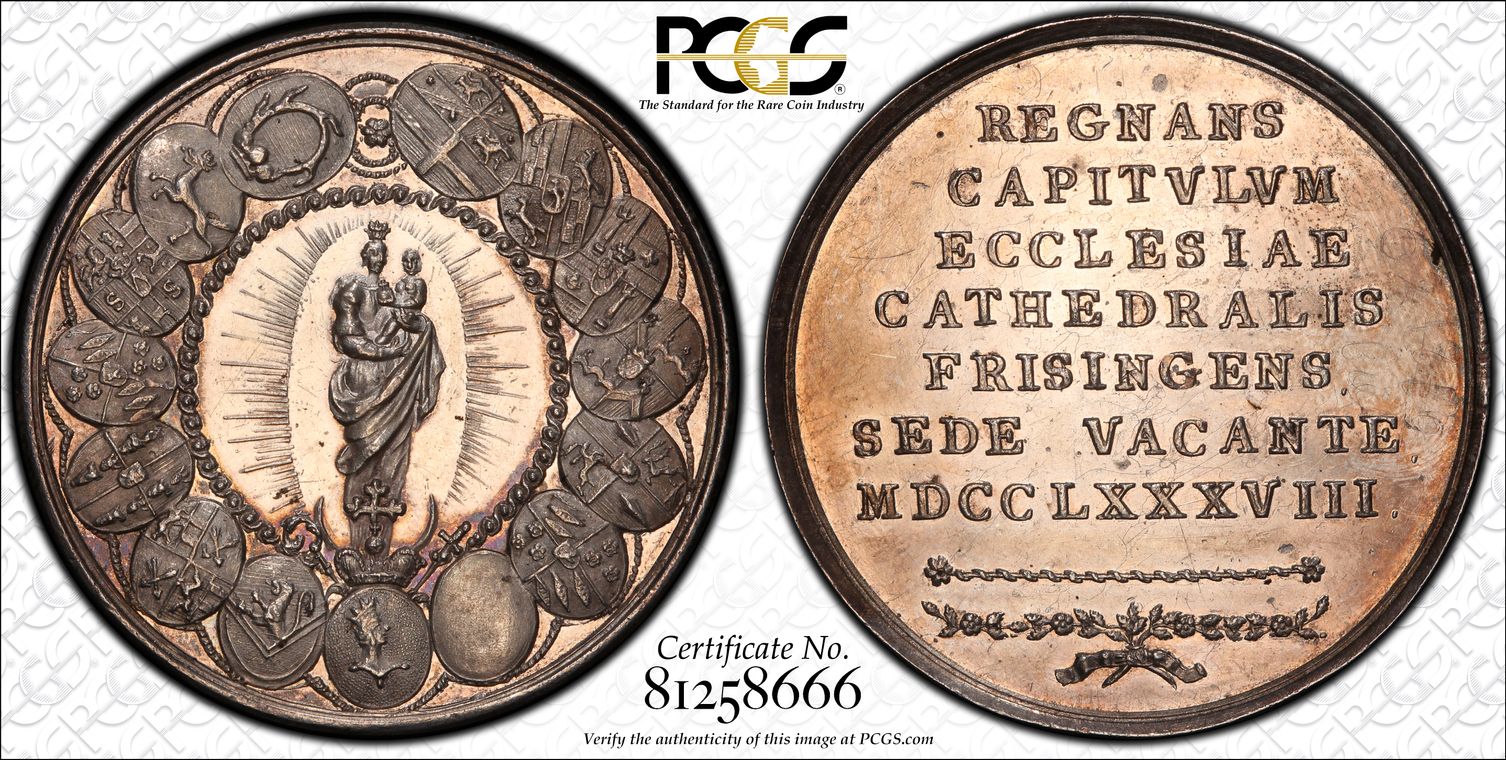
Here is the piece in question graded by our host:
1788 German States - Freising
Sede Vacante medal
PCGS MS-62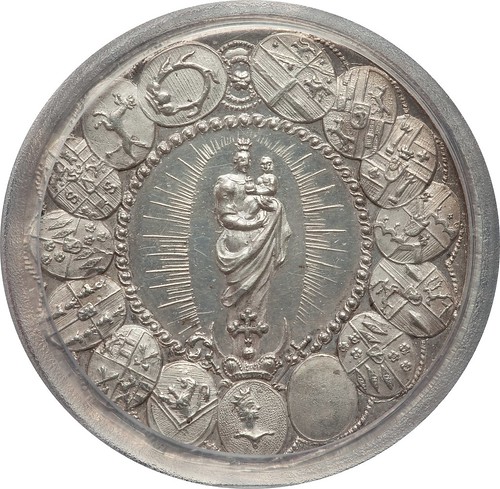
0 -
Brent - is the metal "softer" - this is what one tends to see in aluminum yet silver scratches tend to be localized. To me this seems too systemic and on one side of the medal. Perhaps a die issue.Habsburg Talers
TalerUniverse.com is a curated numismatic project dedicated to the silver talers, crowns, and medals of the Habsburg Empire and the Holy Roman Empire, spanning the 16th–18th centuries. The collection emphasizes historically significant issues, rare mint varieties, and high-grade NGC/PCGS examples, presented with detailed historical context, scholarly references, and high-resolution photography. TalerUniverse aims to serve both as a private collection showcase and a growing reference resource for collectors, researchers, and students of early-modern European coinage.0 -
While it would be insane to have that much it really looks like there was a lot of lint on the die..which would be a strike through.0
-
-
Almost looks like a combination of everything. Yes, die polish is raised.
Question: Is this medal or coin rotation? A possibility on the "straight" lined areas could be clashing from the obverse while the other squiggly areas are scratches mixed with very little or slight die polish. You can possibly do an overlay and see....Persuing choice countermarked coinage on 2 reales.
Enjoyed numismatic conversations with Eric P. Newman, Dave Akers, Jules Reiver, David Davis, Russ Logan, John McCloskey, Kirk Gorman, W. David Perkins...0 -
Looks more like a strike through hair/wool to me.http://stores.ebay.ca/Mattscoin - Canadian coins, World Coins, Silver, Gold, Coin lots, Modern Mint Products & Collections0
-
Looks like struck through fibers to me too.0
-
Thanks for the ideas everybody. I will update the thread once I get hands on the medal with a loop in hand. Who could have guessed that the 1788 issues were struck during the annual Freising wool fair at the cathedral?0
-
Interestingly, this is the same piece.
 0
0





Categories
- All Categories
- 520.1K Coins and Currency - PCGS
- 328.6K U.S. Coin Forum
- 14.8K PCGS Set Registry Forum
- 5.2K Q & A Forum
- 41.4K World & Ancient Coins Forum
- 3K U.S. & World Currency Forum
- 96.4K Buy, Sell, & Trade - U.S. Coins
- 7.3K Buy, Sell & Trade - World & Ancient Coins
- 1.5K Buy, Sell & Trade - Currency
- 61 Random
- 246.2K Trading Cards, Autographs and Memorabilia - PSA
- 90.3K Trading Cards & Memorabilia Forum
- 1.7K Autographs Forum
- 16.4K PSA Set Registry Forum
- 22K Sports Talk
- 115K Buy, Sell & Trade - Cards & Memorabilia
- 663 Buy, Sell & Trade - Autographs
- 2.2K Stamps
- 1.5K Stamps Forum
- 670 Buy, Sell & Trade - Stamps
- 83 Coin Shows
- 83 General Coin Show Information and Discussion
- 11.9K Misc
- 11.9K Testing Forum