3 bust quarters, 3 different dates, but same dies used
Comments
-
As of today, there are no Draped Bust Quarters (1804-1807) off-center errors known. There are 2-3 misaligned die errors known, but these were caused by mis-alignment of only one die (Obv or Rev), which would not preclude any collar die from striking the edge of the planchet.
The reed counts for the Draped Bust die marriages are as follows:
1796 B-1 --- No examples examined with full reeds (this is due to the rarity and availability of coins to examine.)
1796 B-2 --- 122 reeds
1804 B-1 --- 122 reeds
1804 B-2 --- No examples examined with full reeds (This is due to the lack of higher grade coins to examine.)
1805 B-1 --- No examples examined with full reeds (This is due to the lack of higher grade coins to examine.)
1805 B-2 --- 115 reeds
1805 B-3 --- 115 reeds
1805 B-4 --- 115 reeds
1805 B-5 --- 115 reeds
1806 B-1 --- No examples examined with full reeds
1806 B-2 --- 114 reeds
1806 B-3 --- 114 reeds
1806 B-4 --- 114 reeds
1806 B-5 --- 114 reeds
1806 B-6 --- 114 reeds
1806 B-7 --- 114 reeds
1806 B-8 --- 114 reeds
1806 B-9 --- 114 reeds
1807 B-1 --- No examples examined with full reeds
1807 B-2 --- No examples examined with full reeds
What does this mean? Several possible things...
First, that different numbered reeded collar dies were most likely used to produce these coins.
Second, that different numbered castaing machine bar dies with reeds were most likely used to produce these coins.
Third, some other form of application was used to apply the reed edge to the planchet creating multiple different reed counts, either before the strike or after.
As to the second possibility…anyone who is familiar with Capped Bust Halves has observed that there are many "errors" to be found in the edge lettering, so much so that every coin, no matter the die marriage can and does show these errors.
Most of these errors involve the over lapping of letters, omission of letters, and doubling of letters or entire words.
If the reeds were applied prior to striking using a castaing machine such as was used on the Bust Halves, we would expect to see several things on the finished coins, ie. doubled or overlapped reeds, various reed counts even within the same die marriage etc. But in fact we don’t see any of these things.
As to the third possibility…application after the strike would be most unlikely, as this would cause the rims to be upset and raised, which is quite the reverse of what is seen on the 1804-1807 coins.
So this leaves just two possibilities, something unknown was used to apply the reeds to the planchets prior to striking, or the reeds were applied during striking.
-------------------------------------------------------------------------------------------------------
In the Large Capped Bust Quarters (1815-1828), there are at least 6 off-center errors coins known. Every one of these has a plain edge with no reeding. (The 2 known off-center Bust Quarter errors from 1832 & 1838 also have a plain edge.)
The reed counts for all of the die marriages from 1815 B-1 to 1828 B-4 are the same, 108 reeds, with only two exceptions. Both of these exceptions are found on the 1827 B-2 “re-strikes”. There are 128 reeds on the two early DS coins struck over cut down Draped Bust quarters used as planchets (neither of these show any die rust whatsoever). And there are 135 reeds on the late DS coins that show a tremendous amount of rust damage.
What does this mean? Again several possibilities…
First, that the same numbered reeded collar die or same numbered multiple dies were most likely used to produce these coins.
Second, that castaing machine bar dies with reeds were most likely used to produce these coins.
Third, some other form of application was used to apply the reed edge to the planchet, either before the strike or after.
Again we can discount the second possibility due to the reasons stated above.
We can also discount the fact that the reeds were applied to the planchet before the strike due to the observed error coins.
We also can discount that the reeds were applied after the strike as we do not observe raised rims on the coins.
The 1827 B-2 anomalies are due to the fact that these coins were struck at a different time and different circumstances than all of the other die marriages.
What we are left with is that the reeds must have been applied during the strike and were most likely applied with reeded collar die of some type.
---------------------------------------------------------------------------------------------------------
In the Bust Dime series there are coins that show a doubled reed on the 1821 JR-10, 1823 JR-1 & JR-3 and also the 1824 JR-1 die marriages. This doubled reed shows up in the exact same spot on multiple coins, which would give evidence for the use of a reeded collar die. (See America’s Silver Coinage COAC 1986 pg. 123 -124)
Reeded edge collar dies were actually in use in Europe as early as the mid 1780’s. In 1786, Jean-Pierre Droz invented an improved method of striking the edge of the coin at the same time as the obverse and reverse impressions were made, utilizing a six segmented collar die. It was for this reason, and many others, that Thomas Jefferson was impressed with his work and desired to hire Droz to come to America to set up and run the newly proposed Mint.
With this mechanical improvement being known, is it too much to believe that the newly formed Mint would not have tried to incorporate this technology?
Again, these are just things to think about and that need more study. Everyone is welcome to study the coins and come up with their own conclusions, but from the evidence I have seen, I believe that the reeds were applied with a collar die of some sort prior to the use of the “closed” collar die circa 1828.
QN
Go to Early United States Coins - to order the New "Early United States Half Dollar Vol. 1 / 1794-1807" book or the 1st new Bust Quarter book!
0 -
Andy - that looks like the JA Stack coin's toning pattern alright.
How recent is the image? I might have gotten that one confused with the other one of the same die.
edited to add - We can hope that the ANA panel members in the "Early Minting" Numismatic Theatre presentation review this thread and offer supporting evidence to confirm or deny what has been put forth here; and that they will present all available documentation to support whatever they state, and not "make up" their own history.PM me if you are looking for U.S. auction catalogs0 -
<< <i><<
<< <i>Interesting pictures. The unstruck areas appear to not be upset. Would you say that this was the case?
I would. >>
Thank you.
Let me throw out a speculation for discussion. If, as traditionally believed, quarter dollar planchets in this era were reeded prior to being struck, then that trip through the castaing machine to impart the reeding would also serve the function of the modern upsetting mill. No reeding, no upsetting. In other words, a Type One blank.
Whatever method for feeding planchets into the press (human fingers or early mechanical feed fingers) would be used to/ set for handling reeded edge Type Two planchets. If a blank/planchet skips the reeding/upsetting process, it might be more prone to being mis-fed into the press. Such a mis-feed could result in the blank/planchet not being centered on the dies, and being struck off center.
I do not have a Tompkins at hand. Do any of the other pictures show the unstruck areas well enough to tell if they are Type One or Type Two planchets, and/or plain or reeded edges?
TD>> >>
The two known off-center quarters from 1832 & 1838 both show the unstruck areas that are not upset. So that theory may or may not apply.
QNGo to Early United States Coins - to order the New "Early United States Half Dollar Vol. 1 / 1794-1807" book or the 1st new Bust Quarter book!
0 -
Andy - that looks like the JA Stack coin's toning pattern alright.
How recent is the image?
The coin still looks like that. I had it in hand earlier this year.Andy Lustig
Doggedly collecting coins of the Central American Republic.
Visit the Society of US Pattern Collectors at USPatterns.com.0 -
Andy - that's nice to hear. Thank you.PM me if you are looking for U.S. auction catalogs0
-
<< <i>As of today, there are no Draped Bust Quarters (1804-1807) off-center errors known. There are 2-3 misaligned die errors known, but these were caused by mis-alignment of only one die (Obv or Rev), which would not preclude any collar die from striking the edge of the planchet.
The reed counts for the Draped Bust die marriages are as follows:
1796 B-1 --- No examples examined with full reeds (this is due to the rarity and availability of coins to examine.)
1796 B-2 --- 122 reeds
1804 B-1 --- 122 reeds
1804 B-2 --- No examples examined with full reeds (This is due to the lack of higher grade coins to examine.)
1805 B-1 --- No examples examined with full reeds (This is due to the lack of higher grade coins to examine.)
1805 B-2 --- 115 reeds
1805 B-3 --- 115 reeds
1805 B-4 --- 115 reeds
1805 B-5 --- 115 reeds
1806 B-1 --- No examples examined with full reeds
1806 B-2 --- 114 reeds
1806 B-3 --- 114 reeds
1806 B-4 --- 114 reeds
1806 B-5 --- 114 reeds
1806 B-6 --- 114 reeds
1806 B-7 --- 114 reeds
1806 B-8 --- 114 reeds
1806 B-9 --- 114 reeds
1807 B-1 --- No examples examined with full reeds
1807 B-2 --- No examples examined with full reeds
What does this mean? Several possible things...
First, that different numbered reeded collar dies were most likely used to produce these coins.
Second, that different numbered castaing machine bar dies with reeds were most likely used to produce these coins.
Third, some other form of application was used to apply the reed edge to the planchet creating multiple different reed counts, either before the strike or after.
As to the second possibility…anyone who is familiar with Capped Bust Halves has observed that there are many "errors" to be found in the edge lettering, so much so that every coin, no matter the die marriage can and does show these errors.
Most of these errors involve the over lapping of letters, omission of letters, and doubling of letters or entire words.
If the reeds were applied prior to striking using a castaing machine such as was used on the Bust Halves, we would expect to see several things on the finished coins, ie. doubled or overlapped reeds, various reed counts even within the same die marriage etc. But in fact we don’t see any of these things.
As to the third possibility…application after the strike would be most unlikely, as this would cause the rims to be upset and raised, which is quite the reverse of what is seen on the 1804-1807 coins.
So this leaves just two possibilities, something unknown was used to apply the reeds to the planchets prior to striking, or the reeds were applied during striking.
-------------------------------------------------------------------------------------------------------
In the Large Capped Bust Quarters (1815-1828), there are at least 6 off-center errors coins known. Every one of these has a plain edge with no reeding. (The 2 known off-center Bust Quarter errors from 1832 & 1838 also have a plain edge.)
The reed counts for all of the die marriages from 1815 B-1 to 1828 B-4 are the same, 108 reeds, with only two exceptions. Both of these exceptions are found on the 1827 B-2 “re-strikes”. There are 128 reeds on the two early DS coins struck over cut down Draped Bust quarters used as planchets (neither of these show any die rust whatsoever). And there are 135 reeds on the late DS coins that show a tremendous amount of rust damage.
What does this mean? Again several possibilities…
First, that the same numbered reeded collar die or same numbered multiple dies were most likely used to produce these coins.
Second, that castaing machine bar dies with reeds were most likely used to produce these coins.
Third, some other form of application was used to apply the reed edge to the planchet, either before the strike or after.
Again we can discount the second possibility due to the reasons stated above.
We can also discount the fact that the reeds were applied to the planchet before the strike due to the observed error coins.
We also can discount that the reeds were applied after the strike as we do not observe raised rims on the coins.
The 1827 B-2 anomalies are due to the fact that these coins were struck at a different time and different circumstances than all of the other die marriages.
What we are left with is that the reeds must have been applied during the strike and were most likely applied with reeded collar die of some type.
---------------------------------------------------------------------------------------------------------
In the Bust Dime series there are coins that show a doubled reed on the 1821 JR-10, 1823 JR-1 & JR-3 and also the 1824 JR-1 die marriages. This doubled reed shows up in the exact same spot on multiple coins, which would give evidence for the use of a reeded collar die. (See America’s Silver Coinage COAC 1986 pg. 123 -124)
Reeded edge collar dies were actually in use in Europe as early as the mid 1780’s. In 1786, Jean-Pierre Droz invented an improved method of striking the edge of the coin at the same time as the obverse and reverse impressions were made, utilizing a six segmented collar die. It was for this reason, and many others, that Thomas Jefferson was impressed with his work and desired to hire Droz to come to America to set up and run the newly proposed Mint.
With this mechanical improvement being known, is it too much to believe that the newly formed Mint would not have tried to incorporate this technology?
Again, these are just things to think about and that need more study. Everyone is welcome to study the coins and come up with their own conclusions, but from the evidence I have seen, I believe that the reeds were applied with a collar die of some sort prior to the use of the “closed” collar die circa 1828.
QN >>
Thank you for reminding me of the COAC silver issue. I thought I had read something about a fixed mark on the edge proving that a reeded collar was used earlier than previously believed, but I could not remember where.
Of course, it only moves the introduction of reeded collars back to 1825 dimes, and possibly 1821 dimes, while the OP referenced 1805-1807 Draped Bust quarters.
The reeding count information is also very interesting. As to the question of whether or not a castaing machine could reed planchets this consistently, I would cautiously suggest that it might. After all, the toothed bars of a castaing machine set up to do reeded edge planchets might be able to do so with mathematical precision, as the teeth themselves would grip the planchet like a nut around a bolt and prevent it from slipping. The circumferences of the type one blanks were mathematically precise, and it you rotate a precise disc between two precise bars you should, theoretically, get a precise number of reeds.
Yes, the half dollar planchets slipped all the time. That may have been why the later halves have reed-like segments between the words, to keep the planchets rotating properly between the lettered bars.
We are certainly in agreement that the reeding was not added after the strike, a la the edge lettering on the modern brass dollars.
TDProfessional Numismatist, Retired. 55 year member ANA. Former ANA Senior Authenticator. Winner of four ANA Heath Literary Awards; three Wayte and Olga Raymond Literary Awards; Numismatist of the Year Award 2009, and ANA Lifetime Achievement Award 2020. Winner of the PNG's 2026 Robert Friedberg Award for "The Enigmatic Lincoln Cents of 1922," Available now from Whitman or Amazon.0 -
<< <i>There are several "plain edge" off center, early quarters known; indicating that the reeding was not applied prior to striking.
Over the years, I have not seen anything in the edge reeding that would be a diagnostic as to a certain collar (double reeds, missing, etc.).
There are no known 1807 quarters that display complete reeding on the edge.
Perhaps someone who will be attending the Boston ANA will print out this thread and ask the panel members their thoughts and opinions. The panel members scheduled to appear are: Brad Karoleff, Dick Doty, John Dannreuther, Bill Eckberg, R.W. Julian, Craig Sholley, and Doug Mudd. Perhaps they can offer a few "facts" to confirm what they will be saying.
Hopefully, David Lisot will video this event, as it will offer the latest research on the oldest coinage. >>
Is the missing reeding on the 1807 quarters always found in the same area relative to the obverse and reverse designs, which would imply a reeded byt defective collar, or does it occur at random, which would imply improperly reeded planchets?
I do hope that David Lisot films this, since I do not travel well and will not be attending the convention. Has anybody contacted him?
TDProfessional Numismatist, Retired. 55 year member ANA. Former ANA Senior Authenticator. Winner of four ANA Heath Literary Awards; three Wayte and Olga Raymond Literary Awards; Numismatist of the Year Award 2009, and ANA Lifetime Achievement Award 2020. Winner of the PNG's 2026 Robert Friedberg Award for "The Enigmatic Lincoln Cents of 1922," Available now from Whitman or Amazon.0 -
It would be interesting to have a comparison of reed counts for 1796-1807 dimes and quarter eagles, along with quarters and half eagles, since they are approximately the same diameter with the dimes and $2.50's sharing some reverse dies. Reed counts for $2.50 and $5.00 have not been done, and I doubt if it will be any time soon but this would provide very valuable information.
Anthony Taraszka published reed counts for 1795-1804 eagle $10's in the July 1999 JRJ, after a request from Russ Logan. The reed counts by die marriage were in groups of 142, 131, and 126, and a single anomoly at 130 (if my memory from yesterday is correct). Within each grouping there were small variances in the diameter, which could have been partly strike induced.
In the group with 142 reeds, a small .25 mm change in the width between the offset bars of the Castaing machine would have resulted in one more or less reeds - either 141 or 143 depending on if the .25 mm change was an increase or decrease. Even a small variation of a tenth of a millimeter would have resulted in overlapping reeds. The edge pictures pictures Taraszka published show even reed spacing with no overlap. Also, any variation in starting position of the sliding bar could cause an overlap.
Considering half dollars show considerable differences in edge lettering overlap, along with diameter variances, I don't believe the Castaing machine could have held set tolerances tight enough to show the consistency displayed in the reeding count data. Thus, I am with the group that believes reeded edges were formed at strike by a segmented collar.Robert Scot: Engraving Liberty - biography of US Mint's first chief engraver0 -
The several 1807 quarters that I have examined seem to have between 1/3 and 1/2 reeding visible. I seem to recall that it was usually on the bottom part, but it could also be shifted to one side or the other. Hopefully, other current owners can add to this to clarify positioning.
I owned the unique 1807 "plain edge" quarter, which showed absolutely no reeding or the planchet having been upset, or anything else for that matter. The obverse dentils were visible only on the lower portion, while the reverse dentils were barely visible. I don't know how it was struck so that it came out round!PM me if you are looking for U.S. auction catalogs0 -
The lack of overlapping reeds seems like a pretty good argument to me that the reeding was added during striking on these coins.
With all the inconsistencies you see on bust halves and dollars, you would have to imagine we would also see
overlapping and other problems on the reeding of bust quarters if they were also applied before the coin was struck.0 -
<<Thank you for reminding me of the COAC silver issue. I thought I had read something about a fixed mark on the edge proving that a reeded collar was used earlier than previously believed, but I could not remember where.
Of course, it only moves the introduction of reeded collars back to 1825 dimes, and possibly 1821 dimes, while the OP referenced 1805-1807 Draped Bust quarters.
The reeding count information is also very interesting. As to the question of whether or not a castaing machine could reed planchets this consistently, I would cautiously suggest that it might. After all, the toothed bars of a castaing machine set up to do reeded edge planchets might be able to do so with mathematical precision, as the teeth themselves would grip the planchet like a nut around a bolt and prevent it from slipping. The circumferences of the type one blanks were mathematically precise, and it you rotate a precise disc between two precise bars you should, theoretically, get a precise number of reeds.
Yes, the half dollar planchets slipped all the time. That may have been why the later halves have reed-like segments between the words, to keep the planchets rotating properly between the lettered bars.
We are certainly in agreement that the reeding was not added after the strike, a la the edge lettering on the modern brass dollars.
TD>>
Some intriguing thoughts Tom! I am especially interested in your theory about the later Bust Halves with the partial reed-like segments between the words.
As to your theory as to reeding being applied with a castaing machine on other denominations, I admit it has some merit.
However, I would think that no matter how much it might keep the planchet from slipping, we would still see overlapped or doubled reeds at the point where the end of the two parallel bar dies ended or started, at least on some examples. Unfortunately none have so far been discovered to show this feature.
QNGo to Early United States Coins - to order the New "Early United States Half Dollar Vol. 1 / 1794-1807" book or the 1st new Bust Quarter book!
0 -
<< <i>It would be interesting to have a comparison of reed counts for 1796-1807 dimes and quarter eagles, along with quarters and half eagles, since they are approximately the same diameter with the dimes and $2.50's sharing some reverse dies. Reed counts for $2.50 and $5.00 have not been done, and I doubt if it will be any time soon but this would provide very valuable information.
Anthony Taraszka published reed counts for 1795-1804 eagle $10's in the July 1999 JRJ, after a request from Russ Logan. The reed counts by die marriage were in groups of 142, 131, and 126, and a single anomoly at 130 (if my memory from yesterday is correct). Within each grouping there were small variances in the diameter, which could have been partly strike induced.
In the group with 142 reeds, a small .25 mm change in the width between the offset bars of the Castaing machine would have resulted in one more or less reeds - either 141 or 143 depending on if the .25 mm change was an increase or decrease. Even a small variation of a tenth of a millimeter would have resulted in overlapping reeds. The edge pictures pictures Taraszka published show even reed spacing with no overlap. Also, any variation in starting position of the sliding bar could cause an overlap.
Considering half dollars show considerable differences in edge lettering overlap, along with diameter variances, I don't believe the Castaing machine could have held set tolerances tight enough to show the consistency displayed in the reeding count data. Thus, I am with the group that believes reeded edges were formed at strike by a segmented collar. >>
Thanks for reminding me about this study Bill, I had forgotten about it!
There is a slight variance in diameter for the Bust Quarters, at least for the few I have been able to measure. However, many more coins (in as high grade as possible) need to be measured to make any meaningful determination and unfortunately due to encapsulation, this is becoming harder to accomplish every day.
I believe the study done by Anthony also lends more credence to a reeded collar die being used during striking to produce the reeded edge. Whether or not this collar was segmented or not is hard to determine. I agree with Tom, that we need to figure out how the coins would have been ejected if a reeded collar die were used. How this was accomplished may relate directly to the type of collar that could have been used.
QNGo to Early United States Coins - to order the New "Early United States Half Dollar Vol. 1 / 1794-1807" book or the 1st new Bust Quarter book!
0 -
<< <i><<The several 1807 quarters that I have examined seem to have between 1/3 and 1/2 reeding visible. I seem to recall that it was usually on the bottom part, but it could also be shifted to one side or the other. Hopefully, other current owners can add to this to clarify positioning.
I owned the unique 1807 "plain edge" quarter, which showed absolutely no reeding or the planchet having been upset, or anything else for that matter. The obverse dentils were visible only on the lower portion, while the reverse dentils were barely visible. I don't know how it was struck so that it came out round!>> >>
My two examples show only about a third of the reeding. One shows this reeding on the left side (looking at the obverse) and one shows it on the right side.
If the theory is correct that a worn and expanded reeded collar die was used to impart these reeds, the weakness or partial reeds could be located at any point on the edge due to the beginning position of the planchet. Naturally the un-struck planchet would be slightly smaller in diameter than the finished coin (and smaller in diameter than any collar die used, reeded or otherwise). This would allow the planchet to lie to one side or another within the diameter of the collar, with nothing to prevent it from one position or another. When the dies came together to strike the coin, the metal would expand in all directions from the center of the planchet. Whichever side of the planchet was closest to the collar die would receive the most impression of reeds.
As to the 1807 B-1 “plain edge” example, more study needs to be done to determine exactly how it was produced. My theory is that the planchet was undersize to start with. When it was last sold in 2004, the diameter was listed as 27.9 mm. My 1807 B-1 example, while in a lower grade, has a diameter of 30.38 mm. The weights cannot be compared however due to wear differences. Obviously the “plain edge” example may not have had enough planchet to be expanded into the collar die where it might have acquired reeds.
QN
Go to Early United States Coins - to order the New "Early United States Half Dollar Vol. 1 / 1794-1807" book or the 1st new Bust Quarter book!
0 -
Just as a study of edge-marking technology for the era, can anybody suggest a few reeded edge foreign coins of comparable size that might be available in quantity to be looked at?
It would be interesting to see if any of them show overlapped reeds.
.
How about Conder tokens of the era? Admittedly this would be inconclusive because they were made by different people to different quality standards, but it might be fun to look, AND you can find them out of the blankety-blank slabs!!!!!!!
.
TDProfessional Numismatist, Retired. 55 year member ANA. Former ANA Senior Authenticator. Winner of four ANA Heath Literary Awards; three Wayte and Olga Raymond Literary Awards; Numismatist of the Year Award 2009, and ANA Lifetime Achievement Award 2020. Winner of the PNG's 2026 Robert Friedberg Award for "The Enigmatic Lincoln Cents of 1922," Available now from Whitman or Amazon.0 -
<< <i>
<< <i><<The several 1807 quarters that I have examined seem to have between 1/3 and 1/2 reeding visible. I seem to recall that it was usually on the bottom part, but it could also be shifted to one side or the other. Hopefully, other current owners can add to this to clarify positioning.
I owned the unique 1807 "plain edge" quarter, which showed absolutely no reeding or the planchet having been upset, or anything else for that matter. The obverse dentils were visible only on the lower portion, while the reverse dentils were barely visible. I don't know how it was struck so that it came out round!>> >>
My two examples show only about a third of the reeding. One shows this reeding on the left side (looking at the obverse) and one shows it on the right side.
If the theory is correct that a worn and expanded reeded collar die was used to impart these reeds, the weakness or partial reeds could be located at any point on the edge due to the beginning position of the planchet. Naturally the un-struck planchet would be slightly smaller in diameter than the finished coin (and smaller in diameter than any collar die used, reeded or otherwise). This would allow the planchet to lie to one side or another within the diameter of the collar, with nothing to prevent it from one position or another. When the dies came together to strike the coin, the metal would expand in all directions from the center of the planchet. Whichever side of the planchet was closest to the collar die would receive the most impression of reeds.
As to the 1807 B-1 “plain edge” example, more study needs to be done to determine exactly how it was produced. My theory is that the planchet was undersize to start with. When it was last sold in 2004, the diameter was listed as 27.9 mm. My 1807 B-1 example, while in a lower grade, has a diameter of 30.38 mm. The weights cannot be compared however due to wear differences. Obviously the “plain edge” example may not have had enough planchet to be expanded into the collar die where it might have acquired reeds.
QN >>
That is a significant difference in size! My first thought on seeing that was that it was cut down to steal silver.
What are the weights of the two pieces, regardless of wear?
TDProfessional Numismatist, Retired. 55 year member ANA. Former ANA Senior Authenticator. Winner of four ANA Heath Literary Awards; three Wayte and Olga Raymond Literary Awards; Numismatist of the Year Award 2009, and ANA Lifetime Achievement Award 2020. Winner of the PNG's 2026 Robert Friedberg Award for "The Enigmatic Lincoln Cents of 1922," Available now from Whitman or Amazon.0 -
Just as a study of edge-marking technology for the era, can anybody suggest a few reeded edge foreign coins of comparable size that might be available in quantity to be looked at? It would be interesting to see if any of them show overlapped reeds.
I have a couple of early 19th century Latin American pieces on which the edge device - but not reeding - was applied as a separate process. The first is Peruvian, has a full lettered edge, upturned rims, and no obverse or reverse strike. The second is Mexican, with a "Colonial Edge" applied at a significantly improper angle. (Hard to explain, but definitely not done at the time the coin was struck.) Unfortunately, nothing else comes to mind.Andy Lustig
Doggedly collecting coins of the Central American Republic.
Visit the Society of US Pattern Collectors at USPatterns.com.0 -
<<That is a significant difference in size! My first thought on seeing that was that it was cut down to steal silver. What are the weights of the two pieces, regardless of wear?
TD>>
104.8 grains for the 1807 B-1 "plain edge" piece which is MS-60
versus
97.22 grains for my 1807 B-1 piece which is VF-30.
QN
Go to Early United States Coins - to order the New "Early United States Half Dollar Vol. 1 / 1794-1807" book or the 1st new Bust Quarter book!
0 -
<< <i><<That is a significant difference in size! My first thought on seeing that was that it was cut down to steal silver. What are the weights of the two pieces, regardless of wear?
TD>>
104.8 grains for the 1807 B-1 "plain edge" piece which is MS-60
versus
97.22 grains for my 1807 B-1 piece which is VF-30.
QN >>
Well, that Plain Edge sure ain't cut down! (Let's go crazy here and speculate that it was an experimental piece for a new, smaller size quarter that was not struck until 1815 because of the suspension in striking quarters. How's the die state? Any chance it was struck in 1815 to test a new, smaller planchet before the new, smaller dies were cut?)
FWIW, I weighed a couple of low grade 1806 we happened to have in stock. G/VG @ 99.23 grains and VG @ 99.54 grains.
TDProfessional Numismatist, Retired. 55 year member ANA. Former ANA Senior Authenticator. Winner of four ANA Heath Literary Awards; three Wayte and Olga Raymond Literary Awards; Numismatist of the Year Award 2009, and ANA Lifetime Achievement Award 2020. Winner of the PNG's 2026 Robert Friedberg Award for "The Enigmatic Lincoln Cents of 1922," Available now from Whitman or Amazon.0 -
Just to add some fodder to the mill, when I had approximately a dozen large size quarters, and was taking some pictures (they were not slabbed) I carefully placed them together to get an edge shot.
As seen, there were slightly different spacings between the reeds, and the coins were definitely not a uniform diameter, with a 1-2 mm difference. The dates ranged from 1805-1828. I didn't have multiples of any single date.
I don't know where that picture is at this point, as this was done nearly 20 years ago when Russ Logan was conducting his study on the edges.
There's much to study...
edited to add - The 1807 PE was lapped on both dies. This created areas of PL surface (especially on the reverse) with frosty lustre in other places. It's a die stage 5. The most unusual thing is that stars 1-4 were re-punched as the re-lapping did away with the details (same thing around the lower portion of the hair curls) and somebody took a star punch and lightly tapped the die as to make the stars look smaller and pointed compared to the other, flat stars. There's nice color image of this coin in the Tompkins book, p.337.PM me if you are looking for U.S. auction catalogs0 -
<< <i>My 1807 B-1 example, while in a lower grade, has a diameter of 30.38 mm. >>
Steve, is this measurement correct? Were some DBQ's within 2mm of DBH's and about the size of a Kennedy half?Robert Scot: Engraving Liberty - biography of US Mint's first chief engraver0 -
<<Well, that Plain Edge sure ain't cut down! (Let's go crazy here and speculate that it was an experimental piece for a new, smaller size quarter that was not struck until 1815 because of the suspension in striking quarters. How's the die state? Any chance it was struck in 1815 to test a new, smaller planchet before the new, smaller dies were cut?)
FWIW, I weighed a couple of low grade 1806 we happened to have in stock. G/VG @ 99.23 grains and VG @ 99.54 grains.
TD >>
Actually both pieces are over the size they are supposed to be, 27.5 mm. This again lends more thought to the collar die being expanded beyond what it once was. Any one who has tried to use a Whitman folder or a Dansco album to display their bust quarters can attest to the fact that the Draped Bust examples vary in diameter quite a bit and will seldom fit into the appropriate holes.
My thoughts are that the collar die used on the Large Capped Bust Quarters (1815 –1828) was tighter than the one used previously. The diameters for these years are much more consistent than for the Draped Bust type.
As to an experiment related to the 1815 quarters...There is no appreciable difference in die stage between the “plain edge” piece and other 1807 B-1’s, and the diameter is quite a bit larger than the 1815 –1828 type as well (27.9 versus 27 mm).
QN
Go to Early United States Coins - to order the New "Early United States Half Dollar Vol. 1 / 1794-1807" book or the 1st new Bust Quarter book!
0 -
<< <i>
<< <i>My 1807 B-1 example, while in a lower grade, has a diameter of 30.38 mm. >>
Steve, is this measurement correct? Were some DBQ's within 2mm of DBH's and about the size of a Kennedy half? >>
Bill, I measured it with a caliper measured in inches and then used an online conversion calculator to come up with that number. I guess I could have made a mistake somewhere, I will double check...
QNGo to Early United States Coins - to order the New "Early United States Half Dollar Vol. 1 / 1794-1807" book or the 1st new Bust Quarter book!
0 -
Dang it! I can see i am a little late joining in on this thread. It's not often a great post like this shows up.Winner of the "You Suck!" award March 17, 2010 by LanLord, doh, 123cents and Bear.0
-
<< <i><<Well, that Plain Edge sure ain't cut down! (Let's go crazy here and speculate that it was an experimental piece for a new, smaller size quarter that was not struck until 1815 because of the suspension in striking quarters. How's the die state? Any chance it was struck in 1815 to test a new, smaller planchet before the new, smaller dies were cut?)
FWIW, I weighed a couple of low grade 1806 we happened to have in stock. G/VG @ 99.23 grains and VG @ 99.54 grains.
TD >>
Actually both pieces are over the size they are supposed to be, 27.5 mm. This again lends more thought to the collar die being expanded beyond what it once was. Any one who has tried to use a Whitman folder or a Dansco album to display their bust quarters can attest to the fact that the Draped Bust examples vary in diameter quite a bit and will seldom fit into the appropriate holes.
My thoughts are that the collar die used on the Large Capped Bust Quarters (1815 –1828) was tighter than the one used previously. The diameters for these years are much more consistent than for the Draped Bust type.
As to an experiment related to the 1815 quarters...There is no appreciable difference in die stage between the “plain edge” piece and other 1807 B-1’s, and the diameter is quite a bit larger than the 1815 –1828 type as well (27.9 versus 27 mm).
QN >>
As Emily Litella used to say: "Never Mind!" Professional Numismatist, Retired. 55 year member ANA. Former ANA Senior Authenticator. Winner of four ANA Heath Literary Awards; three Wayte and Olga Raymond Literary Awards; Numismatist of the Year Award 2009, and ANA Lifetime Achievement Award 2020. Winner of the PNG's 2026 Robert Friedberg Award for "The Enigmatic Lincoln Cents of 1922," Available now from Whitman or Amazon.0
 -
Sorry, I added an extra 1 in there! It actually measures 1.096 inches = 27.84 mm
I also measured my 1807 B-2 (EF-40) and it measures 1.095 inches = 27.81 mm.
Here are a few other measurements:
1804 B-1 --- 1.115 inches = 28.32 mm (EF-45)
1805 B-2 --- 1.105 inches = 28.07 mm (AU-50)
1805 B-3 --- 1.106 inches = 28.09 mm (EF-45)
1805 B-4 --- 1.107 inches = 28.12 mm (VF-20)
1806 B-2 --- 1.090 inches = 27.68 mm (VG-10)
1806 B-3 --- 1.091 inches = 27.71 mm (F-15)
1806 B-3 --- 1.094 inches = 27.79 mm (VF-30)
1806 B-6 --- 1.094 inches = 27.79 mm (VF-30)
1806 B-9 --- 1.090 inches = 27.68 mm (AU-55)
Of course this doesn't give us the best data to work with, as the coins have different degrees of wear. To be more scientific, we need to measure multiple coins in the same grade.
QN
Go to Early United States Coins - to order the New "Early United States Half Dollar Vol. 1 / 1794-1807" book or the 1st new Bust Quarter book!
0 -
Can anyone shed some light as to what appears to be "finger edge pinching" (just my made up word) on other this example or any other off-center in any series? Or would you call this post minting? This piece I have owned at one time.
 Persuing choice countermarked coinage on 2 reales.
Enjoyed numismatic conversations with Eric P. Newman, Dave Akers, Jules Reiver, David Davis, Russ Logan, John McCloskey, Kirk Gorman, W. David Perkins...0 -
Rory - that coin certain has it's share of problems. My guess is that it is post-mint damage, as it doesn't look like a collar problem or an ejection finger "pinch" (to use your word) as both of the "dents" are not uniform in shape and size.
With that being said, I did notice the damaged areas are equally spaced apart from each other like a "gripping" tool, like pliers (even though it wasn't) would make.
PM me if you are looking for U.S. auction catalogs0 -
I happen to own that coin now and in my opinion it is more likely post mint damage. Unfortunately it is currently in a PCGS slab so it is hard to examine.
However, due to the nature of the coin in question, it looks like the coin was struck at a slight angle, such as might occur due to a collar die being in the way.
You can see that the part of the planchet that was un-struck, on the reverse is sloped towards the obverse. This would lead one to consider that the obverse die was the hammer die and the planchet was forced up at this point by perhaps a collar die. If the coin wound up stuck in the collar die, then someone operating the press may have had to pry it loose and the damage we are seeing is the result.
We can guess at what happened, but we may never fully know what occurred.
QNGo to Early United States Coins - to order the New "Early United States Half Dollar Vol. 1 / 1794-1807" book or the 1st new Bust Quarter book!
0 -
Let's ask Adam Eckfeldt...he should know!
 PM me if you are looking for U.S. auction catalogs0
 -
Why do we see this large variation in diameter in these and other early coins. I would imagine that the punches for the blanks would
have been fairly uniform. Does this come from the lack of a collar?
For the bust halves I have found all three of the 1807 small stars I have owned are noticeably larger diameter than most capped bust halves. In fact, I have been unable to get any of them to fit in my Dansco without cutting the holes with a razor blade. I have never had to do this with any of the other hundreds of bust halves I have tried to fit into an album. Some might be larger, but never to the extent where I had to trim the album.
On the other hand I have owned 2 1807 O102 draped bust halves. Both of these coins were VF coins with the best strikes I have seen
for coins of this grade. The diameter for both of these was smaller than any of the other draped bust halves I own.0 -
Post mint sounds more likely........
Anyone who is listening, please bring your "Bust material" off-centers to the ANA and I'll try to photograph them as best I can. We can study these more carefully. Boston ANA presentation here I come!Persuing choice countermarked coinage on 2 reales.
Enjoyed numismatic conversations with Eric P. Newman, Dave Akers, Jules Reiver, David Davis, Russ Logan, John McCloskey, Kirk Gorman, W. David Perkins...0 -
<< <i>Why do we see this large variation in diameter in these and other early coins. I would imagine that the punches for the blanks would
have been fairly uniform. Does this come from the lack of a collar?
>>
That is exactly the question at hand........Professional Numismatist, Retired. 55 year member ANA. Former ANA Senior Authenticator. Winner of four ANA Heath Literary Awards; three Wayte and Olga Raymond Literary Awards; Numismatist of the Year Award 2009, and ANA Lifetime Achievement Award 2020. Winner of the PNG's 2026 Robert Friedberg Award for "The Enigmatic Lincoln Cents of 1922," Available now from Whitman or Amazon.0 -
The "open" collar definition has never been completely ascertained and cannot be defined by reviewing Mint records. That's one of the major issues that numismatists have been trying to determine for decades (I doubt that this was the case 100 years ago, as there is no written record of such activity).
1-2 mm is not a "large variation", especially for early "open" collar issues.
If there was no collar, the coins would all be broadstruck (no pun intended Frank) and probably couldn't be ejected properly from the screw press. The off-center strikes mentioned and imaged in this thread, were most likely the result of a broken collar, which happens at all Minting facilities worldwide.
We don't know exactly how Eckfeldt modified the early presses to eject the struck coins. There are many parts and pieces to a coining screw press, and regrettably there are none that were used at the first U.S. Mint still existing (the small one on display at the Philadelphia Mint is a put together machine from various parts and was never used to strike any coinage). Regrettably, we don't even have any drawings of any of those presses from the coiners or other Mint employees.
The closest we can get to how an 18th century coinage screw press worked is seen the French book from the 1780's (when Droz was still in France before going to London) that has exploded diagrams of all the various pieces. The title is "L'Encyclopedie by Diderot & d'Alembert - Monnayage - Travail De L'or".
There is a wonderful image from this French book seen on the front cover of the June 5, 1978, Fulton sale by Bowers & Ruddy. Other images and drawings done by Boulton & Watt in England can shed light on the early presses as well.
The Royal Mint even converted their early hand operated screw presses to partial steam power around 1817, when Sir Joseph Banks became involved with that Mint and it's coinage. There exists illustrations of how a long arm came down from the ceiling and turned the screw. Unfortunately, we don't have illustrations available for the American screw presses, as the steam powered press designed by Franklin Peale and made operational in 1836 received all the glory.
Hopefully, all of this will be covered at the ANA event in a few weeks.
PM me if you are looking for U.S. auction catalogs0 -
To sum up the situation, we have an existing theory, as yet unproven, that early eagles, half eagles, quarter eagles, quarter dollars, dimes and half dimes were struck on planchets that were reeded on a castaing machine prior to being struck.
We have an alternate theory, as yet unproven, that the Mint began striking at least some of these coins in reeded collars earlier than that technology has been proven to be in use. It has been proven to have been in use as early as on dimes dated 1821, though it is not known when the technology spread to other denominations.
It is not known how the coin press ejected the struck coin from the reeded collar. Eventually coin presses used a cam mechanism to push the lower die up after the strike to push the coin out of the collar, though it is not known when this became commonly used.
For all we know the collar was spring mounted, and there was some mechanism that pushed the collar down around the lower die after the strike. (I am unaware of any documentation or evidence that supports this notion; I merely mention the possibility to show how little we know about the mechanics of early coin presses.)
So, right now we have two excellent theories, both unproven. Further research is merited.
TDProfessional Numismatist, Retired. 55 year member ANA. Former ANA Senior Authenticator. Winner of four ANA Heath Literary Awards; three Wayte and Olga Raymond Literary Awards; Numismatist of the Year Award 2009, and ANA Lifetime Achievement Award 2020. Winner of the PNG's 2026 Robert Friedberg Award for "The Enigmatic Lincoln Cents of 1922," Available now from Whitman or Amazon.0 -
At the risk of being accused of verbosity, I would like to make mention of one other 1807 quarter, that is reportedly double struck. That is the one from the WGC sale of 1945.
In 1995, when I was in Dallas helping to catalogue the Museum of Connecticut History sale for Heritage, I came across this particular quarter, which had not been seen in some 45 years. I recognized it immediately from my previous research, but did not have access to my library (the Heritage library did not have a copy of the WGC sales) so I had to say that it was possibly the same coin.
My cataloguing of this coin in the MCH sale, lot 6507, was a coin-in-hand description that reads, "The obverse stars, date, and LIBERTY are all shifted from left to right approximately 1mm. This makes everything to appear much thinner than normal. Another interesting characteristic is that only half the edge is reeded, the other half is plain..." The coin was not in a slab at this point and is the first mention in print about the 1807 quarters not having full reeding.
This coin was not double struck, but had the obverse die shift during striking, implying the lock screw or set screw that held the die in place in the die cup loosened up on this particular striking. I believe this was called a "die stake".
When the coin re-appeared at auction, in the ANR 12/1/2003 Classics/Red Bank sale, lot 639, the cataloguer described it thusly "It is double struck in the collar with only slight differentiation between strikes, giving the date and stars an unusual and thin appearance that led Abe Kosoff to call this coin a "new variety" in his cataloguing of the "World's Greatest Collection" sale of 1945." Unfortunately, this double struck classification has been adopted, because of the 2003 description which failed to mention the 1995 appearance.
If the coin was double struck, especially in the collar as mentioned (unfortunately as fact) by the ANR cataloguer then both dies would have been shifted, which is not the case at all, as there is nothing doubled on the reverse. They merely copied and embellished the 1992 Browning/Breen update where Breen authoritively states, "sounds like close double striking" (having not examined the coin). The Breen revision (done while he was in jail) is the reason why there will be two, well researched, quality books about the early quarters by the end of the year.
If, as Tompkins suggested on the 1818 off-center piece, the obverse die was the hammer die, then it can be assumed that the torque of the top die, being forced onto a planchet with a twisting, clockwise motion, is responsible for creating this coin's features.
PM me if you are looking for U.S. auction catalogs0 -
ttt in case anybody has anything to add.Professional Numismatist, Retired. 55 year member ANA. Former ANA Senior Authenticator. Winner of four ANA Heath Literary Awards; three Wayte and Olga Raymond Literary Awards; Numismatist of the Year Award 2009, and ANA Lifetime Achievement Award 2020. Winner of the PNG's 2026 Robert Friedberg Award for "The Enigmatic Lincoln Cents of 1922," Available now from Whitman or Amazon.0
-
FWIW, I have a new purchase, an 1820 quarter, B-2. It is only in VG condition, but has good edge reeding.
.
Relative to the obverse stars, there is a thin gap between two reeds above the right side of star 6, followed by a wide gap between two reeds above the space between stars 6&7, followed by a thin gap between two reeds above the left side of star 7.
There is another thin gap between two reeds above the point of star 8.
Does anybody have one that matches this pattern?
TDProfessional Numismatist, Retired. 55 year member ANA. Former ANA Senior Authenticator. Winner of four ANA Heath Literary Awards; three Wayte and Olga Raymond Literary Awards; Numismatist of the Year Award 2009, and ANA Lifetime Achievement Award 2020. Winner of the PNG's 2026 Robert Friedberg Award for "The Enigmatic Lincoln Cents of 1922," Available now from Whitman or Amazon.0 -
tttProfessional Numismatist, Retired. 55 year member ANA. Former ANA Senior Authenticator. Winner of four ANA Heath Literary Awards; three Wayte and Olga Raymond Literary Awards; Numismatist of the Year Award 2009, and ANA Lifetime Achievement Award 2020. Winner of the PNG's 2026 Robert Friedberg Award for "The Enigmatic Lincoln Cents of 1922," Available now from Whitman or Amazon.0
-
this is a very interesting post worthy of a bookmarking.I seldom check PM's but do check emails often jason@seated.org
Buying top quality Seated Dimes in Gem BU and Proof.
Buying great coins - monster eye appeal only.0 -
For those who would be interested in seeing a coining press at work 200 years ago:

Denga0 -
Thanks for posting that picture. It gives a great sense of what a large screw press looked like and how it was worked, though it omits any detail of the feeding and ejection mechanism. According to popular belief that consisted of a worker sitting in a shallow pit right next to the press, so that he could flick struck coins off the back and insert new blanks. Eventually it was mechanized, but how and when is unknown (as discussed earlier in this thread).
One thing this picture made me ask was: After the four-man gang pulled the swing arm and forced the upper die down, how was the swing arm un-screwed and returned to its original position? This would raise up the upper die and allow the struck coin to be ejected and the next planchet inserted, as well as position the swing arm for the next strike.
My colleague, Dennis Forgue, suggested that the workers may have simply pushed it back by hand as they moved forward for the next pull back. This makes sense to me, but does anybody know of any other, better answer? I could see some sort of spring return mechanism, but have never heard of one being used on a screw press.
Anybody out there have an answer?
TDProfessional Numismatist, Retired. 55 year member ANA. Former ANA Senior Authenticator. Winner of four ANA Heath Literary Awards; three Wayte and Olga Raymond Literary Awards; Numismatist of the Year Award 2009, and ANA Lifetime Achievement Award 2020. Winner of the PNG's 2026 Robert Friedberg Award for "The Enigmatic Lincoln Cents of 1922," Available now from Whitman or Amazon.0 -
One observation: Looks like the underside (where the ropes are attached) are made so the men could swing and switch ends when moving in a CW or CCW direction. No need to do anythng else, if the pitch of the leadscrew is wide one could retain the same starting & ending position within reason. The pitch of the leadscrew is obviously wider than a coin.Persuing choice countermarked coinage on 2 reales.
Enjoyed numismatic conversations with Eric P. Newman, Dave Akers, Jules Reiver, David Davis, Russ Logan, John McCloskey, Kirk Gorman, W. David Perkins...0 -
ttt for the ANA goersProfessional Numismatist, Retired. 55 year member ANA. Former ANA Senior Authenticator. Winner of four ANA Heath Literary Awards; three Wayte and Olga Raymond Literary Awards; Numismatist of the Year Award 2009, and ANA Lifetime Achievement Award 2020. Winner of the PNG's 2026 Robert Friedberg Award for "The Enigmatic Lincoln Cents of 1922," Available now from Whitman or Amazon.0
-
Well, what was said at the meeting in Boston?Professional Numismatist, Retired. 55 year member ANA. Former ANA Senior Authenticator. Winner of four ANA Heath Literary Awards; three Wayte and Olga Raymond Literary Awards; Numismatist of the Year Award 2009, and ANA Lifetime Achievement Award 2020. Winner of the PNG's 2026 Robert Friedberg Award for "The Enigmatic Lincoln Cents of 1922," Available now from Whitman or Amazon.0
-
ttt
Did anything get discussed about this thread in Boston?
TDProfessional Numismatist, Retired. 55 year member ANA. Former ANA Senior Authenticator. Winner of four ANA Heath Literary Awards; three Wayte and Olga Raymond Literary Awards; Numismatist of the Year Award 2009, and ANA Lifetime Achievement Award 2020. Winner of the PNG's 2026 Robert Friedberg Award for "The Enigmatic Lincoln Cents of 1922," Available now from Whitman or Amazon.0 -
deletedProfessional Numismatist, Retired. 55 year member ANA. Former ANA Senior Authenticator. Winner of four ANA Heath Literary Awards; three Wayte and Olga Raymond Literary Awards; Numismatist of the Year Award 2009, and ANA Lifetime Achievement Award 2020. Winner of the PNG's 2026 Robert Friedberg Award for "The Enigmatic Lincoln Cents of 1922," Available now from Whitman or Amazon.0
-
Despite CaptHenway's valiant efforts, a great thread that faded away..
Liberty: Parent of Science & Industry
0 -
-
Wow -- what a great thread. Chock full of theories and numismatic knowledge.Dave Wnuck. Redbook contributor; long time PNG Member; listed on the PCGS Board of Experts. PM me with your email address to receive my e-newsletter, and visit DaveWcoins.com Find me on eBay at davewcoins0
-
Here are a couple of 1805 B-4 coins from my collection, this was the obverse that was overdated to the 1806/5 B-1


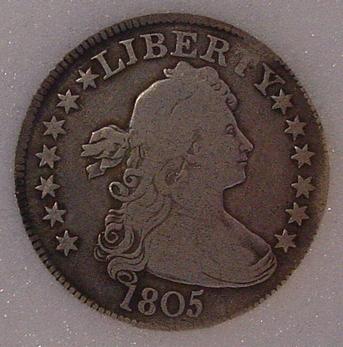

Since they're raw it will be easy to take a look at the reeding the next time I see them, but in this condition there may not be much left. Need to take better pics and also take one of the 1806/5Liberty: Parent of Science & Industry
0


Leave a Comment
Categories
- All Categories
- 520K Coins and Currency - PCGS
- 328.5K U.S. Coin Forum
- 14.8K PCGS Set Registry Forum
- 5.2K Q & A Forum
- 41.4K World & Ancient Coins Forum
- 3K U.S. & World Currency Forum
- 96.4K Buy, Sell, & Trade - U.S. Coins
- 7.3K Buy, Sell & Trade - World & Ancient Coins
- 1.5K Buy, Sell & Trade - Currency
- 60 Random
- 246.2K Trading Cards, Autographs and Memorabilia - PSA
- 90.3K Trading Cards & Memorabilia Forum
- 1.7K Autographs Forum
- 16.4K PSA Set Registry Forum
- 22K Sports Talk
- 115K Buy, Sell & Trade - Cards & Memorabilia
- 663 Buy, Sell & Trade - Autographs
- 2.2K Stamps
- 1.5K Stamps Forum
- 670 Buy, Sell & Trade - Stamps
- 83 Coin Shows
- 83 General Coin Show Information and Discussion
- 11.9K Misc
- 11.9K Testing Forum