PCGS XF40 1922-D Weak D Lincoln Cent
Options

braddick
Posts: 25,185 ✭✭✭✭✭
1922-D Weak D LINK
I came upon the above auction- always interested with this variety- and was somewhat taken aback by the grade vs the coin's overall wear. I know the 1922 NO D varieties easily have either a weak strike or are struck
from worn dies, but this Lincoln caught me off guard.
Enlarge the reverse photos and tell me, is this a clerical error or am I too conservative in grading these?
I came upon the above auction- always interested with this variety- and was somewhat taken aback by the grade vs the coin's overall wear. I know the 1922 NO D varieties easily have either a weak strike or are struck
from worn dies, but this Lincoln caught me off guard.
Enlarge the reverse photos and tell me, is this a clerical error or am I too conservative in grading these?
0
Comments
-
I stay away from all but strong reverse. I cannot wrap my head around grading a pile of mush as XF-40" YOU SUCK " Awarded 5/18/080
-
This one to me is not an xf40 it is very beat up but the mushy back is normal especially on a late die state. Price is also to high in my opinion for what is a die 3 no d weak d.0
-
XF40 is generous but not by much. It looks like a solid choice very fine to me, for this particular issue of course.0
-
Ya really must see one that's uncirculated, then grade down.
0 -
<< <i>I stay away from all but strong reverse. I cannot wrap my head around grading a pile of mush as XF-40 >>
Agree. There is only one real no D 1922 cent made with one die pair. Most cent collector have little or no interest in these so called weak D varieties. I would like to hear Rick and Charmy's thoughts on this.Worry is the interest you pay on a debt you may not owe.
"Paper money eventually returns to its intrinsic value---zero."----Voltaire
"Everything you say should be true, but not everything true should be said."----Voltaire0 -
It is the combination of scratches and dings on the rim that make me feel this is graded to high.0
-
I always heard these were graded by looking at the reverse; thus, I laughed when I saw it.
 "It's far easier to fight for principles, than to live up to them." Adlai Stevenson0
 -
<< <i>I always heard these were graded by looking at the reverse; thus, I laughed when I saw it. >>
The No D strong reverse is graded by the reverse, not the Weak D weak reverse.
Joe.0 -
Hey Uncle Joe that is correct but they do look at reverses to determine die pairing and to determine overall condition. I have a much nicer one in the raw that I will post some pics later this morning for a comparison.0
-
I would never buy that coin as an XF40. In fact, I would never buy that coin at all.All glory is fleeting.0
-
<< <i>I stay away from all but strong reverse. I cannot wrap my head around grading a pile of mush as XF-40 >>
agreedFrank
BHNC #2030 -
I have always been a fan of grading a circulated coin based on the amount of detail that is present, regardless of how well struck or poorly struck the coin was when it left the mint. I grade this one AG-03.
I guess my system of grading without considering strike gets into trouble when one finds a blazing Unc. 1891-O Morgan Dollar that has the mushy details of F-12 due to the strike. I say this type of coin is "MS60" regardless of how beautiful the surfaces are. Once it gets a little circulation wear on it, it drops straight to F-12, regardless of luster. PCGS does not grade weakly struck coins the same way I do!
The coin linked by the OP also makes me wonder if the new gradient holders represent a demotion of grading standards to NGC-like levels. I hope not.
0 -
<< <i>
<< <i>I always heard these were graded by looking at the reverse; thus, I laughed when I saw it. >>
The No D strong reverse is graded by the reverse, not the Weak D weak reverse.
Joe. >>
This is how I've always come to understand it.
Also- check out the reverse of many PCGS VG08's with the WEAK D variety and some look stronger than this XF40.0 -
Just curious, what grade would you attribute to this?...


0 -
Not much actual wear on the piece that I can see, with some original luster could be MS62BN. But these varieties are notorious for a wide range of grades, and as far as the original poster. I agree XF40 for that is very generous in my personal opinion.0
-
drwstr123 I would go ms60 or better as yours has much less wear,scratches and dings that the OPs.0
-
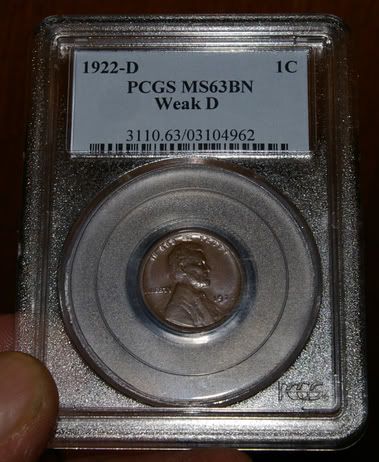 0
0 -
Darn 1 grade off, wonderful piece though. I think many people steer away from these varieties for one reason or another. I find them fascinating, and relevant to when I'm willing to spend the time and money to find higher grade examples.1
-
<< <i>Darn 1 grade off, wonderful piece though. I think many people steer away from these varieties for one reason or another. I find them fascinating, and relevant to when I'm willing to spend the time and money to find higher grade examples. >>
I purchased this coin as a PCGS 1922 D MS63 and resubmitted it as weak D.
It is a solid 63 even as a '22 D.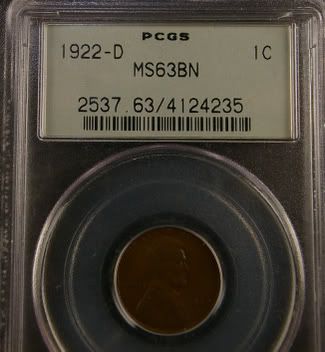 0
0




Leave a Comment
Categories
- All Categories
- 520.1K Coins and Currency - PCGS
- 328.5K U.S. Coin Forum
- 14.8K PCGS Set Registry Forum
- 5.2K Q & A Forum
- 41.4K World & Ancient Coins Forum
- 3K U.S. & World Currency Forum
- 96.4K Buy, Sell, & Trade - U.S. Coins
- 7.3K Buy, Sell & Trade - World & Ancient Coins
- 1.5K Buy, Sell & Trade - Currency
- 60 Random
- 246.2K Trading Cards, Autographs and Memorabilia - PSA
- 90.3K Trading Cards & Memorabilia Forum
- 1.7K Autographs Forum
- 16.4K PSA Set Registry Forum
- 22K Sports Talk
- 115K Buy, Sell & Trade - Cards & Memorabilia
- 663 Buy, Sell & Trade - Autographs
- 2.2K Stamps
- 1.5K Stamps Forum
- 670 Buy, Sell & Trade - Stamps
- 83 Coin Shows
- 83 General Coin Show Information and Discussion
- 11.9K Misc
- 11.9K Testing Forum