Options
Major error eye candy #1: Edge strike, double struck
 jonathanb
Posts: 4,104 ✭✭✭✭✭
jonathanb
Posts: 4,104 ✭✭✭✭✭
I recently had the good fortune to purchase a GREAT collection of error coins. These are not your average tiny clips and small laminations, but in many cases things I've only heard about and never seen in person. I'm going to post some of the more interesting pieces for your drooling pleasure.
To start things off... a 1972-D 5c. But wait! Didn't he just say that these weren't your average errors? You're right, and I'm sticking by that. So... who wants to take a shot at explaining why this ISN'T your run-of-the mill off-center strike?
Full explanation posted tomorrow, unless someone figures it out sooner.
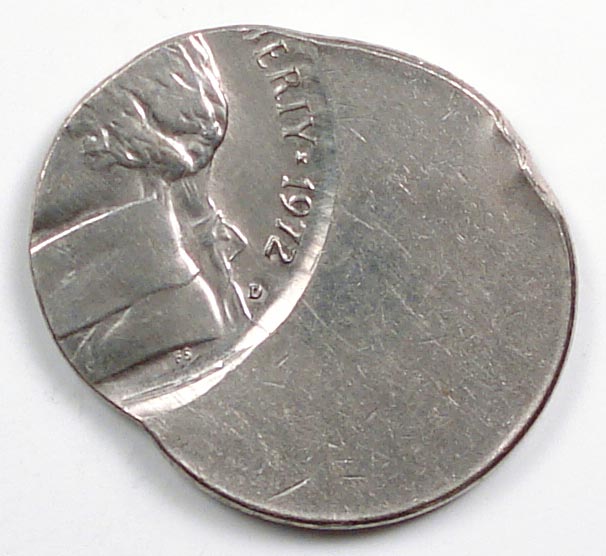
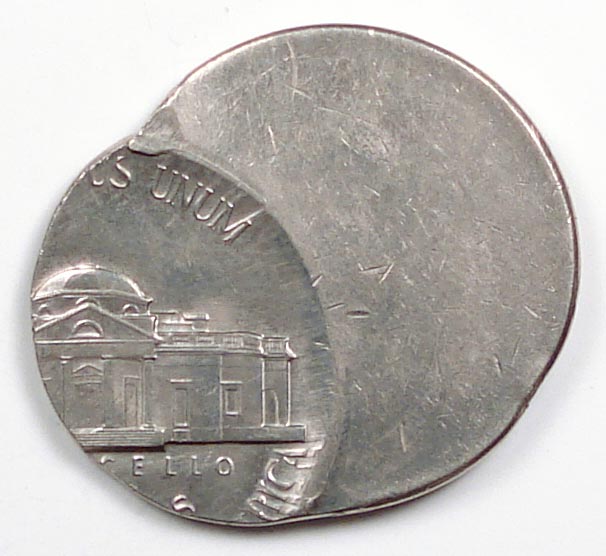
To start things off... a 1972-D 5c. But wait! Didn't he just say that these weren't your average errors? You're right, and I'm sticking by that. So... who wants to take a shot at explaining why this ISN'T your run-of-the mill off-center strike?
Full explanation posted tomorrow, unless someone figures it out sooner.
0
Comments
<< <i>Is it on a Quarter plancet? >>
No. It's a nice regular normal nickel planchet.
Is it also broadstruck (struck out of collar) as well as off-center?
Liberty: Parent of Science & Industry
<< <i>Is it a planchet without an upset rim? (type I planchet) >>
No, it's a normal Type 2 planchet with an upset rim. Nickel planchets typically have far less obvious upset rims than cent planchets. This one is normal for a nickel. You can see the upsetting best towards the bottom right of the obverse picture.
<< <i>Is it also broadstruck (struck out of collar) as well as off-center? >>
Yes, but that's not noteworthy. Pretty much all off-center strikes are struck out of the collar. It's very nearly part of the definition of an off-center strike. In fact, I bet a lot of people would say that it IS part of the definition of an off-center strike, although I actually have something of a counterexample that maybe I'll post later on.
ANA LM
USAF Retired — 34 years of active military service! 🇺🇸
The standard question regarding edge strikes is how to tell that they're true strikes and not simply some conveniently placed damage. A good clue is that the "damage" from an edge strike necessarily must happen in pairs, with similar marks on opposite edges. The clincher is if you can actually read some of the design on the edge... which in this case you can. The edge shows a tiny portion of the base of Monticello, along with the letter O below it (tilt your head to your left):
Furthermore, the off-center strike on this piece actually overlaps the edge strike, distorting it somewhat. So not only is it unquestionably an edge strike, we also know that the edge strike happened first. A complete description of this piece might read something like:
1972-D 5c double strike. First strike: Edge strike showing base of Monticello with O below. Second strike: 50% off-center K-10, die struck reverse, partially overlapping first strike.
This is one of five edge strikes in the collection!
<< <i>Very cool, but wouldn't an edge strike utterly demolish the coin in an edge strike scenario given the amount of pressure the machines exert? I would think the coin would end up being an oblong oval. >>
You would think so, but that doesn't happen. Metal is incredibly strong when stressed edge-on. Think about structural I-beam steel bars, which work on a similar principle. This is totally typical for the way that edge strikes look (ignoring the second strike, of course).
There is a related error that sort of does what you're thinking about. In some cases, the planchet truly can't handle the pressure, and it literally folds in half. That's called, uncreatively, a "fold-over strike". I'm afraid I don't have an example to show you, sorry!
<< <i>
<< <i>Very cool, but wouldn't an edge strike utterly demolish the coin in an edge strike scenario given the amount of pressure the machines exert? I would think the coin would end up being an oblong oval. >>
You would think so, but that doesn't happen. Metal is incredibly strong when stressed edge-on. Think about structural I-beam steel bars, which work on a similar principle. This is totally typical for the way that edge strikes look (ignoring the second strike, of course).
There is a related error that sort of does what you're thinking about. In some cases, the planchet truly can't handle the pressure, and it literally folds in half. That's called, uncreatively, a "fold-over strike". I'm afraid I don't have an example to show you, sorry! >>
Awesome, thanks for the explanation!
....can't wait to see more!!!
A coin standing or spinning on edge cannot resist the impact of the dies.
Steve
Looks like a really dang screwed-up nickel to me.
Collector since 1976. On the CU forums here since 2001.
"She comes out of the sun in a silk dress,
running like a water color in the rain...."
Too many positive BST transactions with too many members to list.