Options
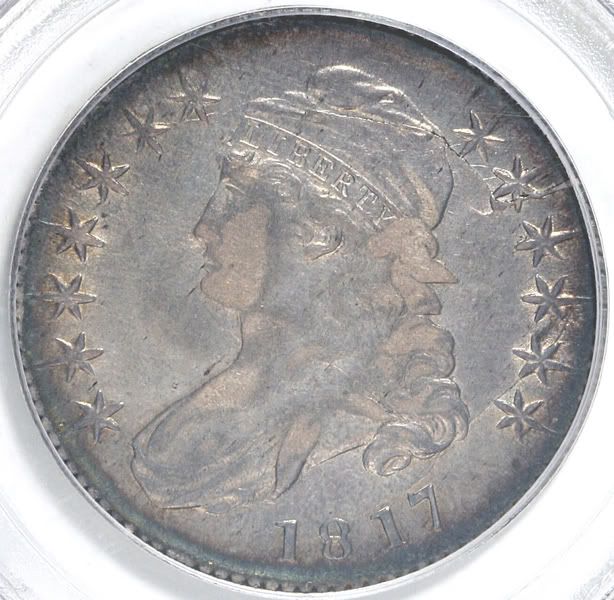
And while you were in Baltimore - 1817 O-105a bust half dollar - PCGS - Die Bulge explains flat face
 BiddlesBank
Posts: 721 ✭
BiddlesBank
Posts: 721 ✭
.
While you were in Baltimore this is one of 4 interesting bust halves I was able to land. I like it when there is very little competition.
The 1817 O-105a is always flat struck on the obverse. In really late die states the chin and face virtually disappear.
When I got this coin I instantly noticed a huge die bulge as outlined in the 3rd photo. This to me really sheds light on the flat striking of the face. Why the face is this flat I do not know, but I am sure the bulge has a lot to do with it.
The highest recorded sale for the "a" die state is the PCGS AU58 that Sheridan Downey sold in 2002 for $5,200. It is my understanding it was flat struck on the obverse also.
On the close-ups you will see die clashing under the bust also and there are other clash marks here and there.
The attributing die break from rim across star 9 and across the head causes two planes. The upper plane is lower. Also there is a two plane element in the crack that goes above the 17 in 1817.
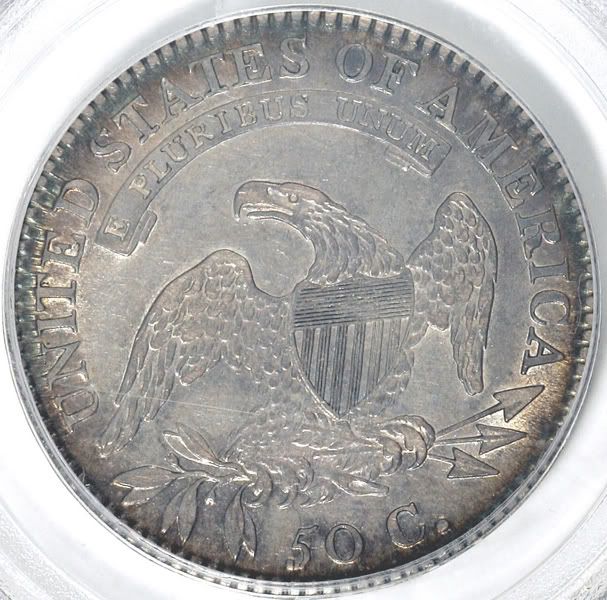
For those that like to grade coins by photos I am not saying what the grade is. The reverse is almost fully lustrous and the obverse has luster in the fields but thin. There is a hint of wiping on the obverse but none on the reverse. Cartwheel luster on the reverse but a tad subdued. ( Edited for luster description.)


While you were in Baltimore this is one of 4 interesting bust halves I was able to land. I like it when there is very little competition.
The 1817 O-105a is always flat struck on the obverse. In really late die states the chin and face virtually disappear.
When I got this coin I instantly noticed a huge die bulge as outlined in the 3rd photo. This to me really sheds light on the flat striking of the face. Why the face is this flat I do not know, but I am sure the bulge has a lot to do with it.
The highest recorded sale for the "a" die state is the PCGS AU58 that Sheridan Downey sold in 2002 for $5,200. It is my understanding it was flat struck on the obverse also.
On the close-ups you will see die clashing under the bust also and there are other clash marks here and there.
The attributing die break from rim across star 9 and across the head causes two planes. The upper plane is lower. Also there is a two plane element in the crack that goes above the 17 in 1817.
For those that like to grade coins by photos I am not saying what the grade is. The reverse is almost fully lustrous and the obverse has luster in the fields but thin. There is a hint of wiping on the obverse but none on the reverse. Cartwheel luster on the reverse but a tad subdued. ( Edited for luster description.)
0
Comments
Nice coin.
I believe Souders did a nice write up explaining the obverse die bulges on some CBH's if I am remembering correctly. Nice job of outlining it and showing a nice example.
Tough coin to grade because the bulge changes the wear pattern drastically. Looking at the wear pattern (obvious on this coin) on the obverse of this one the first thought is 40, and that may be what PCGS put on the label. But looking at the entire coin I believe this one should grade higher. Like you said before-these coins are all about the luster.
You say full luster on the reverse and 80% on the obverse puts this one in the AU category.
Based on the obverse wear-I will say AU 50. I doubt that is what the plastic says, but ... I say 50
Nice coin--is it still an R4 ?
That die bulge and crack is really interesting.
I would say EF detail but probably an AU with a weak strike due to the failing die. The color and luster look nice
thanks for posting
<< <i>we use the common term "die bulge" when what happened, I believe, was "die sinking" that resulted in a bulge on the coin, correct? Either way, it's pretty cool stuff and one of the really neat things about bust coinage! >>
Hey Barndog
Good question. So I went to Taxay's chapter on the First Philadelphia Mint.
Quote: " Any hand-finishing more easily executed in relief was done on the hub, which was thereafter hardened and used to sink working dies. The remainder of the design was now added, the stars, numerals and letters by individual punches ...."
So I guess you sink a working die but strike a coin. This I can be corrected on if necessary.
In response to JRocco: I believe Souders did a nice write up explaining the obverse die bulges on some CBH's if I am remembering correctly.
I am not sure what Souders said as I still haven't decided to fork out $75 for the book but I suspect he mentions that the bulge is nothing more than the upper left eagles wing striking hard enough to bulge the coin on the corresponding obverse side which is outlined in photo #3 above.
I would add that since the outer rim of the obverse die was breaking up the driving force of the reverse die probably had more impact in the center and hence the larger than normal die bulge.
Given the above, for some dynamic reason that only a metallurgist can state, the metal probably did not flow sufficiently into the face and chin cavities, perhaps in part if not all, because the breaking up of the die.
My best shot so far.
BB