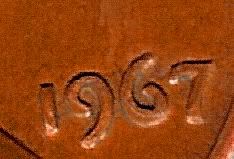
please explain this error (lincoln cent date)
 pontiacinf
Posts: 8,915 ✭✭
pontiacinf
Posts: 8,915 ✭✭
this isnt the greatest of pics, but I found this 1967 lincoln in that 5 gallon water bottle...the 9 and 6 appear doubled, could be machine doubling, but why only on the 9 & 6?
comments from the lincoln gods?
comments from the lincoln gods?

Go BIG or GO HOME. ©Bill
0
Comments
The Lincoln cent store:
http://www.lincolncent.com
My numismatic art work:
http://www.cdaughtrey.com
USAF veteran, 1986-1996 :: support our troops - the American way.
<< <i>Flattened and shelf-like...it's machine doubling. Reason for the oddity in where the doubling occurs is probably because of the direction of the pressure and that only those digits stuck. >>
You made such a short thread out of this Mr Daughtrey ...... I was gonna say almost the same thing, though I am not sure how the die hub and doubling actually occurs only on a part of the coin... I guess a press operator, a good machinist or tool/die guy could explain this better. but I've found this "trait" on several Kennedy's over the years.
AND,,,,, good day to you readers, too.
``https://ebay.us/m/KxolR5
I cannot really come up with a good answer as to why the devices doubled unevenly in this case. I can only say that it is without a doubt machine doubling. Anyone who has seen a few thousand examples of machine doubling would agree that it manifests itself in odd forms sometimes, usually depending on the type of machine doubling you have. The most important characteristic, though, is that it is flattened, does not add to the profile of the affected devices, and does not exhibit "notching" at the corners of the devices...those are the three characteristics that will always differentiate machine doubling from true hub doubling.
The Lincoln cent store:
http://www.lincolncent.com
My numismatic art work:
http://www.cdaughtrey.com
USAF veteran, 1986-1996 :: support our troops - the American way.
Strike doubling occurs when the die lifts, the coin does not eject, and is struck in collar a second time. Often the coin doesn't move between strikes and you would never notice the difference except that the coin receives an apparent strong strike. Sometimes, though, the coin shifts slightly between strikes and receives a slightly out of alignment second strike that completely flattens the devices it hits from the first strike. Other times the coin can shift dramatically, even flip completely over, and receive its second strike. Those would be far less common and actually valuable as errors.
Die chatter occurs when the die is loose and bounces on the coin in a fraction of a second shifting much of the design very slightly in one direction. This is the most common form of machine doubling and is almost always quite minor.
Eject doubling occurs when the coin sticks to the die, usually the hammer die, and is literally scraped off the die by the feeder process that ejects the coin. The characteristics of this form of doubling are slightly different from the others in that the edge of the doubling is actually "scooped upward" from the ejection, and is often a little higher in relief than the device....a little higher meaning so little that it is rarely visible at under 16X. I have found in my experience that this form of machine doubling is the most difficult to predict in how it will manifest itself because of all the minor factors that go into its creation...pressure of ejection, direction of ejection, depth of the design, strength of strike, die state, etc..
edited to correct scientific terminology...a scientist I never was
The Lincoln cent store:
http://www.lincolncent.com
My numismatic art work:
http://www.cdaughtrey.com
USAF veteran, 1986-1996 :: support our troops - the American way.
<< <i>...in a split nanosecond shifting much of the design very slightly in one direction. This is the most common form of machine doubling and is almost always quite minor... >>
I always appreciate your detailed and well educated explanations of the coin minting process. This may be splitting hairs, but for purposes of accuracy, the term "nanosecond", or fractions thereof, are undoubtably mistaken. Given that coin presses operate at mechanical speeds, describing activities as being performed in milliseconds or possibly microseconds would probably be orders of magnitude more accurate. A nanosecond is one billionth (10-9) of a second, and is more often used with speeds associated with electronics - such as access times of DRAMs.
Check out my current listings: https://ebay.com/sch/khunt/m.html?_ipg=200&_sop=12&_rdc=1
<< <i>
<< <i>...in a split nanosecond shifting much of the design very slightly in one direction. This is the most common form of machine doubling and is almost always quite minor... >>
I always appreciate your detailed and well educated explanations of the coin minting process. This may be splitting hairs, but for purposes of accuracy, the term "nanosecond", or fractions thereof, are undoubtably mistaken. Given that coin presses operate at mechanical speeds, describing activities as being performed in milliseconds or possibly microseconds would probably be orders of magnitude more accurate. A nanosecond is one billionth (10-9) of a second, and is more often used with speeds associated with electronics - such as access times of DRAMs. >>
And therein lies the nature of my mistake. I had heard that term used throughout my time in colllege going through a CIS degree, but never really knew just how small it was. I should have used the other described terms because this indeed is far closer to the actual time a die bounce takes. Thanks for the correction in time terminology...a nanosecond it isn't. Point was that it takes VERY little time for a die bounce to occur, and I wanted to differentiate that from a complete second strike which would take far more time. I believe milliseconds would be a far more accurate term to use.
The Lincoln cent store:
http://www.lincolncent.com
My numismatic art work:
http://www.cdaughtrey.com
USAF veteran, 1986-1996 :: support our troops - the American way.
I also want to thank C.D. for his quick knowledgable response. His replies to my lincoln questions are what makes finding stuff like this fun
Go BIG or GO HOME. ©Bill