Auction lot description error- Opinions?
 Proofmorgan
Posts: 994 ✭✭✭✭✭
I recently purchased a raw coin from a large auction company. I did lot view the coin, if that makes any difference (mostly for condition/color). Note, this is not the big 3 but a large international company that often sells estates of raw coins. The coin was fresh in a Wayte Raymond paper flip.
The coin is a key date in MS (1000 mintage) but relatively common in Proof. The coin brought a price as expected for the MS example. The proof is worth about 10% of the mint state coin.
The auction description had the coin as “Choice BU”. The coin was not what I would call reflective and in line with what you would expect from a fresh MS die on a low mintage issue (which can be slightly PL).
The coin came back as PF from PCGS. Do I have any recourse from the auction company? I would not expect them to be liable for the grade, but the type of coin described was incorrect and seemingly misled several underbidders. In this case, the coin being PF vs MS is very significant. If it was within 20% I likely would have left it alone.
I did send an email to the auction company to see what my options would be.
What are your thoughts?
Comments
I'd think it's worth a try, yet honestly, with your in person viewing and determination based on it I'd think it would possibly be "all sales are final."
I'm sure the consigner has been paid (simply based on how long it takes a submission to go through with PCGS.
What do the terms and condition of the auction state? That might help in deciding what your next steps might be.
It would be helpful to see the coin. You are assuming the auction company is wrong, but sometimes it is the TPG that is wrong. Before trying to get a remedy, you need to know who it is that you need the remedy from.
Of note:
Stacks Bowers currently has an 1884, which is similar to 1885 with the proof to MS disparity. Their coin is graded PCGS PF65, but their auction description notes that they believed the coin was MS based on die lapping seen on circulation strikes being present on their coin. Of course, they made no guarantees and are selling as a proof.
It appears this is a challenging issue to differentiate.
Your coin has the JD-2 High Date obverse, which was used for both proof and circulation strikes. Here is what John Dannreuther says:
"The circulation issue...uses the JD-2 obverse die, now usually with a die line in front of the ear and with six to eight degrees clockwise rotation. The Proofs from this combination have no rotation or very slight clockwise rotation; the coins that have prooflike to frosty surfaces with six to eight degrees clockwise rotation are designated circulation strikes. Some satin to frosty examples obviously are circulation strike format, but they are the exceptions with only 1,000 coins struck for commerce. The dies retained their mirrors for a substantial number of circulation strikes."
The first thing I would do is look at your coin to see whether or not it has the die rotation. Unfortunately, Dannreuther does not illustrate the die line in his book, and I have not yet been able to find it on TrueView images.
Thank you. That is very insightful. I’ll have to take a look when I get it back. Although, 6-8 degrees is a very subtle rotation. Like you, I wish I could see that die line.
There is some softness at the top of the 3rd numeral on the reverse of my example. I see it matched in an MS 66+ true view, but I’m not sure that has any true relation to PF vs MS.
Good suggestion on the rotation. Did not know that when I was at ANACS.
I always hated doing 1885's.
TD
Here is a proof 66 on eBay. It does look rotated….which doesn’t help our case. The eBay coin definitely screams proof much more than my example that is more satiny.
Looks rotated to me.
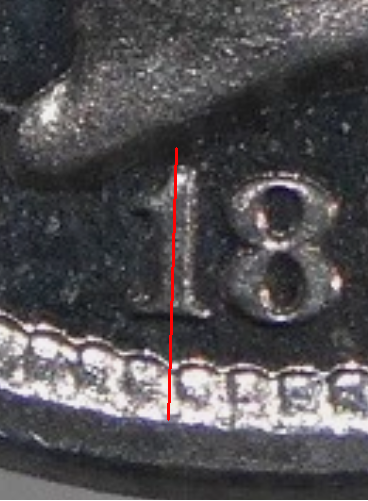
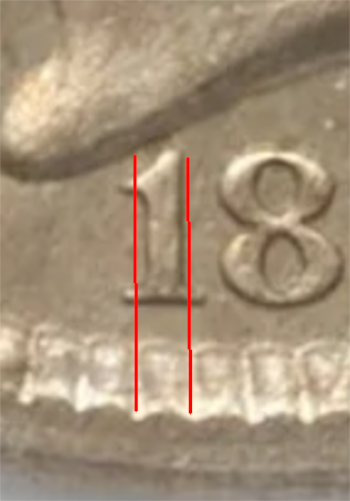
Keep in mind that there are two proof die pairs, JD-1 and JD-2. The coin from ebay is a JD-1, which has the "1" centered over the gap between two denticles. On the JD-2, the "1" is centered over a denticle.
To see the difference in rotation we are looking for, we need to compare a business strike to a JD-2 proof.
JD-1
JD-2
Gotcha. I’ll have to wait for the coin to return to see the rotation. I wasn’t knowledgeable enough when bidding, but between the lot description and the satiny appearance I didn’t question it. Apparently, I wasn’t the only one. The coin went for what a mint state coin should have.
There is a 30 day return clause, but I’m at 32 days based on the PCGS turnaround. Their conditions are vague and seemingly give them an out if they really wish to exercise it.
I think it’s one of those risks of buying raw- you can’t know what the TPG is going to say- and you did lot view it. I would just take this as a lesson, and perhaps crack it out and send it somewhere else after some more research.
I certainly wouldn't throw in the towel just yet. That would be premature at this early stage.
If the auction house was wrong, it would do no harm to ask for a remedy and see if they stand behind their product, regardless of what their terms say.
And if the TPG was wrong, they would owe him a correction.
I agree- just a pain in the butt
I don’t even look at raw coins any more because of all the potential issues with grade, coin doctoring, details, cleaning- I got burned once. Picked up a proof Morgan that looked amazing for a great price- came back altered surfaces!!!
I don't know if the coin can be returned but I'd think if you want a slabbed example, it would be best to buy one already in a slab.
This is unfortunate. Whichever way this turns out, most of us busy folk don't expect to inherit a work project when we bid on a coin.
Based on the terms and conditions of the auction company, the fact that you examined the coin in person and the time that has passed since the date of sale, I don’t like your chances for a return.
Mark Feld* of Heritage Auctions*Unless otherwise noted, my posts here represent my personal opinions.
Allan Gifford found that business strikes from this die have a small 2 degree rotation, while proofs have a 6 degree rotation. Dannreuther however states the opposite. I asked him about this and he believes his assessment is correct, but admits there is a possibility he could be wrong. Every JD-2 example I have seen has shown at least some rotation, even if very small. For an uncirculated coin like this, I would look more at strike and surfaces when making a determination. Examine the edge closely if you can.
What I'm gathering is this is a very tough issue to discern Mint State vs Proof. Were the proof dies potentially recycled for the Mint State coins?
Do the services have clear direction on how to distinguish between the two. I wonder if it would make sense to crack out and try another company if I am unsuccessful with a return.
Correction/Update: I forgot that I had delayed my pickup/payment of the lot to 10/20/26 due to being away for work, despite the auction ending on 10/14/26. I put in the return request on 11/16/26 so I am technically in the 30-day return window.
I also spoke to a local coin auction company, and their belief is that I should be entitled to a return due to what they would call a "material cataloging error". They believe that the coin being mint state or proof was in the realm of the numismatic cataloguer to get correct and be responsible for. He said the grading is subjective, but they should honor that the coin issue was incorrect in their description.
The company also acknowledged my request and said they would get back to me.
I will update as I learn more.
Coincidentally, Stack Bowers has a current auction lot with an 1884 in PCGS Proof 65 that they wrote a paragraph in the description that they believed the coin was a mint state issue due to die lapping and satin surfaces. They acknowledged they still must sell as holdered, but opened the door to a potential opportunity for the buyer.
From the terms:
"Bonhams and its sellers shall not be bound by any
prior or subsequent opinion or certification (or lack
thereof) by any third party grading service, and
bidders on numismatic lots hereby acknowledge
and agree that any such opinion or certification (or
lack thereof) shall not be used as the basis for any
attempted rescission of sale."
Looks like they are saying they're not not legally obligated to accept a TPG opinion obtained after the sale, and that by bidding, you're agreeing to not use the results of such to attempt a return.
not responsible for grading, condition, etc. leaves room for pr/ms.
i'd at least try with the description doesn't match generally covered under basic operations of any reputable auction house
"Prospective bidders are encouraged to make their
own examination of the numismatic lots offered and
not rely on any other party’s opinion as to grade
or other attributes..."
If it were me, I'd interpret "any other party's opinion" to include the description provided by the auction house.
I received the coin back from PCGS and it does have the reverse die rotation. About 6-8 degrees.
The auction house responded asking for a photo of the coin in the proof graded holder.
More to come….
Looking at past MS auctions, most have limited rotation. Some have the 6-8 degree, including a CAC approved NGC fatty.