Options
Die Clash? - 1956 25C FS-901 Study Continued
 Maxvan1
Posts: 189 ✭✭✭
Maxvan1
Posts: 189 ✭✭✭
My prior thread is apparently locked, probably for the better. Moving on...
Checkout this die clash! I think it's pretty cool.
Obverse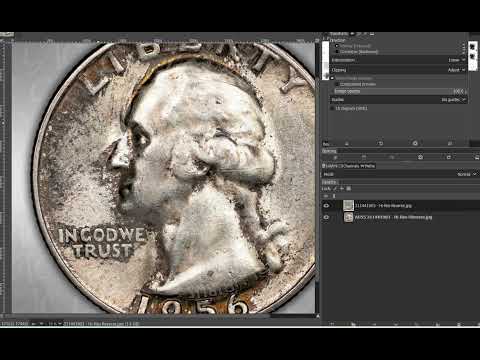 https://youtu.be/BsIQh5JwmKY
Reverse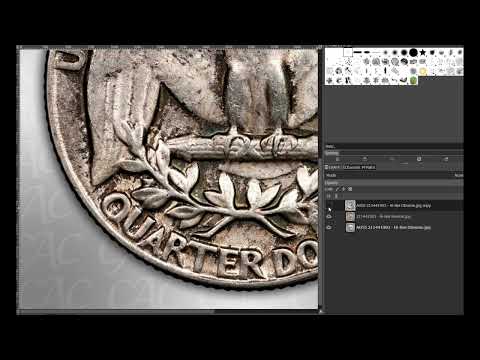 https://youtu.be/IHybWb0jjBk
Clash Overlay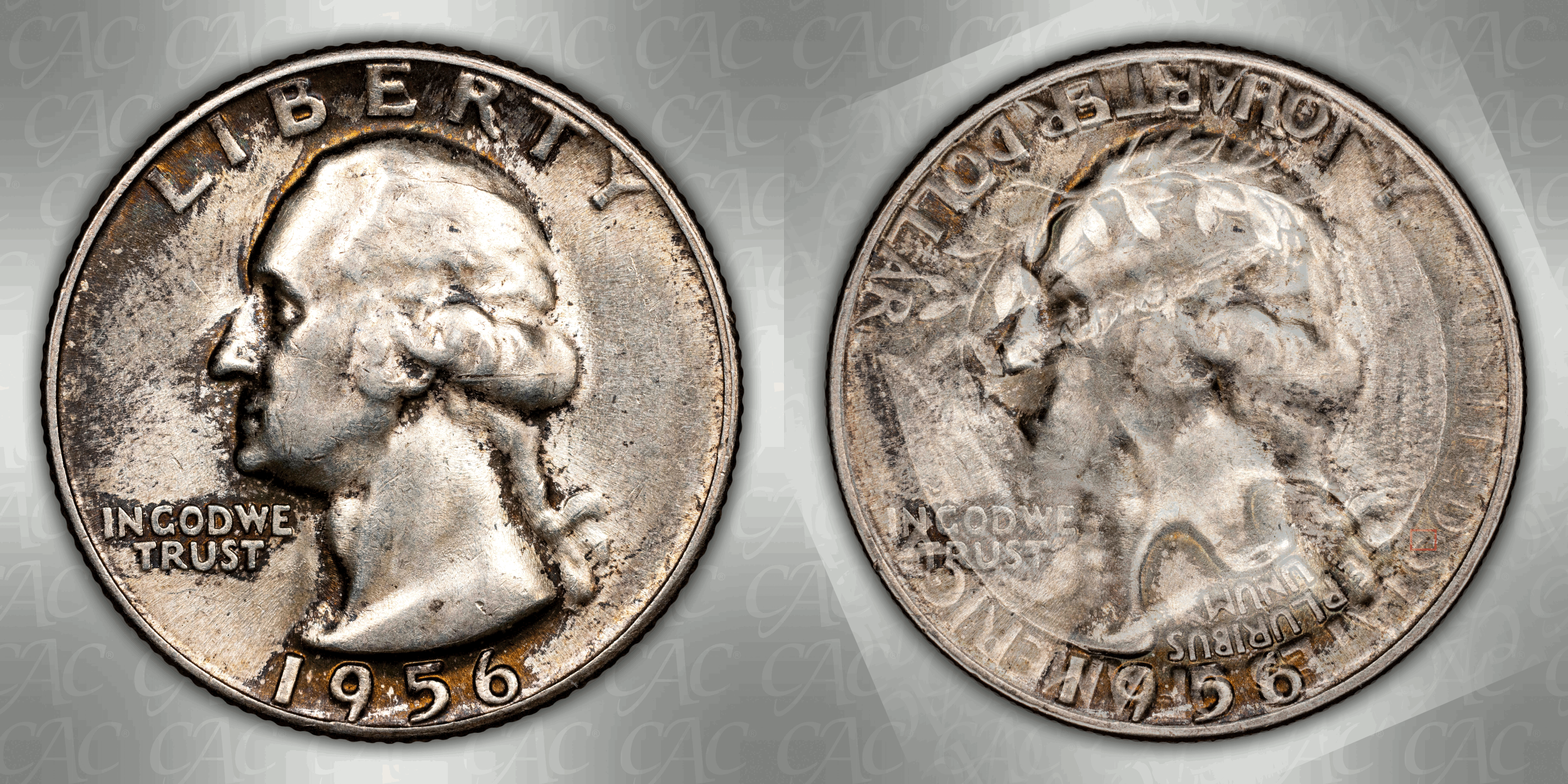
0
Comments
I see no indication that either of your prior threads have been locked, nor do I see any indication of a die clash on your coin.
You are apparently seeing details in either the die deterioration or the toning that remind you of a die clash; this is an example of pareidolia. You can google this term for more information.
I tried to post on the other thread yesterday and it said subject to moderator approval.
I have asked you not to engage with my posts any further. Please respect that.
That is a well known Forum bug. You probably tried doing to many edits too quickly, or something else that triggered it.
Who else is helping you other than me? For that matter, what reason would you have to discriminate? I'm giving you the correct information, so what is your complaint?
I see no indication of a clash.
Coin Photography
I dont see it either 😕
There are actually two or more clashes. The clash from the T in LIBERTY on the reverse and the first A in AMERICA between the 1 and 9 on the obverse are strongest (for this particular example).
Everyone will see it at their own pace. Some might not ever see it.
And here are the die orientations, which do match with the clashes. One die, multiple clashes, multiple orientations.
Do you know what a die clash is? You are showing areas that are not on the other side of the coin ...
how do you suggest the dies came into contact that way?
Those clash overlays assume the dies are not offset, and those are also not Type B reverse overlays. But I think you are right -- I did the overlays in that GIF wrong (it was 2AM). Thanks. Still, nevertheless, the die clashes ARE there and the die ARE offset in a way that matches the clashing I'm seeing. I've shown it to others, they see it too. It's there.
I suspect the shank flat (i.e. flat part on the cylinder of the die that locks it in place with a set screw) was not cut properly, which then allowed movement of the die. This would explain the multiple offset orientations.
In terms of how the clashes occurred, probably an issue with the feeder.
No one here is seeing it.
I hate to say it, but there is nothing there. You are tilting at windmills. I've mentioned to you before that I was worried about the things you report seeing on your coins. I am genuinely worried. Please take care of yourself.
Hmm... No, I think you may be right and I'm wrong here. Maybe not a clash. But something.
Do you see this? I see multiple outline of the wing on the obverse, on multiple coins. I also see what looks like doubling or similar in the same spot on the reverse. It's possible it's nothing, but I'm not the only one seeing this. Do you see what I mean?
You also claim there are four die pairing for this coin, yet the leading researcher concluded that there appeared to only be one defective die or one other (which is entirely consistent with what I'm seeing!). Herb Hicks research on this variety won the Wayte & Olga Raymond Memorial Literary award.
Are you @IkesT saying that Herb Hicks was wrong, too? You proved Herb Hicks wrong based on your 10 minutes looking at CoinFacts? *Edited to add me laughing at you.


Now please go away @IkesT . You have made personal insults, multiple times. I find it highly inappropriate and uncalled for.
Ironically, Herb Hicks was also a leading researcher for Eisenhower Dollar varieties (which is apparently IkesT collects). What a jerk and idiot. It's not about being right all the time. It's about being right in the end.
Herbert Hicks was a great researcher and had a great eye for coins, but he did not do a systematic survey of the dies; he was merely speculating in that quote. When he wrote that article in 1986, CoinFacts images were not available for him to do a quick fact-check on that particular statement. If he were still with us, he would be the first to look at the images I provided in your previous thread and agree that the 1956 Type B quarters were struck from multiple dies in multiple pairs.
It is worth mentioning that you have been looking at this issue from the narrow perspective of someone whose only real experience with die varieties is with Type B quarters. The reality is that all of these are relatively common as varieties go. The 1956 Type B quarter may be least common of the group, but it is still common compared with most other die varieties. Your expectation never should have been that they were struck by only one die pair, and as previously explained, that is easily debunked by spending just a few minutes with CoinFacts images. In this case, I've done it for you, but since you are not able to acknowledge what is in front of you, there is truly nowhere else left for you to go with this project. It's over.
That is a fine way to treat someone who is helping you.
Your @IkesT conclusion is based solely on the location and appearance of die cracks across the forehead on the obverse and through EPU on the reverse, is that correct? That's you how you concluded there are four dies pairing (i.e. based on the location of the die cracks), yes? I hear that. I see those differences.
How do you explain that they all have defective tail feathers and/or lower leaf, though? If I can't see you out, then I guess I'll have to hear you out. I'd like to hear your theory. How is that they all have the same defect?
There is a puzzling disconnect in your behavior that I do not understand. You think I am a "jerk and idiot", but would like my advice again?
I believe I am owed an apology for that comment. You may apologize by explaining how different and mutually exclusive die cracks can appear on the same dies. I'll post the images again below:
.
No, no, no... You tell me how they all have the same defective reverse. Don't weasel out of this.
I'm not 100% certain why the cracks show differently, but I think the different die alignments cause different cracks to show. Notice how the strike on Washington's head shows less and less detail at the top. I think the dies striking at different vertical and rotational alignments results in different cracks showing.
And I mean, look, I can be convinced otherwise but I find your approach totally objectional.
NOW, please explain how it is that all of these reverse dies have the same defect in the arrow and lower leaf between the branches. Explain why they all have the die markers Herb Hicks pointed out. Can you do that, please? I'm all ears. I answered your question. Now you answer mine.
Tail feathers* Not arrows.
I also can't help but notice that the area of the wing he is showing is exactly where it clashes.


Herb Hicks himself didn't say "all", he said "some".
Your explanation for the die cracks does not make sense. How can there only be one die pair when both the obverse and the reverse have different and mutually exclusive die cracks in 4 different places? You may apologize for calling me a "weasel" by answering that question properly. Better still, you may show your respect and appreciation for me and other Forum members (as well as your willingness to learn) by simply admitting that you made a mistake.
.... This guy. Unbelievable.
By the way, the die chip on the forehead from your #1 is visible on #2. Hold your mouse in that spot.
Would you please get lost now?
No and no.
Good lord... I can't help but laugh. The die crack and chip from #1 is clearly visible on #2. Maybe we can get some other opinion.
And #3 is clearly visible on #2.
This is actually good stuff... You actually are helping @IkesT! Thanks buddy.
I am giving you the correct information and you have been disrespectful and unappreciative, so why would anyone else want to get involved?
I do not believe that you are receptive to anything that contradicts your preexisting bias, but this should be helpful to others who are still following the thread:
You can’t see @IkesT out and you don’t have to hear him out. But I recommend the latter.
From what I’ve seen of his posts on numerous topics here, he’s extremely knowledgeable and helpful. And that’s even though he doesn’t go out of his way to be overly polite.😉
Additionally, as you must have noticed, there’s been very little interest shown in this thread by other posters. I think you’re fortunate that he’s engaging you.
Mark Feld* of Heritage Auctions*Unless otherwise noted, my posts here represent my personal opinions.
Thank you very much, @MFeld ! 👍
Well he and I share the characteristic of not going out of our way to be polite, but I'll nicely ask once again...
@IkesT Please explain why these all have the reverse die markers pointed out by Herb Hicks. The die crack from #1 is visible in #2. It appears to be clear as day. If I wasn't at my office, I'd circle what I'm talking about.
BTW: I love conflict. I'm having fun and I think we are making progress, so I hope you're enjoying the conversation too.
Of course, right after you explain how a single reverse die could have 4 different and mutually exclusive die cracks running down the eagle's wing.
Belay that explanation If you are actually doing work for your day job. You are never going to have a career as a coin dealer, so keeping up with your real work has to be your top priority.
Can't imagine anyone is paying their coin dealers $1100/hr, so no plans to change career.
Same explanation as the obverse. That is, I'm not 100% sure but I suspect the difference is the horizontal and vertical alignment of the dies. Again, that area of the wing coincides with the area I am calling clashed.
I'm willing to admit if I'm wrong. I am. I have a tract record of that.
Okay, now your turn. Explain why they all have the die markers pointed out by Herb Hicks...
@IkesT is correct.
Coin Photography
Be sure to watch until the end.
"The harder the conflict, the more glorious the triumph." — Thomas Paine
And here is #4 compared with #1.
This is fantastic help! Thank you guys so much!
You were 1000% right. I was wrong. It's a much better fit once I flip it. No wonder people couldn't see it.
Sorry the video is a little long. Don't have time to make a short one right now.
*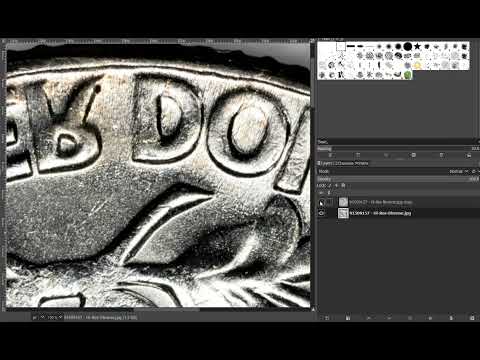 https://youtu.be/tu-whXBRSJM
I legitimately want your guys help figuring this out. I'm not saying I have all the answers. I just think there's more to this coin than what it seems at first glance...
Much appreciated, @FlyingAl ! 👍
@Maxvan1 I would like to apologize. I realize now that it was wrong for me to try to communicate with you using images. When you view an image of a coin, you are seeing as much or more pareidolia as real features. We have had other members here on the Forum that had a problem with this issue, but yours is perhaps the most extreme example I've ever encountered. This means that when you look at an image of a coin, it actually lowers your understanding of the coin, because so much of what you are "seeing" isn't real (or more precisely, isn't what you think it is). The dissonance between what other people see with their eyes and what you see with your mind then causes you to become enraged. We certainly don't want that.
I'm also genuinely sorry that we were not able to catch this sooner. If we could have nipped this in the bud, it would have saved you 8 months of wasted effort, and perhaps the Forum would not have seen as much of your darker side. Better late than never, as they say.
I have examined the specific tailfeather and leaf regions of the reverse that you mentioned, and can confirm that there is nothing about them that conflicts with the existence of the 4 confirmed reverse dies. You can take my word for that. I will not post photos, as I would not want in any way for you to be harmed by them.
As MFeld mentioned, I'm not sure how much outside interest there is in this thread (other than the spectacle), but if anyone else would like to go over the images further, they are welcome to PM me. There, we can view and discuss the images where they will be shielded from any sensitive viewers. I found 4 die marriages in the small sample of coins that I examined on CoinFacts, but it is possible that some sharp-eyed Forum member might find another one, for example.
But before I go, I realized my last video had a processing error on Youtube. I had to split it in two to upload. The marks I leave behind toward the end of the first video are explained once I add the second clash overlay in the second video.
See you around, buddy...


If anyone sees what I'm seeing and is interested in contributing to the discussion, please message me.
I've realized that, unfortunately, posting additional photos only makes you more angry and confused. For you, the additional photos just create more pareidolia problems.
If you are saying the Forum is playing favorites, I think you are wrong. I believe they saw that I was trying to help you, but were also rooting for you to succeed. I think they are sympathetic to your problem, as well, but probably not to your attitude.
If you are on your way out, my parting advice would be that, wherever you end up, try to let people see a more positive side of you. Going forward, try to avoid any future coin projects that rely on your own eye. You'll be much happier in the long run and will avoid many unnecessary conflicts.
Thanks Ike! Hope you have a great week, too.
CONECA Forum is still down, so you're still stuck with my nonsense until it's fixed... Lets just move on to the reverse, I guess... I'm a lot farther along on the reverse, anyway.
Contrary to the assertion above, the reverse die markers identified by Herbert Hick hold true. Out of 18 coins sampled, they all have the relevant die markers. Every coin I've checked on ValueView has these markers.
In addition, this die crack can be used as a reliable secondary die marker and state indicator.
Diagrams are draft. Conclusions subject to change.
I've also measured the die rotation for the 18 coins I'm using as examples. Unfortunately a bunch of coins I submitted to CACG did not cross, so I'm going to have to do another submission to get those ones imaged to finish this off. No early die state examples are included in the 18 samples (those were the crossovers). Ugh.
Maxvan1, you are very good seeing things most people can not see. I suspect you are great at finding varieties like those listed in the CherryPickers Guide.
Thanks!
1962 25C FS-901 Type B Reverse carried into 1963 as FS-901a (space between arrow tip and leaf).
Draft diagrams. Conclusions subject to change. Comments, questions, suggestions welcomed.
Additional photos of 1963 FS-901a below if anyone wants to verify or reference. It appears 1962 also has one reverse die (which was then paired with the 1963 FS-901a obverse die), but my sample set for 1962 is not very large right now. There are at least two reverse dies for 1963 based on a small sample set. I have not checked obverses on any year except 1956.
The 1962 reverse shown is different than the 1963 FS-901a reverse. The two reverses are from two different dies with two different die cracks. Your pareidolia problem has led you to interpret the two different cracks as being the same. It is fortunate that you checked in here so that we could help you nip this new project in the bud; it would have been a real shame to see you spend 8 more months on another wasted effort.
Once again, because of your pareidolia problem, the more you study these images, the more confused you become. It is best for you to close the book on this subject and look at the images no further, as further study will only lead you further down the path of confusion.
This die gouge is a better marker. There are several other markers strongly supporting 1963 FS-901a as the reverse of 1962. The Mint process work on the 1963 is self evident. Confirmed.
No gouge; no other markers.
Pareidolia.
Someone suggested I add pointers for those struggling to see it.
I'll add professional pointers once I go to put it all together...
What year should we do next? Maybe 1964.