General comments on "Branch Mint Proofs"
 CaptHenway
Posts: 34,221 ✭✭✭✭✭
CaptHenway
Posts: 34,221 ✭✭✭✭✭
There is a thread going about Capped Bust Half Proofs that I do not wish to hijack, so I am starting this one. I invite helpful comments about the general subject of "Branch Mint Proofs" here. Please try to stay on subject.
Dan Owens and I have a two part article in The Numismatist about Seated Dimes poorly made at San Francisco and Carson City in 1875 and 1876, which resulted in roughly ten million Dimes being declared unfit to issue, and their being re-melted and re-coined. The second part of the article just became available online in the September issue.
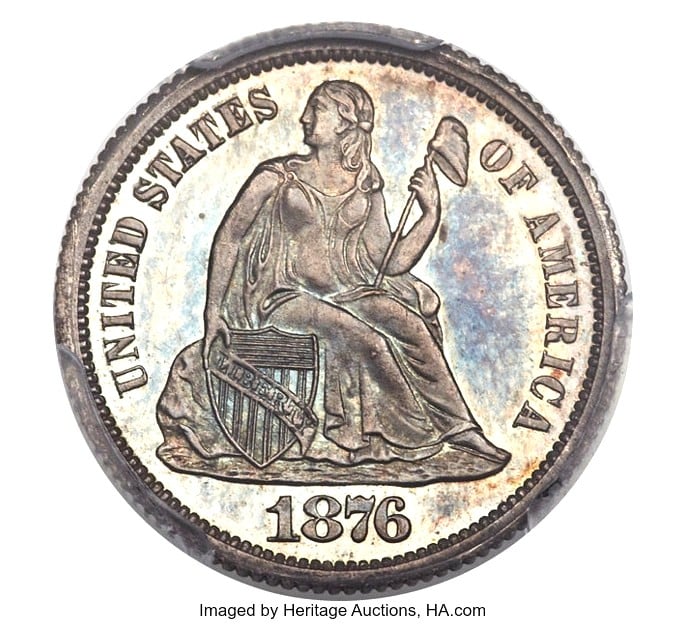
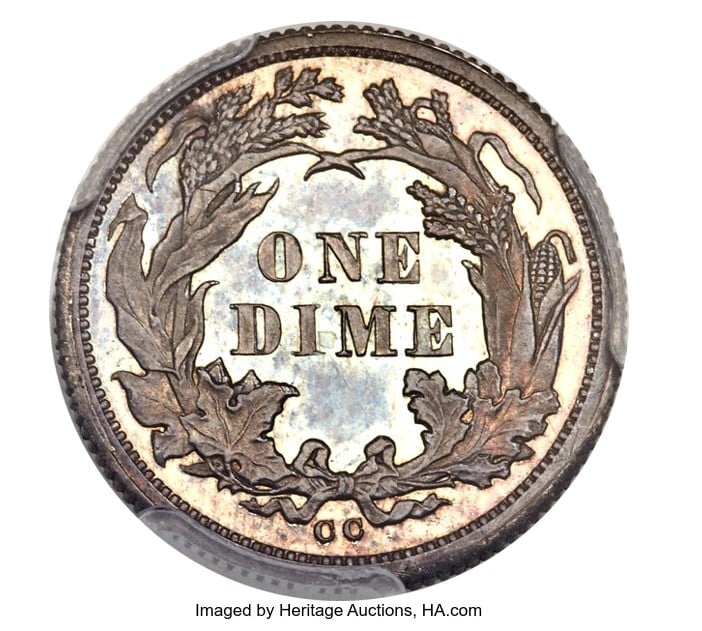
As a very small part of this article we mention the Silver and Copper 1876-CC Dimes commonly called "Branch Mint Proofs." Here are pictures of the silver piece, courtesy of Heritage Auctions:
Here is a picture of a Copper Specimen, courtesy of PCGS CoinFacts:
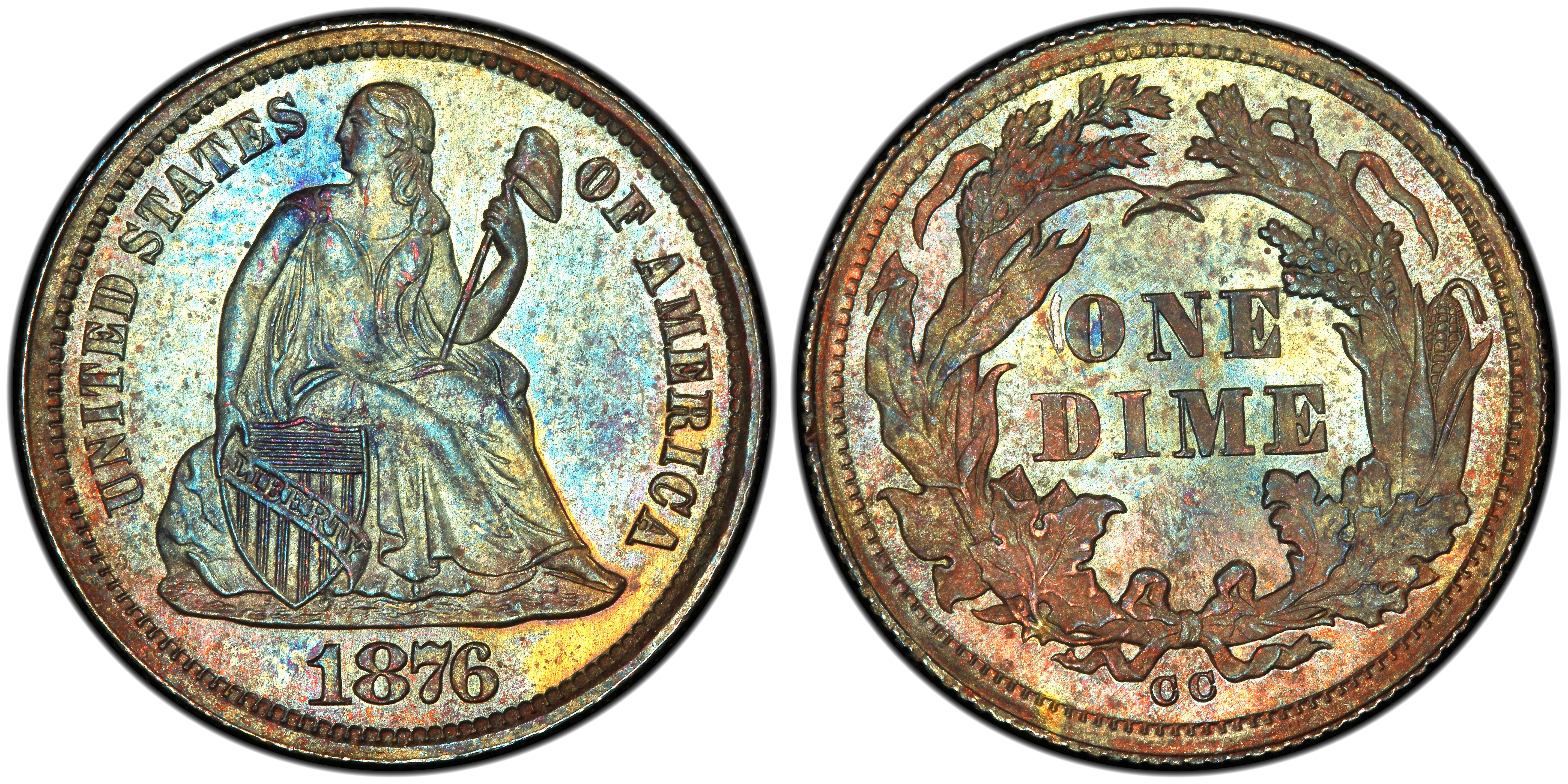
FWIW, I saw one of the Copper Proofs at a Bowers auction back in the early 1980's, and was absolutely convinced that it was a Proof. I bid on it, but being the poor employee of a Non-Profit Organization, could not win it.
As we explain in the article, we think that the silver Proofs were struck at the Philadelphia Mint and sent to Carson City as
as examples of the coinage quality they were expected (perhaps unreasonably) to strive towards. We speculate that the Copper Proofs were struck in Philadelphia at the same time for sale to some collector(s). After all, Carson City would not have had Copper Dime planchets to strike anything on. A rather crudely struck Copper-Nickel piece is also known, thought to have been struck on a Copper-Nickel Three Cent Piece planchet, another item not to be found in the Carson City Mint.
I would like to discuss the possibility that perhaps some of the other so-called "Branch Mint Proofs" were struck at Philadelphia and sent to the various Mints for their respective ceremonies. Obviously this could not have happened with all of them, but I would like to gather input on the subject from those people who have handled various "Branch Mint Proofs" in one place.
I would also appreciate input on whether various "Branch Mint Proofs" are actually "Proofs," or if they should perhaps be referred to as "Specimens" or "Master Coins" or any other term any learned Numismatist would care to offer.
I will open the bidding by saying that I have handled two of the high grade 1894-S Dimes, but did not think that either of them was a "Proofs." I will qualify that statement by saying that I never thought that it really mattered, and that they were what they were and that the terminology did not matter since there was no other issue for them to be different than.
TD
Comments
As a courtesy to Roger W. Burdette, who helped greatly with the article, I will acknowledge here that the term "Branch Mint" became obsolete with the passage of the Coinage Act of 1873, but I am using the term here in its common usage.
@CaptHenway
Absolutely agree. "Branch Mint Proof" is a rather confusing definition since the branch mints simply could not produce Proofs (they lacked a medal press).
True Branch Mint Proofs would be struck on Philadelphia's medal press with mint marked dies and then distributed. Anything not struck at Philadelphia would be a "Specimen" at best, although that definition is even more convoluted.
The above dimes appear to be such a case, especially due to the existence of a copper specimen which would likely have been on hand at Philadelphia in the era due to pattern production.
Coin Photography
I have owned two of the 1838-O halves and an 1894-S dime and do not believe them to be full blown proofs. Just early strikes. So I agree with changing it to specimen in these instances.
When you see what the mint could do in 1834 or 1838 at Philadelphia then the standards are a little different in my mind
Thank you for your input.
The 1838-O is another example of a coin where it just doesn’t matter what you call it.
A thought just popped into my head. I wonder how the collar reeding on these 1876-CC "Branch Mint Proof" DImes compares to the coillar reeding on normal 1876 Proof Dimes?
The same test might be applied to other "Branch Mint Proofs," comparing the normal collars of the Mint in question for that year with the normal Philadelphia Proof collars for that year.
As one would expect, some branch mint proofs are more convincing than others. I only consider one of the silver 76-CC dimes a no-brainer proof. The rest of them look more SP to me, if not just PL. And the copper ones do not look like full blown proofs to me. (BTW, Tom, I’m the guy that outbid you on that coin. Something less than 2K at the time, IIRC. Wish I still had it!) To me, the 1879-O and 1893-CC $1 proofs are unquestionable. (Although there is one DMPL 93-CC that has IMHO been mistakenly been slabbed as a proof.) The only Barber coin that I like as a proof is Pittman’s 1904-O Half Dollar. No surprise that there’s also a 1904-O $10 that has an identical look and feel, and that I consider a true proof. (I suspect that some of the 1906-D proofs might also make my cut, but I would want to see them again.) The 1844-O $5 and $10 slabbed as proofs are off the charts spectacular, but I’d have probably called them SP if it were up to me. Close call.
More later…
Doggedly collecting coins of the Central American Republic.
Visit the Society of US Pattern Collectors at USPatterns.com.
I have a question to start.
1) Didn't Philadelphia typically, or always, send unhardened dies to branch mints? Hardening would then be completed at the branch mint.
2) Is there any evidence that these coins were struck in Philadelphia?
To me, if the dies were sent to the branch mints and used, the "special" coins are either Specimens (SP) or DMPL or PL depending on the intentions of the Mint (number struck, die prep, planchet prep, striking care, etc.).
Keoj
Philadelphia may have hardened a small number of dies to strike a handful of specially prepared mint marked coins there. The branch mints probably tried their best to create a few coins of exceptional quality themselves, albeit not as well executed as Philadelphia could have done. I think the issue is that it becomes difficult to separate the special coins struck at the branch mints from an early and well struck circulation piece. If the Philadelphia struck mint marked coins stand out from the lesser branch mint struck pieces, they should be categorized separately on their own.
The question of when and where the dies were hardened is addressed in the Numismatist article mentioned above. There is also some startling new information about how dies were supposed to properly be acid washed after hardening. This probably has serious implications on the subjects of mint luster and frosting, but there was no room in the article to pursue that.
See the article for our speculation as to where these pieces were struck.
TD
All subjects I hope we can pursue in this thread.
I would bet you that that 1876-CC Copper piece was struck on the medal press in Philadelphia after those dies struck the Silver Proofs on polished Silver Proof planchets from the regular Silver Proof planchet inventory. Whether or not the planchets for the Copper pieces were polished as well is subject to debate.
Roger W. Burdette is working on a serious book that will include sections about the off-metal Proofs struck in the 19th Century. I will ask him what he thinks was normal for the Copper strikings.
And yes, the Copper CC did sell for less that $2,000, but that was back when $2,000 was still worth something and not dinner for eight at a nice restaurant.
This is why I enjoy this forum. I've learned a lot today.
It is my understanding that the medal press required different collars for Proofs, so this is commonly used as an identifier for true Proof coinage.
Coin Photography
TD, Thanks, currently on a trip and will read the article in full when I return. Your comments on collars and reed counts is a very feasible way of getting a little more info regarding where the coin was struck. Its a PITA to count reeds but for what I collect (Trade Dollars), this info as well as the edge-to-coin face sharpness can be used to support a Proof vs BS call.
Best, keoj