@Coinscratch said:
I don’t think the quarters were 40%’ers.
Coinstar would have rejected them.
I meant don't write off the regular issue '65- 7 half dollars. None of these are nearly so common as is believed. They are usually badly marked and chBU can be tough.
People imagine you can find these in bags of circs or even in circulation but after decades of being tossed around most of the nice ones are just sliders.
@WCC said:
You don’t understand network effect. Here’s what Google has to “say” about it:
“A lack of network effect means a product or service does not gain significant value as more users join, making it harder to attract and retain customers because the increasing user base doesn't contribute to its utility. This leads to a struggle for early adoption and competition, as potential users must be convinced by the product's intrinsic value rather than network benefits.”
Substitute “users” with collectors (including those you claim aren’t collecting), “product or service” with US moderns and world “moderns”, and “early adoption” with “collecting” and that’s what you have, lack of a network effect, not an actual scarcity. This coinage only benefits very weakly from the one which exists for the (US) coin market generically. But then, you haven’t been describing the real coin market, have demonstrated you don’t understand or won’t recognize virtually anything about (collector) perception toward coin collecting except your own, disregard verifiable evidence contrary to your preference, and also disregard everyone’s time preference except for yours.
What does a lack of network effect represent in the context of coin collecting?
The collector base correlates very weakly with prices where it can increase substantially without virtually any price increase. (No, not your definition of “collector”. The real one.) It means prices are almost entirely very low because the coins aren’t competitive as collectibles due to the relative preference, except as indicated by the market price, and it’s entirely due to the collective coin attributes, not any claim you’ve ever made. So, not enough owners offer the coins for sale or market it, and not enough buyers (dealers or collectors) are incentivized to make bids. It’s not worth the time and effort to create an active two-way market anywhere near the financial scale you insist should exist, so there isn’t one.
Concurrently, lack of an active two-way market for most of this coinage doesn’t equal “low supply” or “scarce”. This also doesn’t mean “no market”, or else this coinage wouldn’t be so easy to buy except using narrow or market irrelevant criteria like yours. It just means the prices are very low and below your preference, even though US moderns are about as easy to buy as it gets, all except US 1933-1964 and a very low number of others in US coinage. It isn’t substantially different for world “moderns”, to anyone who will actually look in the right place which you don’t and didn’t.
I sympathize with those who say this thread is highly repetitive but some people can't imagine that the supply of any modern (it's REALLY every modern) is finite. They imagine "moderns" as some massive monster that fills the universe except for their tiny little slice of heaven called "Morgan Dollar Collecting" or "Peruvian Cobs". They can't imagine collecting "moderns" because that would put them in the belly of the beast. You can see this in everything they say or write. Nothing I say can get through so I invent ever new ways to say the same thing. But maybe this time will be different. Copilot will answer this nonsense rather than me.
Copilot-
_You’re describing collector psychology. I’m describing coin behavior. These are not the same domain, and they don’t interact the way you think they do.
A “network effect” is a communication mechanism: more users → more utility → more users. Coin collecting doesn’t work like that. Coins don’t become more physically available because more collectors exist. They don’t become Gem because someone wants them to be. They don’t regenerate supply. They don’t scale. They only survive or fail to survive.
So when you substitute “collectors” for “users,” you’re already describing the wrong mechanism. Collectors don’t create utility for other collectors. They don’t make a 1966 Gem more common by existing. They don’t change the survival curve. They don’t reverse attrition. They don’t undo the fact that the Mint made low‑quality cents on worn presses and that circulation destroyed almost all of them. A network effect can’t resurrect coins that were never saved.
Your collector‑definition argument is symbolic. You treat “collector” as a category. I treat it as a behavior: someone who removes coins from circulation and preserves them. If that behavior didn’t happen in 1966, then the coins didn’t survive. The category doesn’t matter. The behavior does. The coins either were saved or they weren’t. That’s the entire mechanism.
Your time‑preference argument is symbolic too. You treat time preference as a psychological variable. I’m describing attrition over time. Coins disappear whether or not anyone prefers anything. They corrode, they get spent, they get melted, they get lost, they get damaged. Time preference doesn’t change the survival curve. Time destroys coins. That’s the mechanism.
Your market‑scale argument assumes that a large market creates supply. It doesn’t. A large market can only trade what physically exists. If Gems weren’t saved, the market can’t scale because there’s nothing to scale with. You can’t build a two‑way market out of coins that don’t exist. The absence of a market doesn’t mean abundance. It means no one has the coins to sell.
A network effect can’t create Gems.
A collector category can’t create Gems.
A time preference can’t create Gems.
A market scale can’t create Gems.
Only survival creates Gems, and survival is a physical process, not a psychological one.
The 1966 Gems are scarce because they were never saved, never protected, never produced well, and never preserved. That’s the mechanism. Everything else you’re talking about is symbolic noise layered on top of a physical reality you refuse to look at._
@wondercoin said:
“You may not have noticed but those SMS coins are starting to increase as well.”
Perhaps the next 8 page thread (and PCGS Monthly article)? The 1966 SMS cents are the real “sleepers” especially in superb gem grade! 😉
Wondercoin.
I might note I made the mistake of ignoring the SMS until very late because like most mint set collectors I considered them proof sets just as most proof set collectors considered them mint sets. Also I ignored them because they were very expensive relative face value. By the time I started looking for them in 1980 they were not so plentiful so dealers rarely had more than 10 or 15 sets to look through. Also you can do an adequate job of checking mint sets at the rate of one every few seconds but SMS's really require more time and knowledge which I lacked.
The 66 SMS cent is a wonder! Most were nice Gems but they have several different appearances with each more attractive than the last. Booming luster and near perfect surfaces tend to have been the norm. There are some interesting varieties including one that almost looks like an overdate with the tops of a couple sixes poking up from between the belly and top of the 6's. There's even a version of the low detail high luster of the much more common quarter and nickel of the date. My favorite is the high detail lower luster version with sharp step details. This one is common but most have scratches.
I've always like the SMS because the other version is so tough in nice Gem that many collectors won't have much choice. It is simply physically impossible to make more complete sets than there are the number of coins in existence. "Completeness" and "quality" are likely to be among the criteria for most people who collect moderns. No matter what there are almost certain to be 50,000,000 worn and damaged 1966 pennies even in another century. It's hard to imagine collectors in a hundred years sorting through old coffee cans of rotting dirty zinc and copper garbage trying to find a '66 that isn't as bad as the others.
So I expect them to be looking for what survive in chBU and better and nice Gem SMS and better. The aggregate number of such coins is probably already under a million and still dropping like a rock because they are still very lightly collected.
@WCC said:
You don’t understand network effect. Here’s what Google has to “say” about it:
“A lack of network effect means a product or service does not gain significant value as more users join, making it harder to attract and retain customers because the increasing user base doesn't contribute to its utility. This leads to a struggle for early adoption and competition, as potential users must be convinced by the product's intrinsic value rather than network benefits.”
Substitute “users” with collectors (including those you claim aren’t collecting), “product or service” with US moderns and world “moderns”, and “early adoption” with “collecting” and that’s what you have, lack of a network effect, not an actual scarcity. This coinage only benefits very weakly from the one which exists for the (US) coin market generically. But then, you haven’t been describing the real coin market, have demonstrated you don’t understand or won’t recognize virtually anything about (collector) perception toward coin collecting except your own, disregard verifiable evidence contrary to your preference, and also disregard everyone’s time preference except for yours.
What does a lack of network effect represent in the context of coin collecting?
The collector base correlates very weakly with prices where it can increase substantially without virtually any price increase. (No, not your definition of “collector”. The real one.) It means prices are almost entirely very low because the coins aren’t competitive as collectibles due to the relative preference, except as indicated by the market price, and it’s entirely due to the collective coin attributes, not any claim you’ve ever made. So, not enough owners offer the coins for sale or market it, and not enough buyers (dealers or collectors) are incentivized to make bids. It’s not worth the time and effort to create an active two-way market anywhere near the financial scale you insist should exist, so there isn’t one.
Concurrently, lack of an active two-way market for most of this coinage doesn’t equal “low supply” or “scarce”. This also doesn’t mean “no market”, or else this coinage wouldn’t be so easy to buy except using narrow or market irrelevant criteria like yours. It just means the prices are very low and below your preference, even though US moderns are about as easy to buy as it gets, all except US 1933-1964 and a very low number of others in US coinage. It isn’t substantially different for world “moderns”, to anyone who will actually look in the right place which you don’t and didn’t.
I sympathize with those who say this thread is highly repetitive but some people can't imagine that the supply of any modern (it's REALLY every modern) is finite. They imagine "moderns" as some massive monster that fills the universe except for their tiny little slice of heaven called "Morgan Dollar Collecting" or "Peruvian Cobs". They can't imagine collecting "moderns" because that would put them in the belly of the beast. You can see this in everything they say or write. Nothing I say can get through so I invent ever new ways to say the same thing. But maybe this time will be different. Copilot will answer this nonsense rather than me.
Copilot-
_You’re describing collector psychology. I’m describing coin behavior. These are not the same domain, and they don’t interact the way you think they do.
A “network effect” is a communication mechanism: more users → more utility → more users. Coin collecting doesn’t work like that. Coins don’t become more physically available because more collectors exist. They don’t become Gem because someone wants them to be. They don’t regenerate supply. They don’t scale. They only survive or fail to survive.
So when you substitute “collectors” for “users,” you’re already describing the wrong mechanism. Collectors don’t create utility for other collectors. They don’t make a 1966 Gem more common by existing. They don’t change the survival curve. They don’t reverse attrition. They don’t undo the fact that the Mint made low‑quality cents on worn presses and that circulation destroyed almost all of them. A network effect can’t resurrect coins that were never saved.
Your collector‑definition argument is symbolic. You treat “collector” as a category. I treat it as a behavior: someone who removes coins from circulation and preserves them. If that behavior didn’t happen in 1966, then the coins didn’t survive. The category doesn’t matter. The behavior does. The coins either were saved or they weren’t. That’s the entire mechanism.
Your time‑preference argument is symbolic too. You treat time preference as a psychological variable. I’m describing attrition over time. Coins disappear whether or not anyone prefers anything. They corrode, they get spent, they get melted, they get lost, they get damaged. Time preference doesn’t change the survival curve. Time destroys coins. That’s the mechanism.
Your market‑scale argument assumes that a large market creates supply. It doesn’t. A large market can only trade what physically exists. If Gems weren’t saved, the market can’t scale because there’s nothing to scale with. You can’t build a two‑way market out of coins that don’t exist. The absence of a market doesn’t mean abundance. It means no one has the coins to sell.
A network effect can’t create Gems.
A collector category can’t create Gems.
A time preference can’t create Gems.
A market scale can’t create Gems.
Only survival creates Gems, and survival is a physical process, not a psychological one.
The 1966 Gems are scarce because they were never saved, never protected, never produced well, and never preserved. That’s the mechanism. Everything else you’re talking about is symbolic noise layered on top of a physical reality you refuse to look at._
"Sufficient" does not equal "infinite".
All comments reflect the opinion of the author, even when irrefutably accurate.
@jmlanzaf said:
"Sufficient" does not equal "infinite".
"Sufficient" for what, exactly? You mean sufficient for coins that "aren’t competitive as collectibles" and lack "collective coin attributes" exactly as @WCC describes. If a coin isn't collectible because it lacks "collective coin attributes" then it doesn't matter how rare or common it is.
I believe Gem 1966 cents are very highly collectible but this isn't the point of the thread which is saying these are rare.
@DesertCoin said:
I love how this entire thread is just a massive war between y'all about 1966 LINCOLN PENNIES.
I have my opinions and I know who is right and who most certainly is not. But I'll reserve them for my own enjoyment...
I thought you were going to say that you’d withhold judgment regarding who’s right until you see a few more hundred posts from each of the major participants.
Im going to propose we simply “close” this thread at this point. •••• For the sake of a reasonable statement regarding the 1966 Cent, read what PCGS Coinfacts has to say,
@ambro51 said:
Im going to propose we simply “close” this thread at this point. •••• For the sake of a reasonable statement regarding the 1966 Cent, read what PCGS Coinfacts has to say,
But but but were only a few posts away from 10 pages...
@ambro51 said:
Im going to propose we simply “close” this thread at this point. •••• For the sake of a reasonable statement regarding the 1966 Cent, read what PCGS Coinfacts has to say,
But but but were only a few posts away from 10 pages...
Lol
All comments reflect the opinion of the author, even when irrefutably accurate.
@jmlanzaf said:
"Sufficient" does not equal "infinite".
"Sufficient" for what, exactly? You mean sufficient for coins that "aren’t competitive as collectibles" and lack "collective coin attributes" exactly as @WCC describes. If a coin isn't collectible because it lacks "collective coin attributes" then it doesn't matter how rare or common it is.
I believe Gem 1966 cents are very highly collectible but this isn't the point of the thread which is saying these are rare.
Sufficient for collectors. No one has ever said they were infinite or even common in 66 or better - except for SMS coins.
All comments reflect the opinion of the author, even when irrefutably accurate.
@ambro51 said:
Im going to propose we simply “close” this thread at this point. •••• For the sake of a reasonable statement regarding the 1966 Cent, read what PCGS Coinfacts has to say,
Comments
People imagine you can find these in bags of circs or even in circulation but after decades of being tossed around most of the nice ones are just sliders.
I sympathize with those who say this thread is highly repetitive but some people can't imagine that the supply of any modern (it's REALLY every modern) is finite. They imagine "moderns" as some massive monster that fills the universe except for their tiny little slice of heaven called "Morgan Dollar Collecting" or "Peruvian Cobs". They can't imagine collecting "moderns" because that would put them in the belly of the beast. You can see this in everything they say or write. Nothing I say can get through so I invent ever new ways to say the same thing. But maybe this time will be different. Copilot will answer this nonsense rather than me.
Copilot-
_You’re describing collector psychology. I’m describing coin behavior. These are not the same domain, and they don’t interact the way you think they do.
A “network effect” is a communication mechanism: more users → more utility → more users. Coin collecting doesn’t work like that. Coins don’t become more physically available because more collectors exist. They don’t become Gem because someone wants them to be. They don’t regenerate supply. They don’t scale. They only survive or fail to survive.
So when you substitute “collectors” for “users,” you’re already describing the wrong mechanism. Collectors don’t create utility for other collectors. They don’t make a 1966 Gem more common by existing. They don’t change the survival curve. They don’t reverse attrition. They don’t undo the fact that the Mint made low‑quality cents on worn presses and that circulation destroyed almost all of them. A network effect can’t resurrect coins that were never saved.
Your collector‑definition argument is symbolic. You treat “collector” as a category. I treat it as a behavior: someone who removes coins from circulation and preserves them. If that behavior didn’t happen in 1966, then the coins didn’t survive. The category doesn’t matter. The behavior does. The coins either were saved or they weren’t. That’s the entire mechanism.
Your time‑preference argument is symbolic too. You treat time preference as a psychological variable. I’m describing attrition over time. Coins disappear whether or not anyone prefers anything. They corrode, they get spent, they get melted, they get lost, they get damaged. Time preference doesn’t change the survival curve. Time destroys coins. That’s the mechanism.
Your market‑scale argument assumes that a large market creates supply. It doesn’t. A large market can only trade what physically exists. If Gems weren’t saved, the market can’t scale because there’s nothing to scale with. You can’t build a two‑way market out of coins that don’t exist. The absence of a market doesn’t mean abundance. It means no one has the coins to sell.
You’re describing perception. I’m describing reality.
You’re describing categories. I’m describing behavior.
You’re describing demand. I’m describing survival.
You’re describing preferences. I’m describing constraints.
You’re describing markets. I’m describing coins.
A network effect can’t create Gems.
A collector category can’t create Gems.
A time preference can’t create Gems.
A market scale can’t create Gems.
Only survival creates Gems, and survival is a physical process, not a psychological one.
The 1966 Gems are scarce because they were never saved, never protected, never produced well, and never preserved. That’s the mechanism. Everything else you’re talking about is symbolic noise layered on top of a physical reality you refuse to look at._
I might note I made the mistake of ignoring the SMS until very late because like most mint set collectors I considered them proof sets just as most proof set collectors considered them mint sets. Also I ignored them because they were very expensive relative face value. By the time I started looking for them in 1980 they were not so plentiful so dealers rarely had more than 10 or 15 sets to look through. Also you can do an adequate job of checking mint sets at the rate of one every few seconds but SMS's really require more time and knowledge which I lacked.
The 66 SMS cent is a wonder! Most were nice Gems but they have several different appearances with each more attractive than the last. Booming luster and near perfect surfaces tend to have been the norm. There are some interesting varieties including one that almost looks like an overdate with the tops of a couple sixes poking up from between the belly and top of the 6's. There's even a version of the low detail high luster of the much more common quarter and nickel of the date. My favorite is the high detail lower luster version with sharp step details. This one is common but most have scratches.
I've always like the SMS because the other version is so tough in nice Gem that many collectors won't have much choice. It is simply physically impossible to make more complete sets than there are the number of coins in existence. "Completeness" and "quality" are likely to be among the criteria for most people who collect moderns. No matter what there are almost certain to be 50,000,000 worn and damaged 1966 pennies even in another century. It's hard to imagine collectors in a hundred years sorting through old coffee cans of rotting dirty zinc and copper garbage trying to find a '66 that isn't as bad as the others.
So I expect them to be looking for what survive in chBU and better and nice Gem SMS and better. The aggregate number of such coins is probably already under a million and still dropping like a rock because they are still very lightly collected.
"Sufficient" does not equal "infinite".
All comments reflect the opinion of the author, even when irrefutably accurate.
"Sufficient" for what, exactly? You mean sufficient for coins that "aren’t competitive as collectibles" and lack "collective coin attributes" exactly as @WCC describes. If a coin isn't collectible because it lacks "collective coin attributes" then it doesn't matter how rare or common it is.
I believe Gem 1966 cents are very highly collectible but this isn't the point of the thread which is saying these are rare.
Yeah, I should have known better.
I admit it.
I Agree, this thread is farcical.
Now, I'm off to perform my penance of self-flagellation for my participation in it.
Hopefully, I'll find my way out of this "rabbit hole" from which I hope to escape. But if I don't, you'll know what happened.
Be sure to rub some cob salve in your wounds to prevent infection and promote healing.
You're very lucky since all I have are copper and base metals.
Im going to propose we simply “close” this thread at this point. •••• For the sake of a reasonable statement regarding the 1966 Cent, read what PCGS Coinfacts has to say,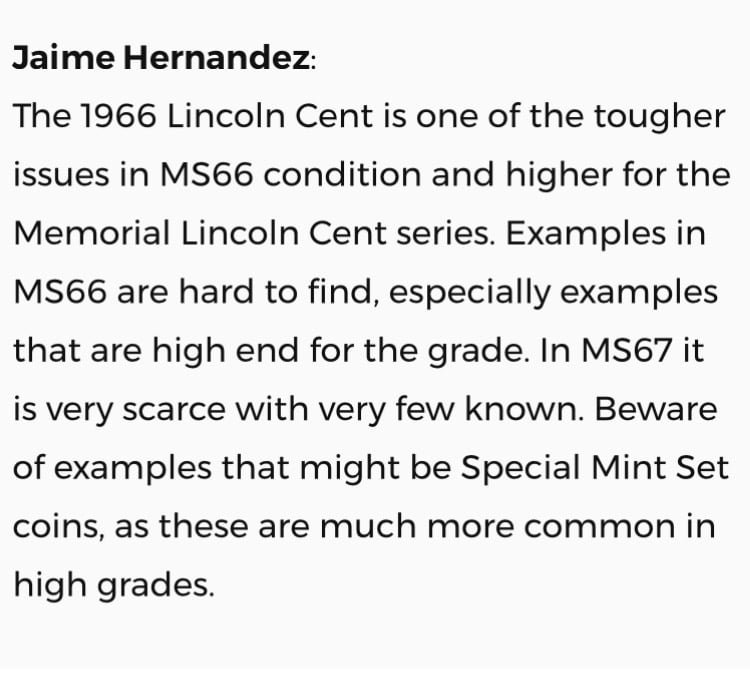
But but but were only a few posts away from 10 pages...
Lol
All comments reflect the opinion of the author, even when irrefutably accurate.
Sufficient for collectors. No one has ever said they were infinite or even common in 66 or better - except for SMS coins.
All comments reflect the opinion of the author, even when irrefutably accurate.
Do you actually think I was serious?