Options
Counterfeit Lafayette Dollar Help Needed
 Danny04
Posts: 6 ✭
Danny04
Posts: 6 ✭
Hello to Forum Members, First time logging in and posting.
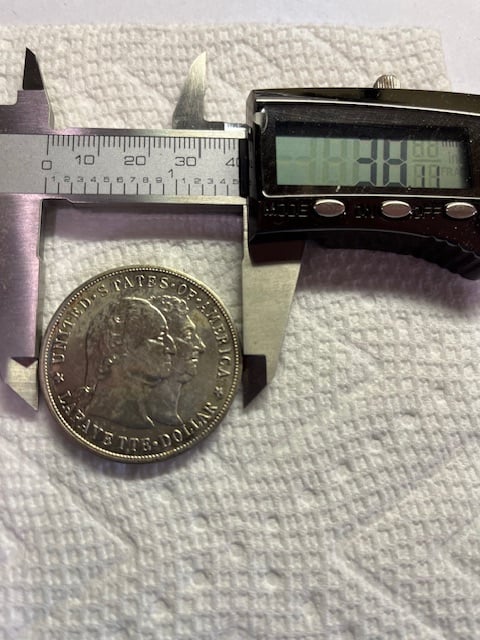
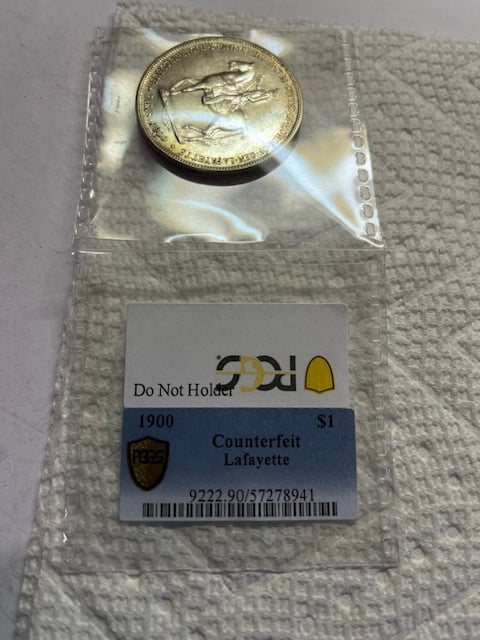
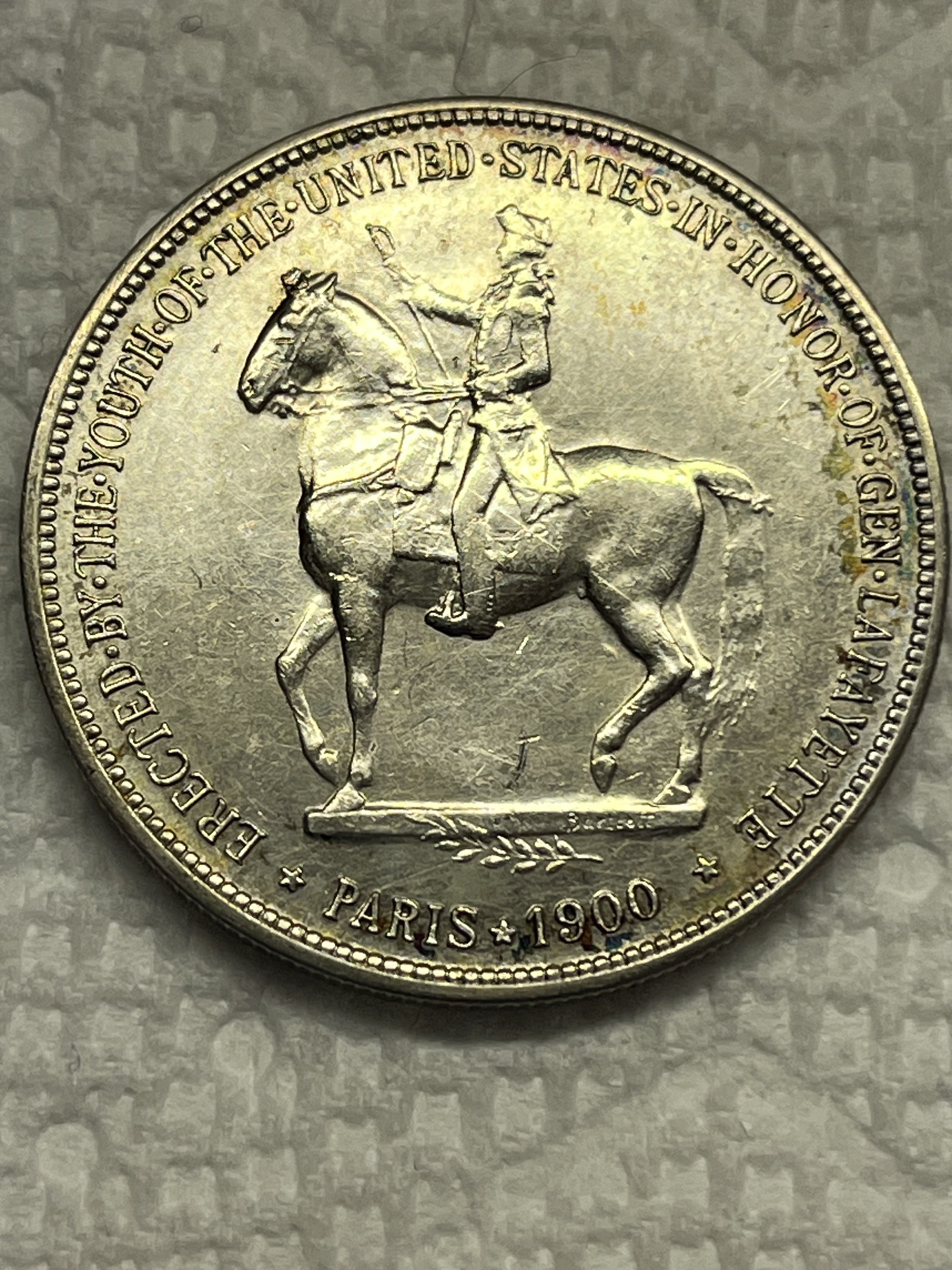
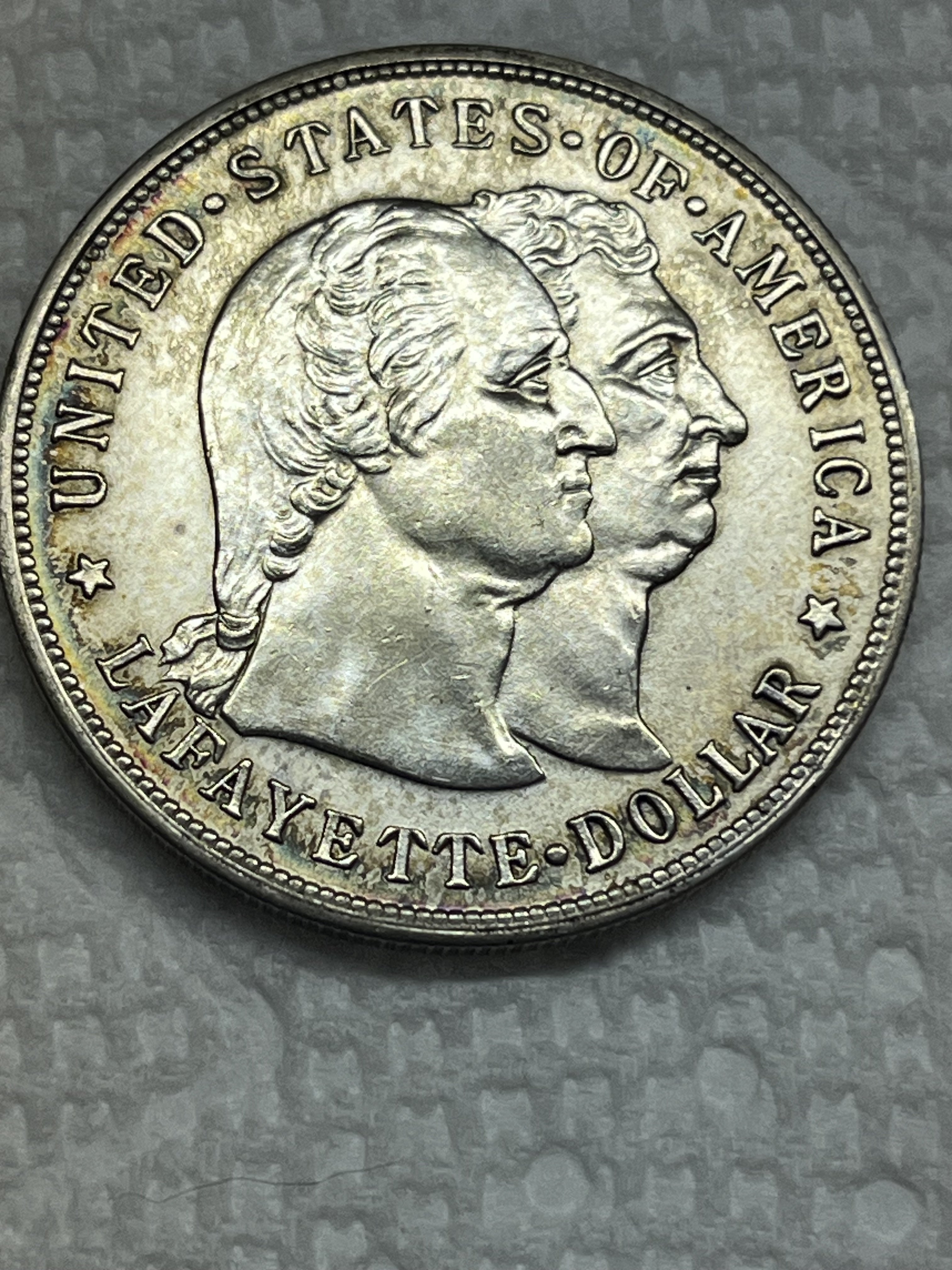
Help needed on counterfeit Lafayette. I submitted to PCGS and came back as counterfeit, which is fine. But they didn't give an explanation to the why and when called they mentioned they just grade period. So I'm asking to help as to why so can learn.
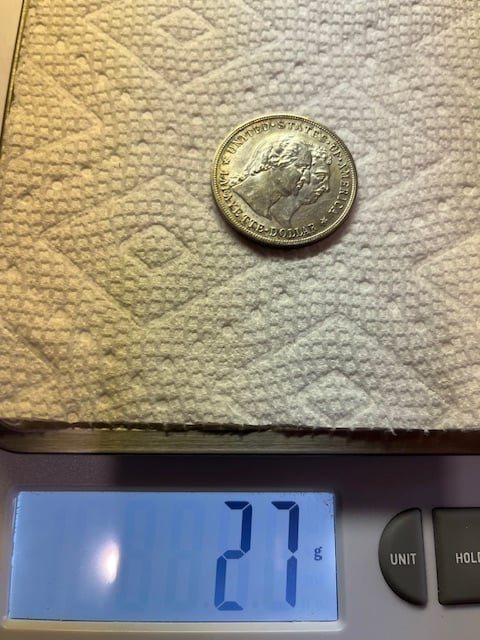
I took measurements and seem within spec.
History: The coin was passed down from my grandfather. He was born in 1900 so he had a couple including this from his birth year. I remember him showing it to me as a kid in the 70's. I'm not a serious collector, just an on/off hobbyist when have time since was little.
Pics following. Many thanks for any help!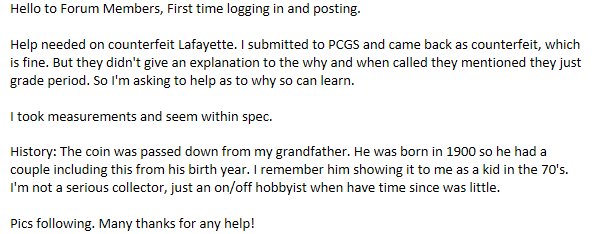
0
Comments
There are a number of issues that you should be able to spot if you download a genuine PCGS graded photo. The letter font is off and the denticles look odd. I did not spend the time, but it is very useful to superimpose a genuine picture of the obverse and reverse with that of your coin, that is a quick way to spot differences, like the incorrect spacing in AMERICA on the obverse.
edit: here is a genuine MS65 dollar without too much heavy toning that you can use to compare:
https://d1htnxwo4o0jhw.cloudfront.net/cert/79358593/TKYN0ybwA0Wo_8nka3ZUsQ.jpg
The lettering, as mentioned by Old_Collector is off. Look at the letters "ES" in STATES and that'll open your eyes to other issues with the lettering too.
It does appear to be struck on a silver planchet, so that is cool.
It is an excellent copy overall and would command a price a bit above melt I'd think for the collector of such fantasy/bogus items.
It's missing the sharpness of detail that a genuine coin has. For example, the serifs, such as on the "E" (see below) are too thick and tubby. The dot is too tubby as well. The denticles are missing detail where they meet the rim.
Your coin compared with a genuine example:
Great comments, appreciate the help!
There are 4 known different obverse dies for the 1900 Lafayette dollar.
Die 3 has a high E in STATES, and the other 3 dies have ES level.
So this critique on the ES letters is not correct.
This thread shows the known die pairs, with descriptions and photos:
https://www.cointalk.com/threads/lafayette-dollar-a-numismatic-treasure.50032/
^
Thank you for this. Some terrific information contained within.
I like it when I'm wrong. It is how I learn.
I appreciate the information and correction.
The font is correct as well. This is a very deceptive counterfeit.
Young Numismatist • My Toned Coins
Life is roadblocks. Don't let nothing stop you, 'cause we ain't stopping. - DJ Khaled
what are the chances this is a mechanical error?
I always thought a mechanical error was, for example, not listing the mint mark or getting the date wrong.
I've yet to hear of a mechanical error accidently stating a coin is a counterfeit when the graders agree is is genuine.
I'm not convinced that is a counterfeit. If it is it is of exceptional quality.
Try sending it to ANACS or NGC and see what they say.
The denticles do appear oddly shaped compared to the genuine coin and there is a raised bump on the throat that is a bit concerning.
The dot before the word DOLLAR is also of a different size than the original
Full resolution if helpful.
Subject coin:
Genuine article from @Old_Collector 's post:
chopmarkedtradedollars.com
Based on the CoinTalk link from @lermish, the reverse dies are very easy to tell apart. If this is real, then it has reverse B. None of the others are close.
Reverse B is only paired with obverse 1. I have a harder time telling the obverses apart, but I could agree that the OP's coin has obverse 1.
I'm not convinced there is a raised bump on the throat. I think I see what @RedRocket is referring to, and that might be right. Or it might be a small ding with a raised area next to it. Or it might be sone other trick of the lighting.
I am concerned about the lack of detail. On the other hand, the OP's example is circulated, and some softening is understandable on a circulated coin.
I don't see anything in the pictures that screams counterfeit. On the other hand, PCGS saw this in hand and I didn't. This is the sort of thing they're very good at. I wouldn't bet against them.
All very interesting. Thanks everyone.
I heard authentic ones have die polishing swirling under the horse that looks like clouds. If not there, counterfeit.
there's more than one reverse die
Agree this is counterfeit but a pretty good one.
Most are easier to tell than this one.
So if this is a half century old die struck counterfeit, there were surely others made. Can anyone reference another from the same transfer dies? I would be better convinced if another one were shown to exist.
If that is, in fact, a counterfeit that was struck more than 50 years ago I hate to think of how many more like it are in collections. I doubt if 1% of collectors would spot it as being a counterfeit. It is a seldom seen coin type that few collectors (or dealers) handle on a regular basis.
jonathanb Posts: 4,025 ✭✭✭✭✭ June 3, 2026 9:17PM
Based on the CoinTalk link from @lermish, the reverse dies are very easy to tell apart. If this is real, then it has reverse B. None of the others are close.
Reverse B is only paired with obverse 1. I have a harder time telling the obverses apart, but I could agree that the OP's coin has obverse 1.
I'm not convinced there is a raised bump on the throat. I think I see what @RedRocket is referring to, and that might be right. Or it might be a small ding with a raised area next to it. Or it might be sone other trick of the lighting.
I am concerned about the lack of detail. On the other hand, the OP's example is circulated, and some softening is understandable on a circulated coin.
I don't see anything in the pictures that screams counterfeit. On the other hand, PCGS saw this in hand and I didn't. This is the sort of thing they're very good at. I wouldn't bet against them.
>
Regarding the lack of detail that you mentioned - when comparing the images posted by @lermish, it looks to me like the subject coin has more details in some areas than the genuine one does.
Mark Feld* of Heritage Auctions*Unless otherwise noted, my posts here represent my personal opinions.
The first thing to look at on a Lafayette is the branch above the date. It seems to have been entirely hand-engraved for all dies, so the position and number of leaves varies. The one shown is reverse B, which as mentioned, is only paired with obverse 1. All peripheral lettering on both sides was hand-punched in the dies, so letter position varies from die to die and repunching is plentiful. The spacing of MER is noticeably different between the two. VAMWorld has a Lafeyette dollar section with micro-photographs of all varieties as well as full-coin photos. Here's DuVall-1B.
Keeper of the VAM Catalog • Professional Coin Imaging • Prime Number Set • World Coins in Early America • British Trade Dollars • Variety Attribution
None of the genuine photos appear to have the thick lettering for DOLLAR like the OP coin.
"To Be Esteemed Be Useful" - 1792 Birch Cent --- "I personally think we developed language because of our deep need to complain." - Lily Tomlin
The horse's tail is also sunken into the fields and poorly detailed
Young Numismatist • My Toned Coins
Life is roadblocks. Don't let nothing stop you, 'cause we ain't stopping. - DJ Khaled
compare to #1 obv and Rev B only