Home U.S. Coin Forum

Overdate die production theory

Theory of overdate die production.
Filing down of the previous date would leave raised section on the coin for new date. No evidence of raised section above the coins field.

Use of steel to fill in die. This would cause reduction of the carbon content in the tool steel as the temperature needed to melt the steel filler would be hot enough to burn out the carbon. This would leave a softer die with a shorter life. Melting point of the steel would be between 2500 and 2800 degrees Fahrenheit.

Alternative theory of mine.

The dies were filled in with a bronze braze. Any incomplete filling or incomplete fusion with the steel die will leave traces of the previous date.

The bronze filler doesn’t have to be hard just as long as it will adhere to the die and not move around. Remember a grease filled die will keep the coins metal from flowing into that section of the die because it is incompressible.

The specifics of the braze would to have a melting point high enough as to not become anything beyond the plastic stage during the heat treatment of the die and low enough to stay below the decarbonization of the die steel.

Augustus Saint-Gaudens the designer of the Saint-Gaudens $20 gold coin of 1907, was a bronze sculptor so he would be familiar with using bronze brazing to fill in holes in sculptures.

I will start with the 1943 over 1942 S cent.

Any raised section of the underlying 42 was impressed into the die by the hub but incompletely filled in. I have sought to find a 1943/1942-S cent that has the common filled in 4 and or mintmark. The 1943 steel cents were notorious for the zinc coating on the planchets filling in the 4 and or mintmark. The theory I liked was because of the basining of the die there and the 4 scraping off some of the zinc because of the sharpness of that digit. With there being no evidence of the overdate die filling in I can conclude the bronze filling not collecting the zinc?

In the early die state you can see there is part of the down-leg of the 4 that was filled in but there is obvious polish marks in the softer bronze fill.
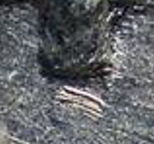
In later die states this segment was completely polished away.
The upper part of the 2 is partially exposed in the early die state.
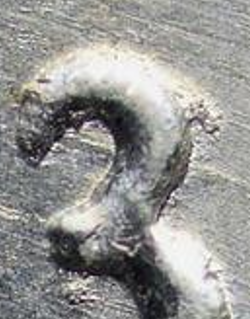
You can see in the later die state the fill is starting to deteriorate. Even on top of the 3 you can see the fill deteriorating.
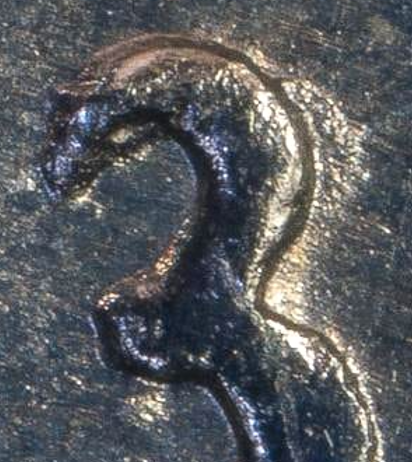
It is no longer smooth on top of the 3.

The 1877/6 half dollar.
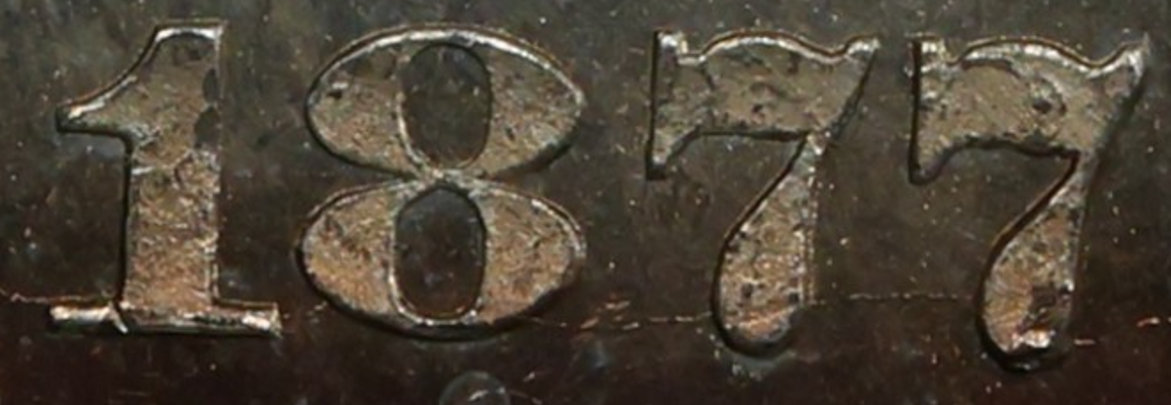
The 6 is on top of the last 7. This can be explained by an incomplete fill of the die with the braze metal. Any left-over hardened flux would be incompressible by the 1877 date punch and leave an impression of the 6. Once the die is hardened and cleaned the flux would be cleaned out to leave the shadow of the previous 6 on the 7 but not in the field.

1887/6 dollar.
There is just a small outline of the lower part of the 6. This shows non adherence of the part of the filler metal with the base metal of the die.
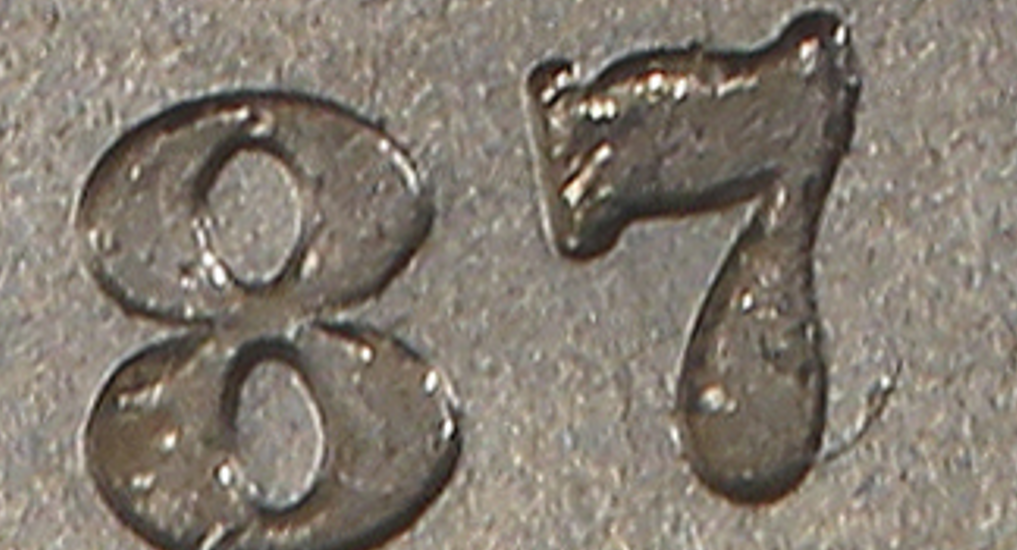
1888/7 Cent.
The small lower part of the 7 looks to be broken out of the die. (The adhesion of the filler metal failed)
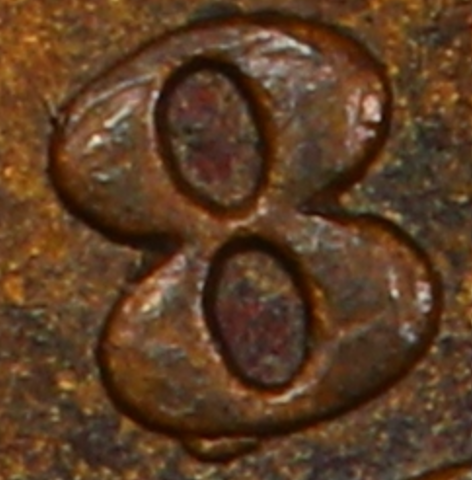
1858/7 Cent
There is showing incomplete filling of the die in the thin section of the 7.
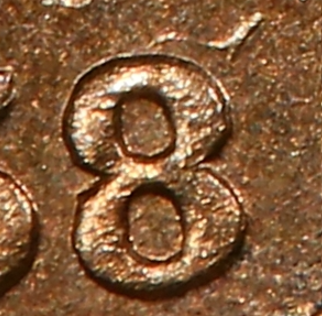
1942 over 41 dimes.

The Philadelphia mint example shows a complete 1941 image under the 1942 date.
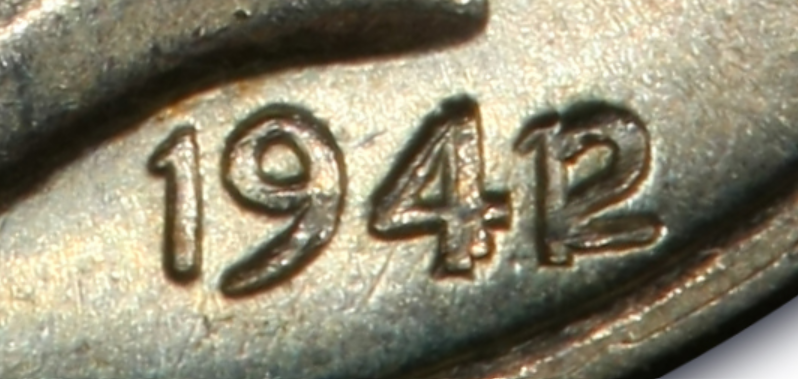
The Denver mint example shows a partial filled in 1941 date under the 1942.
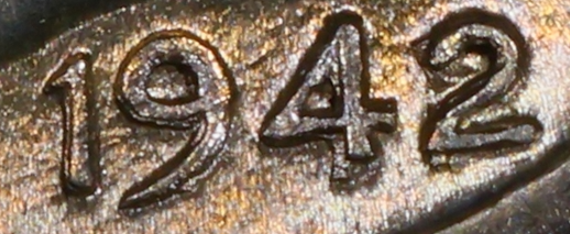
This looks like the die used in Philadelphia was not caught early enough to be modified by the mint employees. The Denver die appears to have been attempted at a coverup.

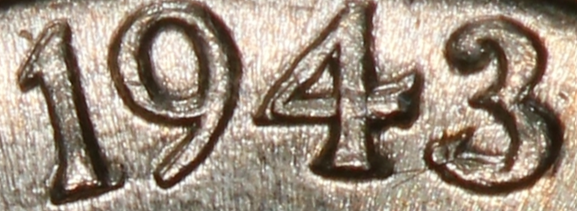
1943/2 nickel.

You can see the underlying 1942 date but most of the 2 have been filled in. You can see where the lower curve of the 3 has affected the filled in 2 there.
1880 Morgan dollars.

Many examples of this date being used over the dies made for 1879.

With all of the examples of overdates through the years, the mint had the knowledge of filling in the dies to get rid of the previous date on a coin. I am sure there are many examples we will never know about because they did a better job on those dies.

Comments

  • jmlanzafjmlanzaf Posts: 40,817 ✭✭✭✭✭
    edited June 3, 2026 12:31PM

    Rather than guess, you could just research the actual process. There's not a real mystery here.

    Are you familiar with search engines?

    All comments reflect the opinion of the author, even when irrefutably accurate.

  • johnny9434johnny9434 Posts: 31,888 ✭✭✭✭✭

    Conspiracy?

  • yosclimberyosclimber Posts: 5,287 ✭✭✭✭✭
    edited June 3, 2026 1:39PM

    Hmm, I believe the prevailing theory on overdates is not that the recessed date digits were filled in with new metal.

    Instead, the die was softened by annealling (heat treatment),
    then flattened in the date area with a fairly blunt tool, to get rid of most of the prior date or digit to be replaced.

    The other steps are the same -

    • punch in the new date or replaced digits
    • new heat treatment to harden the die

    This wiki page does not cover overdates, but does cover heat treatment.
    https://en.wikipedia.org/wiki/Coining_(mint)

  • @jmlanzaf said:
    Rather than guess, you could just research the actual process. There's not a real mystery here.

    Are you familiar with search engines?

    The US mint never acknowledged they had overdates thus there was never any documentation of the process they did. It is really hard to google something that never existed!

  • @yosclimber said:
    Hmm, I believe the prevailing theory on overdates is not that the recessed date digits were filled in with new metal.

    Instead, the die was softened by annealling (heat treatment),
    then flattened in the date area with a fairly blunt tool, to get rid of most of the prior date or digit to be replaced.

    The other steps are the same -

    • punch in the new date or replaced digits
    • new heat treatment to harden the die

    This wiki page does not cover overdates, but does cover heat treatment.
    https://en.wikipedia.org/wiki/Coining_(mint)

    That theory doesn't explain the appearance of raised segments of the previous date. Take for example the 1888/7 cent. The nub of the 7 below the eight is sunken in the die. If you believe the whole 7 was initially punched into the die then the rest of the 7 must show unless that part was filled in on the die. For the most part I have seen no evidence of the dies being previously used in production thus no need to anneal the die and then re-harden them.

    The US mint has not acknowledged they made overdates. There was no notes on how the dies were modified to press a new date into the die. I have seen no interviews with a mint employee on any techniques they used in this process. We are left with doing forensics on the coins themselves and our knowledge of the die making process, the materials used and the peoples experience in the mint.

  • jmlanzafjmlanzaf Posts: 40,817 ✭✭✭✭✭

    @Tahquamenon said:

    @jmlanzaf said:
    Rather than guess, you could just research the actual process. There's not a real mystery here.

    Are you familiar with search engines?

    The US mint never acknowledged they had overdates thus there was never any documentation of the process they did. It is really hard to google something that never existed!

    There's numerous publications from experts outside of the Mint.

    For example:

    https://coinweek.com/classic-mint-errors-collectors-still-chase-the-u-s-overdate-coins-of-the-20th-century/

    https://curiocomp.com/coins/1942-41-mercury-dime-overdate

    etc.

    I'm also skeptical that the Mint never acknowledged the overdates. They did it on purpose to use old tooling. There was nothing secret or nefarious about it.

    All comments reflect the opinion of the author, even when irrefutably accurate.

  • jmlanzafjmlanzaf Posts: 40,817 ✭✭✭✭✭
    edited June 4, 2026 8:46AM

    @Tahquamenon said:

    @yosclimber said:
    Hmm, I believe the prevailing theory on overdates is not that the recessed date digits were filled in with new metal.

    Instead, the die was softened by annealling (heat treatment),
    then flattened in the date area with a fairly blunt tool, to get rid of most of the prior date or digit to be replaced.

    The other steps are the same -

    • punch in the new date or replaced digits
    • new heat treatment to harden the die

    This wiki page does not cover overdates, but does cover heat treatment.
    https://en.wikipedia.org/wiki/Coining_(mint)

    That theory doesn't explain the appearance of raised segments of the previous date. Take for example the 1888/7 cent. The nub of the 7 below the eight is sunken in the die. If you believe the whole 7 was initially punched into the die then the rest of the 7 must show unless that part was filled in on the die. For the most part I have seen no evidence of the dies being previously used in production thus no need to anneal the die and then re-harden them.

    The US mint has not acknowledged they made overdates. There was no notes on how the dies were modified to press a new date into the die. I have seen no interviews with a mint employee on any techniques they used in this process. We are left with doing forensics on the coins themselves and our knowledge of the die making process, the materials used and the peoples experience in the mint.

    This is not correct. When you punch in the 8, metal moves which will naturally fill in parts of the residual 7. You don't need to intentionally fill in the 7, it will fill itself in. You can demonstrate this to yourself by putting a "7" in a stick of butter and then stamping an "8" over the top of it.

    You would also have to anneal the dies to put the second impression into it, it would not have had to have been in production.

    All comments reflect the opinion of the author, even when irrefutably accurate.

  • @jmlanzaf said:

    @Tahquamenon said:

    @jmlanzaf said:
    Rather than guess, you could just research the actual process. There's not a real mystery here.

    Are you familiar with search engines?

    The US mint never acknowledged they had overdates thus there was never any documentation of the process they did. It is really hard to google something that never existed!

    There's numerous publications from experts outside of the Mint.

    For example:

    https://coinweek.com/classic-mint-errors-collectors-still-chase-the-u-s-overdate-coins-of-the-20th-century/

    https://curiocomp.com/coins/1942-41-mercury-dime-overdate

    etc.

    I'm also skeptical that the Mint never acknowledged the overdates. They did it on purpose to use old tooling. There was nothing secret or nefarious about it.

    I would suggest you write to the US mint and ask about overdates on coins. They have no information to give you. Others have done research and found nothing in the records.

    I acknowledge there are other experts that have given their opinions on the subject. This is my opinion from the forensic evidence presented.

  • @jmlanzaf said:

    @Tahquamenon said:

    @yosclimber said:
    Hmm, I believe the prevailing theory on overdates is not that the recessed date digits were filled in with new metal.

    Instead, the die was softened by annealling (heat treatment),
    then flattened in the date area with a fairly blunt tool, to get rid of most of the prior date or digit to be replaced.

    The other steps are the same -

    • punch in the new date or replaced digits
    • new heat treatment to harden the die

    This wiki page does not cover overdates, but does cover heat treatment.
    https://en.wikipedia.org/wiki/Coining_(mint)

    That theory doesn't explain the appearance of raised segments of the previous date. Take for example the 1888/7 cent. The nub of the 7 below the eight is sunken in the die. If you believe the whole 7 was initially punched into the die then the rest of the 7 must show unless that part was filled in on the die. For the most part I have seen no evidence of the dies being previously used in production thus no need to anneal the die and then re-harden them.

    The US mint has not acknowledged they made overdates. There was no notes on how the dies were modified to press a new date into the die. I have seen no interviews with a mint employee on any techniques they used in this process. We are left with doing forensics on the coins themselves and our knowledge of the die making process, the materials used and the peoples experience in the mint.

    This is not correct. When you punch in the 8, metal moves which will naturally fill in parts of the residual 7. You don't need to intentionally fill in the 7, it will fill itself in. You can demonstrate this to yourself by putting a "7" in a stick of butter and then stamping an "8" over the top of it.

    You would also have to anneal the dies to put the second impression into it, it would not have had to have been in production.

    All you need to do is look at some of the overdates like the 1942/1 dime to see the previous date does not get filled in.

  • messydeskmessydesk Posts: 20,722 ✭✭✭✭✭

    First, you need to separate out the different ways the dates were applied to the die. Before the 1830s, digits were punched individually, providing the opportunity for overdates to be sporadic mistakes with regard to punching a digit incorrectly (wrong punch or wrong orientation). This was the cause of the 1809/6 half cent and probably a few other early overdates (see also a current thread about 1819/8 halves).

    Starting in 1909, dates were in the hub, so overdates are technically design-hub (Class III) doubling. As it takes multiple blows from a hub to finish a die, an unfinished die from a previous year could be used, resulting in a weaker underdate. The two 42/41 dimes likely show one finished die and one unfinished die being re-dated with the 1942 hub.

    Between the 1830s and 1908, dates were applied using gang punches with multiple, if not all 4 digits in the punch. These are the coins of interest with regard to how the coin was re-dated. Roger Burdette proposed quite some time ago that dies were brazed to fill digits, and that this technique was imported from the Royal Mint, but he was never able to finish connecting the dots here.

    If you examine Morgan dollars from 1880 (any mints), you'll see that the 80 is usually weaker than the 18. This is because the hub was at least partially dated with 18, if not a 187 or 1879. The 18 was used to register the 1880 in the die for punching, resulting in a strong 18, often with doubling on the surface of the digits, and weaker 80, with the 0 often floating vertically and exhibiting its own doubling. Many of these have traces of a 7 on the upper left surface of the first 9. One (80 VAM 23) has a fairly strong 79 on the surface of the 80. A few have spikes (horns, ears) at the top of the 2nd 8. The most egregious overdated dies were shipped to Carson City. Polishing dies to remove the date is not practical, as the relief of the field would change enough to require rehubbing in order for the denticles to be correctly formed, and you can't do that if an old date is in the hub. The only option was to braze the dies, filling the date, then repunch. An incomplete fill would show up on the surface of the digits, and a failed one would show up as remnants of the filled digit. A good fill would show no evidence of being done once the die was polished for use. Tom DeLorey @CaptHenway has also proposed this, and will hopefully chime in, especially regarding 1880 dollars, which I know he studied a lot back in days of yore.

    In short, I agree with the OP with respect to 1830s-1908. The missing link is documentation supporting the process.

  • @messydesk said:
    First, you need to separate out the different ways the dates were applied to the die. Before the 1830s, digits were punched individually, providing the opportunity for overdates to be sporadic mistakes with regard to punching a digit incorrectly (wrong punch or wrong orientation). This was the cause of the 1809/6 half cent and probably a few other early overdates (see also a current thread about 1819/8 halves).

    Starting in 1909, dates were in the hub, so overdates are technically design-hub (Class III) doubling. As it takes multiple blows from a hub to finish a die, an unfinished die from a previous year could be used, resulting in a weaker underdate. The two 42/41 dimes likely show one finished die and one unfinished die being re-dated with the 1942 hub.

    Between the 1830s and 1908, dates were applied using gang punches with multiple, if not all 4 digits in the punch. These are the coins of interest with regard to how the coin was re-dated. Roger Burdette proposed quite some time ago that dies were brazed to fill digits, and that this technique was imported from the Royal Mint, but he was never able to finish connecting the dots here.

    If you examine Morgan dollars from 1880 (any mints), you'll see that the 80 is usually weaker than the 18. This is because the hub was at least partially dated with 18, if not a 187 or 1879. The 18 was used to register the 1880 in the die for punching, resulting in a strong 18, often with doubling on the surface of the digits, and weaker 80, with the 0 often floating vertically and exhibiting its own doubling. Many of these have traces of a 7 on the upper left surface of the first 9. One (80 VAM 23) has a fairly strong 79 on the surface of the 80. A few have spikes (horns, ears) at the top of the 2nd 8. The most egregious overdated dies were shipped to Carson City. Polishing dies to remove the date is not practical, as the relief of the field would change enough to require rehubbing in order for the denticles to be correctly formed, and you can't do that if an old date is in the hub. The only option was to braze the dies, filling the date, then repunch. An incomplete fill would show up on the surface of the digits, and a failed one would show up as remnants of the filled digit. A good fill would show no evidence of being done once the die was polished for use. Tom DeLorey @CaptHenway has also proposed this, and will hopefully chime in, especially regarding 1880 dollars, which I know he studied a lot back in days of yore.

    In short, I agree with the OP with respect to 1830s-1908. The missing link is documentation supporting the process.

    Hello,

    I appreciate the feedback. I am not sure that the time period of how the dates were applied if the theory here is what was used to coverup the previous date or blunder of the date (9 over 6). I am sure that there were people who proposed how the digits were filled in. The forensic evidence that a braze was used is in the fact of incomplete adherence of the filler metal like in the case of the 1887/6 dollar. I am trying to forensically connect the dots sort of speak. Please let me know what kind of evidence can be proposed as I understand the mint never officially acknowledged overdates.
    Tom DeLorey had a question about the 1877/6 half dollar in another post from 2019. I believe I have proposed the answer to that coin. He has helped me in verifying the overdate designation of the 1943/2-S cent. This kind of started me in looking into this further. There is evidence that the filler metal was buffed away in the later die states of the 1943/2-S cent. I do hope he will chime in, I would like to hear what his comments are.
    I do enjoy the 1880/79 Morgan dollars as there are many VAMs to study from. I could use some more information of that series.

    Thanks

  • MsMorrisineMsMorrisine Posts: 39,147 ✭✭✭✭✭

    I am trying to forensically connect the dots sort of speak. Please let me know what kind of evidence can be proposed as I understand the mint never officially acknowledged overdates.

    never acknowledging overdates, like a 42/1, would mean forensics aren't going to satisfy you until written instructions are found. try starting with asking for the written instructions instead of proposing solutions while denying others' proposals because there is no acknowledgment

    Current maintainer of Stone's Master List of Favorite Websites // My BST transactions
  • @MsMorrisine said:

    I am trying to forensically connect the dots sort of speak. Please let me know what kind of evidence can be proposed as I understand the mint never officially acknowledged overdates.

    never acknowledging overdates, like a 42/1, would mean forensics aren't going to satisfy you until written instructions are found. try starting with asking for the written instructions instead of proposing solutions while denying others' proposals because there is no acknowledgment

    I said that the mint doesn't acknowledge they made overdates. I totally believe in overdates. I have looked at other theories. I go by the fact that if a theory doesn't fit all of the evidence, that it is time for a new theory. All that I am trying to do is provide forensic analysis of why filling in the die with braze fits with what is shown on the observed coins presented. The mint has acknowledged to me they have no records of overdates being made by the mint. Others that have search the records have not uncovered anything on modifying dies from a previous year to the current year. I do not expect that any written instructions will ever be found so that just leaves examining the coins themselves.
    Please provide another's proposal that fits with all of these coins.

  • messydeskmessydesk Posts: 20,722 ✭✭✭✭✭
    edited June 4, 2026 6:10PM

    @Tahquamenon said:

    @messydesk said:
    First, you need to separate out the different ways the dates were applied to the die. Before the 1830s, digits were punched individually, providing the opportunity for overdates to be sporadic mistakes with regard to punching a digit incorrectly (wrong punch or wrong orientation). This was the cause of the 1809/6 half cent and probably a few other early overdates (see also a current thread about 1819/8 halves).

    Starting in 1909, dates were in the hub, so overdates are technically design-hub (Class III) doubling. As it takes multiple blows from a hub to finish a die, an unfinished die from a previous year could be used, resulting in a weaker underdate. The two 42/41 dimes likely show one finished die and one unfinished die being re-dated with the 1942 hub.

    Between the 1830s and 1908, dates were applied using gang punches with multiple, if not all 4 digits in the punch. These are the coins of interest with regard to how the coin was re-dated. Roger Burdette proposed quite some time ago that dies were brazed to fill digits, and that this technique was imported from the Royal Mint, but he was never able to finish connecting the dots here.

    If you examine Morgan dollars from 1880 (any mints), you'll see that the 80 is usually weaker than the 18. This is because the hub was at least partially dated with 18, if not a 187 or 1879. The 18 was used to register the 1880 in the die for punching, resulting in a strong 18, often with doubling on the surface of the digits, and weaker 80, with the 0 often floating vertically and exhibiting its own doubling. Many of these have traces of a 7 on the upper left surface of the first 9. One (80 VAM 23) has a fairly strong 79 on the surface of the 80. A few have spikes (horns, ears) at the top of the 2nd 8. The most egregious overdated dies were shipped to Carson City. Polishing dies to remove the date is not practical, as the relief of the field would change enough to require rehubbing in order for the denticles to be correctly formed, and you can't do that if an old date is in the hub. The only option was to braze the dies, filling the date, then repunch. An incomplete fill would show up on the surface of the digits, and a failed one would show up as remnants of the filled digit. A good fill would show no evidence of being done once the die was polished for use. Tom DeLorey @CaptHenway has also proposed this, and will hopefully chime in, especially regarding 1880 dollars, which I know he studied a lot back in days of yore.

    In short, I agree with the OP with respect to 1830s-1908. The missing link is documentation supporting the process.

    Hello,

    I appreciate the feedback. I am not sure that the time period of how the dates were applied if the theory here is what was used to coverup the previous date or blunder of the date (9 over 6).

    The time period is relevant because all overdates from the years using gang punches for the date are a result of re-dating an old die, while some of those in earlier years are a result of an errant first punch. Errant first punches exist after the 1830s, typically with the first punch rotated, giving us inverted dates such as 1844 and 1851 cents, 1862 3c silver, and 1858 half dime (maybe others?). The 1909-present overdates are due to the die being rehubbed, which is an entirely different process from just punching a date.

    I am sure that there were people who proposed how the digits were filled in. ...

    The Engraver would have set the practice for redating dies. In early 1880, this was William Key, who was acting engraver between Barbers for a few months before Charles' confirmation.

  • MsMorrisineMsMorrisine Posts: 39,147 ✭✭✭✭✭

    there's another "over" where someone alive could speak to: RPMs

    now that I think about it, i believe daniel carr did an rpm on one of his earlier releases. could be wrong. he would be the best person "on hand" who can attest that a proposal is plausible

    Current maintainer of Stone's Master List of Favorite Websites // My BST transactions
  • messydeskmessydesk Posts: 20,722 ✭✭✭✭✭
    edited June 4, 2026 8:10PM

    @MsMorrisine said:
    there's another "over" where someone alive could speak to: RPMs

    now that I think about it, i believe daniel carr did an rpm on one of his earlier releases. could be wrong. he would be the best person "on hand" who can attest that a proposal is plausible

    RPMs or OMMs (overmintmarks)? RPMs were simply due to the fact that a single blow was often insufficient to bring up a mint mark and there'd be misregistration between impressions.

    For OMMs, the modern (post-Barber) mint mark is sufficiently small that it could be sufficiently obliterated by a new mint mark punch. Unlike picking up the wrong digit punch, the RPM was most often a result of a decision made later to send the dies to elsewhere. The pre-Barber mint marks were larger and more open. The 1900-O/CC Morgans and 1875-S/CC Trade dollar definitely needed some sort of repair to get rid of the old mint mark.

  • MsMorrisineMsMorrisine Posts: 39,147 ✭✭✭✭✭

    what bugs me about the braising over the old date and re-punching is that i would seem more likely the whole date would be successfully filled and the overage polished down flat before the re-punch.

    having a perfectly formed bottom of a 7 hiding behind an 1888 wouldn't seem a likely outcome if braised over.

    Current maintainer of Stone's Master List of Favorite Websites // My BST transactions
  • messydeskmessydesk Posts: 20,722 ✭✭✭✭✭

    @MsMorrisine said:
    what bugs me about the braising over the old date and re-punching is that i would seem more likely the whole date would be successfully filled and the overage polished down flat before the re-punch.

    having a perfectly formed bottom of a 7 hiding behind an 1888 wouldn't seem a likely outcome if braised over.

    What we don't know is how many dies were repaired this way with no sign of the repair. We're probably just seeing the ones that weren't perfect. For overdates, I don't know of any that change as the dies wear, other than blurring from die wear. Whatever was done had to withstand having a date punched into it, some lapping, and hardening, all before it could pound out a lot of coins. Punching the date easily could have irritated a repair. Dies get chips in them all the time, and punching a date is more traumatic to the die than stamping coins.

  • @MsMorrisine said:
    what bugs me about the braising over the old date and re-punching is that i would seem more likely the whole date would be successfully filled and the overage polished down flat before the re-punch.

    having a perfectly formed bottom of a 7 hiding behind an 1888 wouldn't seem a likely outcome if braised over.

    You're assuming the brazing metal was fully melted with no contamination. The 1888/7 appears to have fractured the fill metal when the 1888 date was pressed into the die. A lot of high stressed welds today are x-rayed to see if there are any imperfections. Back in 1888 the quality control was probably not so good.

  • @messydesk said:

    @MsMorrisine said:
    what bugs me about the braising over the old date and re-punching is that i would seem more likely the whole date would be successfully filled and the overage polished down flat before the re-punch.

    having a perfectly formed bottom of a 7 hiding behind an 1888 wouldn't seem a likely outcome if braised over.

    What we don't know is how many dies were repaired this way with no sign of the repair. We're probably just seeing the ones that weren't perfect. For overdates, I don't know of any that change as the dies wear, other than blurring from die wear. Whatever was done had to withstand having a date punched into it, some lapping, and hardening, all before it could pound out a lot of coins. Punching the date easily could have irritated a repair. Dies get chips in them all the time, and punching a date is more traumatic to the die than stamping coins.

    Here is a good example of a date that the 8 was fully filled in but there is definite evidence that there is the underlying 1948 design of the 4.

  • CaptHenwayCaptHenway Posts: 33,761 ✭✭✭✭✭

    Been dealing with a medical problem and a planned trip that had become mutually exclusive. Will comment here when I can.

    Numismatist. 54 year member ANA. Former ANA Senior Authenticator. Winner of four ANA Heath Literary Awards; three Wayte and Olga Raymond Literary Awards; Numismatist of the Year Award 2009, and ANA Lifetime Achievement Award 2020. Also won the PNG's Robert Friedberg Award for "The Enigmatic Lincoln Cents of 1922," Available now from Whitman or Amazon.

Leave a Comment

BoldItalicStrikethroughOrdered listUnordered list
Emoji
Image
Align leftAlign centerAlign rightToggle HTML viewToggle full pageToggle lights
Drop image/file