Options
Lincoln Memorial Cent, Error or PMD?
 Cidercottage26
Posts: 54 ✭✭
Cidercottage26
Posts: 54 ✭✭
Thoughts?
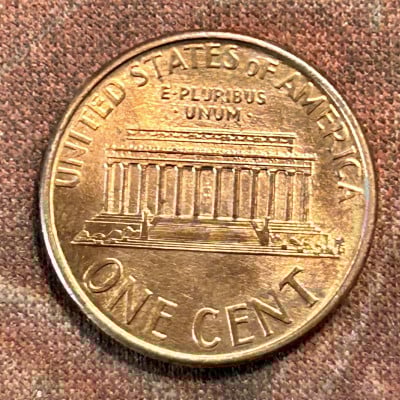
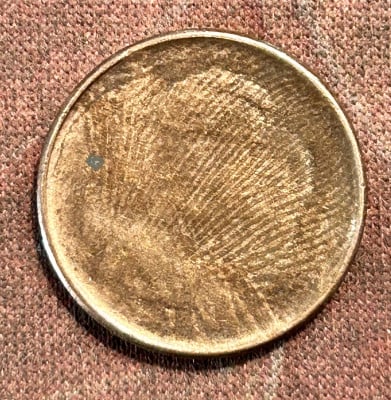
1
Cidercottage26
Posts: 54 ✭✭
Thoughts?
Comments
Unquestionably real error.
@Cidercottage26 can you describe at least two features that make this unquestionably real?
My first thought is that it is a Struck Through.
What it was struck through, I don't. know .
I can't describe one feature that makes this unquestionably real. I have no idea. Is it unquestionably a real mint error or unquestionably real post mint damage. Is it struck thru something? Is it a late die cap?... no idea. That pattern/design looks like a fingerprint to me.
This area looks like a fingerprint to me. Or maybe struck thru cloth?
I guess we'll wait for the big gun error guys to chime in.
My GUESS without seeing it is that it is a late stage capped die strike with a big old fingerprint on it.
That's one big gun! Two more guys here will seal it for me. If they don't chime in, I'm good with your attribution Tom. Thanks!
@Cidercottage26 you should be able to attribute this yourself. Give it a shot? How could this be produced (a) within the mint or (b) outside of the mint? Any answer must be consistent with everything you can see on the coin, including:
@CaptHenway gave one explanation, that a late stage capped die would be consistent with all of those features.
Can you describe how those features could be produced outside of the mint? If not, you have your answer.
Bonus question: How can you tell the difference between a fingerprint and a struck through cloth error? In other words, what features MUST be present with a struck through cloth error, and would NOT be present from a fingerprint on a coin that was not struck through cloth?
Is this a test? 😂
Can you describe how those features could be produced outside of the mint?
No, I don't have a trained error eye for that.
Bonus question: How can you tell the difference between a fingerprint and a struck through cloth error?
No, not really. It just looks like a fingerprint to me. A struck thru cloth coin show a textured weave pattern on the surface of the coin. It apparently causes weak, "mushy" details of the devices.
I think a die cap coin is caused when a struck coin sticks to the hammer die. Most of these capped dies seem to happen on the Obv. When a coin is stuck to the hammer die, it continues to hit other planchets. I don't know how to describe it. I think it makes the coin into a bowl shape. These coins also display a very weak, distorted, or ghost image of the coin.......if that makes sense?
Did I pass? 😂
I will hold off my explanation as to why this is a fingerprint until after others have chimed in.
That's one character away from a complete answer. A coin struck through cloth shows a textured weave pattern IN the surface of the coin. The weave pattern is transferred into the metal, and the metal surface is no longer smooth.
If the only difference is COLOR on an otherwise smooth surface, that's a fingerprint.
I agree with @CaptHenway that this looks like a fingerprint. If you have the coin in hand, you can tell for sure. For example, look at the coin almost edge-on so the color differences are less obvious, and see if you can still see a cloth pattern in the surface itself.
In my opinion the lines radiate out from 8:o'clock too evenly for a fingerprint. No loops or swirls either.
^^^ I agreed at first, but a thumbprint can fit without whorls.
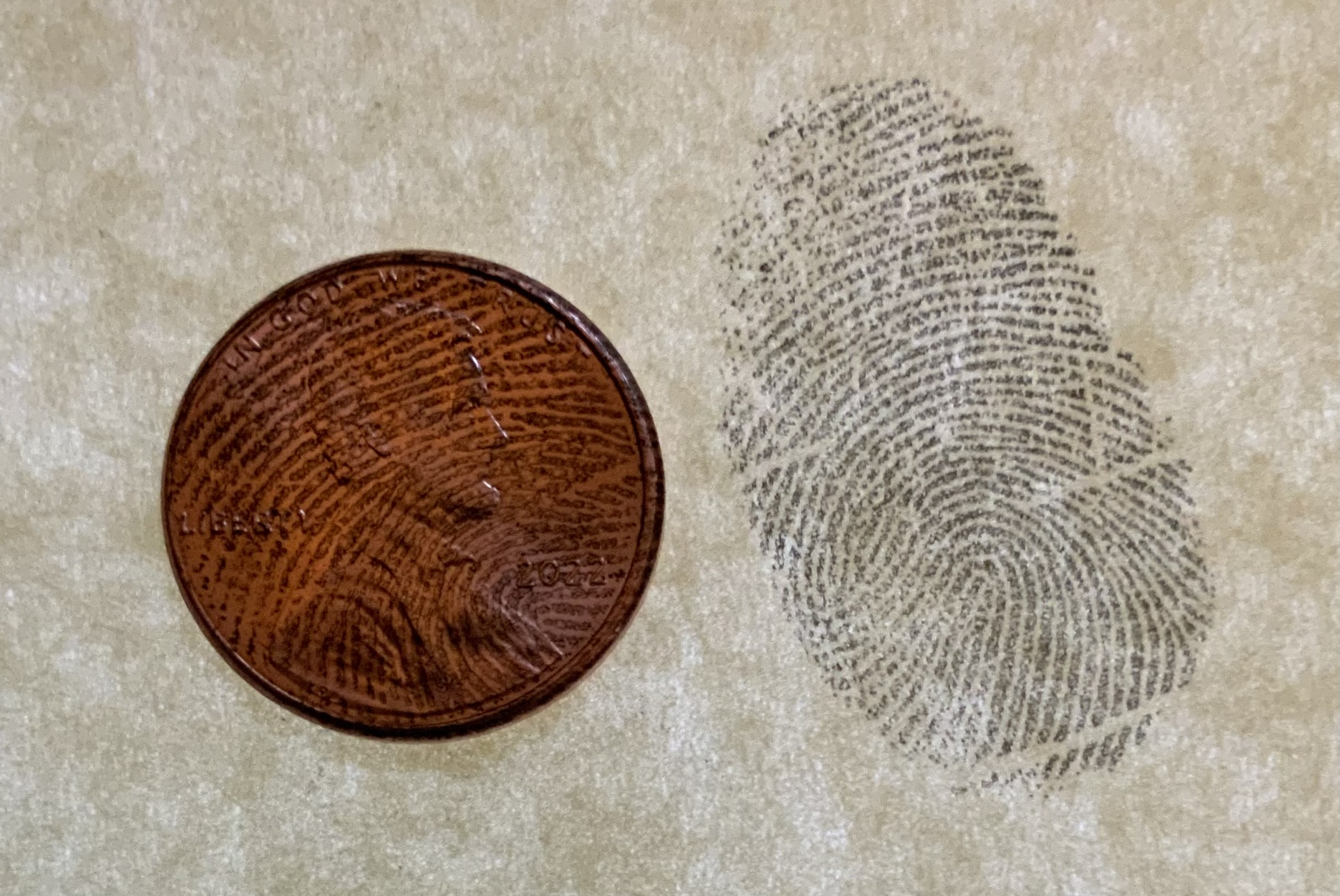
One other thing you can do, in addition to jonathan's suggestions, is to weigh the coin. It is not definitive, if the surface was mechanically damaged after the strike it will still weigh out, but if it was chemically altered the coin would be slightly underweight.
Sean Reynolds
"Keep in mind that most of what passes as numismatic information is no more than tested opinion at best, and marketing blather at worst. However, I try to choose my words carefully, since I know that you guys are always watching." - Joe O'Connor
Okay, that leaves Jon and Fred.
(not the Jon)
Sullivan
You don’t really need my feedback as others have already identified it,
But I’ll add my two cents worth -
It appears to me to be a ‘struck through late stage thinning obverse die cap’
We can put this one to bed! Thanks Fred!
Some of the more skilled numismatists in modern coinage here might even be able to give you a specific date range in which this was struck. Looks like a copper-plated zinc cent, so 1982 onward…
Size of the FG in 1974-onward, but I am uncertain from the color of the composition. My hunch is pre-1982, but a weight test is in order.