Start of Die Study - 1956 25C FS-901.
 Maxvan1
Posts: 189 ✭✭✭
Maxvan1
Posts: 189 ✭✭✭
I've spent WAY more than I should have collecting 1956 quarters, and now I'm trying to turn it into research project...
I've been purchasing 1956 'Type B' Washington Quarters for almost four years now — I have selected 35 examples for a die study. I plan to take detailed photographs and identify each die pairing.
Based on my preliminary examinations, I think only one reverse die was paired with multiple obverse dies. Assuming that is correct, I should be able to create a progression set based on reverse die markers (primarily a die crack through the Eagle's left wing) showing the order in which the obverse dies were used.
Granted, I might not have all the pairings, but hopefully the community can plug any holes.
It's going to take me a while to photograph all these but I will post everything here once I do.
TYA for constructive input!


Comments
Sounds interesting
I've got a few i could try to image. Nice to see one of my flock resting in your collection.
I appreciate your focus on the rev die use. I just searched a bag of approx 200 Wash Qtrs and found a Type B 63, 64 and one Type C 64-D. Good luck with your project. Peace Roy
BST: endeavor1967, synchr, kliao, Outhaul, Donttellthewife, U1Chicago, ajaan, mCarney1173, SurfinHi, MWallace, Sandman70gt, mustanggt, Pittstate03, Lazybones, Walkerguy21D, coinandcurrency242 , thebigeng, Collectorcoins, JimTyler, USMarine6, Elkevvo, Coll3ctor, Yorkshireman, CUKevin, ranshdow, CoinHunter4, bennybravo, Centsearcher, braddick, Windycity, ZoidMeister, mirabela, JJM, RichURich, Bullsitter, jmski52, LukeMarshall, coinsarefun, MichaelDixon, NickPatton, ProfLiz, Twobitcollector,Jesbroken oih82w8, DCW
I removed two that were damaged (improperly cleaned; acid damage), so I am down to 33 examples.
This ANACS MS63 is obviously the latest and likely the final die state. I note that the reverse die is close to broken with a crack running all the way through EPU, down the Eagle's right wing. The obverse die shows heavy deterioration, especially noticeable on the Y in LIBERTY, and a thin die crack through Washington's forehead. I have only one example with this die pair, and I suspect very few were struck in this state.


I believe the next oldest die state includes these two under graded PCGS examples. I note that the reverse die cracking is less progressed, and the obverse is almost certainly a different die than the ANACS example above. I conclude that this obverse is a different die because the die crack through Washington's forehead is different - this obverse die is actually broken with a die chip* visible, and the crack is in a slightly different location. Deterioration on LIBERTY is significantly less - Y remains bold. Note the faint N/S die polish marks on the obverse fields.
I believe the next oldest die state includes these three MS66 examples. I believe die pairing is the same as above based on the N/S die polish marks in the fields. The die polish marks in this state are significantly stronger. LIBERTY is even more bold than above. Reverse die cracks are even less progressed. Three out of four MS66 are this die state and pairing. Approximately six out of 33 total are in this die state and pairing. Several examples have metal shaving strikethroughs in the forehead (e.g. PCGS example below). I am not 100% convinced this is the same observe die as the two die chip* examples pictured above -- conceivably the debris that caused strikethroughs could have caused the chip. Input welcome.
More to come later. I think there may actually be TWO reverse dies, but I am not certain.
Here is an album of all 33 examples. https://ibb.co/album/1fJW9s
FYI, you are misusing the term "cud"; there is no obverse cud on those coins.
Thanks. Still learning.
Is there a correct term? Die chip*?
I am referring to this.
Yes, die chip.
Good luck in your research. Another source of pics is in CoinFacts.
To help in your die progression. some of them also have some reengraving on their wings. The lower row of the wings next to the body occasionally have reengraving between feathers as shown by this one (frequently seen in proof quarters).
Thanks! I will check for that.
Here is an actual proof to compare. It looks like an exact match to me. This would suggest the reengraving occurred prior to the die being used for circulation strikes.
Proof below:

Example FS-901 for comparison:


Yes, the reengraving is on the Type B master die.
I was stuck for a while but I think I've made a bit more progress...
Are these three different obverses? The die cracks are very similar, but I don't think they're the same. Thoughts?
1
2
3
Another obverse No.2 from above. It seems like this obverse tends to have toning, perhaps a coincidence or possibly came in uncirculated mint sets? *Edit: Actually this one doesn't match. I'm not sure which one this is.
Another example, I believe an earlier die state of the same obverse No.2 from above. Again, notable toning. *Same.
I am 80% of the way there, but the last 20% is turning out to be quite tough... I created a Google Sheets document with images of the coins so they can more easily be sorted and compared. Be sure to scroll left and right for additional images. You can sort and filter using the headings.
LINK: https://docs.google.com/spreadsheets/d/1HvnH_TNMQ1XO7cm3NzcVvP5wSVdEVSZ9p2NvX0nFNcQ/edit?gid=0#gid=0
I have categorized the obverse dies in Column E. I currently have seven categories of obverse dies and/or die states, but I'm not certain they're all different. There are also a few examples I have not been able to categorize yet and that may be unique. I think I will need to go back and take additional pictures to continue progressing...
One thing in particular that is throwing me off is that certain examples have SIGNIFICANT deterioration on the tailfeathers, but lesser progression of the EPU die crack. Raw Example 15, for example, has almost no tailfeathers and no crack through EPU. Perhaps grease fill? Or just the way the strike came out? See Google Sheets document for images.
How many days do you feel a type B reverse was used on the presses? What percent of 1956 circulation quarters have a type B reverse? Is cataloging the obverses of any help or just compounding the work on your project?
From my personal searches, I feel there are less than 1 per 200, maybe 1 per 500 or 1 per 1000.
It sounds like> @davewesen said:
Cataloging the obverses is the project. To the extent you're asking what's the point — I mean, fair question...
The project is an evolution from my personal assessment that this variety is undervalued and attempting to corner the circulating market. This is the key date for the set and there is only a single reverse die. I am hoping a complete progression set will be worth more than the sum of the parts.
I think it's a fun way to collect.
How do you figure there is only one reverse die?
All have the same reengraving.
Well now I'm proving my lack of knowledge again...
Do all 1956 Type B have the exact same reengraved wings? I was thinking that the reengraving was unique to the die, but after some googling and Groking... Apparently ALL the Type B dies have the same reengraving.
Ugh.
I do not see all of the reverses having the same re-engraving. Some do not show any at all, unless they are weakly struck, as the re-engraving is sunken into the die and harder to wear away.
The reverses do not have a 'year' marker so they could be used for multiple years.
One difference I have seen on the reverse is the progression of die crack on our left and eagle's right wing. Some coins exhibit a die chip and I am not sure but don't think they are all the same die.
Any progress on your project?
I had always assumed (maybe wrongly) that the decent proof dies were retired and put into the circulation die pile. It also could have been wrongly returned by a mint employee.
I just noticed how many MS66's you have. You might have more than anyone. +++
Yes, that is correct. Again, the engraving is on the Type B master die. The fine details may not be fully visible on every coin, however (such as on weakly struck or late die state examples).
I am not sure that is correct. It might have been on a master die, but not all of them.
How can you explain how the frequency and location on the proof quarters of that year is so variable?
https://pcgs.com/coinfacts/coin/1956-25c/images/5988
and the tied for top pop does not seem to have any re-engraving
https://greatcollections.com/Coin/568475/1956-Washington-Quarter-Type-B-Rev-FS-901-PCGS-MS-67
Sounds like you may not understand the concept of a master die, or how the Type B reverse was used in the Washington Quarter series. It was first used on 1937 proofs, and they and all subsequent quarters with the Type B reverse have the same reengraving. The Type H reverse (which was made from the Type B reverse) also has the same reengraving.
With photos (and proof photos especially) you can add lighting as an important factor.
That's a later die state example of a business strike, coupled with a low-resolution photo, so I wouldn't expect to see much.
I think you might be mistaken on some of your terminology, according to the US Mint
There are many denominations that have areas re-engraved, they would not do that on the earliest die.
Do you have mint documentation to back your assertion?
https://usmint.gov/learn/production-process/die-making
Sorry to hear that you are still confused. Based on their appearance, we infer that the reengraved wing lines on the Type B reverse were done by hand (like the various reengraved tailfeather varieties), but in this case, the lines were engraved on the Type B reverse master die, rather than on individual working dies. The reason the lines were engraved is the same reason that the relief on the Type B reverse was increased over the original Type A reverse - the reverse detail on the 1936 proof quarters (which were struck with the Type A reverse) simply wasn't showing up well enough.
It is unusual for detail to be reengraved by hand on a master die, but not unheard of. In addition to the Type B quarter reverse, the Type 1 and Friendly Eagle reverse master dies in the Eisenhower dollar series also have reengraved detail.
From what I've seen, ALL type B reverse quarters show the re-engraved wing feathers, both business strikes and proofs back to 1937 when they first used the type B for proofs.
This is coming along pretty well. I'm learning lots. I believe this is the final die state. CACG called it scratched, but I do not believe it is a scratch.
Above -- I can see what I think is an elevation difference in the fields. This has GOT to be a die crack, no? Open image in new tab and zoom.
Above -- The entire area circled in red is raised up. I want to call this an interior die break?
Above -- Another angle.
Above -- Looks like a scratch, but the triangular part is raised, at least to my eye. I think the shelf effect adds to the optical appearance of a scratch. There's a little groove on the shelf that looks like a scratch, but I believe it's a shelf...
Above -- I'm also working on a theory that there was a die clash. (Piece of eagle's wing near the bow? Possibly outline of the wings in fields of the AU details CAC image above, too?).
Also... I'm pretty sure there is only one die.
Do all Washington quarters have a die crack running through the eye? Every obverse die I have has the same die crack running all the way through, straight through the eye about out the head.
I'd like to contribute photos of my (3) Type B's. Just recently submitted for grading. I located a total of 4 examples. The 3 I decided on grading in higher MS grade show later stage die cracks, and all seem to be from the same stage. They were all together when I acquired them so they may very well have been produced around the same time.
This is about half of the slabbed collection. This doesn't include any MS66. I think I have five in MS66? Maybe six.
Album link: https://ibb.co/album/vC9crb
I went to my safe deposit box but forgot to pull my PCGS/CAC MS-66 1956 quarter with type B reverse. I will get to my safe deposit box again in a few weeks.
Okay last thing then I'm going to bed...
You can see the same die cracks in 91509157, 181472083, and several others. It's much more faint, but exact. Download and open and flick back and forth with the AU details one posted above. You'll see it.
No and no.
To answer your earlier question, the features that look like scratches are scratches, not die breaks.
Regarding the number of dies & die marriages:
Just scanning through CoinFacts images (16 coins), there were 4 different die marriages, each with a different obverse and reverse (in other words, there were 4 obverses and 4 reverses). If you haven't found at least that many, you are not on the right track.
Can you share more on the four you're seeing? What separates them in your eye? I previously thought there were multiple, too.
What I'm seeing is the line that runs through the field directly in front of Washington's eye and runs through the head, all the way across.
Those are good ones. Thanks.
The later die state obverses are relatively straightforward to tell apart due to the distinctive die cracks through Washington's head. The later die state reverse dies are more difficult, but can be distinguished by the die cracks running through the eagle's wing. These cracks are superficially much more similar looking, so you will have to zoom in and look at them closely to tell them apart.
Here are later die state examples of the 4 die marriages found on CoinFacts:
https://d1htnxwo4o0jhw.cloudfront.net/pcgs/cert/43125692/227565312.jpg
https://d1htnxwo4o0jhw.cloudfront.net/pcgs/cert/33155358/48382619.jpg
https://d1htnxwo4o0jhw.cloudfront.net/cert/90515269/100629320.jpg
https://d1htnxwo4o0jhw.cloudfront.net/pcgs/cert/37545068/174230382.jpg
No. It was worrying when you mistook scratches on the coin for die cracks; it is even more worrying that you are apparently seeing something that isn't there.
Ugh... Rude. I won't let ignorance dishearten me.
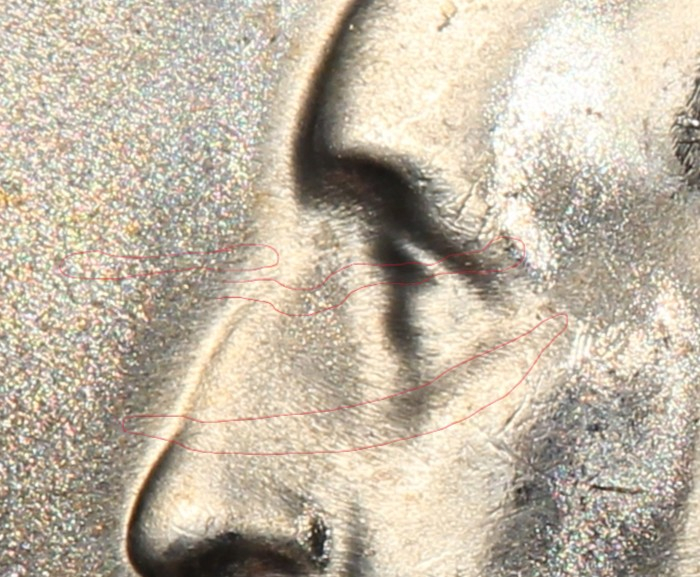
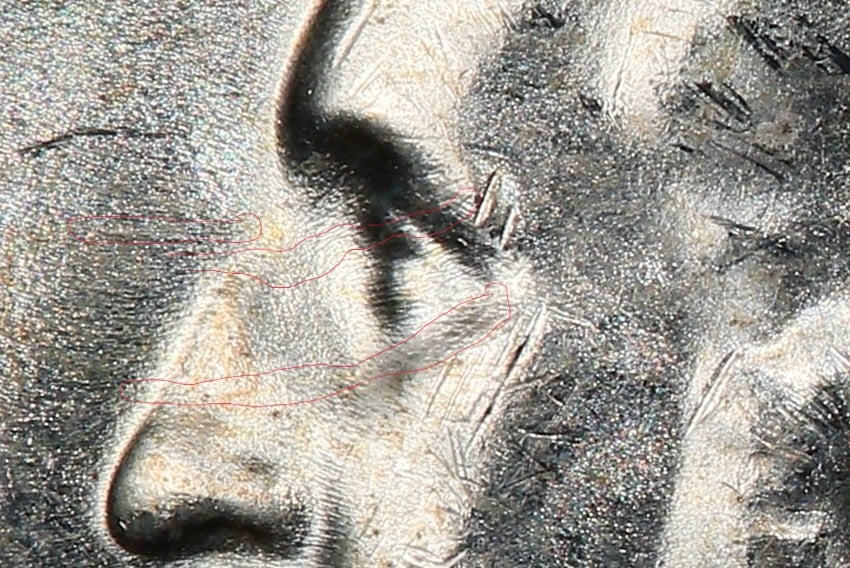
>
I thought the same way as you when I was first starting too. You might have to download and zoom in on the pictures below.
>
Above -- 48382619
Above -- 174230382
>
I'll admit if I'm proven wrong, what about you?
If anyone wants to be CONSTRUCTIVE and help with the project, I'd more than happy to share additional images or discussion. Message me if interested.
The forums are a tough crowd though - It's like going up against a CNN panel. Given the ignorance and disinterest I've felt, I'll probably take my thoughts offline until the project is complete or I hit another roadblock...
Die cracks appear as recessed scratches or “gouges” on the die itself or a raised line on the coin. Hard to tell from the photos if the “scratches” are raised or recessed.
Damn it. I told myself I wasn't going to do this...
@Maxvan1 The features you are seeing near the eye and the nose are due to die deterioration. Ripples develop in the die steel in as the dies age and these ripples are then imparted onto the coin when it is struck. As the dies age, they may convergently develop similar patterns of die deterioration, just as they may develop similar die cracks. They are certainly not on every coin, as you had claimed, nor do they indicate that all 1956 Type B quarters were struck from a single obverse.
Up until this point, I have been rooting for you during your journey, but now I am afraid that you have come up against the limits of your knowledge and ability. You are asking questions, but are not willing to hear the answers that you might actually learn from. As long as you are committed to the idea of the 1956 Type B quarters being produced by a single die pair, there is no project, nor is there any useful result that can emerge from your efforts. In spite of your defensiveness, I feel badly for you, and believe it would be cruel to allow this to continue on any longer. It took me about 10 minutes to sort out on CoinFacts what you've been struggling with for many months, and that's just not right; at some point, you have to acknowledge when to throw in the towel, and that point is now.
For anyone following the thread who would like to see the die markers for the 4 obverses and 4 reverses, I will be posting them below.
Obverse dies
Reverse dies
Redacted
See yourself out. Thanks.
*I will prove that's a single die. I will.
Saved.
Let it go, Max. It's over. There is no more project. Believe it or not, I'm doing you a favor by telling you this.
I'm insulted frankly.
I categorized them like you did months ago and have it saved to a google doc.
I was trying to make progression sets for those and came to the conclusion that they're all the same... I'll prove it. I don't need help. If anyone wants to help, fine. I'll report back. I'll be back in a few months...
But you can move on, Ike. I don't want your input, right or wrong.