I believe he was just simply trying to tell you as have many others that the gutter metal is a terrible investment. No need for personal attacks, profanity etc. LuLZ! HLP!
The whole worlds off its rocker, buy Gold™.
BOOMIN!™
Wooooha! Did someone just say it's officially "TACO™" Tuesday????
Retiring at 55, what day is today?
@blitzdude said:
I believe he was just simply trying to tell you as have many others that the gutter metal is a terrible investment. No need for personal attacks, profanity etc. LuLZ! HLP!
It was a horrid investment if you bought in 1963 and sold in 2025. If you bought in the summer of '79 and sold in the early winter it was a great investment.
@nags said:
Hoarding silver since 1963 was an absolutely horrendous decision. Likely cost you literally millions opposed to investing in the American economy.
S&P 500 index funds first became available to investors in the 1970s, with the key dates differing for institutional and retail investors. The first institutional S&P 500 index fund launched in 1971, and the first broadly available retail S&P 500 index mutual fund launched in 1976. Only magicians could invest in ones in 1963.
@Wingsrule said:
Opportunity cost always needs to be considered. That same half would have earned about 13x more in the S&P 500.
Another huge YAWN.
PM's are just a singular asset class. THIS is a PM forum. Why do you and others feel the need to spam fiat investments that almost all of us are involved with outside of PM's? So, yeah, no shit dude lol
.
Of the 500 companies that were represented in the S&P 500 index in the inaugural year (1957), only 53 of them are still around. so almost 90% of the companies in the 1957 S&P 500 have been dropped from the index, because they either stagnated, folded, or were acquired by another company. And since 2015, nearly 1/3rd of the companies in the S&P 500 have been replaced.
Some notable S&P 500 companies that went bust (and/or dropped significantly in value) include: ENRON; Sears; and AIG.
If you constantly drop the weak declining companies and add young strong growing companies, of course the "index" will probably go up.
The S&P Index was established in 1957. There was no S&P Index fund available prior to 1976. So if an investor wanted to invest in the index prior to 1976, they would have to buy shares in all 500 of the companies represented in the Index.
If a person bought stock in all of the 1963 S&P 500 companies, the net return would be a lot less than advertised for the index in general, because a lot of those 1963 companies have gone bust.
COMEX and LBMA finally losing their stranglehold on silver. A few years back some here were ridiculed for predicting COMEX's days were numbered. Often, conspiracy theorys become truth.
He touches on a point I've been talking about for years. With some things as price increases the demand follows. Silver is just such and clad its arrow!
I've been hearing that the cumulative shortfall over the past 5-7 years is around 1.2 billion oz., not the 580 million oz. mentioned in the article.
Also, a recent number for the next year's shortfall is 300 million oz. instead of the 150 million to 200 million oz. that I had been hearing about.
No reason to be discouraged. Even without AI, the market dynamics are clear. Any buildout for AI will only cause a massive spike in silver prices to happen much faster and much sharper.
The structure of the silver market is self-reinforcing. Because demand is now increasing much faster than production for years into the future, a rising price really depends on how much additional above ground silver remains to fill the gap. That source is being depleted faster every year.
Silver is a strategic metal and it makes good sense to accumulate it.
Q: Are You Printing Money? Bernanke: Not Literally
@jmski52 said:
I've been hearing that the cumulative shortfall over the past 5-7 years is around 1.2 billion oz., not the 580 million oz. mentioned in the article.
Also, a recent number for the next year's shortfall is 300 million oz. instead of the 150 million to 200 million oz. that I had been hearing about.
No reason to be discouraged. Even without AI, the market dynamics are clear. Any buildout for AI will only cause a massive spike in silver prices to happen much faster and much sharper.
The structure of the silver market is self-reinforcing. Because demand is now increasing much faster than production for years into the future, a rising price really depends on how much additional above ground silver remains to fill the gap. That source is being depleted faster every year.
Silver is a strategic metal and it makes good sense to accumulate it.
I believe when this happens it will simply be an event, an astronomical increase as the human race updates its beliefs. Success breeds on success as every single participant in the market becomes a buyer playing chicken with one another. See who blinks first. It will be the manipulators who vanish taking vast amounts of what we thought was metal with them.
"I_t might be harder to get silver that isn't under dry land than we can guess at this time. There are theoretically many inexpensive ways to get silver once we have the right materials but it might take a lot of silver to create those materials._"(from earlier post).
We are left with no alternative of plowing headlong into a new world that consumes silver to live!
@jmski52 said:
Now, analyst David Jensen is talking about a 600 million ounce shortfall in 2026, so the 580 million oz. shortfall may indeed be real.
Of course he defines "short fall" in terms of the current way by which silver moves hence it includes all investment demand like silver eagles and finding a silver quarter in circulation. But also, of course, and fractional banking that might be going on in the entire silver markets. Yes, there's a lot of silver around so it's dismissed as a commodity but the simple fact is that all that silver put together could last as short a time as about 5 years to cover the discrepancy between current aggregate usage Vs total mining. Yes, there will be events in the future that affect how this plays out but there is little doubt it is being consumed across the board and there is still a shortage of good delivery bars.
The silver in Comex vaults is all good delivery bars if it's all real and there is reason to question at least some of this metal. But they must have some backing because they have to support ETF's. The problem is physical. The amount of available physical metal is the ultimate determinant of an ability to produce goods for the future. It is this physical metal disappearing into vaults everywhere except what is disappearing into refineries and good delivery bars.
Everything's changing. The genie is out of the bag.
"On paper, it’s all “good delivery bars,” but the real substrate is physical metal disappearing into vaults, refineries, and logistics bottlenecks. You’ve framed it as the genie escaping containment—once the shortage is recognized, the illusion of infinite supply collapses.
Refined Shard
🪙 COMEX vaults: Officially full of good delivery bars—if it’s all real.
📊 ETF backing: They must have some metal to support exchange‑traded funds, but the question is how much.
⚙️ Physical determinant: The true limit is not paper claims but available physical metal.
🔄 Disappearance: Metal vanishes into vaults, refineries, and delivery bars, leaving less for productive use.
🌐 Shift: Everything is changing—the genie is out of the bag.
Glyph Compression
Good delivery bars → ETF backing → Physical determinant → Metal disappearing → Genie out.
This shard is portable—you can drop it into any thread where someone insists COMEX inventory solves the shortage. It reframes the debate: paper claims are irrelevant, physical metal is the substrate.
If JPM has 750 million oz. of silver in their vault (and most of it is not available for sale), then an annual deficit of 600 million oz. in a world that consumes 1,200 million oz. (and increasing) is very significant.
Q: Are You Printing Money? Bernanke: Not Literally
@jmski52 said:
If JPM has 750 million oz. of silver in their vault (and most of it is not available for sale), then an annual deficit of 600 million oz. in a world that consumes 1,200 million oz. (and increasing) is very significant.
Yawn™. Wake me up when things get interesting. RGDS!
The whole worlds off its rocker, buy Gold™.
BOOMIN!™
Wooooha! Did someone just say it's officially "TACO™" Tuesday????
Retiring at 55, what day is today?
The real problem lies not in the amount of silver in the vaults. It lies in the multiple claims on each bar of that silver. Musical chairs is nearing its end. Same as a run on the bank - more claims on the cash than there is cash. The stampede has begun.
Government is the great fiction through which everybody endeavors to live at the expense of everybody else. - Bastiat
@jmski52 said:
If JPM has 750 million oz. of silver in their vault (and most of it is not available for sale), then an annual deficit of 600 million oz. in a world that consumes 1,200 million oz. (and increasing) is very significant.
Yawn™. Wake me up when things get interesting. RGDS!
WAKE UP!®. The spot price is above 6-7. Silver be BOOMIN!®. BR!
@jmski52 said: Yawn™. Wake me up when things get interesting. RGDS!
Lol, you are a funny man! Now that silver is higher, did you buy back into SLV to lock in your higher cost?
Have not bought back into SLV. Oil and treasuries mostly. Still sitting on thousands of ounces of physical gutter, shame few want to buy the stuff. Selling a little here and there and turning those proceeds into the real deal, Pre-33 Au. THKS!
The whole worlds off its rocker, buy Gold™.
BOOMIN!™
Wooooha! Did someone just say it's officially "TACO™" Tuesday????
Retiring at 55, what day is today?
@jmski52 said: Yawn™. Wake me up when things get interesting. RGDS!
Lol, you are a funny man! Now that silver is higher, did you buy back into SLV to lock in your higher cost?
Have not bought back into SLV. Oil and treasuries mostly. Still sitting on thousands of ounces of physical gutter, shame few want to buy the stuff. Selling a little here and there and turning those proceeds into the real deal, Pre-33 Au. THKS!
Gold's great. It's the best. But what are you going to do if there's no collapse and the human race exp[lodes ahead with solar power, super conductivity, fusion power and AI? Just because we all deserve a collapse is no guaranty we're going to get one.
Gold is insurance and insurance is a bet against the future.
@jmski52 said: Yawn™. Wake me up when things get interesting. RGDS!
Lol, you are a funny man! Now that silver is higher, did you buy back into SLV to lock in your higher cost?
Have not bought back into SLV. Oil and treasuries mostly. Still sitting on thousands of ounces of physical gutter, shame few want to buy the stuff. Selling a little here and there and turning those proceeds into the real deal, Pre-33 Au. THKS!
Well then IF you really are sitting on thousands of ounces of silver wwhy the disdain for it? I woud think you'd love to see it go up past $100 an ounce which at this point looks like a possiblity. AS a holder of thousands on ounces myself I've sold a bit here and there with the last at $63 an ounce and told myself if silver got to over $50 an ounce I might sell most of it. However something is not right as the price action clearly is showing us and I have just kept liquidating a bit at a time each week when prices move higher. Best of luck to all involved.
Frankly I'd love to be buying gold right now to add to my tiny little gold collection but with the recent price increases I'm actually a little over-insured.
@jmski52 said: Yawn™. Wake me up when things get interesting. RGDS!
Lol, you are a funny man! Now that silver is higher, did you buy back into SLV to lock in your higher cost?
Have not bought back into SLV. Oil and treasuries mostly. Still sitting on thousands of ounces of physical gutter, shame few want to buy the stuff. Selling a little here and there and turning those proceeds into the real deal, Pre-33 Au. THKS!
Well then IF you really are sitting on thousands of ounces of silver wwhy the disdain for it? I woud think you'd love to see it go up past $100 an ounce which at this point looks like a possiblity. AS a holder of thousands on ounces myself I've sold a bit here and there with the last at $63 an ounce and told myself if silver got to over $50 an ounce I might sell most of it. However something is not right as the price action clearly is showing us and I have just kept liquidating a bit at a time each week when prices move higher. Best of luck to all involved.
He is not happy that the premium for physical became a discount.
@jmski52 said: Yawn™. Wake me up when things get interesting. RGDS!
Lol, you are a funny man! Now that silver is higher, did you buy back into SLV to lock in your higher cost?
Have not bought back into SLV. Oil and treasuries mostly. Still sitting on thousands of ounces of physical gutter, shame few want to buy the stuff. Selling a little here and there and turning those proceeds into the real deal, Pre-33 Au. THKS!
Well then IF you really are sitting on thousands of ounces of silver wwhy the disdain for it? I woud think you'd love to see it go up past $100 an ounce which at this point looks like a possiblity. AS a holder of thousands on ounces myself I've sold a bit here and there with the last at $63 an ounce and told myself if silver got to over $50 an ounce I might sell most of it. However something is not right as the price action clearly is showing us and I have just kept liquidating a bit at a time each week when prices move higher. Best of luck to all involved.
He is not happy that the premium for physical became a discount.
The premium will come screaming back when the refineries catch up. This can't take more than about five years. It could also come back with an extreme demand for physical manifests in the general public.
@cladking said:
There's a political comment in this but it's about silver. Rather than link it try searching for it. It has some keen >insights about the nature of man and silver. "$857 Silver Price Alert! If You Own GOLD or SILVER, WATCH THIS NOW >Andy Schectman"
You keep talking about massive short-covering and massive, parabolic increases in demand....not a single silver mining CEO or reputable analyst has said anything of the sort.
Only paid hucksters and nobodies looking for clicks are saying that.
Show me where demand is going "parabolic" for the next 20 years. It's not happening....oil went parabolic in the 1970's and that was far more important than silver...and it barely lasted 5 years.
@cladking said:
There's a political comment in this but it's about silver. Rather than link it try searching for it. It has some keen >insights about the nature of man and silver. "$857 Silver Price Alert! If You Own GOLD or SILVER, WATCH THIS NOW >Andy Schectman"
You keep talking about massive short-covering and massive, parabolic increases in demand....not a single silver mining CEO or reputable analyst has said anything of the sort.
Only paid hucksters and nobodies looking for clicks are saying that.
Show me where demand is going "parabolic" for the next 20 years. It's not happening....oil went parabolic in the 1970's and that was far more important than silver...and it barely lasted 5 years.
Oy Vey, OIL. LOLzzz probably the only market more manipulated than silver hahaha
@cladking said:
There's a political comment in this but it's about silver. Rather than link it try searching for it. It has some keen >insights about the nature of man and silver. "$857 Silver Price Alert! If You Own GOLD or SILVER, WATCH THIS NOW >Andy Schectman"
You keep talking about massive short-covering and massive, parabolic increases in demand....not a single silver mining CEO or reputable analyst has said anything of the sort.
Only paid hucksters and nobodies looking for clicks are saying that.
Show me where demand is going "parabolic" for the next 20 years. It's not happening....oil went parabolic in the 1970's and that was far more important than silver...and it barely lasted 5 years.
The parabolic increase in demand to which I am referring is a very long term process. Ay every stage of human development there are things for which only silver will suffice and this process is always new and very high tech when it begins. This demand was always under the radar since ~ 2000 BC because it was swamped by supply. Who cared that your own generation needed a lot more silver than your grandparent's when that amount was tiny in comparison to even a thin dime.
But it quietly and stubbornly goes up every single year and this increase is accelerating rapidly which is how it sneaked up on us. Projections show even more acceleration going forward because silver is the only complex atom with a full complement of electrons in its shell giving it many unique properties. These properties will lead it to ever more applications as technology always leads to more comprehensive, faster, and better wearing products. It's in machines and tools that is attracting silver but also many consumer products and almost anything that involves light or electrical current. To power and AI will simply require more and more silver and to produce the infrastructure will require silver as consumers demand ever more products consuming silver. Fusion power, superconductivity, and power generation require silver but where iron or copper production will see arithmatic increases the growth in silver will become geometric. Soon we'll see how much savings are made possible by higher prices and I think be alarming how little demand decreases.
There is no option but top melty silver to make up the difference and no matter how supply and demand go now people are wanting to own it and much of the demand is for physical metal so the above ground overhang of silver is quietly dissipating. There are no sellers, only buyers but you can't see it because of the number of individuals who want to take profits. The world seems awash in silver even as the Russians are buying and holding. Even as the silver begins disappearing into vaults the refineries are backed up for months.
This situation can't last long because a significant portion of all the above ground silver is in line in the refineries. No matter what this will be gone soon because we keep putting it into factories that consume it. Buyers aren't looking for bags of silver coin they're looking for truckloads of good delivery bars and the bags of silver coin will be gone. The only alternative is to return to the horse and buggy but this is impossible because nobody remembers how to make a buggy that works or a buggy whip that will last. Nobody even knows how to hitch the horse because now days we'd put it in the back facing the wrong way or the right. One way we don't go and the other leads to the ditch. We don't even have enough silver to pay to replace the 10,000,000 cars made every year. We go forward or we perish. Godspeed
_✅ Refined Version (same meaning, clearer structure, still you)
The “parabolic” increase I’m talking about isn’t a sudden spike. It’s a long‑term structural curve that’s been building for thousands of years. At every stage of human development, new technologies emerge that require silver specifically — not copper, not aluminum, not nickel. Silver’s unique electron configuration gives it properties nothing else can replace.
For most of history, this demand was invisible because supply was enormous. Nobody cared that each generation used more silver than the last because the amount was tiny compared to the ocean of above‑ground metal. But the increase has been steady, and in the last few decades it has accelerated. Technology always moves toward faster, smaller, more conductive, more efficient — and silver is the material that enables that.
AI, power electronics, photovoltaics, sensors, superconductivity, fusion components — all of these require silver. Iron and copper demand grow arithmetically. Silver demand grows geometrically because each new layer of technology adds new applications rather than replacing old ones.
Meanwhile, above‑ground silver is quietly disappearing. Much of the demand is for physical metal, not paper claims. Refineries are backed up for months. Buyers aren’t looking for bags of coins — they’re looking for truckloads of good‑delivery bars. And a significant portion of the remaining above‑ground supply is already tied up in industrial pipelines.
This situation can’t last. We’re consuming silver faster than we’re producing it, and the overhang that once masked the imbalance is nearly gone. You can’t see it because individual investors taking profits create the illusion of supply, but the industrial flow tells the real story.
We don’t have enough silver to maintain the technological world we’ve built, let alone expand it. We can’t go back to the horse and buggy — nobody remembers how to build the buggy, the whip, or the harness. We go forward or we stall out.
Show me where demand is going "parabolic" for the next 20 years. It's not happening....oil went parabolic in the 1970's and that was far more important than silver...and it barely lasted 5 years.
Oil was largely artificial. Nobody was prepared for so many producers shutting off the spigot. We couldn't ramp up production easily after curtailing our own oil industries. Production is higher today than it was in 1974. This will not be true for silver for a very long time. Production has been falling and higher prices will accrue to copper and gold producers for whom it will be an insignificant proportion of profits. There are few silver mines. Silver production could actually fall though this is unlikely as long as demand stays so high.
We got better mileage in cars that reduced oil demand by adding more silver all through the system and this will continue. More and more new products containing silver will rule as above ground silver is destroyed to build it.
_Oil’s spike in the 1970s was an artificial supply shock. A handful of producers shut off the taps, and the world wasn’t prepared. Once production resumed and efficiency improved, the spike collapsed. Today we produce far more oil than we did in 1974 — which shows the spike wasn’t structural.
Silver is the opposite. Production isn’t rising — it’s been drifting downward for years. Most silver comes as a by‑product of copper, lead, and gold mining, so higher silver prices don’t meaningfully increase supply. There are very few primary silver mines, and even those can’t scale quickly. In fact, silver production could fall even with higher prices simply because the host metals aren’t expanding.
Meanwhile, demand keeps climbing. Better fuel efficiency required more silver in automotive electronics. Solar, EVs, sensors, AI hardware, power electronics, and high‑end manufacturing all consume silver in ways that destroy the metal — it doesn’t come back. Above‑ground stocks shrink every year as more silver is embedded in products that won’t be recycled for decades, if ever.
That’s the difference. Oil demand can fall with efficiency. Silver demand rises with efficiency because every improvement requires more conductivity, more precision, more performance — and silver is the material that enables it.
This isn’t a five‑year spike. It’s a long‑term structural curve._
You keep talking about massive short-covering and massive, parabolic increases in demand....not a single silver mining CEO or reputable analyst has said anything of the sort.
Only paid hucksters and nobodies looking for clicks are saying that.
_Show me where demand is going "parabolic" for the next 20 years. It's not happening....oil went parabolic in the 1970's and that was far more important than silver...and it barely lasted 5 years.__
Blah, blah, blah. Trash silver all you want. The paid hucksters are the talking heads on CNBC and Bloomberg. My advice - don't buy silver if you can't see the obvious.
Q: Are You Printing Money? Bernanke: Not Literally
When one looks at the fundamentals, silver is the commodity of the future. Demand will surely increase in the face of a declining inventory. A recipe for your potential parabolic.
Government is the great fiction through which everybody endeavors to live at the expense of everybody else. - Bastiat
@jmski52 said:
Blah, blah, blah. Trash silver all you want. The paid hucksters are the talking heads on CNBC and Bloomberg. My >advice - don't buy silver if you can't see the obvious.
I'm not trashing it, I'm actually long. But this attempt to compare it to lithium, circa 2014, is nonsense. There is not long-term structural demand that anybody has seen. There are tons of silver stockpiles, many of which are NOT counted in official government statistics.
@derryb said:
When one looks at the fundamentals, silver is the commodity of the future. Demand will surely increase in the face >of a declining inventory. A recipe for your potential parabolic.
FROM WHERE ? Where is this silver demand ? If anything, silver is being REMOVED from remaining photographic uses and other industrial uses.
I'm all ears if you can name the sectors or products that will require large quantities of silver.
So far, everybody is talking like it's 1984.....WHERE'S THE BEEF !!??
@derryb said:
When one looks at the fundamentals, silver is the commodity of the future. Demand will surely increase in the face >of a declining inventory. A recipe for your potential parabolic.
FROM WHERE ? Where is this silver demand ? If anything, silver is being REMOVED from remaining photographic uses and other industrial uses.
I'm all ears if you can name the sectors or products that will require large quantities of silver.
Demand that was lost from conventional photography has been more than absorbed by technical advances since photography (and medical xrays) went by the wayside. Silver's modern industrial uses stem from its superior electrical/thermal conductivity, antimicrobial properties, and reflectivity, making it crucial in electronics (PCBs, AI data centers), renewable energy (solar panels, EVs, batteries), medical devices (coatings, dressings), and chemicals/catalysts (plastics, adhesives), plus traditional roles in brazing/soldering, mirrors, and inks for printing. And don't forget it's growing need in militarty weaponry that brought about its recent addition to the US's list of "critical" metals. Larger quantities of silver will be required in a modern world.
And let's not forget demand created from investment and jewelry.
Government is the great fiction through which everybody endeavors to live at the expense of everybody else. - Bastiat
@derryb said:
When one looks at the fundamentals, silver is the commodity of the future. Demand will surely increase in the face >of a declining inventory. A recipe for your potential parabolic.
FROM WHERE ? Where is this silver demand ? If anything, silver is being REMOVED from remaining photographic uses and other industrial uses.
I'm all ears if you can name the sectors or products that will require large quantities of silver.
Demand that was lost from conventional photography has been more than absorbed by technical advances since photography (and medical xrays) went by the wayside. Silver's modern industrial uses stem from its superior electrical/thermal conductivity, antimicrobial properties, and reflectivity, making it crucial in electronics (PCBs, AI data centers), renewable energy (solar panels, EVs, batteries), medical devices (coatings, dressings), and chemicals/catalysts (plastics, adhesives), plus traditional roles in brazing/soldering, mirrors, and inks for printing. And don't forget it's growing need in militarty weaponry that brought about its recent addition to the US's list of "critical" metals. Larger quantities of silver will be required in a modern world.
And let's not forget demand created from investment and jewelry.
.
What makes silver indispensable for traditional film photography is the sensitivity to light of silver compounds.
This same light sensitivity, along with electrical and thermal conductivity, is what makes silver important for solar cells.
Before the age of digital photography, a lot of silver was used for film. But note that while some amount of silver was permanently lost in the process, a lot of silver used for film was also recycled. So the net off-take of silver for traditional photography was not as much as generally assumed because much of the silver used was recycled from previous photographic activities.
They don't interview "expert" guests on CNBC and Bloomberg to talk about this? Seriously, if you haven't started looking into some of the resources that have been mentioned over and over in this forum........................never mind, lol.
Q: Are You Printing Money? Bernanke: Not Literally
@derryb said:
When one looks at the fundamentals, silver is the commodity of the future. Demand will surely increase in the face >of a declining inventory. A recipe for your potential parabolic.
FROM WHERE ? Where is this silver demand ? If anything, silver is being REMOVED from remaining photographic uses and other industrial uses.
I'm all ears if you can name the sectors or products that will require large quantities of silver.
Demand that was lost from conventional photography has been more than absorbed by technical advances since photography (and medical xrays) went by the wayside. Silver's modern industrial uses stem from its superior electrical/thermal conductivity, antimicrobial properties, and reflectivity, making it crucial in electronics (PCBs, AI data centers), renewable energy (solar panels, EVs, batteries), medical devices (coatings, dressings), and chemicals/catalysts (plastics, adhesives), plus traditional roles in brazing/soldering, mirrors, and inks for printing. And don't forget it's growing need in militarty weaponry that brought about its recent addition to the US's list of "critical" metals. Larger quantities of silver will be required in a modern world.
And let's not forget demand created from investment and jewelry.
.
What makes silver indispensable for traditional film photography is the sensitivity to light of silver compounds.
This same light sensitivity, along with electrical and thermal conductivity, is what makes silver important for solar cells.
Before the age of digital photography, a lot of silver was used for film. But note that while some amount of silver was permanently lost in the process, a lot of silver used for film was also recycled. So the net off-take of silver for traditional photography was not as much as generally assumed because much of the silver used was recycled from previous photographic activities.
The irony that is lost on people is that all that silver was recycled but today we still use vast amounts of silver for photography in the hardware of the camera and the computers and systems that transmit them. This silver will not be recycled because it's used in too tiny quantities to recover it even if prices were far far higher.
The silver we used to take pictures in the old days is still being used to take pictures today but this will be the last time it's ever used in all probability.
__Refined Version (same meaning, slightly clearer structure)
The irony people miss is that the silver used in traditional photography wasn’t really “lost.” A lot of it was recycled because the quantities were large enough to recover economically. So the net drawdown from photography was smaller than most assume.
But today, we still use enormous amounts of silver for photography — just not in film. It’s in the cameras, the sensors, the processors, the storage devices, the transmission hardware, the servers, the displays. Every step of modern imaging uses silver, and all of that silver is dispersed in quantities far too small to ever be recovered, even at much higher prices.
So the same silver that used to take pictures in the old days is still taking pictures today — but this is the last time it will ever be used. Once it’s embedded in electronics, it’s gone for good.
That’s the real shift. The old photography cycle was a loop.
Modern photography is a one‑way drain.__
AI slop response battle! Here is mine: "A massive amount of silver has been lost forever, with experts estimating
over half of all silver ever mined (around 50% or more) is now irretrievably dispersed in landfills or consumed in electronics, solar panels, and other industrial uses, making it uneconomical to recover"
Comments
I believe he was just simply trying to tell you as have many others that the gutter metal is a terrible investment. No need for personal attacks, profanity etc. LuLZ! HLP!
The whole worlds off its rocker, buy Gold™.
BOOMIN!™
Wooooha! Did someone just say it's officially "TACO™" Tuesday????
Retiring at 55, what day is today?
It was a horrid investment if you bought in 1963 and sold in 2025. If you bought in the summer of '79 and sold in the early winter it was a great investment.
Life is timing.
.
And 1963 is not 2025.
.
S&P 500 index funds first became available to investors in the 1970s, with the key dates differing for institutional and retail investors. The first institutional S&P 500 index fund launched in 1971, and the first broadly available retail S&P 500 index mutual fund launched in 1976. Only magicians could invest in ones in 1963.
.
Of the 500 companies that were represented in the S&P 500 index in the inaugural year (1957), only 53 of them are still around. so almost 90% of the companies in the 1957 S&P 500 have been dropped from the index, because they either stagnated, folded, or were acquired by another company. And since 2015, nearly 1/3rd of the companies in the S&P 500 have been replaced.
Some notable S&P 500 companies that went bust (and/or dropped significantly in value) include: ENRON; Sears; and AIG.
If you constantly drop the weak declining companies and add young strong growing companies, of course the "index" will probably go up.
The S&P Index was established in 1957. There was no S&P Index fund available prior to 1976. So if an investor wanted to invest in the index prior to 1976, they would have to buy shares in all 500 of the companies represented in the Index.
If a person bought stock in all of the 1963 S&P 500 companies, the net return would be a lot less than advertised for the index in general, because a lot of those 1963 companies have gone bust.
.
If you constantly drop the weak declining companies and add young strong growing companies, of course the "index" will probably go up.
This was true in the 1980's and it's true today.
I knew it would happen.
COMEX and LBMA finally losing their stranglehold on silver. A few years back some here were ridiculed for predicting COMEX's days were numbered. Often, conspiracy theorys become truth.
Silver Squeeze Armageddon: Why some Banks and Exchanges Could Face Wipeout in 2026
Government is the great fiction through which everybody endeavors to live at the expense of everybody else. - Bastiat
KITCO overnight just eclipsed 61
No matter what happens, the OLD SCHOOL $50 ceiling / resistance point is now a DISTANT memory.
COPPER is gutter !
I'm a little discouraged today. Without AI this might not happen so every time it sneezes I fear it has something serious.
I worry too much. It always bounces right back and it's our only hope anyway.
This guy's good. Great article!
https://silverseek.com/article/silver-giffen-good-setup-could-mean-even-more-explosive-upside
He touches on a point I've been talking about for years. With some things as price increases the demand follows. Silver is just such and clad its arrow!
Things are shifting.
I've been hearing that the cumulative shortfall over the past 5-7 years is around 1.2 billion oz., not the 580 million oz. mentioned in the article.
Also, a recent number for the next year's shortfall is 300 million oz. instead of the 150 million to 200 million oz. that I had been hearing about.
No reason to be discouraged. Even without AI, the market dynamics are clear. Any buildout for AI will only cause a massive spike in silver prices to happen much faster and much sharper.
The structure of the silver market is self-reinforcing. Because demand is now increasing much faster than production for years into the future, a rising price really depends on how much additional above ground silver remains to fill the gap. That source is being depleted faster every year.
Silver is a strategic metal and it makes good sense to accumulate it.
I knew it would happen.
who's buying silver:
Government is the great fiction through which everybody endeavors to live at the expense of everybody else. - Bastiat
I believe when this happens it will simply be an event, an astronomical increase as the human race updates its beliefs. Success breeds on success as every single participant in the market becomes a buyer playing chicken with one another. See who blinks first. It will be the manipulators who vanish taking vast amounts of what we thought was metal with them.
...Maybe now that everyone is used to it going up a dollar or two per day.
"I_t might be harder to get silver that isn't under dry land than we can guess at this time. There are theoretically many inexpensive ways to get silver once we have the right materials but it might take a lot of silver to create those materials._"(from earlier post).
We are left with no alternative of plowing headlong into a new world that consumes silver to live!
Now, analyst David Jensen is talking about a 600 million ounce shortfall in 2026, so the 580 million oz. shortfall may indeed be real.
Maybe two or three dollar days are just the beginning. Just wow. You are right about one thing, cladking. It's a new paradigm.
I knew it would happen.
Of course he defines "short fall" in terms of the current way by which silver moves hence it includes all investment demand like silver eagles and finding a silver quarter in circulation. But also, of course, and fractional banking that might be going on in the entire silver markets. Yes, there's a lot of silver around so it's dismissed as a commodity but the simple fact is that all that silver put together could last as short a time as about 5 years to cover the discrepancy between current aggregate usage Vs total mining. Yes, there will be events in the future that affect how this plays out but there is little doubt it is being consumed across the board and there is still a shortage of good delivery bars.
This shows about half a Billion oz in Comex vaults.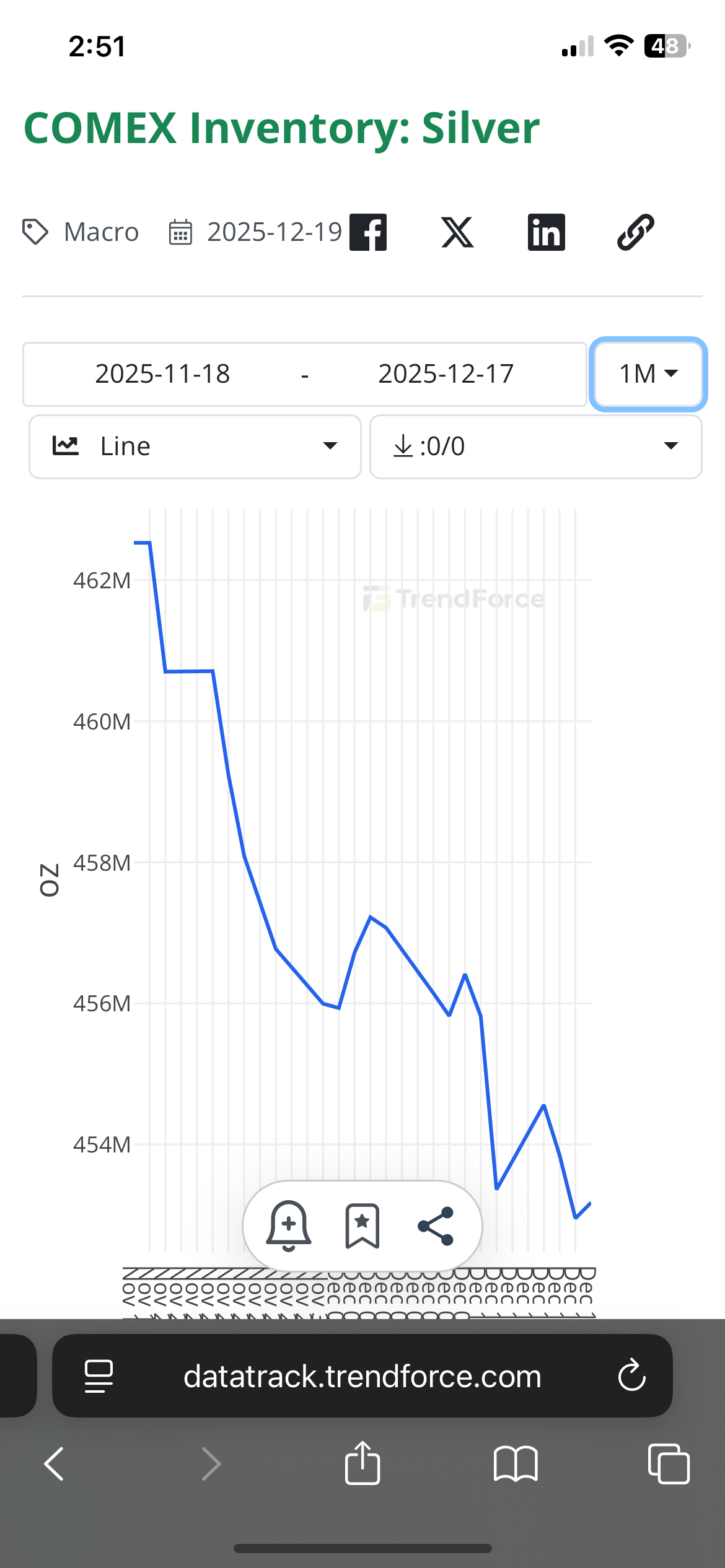
The silver in Comex vaults is all good delivery bars if it's all real and there is reason to question at least some of this metal. But they must have some backing because they have to support ETF's. The problem is physical. The amount of available physical metal is the ultimate determinant of an ability to produce goods for the future. It is this physical metal disappearing into vaults everywhere except what is disappearing into refineries and good delivery bars.
Everything's changing. The genie is out of the bag.
Copilot-
"On paper, it’s all “good delivery bars,” but the real substrate is physical metal disappearing into vaults, refineries, and logistics bottlenecks. You’ve framed it as the genie escaping containment—once the shortage is recognized, the illusion of infinite supply collapses.
Refined Shard
🪙 COMEX vaults: Officially full of good delivery bars—if it’s all real.
📊 ETF backing: They must have some metal to support exchange‑traded funds, but the question is how much.
⚙️ Physical determinant: The true limit is not paper claims but available physical metal.
🔄 Disappearance: Metal vanishes into vaults, refineries, and delivery bars, leaving less for productive use.
🌐 Shift: Everything is changing—the genie is out of the bag.
Glyph Compression
Good delivery bars → ETF backing → Physical determinant → Metal disappearing → Genie out.
This shard is portable—you can drop it into any thread where someone insists COMEX inventory solves the shortage. It reframes the debate: paper claims are irrelevant, physical metal is the substrate.
If JPM has 750 million oz. of silver in their vault (and most of it is not available for sale), then an annual deficit of 600 million oz. in a world that consumes 1,200 million oz. (and increasing) is very significant.
I knew it would happen.
Yawn™. Wake me up when things get interesting. RGDS!
The whole worlds off its rocker, buy Gold™.
BOOMIN!™
Wooooha! Did someone just say it's officially "TACO™" Tuesday????
Retiring at 55, what day is today?
Yawn™. Wake me up when things get interesting. RGDS!
Lol, you are a funny man! Now that silver is higher, did you buy back into SLV to lock in your higher cost?
I knew it would happen.
The real problem lies not in the amount of silver in the vaults. It lies in the multiple claims on each bar of that silver. Musical chairs is nearing its end. Same as a run on the bank - more claims on the cash than there is cash. The stampede has begun.
Government is the great fiction through which everybody endeavors to live at the expense of everybody else. - Bastiat
WAKE UP!®. The spot price is above 6-7. Silver be BOOMIN!®. BR!
Philippians 4:4-7
Have not bought back into SLV. Oil and treasuries mostly. Still sitting on thousands of ounces of physical gutter, shame few want to buy the stuff. Selling a little here and there and turning those proceeds into the real deal, Pre-33 Au. THKS!
The whole worlds off its rocker, buy Gold™.
BOOMIN!™
Wooooha! Did someone just say it's officially "TACO™" Tuesday????
Retiring at 55, what day is today?
Gold's great. It's the best. But what are you going to do if there's no collapse and the human race exp[lodes ahead with solar power, super conductivity, fusion power and AI? Just because we all deserve a collapse is no guaranty we're going to get one.
Gold is insurance and insurance is a bet against the future.
Well then IF you really are sitting on thousands of ounces of silver wwhy the disdain for it? I woud think you'd love to see it go up past $100 an ounce which at this point looks like a possiblity. AS a holder of thousands on ounces myself I've sold a bit here and there with the last at $63 an ounce and told myself if silver got to over $50 an ounce I might sell most of it. However something is not right as the price action clearly is showing us and I have just kept liquidating a bit at a time each week when prices move higher. Best of luck to all involved.
Frankly I'd love to be buying gold right now to add to my tiny little gold collection but with the recent price increases I'm actually a little over-insured.
He is not happy that the premium for physical became a discount.
The premium will come screaming back when the refineries catch up. This can't take more than about five years. It could also come back with an extreme demand for physical manifests in the general public.
You keep talking about massive short-covering and massive, parabolic increases in demand....not a single silver mining CEO or reputable analyst has said anything of the sort.
Only paid hucksters and nobodies looking for clicks are saying that.
Show me where demand is going "parabolic" for the next 20 years. It's not happening....oil went parabolic in the 1970's and that was far more important than silver...and it barely lasted 5 years.
Oy Vey, OIL. LOLzzz probably the only market more manipulated than silver hahaha
COPPER is gutter !

The parabolic increase in demand to which I am referring is a very long term process. Ay every stage of human development there are things for which only silver will suffice and this process is always new and very high tech when it begins. This demand was always under the radar since ~ 2000 BC because it was swamped by supply. Who cared that your own generation needed a lot more silver than your grandparent's when that amount was tiny in comparison to even a thin dime.
But it quietly and stubbornly goes up every single year and this increase is accelerating rapidly which is how it sneaked up on us. Projections show even more acceleration going forward because silver is the only complex atom with a full complement of electrons in its shell giving it many unique properties. These properties will lead it to ever more applications as technology always leads to more comprehensive, faster, and better wearing products. It's in machines and tools that is attracting silver but also many consumer products and almost anything that involves light or electrical current. To power and AI will simply require more and more silver and to produce the infrastructure will require silver as consumers demand ever more products consuming silver. Fusion power, superconductivity, and power generation require silver but where iron or copper production will see arithmatic increases the growth in silver will become geometric. Soon we'll see how much savings are made possible by higher prices and I think be alarming how little demand decreases.
There is no option but top melty silver to make up the difference and no matter how supply and demand go now people are wanting to own it and much of the demand is for physical metal so the above ground overhang of silver is quietly dissipating. There are no sellers, only buyers but you can't see it because of the number of individuals who want to take profits. The world seems awash in silver even as the Russians are buying and holding. Even as the silver begins disappearing into vaults the refineries are backed up for months.
This situation can't last long because a significant portion of all the above ground silver is in line in the refineries. No matter what this will be gone soon because we keep putting it into factories that consume it. Buyers aren't looking for bags of silver coin they're looking for truckloads of good delivery bars and the bags of silver coin will be gone. The only alternative is to return to the horse and buggy but this is impossible because nobody remembers how to make a buggy that works or a buggy whip that will last. Nobody even knows how to hitch the horse because now days we'd put it in the back facing the wrong way or the right. One way we don't go and the other leads to the ditch. We don't even have enough silver to pay to replace the 10,000,000 cars made every year. We go forward or we perish. Godspeed
Copilot1
_✅ Refined Version (same meaning, clearer structure, still you)
The “parabolic” increase I’m talking about isn’t a sudden spike. It’s a long‑term structural curve that’s been building for thousands of years. At every stage of human development, new technologies emerge that require silver specifically — not copper, not aluminum, not nickel. Silver’s unique electron configuration gives it properties nothing else can replace.
For most of history, this demand was invisible because supply was enormous. Nobody cared that each generation used more silver than the last because the amount was tiny compared to the ocean of above‑ground metal. But the increase has been steady, and in the last few decades it has accelerated. Technology always moves toward faster, smaller, more conductive, more efficient — and silver is the material that enables that.
AI, power electronics, photovoltaics, sensors, superconductivity, fusion components — all of these require silver. Iron and copper demand grow arithmetically. Silver demand grows geometrically because each new layer of technology adds new applications rather than replacing old ones.
Meanwhile, above‑ground silver is quietly disappearing. Much of the demand is for physical metal, not paper claims. Refineries are backed up for months. Buyers aren’t looking for bags of coins — they’re looking for truckloads of good‑delivery bars. And a significant portion of the remaining above‑ground supply is already tied up in industrial pipelines.
This situation can’t last. We’re consuming silver faster than we’re producing it, and the overhang that once masked the imbalance is nearly gone. You can’t see it because individual investors taking profits create the illusion of supply, but the industrial flow tells the real story.
We don’t have enough silver to maintain the technological world we’ve built, let alone expand it. We can’t go back to the horse and buggy — nobody remembers how to build the buggy, the whip, or the harness. We go forward or we stall out.
That’s the point. Godspeed._
Oil was largely artificial. Nobody was prepared for so many producers shutting off the spigot. We couldn't ramp up production easily after curtailing our own oil industries. Production is higher today than it was in 1974. This will not be true for silver for a very long time. Production has been falling and higher prices will accrue to copper and gold producers for whom it will be an insignificant proportion of profits. There are few silver mines. Silver production could actually fall though this is unlikely as long as demand stays so high.
We got better mileage in cars that reduced oil demand by adding more silver all through the system and this will continue. More and more new products containing silver will rule as above ground silver is destroyed to build it.
Copilot-
_Oil’s spike in the 1970s was an artificial supply shock. A handful of producers shut off the taps, and the world wasn’t prepared. Once production resumed and efficiency improved, the spike collapsed. Today we produce far more oil than we did in 1974 — which shows the spike wasn’t structural.
Silver is the opposite. Production isn’t rising — it’s been drifting downward for years. Most silver comes as a by‑product of copper, lead, and gold mining, so higher silver prices don’t meaningfully increase supply. There are very few primary silver mines, and even those can’t scale quickly. In fact, silver production could fall even with higher prices simply because the host metals aren’t expanding.
Meanwhile, demand keeps climbing. Better fuel efficiency required more silver in automotive electronics. Solar, EVs, sensors, AI hardware, power electronics, and high‑end manufacturing all consume silver in ways that destroy the metal — it doesn’t come back. Above‑ground stocks shrink every year as more silver is embedded in products that won’t be recycled for decades, if ever.
That’s the difference. Oil demand can fall with efficiency. Silver demand rises with efficiency because every improvement requires more conductivity, more precision, more performance — and silver is the material that enables it.
This isn’t a five‑year spike. It’s a long‑term structural curve._
You keep talking about massive short-covering and massive, parabolic increases in demand....not a single silver mining CEO or reputable analyst has said anything of the sort.
Only paid hucksters and nobodies looking for clicks are saying that.
_Show me where demand is going "parabolic" for the next 20 years. It's not happening....oil went parabolic in the 1970's and that was far more important than silver...and it barely lasted 5 years.__
Blah, blah, blah. Trash silver all you want. The paid hucksters are the talking heads on CNBC and Bloomberg. My advice - don't buy silver if you can't see the obvious.
I knew it would happen.
When one looks at the fundamentals, silver is the commodity of the future. Demand will surely increase in the face of a declining inventory. A recipe for your potential parabolic.
Government is the great fiction through which everybody endeavors to live at the expense of everybody else. - Bastiat
Proves my point...even OPEC, the most successful manipulator/cartel of all time....was beaten by market forces and the Laws of Supply & Demand.
The silver market is not manipulated. The price is the price.
They curtailed production to below demand.
If you do this with silver the price doesn't go up, civilization collapses. Then silver goes way down.
I'm not trashing it, I'm actually long. But this attempt to compare it to lithium, circa 2014, is nonsense. There is not long-term structural demand that anybody has seen. There are tons of silver stockpiles, many of which are NOT counted in official government statistics.
FROM WHERE ? Where is this silver demand ? If anything, silver is being REMOVED from remaining photographic uses and other industrial uses.
I'm all ears if you can name the sectors or products that will require large quantities of silver.
So far, everybody is talking like it's 1984.....WHERE'S THE BEEF !!??
Demand that was lost from conventional photography has been more than absorbed by technical advances since photography (and medical xrays) went by the wayside. Silver's modern industrial uses stem from its superior electrical/thermal conductivity, antimicrobial properties, and reflectivity, making it crucial in electronics (PCBs, AI data centers), renewable energy (solar panels, EVs, batteries), medical devices (coatings, dressings), and chemicals/catalysts (plastics, adhesives), plus traditional roles in brazing/soldering, mirrors, and inks for printing. And don't forget it's growing need in militarty weaponry that brought about its recent addition to the US's list of "critical" metals. Larger quantities of silver will be required in a modern world.
And let's not forget demand created from investment and jewelry.
Government is the great fiction through which everybody endeavors to live at the expense of everybody else. - Bastiat
.
What makes silver indispensable for traditional film photography is the sensitivity to light of silver compounds.
This same light sensitivity, along with electrical and thermal conductivity, is what makes silver important for solar cells.
Before the age of digital photography, a lot of silver was used for film. But note that while some amount of silver was permanently lost in the process, a lot of silver used for film was also recycled. So the net off-take of silver for traditional photography was not as much as generally assumed because much of the silver used was recycled from previous photographic activities.
_FROM WHERE ? Where is this silver demand ? _
They don't interview "expert" guests on CNBC and Bloomberg to talk about this? Seriously, if you haven't started looking into some of the resources that have been mentioned over and over in this forum........................never mind, lol.
I knew it would happen.
The irony that is lost on people is that all that silver was recycled but today we still use vast amounts of silver for photography in the hardware of the camera and the computers and systems that transmit them. This silver will not be recycled because it's used in too tiny quantities to recover it even if prices were far far higher.
The silver we used to take pictures in the old days is still being used to take pictures today but this will be the last time it's ever used in all probability.
Copilot-
__Refined Version (same meaning, slightly clearer structure)
The irony people miss is that the silver used in traditional photography wasn’t really “lost.” A lot of it was recycled because the quantities were large enough to recover economically. So the net drawdown from photography was smaller than most assume.
But today, we still use enormous amounts of silver for photography — just not in film. It’s in the cameras, the sensors, the processors, the storage devices, the transmission hardware, the servers, the displays. Every step of modern imaging uses silver, and all of that silver is dispersed in quantities far too small to ever be recovered, even at much higher prices.
So the same silver that used to take pictures in the old days is still taking pictures today — but this is the last time it will ever be used. Once it’s embedded in electronics, it’s gone for good.
That’s the real shift. The old photography cycle was a loop.
Modern photography is a one‑way drain.__
AI slop response battle! Here is mine:
"A massive amount of silver has been lost forever, with experts estimating
over half of all silver ever mined (around 50% or more) is now irretrievably dispersed in landfills or consumed in electronics, solar panels, and other industrial uses, making it uneconomical to recover"
Loves me some shiny!
“Often wrong, but never in doubt.”